
Goal of the analysis:
The goal of a Supplier Risk and Dependency Analysis is to evaluate the risks associated with relying on external suppliers and assess the level of dependency on each supplier. This analysis helps identify potential risks that could disrupt the supply chain, such as supply shortages, quality issues, or financial instability, and helps develop strategies to mitigate these risks by diversifying the supplier base, building stronger partnerships, or creating contingency plans.
Data required:
- Supplier Portfolio: A list of all current suppliers, their products, and the volume of goods or materials they supply.
- Supplier Performance Data: Metrics on supplier performance, including on-time delivery rates, quality metrics (e.g., defect rates), and lead times.
- Supplier Financial Stability: Data on the financial health of key suppliers, such as credit ratings, financial statements, and market reputation.
- Supplier Market Position: The market share, reputation, and competitive position of each supplier.
- Supply Chain Dependency: The percentage of raw materials, components, or finished goods sourced from each supplier.
- Geopolitical and Environmental Factors: Data on the geopolitical, environmental, or regulatory risks associated with supplier locations.
- Alternative Supplier Availability: Information on available alternative suppliers, including their capacity and ability to meet the company’s needs.
- Supply Chain Disruption History: Historical data on past disruptions or issues with suppliers, including shortages, quality problems, or geopolitical factors.
Detailed step-by-step instruction on how to conduct the analysis:
- Create a Supplier Inventory:
- Compile a comprehensive list of all suppliers, including the materials, components, or products they provide. Classify suppliers based on their criticality to the business (e.g., strategic, operational, commodity suppliers).
- Assess Supplier Performance:
- Evaluate each supplier’s performance based on metrics such as on-time delivery, lead time reliability, defect rates, and responsiveness to issues. Poor performance increases the risk of supply chain disruption.
- Analyze Financial Stability:
- Review the financial health of key suppliers, especially those that are critical to your operations. A financially unstable supplier may be at risk of bankruptcy, which could lead to sudden disruptions. Use publicly available financial data, credit reports, and market analysis.
- Measure Supply Chain Dependency:
- Calculate the percentage of total supply sourced from each supplier. Higher dependency increases the risk of a supply chain disruption if a key supplier fails. For example, if a supplier provides 80% of a critical component, the company is highly dependent on that supplier.
- Dependency (%) = (Value of Supplies from a Supplier / Total Value of Supplies) x 100
- Evaluate Supplier Concentration Risk:
- Assess how many suppliers provide the same materials or components. If there is only one supplier (sole-source risk), the company is vulnerable to disruptions. Diversifying the supplier base reduces concentration risk and enhances supply chain resilience.
- Consider Geopolitical and Environmental Risks:
- Analyze the geopolitical and environmental risks associated with the countries or regions where suppliers are based. This includes risks such as political instability, trade tariffs, natural disasters, or regulatory changes that could disrupt the supply chain.
- Identify Alternative Suppliers:
- Research potential alternative suppliers who can serve as backups in case of disruptions. Evaluate their capacity, lead times, and quality standards to ensure they can meet your company’s needs if your primary supplier fails.
- Evaluate Supply Chain Flexibility:
- Assess the flexibility of your supply chain in responding to disruptions. This includes how quickly you can switch suppliers, ramp up production with alternative suppliers, or find substitute materials in case of shortages.
- Prioritize Risks and Develop Mitigation Strategies:
- Rank suppliers based on the severity of risk and the level of dependency. For high-risk suppliers, develop contingency plans such as diversifying suppliers, holding safety stock, or creating long-term agreements to lock in supply.
Format of the output of analysis:
- Supplier Risk Scorecard: A table ranking suppliers based on performance metrics, financial stability, and dependency levels. This scorecard highlights high-risk suppliers and areas for improvement.
- Dependency Analysis Chart: A visual representation (e.g., pie chart) showing the percentage of total supply sourced from each supplier, highlighting areas of high dependency.
- Risk Map: A geographical map showing the location of suppliers, along with associated geopolitical or environmental risks.
- Mitigation Plan: A report outlining specific mitigation strategies for each high-risk supplier, such as diversifying the supplier base or negotiating long-term contracts.
How to interpret results:
- High Dependency on a Single Supplier: If the company relies heavily on one supplier for critical materials, it is at high risk of disruption if that supplier experiences financial instability, operational issues, or geopolitical challenges. Reducing dependency by finding alternative suppliers or negotiating better terms with the current supplier can reduce this risk.
- Poor Supplier Performance: Suppliers with consistently poor performance metrics, such as frequent late deliveries or high defect rates, increase the risk of production delays and quality issues. Consider replacing these suppliers or working closely with them to improve performance.
- Geopolitical and Environmental Risks: Suppliers located in regions with political instability, trade risks, or frequent natural disasters pose a higher risk of disruption. Consider diversifying your supplier base geographically to mitigate these risks.
Steps a company can take to improve on this measure:
- Diversify Supplier Base:
- Reduce supplier dependency by working with multiple suppliers for critical materials or components. Diversification ensures that the company is not overly reliant on any one supplier and can switch easily in case of disruptions.
- Establish Strong Supplier Relationships:
- Build long-term partnerships with key suppliers to ensure more reliable supply. Strong relationships can lead to better contract terms, priority access during shortages, and improved collaboration in times of disruption.
- Create Contingency Plans:
- Develop contingency plans for high-risk suppliers. This could include holding safety stock, having contracts with backup suppliers, or finding alternative materials that could be substituted in production if needed.
- Monitor Supplier Financial Health Regularly:
- Continuously monitor the financial health of critical suppliers. Early detection of financial difficulties allows the company to make proactive decisions, such as transitioning to alternative suppliers before the issue affects the supply chain.
- Negotiate Flexible Contracts:
- Negotiate flexible contracts with suppliers that allow for adjustments in volumes or prices during periods of volatility or uncertainty. Flexibility in contracts can help manage risks associated with demand fluctuations or supply shortages.
- Use Technology for Supply Chain Transparency:
- Leverage supply chain management software and digital platforms to gain real-time visibility into supplier performance, inventory levels, and potential risks. This allows for quicker responses to disruptions and better decision-making.
- Conduct Regular Risk Audits:
- Periodically audit the supplier base to reassess risks and dependencies. This ensures that the company stays ahead of potential supply chain issues and can adapt strategies as market conditions or supplier situations change.
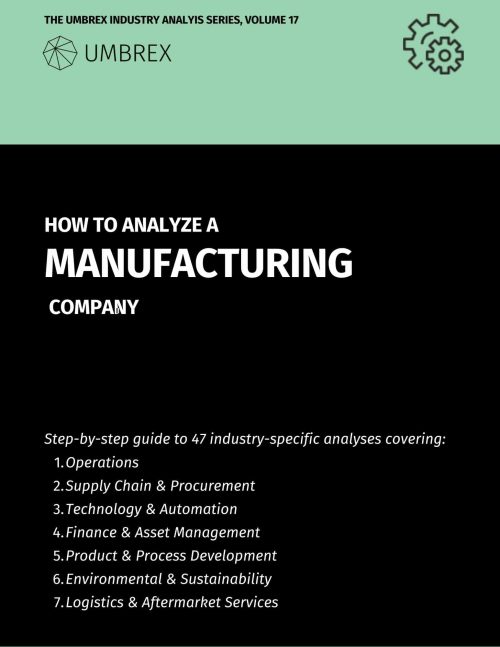
Request the PDF Download of How to Analyze a Manufacturing Company
Menu of the 47 analyses:
Table of Contents
A. OPERATIONS
- Capacity Utilization Analysis
- Operational Efficiency (OEE) Analysis
- Supply Chain and Logistics Optimization
- Production Lead Time Analysis
- Lean Manufacturing and Waste Reduction Assessment
- Inventory Turnover and Management Efficiency
- Quality Control and Defect Rate Analysis
- Capacity Expansion and Flexibility Assessment
- Maintenance Strategy and Downtime Analysis
- Factory Layout and Process Flow Optimization
- Throughput and Bottleneck Identification
- Production Scheduling and Demand Alignment
- Process Standardization and Replication Across Plants
- Work-in-Progress (WIP) Inventory Management
- Material Handling and Internal Logistics Efficiency
- Finished Goods Storage and Warehousing Optimization
- Capacity Buffers and Flexibility in Response to Demand Fluctuations
B. SUPPLY CHAIN & PROCUREMENT
- Bill of Materials (BOM) and Cost Structure Analysis
- Supplier Risk and Dependency Analysis
- Supplier Quality Management
- Raw Material Sourcing and Procurement Efficiency
- Vendor-Managed Inventory (VMI) Program Evaluation
- In-house Production vs. Outsourcing Feasibility
C. TECHNOLOGY & AUTOMATION
- Automation and Technology Integration Analysis
- Factory Automation Level and Robotics Utilization
- Tooling and Machine Setup Time Optimization
- Equipment Downtime Tracking and Root Cause Analysis
- Spare Parts Management and Predictive Maintenance Systems
- Manufacturing Cycle Time Reduction
- Energy Consumption and Efficiency Analysis
D. FINANCE & ASSET MANAGEMENT
- Capital Expenditure (CapEx) Effectiveness in Equipment and Technology
- Cost of Goods Sold (COGS) Breakdown and Margins Analysis
- Asset Utilization and Lifecycle Management
- Return on Invested Capital (ROIC) for Manufacturing Assets
- Working Capital Management in Manufacturing
E. PRODUCT & PROCESS DEVELOPMENT
- Product Customization and Modularity Assessment
- New Product Introduction (NPI) and Time-to-Market Evaluation
- Custom Manufacturing vs. Mass Production Analysis
- Product Yield and Scrap Rate Analysis
- Make-to-Stock vs. Make-to-Order Strategy Evaluation
F. ENVIRONMENTAL & SUSTAINABILITY
- Sustainability and Environmental Impact Analysis
- Heat, Water, and Waste Management in Production
- Environmental Compliance and Emissions Reduction Strategies
- Reverse Logistics and Product Lifecycle Management
G. LOGISTICS & AFTERMARKET SERVICES
- Aftermarket Services and Spare Parts Logistics
- Multi-Site Manufacturing Network Optimization
- Safety and Compliance Audit