
Goal of the analysis:
The goal of a Cost of Goods Sold (COGS) Breakdown and Margins Analysis is to provide a detailed understanding of the direct costs involved in producing goods or services and how these costs impact the company’s profitability. By analyzing COGS, companies can identify cost-saving opportunities, improve pricing strategies, and better understand the relationship between production costs and gross margins. This analysis helps management optimize production processes, supplier relationships, and pricing to enhance profitability.
Data required:
- Direct Material Costs: The cost of raw materials or components used in the production of goods, including any transportation or handling costs.
- Direct Labor Costs: The wages and benefits paid to workers directly involved in the production process.
- Manufacturing Overhead: Indirect production costs, such as utilities, depreciation of equipment, factory rent, and maintenance.
- Production Volume Data: Information on the number of units produced over a given period.
- Supplier Pricing Data: Data on the prices paid to suppliers for materials, including any fluctuations or bulk discounts.
- Inventory Levels: Current levels of raw materials, work-in-progress (WIP), and finished goods to understand inventory carrying costs and their contribution to COGS.
- COGS Data: Historical COGS data from financial statements, broken down by material, labor, and overhead categories.
- Sales Price and Revenue Data: Information on the selling price of goods and services, as well as total revenue generated, to calculate gross margins.
- Gross Margin Targets: Internal targets or industry benchmarks for gross margins, used to evaluate profitability performance.
- Seasonal or Market Variability: Data on how seasonal demand or market conditions impact production costs and margins over time.
Detailed step-by-step instruction on how to conduct the analysis:
- Collect COGS Data:
- Gather data on the total cost of goods sold, broken down into its three main components: direct materials, direct labor, and manufacturing overhead. Ensure that this data is accurate and up to date to reflect the most current costs associated with production.
- Break Down Direct Material Costs:
- Analyze the cost of raw materials or components used in production. Identify the largest material cost drivers and any changes in supplier pricing, transportation costs, or waste. Review whether material costs have fluctuated due to external factors such as supply chain disruptions or commodity price changes.
- Analyze Direct Labor Costs:
- Break down direct labor costs, including wages, benefits, overtime, and bonuses for workers directly involved in production. Compare these costs against production output to assess labor efficiency. Identify any opportunities to reduce labor costs, such as improving workflow or investing in automation.
- Examine Manufacturing Overhead:
- Evaluate manufacturing overhead costs, which include indirect expenses such as equipment depreciation, factory rent, utilities, and maintenance. Determine whether these overhead costs are consistent with production volumes and explore ways to optimize overhead, such as energy efficiency improvements or better maintenance scheduling.
- Calculate COGS per Unit:
- Calculate the cost of goods sold per unit produced to get a more granular view of production costs. This calculation helps determine if production costs are aligned with pricing and profitability goals.
- COGS per Unit = Total COGS / Total Units Produced
- Assess Inventory Impact on COGS:
- Evaluate how inventory levels (raw materials, WIP, and finished goods) affect COGS. Excess inventory can lead to higher carrying costs, while inadequate inventory can cause production delays. Optimize inventory management to balance production needs with cost efficiency.
- Analyze Supplier and Material Costs:
- Review supplier pricing and relationships to identify opportunities for cost savings, such as negotiating bulk discounts, switching suppliers, or exploring alternative materials. Track how changes in material prices affect overall COGS and gross margins.
- Calculate Gross Margins:
- Gross margin is the percentage of revenue that exceeds COGS. Calculate gross margins for each product line or service to assess profitability. Compare these margins to internal targets or industry benchmarks.
- Gross Margin = (Revenue – COGS) / Revenue x 100
- Compare COGS and Margins Over Time:
- Track COGS and gross margins over time to identify trends, seasonality, or market-driven changes. Analyze whether production costs are rising, margins are shrinking, or external factors are impacting profitability.
- Identify Cost-Saving Opportunities:
- Based on the analysis, identify areas for cost reduction. These may include renegotiating supplier contracts, improving labor efficiency, optimizing energy use, or implementing lean manufacturing techniques. Prioritize changes that will have the greatest impact on reducing COGS and improving margins.
Format of the output of analysis:
- COGS Breakdown Report: A detailed report breaking down COGS into direct materials, direct labor, and manufacturing overhead. Highlight the largest cost drivers in each category.
- Cost per Unit Report: A summary of COGS per unit produced, providing insights into cost efficiency at a granular level.
- Supplier and Material Cost Analysis: A report evaluating supplier pricing, material costs, and potential cost-saving opportunities, including bulk discounts or alternative sourcing options.
- Gross Margin Report: A summary of gross margins across different products or services, comparing actual margins to target margins and industry benchmarks.
- Cost-Saving Recommendations: A list of potential cost-saving measures, prioritized by their expected impact on reducing COGS and improving margins.
- Trend Analysis Report: A report tracking how COGS and margins have changed over time, including insights into seasonality, market conditions, and external cost drivers.
How to interpret results:
- High COGS and Low Margins: If COGS are high and gross margins are low, the company may need to focus on reducing production costs. This could involve negotiating better material prices, improving labor efficiency, or reducing overhead expenses. Low margins may also suggest that pricing strategies need to be reviewed.
- Fluctuating Material Costs: If material costs fluctuate frequently, it may be necessary to build more flexibility into supplier relationships or explore alternative materials. A high reliance on a single supplier could also expose the company to price volatility.
- Low Direct Labor Efficiency: If labor costs are high relative to output, consider streamlining production processes, reducing overtime, or investing in automation. Poor labor efficiency can significantly increase COGS and erode margins.
- Consistent or Increasing Margins: If margins are stable or increasing, it suggests that production costs are being well-managed and that pricing strategies are effective. Higher margins also provide greater flexibility for reinvestment or price adjustments in response to market conditions.
Steps a company can take to improve on this measure:
- Negotiate Better Supplier Terms:
- Regularly review supplier contracts to identify opportunities for cost savings through bulk purchasing, long-term agreements, or switching to lower-cost suppliers. Ensure that material costs are competitive in the market.
- Implement Lean Manufacturing Practices:
- Adopt lean manufacturing techniques to reduce waste and improve production efficiency. This can include minimizing excess inventory, streamlining workflows, and improving material handling.
- Automate Labor-Intensive Processes:
- Invest in automation to reduce direct labor costs and increase production speed. Automation helps eliminate repetitive tasks, reduce human error, and improve labor efficiency.
- Optimize Inventory Management:
- Implement just-in-time (JIT) inventory management to reduce carrying costs and minimize waste. Efficient inventory management ensures that materials are available when needed without overstocking.
- Improve Overhead Cost Allocation:
- Review how overhead costs are allocated to ensure they accurately reflect production activity. Find ways to reduce indirect costs, such as energy consumption, equipment depreciation, and facility management.
- Monitor COGS and Margins Regularly:
- Track COGS and gross margins continuously to identify emerging trends or issues. Regular monitoring enables proactive adjustments to pricing, production processes, or supplier relationships to maintain profitability.
- Revisit Pricing Strategies:
- If margins are consistently low, consider revising pricing strategies. Ensure that the pricing reflects not only production costs but also market demand, competitive positioning, and desired profit margins.
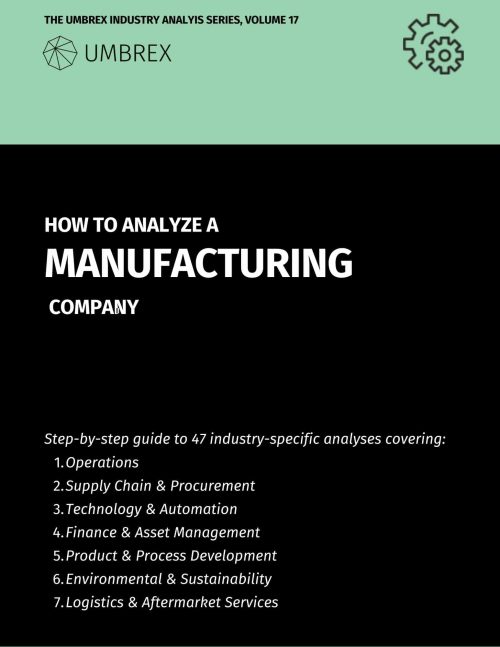
Request the PDF Download of How to Analyze a Manufacturing Company
Menu of the 47 analyses:
Table of Contents
A. OPERATIONS
- Capacity Utilization Analysis
- Operational Efficiency (OEE) Analysis
- Supply Chain and Logistics Optimization
- Production Lead Time Analysis
- Lean Manufacturing and Waste Reduction Assessment
- Inventory Turnover and Management Efficiency
- Quality Control and Defect Rate Analysis
- Capacity Expansion and Flexibility Assessment
- Maintenance Strategy and Downtime Analysis
- Factory Layout and Process Flow Optimization
- Throughput and Bottleneck Identification
- Production Scheduling and Demand Alignment
- Process Standardization and Replication Across Plants
- Work-in-Progress (WIP) Inventory Management
- Material Handling and Internal Logistics Efficiency
- Finished Goods Storage and Warehousing Optimization
- Capacity Buffers and Flexibility in Response to Demand Fluctuations
B. SUPPLY CHAIN & PROCUREMENT
- Bill of Materials (BOM) and Cost Structure Analysis
- Supplier Risk and Dependency Analysis
- Supplier Quality Management
- Raw Material Sourcing and Procurement Efficiency
- Vendor-Managed Inventory (VMI) Program Evaluation
- In-house Production vs. Outsourcing Feasibility
C. TECHNOLOGY & AUTOMATION
- Automation and Technology Integration Analysis
- Factory Automation Level and Robotics Utilization
- Tooling and Machine Setup Time Optimization
- Equipment Downtime Tracking and Root Cause Analysis
- Spare Parts Management and Predictive Maintenance Systems
- Manufacturing Cycle Time Reduction
- Energy Consumption and Efficiency Analysis
D. FINANCE & ASSET MANAGEMENT
- Capital Expenditure (CapEx) Effectiveness in Equipment and Technology
- Cost of Goods Sold (COGS) Breakdown and Margins Analysis
- Asset Utilization and Lifecycle Management
- Return on Invested Capital (ROIC) for Manufacturing Assets
- Working Capital Management in Manufacturing
E. PRODUCT & PROCESS DEVELOPMENT
- Product Customization and Modularity Assessment
- New Product Introduction (NPI) and Time-to-Market Evaluation
- Custom Manufacturing vs. Mass Production Analysis
- Product Yield and Scrap Rate Analysis
- Make-to-Stock vs. Make-to-Order Strategy Evaluation
F. ENVIRONMENTAL & SUSTAINABILITY
- Sustainability and Environmental Impact Analysis
- Heat, Water, and Waste Management in Production
- Environmental Compliance and Emissions Reduction Strategies
- Reverse Logistics and Product Lifecycle Management
G. LOGISTICS & AFTERMARKET SERVICES
- Aftermarket Services and Spare Parts Logistics
- Multi-Site Manufacturing Network Optimization
- Safety and Compliance Audit