
Goal of the analysis:
The goal of the Return on Invested Capital (ROIC) analysis for manufacturing assets is to assess the profitability generated from the company’s investment in its manufacturing assets, such as machinery, equipment, and facilities. ROIC measures how effectively the company is using its capital to generate profits from its operations. This analysis helps companies evaluate whether their manufacturing investments are delivering sufficient returns and can guide future capital allocation decisions to maximize long-term value.
Data required:
- Net Operating Profit After Taxes (NOPAT): The company’s operating profit after deducting taxes, excluding interest expenses.
- Invested Capital: The total amount of capital invested in manufacturing assets, including machinery, equipment, facilities, and working capital. This can be calculated by adding equity and debt used to finance the assets.
- Asset Values: The book value of manufacturing assets, including their acquisition cost, depreciation, and current value.
- Depreciation Data: The depreciation schedules and accumulated depreciation for each manufacturing asset.
- Revenue from Manufacturing Operations: The revenue generated specifically from the company’s manufacturing activities.
- Operating Costs: Information on the operating expenses related to manufacturing, such as labor, raw materials, utilities, maintenance, and overhead.
- Capital Expenditure (CapEx): Data on recent and historical investments in manufacturing assets, including machinery purchases, facility upgrades, and technology improvements.
- Working Capital: Data on working capital, including inventory, accounts receivable, and accounts payable, related to the manufacturing assets.
Detailed step-by-step instruction on how to conduct the analysis:
- Calculate Net Operating Profit After Taxes (NOPAT):
- Determine the company’s net operating profit after taxes (NOPAT) by subtracting operating expenses and taxes from the company’s revenue. NOPAT is used to measure the profitability of the company’s operations, excluding interest expenses.
- NOPAT = Operating Income x (1 – Tax Rate)
- Determine Invested Capital:
- Calculate the total invested capital in manufacturing assets. This includes both the equity and debt used to finance manufacturing operations, as well as any working capital tied to production activities. Invested capital typically includes the value of fixed assets (e.g., machinery, equipment, facilities) and working capital (e.g., inventory, accounts receivable).
- Invested Capital = Fixed Assets + Working Capital
- Calculate ROIC for Manufacturing Assets:
- Use the NOPAT and invested capital to calculate the Return on Invested Capital (ROIC) for manufacturing assets. ROIC measures how efficiently the company generates profits from the capital invested in its manufacturing operations.
- ROIC = (NOPAT / Invested Capital) x 100
- Assess Asset Efficiency and Utilization:
- Evaluate how efficiently the manufacturing assets are being utilized. Compare the ROIC to industry benchmarks to determine whether the company is generating a competitive return on its manufacturing investments. Higher ROIC values indicate that the company is using its manufacturing assets efficiently to generate profits.
- Review Capital Expenditure Impact:
- Analyze the impact of recent capital expenditures (CapEx) on ROIC. Determine whether new investments in machinery, equipment, or facilities have led to improved profitability and whether these investments are justified based on the return they generate.
- Analyze Depreciation and Asset Value:
- Review the depreciation of manufacturing assets and assess how it impacts the company’s invested capital. If depreciation significantly reduces the book value of assets, it may affect ROIC calculations. Consider whether aging assets are still contributing to profitability or if they need replacement.
- Compare ROIC to Cost of Capital (WACC):
- Compare the ROIC for manufacturing assets to the company’s weighted average cost of capital (WACC). If ROIC exceeds WACC, it indicates that the company is generating value from its manufacturing investments. If ROIC is below WACC, the company may not be earning sufficient returns to justify its capital investments.
- Track ROIC Over Time:
- Monitor ROIC over multiple periods to identify trends in how effectively the company is using its manufacturing assets. A declining ROIC may suggest that assets are underperforming or that new investments are not delivering expected returns.
- Identify Opportunities for Improvement:
- Based on the analysis, identify areas where asset utilization can be improved to increase ROIC. This could include optimizing production processes, improving maintenance practices, or investing in more efficient equipment. Explore ways to reduce operating costs while maximizing asset output to enhance profitability.
Format of the output of analysis:
- ROIC Calculation Report: A report summarizing the ROIC for the company’s manufacturing assets, including detailed calculations of NOPAT, invested capital, and ROIC percentage.
- Asset Efficiency and Utilization Analysis: A breakdown of how effectively the company is using its manufacturing assets, including comparisons to industry benchmarks.
- CapEx Impact Report: A summary of how recent capital expenditures have affected ROIC, including an analysis of whether new investments have improved profitability.
- Depreciation Impact Report: An evaluation of how asset depreciation affects the ROIC calculation and recommendations for managing aging assets.
- WACC Comparison Report: A comparison of ROIC to the company’s weighted average cost of capital (WACC) to assess whether the company is generating sufficient returns from its manufacturing assets.
How to interpret results:
- High ROIC: A high ROIC indicates that the company is effectively using its manufacturing assets to generate profits. This suggests that capital is being allocated efficiently, and the company is creating value from its investments in equipment, machinery, and facilities.
- ROIC Exceeding WACC: If the ROIC is higher than the company’s WACC, it means that the manufacturing assets are generating returns that exceed the cost of capital, indicating value creation and strong asset utilization.
- Low or Declining ROIC: A low or declining ROIC may suggest that the company’s manufacturing assets are underperforming or that new investments are not delivering expected returns. Investigate whether assets are being fully utilized or if operational inefficiencies are reducing profitability.
- High Depreciation Impact: If asset depreciation is significantly affecting ROIC, it may indicate that the company’s assets are nearing the end of their useful life. Consider replacing outdated equipment with more efficient machinery to improve long-term returns.
Steps a company can take to improve on this measure:
- Optimize Asset Utilization:
- Focus on improving asset utilization by increasing production output, reducing downtime, and ensuring that equipment is operating at full capacity. Higher utilization rates typically lead to better returns on invested capital.
- Invest in Efficient Equipment:
- Consider investing in energy-efficient or higher-capacity machinery that can reduce operating costs while increasing production output. More efficient equipment can enhance profitability and improve ROIC.
- Monitor and Reduce Operating Costs:
- Continuously monitor operating expenses such as labor, energy, and maintenance. Identify opportunities to reduce costs through process improvements, automation, or better supplier negotiations.
- Enhance Preventive Maintenance Programs:
- Implement or enhance preventive maintenance programs to extend the useful life of assets and minimize unexpected breakdowns. Well-maintained assets can reduce downtime and improve overall asset efficiency, leading to a higher ROIC.
- Rationalize Capital Expenditures:
- Ensure that future capital investments are aligned with the company’s strategic goals and deliver a clear ROI. Prioritize investments that will improve asset efficiency, reduce costs, or enhance capacity.
- Evaluate and Replace Aging Assets:
- Regularly evaluate the performance of aging assets. If an asset’s performance declines due to depreciation or wear and tear, consider replacing it with new equipment that can generate better returns and improve ROIC.
- Monitor ROIC Trends:
- Continuously track ROIC for manufacturing assets to identify changes in performance over time. Use this data to inform decisions about asset allocation, capital investment, and operational improvements.
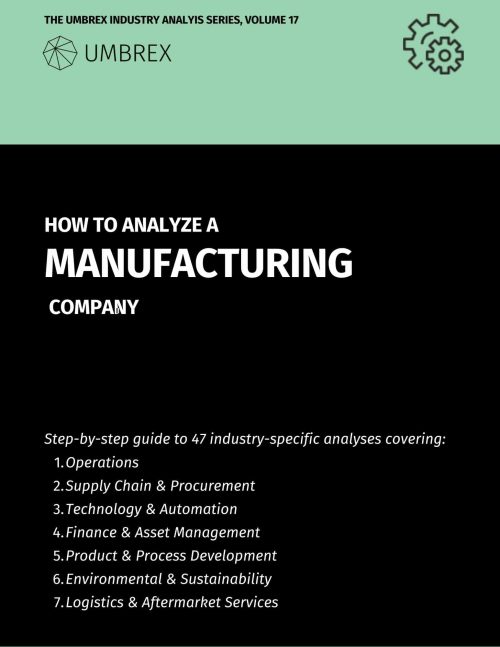
Request the PDF Download of How to Analyze a Manufacturing Company
Menu of the 47 analyses:
Table of Contents
A. OPERATIONS
- Capacity Utilization Analysis
- Operational Efficiency (OEE) Analysis
- Supply Chain and Logistics Optimization
- Production Lead Time Analysis
- Lean Manufacturing and Waste Reduction Assessment
- Inventory Turnover and Management Efficiency
- Quality Control and Defect Rate Analysis
- Capacity Expansion and Flexibility Assessment
- Maintenance Strategy and Downtime Analysis
- Factory Layout and Process Flow Optimization
- Throughput and Bottleneck Identification
- Production Scheduling and Demand Alignment
- Process Standardization and Replication Across Plants
- Work-in-Progress (WIP) Inventory Management
- Material Handling and Internal Logistics Efficiency
- Finished Goods Storage and Warehousing Optimization
- Capacity Buffers and Flexibility in Response to Demand Fluctuations
B. SUPPLY CHAIN & PROCUREMENT
- Bill of Materials (BOM) and Cost Structure Analysis
- Supplier Risk and Dependency Analysis
- Supplier Quality Management
- Raw Material Sourcing and Procurement Efficiency
- Vendor-Managed Inventory (VMI) Program Evaluation
- In-house Production vs. Outsourcing Feasibility
C. TECHNOLOGY & AUTOMATION
- Automation and Technology Integration Analysis
- Factory Automation Level and Robotics Utilization
- Tooling and Machine Setup Time Optimization
- Equipment Downtime Tracking and Root Cause Analysis
- Spare Parts Management and Predictive Maintenance Systems
- Manufacturing Cycle Time Reduction
- Energy Consumption and Efficiency Analysis
D. FINANCE & ASSET MANAGEMENT
- Capital Expenditure (CapEx) Effectiveness in Equipment and Technology
- Cost of Goods Sold (COGS) Breakdown and Margins Analysis
- Asset Utilization and Lifecycle Management
- Return on Invested Capital (ROIC) for Manufacturing Assets
- Working Capital Management in Manufacturing
E. PRODUCT & PROCESS DEVELOPMENT
- Product Customization and Modularity Assessment
- New Product Introduction (NPI) and Time-to-Market Evaluation
- Custom Manufacturing vs. Mass Production Analysis
- Product Yield and Scrap Rate Analysis
- Make-to-Stock vs. Make-to-Order Strategy Evaluation
F. ENVIRONMENTAL & SUSTAINABILITY
- Sustainability and Environmental Impact Analysis
- Heat, Water, and Waste Management in Production
- Environmental Compliance and Emissions Reduction Strategies
- Reverse Logistics and Product Lifecycle Management
G. LOGISTICS & AFTERMARKET SERVICES
- Aftermarket Services and Spare Parts Logistics
- Multi-Site Manufacturing Network Optimization
- Safety and Compliance Audit