
Goal of the analysis:
The goal of a Capacity Buffers and Flexibility in Response to Demand Fluctuations analysis is to ensure that a manufacturing company can handle variations in demand without overextending resources or causing production delays. This analysis helps in determining the right level of capacity buffers (additional capacity beyond normal operations) and implementing flexible production practices to efficiently respond to demand spikes, seasonality, or unexpected market shifts. It focuses on minimizing lead times, avoiding stockouts, and optimizing resource utilization.
Data required:
- Historical Demand Data: Historical sales and production data showing seasonal trends, demand peaks, and troughs.
- Forecasted Demand: Projected customer demand for products over upcoming periods (e.g., weekly, monthly, quarterly).
- Current Production Capacity: The maximum output that the facility can produce under normal conditions.
- Lead Times: Time required to complete the production process, from order placement to delivery.
- Inventory Levels: Data on current inventory of raw materials, WIP (work-in-progress), and finished goods.
- Labor and Machine Availability: Availability of workers and machines, including current utilization rates and the potential for additional shifts or overtime.
- Production Cycle Times: Time taken to complete each stage of the manufacturing process.
- Flexibility Measures: Data on existing flexibility in production processes, such as quick changeover times, modular production setups, or cross-trained employees.
Detailed step-by-step instruction on how to conduct the analysis:
- Analyze Historical Demand and Seasonal Patterns:
- Review historical demand data to identify patterns such as seasonal peaks, holiday demand surges, or cyclical market trends. This helps anticipate when capacity buffers may be needed to handle increased production volumes.
- Forecast Future Demand Fluctuations:
- Use sales forecasts, market trends, and customer order projections to estimate future demand fluctuations. Compare these forecasts to current production capacity to assess whether the existing setup can handle projected demand.
- Determine Current Capacity Utilization:
- Calculate the current utilization rate of production resources, including labor, machines, and facilities. If capacity utilization is consistently high (85% or higher), it may indicate limited flexibility to handle additional demand.
- Capacity Utilization (%) = (Actual Output / Maximum Output Capacity) x 100
- Calculate Buffer Capacity Requirements:
- Estimate the amount of buffer capacity needed to accommodate demand spikes. A common approach is to set buffer capacity at 10-20% above the average capacity utilization, depending on the variability of demand.
- Buffer Capacity = (Forecasted Peak Demand – Current Capacity) / Current Capacity x 100
- Identify Production Bottlenecks:
- Analyze production cycle times and bottlenecks that could limit the ability to scale up production in response to demand. Bottlenecks can create constraints that slow down overall output, even if buffer capacity is available.
- Evaluate Labor and Machine Flexibility:
- Assess the flexibility of labor and equipment. Determine whether the workforce can be easily scaled (e.g., through temporary staffing, cross-training, or overtime) and whether machines can handle quick changeovers to different product lines or configurations.
- Set Up Dynamic Scheduling:
- Implement flexible scheduling practices to adjust production resources based on demand. This includes scheduling additional shifts, utilizing overtime, or rotating workers between tasks to meet fluctuating demand without overloading the system.
- Implement Modular or Flexible Manufacturing Systems:
- Use modular production setups that allow for quick reconfiguration of production lines to meet changes in product demand. Flexible systems can reduce changeover times, improve throughput, and allow production to pivot quickly in response to demand fluctuations.
- Develop a Contingency Plan:
- Create a contingency plan that outlines steps for rapidly scaling capacity during unexpected demand surges. This plan should include strategies for increasing production, utilizing buffer capacity, and addressing potential supply chain bottlenecks.
Format of the output of analysis:
- Capacity Utilization Report: A table or chart showing current capacity utilization and buffer capacity requirements based on forecasted demand fluctuations.
- Demand vs. Capacity Alignment: A graph comparing forecasted demand to current capacity and buffer capacity, highlighting gaps where additional resources may be required.
- Labor and Machine Flexibility Analysis: A summary of labor availability, cross-training programs, and machine flexibility (e.g., quick changeovers, modular setups).
- Production Bottleneck Report: A list of production stages where bottlenecks could limit the ability to increase capacity in response to demand surges.
How to interpret results:
- High Capacity Utilization: If current capacity utilization is consistently high (above 85%), the facility may struggle to meet demand fluctuations without additional buffer capacity. Adding capacity buffers or implementing more flexible systems can help accommodate demand spikes.
- Low Buffer Capacity: If buffer capacity is inadequate to meet projected demand surges, the company risks stockouts, delays, or missed sales opportunities. Increasing buffer capacity or utilizing more flexible labor and machines may be necessary.
- Production Bottlenecks: If bottlenecks are identified, they may prevent the facility from effectively scaling up production during high-demand periods. Addressing these bottlenecks can improve the facility’s ability to respond to demand fluctuations.
Steps a company can take to improve on this measure:
- Increase Buffer Capacity:
- Invest in additional production capacity (e.g., equipment, facilities) to create buffer zones that can be activated during demand surges. Buffer capacity can include extra shifts, backup machines, or temporary staffing.
- Implement Cross-Training for Employees:
- Cross-train employees to perform multiple roles so that labor resources can be flexibly reallocated to areas with the highest demand. This can reduce the need for hiring additional workers during peak times and increase labor flexibility.
- Use Quick Changeover Techniques:
- Implement quick changeover (Single-Minute Exchange of Die, or SMED) techniques to reduce the time required to switch between production lines or product types. Faster changeovers allow for more flexible responses to changing demand without significant downtime.
- Leverage Temporary Labor or Overtime:
- Utilize temporary workers, part-time staff, or overtime to quickly scale labor capacity during demand peaks. This ensures that production can increase without hiring full-time workers during short-term demand surges.
- Adopt a Scalable Production Model:
- Design production processes with scalability in mind. Use modular workstations, scalable automation systems, and flexible assembly lines that can expand or contract based on demand without significant reconfiguration costs.
- Use Real-Time Monitoring:
- Implement real-time monitoring systems to track production capacity, labor availability, and equipment performance. This helps managers quickly identify capacity constraints and take action to adjust resources as demand fluctuates.
- Collaborate with Suppliers:
- Work closely with suppliers to ensure that raw materials and components are available to support increased production during demand spikes. Building flexible supplier relationships can help maintain supply continuity when demand fluctuates unexpectedly.
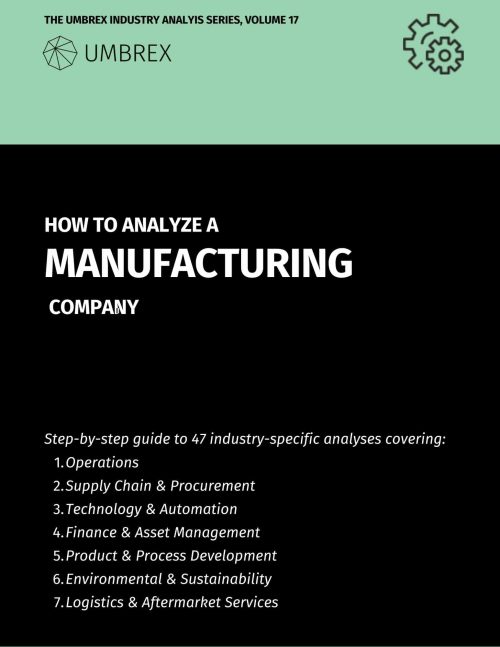
Request the PDF Download of How to Analyze a Manufacturing Company
Menu of the 47 analyses:
Table of Contents
A. OPERATIONS
- Capacity Utilization Analysis
- Operational Efficiency (OEE) Analysis
- Supply Chain and Logistics Optimization
- Production Lead Time Analysis
- Lean Manufacturing and Waste Reduction Assessment
- Inventory Turnover and Management Efficiency
- Quality Control and Defect Rate Analysis
- Capacity Expansion and Flexibility Assessment
- Maintenance Strategy and Downtime Analysis
- Factory Layout and Process Flow Optimization
- Throughput and Bottleneck Identification
- Production Scheduling and Demand Alignment
- Process Standardization and Replication Across Plants
- Work-in-Progress (WIP) Inventory Management
- Material Handling and Internal Logistics Efficiency
- Finished Goods Storage and Warehousing Optimization
- Capacity Buffers and Flexibility in Response to Demand Fluctuations
B. SUPPLY CHAIN & PROCUREMENT
- Bill of Materials (BOM) and Cost Structure Analysis
- Supplier Risk and Dependency Analysis
- Supplier Quality Management
- Raw Material Sourcing and Procurement Efficiency
- Vendor-Managed Inventory (VMI) Program Evaluation
- In-house Production vs. Outsourcing Feasibility
C. TECHNOLOGY & AUTOMATION
- Automation and Technology Integration Analysis
- Factory Automation Level and Robotics Utilization
- Tooling and Machine Setup Time Optimization
- Equipment Downtime Tracking and Root Cause Analysis
- Spare Parts Management and Predictive Maintenance Systems
- Manufacturing Cycle Time Reduction
- Energy Consumption and Efficiency Analysis
D. FINANCE & ASSET MANAGEMENT
- Capital Expenditure (CapEx) Effectiveness in Equipment and Technology
- Cost of Goods Sold (COGS) Breakdown and Margins Analysis
- Asset Utilization and Lifecycle Management
- Return on Invested Capital (ROIC) for Manufacturing Assets
- Working Capital Management in Manufacturing
E. PRODUCT & PROCESS DEVELOPMENT
- Product Customization and Modularity Assessment
- New Product Introduction (NPI) and Time-to-Market Evaluation
- Custom Manufacturing vs. Mass Production Analysis
- Product Yield and Scrap Rate Analysis
- Make-to-Stock vs. Make-to-Order Strategy Evaluation
F. ENVIRONMENTAL & SUSTAINABILITY
- Sustainability and Environmental Impact Analysis
- Heat, Water, and Waste Management in Production
- Environmental Compliance and Emissions Reduction Strategies
- Reverse Logistics and Product Lifecycle Management
G. LOGISTICS & AFTERMARKET SERVICES
- Aftermarket Services and Spare Parts Logistics
- Multi-Site Manufacturing Network Optimization
- Safety and Compliance Audit