
Goal of the analysis:
The goal of a Lean Manufacturing and Waste Reduction Assessment is to identify inefficiencies and waste in the production process and apply lean principles to reduce or eliminate these wastes. This improves operational efficiency, reduces costs, and increases overall productivity by streamlining workflows and minimizing non-value-added activities.
Data required:
- Production Process Mapping: Detailed workflow of the entire production process from raw material to finished goods.
- Cycle Times: The time taken to complete each stage of production.
- Inventory Levels: Amount of raw materials, work-in-progress (WIP), and finished goods in stock.
- Defect Rates: Data on the number of defective products or materials.
- Downtime Data: Time lost due to equipment failure, maintenance, or changeovers.
- Employee Movement Data: Information on the movement of workers, materials, and tools throughout the facility.
- Scrap and Rework Data: Amount of material wasted and products reworked due to defects.
Detailed step-by-step instruction on how to conduct the analysis:
- Map the Value Stream:
- Create a value stream map that outlines every step in the production process, from raw material acquisition to delivery of the finished product. Identify all activities that add value and those that do not.
- Identify the 7 Wastes (Muda):
- Lean manufacturing focuses on eliminating the following seven types of waste (Muda):
- Overproduction: Producing more than what is needed.
- Waiting: Idle time when resources are not in use.
- Transportation: Unnecessary movement of products or materials.
- Overprocessing: Doing more work than is required (e.g., redundant steps).
- Inventory: Holding more inventory than necessary (raw materials, WIP, finished goods).
- Motion: Unnecessary movement of workers, tools, or machines.
- Defects: Production of defective products requiring rework or scrap.
- Lean manufacturing focuses on eliminating the following seven types of waste (Muda):
- Measure Current Waste:
- Quantify the waste in each of the 7 areas. For example, measure how much time is spent waiting for materials, how much excess inventory is carried, or how much scrap is produced due to defects.
- Analyze Cycle Times:
- Review cycle times for each stage of production. Compare the actual cycle times to the ideal cycle times to identify inefficiencies. Long cycle times could indicate bottlenecks or overprocessing.
- Assess Inventory Levels:
- Examine inventory levels of raw materials, WIP, and finished goods. Excessive inventory indicates waste, while stockouts indicate poor demand forecasting or production scheduling.
- Evaluate Motion and Workflow:
- Analyze the physical movement of workers, tools, and materials within the facility. Unnecessary or excessive movement can lead to wasted time and energy, which can be reduced by optimizing the factory layout.
- Review Scrap and Rework:
- Assess the amount of scrap and rework required due to defects in the production process. High levels of defects indicate a need for better quality control or process improvements.
- Develop Action Plan for Waste Reduction:
- Based on the analysis, create an action plan to eliminate waste. Prioritize the areas with the most significant waste for improvement and apply lean principles such as just-in-time (JIT), 5S (sort, set in order, shine, standardize, sustain), and continuous improvement (Kaizen).
Format of the output of analysis:
- Value Stream Map: A detailed map of the production process highlighting areas of waste and inefficiencies.
- Waste Quantification Table: A table showing the amount of waste (e.g., waiting time, excess inventory, scrap) in each of the 7 waste categories.
- Cycle Time vs. Ideal Time Analysis: A comparison of actual vs. ideal cycle times for each production stage.
- Action Plan: A prioritized list of recommendations for reducing waste and improving efficiency.
How to interpret results:
- High Levels of Waste: High levels of waste in any of the 7 areas indicate significant inefficiencies. This means that resources (time, labor, materials) are being underutilized or misallocated.
- Excess Inventory: High inventory levels of raw materials, WIP, or finished goods suggest poor demand forecasting, overproduction, or inefficiencies in production scheduling.
- Long Cycle Times: Long cycle times compared to ideal times indicate inefficiencies in production. These may be caused by overprocessing, waiting, or bottlenecks.
- High Defect Rates: A high defect rate points to quality control issues, which lead to waste in the form of rework and scrap.
Steps a company can take to improve on this measure:
- Implement Just-in-Time (JIT) Production:
- Adopt JIT production to reduce inventory levels. This approach ensures that materials and products are only produced when needed, minimizing excess inventory.
- Apply 5S Methodology:
- Use the 5S methodology (Sort, Set in Order, Shine, Standardize, Sustain) to organize the workplace, reduce motion waste, and create a more efficient, clean working environment.
- Reduce Overproduction:
- Adjust production schedules to better align with customer demand. Avoid producing more than what is required to prevent overproduction waste.
- Optimize Workflow and Factory Layout:
- Rearrange the layout of the factory to reduce unnecessary movement of workers, materials, and tools. A more streamlined layout can save time and reduce motion waste.
- Implement Continuous Improvement (Kaizen):
- Foster a culture of continuous improvement through Kaizen events, where teams regularly meet to identify and solve problems, reduce waste, and improve processes.
- Improve Quality Control:
- Implement stricter quality control processes to reduce defects, rework, and scrap. Use root cause analysis to identify and correct sources of defects in the production process.
- Minimize Downtime:
- Implement preventive maintenance schedules to reduce downtime from equipment failure and changeovers, improving availability and reducing waiting waste.
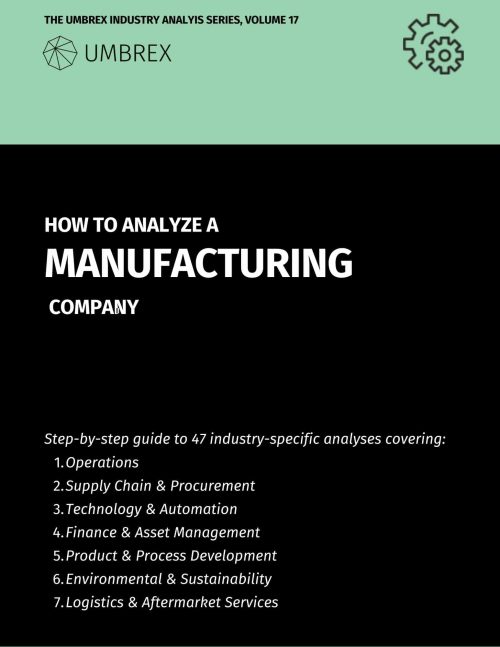
Request the PDF Download of How to Analyze a Manufacturing Company
Menu of the 47 analyses:
Table of Contents
A. OPERATIONS
- Capacity Utilization Analysis
- Operational Efficiency (OEE) Analysis
- Supply Chain and Logistics Optimization
- Production Lead Time Analysis
- Lean Manufacturing and Waste Reduction Assessment
- Inventory Turnover and Management Efficiency
- Quality Control and Defect Rate Analysis
- Capacity Expansion and Flexibility Assessment
- Maintenance Strategy and Downtime Analysis
- Factory Layout and Process Flow Optimization
- Throughput and Bottleneck Identification
- Production Scheduling and Demand Alignment
- Process Standardization and Replication Across Plants
- Work-in-Progress (WIP) Inventory Management
- Material Handling and Internal Logistics Efficiency
- Finished Goods Storage and Warehousing Optimization
- Capacity Buffers and Flexibility in Response to Demand Fluctuations
B. SUPPLY CHAIN & PROCUREMENT
- Bill of Materials (BOM) and Cost Structure Analysis
- Supplier Risk and Dependency Analysis
- Supplier Quality Management
- Raw Material Sourcing and Procurement Efficiency
- Vendor-Managed Inventory (VMI) Program Evaluation
- In-house Production vs. Outsourcing Feasibility
C. TECHNOLOGY & AUTOMATION
- Automation and Technology Integration Analysis
- Factory Automation Level and Robotics Utilization
- Tooling and Machine Setup Time Optimization
- Equipment Downtime Tracking and Root Cause Analysis
- Spare Parts Management and Predictive Maintenance Systems
- Manufacturing Cycle Time Reduction
- Energy Consumption and Efficiency Analysis
D. FINANCE & ASSET MANAGEMENT
- Capital Expenditure (CapEx) Effectiveness in Equipment and Technology
- Cost of Goods Sold (COGS) Breakdown and Margins Analysis
- Asset Utilization and Lifecycle Management
- Return on Invested Capital (ROIC) for Manufacturing Assets
- Working Capital Management in Manufacturing
E. PRODUCT & PROCESS DEVELOPMENT
- Product Customization and Modularity Assessment
- New Product Introduction (NPI) and Time-to-Market Evaluation
- Custom Manufacturing vs. Mass Production Analysis
- Product Yield and Scrap Rate Analysis
- Make-to-Stock vs. Make-to-Order Strategy Evaluation
F. ENVIRONMENTAL & SUSTAINABILITY
- Sustainability and Environmental Impact Analysis
- Heat, Water, and Waste Management in Production
- Environmental Compliance and Emissions Reduction Strategies
- Reverse Logistics and Product Lifecycle Management
G. LOGISTICS & AFTERMARKET SERVICES
- Aftermarket Services and Spare Parts Logistics
- Multi-Site Manufacturing Network Optimization
- Safety and Compliance Audit