
Goal of the analysis:
The goal of Equipment Downtime Tracking and Root Cause Analysis is to systematically monitor and analyze instances of equipment downtime to identify the underlying causes. This analysis helps manufacturers reduce unplanned downtime, improve overall equipment effectiveness (OEE), and minimize production losses. By understanding the root causes of downtime, companies can implement targeted corrective actions, improve maintenance practices, and enhance equipment reliability.
Data required:
- Downtime Logs: Detailed records of equipment downtime, including the start and end time of each downtime event, machine ID, and production line affected.
- Downtime Categories: Classification of downtime by cause, such as mechanical failure, human error, setup/changeover, supply chain issues, or scheduled maintenance.
- Maintenance Records: Historical data on maintenance activities, including preventive maintenance schedules, repairs, and replacement of parts.
- Production Schedules: Data on production schedules, shifts, and the operational hours of each machine or production line.
- Operator Input: Feedback from operators and technicians on machine performance, observed issues, and potential causes of downtime.
- Mean Time Between Failures (MTBF): The average time between equipment failures, used to assess equipment reliability.
- Mean Time to Repair (MTTR): The average time required to repair equipment and bring it back online.
- OEE Metrics: Overall equipment effectiveness data, including availability, performance, and quality metrics to evaluate the impact of downtime on production.
- Root Cause Analysis (RCA) Tools: Tools and techniques such as the 5 Whys method, fishbone diagrams, and Pareto analysis to identify the root causes of downtime.
Detailed step-by-step instruction on how to conduct the analysis:
- Track and Log Equipment Downtime:
- Implement a downtime tracking system to record every instance of equipment downtime. Capture the duration, affected machine, and a preliminary cause for each downtime event. Use automated systems or manual logs to ensure that all downtime is accurately tracked.
- Classify Downtime Events:
- Categorize downtime events based on their cause. Common categories include mechanical failure, operator error, tooling issues, material shortages, scheduled maintenance, and unplanned breakdowns. These categories help in identifying recurring issues.
- Analyze Frequency and Duration of Downtime:
- Calculate the frequency and total duration of downtime for each machine, production line, and downtime category. Identify which machines experience the most frequent or longest downtime periods to prioritize corrective actions.
- Calculate MTBF and MTTR:
- Calculate the Mean Time Between Failures (MTBF) and Mean Time to Repair (MTTR) for each piece of equipment. MTBF measures equipment reliability, while MTTR assesses how quickly breakdowns are resolved. A high MTBF and low MTTR indicate reliable and efficiently maintained equipment.
- MTBF = Total Operating Time / Number of Failures
- MTTR = Total Repair Time / Number of Repairs
- Conduct a Root Cause Analysis (RCA):
- For recurring or significant downtime events, perform a root cause analysis (RCA) to identify the underlying issue. Use techniques such as:
- 5 Whys: Ask “Why?” repeatedly to drill down into the root cause of a problem.
- Fishbone (Ishikawa) Diagram: Visualize the problem and its potential causes by categorizing factors such as manpower, materials, methods, and machinery.
- Pareto Analysis: Use the 80/20 rule to identify the most significant causes of downtime that account for the majority of downtime occurrences.
- For recurring or significant downtime events, perform a root cause analysis (RCA) to identify the underlying issue. Use techniques such as:
- Evaluate Preventive Maintenance Practices:
- Review the preventive maintenance schedule and maintenance records for each machine. Determine whether equipment is being maintained regularly or if maintenance tasks are being skipped or delayed. Identify equipment that may require more frequent maintenance to prevent breakdowns.
- Incorporate Operator and Technician Feedback:
- Engage with machine operators and maintenance technicians to gather insights into equipment performance. Operators often have firsthand knowledge of recurring issues or signs of potential failures. Use this input to cross-check the accuracy of downtime logs and identify potential root causes.
- Assess the Impact of Downtime on OEE:
- Measure the effect of equipment downtime on OEE. Downtime reduces equipment availability, which is a key component of OEE. Calculate how much downtime is affecting overall production performance and quality.
- Identify and Implement Corrective Actions:
- Based on the root cause analysis, identify corrective actions to address the underlying causes of downtime. These actions may include more frequent maintenance, equipment upgrades, process improvements, or additional operator training. Prioritize corrective actions for the most frequent or costly downtime events.
- Monitor the Effectiveness of Corrective Actions:
- After implementing corrective actions, continue to track downtime and measure whether the changes have reduced the frequency or duration of downtime events. Adjust maintenance schedules, training programs, or equipment usage based on the results.
Format of the output of analysis:
- Downtime Log: A detailed log of all downtime events, including the machine affected, duration, preliminary cause, and any corrective actions taken.
- Downtime Categorization Report: A summary report categorizing downtime by cause, showing the frequency and duration of downtime events for each category.
- MTBF and MTTR Metrics: A report showing MTBF and MTTR calculations for each piece of equipment, along with trends over time.
- Root Cause Analysis Report: A detailed RCA report for significant or recurring downtime events, including diagrams (5 Whys, fishbone, Pareto) and recommended corrective actions.
- OEE Impact Report: A summary of how downtime affects OEE metrics, including availability, performance, and quality. Show how reducing downtime improves overall productivity.
- Corrective Action Plan: A list of specific actions to address the root causes of downtime, with timelines and responsibilities for implementation.
How to interpret results:
- High Downtime Frequency: If certain machines or production lines experience frequent downtime, it indicates underlying issues that need attention, such as equipment wear, poor maintenance, or operator error. Focus on high-frequency downtime events to reduce production losses.
- Long Downtime Duration: Long downtime durations suggest inefficiencies in repair processes or the need for equipment upgrades. Reducing MTTR can help get equipment back online faster, improving overall production efficiency.
- Low MTBF: A low MTBF indicates that equipment is prone to frequent failures. This may point to equipment nearing the end of its lifecycle, inadequate maintenance, or improper usage. Addressing the root cause of frequent breakdowns can extend equipment life and reduce downtime.
- Impact on OEE: Downtime significantly affects OEE by reducing equipment availability. If downtime is causing OEE to fall below industry benchmarks (typically 85% or higher), prioritize corrective actions to improve uptime and overall productivity.
Steps a company can take to improve on this measure:
- Implement Predictive Maintenance:
- Use predictive maintenance technologies, such as sensors and machine learning algorithms, to monitor equipment performance in real-time and predict when failures are likely to occur. Predictive maintenance can help prevent unexpected downtime by allowing maintenance to be performed before a failure happens.
- Standardize Downtime Tracking Procedures:
- Establish standardized procedures for logging and categorizing downtime events. Ensure that all operators and technicians consistently track downtime and provide detailed information about the cause and duration of each event.
- Use Automation for Downtime Tracking:
- Implement automated downtime tracking systems that integrate with manufacturing execution systems (MES) or enterprise resource planning (ERP) platforms. Automation ensures accurate data collection and reduces the risk of manual entry errors.
- Optimize Preventive Maintenance Schedules:
- Regularly review and optimize preventive maintenance schedules based on downtime data and root cause analysis. Adjust maintenance frequency to ensure that equipment is properly maintained without excessive downtime for scheduled repairs.
- Train Operators on Early Detection:
- Train machine operators to recognize early signs of equipment failure, such as unusual noises, vibrations, or temperature changes. Early detection of issues can prevent unplanned downtime and allow operators to take corrective action before a breakdown occurs.
- Invest in Spare Parts and Inventory Management:
- Ensure that spare parts for critical equipment are readily available to minimize repair times. A well-managed spare parts inventory can reduce downtime by allowing maintenance teams to quickly replace faulty components.
- Conduct Regular Root Cause Analysis Reviews:
- Periodically review and update root cause analysis findings to ensure that corrective actions remain effective. As equipment ages or production conditions change, new causes of downtime may emerge, requiring ongoing analysis and adjustments.
- Benchmark Downtime Performance:
- Benchmark downtime performance against industry standards or similar facilities to gauge how well your equipment uptime compares to competitors. Use this information to set realistic goals for reducing downtime and improving equipment performance.
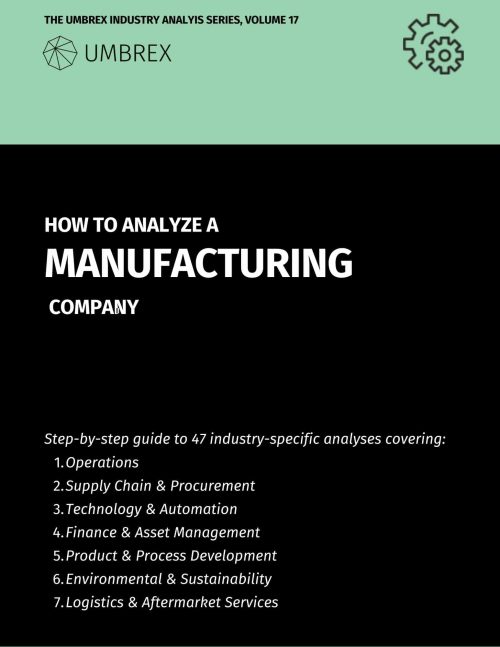
Request the PDF Download of How to Analyze a Manufacturing Company
Menu of the 47 analyses:
Table of Contents
A. OPERATIONS
- Capacity Utilization Analysis
- Operational Efficiency (OEE) Analysis
- Supply Chain and Logistics Optimization
- Production Lead Time Analysis
- Lean Manufacturing and Waste Reduction Assessment
- Inventory Turnover and Management Efficiency
- Quality Control and Defect Rate Analysis
- Capacity Expansion and Flexibility Assessment
- Maintenance Strategy and Downtime Analysis
- Factory Layout and Process Flow Optimization
- Throughput and Bottleneck Identification
- Production Scheduling and Demand Alignment
- Process Standardization and Replication Across Plants
- Work-in-Progress (WIP) Inventory Management
- Material Handling and Internal Logistics Efficiency
- Finished Goods Storage and Warehousing Optimization
- Capacity Buffers and Flexibility in Response to Demand Fluctuations
B. SUPPLY CHAIN & PROCUREMENT
- Bill of Materials (BOM) and Cost Structure Analysis
- Supplier Risk and Dependency Analysis
- Supplier Quality Management
- Raw Material Sourcing and Procurement Efficiency
- Vendor-Managed Inventory (VMI) Program Evaluation
- In-house Production vs. Outsourcing Feasibility
C. TECHNOLOGY & AUTOMATION
- Automation and Technology Integration Analysis
- Factory Automation Level and Robotics Utilization
- Tooling and Machine Setup Time Optimization
- Equipment Downtime Tracking and Root Cause Analysis
- Spare Parts Management and Predictive Maintenance Systems
- Manufacturing Cycle Time Reduction
- Energy Consumption and Efficiency Analysis
D. FINANCE & ASSET MANAGEMENT
- Capital Expenditure (CapEx) Effectiveness in Equipment and Technology
- Cost of Goods Sold (COGS) Breakdown and Margins Analysis
- Asset Utilization and Lifecycle Management
- Return on Invested Capital (ROIC) for Manufacturing Assets
- Working Capital Management in Manufacturing
E. PRODUCT & PROCESS DEVELOPMENT
- Product Customization and Modularity Assessment
- New Product Introduction (NPI) and Time-to-Market Evaluation
- Custom Manufacturing vs. Mass Production Analysis
- Product Yield and Scrap Rate Analysis
- Make-to-Stock vs. Make-to-Order Strategy Evaluation
F. ENVIRONMENTAL & SUSTAINABILITY
- Sustainability and Environmental Impact Analysis
- Heat, Water, and Waste Management in Production
- Environmental Compliance and Emissions Reduction Strategies
- Reverse Logistics and Product Lifecycle Management
G. LOGISTICS & AFTERMARKET SERVICES
- Aftermarket Services and Spare Parts Logistics
- Multi-Site Manufacturing Network Optimization
- Safety and Compliance Audit