
Goal of the analysis:
The goal of a Capital Expenditure (CapEx) Effectiveness analysis in Equipment and Technology is to assess whether the company’s investments in new equipment, machinery, and technology are delivering the expected returns and operational benefits. This analysis evaluates the impact of CapEx on productivity, cost savings, and overall performance, while ensuring that capital is allocated efficiently to maximize value. It helps decision-makers determine if CapEx projects are justified and whether future investments align with strategic goals.
Data required:
- CapEx Investment Data: A breakdown of recent and planned capital expenditures on equipment, machinery, and technology, including initial purchase costs, installation, and related expenses.
- Expected ROI and Payback Period: Projections for the return on investment (ROI) and payback period for each CapEx project, including cost savings, revenue improvements, or productivity gains.
- Operational Performance Metrics: Data on how the new equipment or technology has affected production, including output volume, cycle times, efficiency improvements, and defect rates.
- Cost Savings Data: Information on any reductions in labor, energy, maintenance, or operational costs as a result of CapEx investments.
- Depreciation Schedules: The depreciation rates and remaining useful life of equipment and technology purchased through CapEx, as well as how depreciation affects financial reporting and tax liabilities.
- Maintenance and Downtime Costs: Historical data on the maintenance costs, repair frequency, and downtime before and after implementing the new equipment or technology.
- Alternative Investment Opportunities: Data on other potential uses of capital, including comparisons of projects that were prioritized versus those that were deferred.
- Asset Utilization Rates: Information on how effectively the new equipment or technology is being utilized, including machine uptime, capacity utilization, and throughput improvements.
- Risk Factors and Contingencies: An assessment of risks associated with CapEx projects, such as technology obsolescence, supply chain risks, or market volatility, which may affect the effectiveness of the investment.
Detailed step-by-step instruction on how to conduct the analysis:
- Collect CapEx Investment Data:
- Gather data on all recent and planned capital expenditures on equipment, machinery, and technology. Break down each project by purchase price, installation costs, and other related expenses. Ensure that each CapEx project is clearly linked to its expected goals, such as productivity improvements or cost savings.
- Assess Expected ROI and Payback Period:
- Review the original projections for ROI and payback period when the CapEx investment was approved. These projections typically include cost savings, revenue gains, or operational improvements. Ensure that these expectations are realistic and in line with actual performance.
- ROI Calculation: ROI = (Net Benefits / Total Investment) x 100
- Payback Period Calculation: Payback Period = Total Investment / Annual Net Benefits
- Evaluate Operational Performance Improvements:
- Compare key performance indicators (KPIs) such as production output, cycle times, machine uptime, and defect rates before and after the implementation of the new equipment or technology. Quantify how the CapEx investment has improved operational efficiency, productivity, or quality.
- Analyze Cost Savings and Benefits:
- Assess whether the CapEx investments have led to cost reductions in areas such as labor, energy consumption, maintenance, or raw material usage. Calculate the direct financial benefits of these savings and compare them to the original projections to determine if the investment has met expectations.
- Track Asset Utilization Rates:
- Analyze the utilization rates of the newly purchased equipment or technology. High utilization rates indicate that the assets are being fully leveraged, while low utilization may suggest that the investment is underperforming or that demand was overestimated.
- Review Depreciation and Financial Impact:
- Review the depreciation schedules of newly acquired equipment and technology. Assess how depreciation affects the company’s financial statements, tax liabilities, and cash flow. Ensure that the remaining useful life of the assets aligns with their expected performance and contribution to operations.
- Compare Alternative Investment Opportunities:
- Consider the opportunity cost of CapEx investments by comparing the performance of completed projects with other potential uses of capital. If certain projects have underperformed, evaluate whether deferring them in favor of other initiatives would have been a better decision.
- Analyze Maintenance and Downtime Costs:
- Track maintenance and downtime costs associated with the new equipment or technology. Assess whether the CapEx investments have reduced the frequency of breakdowns and the associated repair costs. If downtime or repair needs have increased, the effectiveness of the investment may be in question.
- Assess Risk Factors and Contingencies:
- Identify any risks or contingencies that could affect the effectiveness of the CapEx investments, such as supply chain issues, market volatility, or technological obsolescence. If risks have materialized, assess their impact on ROI and explore strategies for mitigating future risks.
- Monitor and Report on Results:
- Continuously track the performance of CapEx investments, using both financial and operational metrics. Create regular reports to communicate whether investments are delivering the expected value and identify areas for improvement or course correction. Ensure that lessons learned are applied to future CapEx decision-making processes.
Format of the output of analysis:
- CapEx Investment Summary: A detailed breakdown of recent and planned capital expenditures, including purchase costs, installation expenses, and projected benefits.
- ROI and Payback Period Report: A financial report comparing the projected and actual ROI and payback periods for each CapEx project, highlighting any deviations from expectations.
- Operational Improvement Report: A summary of the performance improvements achieved through CapEx investments, including metrics on productivity, quality, and efficiency.
- Cost Savings Analysis: A detailed analysis of cost savings realized as a result of CapEx projects, broken down by category (e.g., labor, energy, maintenance).
- Asset Utilization and Depreciation Report: A report tracking how effectively newly acquired assets are being used, including utilization rates and the impact of depreciation on financial statements.
- Risk and Contingency Report: A summary of any risks or contingencies affecting CapEx investments, along with recommendations for mitigating future risks.
How to interpret results:
- High ROI and Short Payback Period: If actual ROI and payback periods meet or exceed projections, the CapEx investment is likely performing as expected and delivering value. If ROI is low or the payback period is extended, reassess the project’s long-term viability.
- Improved Operational Efficiency: If CapEx investments have led to significant improvements in productivity, quality, or efficiency, it indicates that the investment was effective. Poor or negligible improvements may suggest that the project was overestimated or poorly executed.
- Cost Savings Realization: If the CapEx projects have delivered tangible cost savings (e.g., lower labor, energy, or maintenance costs), the investment is yielding positive financial returns. If cost savings fall short, investigate the root causes and consider whether the investment was justified.
- Asset Underutilization: Low utilization rates suggest that the equipment or technology may not have been necessary or is being underutilized due to overcapacity or poor planning. Consider repurposing, reallocating, or selling underutilized assets to optimize capital use.
Steps a company can take to improve on this measure:
- Strengthen CapEx Planning and Forecasting:
- Improve the accuracy of CapEx projections by conducting thorough feasibility studies, ROI analyses, and market assessments before committing to large capital investments. Use conservative estimates and factor in potential risks to avoid overestimating returns.
- Increase Post-Implementation Reviews:
- Conduct regular post-implementation reviews to assess whether CapEx projects are meeting their objectives. These reviews help identify deviations from expected performance early, allowing for corrective actions.
- Optimize Asset Utilization:
- Ensure that new equipment and technology are fully utilized by aligning them with production needs and demand forecasts. If utilization is low, consider redistributing assets to higher-demand areas or scaling down operations.
- Leverage Predictive Maintenance:
- Implement predictive maintenance strategies to extend the lifespan of CapEx assets and reduce downtime. Monitoring equipment health in real time helps avoid costly repairs and ensures that assets remain operational.
- Focus on Continuous Improvement:
- Use data from CapEx effectiveness analyses to inform future investment decisions. Continuously refine the CapEx process by learning from past investments, improving forecasting, and ensuring alignment with strategic goals.
- Consider Leasing or Outsourcing:
- For non-core assets, consider leasing equipment or outsourcing certain functions rather than purchasing new machinery. This approach can reduce upfront capital requirements and provide greater flexibility.
- Incorporate Sustainability into CapEx Decisions:
- Evaluate how sustainable investments in equipment and technology can provide long-term benefits, such as energy savings, reduced carbon emissions, and regulatory compliance. This can enhance both financial and environmental outcomes.
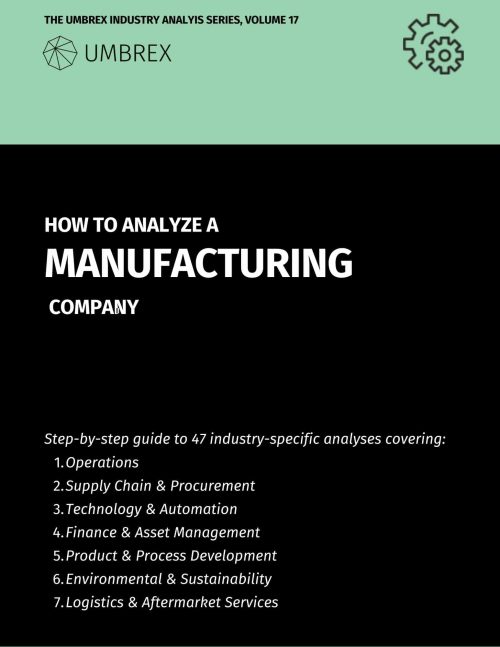
Request the PDF Download of How to Analyze a Manufacturing Company
Menu of the 47 analyses:
Table of Contents
A. OPERATIONS
- Capacity Utilization Analysis
- Operational Efficiency (OEE) Analysis
- Supply Chain and Logistics Optimization
- Production Lead Time Analysis
- Lean Manufacturing and Waste Reduction Assessment
- Inventory Turnover and Management Efficiency
- Quality Control and Defect Rate Analysis
- Capacity Expansion and Flexibility Assessment
- Maintenance Strategy and Downtime Analysis
- Factory Layout and Process Flow Optimization
- Throughput and Bottleneck Identification
- Production Scheduling and Demand Alignment
- Process Standardization and Replication Across Plants
- Work-in-Progress (WIP) Inventory Management
- Material Handling and Internal Logistics Efficiency
- Finished Goods Storage and Warehousing Optimization
- Capacity Buffers and Flexibility in Response to Demand Fluctuations
B. SUPPLY CHAIN & PROCUREMENT
- Bill of Materials (BOM) and Cost Structure Analysis
- Supplier Risk and Dependency Analysis
- Supplier Quality Management
- Raw Material Sourcing and Procurement Efficiency
- Vendor-Managed Inventory (VMI) Program Evaluation
- In-house Production vs. Outsourcing Feasibility
C. TECHNOLOGY & AUTOMATION
- Automation and Technology Integration Analysis
- Factory Automation Level and Robotics Utilization
- Tooling and Machine Setup Time Optimization
- Equipment Downtime Tracking and Root Cause Analysis
- Spare Parts Management and Predictive Maintenance Systems
- Manufacturing Cycle Time Reduction
- Energy Consumption and Efficiency Analysis
D. FINANCE & ASSET MANAGEMENT
- Capital Expenditure (CapEx) Effectiveness in Equipment and Technology
- Cost of Goods Sold (COGS) Breakdown and Margins Analysis
- Asset Utilization and Lifecycle Management
- Return on Invested Capital (ROIC) for Manufacturing Assets
- Working Capital Management in Manufacturing
E. PRODUCT & PROCESS DEVELOPMENT
- Product Customization and Modularity Assessment
- New Product Introduction (NPI) and Time-to-Market Evaluation
- Custom Manufacturing vs. Mass Production Analysis
- Product Yield and Scrap Rate Analysis
- Make-to-Stock vs. Make-to-Order Strategy Evaluation
F. ENVIRONMENTAL & SUSTAINABILITY
- Sustainability and Environmental Impact Analysis
- Heat, Water, and Waste Management in Production
- Environmental Compliance and Emissions Reduction Strategies
- Reverse Logistics and Product Lifecycle Management
G. LOGISTICS & AFTERMARKET SERVICES
- Aftermarket Services and Spare Parts Logistics
- Multi-Site Manufacturing Network Optimization
- Safety and Compliance Audit