
Goal of the analysis:
The goal of a Make-to-Stock (MTS) vs. Make-to-Order (MTO) Strategy Evaluation is to assess the effectiveness and suitability of each production strategy for a company’s operations, market demand, and supply chain capabilities. This analysis helps determine whether the company should produce goods in anticipation of customer demand (MTS) or manufacture products only after receiving customer orders (MTO). The evaluation balances factors such as production efficiency, inventory costs, lead times, customer satisfaction, and market variability to identify the best approach or combination of strategies for the business.
Data required:
- Customer Demand Patterns: Historical sales data, demand forecasts, and seasonal fluctuations to assess demand variability and predictability.
- Lead Time Data: Information on lead times for both MTS and MTO production, including order processing, production, and delivery times.
- Inventory Levels and Costs: Data on current inventory levels, carrying costs, stockouts, and excess inventory related to make-to-stock products.
- Production Capacity and Flexibility: Information on the production line’s capacity and flexibility to switch between different products and accommodate custom orders.
- Raw Material Availability: Data on the availability of raw materials or components and supplier lead times, particularly for MTO production, where timely procurement is crucial.
- Customer Satisfaction Metrics: Insights from customer feedback on product availability, lead times, and satisfaction with MTO versus MTS products.
- Cost Data: Detailed cost breakdowns for both MTS and MTO strategies, including production costs, inventory holding costs, and cost of lost sales due to stockouts or long lead times.
- Market Trends and Competitor Strategies: Information on market trends, competitive positioning, and how competitors manage their production strategies.
- Product Lifecycle Data: Insights into product lifecycles, including how frequently products are updated or replaced and how this impacts demand predictability.
Detailed step-by-step instruction on how to conduct the analysis:
- Evaluate Customer Demand Predictability:
- Analyze historical sales data to understand how predictable customer demand is. If demand is relatively stable and easy to forecast, a make-to-stock strategy may be more effective. If demand is highly variable or customers require customized products, a make-to-order strategy may be better suited.
- Compare Lead Times:
- Compare the lead times for MTS versus MTO production. Make-to-stock typically offers shorter lead times because products are pre-produced and ready to ship. Make-to-order, on the other hand, requires more production time since products are only made after the order is received.
- Assess Inventory Management for MTS:
- For MTS, evaluate current inventory levels and costs, including the risk of stockouts or excess inventory. High inventory carrying costs or frequent stockouts may suggest that demand is not well-aligned with production, leading to inefficiencies in the MTS approach.
- Inventory Carrying Costs = (Total Inventory Value x Carrying Cost Percentage)
- Examine Production Flexibility for MTO:
- Assess how flexible the production process is for handling MTO orders, especially if customization is required. Evaluate whether the company has the capacity to scale up or down based on incoming orders and whether it can accommodate product variability without significant delays or cost increases.
- Analyze Raw Material and Supply Chain Constraints:
- For MTO production, review the availability of raw materials and supplier lead times. A strong supply chain that can quickly deliver materials for MTO production is essential to avoid long customer wait times. If materials are difficult to procure on short notice, MTS may be a safer option for ensuring product availability.
- Compare Production and Inventory Costs:
- Compare the overall costs of MTS and MTO, including production costs, inventory holding costs, and stockout or lost sales costs. MTS may have higher carrying costs due to inventory, while MTO could lead to higher production costs due to smaller batch sizes and the need for flexibility.
- Review Customer Satisfaction and Lead Time Expectations:
- Analyze customer satisfaction data related to product availability and lead times. MTS typically results in faster deliveries, which may enhance customer satisfaction for standard products. MTO offers customization but can result in longer lead times, which may impact customer satisfaction if expectations aren’t properly managed.
- Evaluate Market Trends and Competitor Approaches:
- Review market trends and competitor strategies to determine whether there is a shift towards customized, made-to-order products or if there is a competitive advantage in offering ready-to-ship inventory. Market conditions, customer preferences, and competitive pressures may influence the choice between MTS and MTO.
- Consider Product Lifecycles:
- Evaluate how product lifecycle impacts the choice of strategy. For products with short lifecycles, MTO may be preferable to avoid overproduction and obsolescence. For mature products with consistent demand, MTS may be more efficient.
- Identify a Hybrid Approach:
- Consider whether a hybrid approach that combines elements of both MTS and MTO is feasible. For example, a company could use MTS for high-volume, standard products while offering MTO for customized or low-demand products. This hybrid strategy can balance inventory costs with customer flexibility.
Format of the output of analysis:
- Customer Demand and Forecasting Report: A report summarizing demand patterns and predictability, including historical sales data, seasonal trends, and forecast accuracy.
- Lead Time Comparison: A comparison of lead times for MTS and MTO production, highlighting any significant differences and recommendations for improving delivery times.
- Inventory Management and Cost Analysis: A breakdown of inventory carrying costs for MTS, including stockouts, excess inventory, and associated financial impacts.
- Production Flexibility and Capacity Report: An evaluation of the production line’s ability to handle MTO orders and accommodate customization, with recommendations for improving flexibility if necessary.
- Supply Chain and Material Availability Analysis: A report on supplier lead times, raw material availability, and the impact of these factors on MTO production.
- Cost Comparison for MTS vs. MTO: A financial analysis comparing the costs of make-to-stock and make-to-order production, including production costs, inventory costs, and potential lost sales.
- Customer Satisfaction and Lead Time Report: An analysis of customer feedback regarding product availability and lead times for MTS and MTO products, with suggestions for improving satisfaction levels.
- Market Trends and Competitor Analysis: A review of market trends and competitor strategies related to production methods, with recommendations based on industry benchmarks.
- Hybrid Strategy Recommendations: A proposal for adopting a hybrid strategy that combines the best aspects of MTS and MTO, tailored to the company’s operational capabilities and market demand.
How to interpret results:
- Stable Demand and High Inventory Costs: If demand is predictable but inventory costs are high, focus on improving demand forecasting to reduce excess inventory or consider moving some products to MTO to lower carrying costs.
- Variable Demand and High Lead Times: If demand is variable and lead times for MTO are long, look for ways to improve production flexibility or streamline the supply chain to reduce lead times for custom orders.
- High Customer Satisfaction with Fast Delivery: If customers expect fast delivery and are satisfied with ready-to-ship products, MTS may be the best strategy for standard products. Focus on inventory optimization to reduce stockouts.
- High Customization Demand with Long Lead Times: If customization is in high demand but lead times for MTO are long, invest in flexible manufacturing
Steps a company can take to improve on this measure:
- Optimize Inventory Management for MTS:
- Improve inventory management by using advanced forecasting tools, just-in-time (JIT) systems, or demand planning software. This helps minimize carrying costs and reduce excess inventory while ensuring products are available for immediate shipping.
- Increase Production Flexibility for MTO:
- Invest in flexible manufacturing systems (FMS) or automation to accommodate customization in MTO production. This reduces lead times and allows for efficient small-batch production without sacrificing quality or increasing costs significantly.
- Improve Supply Chain Agility:
- Work with suppliers to reduce lead times for key materials needed in MTO production. Consider vendor-managed inventory (VMI) or dual sourcing strategies to ensure raw materials are available when needed.
- Adopt a Hybrid MTS-MTO Strategy:
- Use a hybrid approach by producing standard, high-demand products for stock (MTS) while offering custom or low-demand products through MTO. This balances the benefits of fast delivery with the flexibility of customization.
- Enhance Demand Forecasting for MTS:
- Use advanced demand forecasting methods, including machine learning or AI tools, to improve the accuracy of sales predictions. This helps align production with demand, minimizing overproduction and stockouts.
- Manage Customer Expectations for MTO:
- For MTO products, clearly communicate lead times and set realistic delivery expectations with customers. Offering regular updates on order status can improve customer satisfaction, even if lead times are longer than for MTS products.
- Leverage Technology for Both Strategies:
- Use enterprise resource planning (ERP) systems or manufacturing execution systems (MES) to streamline both MTS and MTO processes. These tools provide real-time data on inventory, production, and orders, improving overall efficiency.
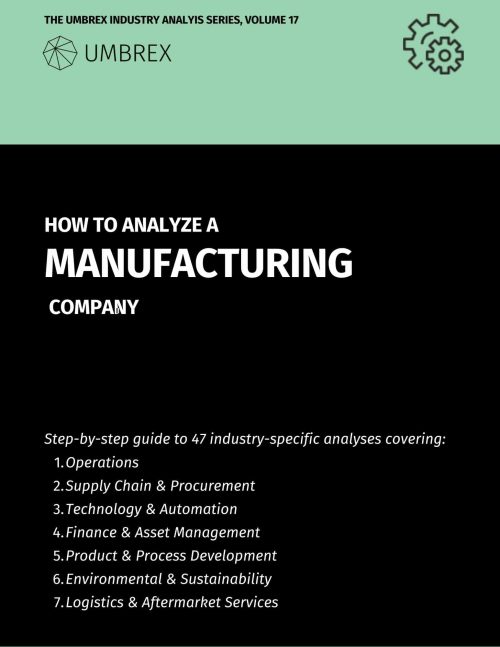
Request the PDF Download of How to Analyze a Manufacturing Company
Menu of the 47 analyses:
Table of Contents
A. OPERATIONS
- Capacity Utilization Analysis
- Operational Efficiency (OEE) Analysis
- Supply Chain and Logistics Optimization
- Production Lead Time Analysis
- Lean Manufacturing and Waste Reduction Assessment
- Inventory Turnover and Management Efficiency
- Quality Control and Defect Rate Analysis
- Capacity Expansion and Flexibility Assessment
- Maintenance Strategy and Downtime Analysis
- Factory Layout and Process Flow Optimization
- Throughput and Bottleneck Identification
- Production Scheduling and Demand Alignment
- Process Standardization and Replication Across Plants
- Work-in-Progress (WIP) Inventory Management
- Material Handling and Internal Logistics Efficiency
- Finished Goods Storage and Warehousing Optimization
- Capacity Buffers and Flexibility in Response to Demand Fluctuations
B. SUPPLY CHAIN & PROCUREMENT
- Bill of Materials (BOM) and Cost Structure Analysis
- Supplier Risk and Dependency Analysis
- Supplier Quality Management
- Raw Material Sourcing and Procurement Efficiency
- Vendor-Managed Inventory (VMI) Program Evaluation
- In-house Production vs. Outsourcing Feasibility
C. TECHNOLOGY & AUTOMATION
- Automation and Technology Integration Analysis
- Factory Automation Level and Robotics Utilization
- Tooling and Machine Setup Time Optimization
- Equipment Downtime Tracking and Root Cause Analysis
- Spare Parts Management and Predictive Maintenance Systems
- Manufacturing Cycle Time Reduction
- Energy Consumption and Efficiency Analysis
D. FINANCE & ASSET MANAGEMENT
- Capital Expenditure (CapEx) Effectiveness in Equipment and Technology
- Cost of Goods Sold (COGS) Breakdown and Margins Analysis
- Asset Utilization and Lifecycle Management
- Return on Invested Capital (ROIC) for Manufacturing Assets
- Working Capital Management in Manufacturing
E. PRODUCT & PROCESS DEVELOPMENT
- Product Customization and Modularity Assessment
- New Product Introduction (NPI) and Time-to-Market Evaluation
- Custom Manufacturing vs. Mass Production Analysis
- Product Yield and Scrap Rate Analysis
- Make-to-Stock vs. Make-to-Order Strategy Evaluation
F. ENVIRONMENTAL & SUSTAINABILITY
- Sustainability and Environmental Impact Analysis
- Heat, Water, and Waste Management in Production
- Environmental Compliance and Emissions Reduction Strategies
- Reverse Logistics and Product Lifecycle Management
G. LOGISTICS & AFTERMARKET SERVICES
- Aftermarket Services and Spare Parts Logistics
- Multi-Site Manufacturing Network Optimization
- Safety and Compliance Audit