
Goal of the analysis:
The goal of a Production Lead Time Analysis is to measure the time it takes from the start of the production process to the completion of finished goods. This analysis helps identify bottlenecks, inefficiencies, and areas where production times can be reduced to improve overall operational efficiency.
Data required:
- Order Placement Date: The date when the production order was placed.
- Start of Production Date: The date when production for the order began.
- End of Production Date: The date when production for the order was completed.
- Production Process Breakdown: Data on each stage of production (e.g., preparation, assembly, quality control).
- Machine and Labor Availability: Availability of machines and workers that might affect production speed.
- Downtime Data: Time when machines were idle or down due to maintenance, setup, or changeovers.
Detailed step-by-step instruction on how to conduct the analysis:
- Gather Data on Production Orders:
- Collect data for several recent production orders, including the date of order placement, start of production, and completion date.
- Break Down Production Stages:
- Identify the key stages in the production process (e.g., raw material preparation, assembly, packaging, quality checks). For each stage, record the time taken.
- Calculate Total Production Lead Time:
- Production Lead Time = End of Production Date – Start of Production Date
- For example, if production started on September 1 and ended on September 10, the lead time is 9 days.
- Identify Bottlenecks:
- Analyze each stage of production to identify where the most time is spent. Compare this to standard cycle times or benchmarks to find bottlenecks or inefficiencies.
- Evaluate Impact of Downtime:
- Assess downtime data to determine how much of the lead time is caused by machine breakdowns, maintenance, or setup times. Downtime can significantly extend lead times.
- Compare Lead Times Across Orders:
- Compare the production lead times for different orders to identify trends or recurring delays. This can help highlight persistent issues such as material shortages, machine overload, or staffing constraints.
- Monitor External Factors:
- Evaluate how external factors, such as supplier lead times or transportation delays, impact the production lead time.
Format of the output of analysis:
- Lead Time Table: A table showing the start and end dates for production orders, total lead time, and time spent at each stage of production.
- Bottleneck Analysis: A chart or visual representation that shows where bottlenecks occur in the production process.
- Downtime Breakdown: A table or graph showing total downtime and the reasons for machine or production delays.
- Lead Time Trends: A graph (e.g., line chart) showing how lead times have changed over time.
How to interpret results:
- Short Lead Times: Short production lead times indicate that the production process is running efficiently, with minimal delays and bottlenecks.
- Long Lead Times: Long lead times suggest inefficiencies, such as bottlenecks, excessive downtime, or capacity constraints, that are slowing down production.
- Bottleneck Identification: Stages of production where the time spent is significantly longer than the average may indicate bottlenecks that need to be addressed.
- Impact of Downtime: High levels of downtime, particularly during critical stages of production, indicate that maintenance schedules or machine reliability should be improved.
Steps a company can take to improve on this measure:
- Optimize Production Scheduling:
- Review production schedules to better align machine and labor availability with demand. This can help reduce idle time and shorten lead times.
- Implement Lean Manufacturing Practices:
- Introduce lean manufacturing techniques, such as just-in-time (JIT) production, to minimize waste and reduce unnecessary steps in the production process.
- Automate Repetitive Processes:
- Invest in automation to reduce manual labor and increase the speed of repetitive tasks such as assembly, packaging, or inspections.
- Improve Machine Maintenance:
- Implement a more rigorous preventive maintenance schedule to minimize unplanned downtime and improve machine reliability, reducing production delays.
- Streamline Changeovers:
- Analyze changeover times between production runs. By implementing quicker changeover procedures or introducing more flexible machinery, companies can reduce the time lost between production cycles.
- Enhance Workforce Training:
- Train workers to perform tasks more efficiently and handle multiple stages of production if needed. A well-trained workforce can help reduce errors and speed up the overall production process.
- Improve Supplier Coordination:
- Work closely with suppliers to ensure timely delivery of raw materials, avoiding delays that can extend production lead times.
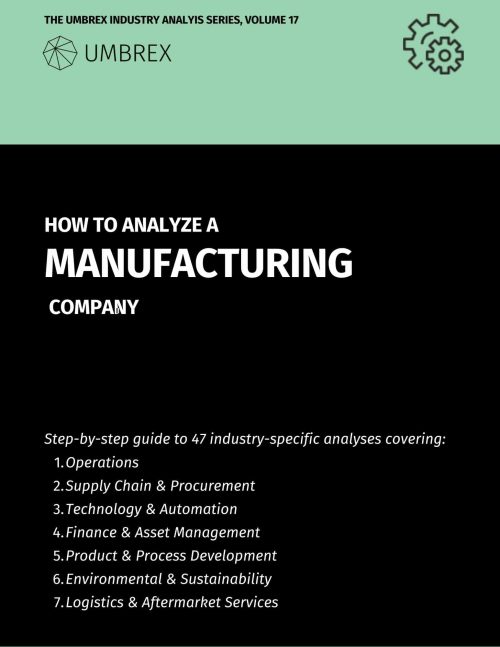
Request the PDF Download of How to Analyze a Manufacturing Company
Menu of the 47 analyses:
Table of Contents
A. OPERATIONS
- Capacity Utilization Analysis
- Operational Efficiency (OEE) Analysis
- Supply Chain and Logistics Optimization
- Production Lead Time Analysis
- Lean Manufacturing and Waste Reduction Assessment
- Inventory Turnover and Management Efficiency
- Quality Control and Defect Rate Analysis
- Capacity Expansion and Flexibility Assessment
- Maintenance Strategy and Downtime Analysis
- Factory Layout and Process Flow Optimization
- Throughput and Bottleneck Identification
- Production Scheduling and Demand Alignment
- Process Standardization and Replication Across Plants
- Work-in-Progress (WIP) Inventory Management
- Material Handling and Internal Logistics Efficiency
- Finished Goods Storage and Warehousing Optimization
- Capacity Buffers and Flexibility in Response to Demand Fluctuations
B. SUPPLY CHAIN & PROCUREMENT
- Bill of Materials (BOM) and Cost Structure Analysis
- Supplier Risk and Dependency Analysis
- Supplier Quality Management
- Raw Material Sourcing and Procurement Efficiency
- Vendor-Managed Inventory (VMI) Program Evaluation
- In-house Production vs. Outsourcing Feasibility
C. TECHNOLOGY & AUTOMATION
- Automation and Technology Integration Analysis
- Factory Automation Level and Robotics Utilization
- Tooling and Machine Setup Time Optimization
- Equipment Downtime Tracking and Root Cause Analysis
- Spare Parts Management and Predictive Maintenance Systems
- Manufacturing Cycle Time Reduction
- Energy Consumption and Efficiency Analysis
D. FINANCE & ASSET MANAGEMENT
- Capital Expenditure (CapEx) Effectiveness in Equipment and Technology
- Cost of Goods Sold (COGS) Breakdown and Margins Analysis
- Asset Utilization and Lifecycle Management
- Return on Invested Capital (ROIC) for Manufacturing Assets
- Working Capital Management in Manufacturing
E. PRODUCT & PROCESS DEVELOPMENT
- Product Customization and Modularity Assessment
- New Product Introduction (NPI) and Time-to-Market Evaluation
- Custom Manufacturing vs. Mass Production Analysis
- Product Yield and Scrap Rate Analysis
- Make-to-Stock vs. Make-to-Order Strategy Evaluation
F. ENVIRONMENTAL & SUSTAINABILITY
- Sustainability and Environmental Impact Analysis
- Heat, Water, and Waste Management in Production
- Environmental Compliance and Emissions Reduction Strategies
- Reverse Logistics and Product Lifecycle Management
G. LOGISTICS & AFTERMARKET SERVICES
- Aftermarket Services and Spare Parts Logistics
- Multi-Site Manufacturing Network Optimization
- Safety and Compliance Audit