
Goal of the analysis:
The goal of the Private Label vs. Branded Product Performance and Supplier Dependency Strategy analysis is to assess the performance of private label products compared to branded products. It also evaluates the company’s dependency on specific suppliers for branded products. This analysis helps retail companies make informed decisions on product assortment, pricing strategies, and supplier relationships to maximize profitability and reduce risk.
Data required:
- Sales data for both private label and branded products, segmented by category.
- Cost of Goods Sold (COGS) for private label and branded products.
- Profit margins for each product type (private label and branded).
- Supplier information, including the percentage of inventory sourced from each supplier.
- Supplier terms and agreements (e.g., pricing, lead times).
- Customer feedback or reviews for private label and branded products (optional for deeper insights).
Detailed step-by-step instruction on how to conduct the analysis:
1. Collect sales and COGS data.
Gather the total sales and COGS for private label and branded products across all relevant categories during a specific period (e.g., monthly, quarterly).
2. Calculate gross profit margins.
Use the following equation to calculate the gross profit margin for both private-label and branded products:
Gross Profit Margin (%) = ((Sales – COGS) / Sales) x 100
This helps determine which product type is more profitable.
3. Compare sales volumes.
Analyze the total sales volume for private label versus branded products to understand customer preferences.
You can use the following equation to calculate the proportion of each type:
Sales Proportion (%) = (Product Sales / Total Sales) x 100
This shows the percentage of total sales coming from private label vs. branded products.
4. Assess supplier dependency.
For branded products, calculate the company’s reliance on specific suppliers using this formula:
Supplier Dependency (%) = (Supplier’s Sales Contribution / Total Branded Sales) x 100
This will highlight any overreliance on a particular supplier.
5. Analyze customer feedback (optional).
If customer reviews or feedback data is available, analyze whether private label products are meeting customer expectations compared to branded products. This can help assess whether the lower price point of private labels is balanced by product quality.
6. Evaluate the impact of supplier terms.
Review supplier terms such as pricing, lead times, and volume discounts. Consider how flexible or restrictive these terms are, and assess the risk of being dependent on a limited number of suppliers for branded products.
7. Segment analysis by product category.
If the data allows, break down the performance of private label vs. branded products by category to identify which categories have stronger private label potential.
Potential complications that can arise with this analysis:
- Incomplete supplier data: If the terms or sourcing information for certain suppliers is missing or unclear, it can skew the assessment of supplier dependency.
- Customer perception of quality: While private label products often have higher margins, poor quality perception compared to branded products may result in lower customer satisfaction, leading to higher returns or lower repeat purchases.
- Seasonal variation: Seasonal sales spikes (e.g., holidays) may favor branded products or private labels, making it difficult to isolate underlying trends.
- Pricing discrepancies: Branded products often have higher prices, which may complicate direct sales volume comparisons between branded and private label items.
Format of the output of analysis:
The output is typically a comparison of sales, profitability, and supplier dependency for private label and branded products. It can be broken down by category or supplier to provide more granular insights.
Example output:
- Private Label Performance:
- Sales: $500,000
- Gross Profit Margin: 40%
- Customer Rating: 4.2/5
- Branded Product Performance:
- Sales: $1,000,000
- Gross Profit Margin: 30%
- Customer Rating: 4.5/5
- Supplier Dependency:
- Supplier A: 40% of branded sales
- Supplier B: 35% of branded sales
- Supplier C: 25% of branded sales
How to interpret results:
- High private label performance: High sales and profit margins for private label products suggest that the retailer’s private brands are resonating with customers and generating better margins. Consider expanding the private label assortment.
- Low private label performance: If private label sales are low despite higher profit margins, this may indicate poor customer perception or quality issues. Marketing efforts may need to be adjusted, or product quality improved.
- High supplier dependency: If one supplier provides a significant portion of branded products, the company may face supply chain risks. Negotiating better terms with existing suppliers or diversifying the supplier base may be necessary.
- Branded products dominating sales: If branded products are consistently outselling private label products, customer loyalty to branded products might be strong. Consider whether private labels need more promotion or whether branded products should be given higher prominence.
Steps a company can take to improve on this measure:
- Optimize private label offerings: Expand the range of private label products in categories where sales and margins are strong. Focus on improving product quality and marketing to attract customers.
- Diversify supplier base: If the company is overly reliant on a single supplier for branded products, explore alternative suppliers to reduce risk and improve bargaining power in negotiations.
- Negotiate better terms with suppliers: Work with branded product suppliers to negotiate better pricing, discounts, or more flexible delivery terms to improve margins and reduce costs.
- Improve customer perception of private labels: Invest in quality improvements, packaging, and branding for private label products to make them more competitive with branded products.
- Segment product offerings: Identify which product categories perform better as private label or branded products and adjust product mix accordingly. For example, offer more private label options in low-competition categories, while maintaining branded products in high-demand categories.
- Tailor marketing strategies: Promote private label products through loyalty programs, in-store displays, or special promotions to increase customer awareness and boost sales.
Request the PDF Download of How to Analyze a Retail Company
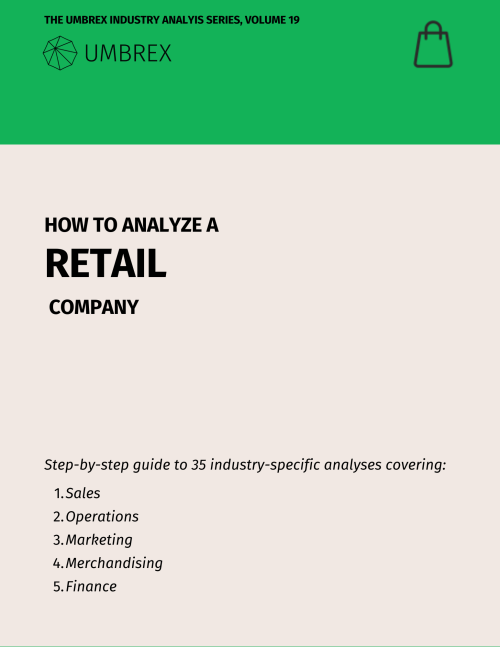
Menu of the 35 analyses:
Sales:
- Comparable Store Sales Analysis
- Cross-Selling and Up-Selling Effectiveness
- Customer Lifetime Value
- Customer Return Rate Analysis
- Foot Traffic and Conversion Rate Analysis
- Location-Based Performance Analysis
- Omnichannel Strategy Effectiveness
- Seasonality Impact and Sales Mix Analysis
- Store Atmosphere and Experience Impact on Sales
Operations:
- Click-and-Collect/Buy Online, Pickup In-Store (BOPIS) Effectiveness
- E-commerce Fulfillment Efficiency and Cost Analysis
- In-Stock Rate and Out-of-Stock Analysis
- Inventory Turnover and Management Analysis
- Shelf Space Allocation and Optimization
- Store Closure and Rationalization Analysis
- Store Expansion and Cannibalization Risk Analysis
- Store Labor Productivity Analysis
- Store Lease and Real Estate Cost Efficiency
- Sustainability and Ethical Sourcing in Retail
Marketing:
Merchandising:
- Markdown Strategy and Effectiveness
- Merchandising Strategy Effectiveness
- Planogram Compliance and Store Layout Efficiency, including Endcap Performance
- Private Label vs. Branded Product Performance and Supplier Dependency Strategy
- Product Category Margin Analysis
- Stock Keeping Unit (SKU) Rationalization and Retail Product Assortment Optimization
- Visual Merchandising Performance