
Goal of the analysis:
The goal of the Loyalty Program Engagement and ROI analysis is to evaluate how effectively a retail company’s loyalty program engages customers and generates a return on investment. This analysis helps determine whether the program is driving customer retention, increasing purchase frequency, and ultimately contributing to the company’s profitability.
Data required:
- Number of loyalty program members.
- Purchase frequency and transaction value of loyalty members vs. non-members.
- Cost of the loyalty program (e.g., rewards, discounts, marketing, and technology).
- Incremental revenue generated by loyalty program members.
- Redemption rates for loyalty points or rewards.
- Customer acquisition and retention data (optional for deeper insights).
- Customer lifetime value (CLV) for loyalty members (optional).
Detailed step-by-step instruction on how to conduct the analysis:
1. Collect loyalty program data.
Gather the number of active loyalty program members, the number of transactions they make, and the total revenue they generate. Compare this data to non-members to assess the program’s impact.
2. Calculate loyalty member engagement.
Measure loyalty program engagement by comparing the average purchase frequency and average transaction value of loyalty members to non-members.
Use the following equations:
Purchase Frequency (Loyalty Members) = Total Transactions by Loyalty Members / Total Loyalty Members
Average Transaction Value = Total Revenue from Loyalty Members / Total Transactions by Loyalty Members
Compare these to the same metrics for non-members.
3. Measure incremental revenue.
Determine the additional revenue generated by loyalty members compared to non-members.
Use this equation to calculate incremental revenue:
Incremental Revenue = (Revenue per Loyalty Member – Revenue per Non-Member) x Number of Loyalty Members
4. Calculate the redemption rate.
Evaluate how frequently members redeem loyalty points or rewards using this equation:
Redemption Rate (%) = (Number of Rewards Redeemed / Total Rewards Earned) x 100
This indicates how effectively the rewards system is being used by members.
5. Calculate loyalty program ROI.
To assess the financial impact of the loyalty program, calculate the return on investment (ROI) using the following formula:
Loyalty Program ROI (%) = ((Incremental Revenue – Loyalty Program Costs) / Loyalty Program Costs) x 100
This shows whether the program is generating more revenue than it costs to operate.
6. Analyze customer lifetime value (optional).
If customer lifetime value (CLV) data is available, calculate the difference in CLV between loyalty members and non-members to assess the long-term impact of the program.
7. Segment analysis by member tier or demographic (optional).
If the loyalty program has multiple tiers or customer segments, analyze engagement and ROI across different tiers to identify which groups are driving the most value.
Potential complications that can arise with this analysis:
- Attribution issues: It may be difficult to attribute incremental revenue solely to the loyalty program, especially if other marketing efforts are influencing customer behavior.
- Data consistency: Incomplete or inaccurate data on loyalty program costs or member behavior can lead to incorrect conclusions about the program’s effectiveness.
- Reward overuse: High redemption rates without corresponding increases in purchase frequency may indicate that members are taking advantage of rewards without driving additional revenue.
- Customer behavior variability: Customer preferences for loyalty programs may vary by region, demographic, or season, making it challenging to generalize the results.
Format of the output of analysis:
The output typically includes key metrics such as purchase frequency, average transaction value, incremental revenue, redemption rates, and ROI. These can be presented in tables, graphs, or summary reports.
Example output:
- Purchase frequency (loyalty members): 5 purchases per member per quarter
- Purchase frequency (non-members): 3 purchases per customer per quarter
- Average transaction value (loyalty members): $50
- Average transaction value (non-members): $40
- Incremental revenue: $100,000
- Redemption rate: 75%
- Loyalty program ROI: 120%
How to interpret results:
- High purchase frequency and transaction value among loyalty members: Indicates that the loyalty program is successfully engaging members and driving more frequent or larger purchases compared to non-members.
- High incremental revenue: Shows that the program is contributing additional revenue that would not have been generated without the loyalty program.
- High redemption rate: A high redemption rate suggests that members are actively using their rewards, which can enhance customer satisfaction and retention.
- Low ROI: If the loyalty program’s costs outweigh the incremental revenue, it indicates that the program may not be financially sustainable and needs to be restructured.
Steps a company can take to improve on this measure:
- Enhance reward structures: Offer more attractive or personalized rewards to increase engagement and encourage repeat purchases among loyalty members.
- Optimize program costs: Review the costs of running the loyalty program, such as marketing and rewards, and seek ways to reduce expenses without compromising member engagement.
- Target high-value customers: Focus on acquiring and retaining high-value customers who are more likely to engage with the loyalty program and generate incremental revenue.
- Improve reward redemption options: Make it easier and more appealing for members to redeem their rewards, potentially boosting purchase frequency and long-term loyalty.
- Use personalized marketing: Leverage customer data to send personalized offers and communications to loyalty members based on their preferences and shopping behavior.
- Monitor program performance regularly: Conduct frequent evaluations of the loyalty program’s performance and adjust rewards, promotions, and member engagement strategies as needed.
- Segment loyalty members: Analyze loyalty program engagement by customer segments or tiers to tailor the program to different groups’ preferences and maximize its effectiveness.
Request the PDF Download of How to Analyze a Retail Company
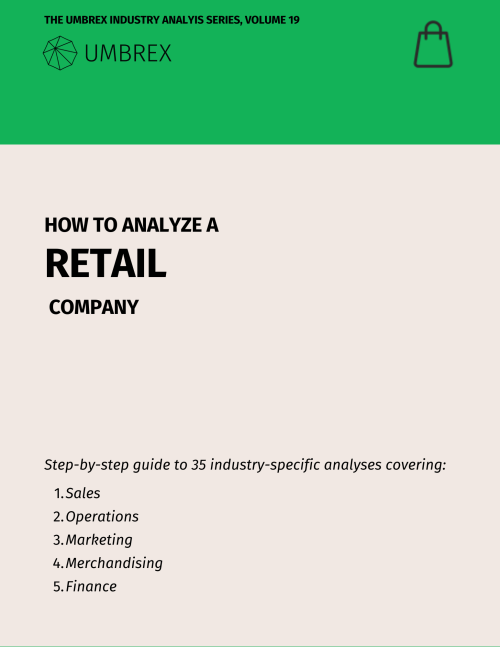
Menu of the 35 analyses:
Sales:
- Comparable Store Sales Analysis
- Cross-Selling and Up-Selling Effectiveness
- Customer Lifetime Value
- Customer Return Rate Analysis
- Foot Traffic and Conversion Rate Analysis
- Location-Based Performance Analysis
- Omnichannel Strategy Effectiveness
- Seasonality Impact and Sales Mix Analysis
- Store Atmosphere and Experience Impact on Sales
Operations:
- Click-and-Collect/Buy Online, Pickup In-Store (BOPIS) Effectiveness
- E-commerce Fulfillment Efficiency and Cost Analysis
- In-Stock Rate and Out-of-Stock Analysis
- Inventory Turnover and Management Analysis
- Shelf Space Allocation and Optimization
- Store Closure and Rationalization Analysis
- Store Expansion and Cannibalization Risk Analysis
- Store Labor Productivity Analysis
- Store Lease and Real Estate Cost Efficiency
- Sustainability and Ethical Sourcing in Retail
Marketing:
Merchandising:
- Markdown Strategy and Effectiveness
- Merchandising Strategy Effectiveness
- Planogram Compliance and Store Layout Efficiency, including Endcap Performance
- Private Label vs. Branded Product Performance and Supplier Dependency Strategy
- Product Category Margin Analysis
- Stock Keeping Unit (SKU) Rationalization and Retail Product Assortment Optimization
- Visual Merchandising Performance