
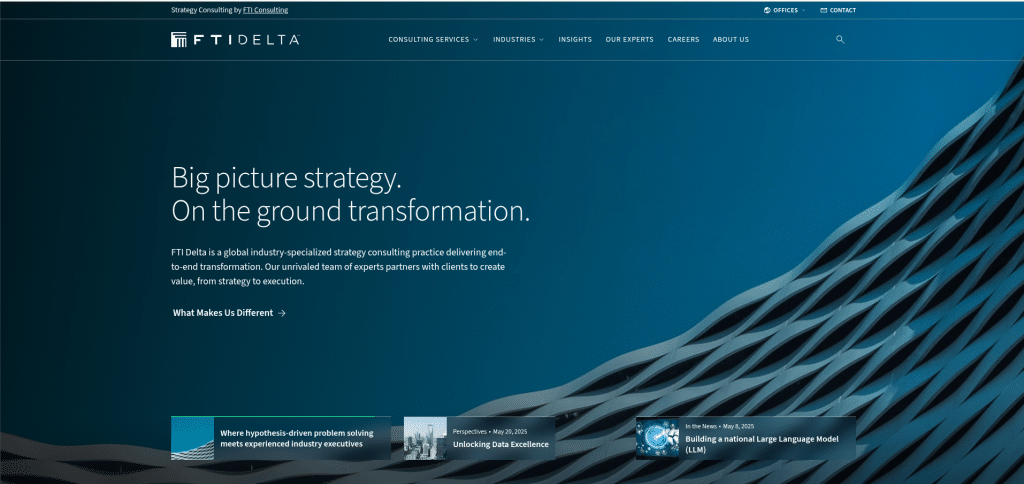
FTI Delta is the dedicated strategy consulting division of FTI Consulting, Inc., focused on delivering end-to-end business transformation for clients from strategy through execution. Launched as a formal practice in late 2023, FTI Delta combines deep industry specialization with FTI Consulting’s broader advisory expertise. It was created to directly compete with traditional strategy firms by leveraging FTI’s strengths in hands-on implementation, financial acumen, and industry insight. FTI Delta’s consultants partner with corporations, investors, and government agencies to define strategies, drive large-scale transformations, and achieve tangible results. The team operates globally with hundreds of consultants across North America, EMEA, and Asia, and is fully integrated into FTI Consulting’s worldwide platform of over 8,000 professionals. This integration allows FTI Delta to offer strategy clients a seamless suite of services, drawing on the firm’s capabilities in restructuring, risk management, economic analysis, technology, and communications. Overall, FTI Delta serves as FTI Consulting’s spearhead for strategic advisory services, helping executive clients navigate complex challenges and capitalize on growth opportunities with a practical, execution-oriented approach.
History and Evolution
Origins as Delta Partners (2006–2020): FTI Delta’s roots trace back to Delta Partners, a boutique management consulting and investment advisory firm founded in 2006 in Dubai. Delta Partners was established by experienced consultants (including co-founders Victor Font and Kristoff Puelinckx) who had a shared passion for the Telecommunications, Media, and Technology (TMT) sector. The firm grew throughout the 2000s and 2010s as a specialist advisor to telecom operators, media companies, and tech firms, particularly in emerging markets across the Middle East, Africa, and Asia. Delta Partners developed a reputation for its deep sector knowledge and end-to-end services – uniquely combining strategic consulting with an in-house investment banking arm that advised on TMT mergers, acquisitions, and capital raises. By 2020, Delta Partners had around 150 consultants and a footprint spanning offices in Dubai (headquarters), New York, Singapore, Barcelona, Johannesburg, San Francisco, and Sydney. It had become a recognized name in the TMT consulting arena, advising both industry incumbents and disruptors, and working on projects ranging from telecom market entry strategies to digital transformation and M&A support.
Acquisition by FTI Consulting (2020): In July 2020, FTI Consulting announced a definitive agreement to acquire the majority of Delta Partners’ assets, aiming to bolster FTI’s capabilities in strategy consulting. This strategic acquisition aligned with FTI Consulting’s vision to expand beyond its traditional offerings in restructuring, litigation support, and economic consulting, by adding top-tier strategic advisory talent. Approximately 150 Delta professionals (including 21 Senior Managing Directors/Partners) joined FTI as part of the Corporate Finance & Restructuring segment. Notably, Delta Partners’ CEO and co-founder, Victor Font, came on board as a Senior Managing Director at FTI Consulting and co-leader of FTI’s telecom, media & technology practice, working alongside FTI veteran Luke Schaeffer. (A small portion of Delta’s business – such as certain investment funds – remained independent, but the core consulting practice moved to FTI.) The integration process took place in the latter half of 2020, with Delta’s regional teams and offices being folded into FTI Consulting’s global offices. This brought new industry depth to FTI, especially in telecommunications and digital sectors, and also expanded FTI’s geographic presence in regions like the Middle East and Southeast Asia. FTI’s CEO, Steven Gunby, and other leaders welcomed the Delta team, highlighting that the firms had collaborated on projects in the past and shared a compatible culture of client-focused, value-driven consulting.
Building a Strategy Consulting Practice (2021–2023): After the acquisition, the former Delta Partners group operated within FTI’s Corporate Finance & Restructuring (CF&R) segment, under a practice area focused on TMT strategy and business transformation. Throughout 2021 and 2022, this team worked alongside FTI’s other services, contributing strategic insights on projects such as performance improvement for telecom clients, commercial due diligence for technology investments, and growth strategy for media companies. FTI Consulting leadership, notably Carlyn Taylor (Global Co-Leader of CF&R and head of FTI’s TMT practice), played a key role in nurturing the growth of the strategy unit. The success of the integrated team led FTI to invest further in expanding its strategic advisory offerings. They recruited additional talent from the market – including experienced consultants from other top firms – and looked to broaden industry coverage beyond TMT. During this period, FTI also established a Public Sector consulting team, recognizing growing opportunities to advise governments (especially in the Middle East) on economic modernization, policy agendas, and large-scale transformation programs. By mid-2023, the foundation was set for a more cohesive, branded strategy consulting practice within FTI Consulting.
Launch of FTI Delta (2023): In October 2023, FTI Consulting officially launched FTI Delta as its global strategy consulting practice. This launch marked the culmination of the previous three years of integration and growth. FTI Delta was positioned as a “global, industry-specialized strategy consulting practice delivering tangible value from strategy definition to execution.” At inception, FTI Delta comprised over 350 billable consultants worldwide (including 39 Senior Managing Directors), drawn from the former Delta Partners team, FTI’s existing strategy and transactions experts, and new hires in key areas. The practice was built around FTI’s deepest vertical expertise: Telecommunications, Media & Technology (TMT) – the legacy strength from Delta Partners – and the Public Sector – a newly established focus where FTI had been investing. FTI Delta was structured under the Business Transformation & Strategy sub-segment within FTI’s Corporate Finance & Restructuring business segment, rather than as a standalone division, to ensure tight integration with FTI’s core offerings in restructuring and transactions. The launch announcement emphasized FTI Delta’s differentiated approach: combining classical strategy consulting capabilities with FTI’s “roll-up our sleeves” culture of implementation. It signaled FTI’s intent to compete head-on with traditional strategy firms (e.g. the MBBs and Big 4 strategy arms) by offering a mix of strategic insight, operational know-how, and financial expertise.
Expansion and Developments (2024–2025): Since its formal launch, FTI Delta has continued to expand its scope and global reach. In 2024, the practice added a Consumer & Retail vertical to its portfolio – effectively its third industry practice alongside TMT and Public Sector. To lead this new practice, FTI Delta hired Jeff Wray (formerly a senior leader at EY-Parthenon and a BCG alumnus) as a Senior Managing Director. Wray’s mandate has been to build out dedicated teams focusing on consumer products, retail, and related industries, leveraging FTI’s existing expertise in retail turnarounds and transactions. This move demonstrated FTI Delta’s commitment to grow beyond its initial niches and cover more industries critical to FTI’s client base. Also in 2024, FTI Delta’s Public Sector practice saw rapid growth, particularly in the Middle East. Within a year of inception, the public sector team grew to over 100 consultants, bringing on board directors and consultants from leading competitors and government entities. They have been deeply involved in advising on national transformation programs, economic diversification plans, and policy strategy for governments in the Gulf region and beyond. Meanwhile, the TMT practice (the largest part of FTI Delta) has continued to strengthen its team in telecommunications and technology strategy; in early 2025, for example, FTI Delta announced the recruitment of two senior telecom experts to further bolster its telecom consulting offerings. By 2025, FTI Delta is an integral part of FTI Consulting’s growth story – it has significantly expanded FTI’s advisory services and contributed to FTI Consulting’s record revenues in recent years. The evolution from a 150-person niche firm (Delta Partners) into a several-hundred-strong global practice within a public company showcases the successful integration and scaling of FTI Delta. It also reflects FTI Consulting’s strategic direction of balancing its legacy businesses (like restructuring and litigation consulting) with forward-looking strategy and transformation capabilities.
Integration with FTI Consulting’s Broader Business Lines
FTI Delta is deliberately structured to work in tandem with FTI Consulting’s other service lines, ensuring that clients benefit from a multi-disciplinary approach. The practice sits within FTI’s Corporate Finance & Restructuring segment, which historically is known for turnaround, bankruptcy advisory, and performance improvement. This proximity means that FTI Delta’s strategy consultants often collaborate with FTI’s restructuring and business turnaround experts when a client’s strategic challenge involves financial distress or operational underperformance. For example, if a company is formulating a new growth strategy in the wake of a restructuring, an FTI Delta team can work alongside FTI’s restructuring advisors to align the strategic plan with the company’s reorganization and financial constraints. This integration allows FTI to deliver both a high-level strategy and a detailed turnaround roadmap as one cohesive service.
Beyond restructuring, FTI Delta also leverages capabilities from other FTI Consulting segments:
- Forensic and Litigation Consulting: In complex situations where strategy and disputes intersect, FTI Delta can draw on the firm’s forensic accountants, investigation specialists, and litigation consultants. For instance, if a client’s strategic review uncovers potential fraud, compliance gaps, or the need for regulatory approval, FTI’s forensic team can step in to support risk assessments, due diligence, or expert testimony. Likewise, if a company is involved in litigation that might affect its corporate strategy or M&A plans, FTI Delta and the litigation consulting team can coordinate to ensure strategy recommendations account for legal realities.
- Risk Advisory and Compliance: FTI Consulting has robust risk management and regulatory advisory expertise (including segments focusing on risk & compliance and cybersecurity). FTI Delta integrates these insights into its strategic projects to help clients not only craft growth strategies but also manage enterprise risks. As an example, when developing a market entry strategy in a heavily regulated industry, FTI Delta consultants might partner with FTI’s regulatory experts to map out compliance requirements and mitigate risks. In public sector engagements, the team may involve specialists in governance and risk to design frameworks for government entities. This ensures that strategic plans are resilient against regulatory, political, or security risks.
- Transactions and M&A Advisory: A significant portion of FTI Delta’s work involves transactions strategy and commercial due diligence. Being part of FTI allows Delta consultants to collaborate closely with FTI’s transaction services professionals, such as valuation experts, deal advisors, and integration specialists. For example, FTI Delta might lead the commercial strategy and market analysis for a private equity client considering an acquisition, while FTI’s valuation team provides financial modeling and the restructuring team advises on integration or carve-out planning. Together, they can deliver a holistic M&A advisory offering covering strategy, finance, and execution.
- Economic Consulting: FTI’s economic consulting division (which includes subsidiaries like Compass Lexecon) provides economic analysis, econometric modeling, and expert testimony in areas like competition economics and policy. On certain strategic engagements—particularly in policy-heavy or infrastructure projects—FTI Delta might coordinate with FTI’s economists. For instance, if a government client is developing a national broadband strategy or evaluating the economic impact of an industry reform, FTI Delta’s strategic recommendations can be underpinned by rigorous economic impact modeling from the Economic Consulting team. This cross-pollination gives credibility and quantitative depth to FTI Delta’s strategic advice, especially in regulated sectors.
- Strategic Communications: Many transformations and strategic initiatives have a communications component (internal or external). FTI Consulting’s Strategic Communications segment specializes in stakeholder communications, public affairs, and investor relations. FTI Delta often works hand-in-hand with these professionals to help clients not only design a strategy but also communicate it effectively. For example, if a multinational is executing a post-merger integration (a strategy crafted with FTI Delta’s guidance), FTI’s communications consultants might develop the messaging plan to reassure employees, investors, and customers. Similarly, for government transformation programs, strategic communications experts help in managing public announcements, change management communication, and media strategy. This integrated approach ensures the impact of FTI Delta’s work is realized and well-received by stakeholders.
In summary, FTI Delta acts as a hub that connects to all of FTI Consulting’s specialty areas. The practice’s “strategy + execution” philosophy is made possible by tapping into FTI’s broad capabilities. Clients of FTI Delta can therefore expect more than just PowerPoint decks – they get access to teams that can implement recommendations, manage crises, handle legal/regulatory hurdles, and address financial complexities as they arise. Internally, FTI Delta consultants often work on cross-segment teams, and knowledge sharing across the firm is encouraged. This one-firm approach is a distinctive aspect of FTI Consulting’s model, setting FTI Delta apart from pure-play strategy consultancies that might lack such in-house execution resources. It enables FTI Delta to integrate restructuring, litigation support, and risk advisory seamlessly into strategic engagements as needed, providing comprehensive solutions to complex business problems.
Industry Focus and Service Offerings
Core Industries – Specialization in TMT, Public Sector, and More: FTI Delta is intentionally structured around industry practices, allowing teams to develop deep domain expertise. As of 2025, the practice’s primary industry focuses include:
- Telecommunications, Media & Technology (TMT): This is FTI Delta’s heritage and largest practice, built on the legacy of Delta Partners. The TMT team serves telecom operators (mobile and fixed-line carriers), telecom infrastructure providers, media companies (such as broadcasters, content distributors, OTT streaming platforms), and technology firms (from software companies to tech service providers). Within TMT, FTI Delta tackles issues like telecom corporate strategy, 5G rollout planning, pricing strategy for mobile operators, media content distribution strategy, digital product innovation, and tech-driven transformations. They also advise investors in the TMT space, providing commercial due diligence for telecom and tech acquisitions. Given FTI’s strong financial background, the TMT practice is adept at bridging strategy with financial and technical analyses – for example, helping a telecom client evaluate the business case for network expansion or helping a media company pivot to digital models.
- Public Sector (Government & Socio-economic Development): FTI Delta’s Public Sector practice works with governments, public-sector organizations, and state-owned enterprises – particularly in regions undergoing rapid development or reform (notably the Middle East, as well as parts of Asia, Africa, and emerging Europe). This team helps design and implement national visions and economic development plans, sector-specific strategies (e.g. tourism strategy, digital economy initiatives, education and workforce development plans), and large-scale public transformation programs. They often serve as advisors on government modernization efforts, bringing global best practices in public administration and policy execution. Unique to this practice is its focus on what FTI calls “platform specialization”: the team has dedicated groups focusing on domains like urban development (smart cities), infrastructure and real estate, public finance and investment agencies, social development programs, and environment & sustainability initiatives. By combining strategy consulting with FTI’s policy, economic, and communications expertise, the Public Sector practice offers comprehensive support to governments pursuing ambitious reforms (for example, advising on a Gulf country’s Vision 2030 diversification plan or helping a ministry set up a delivery unit to execute multiple transformation projects).
- Consumer & Retail: Launched in late 2024, the Consumer & Retail industry practice extends FTI Delta’s reach into consumer products, retail, apparel, and related sectors. This practice benefits from FTI Consulting’s existing experience in retail turnarounds and consumer goods supply chain improvements. FTI Delta’s consultants in this vertical advise on growth strategy for consumer brands, omni-channel retail strategy, customer experience transformation, and performance improvement for retailers facing margin pressures. They also work on consumer industry M&A (for instance, evaluating a retail chain acquisition or a consumer brand carve-out) and help consumer-facing companies adapt to trends like e-commerce acceleration or changing consumer behaviors. The Consumer & Retail team is led by senior experts with decades of experience in the field, ensuring that their consulting recommendations are grounded in real-world retail and consumer economics. This new industry practice also collaborates with FTI’s restructuring experts on cases where struggling retail companies need both strategic repositioning and turnaround execution.
In addition to these three core verticals, FTI Delta and FTI Consulting together cover a wide array of other industries and sectors. While FTI Delta’s own consultants concentrate on the areas above, they often partner with colleagues in other FTI segments to serve industries such as:
- Healthcare and Life Sciences: FTI has specialists (especially in its economic consulting and communications segments) who focus on healthcare providers, pharma/biotech companies, and health policy. Although FTI Delta does not yet have a dedicated healthcare strategy practice, its methodologies can be applied in joint teams with FTI’s healthcare experts for strategic projects (e.g. hospital system restructuring strategy or market entry for a pharma product).
- Financial Services: FTI’s financial services team (within forensic, risk, and economic segments) frequently addresses regulatory and operational challenges in banking, insurance, and asset management. FTI Delta can contribute on strategic initiatives like digital banking strategy or growth plans for financial institutions, working alongside risk and compliance consultants.
- Energy, Power & Industrials: FTI Consulting has a strong track record in energy sector advisory (including through its Compass Lexecon economists for regulatory matters and restructuring experts for energy company turnarounds). FTI Delta’s strategy expertise can complement this by advising on energy transition strategy, market entry in renewables, or operational strategy for industrial companies, pulling in technical experts as needed.
- Real Estate and Infrastructure: Within corporate finance, FTI advises on real estate restructuring and infrastructure finance. FTI Delta’s public sector platform includes city and infrastructure strategy, which overlaps here – for instance, developing a smart city strategy or advising on a large infrastructure project’s feasibility and governance structure.
Broadly, FTI Delta’s service offerings span the gamut of strategy and transaction advisory needs. Key consulting services provided by FTI Delta include:
- Corporate and Growth Strategy: Helping clients set their strategic direction, be it a five-year growth plan, market entry strategy for a new geography, product portfolio strategy, or business model innovation. The team uses rigorous market analysis, scenario planning, and financial forecasting to craft strategies that align with the client’s goals and market opportunities.
- M&A Strategy and Commercial Due Diligence: Working with corporations and private equity firms on the strategic aspects of mergers, acquisitions, investments, and partnerships. This includes assessing market attractiveness, competitive positioning of acquisition targets, synergy analysis, and post-merger integration planning. FTI Delta often performs commercial due diligence (market sizing, competitive analysis, customer analysis) to support investment decisions, and then helps clients with integration or carve-out strategies to realize deal value.
- Transformation and Performance Improvement: Designing and executing holistic transformation programs to improve financial and operational performance. This could involve revenue enhancement (e.g. pricing strategy, salesforce effectiveness, new product launches) and cost optimization (e.g. cost reduction programs, operational efficiency, supply chain optimization). FTI Delta teams not only identify opportunities but also set up transformation management offices (PMOs) to implement changes, working side by side with client teams. In many cases, these programs directly tie into bottom-line impact – for example, helping a tech company achieve a targeted percentage margin improvement or turning around a telecom operator’s declining profitability through a new operating model.
- Organizational Design and Governance: Advising on optimal organizational structures, governance frameworks, and processes to support the client’s strategy. This can include redesigning a company’s organizational hierarchy, defining roles and decision rights, improving board governance for state-owned enterprises, or establishing new business units or innovation hubs within an organization. Especially in public sector projects, FTI Delta might guide ministries on how to set up effective project delivery units or cross-agency governance for major initiatives.
- Digital and Innovation Strategy: Many engagements involve helping clients harness technology and innovation. FTI Delta provides services such as digital strategy (e.g. roadmap for digital transformation, adopting AI and data analytics in operations), product innovation and R&D portfolio management (deciding where to invest in new product development), and evaluating emerging tech opportunities. Given the TMT focus, this often overlaps with helping telecom and tech companies innovate, but it also extends to traditional industries looking to digitize their business models.
- Transactions and Investment Advisory: Beyond commercial due diligence, FTI Delta sometimes supports clients on investment strategy and transaction execution. For example, for a sovereign wealth fund or investment firm, the team might evaluate which sectors or companies to invest in as part of a growth strategy. They can also advise telecom or media clients on strategic partnerships, joint ventures, or divestitures (leveraging the investment banking heritage of Delta Partners to provide insights on deal structuring and valuation, in concert with FTI’s finance professionals).
This blend of industry focus and service breadth allows FTI Delta to offer highly tailored solutions. Rather than taking a one-size-fits-all approach, the practice deploys teams that understand the client’s sector intricately and can address issues across strategy, operations, and transactions. Clients range from Fortune 500 corporations and global telecom giants, to mid-market companies and start-ups, to government ministries and agencies. In all cases, FTI Delta positions itself as a partner through the entire lifecycle of a project – from the initial strategic idea, through detailed planning, and into execution and realized results. This is a distinguishing factor of FTI Delta’s services, aligning with FTI Consulting’s broader ethos of “Experts with Impact” and practical problem-solving.
Consulting Methodologies and Approach
FTI Delta employs consulting methodologies that blend classic strategy consulting techniques with the pragmatic, execution-driven culture of FTI Consulting. The practice prides itself on hypothesis-driven problem solving, a hallmark approach in strategy consulting where consultants begin with key hypotheses and use data to iteratively test and refine strategic options. In practice, an FTI Delta engagement often starts by clearly defining the client’s core challenge and formulating initial hypotheses (for example, “We believe entering Market X will double the client’s revenue in five years” or “Reducing product complexity could cut costs by 20%”). The team then conducts rigorous analysis to prove or disprove these hypotheses – gathering market data, conducting stakeholder interviews, analyzing financials and operational metrics – and converges on a strategy supported by evidence.
What sets FTI Delta’s approach apart is the deep industry specialization of its teams. Consultants are not generalists; they come with substantial experience in the sectors they serve (some team members are former industry executives or engineers in telecom/tech, and others are career consultants specialized in their industry). This means FTI Delta engagements leverage sector-specific frameworks and benchmarks. For example, in telecommunications projects, the team might use proprietary models for subscriber acquisition cost, ARPU (average revenue per user) dynamics, spectrum valuation, and network ROI analysis. In a public sector project, they might apply frameworks for economic development planning or public policy analysis (perhaps using logic models for national outcomes, or specific KPIs aligned to a country’s vision goals). The consultants combine these industry frameworks with time-tested strategy tools like SWOT analysis, Porter’s Five Forces, customer segmentation, and scenario planning, all tailored to the context of the client.
Another key element of FTI Delta’s methodology is its value-centric and financially rigorous approach. Being part of FTI (a firm with roots in financial advisory), FTI Delta emphasizes strategies that create measurable value – whether financial (EBITDA improvement, ROI, shareholder value) or socioeconomic (for government clients). Engagement teams often include individuals with strong financial modeling skills to quantify the impact of strategic recommendations. For instance, if recommending a cost transformation program, FTI Delta will produce a detailed business case model showing the cost savings over time, the implementation costs, and the effect on margins or cash flow. This financial discipline ensures that strategies are grounded in economic reality and can be presented credibly to boards, investors, or cabinet officials. The firm’s consulting toolkit might also integrate performance management frameworks (like balanced scorecards or OKRs) to help clients track execution and results post-strategy.
FTI Delta’s approach to problem-solving is notably collaborative and “hands-on.” The mantra of “rolling up our sleeves” is often mentioned by its leaders. Rather than simply handing over a strategy report, FTI Delta consultants typically work alongside client teams through implementation phases. They often embed practices like agile project management and design thinking workshops into their engagements. For example, in a digital strategy project, the team might facilitate design thinking sessions with the client’s employees to ideate new digital services, and then pivot to an agile execution mode to pilot those services. In a cost reduction project, FTI Delta might set up war-room style working sessions with client executives to identify quick wins and to instill an ownership mentality for changes. This co-creation and partnership style is deliberate – it builds client buy-in and leverages the client’s internal knowledge, increasing the likelihood of long-term success.
Methodologically, FTI Delta also benefits from FTI Consulting’s investments in data and research resources. The firm maintains extensive research on industry trends, competitor intelligence, and macroeconomic indicators through its global network. FTI Delta consultants can tap into specialized datasets or experts (for instance, FTI’s technology team for big data analysis or FTI’s economic researchers for forecasting). They often use advanced analytics to support strategies – such as using customer data to inform a marketing strategy or modeling different macroeconomic scenarios for a country’s development plan. In recent years, FTI Delta has also incorporated tools like scenario modeling software, visualization dashboards, and proprietary diagnostic frameworks to quickly assess a client’s situation. For example, they might have an “organizational health” diagnostic or a “digital maturity assessment” toolkit that accelerates the discovery phase of a project.
Importantly, while applying these sophisticated methodologies, FTI Delta maintains a practical, results-oriented mindset. The firm’s culture (inherited from both Delta Partners and FTI) emphasizes telling clients not just what they want to hear, but what they need to hear – even if it’s a hard truth. Consultants are encouraged to be direct and fact-based in their recommendations. They also focus on transparent communication and setting realistic expectations. During an engagement, progress is frequently communicated through interim workshops and iterative updates, ensuring stakeholders are aligned and there are no surprises at the end. The end deliverables from FTI Delta are typically actionable: along with strategic recommendations, the team provides detailed implementation roadmaps, governance structures, and performance metrics to guide execution. This approach ensures that the strategy is not only sound on paper but is also primed for execution within the client’s organization.
In summary, FTI Delta’s consulting methodology blends the best of high-end strategy consulting (hypothesis-driven analysis, industry frameworks, data-driven insights) with a down-to-earth execution focus (financial rigor, hands-on implementation support, and cross-functional teamwork). This combination aligns with the expectations of business executives who want advisors that can both think and do – providing insight and rolling up their sleeves to realize that insight in practice. It also aligns with FTI Consulting’s overarching philosophy of being an “advisor and partner” through the entire client journey.
Leadership and Organizational Structure
FTI Delta’s leadership team features a mix of former Delta Partners executives and seasoned FTI Consulting leaders, reflecting the integrated nature of the practice. At the top, Luke Schaeffer and Victor Font serve as Global Co-Leaders of FTI Delta. Luke Schaeffer is a Senior Managing Director at FTI who has long been involved in business transformation and strategy initiatives within the Corporate Finance & Restructuring segment. He brings extensive experience advising companies on turnarounds and growth strategy, and is known for his strong financial background and client-centric approach. Victor Font, as the co-leader, is a Vice Chairman of FTI Delta and one of its founders – he co-founded Delta Partners in 2006 and led it as CEO. With over 25 years in TMT consulting, Font is a prominent figure whose expertise includes telecom strategy, digital innovation, and investments in the tech/media space. Since joining FTI in 2020, he has been pivotal in shaping FTI’s strategy consulting vision. Together, Schaeffer (based in the United States) and Font (based in Europe, with frequent presence in the Middle East) provide dual leadership that spans key regions and ensures global coverage for the practice. They continue to also lead the TMT industry practice within FTI Delta, leveraging Font’s deep sector knowledge and Schaeffer’s broad consulting experience.
Supporting the co-leaders is a broader leadership team segmented by industry and geography. For the Public Sector practice, Antoine Nasr heads the team. Nasr is a Senior Managing Director based in Dubai with over two decades of management consulting experience, including prior roles advising governments in the Middle East. He joined FTI Delta to build the public sector offering and has been instrumental in hiring top talent and winning major government projects. Under his leadership, the public sector team has grown rapidly and established FTI Delta as a credible advisor for national transformation programs. For the newly formed Consumer & Retail practice, Jeff Wray leads as Senior Managing Director and Industry Strategy Leader. Wray’s background includes leadership roles at EY-Parthenon (where he was a global leader) and earlier career stints at BCG and A.T. Kearney. His mandate at FTI Delta is to cultivate industry-specific teams for consumer and retail and to integrate those with FTI’s existing operations expertise in that sector. His presence signals FTI Delta’s commitment to attract top industry specialists from rival firms to broaden its capabilities.
In addition to these industry heads, FTI Delta’s organizational structure includes regional leaders and functional experts:
- Regional Leadership: While FTI Delta operates as a global practice, key regions such as North America, EMEA, and Asia-Pacific have local leaders (typically Senior Managing Directors) who coordinate client development and project delivery in those markets. For example, in EMEA (Europe, Middle East, Africa), Victor Font and Antoine Nasr are prominent figures, and there may be country-specific leaders in places like Spain or the UK to manage European engagements. In North America, Luke Schaeffer and Jeff Wray (who splits time between Philadelphia and New York) are among those driving growth, along with other Senior MDs focusing on U.S. sectors (like media or technology clients). In Asia, leaders in Singapore or India offices manage the practice’s outreach and projects across Southeast Asia and South Asia. This regional structure ensures that FTI Delta’s global expertise is delivered with local cultural understanding and on-the-ground presence.
- Functional and Delivery Leadership: Given its execution focus, FTI Delta also has leaders responsible for areas like Transformation Delivery, Transactions Advisory, and Organization & Change. These are senior experts who ensure that, for instance, the transformation programs run by FTI Delta have the right project governance or that the commercial due diligence processes are consistent globally. They work closely with the industry teams to provide specialized methodological support. For instance, a Senior Managing Director might oversee Transformation Services (making sure that across all projects, best practices in change management and project implementation are used), or a leader for Transaction Advisory might coordinate how FTI Delta teams conduct diligence and interact with FTI’s investment bankers and valuation experts.
FTI Delta benefits from strategic guidance at the FTI Consulting corporate level as well. Carlyn Taylor, FTI’s Chief Growth Officer and Co-Leader of the CF&R segment, has been a key executive sponsor of FTI Delta. She is credited with founding FTI’s original TMT practice years ago and championing the acquisition of Delta Partners. In her Growth Officer role, Taylor focuses on expanding FTI’s services (like FTI Delta) and often works with the FTI Delta leadership on go-to-market strategy and cross-segment client opportunities. FTI’s CEO, Steven Gunby, and other segment leaders (Economic Consulting, Forensic & Litigation, etc.) are also stakeholders in FTI Delta’s success, fostering a culture of collaboration rather than siloed businesses. This means FTI Delta’s leaders frequently coordinate with their counterparts in other segments to share insights and jointly manage key client relationships (especially large clients that use multiple FTI services).
The organizational hierarchy within FTI Delta follows a consultant career pyramid typical of consulting firms, but with FTI’s titles. At the junior levels are Consultants (often entry-level for undergraduates) and Senior Consultants (post-MBA hires or experienced hires). Above them, a layer of Directors or Managing Directors (the title varies by region) lead project teams day-to-day and manage client engagements. At the top of the pyramid are the Senior Managing Directors (SMDs) – these are the senior partners who not only lead major engagements but also drive business development and practice leadership. FTI Delta’s SMDs include those mentioned (Font, Schaeffer, Nasr, Wray, etc.) and others heading various initiatives or geographies. A few extremely senior figures, like Victor Font, carry additional titles such as Vice Chairman of FTI Delta, reflecting their role in the overall strategy and their stature in the firm.
FTI Delta’s culture and leadership style emphasize entrepreneurship, teamwork, and mentorship. Many of its senior leaders have backgrounds at top consulting firms and bring that professionalism, while the integration with FTI’s legacy means a results-oriented, no-nonsense ethos. The leadership encourages a relatively flat structure when it comes to idea contribution – junior members are expected to voice insights and industry knowledge is valued over hierarchy. Regular practice meetings, training sessions, and knowledge-sharing forums are held to keep the geographically dispersed team connected. Organizationally, FTI Delta as a practice reports into the Corporate Finance & Restructuring segment structure, so its financial performance and operations are overseen by CF&R management, but it has the autonomy to carve out its strategy in terms of market focus and hiring (with Carlyn Taylor and the co-leaders at the helm). This balance allows FTI Delta to remain entrepreneurial and growth-focused (almost like a “firm within a firm”) while enjoying the resources and infrastructure of a large public company.
Global Presence and Operations
FTI Delta operates on a global scale, reflecting both the international legacy of Delta Partners and FTI Consulting’s worldwide network. The practice has a truly multinational footprint, with teams and offices across major regions:
- North America: FTI Delta has a strong presence in the United States and Canada, aligning with FTI Consulting’s large North American operations. Key offices include New York, which is a hub for TMT consulting (especially media and technology clients, as well as private equity clients for due diligence projects), and Washington, D.C., where FTI is headquartered and where some strategy consultants work closely with other segments (including public sector related work and federal government consulting). The West Coast (e.g. San Francisco/Los Angeles) likely hosts consultants focusing on tech and media engagements, given the industries in Silicon Valley and Hollywood. In Canada, FTI has offices (like Toronto) that extend FTI Delta’s reach into the Canadian market. Overall, North America provides a significant portion of FTI Delta’s corporate client base, from telecom companies to consumer goods conglomerates, and the consultants there often collaborate with their colleagues overseas on global engagements.
- Europe: Europe is another critical region for FTI Delta. London serves as a major office, given London’s status as a financial center and base for many multinational clients. FTI Consulting already had a sizeable London office for its other segments, and FTI Delta leverages this for UK and European Union projects. Barcelona is a notable location as well, inherited from Delta Partners (which had an office there led by Victor Font). The Barcelona team has been central to serving European telecom and media clients, as well as projects in Latin America and Africa due to language and time zone advantages. FTI Delta also has a presence in Paris, Germany (e.g. Frankfurt or Berlin), and other Western European locations through the broader FTI footprint, though strategy consulting teams in those offices may be smaller or project-based. Additionally, Eastern Europe and Nordics might be served via London or other hubs as needed. Europe’s role in FTI Delta’s operations includes work with global telecom operators based in Europe, media companies, and supporting European corporate clients with international expansions. Given FTI’s Economic Consulting strength in Europe, FTI Delta often works with economists in offices like London or Paris on cross-functional engagements.
- Middle East and Africa: The Middle East is a particular stronghold for FTI Delta, thanks to the Delta Partners origin and the focus on public sector and TMT in the region. Dubai, UAE is one of FTI Delta’s largest offices and effectively a center of excellence for both telecom consulting and government consulting. A significant portion of FTI Delta’s consultants (especially those in the Public Sector practice and many in TMT) are based in or regularly work in the Gulf region. They serve clients across the Gulf Cooperation Council (GCC) countries – for instance, advising telecom operators in the UAE and Saudi Arabia, or working with government ministries in Saudi Arabia, the UAE, Qatar, and other neighboring countries on strategic initiatives. Riyadh, Saudi Arabia is an increasingly important location, as Saudi’s Vision 2030 projects have created demand for on-the-ground consulting support; FTI Consulting has an office in Saudi Arabia, and FTI Delta has stationed many team members there for ongoing engagements. Elsewhere in the Middle East, FTI Delta may cover markets like Kuwait, Egypt, or Oman on a project basis. In Africa, Johannesburg, South Africa was part of Delta Partners’ original offices and continues to serve as a hub for Sub-Saharan Africa projects (such as telecom assignments in South Africa, Nigeria, Kenya, etc.). The South Africa team often handles both regional African telecom projects and supports public sector work (e.g. economic development projects in African nations) in collaboration with colleagues from Dubai or London. FTI’s presence in Africa is smaller compared to other regions, but through Johannesburg and occasional project offices, FTI Delta addresses key African markets.
- Asia-Pacific: FTI Delta’s presence in Asia is also significant, though more focused on certain key markets. Singapore is a major base, reflecting its role as an Asian business hub and Delta Partners’ past operations there. The Singapore team covers Southeast Asia and sometimes broader Asia for TMT projects – for example, consulting for telecom clients in Indonesia, Malaysia, or advising tech companies in Singapore’s vibrant tech scene. India has been mentioned as a location where FTI Delta has professionals; FTI Consulting’s offices in India (such as Mumbai or Delhi) likely host strategy consultants focusing on both Indian market projects and supporting Middle East work (given geographic proximity and some overlapping industry dynamics). East Asia (China, Hong Kong, Japan, Korea) is not a primary focus of the legacy Delta practice, but FTI Consulting has strong operations in Hong Kong, China and Japan in other segments. FTI Delta can leverage these to conduct projects in East Asia when opportunities arise, often in conjunction with FTI’s other experts (for instance, advising a global tech company on China market strategy with help from FTI’s local market specialists). Additionally, Australia (Sydney) was an office under Delta Partners; FTI has a presence in Australia as well, so there may be a small FTI Delta contingent in Sydney focusing on TMT or supporting regional private equity clients.
Across all these regions, FTI Delta operates in an integrated manner rather than as isolated local boutiques. Consultants frequently work on cross-border teams – for instance, a project for a multinational telecom client might have team members in Dubai, London, and New York collaborating. The global integration is facilitated by FTI’s infrastructure and a one-firm culture. FTI Delta consultants share methodologies and knowledge through global practice forums and travel as needed (subject to client and project requirements) to deliver expertise on-site. English is the primary working language, but the team’s multilingual capabilities (Arabic, Spanish, French, etc., reflecting their markets) help in local client interactions.
FTI Delta’s global operations are underpinned by FTI Consulting’s corporate platform. Being part of a publicly traded company, FTI Delta benefits from robust support functions – such as IT systems, research databases, HR recruitment pipelines, and legal/compliance frameworks – that smaller consulting firms might lack. This has facilitated rapid scaling. For example, when the Public Sector practice in the Middle East expanded to 100+ people in a year, FTI’s global recruiting machinery supported hiring from top competitors and the public sector, and FTI’s infrastructure allowed quick setup of those consultants in existing office spaces or project locations. Similarly, FTI Delta can easily open project offices or leverage FTI’s 30+ country footprint to meet client needs without the friction of building new entities from scratch.
From an operational standpoint, FTI Delta maintains high utilization and travel patterns comparable to other strategy firms. Consultants often go on-site at client locations Monday-Thursday, especially for large projects, then return to home offices on Fridays (though this model has become more flexible with hybrid work trends). The global distribution of the team also means that internal coordination is done through regular video conferences and periodic in-person meetings. Senior Managing Directors convene periodically (quarterly or semi-annually) for global leadership meetings to set strategy and share best practices. Training programs for staff are run globally, often rotating location – one year a training “offsite” might be in Barcelona for the EMEA team, another year a global training might be in Dubai or New York, fostering a cohesive culture.
In terms of client reach, FTI Delta by 2025 has executed projects across all inhabited continents. It is building a brand in the marketplace as an agile but well-resourced consultancy that can serve clients anywhere, often emphasizing its strength in emerging markets and complex environments. The global operations strategy for FTI Delta seems to be to grow where client demand dictates – for instance, doubling down on the Middle East due to its boom in projects, and expanding in the U.S. and Europe to win more corporate strategy mandates. There is still room for growth in Asia for FTI Delta, and that may be a future focus area. Overall, the combination of a global footprint with local insight is a key selling point: FTI Delta can credibly say it has teams on the ground in major financial centers and developing markets alike, ready to serve clients with both global expertise and local cultural understanding.
Career Progression and Compensation
FTI Delta offers career paths and compensation packages that are competitive with other high-end consulting firms, while also reflecting the unique mix of experiences at FTI Consulting. Careers at FTI Delta typically follow a tiered progression system, with opportunities for both rapid advancement and international experience for top performers.
Career Progression Path: Like most consulting firms, FTI Delta has a structured hierarchy of roles, though titles can vary by region. A common progression for a new graduate or junior hire would be:
- Consultant (or Analyst): Entry-level position for those joining with an undergraduate degree (or sometimes a Master’s without work experience). Consultants/Analysts focus on core analytical work – building financial models, conducting research, supporting workstream leads, and learning the consulting toolkits. Typically, one would spend about 2–3 years at this level. High performers are groomed to take on more responsibility quickly, possibly handling a small module of a project on their own by their second year.
- Senior Consultant (or Associate/Senior Analyst): This is often the post-MBA entry level as well as the promotion for experienced analysts. Senior Consultants take on larger workstream leadership, interface more with clients, and begin to manage junior team members. For an MBA hire, joining as a Senior Consultant means immediately leading analysis and contributing to strategy formulation, drawing on prior experience. Time at this level is usually 2–3 years. By the end of it, individuals are expected to be adept at structuring client problems and delivering substantial parts of the engagement with minimal oversight.
- Director (or Engagement Manager/Project Leader): This mid-level role is analogous to a project manager in consulting. Directors (a title often used within FTI for mid-level leaders) are responsible for running entire projects day-to-day, managing the team, and being the primary contact for the client’s middle/senior management. They translate the partners’ vision into detailed project plans and ensure the quality of deliverables. Promotion to Director might come ~5–6 years after MBA (or 7–8 years after undergrad entry), depending on performance. At this stage, consultants start contributing to business development (proposals, thought leadership) and mentoring younger consultants.
- Managing Director (or Principal): Many consulting firms would call this level Principal or Associate Partner. At FTI, Managing Director can be a title for senior project leaders who are on the cusp of partnership. Managing Directors take on multiple project oversight, lead major proposals, and often have sales targets. They serve as second-in-command to Senior Managing Directors on client accounts. Some experienced hires (for example, someone with 10+ years from an industry role or another firm) might enter at this level. Time to progress here varies, but typically a few years demonstrating ability to win and deliver business is required.
- Senior Managing Director (Partner): Senior Managing Director (SMD) is effectively the partner level at FTI Consulting (with the term “partner” not used formally since it’s a public company, but SMDs have similar responsibilities and status). SMDs lead client relationships, own practice areas or regions, and are accountable for revenue generation and team development. Many SMDs in FTI Delta either came through the ranks (including some from the Delta Partners days) or were hired as lateral partners from other firms. Promotion to SMD is based on a combination of consistent high performance, business case (i.e., a need for more leadership in a growing area), and the individual’s ability to generate business. At this level, they also partake in firm leadership decisions and collaborate on strategy for FTI Delta’s growth.
Beyond SMD, a few individuals hold titles like Vice Chair or Segment Leader, which are roles given to top leadership managing the entire practice or broader firm initiatives. For instance, Victor Font as Vice Chairman of FTI Delta signifies his role in steering the strategy practice globally. These roles are not so much a step in progression as they are specific appointments for significant contributions.
Career Development and Culture: FTI Delta emphasizes mentorship and continuous learning at each step. New hires often go through training programs that cover both general consulting skills and industry-specific knowledge. Given the importance of industry depth, consultants might receive training modules on, say, telecom network economics or retail inventory analytics, depending on their practice. The firm encourages apprenticeship – junior consultants learn by working closely with experienced Senior MDs and industry experts. There is a conscious effort to blend people from different backgrounds: it’s common for a team to have someone who previously worked at a top consulting firm (like MBB or Big 4) alongside someone who came from an industry role (like a former telecom executive) and someone who has grown entirely within FTI/Delta’s ranks. This diversity provides a rich learning environment for consultants to pick up both consulting rigor and real-world perspective.
International mobility is another feature of careers at FTI Delta. Consultants often have the chance to work abroad or on global cases, and short-term assignments in different offices are possible. For example, a North America-based consultant might spend several months in Dubai on a public sector project, or a Dubai-based consultant might rotate to London or New York for specialized experience. Such opportunities help rising consultants build a global mindset and network.
Performance evaluation is typically meritocratic, as in most consulting firms, with promotions based on hitting defined competencies and contributions at each level. However, being part of a large firm like FTI, there is also some flexibility for non-linear career paths. Occasionally, specialists or experienced industry hires might come in at unusual levels (e.g., a former government official might join as a Managing Director in the public sector team without climbing the typical consulting ladder from scratch). The environment rewards entrepreneurial behavior – consultants who proactively develop new service offerings or win clients are recognized and can accelerate their progression.
Compensation: FTI Delta’s compensation is designed to attract and retain top talent, often benchmarking near levels of other strategy consulting firms and well above many general consulting roles. Key aspects of the compensation structure include:
- Base Salary: Salaries are highly competitive. For example, an MBA graduate joining FTI Delta in the U.S. can expect a base salary in the range of $170,000–$180,000. (This is roughly in line with second-tier strategy firms and only slightly below MBB firms, which in recent years have been around $190K base for MBA hires.) Undergraduate entry-level consultants might see base salaries around $80,000–$90,000, which again is on par with many major consulting firms. As one progresses, base salaries increase significantly; a Director/Manager in the U.S. could be earning a base well into the low-to-mid six figures (e.g., $150K–$200K range), and Senior Managing Directors often have base salaries that are quite substantial, though at that level a larger portion of total pay comes from bonuses and other incentives.
- Performance Bonuses: FTI Delta rewards high performance with annual bonuses that are tied to both individual performance and the firm’s overall success. For consultant through Director levels, bonuses might range from ~10% to 35% of base salary, increasing with seniority and personal performance rating. For example, that MBA-level Senior Consultant with $180K base might have an annual bonus up to around $40K (roughly 20–25%), bringing total cash compensation to roughly $220K. In some international offices, bonus percentages can differ; for instance, in the Middle East, it’s reported that bonus potential can be even higher relative to base (possibly to compensate for lower base or to incentivize performance in fast-growth markets). Senior Managing Directors effectively have a profit-sharing-like bonus – their bonuses can be several multiples of their base if they bring in significant business, aligning with a partner model.
- Signing and Other Bonuses: To compete for top talent, FTI Delta offers signing bonuses to new hires, especially MBAs and experienced hires from competitors. A typical signing bonus for an MBA in the U.S. might be $25,000–$30,000 (and perhaps slightly lower in some international offices; e.g., around $20,000 in a place like Dubai where base is slightly lower). There may also be relocation bonuses or allowances for those moving internationally to join. Additionally, for interns who return full-time, there could be an extra bonus. These upfront bonuses help FTI Delta lure candidates who might also be considering offers from McKinsey, Deloitte, etc.
- Benefits and Long-term Incentives: As part of FTI Consulting, employees have comprehensive benefits – including health insurance, retirement plan contributions (FTI typically offers a 401k match in the U.S., for example), and paid time off (often around 20 days of vacation for consultants, which is competitive). FTI Consulting being a public company means there’s potentially an equity component for very senior members – top executives and some SMDs may receive stock-based compensation or the opportunity to purchase stock at favorable terms, aligning them with shareholder value. While not the traditional “partnership equity” of private firms, this can be lucrative as FTI’s stock has performed well in recent years.
- Regional Differences: Compensation is adjusted for local markets. In regions like Dubai, salaries might be slightly lower than U.S./UK in nominal terms, but since there’s typically no income tax in the UAE, the take-home can be comparable or better. For example, an MBA hire in Dubai might have a base around $160,000 (USD equivalent), but also a higher bonus potential (maybe up to $60K or more) and lower living costs, which makes it attractive. In Europe, base salaries can be lower due to market norms (for instance, an equivalent consultant in London might earn slightly less base than in New York, but with other benefits). However, FTI Delta strives to keep a globally equitable pay scale to attract talent anywhere – offering, for instance, highly competitive packages in places like London, Madrid, or Singapore relative to local consulting pay.
- Work-Life Balance and Culture: While consulting is demanding everywhere, FTI Delta’s leadership is mindful of balancing intense project work with sustainable workload. The firm offers policies like flexible time-off between projects, opportunities to transfer to less travel-heavy internal roles temporarily (some might do a stint in an FTI internal corporate role or a secondment to a client, if needed, to alleviate burnout). The compensation structure, which rewards extra efforts and results, is complemented by recognition programs, such as annual awards for high performers or fast-track promotion opportunities. Career progression at FTI Delta is also a form of reward – top contributors can rise faster and take on bigger roles (which come with pay increases and more influence).
For a consultant considering a career at FTI Delta, the overall proposition is compelling: competitive pay, a clear advancement trajectory, and the chance to build expertise in hot industries. The firm’s growth means there are many opportunities for promotion as new practices and regions scale up. Moreover, the integration with a larger firm gives some career flexibility – for instance, some individuals might move from FTI Delta into other parts of FTI Consulting or vice versa, broadening their skill set (e.g., a strategy consultant might transition to a specialist role in FTI’s risk advisory for a period, or a corporate finance consultant might join FTI Delta to focus on strategy). Such moves, while not common, are possible given the one-firm structure and can enrich career development.
In summary, FTI Delta compensates its consultants at a level that reflects the high-impact, high-value work they do, with rewards growing significantly as one moves up. The career path is designed to cultivate seasoned advisors who can eventually take on leadership roles within the firm. This approach helps FTI Delta attract talent not only from top business schools but also experienced hires from other consulting firms and industry, fueling its growth with a diverse and skilled workforce.
Thought Leadership and Publications
FTI Delta places a strong emphasis on thought leadership as a means to demonstrate expertise and stay at the forefront of industry trends. The practice, together with FTI Consulting at large, produces a wide array of publications and intellectual capital targeted at business leaders, industry professionals, and government stakeholders. These thought leadership initiatives serve to both inform the market and establish FTI Delta’s voice in the strategy consulting space.
One of the primary vehicles for thought leadership is the FTI Delta Insights platform (often featured on the FTI Delta section of FTI’s website). Here, the firm’s experts regularly publish articles, research reports, and commentary on current issues in their focus industries. For example, in the Telecom, Media & Technology domain, FTI Delta has published pieces analyzing industry developments such as the rise of 5G and its economic implications, the convergence of telecom and digital services, and trends in media & entertainment mergers and acquisitions. A recent report in 2024 examined the resurgence of M&A activity in the media and entertainment sector, providing data on deal volumes and strategic rationales that helped position FTI Delta as knowledgeable advisors in media consolidation strategies. Similarly, FTI Delta experts have written on technology topics like the adoption of artificial intelligence and data analytics – for instance, exploring how AI initiatives can be aligned with business strategy and what best practices are emerging in industries that are early adopters of AI.
In the Public Sector and broader economy space, FTI Delta produces thought leadership geared towards government and policy circles. The team has published insights on Middle East transformation programs, including analyses of Saudi Arabia’s Vision 2030 progress, UAE’s digital government initiatives, and more generally on how governments can effectively implement large-scale change. An example is a piece titled “Saudi Arabia’s Bold AI Vision,” which discusses the Kingdom’s strategy to become a global leader in AI by 2030 – the article breaks down the initiatives in education, infrastructure, and regulation that are underway and offers perspective on challenges and success factors. These kinds of publications bolster FTI Delta’s credibility when pitching to public sector clients by showing a nuanced understanding of local context and global benchmarks. Additionally, FTI Delta has shared frameworks on topics like national innovation strategy, public-private partnership models, and sustainable development – often drawing on real project experience (presented anonymously) to illustrate points.
The newly launched Consumer & Retail practice is also beginning to contribute thought leadership. Given Jeff Wray’s background, we might expect white papers on consumer behavior post-pandemic, the future of retail in an omnichannel world, or strategies for consumer goods companies facing supply chain disruptions. By 2025, early output from this practice could include case studies or point-of-view pieces on how to turn around a struggling retail chain or how data analytics can improve customer personalization in retail.
Apart from online articles, FTI Delta’s consultants frequently author or co-author in-depth reports and industry studies. These might be annual or periodic studies. For instance, the team could produce an annual Telecom Industry Outlook that forecasts market growth, ARPU trends, and capital investment patterns globally, or a benchmarking study of digital economy readiness in the GCC countries. Being part of a larger firm, FTI Delta sometimes collaborates with other FTI segments on such studies – for example, teaming with FTI’s Technology segment to survey executives about cybersecurity strategy, or with the Economic Consulting team to model the economic impact of new technologies.
FTI Consulting also has a broader publication known as the FTI Journal, which is a corporate publication featuring insights across all practices. FTI Delta leaders often contribute articles to the FTI Journal, ensuring that strategy and transformation topics are well-represented. These articles are written in a narrative style and tackle contemporary business challenges. For example, a Senior Managing Director from FTI Delta might write a piece on “Embedding agility in legacy organizations” or “Navigating the next disruption in telecom,” sharing both conceptual advice and practical takeaways from their consulting engagements.
In addition to written content, FTI Delta engages in thought leadership through events and media. Consultants and leaders are regularly present at industry conferences, panel discussions, and webinars. They might speak at telecom industry conferences in Barcelona or Dubai (such as Mobile World Congress or regional telecom forums), sharing insights on industry panels about topics like 5G monetization or the digital content landscape. In the public sector arena, FTI Delta’s team members participate in economic development conferences or government innovation summits, where they might present case studies of successful government reforms or discuss public-private collaboration models. The practice also hosts its own roundtables or executive seminars for clients: for example, inviting CIOs of telecom companies to a private roundtable on digital transformation challenges, moderated by FTI experts, or holding workshops with government clients on best practices in strategic planning.
FTI Delta has been leveraging media outlets and professional publications to amplify its thought leadership. Its experts are occasionally quoted in business media (e.g., The Financial Times, Forbes, industry-specific magazines like Telecom Asia or African Business) on relevant stories. Press releases announcing new hires or new practices usually include quotes that articulate FTI Delta’s perspective on industry trends, further reinforcing their thought leadership stance. Moreover, FTI Delta uses social media (like LinkedIn) to share bite-sized insights and promote its longer publications. For example, consultants might share data points or infographics from their research on LinkedIn, tagging it with relevant industry hashtags and driving traffic to the full reports.
A notable thought leadership initiative is FTI Delta’s emphasis on “Experts with Impact” stories – essentially mini case studies or success stories. These highlight how FTI’s multidisciplinary approach solved a client’s complex problem. While these stories often appear in marketing materials or the FTI website rather than public journals, they serve as a proof-of-concept for FTI Delta’s capabilities. For instance, a success story might detail (anonymously) how FTI Delta helped a cloud services provider streamline operations to save $150 million and improve margins, or how the team guided a Middle Eastern government in designing a tourism strategy that led to X% growth in visitors. These narratives, when shared with prospective clients or in industry forums, underscore FTI Delta’s real-world impact and methodologies.
In summary, thought leadership is a pillar of FTI Delta’s strategy to establish itself in the marketplace. Through a combination of insightful publications, public speaking, and sharing of success stories, the firm’s consultants demonstrate their expertise beyond their day-to-day client work. This ongoing intellectual contribution not only aids in business development (by attracting prospective clients looking for informed advisors) but also keeps FTI Delta’s professionals at the cutting edge of developments in their industries. The tone of these publications is typically analytical yet accessible, aiming to influence C-level executives and policymakers by providing clarity on complex issues and presenting FTI Delta as a trusted thought partner.
Notable Projects and Impact
Despite being a relatively new branded practice, FTI Delta (and its predecessor teams) have delivered several high-impact projects that illustrate the firm’s capabilities and the value it brings to clients. While confidentiality often limits the details that can be shared publicly, a number of engagements have been recognized either through client testimonials, case studies, or industry award nominations as exemplars of FTI Delta’s work. Below are a few distinctive projects and areas of impact for which FTI Delta is known:
- Telecom Turnaround and Market Strategy: FTI Delta has made its mark helping telecommunications companies navigate major industry shifts. In one notable engagement, the team worked with a leading mobile network operator in an emerging market that was facing profitability pressures due to new competition and heavy infrastructure investment in 4G. FTI Delta conducted a comprehensive strategy refresh – including a market re-segmentation, a revamp of product offerings, and a cost efficiency program. They helped the client identify high-value customer segments and tailor new bundled service plans, while simultaneously implementing a cost transformation that optimized network operations and reduced overhead. Over an 18-month period, this dual strategy of revenue uplift and cost reduction restored the operator’s EBITDA margin by several percentage points and positioned it strongly for a subsequent rollout of 5G services. This project is often cited internally as a template for how FTI Delta integrates strategic market insight with hands-on implementation (the team didn’t just recommend a new pricing strategy; they stayed to design the pricing model, pilot it in select regions, and tweak the go-to-market approach in real time alongside the client’s sales team).
- Cost Optimization for a Technology Provider: In the tech sector, a standout example involved a managed cloud services provider that was experiencing margin erosion due to rising costs. FTI Delta was engaged to drive a cost optimization and operational improvement program. Utilizing its hypothesis-driven approach, the team quickly identified key cost drivers and benchmarked them against industry peers. They discovered inefficiencies in the provider’s service delivery model and an opportunity to renegotiate third-party vendor contracts. Implementing changes such as streamlining processes, automating certain support functions, and consolidating vendors, FTI Delta helped the company achieve its target of $150 million in cost savings over a year. Moreover, the team didn’t stop at high-level recommendations – they set up a transformation office and worked side by side with the client’s executives to execute the plan, track savings, and instill a continuous improvement mindset. The result was not only immediate financial relief but also a cultural change at the client, where data-driven cost management became a norm. This successful engagement earned praise from the client’s CEO and was internally recognized within FTI Consulting as a prime example of “strategy meets execution,” demonstrating FTI Delta’s ability to deliver results that show up on the bottom line.
- Strategic Transactions and M&A Support: FTI Delta has been involved in high-profile transaction situations, where its unique blend of strategy and deal expertise made a difference. For instance, the firm supported a private equity consortium in evaluating the acquisition of a regional streaming media platform (analogous to a “Netflix of the Middle East” scenario). The platform, while popular, had a complex ownership structure and was in need of fresh capital to expand. FTI Delta’s team, leveraging its TMT knowledge, performed a commercial due diligence that assessed subscriber growth potential, content strategy viability, and monetization opportunities. They identified that the company’s fragmented capital table (result of legacy investors) was hindering strategic decisions, and recommended a restructuring of equity alongside the new investment. Post-deal, FTI Delta continued to advise the company by developing a growth strategy and a roadmap to partner with telecom operators for bundled offerings. This advisory role helped unlock new value – within a year, the platform secured a strategic investment from a global media conglomerate at a significantly higher valuation. Such work underscores FTI Delta’s credibility in the investment community, essentially bridging the gap between pure strategy advice and investment banking perspectives.
- National Transformation Programs: A signature realm for FTI Delta has been its involvement in ambitious public sector transformations. For example, in collaboration with government authorities in the Middle East, FTI Delta professionals have contributed to drafting and implementing parts of national “Vision” agendas. In one case, the team was deeply involved in a tourism sector strategy for a country aiming to quadruple its tourist visits within a decade as part of economic diversification. FTI Delta helped create a strategic blueprint outlining how to develop new tourism destinations, attract international hospitality investors, build local tourism talent, and market the country’s heritage globally. They worked with the country’s tourism ministry and delivered not just a high-level plan but also operational playbooks for newly formed tourism development agencies. Subsequently, some FTI Delta team members took on interim roles within those agencies to kick-start project implementation (illustrating the practice’s commitment to execution). Early results saw a notable uptick in tourist numbers and investment commitments, contributing to the country’s Vision 2030 milestones. This kind of high-impact work – essentially guiding a country’s policy and investment priorities – is a distinctive niche that FTI Delta has carved out, often competing with or working alongside big-name consultancies in the region. It has given FTI Delta a profile of being a go-to advisor for governments seeking to drive rapid socio-economic change.
- Cross-Segment Mega-Cases: One area where FTI Delta has distinguished itself is in complex situations requiring cross-functional expertise. A notable example was FTI’s engagement with a global automotive company that faced both financial distress and the need for a strategic pivot toward electric vehicles. FTI assembled a multi-segment team: Corporate Finance & Restructuring experts to manage the turnaround and restructuring of debt, FTI Delta strategists to chart the EV strategy and new business model, and FTI Strategic Communications advisors to handle investor messaging and stakeholder communication. The FTI Delta portion of the work involved developing a strategic plan for exiting unprofitable markets, reallocating R&D budget to electric and autonomous vehicle programs, and forming strategic alliances in battery technology. By integrating with the restructuring plan, the strategy ensured the company’s reorganization would support future growth areas rather than just cut costs. This project’s success – the company returned to profitability and launched a new line of EVs – showcased how FTI Delta, as part of a holistic FTI solution, can drive transformative change even in crisis scenarios. It’s a case that FTI leaders often cite when explaining the value of having a strategy capability within a firm known for “hands dirty” consulting.
FTI Delta’s impact in these projects is measured not only in financial terms but also in client feedback and market recognition. Clients often commend the team’s ability to immerse themselves in the client’s challenges and operate almost like an extension of management. The phrase “trusted advisor” comes through in testimonials, where executives note that FTI Delta didn’t just give recommendations and leave, but stayed with them through execution and delivered outcomes. This practical orientation, combined with strategic thinking, is consistently highlighted as a differentiator.
In terms of recognition, FTI Delta’s work has contributed to FTI Consulting receiving various accolades. For example, FTI Consulting regularly appears in rankings such as Forbes’ lists of top consulting firms, and industry-specific awards (like TMT Consulting awards in the Middle East) have acknowledged the firm’s role in notable telecom and public sector projects. Publications like Chambers and Partners have also noted FTI’s expanded capabilities (Chambers’ Litigation Support Guide 2024 referenced FTI Delta’s assistance in a cost optimization case, highlighting it in the context of the firm’s consulting prowess). These external mentions validate that FTI Delta is becoming known in the wider consulting market.
Consulting Firm Profiles:
- Accenture
- Accordion Consulting
- Advisory Board
- AlixPartners
- Alvarez and Marsal
- Altman Solon Consulting
- Analysis Group
- Ankura Consulting Group
- Archstone Consulting (Acquired by The Hackett Group, Inc)
- Arthur D. Little
- Arthur J. Gallagher & Co.
- Arcadis
- Aon Consulting Services
- Arup Group
- Atos Group and Atos Consulting
- Bain & Company
- Baker Tilly International
- Bates White Economic Consulting
- BDO Consulting
- BearingPoint
- Berkeley Research Group
- BNP Paribas CIB Consulting & Transformation
- Booz Allen Hamilton
- Boston Consulting Group
- Bridgespan Group
- Capco Consulting
- Capgemini
- Capgemini Invent
- Carpedia International Consulting
- CGI Inc.
- Charles River Associates (CRA)
- Chemonics International Inc.
- ClearView Healthcare Partners
- Coalition Greenwich
- Cognizant Technology Solutions
- Compass Lexecon
- Computer Sciences Corporation (CSC) and Evolution into DXC Technology
- Cornerstone Research
- Corporate Executive Board (CEB)
- Crowe Global and Crowe LLP
- Dalberg Global Development Advisors
- Deloitte
- DGC Partners LLC
- dss+ (Formerly DuPont Sustainable Solutions)
- Environmental Resources Management (ERM)
- Everest Group (acquired by Wavestone)
- EVERSANA and EVERSANA CONSULTING
- EXL Service
- EY Consulting
- EY-Parthenon
- FTI Consulting
- FTI Delta (formerly Delta Partners)
- Forvis Mazars
- Galt & Company (acquired by AlixPartners)
- Gartner Inc. and Gartner Consulting
- GEP Worldwide
- ghSMART Consulting
- Grant Thornton Consulting – U.S. and Global
- Guidehouse
- Hay Group (acquired by Korn Ferry)
- HCL Axon Consulting
- HCLTech Consulting
- HDR, Inc.
- Health Advances Consulting
- Hewitt Associates (acquired by Aon)
- Hitachi Consulting (acquired by Hitachi Vantara)
- HP Enterprise Services Consulting (acquired by Hewlett Packard Enterprise)
- Horváth & Partners Consulting
- Huron Consulting Group
- IDEO
- IBM Consulting
- Infosys Ltd and Infosys Consulting
- Information Services Group (ISG) Consulting
- IQVIA Consulting Business
- INSIGHT2PROFIT Consulting
- Ipsos Consulting
- Jacobs Solutions Consulting
- John Wood Group PLC
- Kantar
- Kearney
- Korn Ferry
- KPMG
- Kroll (formerly Duff and Phelps)
- Kurt Salmon (acquired by Accenture)
- Larx Advisors Consulting
- Launch Consulting Group
- Leidos
- L.E.K. Consulting
- LTIMindtree
- Maine Pointe Consulting (acquired by SGS Group)
- Marakon Consulting
- Marsh & McLennan
- Mars & Co
- Mastercard Advisors and Mastercard Data & Services Division
- McKinsey & Company
- Mercer Consulting
- Metyis
- Miller Heiman Group
- Mitchell Madison Group
- Monitor Deloitte
- Mott MacDonald
- Navigant Consulting (acquired by Guidehouse)
- NERA Economic Consulting
- Newton Consulting Partners
- North Highland Consulting
- NTT DATA Consulting and NTT DATA Inc
- OC&C Strategy Consultants
- Oliver Wyman
- PA Consulting
- Palm Tree LLC
- Parsons Corporation
- Partners in Performance (acquired by Accenture)
- Point B Inc.
- Pointe Advisory
- Porsche Consulting
- ProcureAbility
- Propeller Consulting LLC
- Protiviti
- PRTM Consulting (acquired by PwC)
- Putnam
- PwC Consulting and Strategy&
- Ramboll
- RAND Corporation
- Riveron Consulting
- RGP Global Consulting Firm
- Roland Berger
- RSM International
- Schlumberger Business Consulting (acquired by Accenture)
- Science Applications International Corporation (SAIC)
- ScottMadden Consulting
- Simon-Kucher & Partners
- Slalom Consulting
- SSA & Company
- Stantec
- Strategy& (PwC)
- St. Onge Company
- Syneos Health Consulting
- SynFiny Advisors
- Targus Management Consulting AG
- Tata Consultancy Services
- Teneo Consulting
- Tetra Tech Consulting
- The Brattle Group
- The Cambridge Group
- The Chartis Group
- The Hackett Group
- Tompkins Solutions
- TriVista Consulting
- Visa Consulting & Analytics (VCA)
- Wavestone Consulting
- West Monroe Partners
- Willis Towers Watson Consulting
- Wilson Perumal & Company
- Wipro Consulting
- Worley
- WSP Global
- Xynteo
- ZS
