
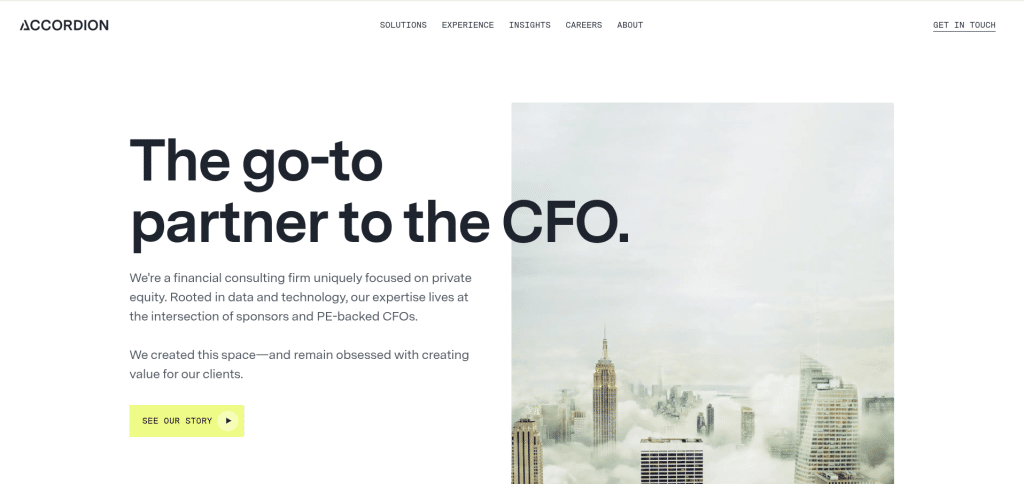
Accordion is a boutique consulting firm specializing in private equity-focused financial consulting and strategic advisory services. Founded in 2009 and headquartered in New York City, Accordion serves as an extension of private equity sponsors and their portfolio company CFOs. The firm has rapidly expanded across the U.S., with offices in major financial hubs including Boston, Chicago, Dallas, San Francisco, and Los Angeles.
Accordion’s service offerings include finance function enhancement, operational and technical accounting, transaction execution support, interim CFO and controller services, performance improvement, strategic finance, and ERP implementation support. What sets Accordion apart is its exclusive focus on the private equity ecosystem—working closely with sponsors and portfolio companies to drive growth, improve financial visibility, and accelerate value creation.
The firm is known for its “roll-up-your-sleeves” approach, combining technical expertise with a deep understanding of the fast-paced, deal-driven environment of private equity. Accordion consultants often serve in embedded, hands-on roles at portfolio companies to deliver impactful, execution-oriented results.
In recent years, Accordion has grown significantly through both organic expansion and strategic acquisitions, solidifying its position as a go-to consulting partner for middle-market private equity firms.
Historical Overview and Milestones
Accordion (founded in 2009 as Accordion Partners by CEO Nick Leopard) began as a specialized financial consulting firm with a singular focus: serving the Office of the CFO at private equity-backed companies. The firm’s name itself signifies flexibility – much like an accordion, its teams could expand a client’s capacity on demand. Early on, Accordion established itself as a “rapid response” finance unit for private equity sponsors and their portfolio companies, dropping in to build complex financial models, forecasts, and analytics when in-house teams were stretched thin. This niche focus on value creation and financial rigor for PE-owned businesses drove steady growth through the 2010s.
Key milestones marked Accordion’s evolution from a boutique to an international platform. In 2017, the firm opened a San Francisco office, its first expansion beyond New York, to support a growing West Coast client base. A pivotal moment came in 2018 when private equity firm FFL Partners made a minority investment in Accordion, providing capital and strategic guidance that accelerated growth. The following year, industry veteran Atul Aggarwal (formerly a Bain & Company partner) joined as President to help evolve Accordion’s operating model and scale the business. Around the same time, Accordion developed a proprietary software platform called Maestro (launched 2020) aimed at helping PE firms track and maximize value creation in their portfolio companies. Maestro was later spun off into its own venture-backed company, underscoring Accordion’s innovative approach to supporting CFOs with technology.
Beginning in 2021, Accordion embarked on a series of strategic acquisitions to broaden its capabilities. In May 2021, it acquired Mackinac Partners, a respected turnaround and restructuring advisory firm. This move gave Accordion in-house expertise to stabilize distressed businesses and expanded its services into the “value stabilization” side of the investment cycle. Early 2022 saw the acquisition of Platform Specialists, an enterprise performance management consultancy, followed in August 2022 by ABACI, a specialist in ERP and enterprise performance management solutions (notably NetSuite and Adaptive Insights). These additions greatly enhanced Accordion’s Digital Finance practice, allowing it to offer end-to-end CFO tech implementation and systems integration alongside its financial consulting.
Later in 2022, Accordion’s ownership shifted to support its next growth phase. In September 2022, Charlesbank Capital Partners and Motive Partners acquired a majority stake in the firm (FFL exited its investment at this time). Backed by these investors – one a middle-market private equity firm and the other a financial technology-focused fund – Accordion gained resources to expand both organically and through further acquisitions. The firm’s trajectory continued upward: by late 2022 it had a footprint of 10 offices across the U.S. and a rapidly growing team.
Accordion’s expansion continued with a focus on data, technology, and operational expertise. In May 2023, it acquired Merilytics, a Hyderabad, India-based data analytics and business intelligence firm with over 500 employees. This deal not only created a new Data & Analytics practice within Accordion but also established a global delivery center in India to support clients with advanced analytics, reporting, and data management solutions. By integrating Merilytics, Accordion signaled that data-driven decision support is now core to its offerings for CFOs.
The year 2024 was especially active. In February 2024, Accordion acquired OperationsRx, a boutique firm specializing in operations and supply chain transformation. This broadened Accordion’s capabilities beyond pure finance into operational improvements – such as strategic sourcing, process optimization, and supply chain efficiency – all aimed at boosting portfolio companies’ EBITDA. In March 2024, the firm also purchased the Salesforce solutions division of Kavaliro, bringing in a team of Salesforce experts and launching Accordion’s dedicated CFO Technology practice for CRM and revenue cycle solutions. Another significant addition came in July 2024, when a team of healthcare turnaround specialists from ToneyKorf Partners joined Accordion. ToneyKorf’s professionals, known for restructuring hospitals and healthcare companies, bolstered Accordion’s turnaround & restructuring practice with deep healthcare industry expertise.
By 2025, Accordion had transformed from a 25-person New York boutique into a diversified consulting platform. The firm’s headcount grew to over 1,200 professionals worldwide (up from roughly 250 in the late 2010s), and annual revenues climbed into the hundreds of millions. Accordion’s entire history has been defined by aggressive growth: combining organic expansion (new offices and service lines) with strategic acquisitions that fill capability gaps. Each merger – whether in turnaround management, enterprise systems, analytics, or operations – was aimed at making Accordion a one-stop consulting partner for private equity sponsors seeking to improve their portfolio companies.
Leadership and Key Executives
Accordion’s growth and culture have been shaped by a leadership team blending finance, consulting, and industry experience. Nick Leopard, Founder and CEO, has been the driving force since inception. A former Bear Stearns investment banker and mezzanine fund investor, Leopard saw an opportunity during the late-2000s financial crisis to create a new model of consulting for private equity. Under his vision, Accordion focuses on practical execution and value creation, rather than traditional off-site advisory reports. Leopard remains deeply involved in strategy and often evangelizes the evolving role of the CFO in PE-backed businesses.
Supporting Leopard is a cadre of senior executives. Notably, Atul Aggarwal serves as President (and President of Europe as of 2025). Aggarwal joined in 2019 from a top consulting firm and has been instrumental in scaling Accordion’s operations and expanding into new markets. He led initiatives to professionalize the firm’s infrastructure and spearheaded the launch of the London office for European expansion. Another key figure is Jon Apter, Chief Financial Officer, who ensures Accordion’s own finances and rapid growth are well managed – a critical role as the firm integrates acquisitions and new service lines. The firm’s leadership also includes specialists heading each practice area: for example, Andrew Hede (Senior Managing Director, Turnaround & Restructuring, formerly of Mackinac Partners) who guides all restructuring engagements, and Junaid Samnani (Managing Director, Transformation) co-leading large-scale operational improvement projects.
Accordion has cultivated a leadership ethos that mirrors its client service philosophy – many of its Managing Directors and practice leaders are former operators, CFOs, or experienced consultants who “roll up their sleeves.” The executive team emphasizes hands-on mentorship, with senior leaders often working directly on client engagements. Additionally, after the Charlesbank and Motive investment, Accordion formed a formal Board of Directors (including representatives from those firms and independent advisors) to guide strategy. The combination of an entrepreneurial founder-led spirit and seasoned executives from larger consulting firms has enabled Accordion to maintain a high-growth startup culture while adding the processes needed for a larger enterprise.
Industry Focus and Clients
From its founding, Accordion has maintained a sharp focus on serving private equity sponsors and their portfolio companies. Rather than limit itself to one sector, the firm works across a wide range of industries – but always within the context of PE ownership and the unique demands that come with it. Accordion’s client base includes hundreds of mid-sized and large private equity funds (by 2025, the firm has partnered with over 200 sponsor firms globally) and countless portfolio businesses under those sponsors.
The industries supported by Accordion’s consulting teams span business services, financial services, technology, media, telecommunications, healthcare and life sciences, retail and consumer products, manufacturing, energy and utilities, real estate and hospitality, among others. For example, one project may involve improving the forecasting process at a software company, while the next might focus on cost restructuring at a manufacturing plant or preparing a healthcare company for a sale. In each case, Accordion brings industry-specific experts when needed (often enhanced via targeted hires or acquisitions like ToneyKorf for healthcare), but the common thread is an emphasis on value creation under PE ownership.
Private equity clients engage Accordion at every stage of the investment lifecycle. During due diligence and acquisition, Accordion might be called to validate a target’s financial projections or set up a post-merger integration plan. In the hold period, portfolio company CEOs and CFOs rely on Accordion for initiatives like implementing new financial systems, optimizing working capital, professionalizing the finance function, and accelerating growth through performance improvement. As companies approach exit (sale or IPO), Accordion helps with exit readiness – polishing financial reporting, carving out divisions, and ensuring the finance team can meet public-company standards. This integrated understanding of the PE lifecycle makes Accordion distinct; it is not just an industry generalist, but an expert in the pressures and timelines of private equity ownership.
Consulting Methodologies and Delivery Model
ccordion’s consulting approach is characterized by hands-on, results-oriented delivery tailored to the needs of CFOs and finance teams. Unlike traditional consultants that may only recommend strategies, Accordion prides itself on execution and “doing the work” side by side with management. The firm often describes itself as a “non-consulting” consulting firm – meaning its professionals act as extensions of the client team rather than outside theorists. Key elements of Accordion’s delivery model include:
- Embedded Teams and Interim Roles: Accordion deploys small, cross-functional teams that work on-site (or closely virtually) with client staff. They often fill critical gaps – for instance, serving as interim controllers, leading a finance workstream, or providing a “surgical strike” of analytical manpower during crunch times. This embeds accountability and speeds up knowledge transfer. The firm’s name reflects this elasticity: clients can “stretch” their capacity by bringing in Accordion’s specialists when needed and scale back when finished.
- Office of the CFO Expertise: All methodologies center on empowering the CFO organization. Accordion consultants have deep expertise in accounting, financial planning & analysis (FP&A), reporting, treasury, and transaction execution. They use established best practices to upgrade these functions. For example, Accordion might introduce a rigorous 13-week cash flow forecasting process to a company with liquidity issues, or redesign the monthly financial reporting package to provide clearer insights for the board. Every project ties back to improving financial management and value creation.
- Value-Creation Playbooks: Drawing on experience across hundreds of portfolio companies, Accordion employs repeatable playbooks for common challenges. These include things like the 100-Day Plan post acquisition (to rapidly implement operational improvements), KPI development and dashboarding for growing companies, and profitability enhancement initiatives (ranging from pricing optimization to overhead cost rationalization). However, Accordion is careful not to give “cookie cutter” solutions – their consultants customize approaches to each company’s context, often building strategies interactively with management so there is buy-in.
- Data-Driven and Tech-Enabled Solutions: A distinctive aspect of Accordion’s methodology is leveraging technology and data at every step. The firm integrates advanced analytics (strengthened by the Merilytics team) to provide deeper insights, such as predictive models for sales or customer churn analysis, which inform strategic decisions. Its Digital Finance & IT practice implements leading financial systems – ERP, EPM (Enterprise Performance Management), CRM, and business intelligence tools – to improve processes. For instance, Accordion might lead a NetSuite ERP rollout at a mid-market company or configure Adaptive Insights for better budgeting and planning. The firm’s consultants are often certified in these systems and follow a delivery model that combines process redesign with technical configuration. By uniting financial data and modern tools, Accordion helps CFOs create transparency and efficiency in their operations.
- Flexible Billing and Incentive Alignment: In contrast to investment banks that charge success fees, Accordion typically bills on a time-and-materials or project fee basis. This means Accordion is paid for effort rather than outcome, aligning its incentives with the client’s needs rather than just closing deals. The firm often works in short, focused sprints – for example, a 8-week engagement to improve cash flow management – which can be extended if new issues emerge. This flexible engagement model allows sponsors to deploy Accordion as situations demand, without long-term on-site overhead when not needed.
Through this delivery model, Accordion has built a reputation for speed and tangible impact. It is not uncommon for an Accordion team to arrive at a portfolio company and within a few weeks produce a new forecast model, identify several million dollars in cost savings, or implement a critical software tool. The firm’s methodology emphasizes working “with” management (often coaching the company’s finance staff) so that improvements are sustainable after the consultants roll off. This approach has resonated strongly in the private equity world, where time is short and results are paramount.
Global Operations and Office Locations
By 2025, Accordion has established a global presence, with operations spanning North America, Asia, and Europe. The firm is headquartered in New York City at One Vanderbilt, a prime Manhattan address that signifies its prominence in the finance community. In the United States, Accordion has grown to ten offices in major financial and business hubs: New York, Atlanta, Boston, Charlotte, Chicago, Dallas, Detroit, Los Angeles, San Francisco, and a South Florida location. These offices support clients regionally and serve as bases for Accordion’s consultants, though the firm’s teams are often traveling to client sites nationwide.
Internationally, Accordion has expanded both through acquisitions and strategic new offices. In India, the acquisition of Merilytics in 2023 established Accordion’s Hyderabad office, which serves as a center of excellence for data & analytics and also provides cost-effective offshore support on projects globally. This Indian presence gives Accordion a 24/7 capability (with teams in India able to continue analyses overnight for U.S. clients) and access to a large talent pool of data scientists and financial analysts.
In Europe, Accordion launched its first European office in London in early 2025, responding to client demand to replicate Accordion’s U.S. success overseas. The London team, led by senior executives including Atul Aggarwal (now President of Europe), caters to European private equity sponsors and their portfolio CFOs. This makes Accordion one of the only consulting firms focused exclusively on PE-backed CFO needs in the European market. The London office is poised to expand further as Accordion builds out local teams in key European markets in the coming years.
The firm’s global operating model ensures that knowledge and practices are shared across borders. For example, a turnaround expert from the Detroit office might collaborate with colleagues in London on a European manufacturing client, or the data team in Hyderabad might support a Los Angeles-based engagement with advanced analytics. Despite its global reach, Accordion maintains a unified culture through regular firm-wide trainings, offsite meetings, and a strong set of values emphasizing collaboration and execution. By 2025, the firm has consultants working across five continents and serving clients wherever private equity capital is invested. This network of offices and talent allows Accordion to respond quickly on-site if needed, while also leveraging global capabilities to deliver the best of the firm to every client.
Career Pathways and Compensation
Accordion offers clear career progression for its consulting professionals, with roles that mirror a blend of investment banking and management consulting titles. A typical entry point for new graduates or those early in their career is the Analyst position, where one supports project teams with financial analysis, research, and modeling. After gaining experience, an Analyst can be promoted to Associate, taking on greater responsibility in client engagements such as owning work streams or sections of a financial model. Following the Associate level, the next step is Vice President (VP) – roughly equivalent to a project leader or manager. VPs at Accordion lead day-to-day client interactions, supervise analysts/associates, and ensure deliverables meet the firm’s standards. Above VP, one progresses to Director, who oversees multiple project teams or a large engagement and often specializes in a particular service area (such as Technical Accounting or CFO Tech). The senior-most client service role is Managing Director (MD), which is akin to a partner. MDs cultivate client relationships, drive business development, and provide high-level advisory on engagements. A select few may attain the title of Senior Managing Director or other executive leadership roles, reflecting firm-wide influence and substantial experience.
Career progression at Accordion tends to be merit-based and relatively fast-paced due to the firm’s growth. Employees are often promoted in recognition of their contributions to successful projects and ability to take on greater leadership. The firm also actively hires experienced professionals (for example, former Big-4 accountants or ex-consultants from larger firms) directly into mid-level and senior roles to infuse expertise. For those joining internationally, the ladder is similar, though titles might sometimes vary (in new markets like Europe, the term “Manager” might be used informally for a VP-equivalent). Importantly, Accordion’s culture encourages entrepreneurial leadership at every level – even junior team members are expected to voice ideas and drive initiatives, which helps accelerate their development.
In terms of compensation, Accordion positions itself to be competitive with other top-tier consulting and financial advisory firms, though exact figures vary by role and region. In the United States, base salaries for entry-level consulting roles (Analyst/Associate) typically enter six-figure territory when combined with annual bonuses. For instance, an Associate in New York might have a base salary in the range of $80,000–$100,000, with performance bonus bringing total annual compensation into the $120,000+ range. Vice Presidents often earn a total compensation in the mid-to-high $200,000s, reflecting their project management role and significant bonus potential tied to project success and firm performance. Directors and Managing Directors have correspondingly higher packages – Directors commonly see total compensation in the $300,000+ range, and Managing Directors can earn in the high six figures (with some senior MDs potentially reaching or exceeding around $500,000 annually when bonuses and profit-sharing are included). The firm’s rapid growth and private equity backing also means top performers may receive equity incentives or participation in value created, aligning them with Accordion’s success.
Internationally, compensation is adjusted to local market standards but remains very attractive relative to the cost of living. In London, for example, an Associate might earn a base salary around £60,000–£70,000, with bonuses pushing total comp toward the equivalent of low six figures in U.S. dollars – slightly lower than New York levels, but on par with other London consulting firms. European senior consultants and Directors at Accordion likewise receive compensation packages benchmarked against the high end of the local market to entice talent from big firms. In India, where Accordion has a large analytics team, salaries are on a different scale: an entry-level analyst might earn on the order of ₹800,000–₹1,000,000 per year (roughly $10,000–$13,000 USD), which is very competitive for the local finance/tech talent pool. Senior managers and directors in India can earn substantially more (in the millions of rupees annually), commensurate with their experience, though still below absolute U.S./Europe pay levels.
Accordion also provides a comprehensive benefits package, including health insurance, retirement plans, and generous paid time off, to attract and retain talent. Notably, employees often cite the firm’s bonus structure as a strong motivator – bonuses are performance-driven and can be a large percentage of base pay, especially when the firm as a whole hits growth targets. In summary, Accordion’s career paths offer the chance for rapid advancement in a high-growth environment, and its compensation (while slightly below the biggest global consultancies at certain junior levels) is robust, with upside for high performers and adjustments made for local economics in its international offices.
Thought Leadership and Initiatives
Accordion has established itself not only as an execution partner but also as a thought leader in the realm of private equity finance and value creation. The firm regularly produces research, publications, and events to share insights with clients and the broader industry. One cornerstone of Accordion’s thought leadership is its series of white papers and surveys on topics affecting PE-backed CFOs. For example, Accordion publishes an annual CFO Value Creation Report that examines how CFOs at portfolio companies are driving growth and efficiency, often including data from surveys or interviews with dozens of CFOs and PE executives. In Europe, as part of launching its London office, Accordion conducted a comprehensive survey of 100 European private equity firms and 100 portfolio company CFOs, shedding light on regional challenges and priorities (such as the need for European CFOs to focus on EBITDA enhancement given limited market multiple expansion). These kinds of studies position Accordion at the forefront of understanding trends in private equity operations.
The firm also contributes frequent articles and expert commentary. Its Knowledge Center (often branded as “The Accordion File”) features articles on best practices like “Building a 13-Week Cash Flow for Distressed Companies” or “Integrating Add-on Acquisitions: A CFO’s Playbook.” Senior Accordion professionals are encouraged to publish insights – whether through the company’s site, LinkedIn, or industry journals – and many serve as panelists at conferences. They have spoken at events such as the Private Equity Operating Partners Forum and CFO leadership summits, often addressing the evolving role of finance in value creation. The firm’s presence at these events, alongside top consulting and accounting firms, has helped build its brand as the go-to expert on sponsor-backed company finance issues.
In addition, Accordion hosts its own events and roundtables for clients. These range from intimate breakfast roundtables for portfolio CFOs to discuss common challenges, to larger forums where Accordion presents research findings and facilitates networking among finance executives in the PE community. During the pandemic and beyond, Accordion also leveraged webinars to share timely advice (for instance, sessions on navigating liquidity during COVID-19, and on preparing for economic downturns from a CFO perspective). The firm’s thought leadership efforts are often led by a dedicated internal team that includes marketing strategists and former journalists who help craft content that is both insightful and actionable.
A notable innovative initiative from Accordion was the development of the Maestro platform (mentioned earlier in the historical overview). While it eventually spun off as an independent tech company, Maestro originated as Accordion’s intellectual property – a digital tool embodying the firm’s thought leadership on tracking value creation. It provided dashboards for metrics like revenue growth, cost savings, and working capital improvements across a PE portfolio. The fact that Maestro attracted outside investors (including a major data/analytics company) underscores Accordion’s forward-thinking approach to marrying consulting expertise with technology products.
Through publications, events, and tools, Accordion has created a voice in the industry that extends beyond its billable client work. The firm is often cited in financial press and by private equity professionals when discussing trends like the increased demand for operating partners or the impact of technology on mid-market companies. By continually investing in thought leadership, Accordion not only differentiates its brand but also educates its clients – reinforcing the value of the services it provides and staying ahead of emerging issues that PE-backed companies face.
Notable Projects and Impact
Over the years, Accordion has been involved in numerous high-impact projects that illustrate its unique value proposition. The firm is known for stepping into complex, urgent situations and delivering results under pressure. One illustrative engagement from Accordion’s early days was with a major private equity fund struggling to consolidate financial reporting for dozens of portfolio companies. Accordion’s team was called in as an “analytics SWAT team” to build a comprehensive five-year budget model across more than 80 businesses on four continents. Working closely with the client’s COO and CFOs of each portfolio company, Accordion not only delivered the consolidated budget on time but also put in place standardized forecasting practices that reduced future budgeting cycles from months to weeks. This kind of quick-turnaround solution gained Accordion a reputation among sponsors like Riverside Company and Providence Equity (both early clients) as the first call when extra financial expertise was needed.
Accordion has also made headlines through its turnaround and restructuring work, especially after the Mackinac Partners acquisition. The firm has quietly guided a number of distressed companies back from the brink. For instance, when a manufacturing portfolio company faced insolvency due to operational missteps, Accordion’s turnaround experts took interim management roles, restructured the company’s debt, and implemented a turnaround plan that stabilized cash flow within 100 days. In another high-profile case, Accordion professionals were part of the advisory team in the Chapter 11 restructuring of a global cryptocurrency exchange in 2022, helping to untangle financial records and establish creditor reporting (this engagement showcased Accordion’s ability to handle cutting-edge, complex situations in the fintech realm). Similarly, through the ToneyKorf team, Accordion has been involved in saving failing hospitals by streamlining their operations and finances, ensuring continuity of critical healthcare services. These cases highlight Accordion’s capacity to handle sensitive and high-stakes assignments that have significant jobs and capital at risk.
In the domain of performance improvement and value creation, Accordion has numerous success stories where its interventions directly enhanced a company’s financial performance. For example, at a PE-owned consumer products company, Accordion led a cross-functional earnings improvement program: they identified supply chain inefficiencies and pricing opportunities that resulted in a 20% increase in EBITDA within a year. The project combined OperationsRx’s expertise in supply chain with Accordion’s financial modeling – a testament to the synergy of its acquisitions. Likewise, Accordion’s CFO Tech practice (bolstered by ABACI and the Salesforce team) has delivered high-impact projects such as overhauling a subscription billing system for a software company, which not only automated revenue recognition (reducing manual accounting effort by thousands of hours annually) but also improved cash collection by double-digit percentages. Accordion’s teams often achieve these results on tight timelines, aligning with the PE sponsor’s goal to boost the company’s performance before an exit event.
Another distinctive aspect of Accordion’s work is its involvement in exit readiness and transaction support. The firm has prepared numerous companies for successful exits, whether sales or IPOs. In one notable project, Accordion was engaged by a multinational services company preparing to go public. The team helped transform the finance function to public-company standards in under a year: implementing a new financial close process, drafting SEC-quality financial statements, and coaching the CFO through investor roadshows. The IPO was a success, and the company’s CFO credited Accordion for establishing the robust financial infrastructure that gave public investors confidence. On the M&A side, Accordion frequently supports carve-outs (separating a division from a parent company) – in one case, carving out a division of an industrial company involved setting up standalone finance operations, which Accordion managed seamlessly so that the newly independent entity had no interruptions in its reporting or controls.
Across all these examples, what stands out is Accordion’s impact on value. Whether it’s turning around a distressed asset, adding millions to EBITDA through operational tweaks, or enabling a smooth exit at a higher valuation, Accordion’s work directly ties to the metrics that private equity owners care about. The firm is often praised for its ability to execute under pressure: sponsors know that if a critical deadline or crisis looms, Accordion’s consultants will burn the midnight oil alongside management to get the job done. This reputation has cemented Accordion’s standing in the market. By 2025, it is widely regarded as the premier consulting partner for private equity portfolio operations – a firm that may not be as large as the Big Four or global strategy giants, but one that delivers outsized impact in its domain.
Consulting Firm Profiles:
- Accenture
- Accordion Consulting
- Advisory Board
- AlixPartners
- Alvarez and Marsal
- Altman Solon Consulting
- Analysis Group
- Ankura Consulting Group
- Archstone Consulting (Acquired by The Hackett Group, Inc)
- Arthur D. Little
- Arthur J. Gallagher & Co.
- Arcadis
- Aon Consulting Services
- Arup Group
- Atos Group and Atos Consulting
- Bain & Company
- Baker Tilly International
- Bates White Economic Consulting
- BDO Consulting
- BearingPoint
- Berkeley Research Group
- BNP Paribas CIB Consulting & Transformation
- Booz Allen Hamilton
- Boston Consulting Group
- Bridgespan Group
- Capco Consulting
- Capgemini
- Capgemini Invent
- Carpedia International Consulting
- CGI Inc.
- Charles River Associates (CRA)
- Chemonics International Inc.
- ClearView Healthcare Partners
- Coalition Greenwich
- Cognizant Technology Solutions
- Compass Lexecon
- Computer Sciences Corporation (CSC) and Evolution into DXC Technology
- Cornerstone Research
- Corporate Executive Board (CEB)
- Crowe Global and Crowe LLP
- Dalberg Global Development Advisors
- Deloitte
- DGC Partners LLC
- dss+ (Formerly DuPont Sustainable Solutions)
- Environmental Resources Management (ERM)
- Everest Group (acquired by Wavestone)
- EVERSANA and EVERSANA CONSULTING
- EXL Service
- EY Consulting
- EY-Parthenon
- FTI Consulting
- FTI Delta (formerly Delta Partners)
- Forvis Mazars
- Galt & Company (acquired by AlixPartners)
- Gartner Inc. and Gartner Consulting
- GEP Worldwide
- ghSMART Consulting
- Grant Thornton Consulting – U.S. and Global
- Guidehouse
- Hay Group (acquired by Korn Ferry)
- HCL Axon Consulting
- HCLTech Consulting
- HDR, Inc.
- Health Advances Consulting
- Hewitt Associates (acquired by Aon)
- Hitachi Consulting (acquired by Hitachi Vantara)
- HP Enterprise Services Consulting (acquired by Hewlett Packard Enterprise)
- Horváth & Partners Consulting
- Huron Consulting Group
- IDEO
- IBM Consulting
- Infosys Ltd and Infosys Consulting
- Information Services Group (ISG) Consulting
- IQVIA Consulting Business
- INSIGHT2PROFIT Consulting
- Ipsos Consulting
- Jacobs Solutions Consulting
- John Wood Group PLC
- Kantar
- Kearney
- Korn Ferry
- KPMG
- Kroll (formerly Duff and Phelps)
- Kurt Salmon (acquired by Accenture)
- Larx Advisors Consulting
- Launch Consulting Group
- Leidos
- L.E.K. Consulting
- LTIMindtree
- Maine Pointe Consulting (acquired by SGS Group)
- Marakon Consulting
- Marsh & McLennan
- Mars & Co
- Mastercard Advisors and Mastercard Data & Services Division
- McKinsey & Company
- Mercer Consulting
- Metyis
- Miller Heiman Group
- Mitchell Madison Group
- Monitor Deloitte
- Mott MacDonald
- Navigant Consulting (acquired by Guidehouse)
- NERA Economic Consulting
- Newton Consulting Partners
- North Highland Consulting
- NTT DATA Consulting and NTT DATA Inc
- OC&C Strategy Consultants
- Oliver Wyman
- PA Consulting
- Palm Tree LLC
- Parsons Corporation
- Partners in Performance (acquired by Accenture)
- Point B Inc.
- Pointe Advisory
- Porsche Consulting
- ProcureAbility
- Propeller Consulting LLC
- Protiviti
- PRTM Consulting (acquired by PwC)
- Putnam
- PwC Consulting and Strategy&
- Ramboll
- RAND Corporation
- Riveron Consulting
- RGP Global Consulting Firm
- Roland Berger
- RSM International
- Schlumberger Business Consulting (acquired by Accenture)
- Science Applications International Corporation (SAIC)
- ScottMadden Consulting
- Simon-Kucher & Partners
- Slalom Consulting
- SSA & Company
- Stantec
- Strategy& (PwC)
- St. Onge Company
- Syneos Health Consulting
- SynFiny Advisors
- Targus Management Consulting AG
- Tata Consultancy Services
- Teneo Consulting
- Tetra Tech Consulting
- The Brattle Group
- The Cambridge Group
- The Chartis Group
- The Hackett Group
- Tompkins Solutions
- TriVista Consulting
- Visa Consulting & Analytics (VCA)
- Wavestone Consulting
- West Monroe Partners
- Willis Towers Watson Consulting
- Wilson Perumal & Company
- Wipro Consulting
- Worley
- WSP Global
- Xynteo
- ZS
