
Overview and History of HCLTech Consulting Division
HCLTech (formerly HCL Technologies) is a leading Indian multinational IT services and consulting company with a rich history dating back to 1976. Initially founded as Hindustan Computers Limited by Shiv Nadar and partners, the enterprise began in hardware and later pivoted to software services. HCLTech’s dedicated consulting division – historically known as HCL Enterprise Transformation Services (ETS) and later branded as HCL Business Consulting – has grown into a significant practice focused on business advisory and digital transformation consulting. Below are key milestones in HCLTech’s journey through 2025, including the evolution of its consulting arm:
- 1976: HCL is founded in India as a hardware firm; develops one of India’s first microcomputers by 1978.
- 1991: HCL launches its software services unit (later spun off as HCL Technologies).
- 1994: The company briefly adopts the name HCL Consulting Limited, signaling a shift towards software and IT consulting services.
- 1999–2000: Renamed HCL Technologies Ltd. to reflect broader IT services; goes public in 2000 as one of India’s pioneering tech IPOs.
- 2000s Expansion: Rapid global growth into North America, Europe, and Asia-Pacific. In 2005–2006, HCL establishes a presence in Europe and wins large IT infrastructure deals (e.g. setting up India’s first floorless stock exchange for NSE).
- 2007: Vineet Nayar becomes CEO and drives a culture of innovation with the famous “Employees First, Customers Second” philosophy – a management approach that gains worldwide attention and redefines HCL’s workplace culture.
- 2008: Acquisition of Axon Group (UK) for £440M – a pivotal moment for HCL’s consulting capabilities. Axon was a leading SAP consulting firm, and HCL merged its Enterprise Application Services unit into Axon to form HCL Axon. This greatly expanded HCL’s enterprise consulting expertise (especially in ERP/business transformation) and increased the consulting division’s revenue contribution substantially.
- 2009–2013: Further strategic deals bolster consulting and domain expertise (e.g. acquiring UCS Group’s SAP practice in South Africa in 2009, and establishing joint ventures like one with Deutsche Bank for financial IT services). HCL’s consulting practice (ETS/Business Consulting) grows, serving about a quarter of the company’s revenue by the late 2000s.
- 2013–2016: Anant Gupta succeeds Nayar as CEO in 2013. HCL continues global expansion and launches new service lines in digital and engineering services. The consulting division, now often called HCL Business Consulting, operates as an agile, fast-growing unit advising clients on IT-business alignment and process optimization.
- 2016: C. Vijayakumar (“CVK”) is appointed CEO. Under his leadership HCL adopts a “Mode 1-2-3” growth strategy, balancing core services (Mode 1), next-gen digital offerings (Mode 2), and products & platforms (Mode 3). The consulting practice becomes a key part of Mode 2, helping clients navigate digital transformation.
- 2018–2019: Major investments in products and digital consulting – HCL acquires several IBM software products (for $1.8B in 2019) and buys U.S.-based digital consultancy Strong-Bridge Envision (2019) to strengthen its digital strategy consulting in North America.
- 2020–2022: HCL’s revenue crosses $10 billion. Shiv Nadar’s daughter, Roshni Nadar Malhotra, becomes Chairperson (the first woman to lead a top Indian IT company’s board), while CVK continues as CEO. In 2022, the company rebrands from “HCL Technologies” to HCLTech with a refreshed focus on digital consulting and engineering. HCLTech also acquires Confinale AG (a Swiss banking/wealth management consulting firm) in 2022, expanding its financial services consulting footprint in Europe.
- 2023–2025: HCLTech secures one of its largest deals – a $2.1 billion network services agreement with Verizon (2023) – underlining its capability to execute large-scale IT transformations. It also acquires ASAP Group (German automotive engineering services) and in 2024 purchases select assets of Hewlett Packard Enterprise’s services business, deepening domain expertise. By 2025, HCLTech’s annual revenues approach $14 billion with over 220,000 employees across 60+ countries. The consulting division (now under Digital Consulting & Strategy Services) is firmly integrated, advising clients on digital strategy, process re-engineering, and enterprise cloud adoption as part of HCLTech’s end-to-end offerings.
Industries Served and Service Offerings
HCLTech today provides a broad range of IT services, consulting, and digital transformation solutions across virtually all major industries. The company’s client base spans Fortune 500 enterprises in multiple verticals. Key industries served include:
- Financial Services – Banking, capital markets, and insurance firms leverage HCL for core banking IT modernization, digital payment platforms, risk and compliance solutions, and consulting on fintech integration. HCLTech has dedicated banking domain units (strengthened by past Deutsche Bank partnerships) and is a leader in financial IT services.
- Manufacturing & Automotive – HCL works with automotive OEMs, industrial manufacturers, and hi-tech manufacturing companies. Services range from engineering R&D (product design, embedded software, IoT for smart factories) to ERP implementation and supply chain transformation. The 2023 acquisition of ASAP in Germany boosted automotive engineering consulting.
- Life Sciences & Healthcare – HCLTech provides consulting and IT services to pharmaceutical companies, biotech firms, hospitals, and healthcare providers. This includes digital health platform development, electronic medical record (EMR) system consulting, drug R&D IT support, and recently, AI-driven healthcare operations. (For example, in 2024 HCLTech partnered with Children’s Minnesota hospital to modernize operations using AI, improving patient care through analytics and automation.)
- Retail & Consumer Packaged Goods (CPG) – HCL consults for global retailers and consumer goods companies on e-commerce modernization, omnichannel customer experience, supply chain optimization, and analytics. Notably, industry analysts in the mid-2000s cited HCL’s strong retail domain consulting (with HCL’s business consulting contributing significantly to retail client successes such as advanced planning, loyalty management, and JDA merchandise systems in India).
- Telecom, Media & Technology – Telecom operators and media companies engage HCLTech for network virtualization, OSS/BSS transformations, 5G enablement, and media platform engineering. The Verizon engagement highlights HCL’s capability in telecom network transformation. In the technology sector, HCL serves software companies and tech platform providers, often co-innovating on product development (HCL’s Engineering and R&D Services arm is especially strong here, designing software and electronics for global tech firms).
- Energy & Utilities – HCLTech supports oil & gas, utilities, and renewable energy firms with asset management systems, IoT solutions for field operations, and enterprise asset planning (including SAP implementations tailored to energy).
- Public Sector & Government – HCL has executed projects for government agencies and public-sector organizations, particularly in India and Europe. For instance, HCL built the trading infrastructure for India’s National Stock Exchange in the 1990s and has provided digital services to government departments. Its consulting teams assist public organizations in IT modernization, smart city initiatives, and citizen services platforms.
- Cross-Industry Digital Services – Across all verticals, HCLTech’s consulting and IT services span cloud computing, cybersecurity, data & analytics, application development and modernization, ERP and CRM implementation, and business process outsourcing (BPO). The firm often delivers end-to-end “digital transformation” programs – from upfront strategy and consulting (IT strategy, process redesign, change management) through technology implementation and managed services.
HCLTech’s breadth of offerings is organized under three major business units: IT & Business Services (ITBS), Engineering and R&D Services (ERS), and Products & Platforms (P&P). The consulting division primarily falls within ITBS, focusing on digital strategy, process consulting, and enterprise application advisory. However, it works in tandem with ERS and P&P teams – for example, consultants might devise a digital roadmap (ITBS) which HCL’s engineering team builds (ERS) and leverage HCL’s software products or platforms (P&P) as part of the solution. This integrated model allows HCLTech to serve as a one-stop partner for clients, from high-level business consulting through to technology execution and even software products.
Consulting Methodologies and Frameworks
HCLTech’s consulting practice differentiates itself by the methodologies and frameworks it uses to drive transformation. Over the years, the firm has developed and adopted several approaches:
- Business-Aligned IT Consulting: A legacy of the HCL Axon acquisition is a consulting approach that starts with business process re-engineering rather than pure technology deployment. For instance, in large ERP implementations (SAP, Oracle, etc.), HCL consultants emphasize aligning the system with reimagined business processes and organizational change management. This business-first, technology-second mindset was pioneered by Axon and became core to HCL’s methodology in enterprise transformation projects. Rather than treating an SAP project as a software install, HCL’s consultants frame it as a full business transformation – mapping current processes, designing a future state, and only then configuring technology to enable it.
- Structured Transformation Frameworks: HCLTech has codified frameworks to guide clients through digital transformation. Its “Digital Transformation Framework” typically covers end-to-end stages – from digital vision and strategy, to pilot/prototype (often using Design Thinking workshops to ideate solutions), to agile implementation, and continuous improvement. Key elements include robust change management (HCL has dedicated change management consulting to ensure workforce adoption) and a focus on building a “Digital Operating Model” for clients (i.e. new processes, governance, and skills needed in a digital era). HCL often establishes a Digital Transformation Office for large programs, providing governance and tracking of benefits realization.
- HCLTech’s Mode 1-2-3 Strategy: As a guiding philosophy for its own services, Mode 1-2-3 also translates into client engagements.
- Mode 1 (Core) – HCL emphasizes efficiency and optimization of core IT (applications, infrastructure, legacy systems). Here, consulting might involve IT service management improvements, lean processes, or Alt ASM (Alternative Application Support Models) to drive down cost and improve quality.
- Mode 2 (Experience & Digital) – This is where HCL’s digital consulting thrives: leveraging automation, cloud, analytics, IoT, and AI to drive business outcomes. HCL’s consultants use frameworks like the “ADvantage” suite (proprietary toolkits for application modernization and cloud migration) to accelerate projects. For example, ADvantage Modernize is a methodology combining automated code analysis, cloud-readiness assessment, and agile delivery for mainframe or legacy modernization. Similarly, HCL’s Cloud Adoption Framework helps clients assess applications and choose the right cloud model, and its IoT WoRKSTM methodology guides enterprises in deploying Internet of Things solutions from pilot to scale.
- Mode 3 (Products & Platforms) – Here HCL often takes on the role of a technology partner with its own software products (e.g. the HCLSoftware product portfolio like HCL Notes/Domino, Unica marketing automation, etc.). Consultants integrate these products or others into client environments. HCL’s DRYiCETM suite – an AI-driven automation platform – is one such example: consulting teams might implement DRYiCE for a client’s IT automation needs, providing framework and best practices for AIOps (AI-driven IT operations).
- Agile and DevOps, at Scale: HCLTech consulting has embraced Agile methodologies and DevOps frameworks as default in modern programs. They often begin engagements with an Agile maturity assessment and then help inculcate agile ways of working in client organizations. HCL has frameworks for Scaled Agile (SAFe) implementation and a DevOps toolchain reference model. This ensures that beyond just delivering a project, HCL consultants help the client’s teams adopt a more iterative, high-collaboration approach that continues post-engagement.
- Global Delivery Model: Methodologically, HCL’s consulting leverages a global delivery approach. For strategy and design phases, on-site consultants (often at client locations) work closely with client stakeholders. Then for solution development and analysis, HCL taps its offshore and near-shore delivery centers to provide cost-effective, round-the-clock teams. This model is integrated via well-defined process frameworks (e.g. ITIL for service delivery, PRINCE2 / PMI for project management, and HCL’s internal quality system dubbed the HCL Enterprise Process Model). Such frameworks ensure consistency and quality when teams distributed across India, Europe, and the U.S. collaborate on a single transformation program.
- Proprietary Tools and Accelerators: Over decades, HCLTech has invested in creating solution accelerators that consultants use to reduce project time. Examples include domain-specific templates (like pre-configured industry solutions for SAP), automated code migration tools, and AI-powered analytics platforms. One recent innovation is HCLTech’s AI‐powered platform “AI‐Force” which is used to analyze and optimize business processes using AI. In the Children’s Minnesota project, for example, HCL’s consultants deployed AI-Force to identify operational inefficiencies and recommend process changes, showcasing how such frameworks add value beyond human consulting alone.
In summary, HCLTech Consulting’s methodologies blend industry best practices (Lean, Six Sigma, Agile, Design Thinking) with proprietary frameworks and IP. The firm’s consulting ethos is to bridge business and technology – ensuring that any tech implementation is guided by business strategy and that their advice is backed by practical execution know-how. This pragmatic, execution-focused consulting style is a hallmark of HCL, distinguishing it from pure strategy firms. HCL’s consultants often stay through execution, which clients appreciate as it translates strategic roadmaps into tangible outcomes.
Leadership and Organizational Structure
HCLTech’s growth and strategic direction have been shaped by several key leaders, both at the corporate level and within its consulting practice. The organizational structure is designed to manage a global, multi-service-line business efficiently:
- Shiv Nadar (Founder) – As the founder (in 1976) and the long-time CEO (until 2007) and later Chairman Emeritus, Shiv Nadar set the vision and culture for HCL. He transitioned the company from a hardware maker to an IT services powerhouse. Nadar’s focus on “relationships beyond the contract” (an HCL motto) and long-term client partnerships laid the groundwork for the consulting-oriented approach, where understanding client business deeply was emphasized even in technical projects.
- Vineet Nayar (CEO 2007–2013) – Nayar is renowned for his transformative leadership. Under his tenure, HCL made its boldest consulting acquisition (Axon in 2008) and positioned itself as a value partner rather than just a low-cost vendor. He championed the Employees First, Customers Second (EFCS) philosophy – empowering employees (especially those in customer-facing roles like consultants) to take initiative and innovate for clients. Nayar also authored a book on this philosophy, contributing to management thought leadership globally. His era saw HCL’s consulting and higher-value services grow significantly and the company’s global brand strengthen.
- Anant Gupta (CEO 2013–2016) – Gupta, having risen through HCL’s ranks (with a background in infrastructure services), continued the trajectory of growth. He fostered what HCL called the “21st Century Enterprise” vision, preparing clients for cloud and digital. During this period, HCL’s consulting offerings in areas like cloud strategy, automation, and digitalization were refined. Gupta also helped integrate a more formal structure for the consulting practice within HCL’s service lines to ensure consistent delivery worldwide.
- C. Vijayakumar – CVK (CEO 2016–present) – As current CEO and MD, CVK has led HCLTech into its next phase: digital transformation and product-centric growth. He formulated the Mode 1-2-3 strategy and oversaw the reorganization into the three business units (ITBS, ERS, P&P). Under his leadership, HCLTech’s consulting capabilities have been repositioned as Digital Strategy and Consulting under the Digital Business Services umbrella. Vijayakumar spearheaded key acquisitions (like the IBM software products deal and various consulting firms) to broaden HCL’s portfolio. He also emphasizes “Ideapreneurship” – the company’s culture of grassroots innovation – encouraging consultants and engineers alike to proactively propose ideas and solutions. CVK often engages with large clients personally, reflecting HCL’s high-touch leadership approach in major transformation programs.
- Roshni Nadar Malhotra (Chairperson) – Taking over as Chairperson of HCLTech in 2020, Roshni Nadar (Shiv Nadar’s daughter) has been an influential figure in strategy and governance. While not involved in day-to-day operations, she has been driving long-term initiatives such as sustainability, diversity, and brand-building. Her leadership ensures continuity of HCL’s core values and philanthropic efforts (the Shiv Nadar Foundation) while also modernizing the company’s image (e.g., the 2022 rebrand to HCLTech).
- Consulting Practice Leadership – HCL’s consulting division has its own leadership structure embedded within the larger organization. Typically, a Corporate Vice President or Senior Vice President leads the global consulting practice (Digital Consulting), often reporting into the head of IT & Business Services. Over the years, HCL has brought in seasoned professionals from top consulting firms to bolster its capabilities – for example, HCL’s consulting units in certain regions have been led by ex-Big Four or industry experts. The practice is organized by industry vertical and functional capability. For instance, there may be a global head for Financial Services Consulting, or practice leaders for areas like Supply Chain Consulting, Change Management, etc. These leaders ensure that knowledge and methodology are consistently applied across all client engagements. The consulting group operates somewhat like an internal boutique firm within HCL, working alongside delivery teams. A hallmark of HCL’s structure is its flat hierarchy and empowered mid-level management – as evidenced by the Business Consulting unit’s ethos of a “flat, energetic team” with fast-track career paths. This means consultants often have direct access to senior leadership and can make decisions quickly to respond to client needs.
- Global Delivery Organization – HCLTech’s organizational model for delivery is geographically distributed. The company has Presidents or CEOs for major geographies (e.g. Americas, Europe, APAC) who oversee all business in those regions, including consulting engagements. Below them, delivery center heads manage large clusters of delivery locations (for example, a Delivery Head for Northern Europe or for India operations). HCL’s matrix structure allows a project team to report into both a vertical leader (for domain expertise) and a delivery leader (for execution oversight). This dual reporting ensures that an automotive consulting project, for instance, gets automotive domain guidance from the vertical practice and also meets quality/timeline metrics under the delivery organization.
Overall, HCLTech’s leadership has cultivated a balance of entrepreneurial culture and structured global processes. Decision-making is relatively decentralized – which ties back to ideapreneurship – so regional and practice leaders have leeway to drive innovation and tailor solutions for clients. Yet, the company maintains centralized governance on financial performance, talent development, and IP creation. This structure has enabled HCL to scale its consulting services rapidly across continents while maintaining consistency in service quality.
Global Operations and Delivery Centers
As a global IT services giant, HCLTech operates an extensive network of offices and delivery centers across the world. By 2025, the company’s presence spans 60+ countries, ensuring that consulting and project delivery can be conducted both on-site (close to clients) and offshore (for cost and scale benefits). Key aspects of HCL’s global operations include:
- India – The Core Delivery Hub: India remains the heart of HCLTech’s delivery engine. The company has major campuses in multiple Indian cities: Noida (headquarters in the Delhi NCR region), Chennai, Bengaluru, Pune, Hyderabad, Kolkata, and Mumbai, among others. In total, HCL has dozens of delivery centers across India (including in emerging tech hubs like Nagpur, Madurai, Lucknow, and Vijayawada), employing well over 150,000 professionals in the country. These centers handle everything from software development and support to research labs and back-office operations. Many of HCL’s consultants and domain experts are based in India as well, especially for analysis and solution design tasks that can be done remotely. The Indian delivery centers often work in close coordination with on-site teams to provide a 24×7 execution model.
- Americas: HCLTech has a strong presence in the United States, its largest market. Major U.S. offices and delivery centers exist in locations such as New York (global business office), Seattle, Plano, Texas, and Cary, North Carolina (where HCL established a large Global Development Center). Additionally, HCL has near-shore delivery units in Canada (Toronto) and across Latin America. For example, HCL has operations or partnerships in Mexico, Brazil, and Costa Rica, which serve U.S. clients requiring time-zone aligned support. The North America delivery centers focus on high-end consulting, client management, and critical engineering projects. By having local teams, HCL addresses clients’ regulatory and language needs (especially for public sector or healthcare projects in the U.S.), and these local teams are backed by the larger offshore workforce in India.
- Europe: Europe is another key region, with the UK being one of HCL’s largest bases due to the Axon legacy and long-term clients. HCLTech’s London office and its offices in Guildford (UK) became centers of excellence for SAP consulting post-Axon. Across continental Europe, HCL has delivery centers in countries like Germany, France, Sweden, the Netherlands, and Poland. It has grown significantly in Eastern Europe as well – for instance, opening delivery centers in Lithuania and Estonia in recent years to serve EU clients with near-shore support. As of mid-2020s, HCL employs over 12,000 people in Europe across more than 80 delivery locations (some are small client-dedicated sites). European delivery units often specialize in specific domains – e.g., engineering services in Germany for automotive, fintech and wealth management consulting in Switzerland (boosted by the Confinale acquisition), and telecom and manufacturing consulting in the Nordics. The widespread European presence allows HCL consultants to work in local languages and be on-site with clients when needed, aligning with data sovereignty and compliance requirements of the EU.
- Asia-Pacific and Middle East: Beyond India, HCLTech also has centers in Asia-Pacific countries such as Australia, Singapore, Malaysia, Japan, and China. In Australia, HCL acquired a local IT firm (DWS Ltd in 2020), giving it offices in Melbourne, Sydney, etc., and a stronger onshore consulting team for Australian government and banking clients. In Japan, HCL has a joint venture approach to serve Japanese corporations in their local market. The Middle East is served through offices in Dubai, Riyadh, etc., primarily focusing on banking and telecom consulting in the Gulf region. Additionally, HCL’s presence in Africa (like South Africa – through the UCS acquisition – and Nigeria) supports clients in those emerging markets as well.
- Global Delivery and Innovation Centers: HCLTech invests in special delivery hubs and labs beyond standard offices. For example, it has Innovation Labs (HCLTech Labs) dedicated to areas like IoT, Cloud, and Cybersecurity, where experts develop prototypes and IP that feed into consulting solutions. These labs are in locations such as India, the Silicon Valley (USA), and some European tech clusters. HCL also runs Co-Innovation Labs on-site at certain client locations, wherein HCL consultants and the client’s team work together to brainstorm and develop new digital solutions in an agile environment. This global network of labs and centers underpins HCL’s “Ideapreneurship” culture internationally.
- Follow-the-Sun Model: With operations across all time zones, HCLTech employs a “follow-the-sun” model for support and development. Critical projects hand off work between India, Europe, and America teams to provide continuous progress. For instance, a strategy consulting team in the U.S. might gather business requirements by day, which a team in India then analyzes overnight to develop solution options, which can be reviewed again by the U.S. team the next morning – drastically reducing turnaround time for deliverables. This global workflow is coordinated by robust communication processes and digital collaboration tools internally.
From a consulting engagement perspective, HCL’s global footprint means it can deploy consultants locally for high-touch interactions and simultaneously leverage offshore expertise to scale quickly and manage costs. Clients in any region benefit from this blended model: they get local presence and cultural familiarity, along with the depth and scalability of a vast offshore talent pool. By 2025, HCLTech has truly become a globally distributed consultancy and services provider, with delivery centers knit together in one of the industry’s most extensive delivery networks.
Career Progression and Compensation in Consulting
Working in HCLTech’s consulting and digital transformation teams offers professionals a defined career path with opportunities for rapid growth, international exposure, and competitive compensation. The company’s talent philosophy – influenced by the “Employees First” culture – places emphasis on continuous learning and merit-based advancement. Here’s an overview of career progression and compensation for consulting roles across regions:
- Career Path and Roles: HCLTech consulting careers typically begin at the entry-level or junior consultant stage for those coming from university or MBA programs. In India, for example, HCL hires MBA graduates and engineers into roles like Associate Consultant or Management Trainee (Consulting) where they learn the ropes of client engagements, project management basics, and HCL’s frameworks. With a few years of experience and strong performance, employees move up to Consultant (independently handling workstreams or small projects). Next, the progression goes through Senior Consultant / Lead Consultant, where one might lead larger project modules or small teams. Above this, roles diverge into more senior leadership: Managing Consultant / Principal Consultant (who oversee major projects or multiple engagements, often acting as trusted advisors to client middle-management), and then into Consulting Partner-equivalent roles. While HCL doesn’t always use the title “Partner” as in traditional firms, equivalents could be Practice Director, Associate Vice President (AVP), or Vice President overseeing a portfolio of accounts or a geography’s consulting practice. At the highest levels, a consulting leader might become a Delivery Director or Practice Head globally for an industry.
HCL encourages a “fast-track” career progression for high performers – as noted in internal materials, an energetic consultant in HCL Business Consulting could rise quickly with the right impact. The hierarchy is relatively flat within project teams: even junior consultants are encouraged to take ownership and interact with clients. This empowerment means that promotions are often based on demonstrated capability rather than just tenure. By the time consultants reach 8-10 years experience, they can be in managerial roles running large transformation programs with significant responsibility. International assignments are common: a consultant may start in India and, after a few years, find themselves leading a deployment in Europe or the U.S., reflecting HCL’s practice of offering on-site opportunities as part of career growth. - Training and Skill Development: At each career level, HCL provides training aligned to the next role. Entry-level hires undergo induction programs in consulting methodologies, soft skills, and relevant technology domains. As they progress, there are leadership development workshops and domain certification tracks (for instance, a consultant in the financial services practice might get certified in FinTech or risk management, whereas a senior consultant in ERP could pursue SAP consultant certifications). HCL’s internal knowledge management and “knowledge-building model” means consultants have access to a vast repository of case studies, frameworks, and mentorship from industry experts, helping them build niche skills that aid progression.
- Compensation in India: In India, HCLTech offers consulting roles with salaries that are very competitive among Indian IT firms and on par with or slightly above many industry averages (though typically below the pay at MBB strategy consulting firms). As of mid-2020s, an entry-level Associate Consultant might earn on the order of ₹800,000 to ₹1,200,000 per annum (around ₹8–12 lakh). Upon reaching the Consultant/Senior Consultant level (roughly 5-8 years experience), salaries commonly fall in the range of ₹1,000,000 to ₹2,000,000 (₹10–20 lakh) annually, with high performers or those in specialized domains reaching even ₹2.5 million. According to employee-reported data, the average senior consultant at HCLTech in India earns approximately ₹1.4–1.5 million per year, with a broad range based on experience and role (some senior experts can earn ₹3+ million especially in high-demand areas like analytics or SAP consulting). Moving up, Managing Consultants and practice managers in India often earn in the high single-digit millions of rupees. For instance, a delivery manager or AVP in consulting might have a package in the ₹3–5 million range, plus performance bonuses. It’s also worth noting HCL provides other benefits – healthcare, provident fund, and potential stock options at very senior levels – which add to total compensation.
- Compensation in the USA: In the United States, HCLTech must offer market-competitive salaries to attract and retain talent, especially given competition from global consultancies and tech firms. A typical Consultant (mid-level) in the US can expect a total compensation roughly around $75,000 to $100,000 per year (with some variation by location and expertise). Indeed, Glassdoor data shows HCLTech consultants in the US often in the high-$70k to $90k base salary range, with potential bonuses pushing total pay into six figures for experienced individuals. At the Senior Consultant or Manager level (roughly equivalent to 8-12 years experience), salaries rise significantly – often in the $110k to $150k range total. And for Managing Consultants or consulting directors handling large accounts, compensation can reach into the mid-six-figures; for example, a managing consulting lead might earn on the order of $160k–$200k+ (inclusive of bonuses). These figures reflect HCL’s need to meet local talent benchmarks, though typically HCL’s pay might be slightly under pure-play strategy firms; it often makes up for this with a robust bonus structure and opportunities for accelerated advancement.
- Compensation in Europe: In Europe, salaries vary by country (UK, for instance, tends to have higher salaries than, say, Eastern Europe). In the UK, a Consultant at HCL might earn approximately £40,000 to £70,000 annually. Senior consultants/managers in the UK are often in the £75k–£100k range, plus bonuses. In other Western European countries (Germany, France), salaries are in a similar band when converted (maybe €60k–€90k for mid-level, crossing €100k for senior roles). HCL’s presence in Eastern Europe involves many delivery roles where costs are lower; local consultants in countries like Poland or Lithuania may have lower absolute salaries, but HCL often uses those locations primarily for delivery rather than front-end consulting, so the client-facing European consultants are usually in major hubs like London, Stockholm, or Zurich and compensated accordingly.
- Onsite Allowances and Perks: A notable aspect of HCL (and Indian IT firms in general) is the use of onsite assignments. When Indian-based consultants travel or relocate to the US/Europe for projects, they receive significant allowances (housing, per diem, etc.) in addition to base salary. This often makes an overseas stint financially attractive and is seen as a career milestone. HCL also offers performance bonuses tied to project success and utilization, which can range from 10-20% of annual salary for consulting roles. At senior levels, a portion of compensation may be variable pay linked to the division’s profitability.
- Career Progression Culture: HCL’s HR model encourages internal promotions. There are well-defined bands and promotion cycles, and the company’s fast growth provides ample room for advancement. A standout performer in the consulting practice could realistically go from entry-level to a team lead in perhaps 5-6 years, and to a group manager in under a decade, which is a relatively accelerated path. The “flat hierarchy” notion in the consulting team means juniors can often challenge ideas and contribute, which helps them build the skills needed for leadership early. The company also has a “Young Leaders” program to groom high-potential employees, which many consultants participate in, further accelerating their progression.
- Compensation vs. Competitors: In consulting and digital roles, HCLTech aims to balance cost with talent retention. In India, its salary offers for consultants are generally on par with other large IT services firms like Infosys, TCS, or Wipro, and sometimes a bit higher for niche consulting skills. Globally, HCL tends to price its services competitively, which means it cannot offer boutique-firm level salaries to all; however, it selectively pays premium to critical talent (for example, domain consulting experts in banking or top SAP architects) to keep them from being poached. The firm also leverages its brand and career opportunities – many professionals join HCL for the chance to work on large international projects and with latest technologies, even if initial pay could be slightly lower than a rival, knowing that HCL’s growth will open up future pay raises and roles.
In summary, a career in HCLTech’s consulting division is often described as rewarding and dynamic. Consultants get to work on impactful projects globally, enjoy a clear ladder of advancement, and receive compensation that grows substantially with each step up. The company’s commitment to meritocracy and employee-first values ensures that those who deliver results and show initiative are recognized – whether through promotions, bonuses, or opportunities to lead new ventures. HCL’s focus on continuous learning means consultants are encouraged (and often sponsored) to acquire new certifications and skills, further enhancing their market value. By 2025, HCLTech is not only attracting seasoned consultants from competitors but also successfully nurturing home-grown talent into consulting leaders, thanks to this supportive career progression framework.
Thought Leadership and Innovation Initiatives
HCLTech has built a reputation for thought leadership in technology and management, often punching above its weight in terms of intellectual contributions for a firm of its origin. Several initiatives and cultural tenets at HCL drive innovation and thought leadership:
- “Employees First, Customers Second” Philosophy: This groundbreaking idea, championed by Vineet Nayar, became a Harvard Business School case study and a talking point in management circles. By inverting the traditional service industry hierarchy, HCL empowered employees (especially those working directly with clients) to make decisions and drive innovation. Internally, this led to initiatives like Value Portal, an online platform where any employee could submit ideas to improve client value or internal efficiency. Thousands of ideas from frontline teams have been implemented, leading to cost savings and new solutions. This philosophy and its outcomes were widely discussed in conferences and journals, establishing HCL as a thought leader in organizational innovation and employee engagement.
- Ideapreneurship™ Culture: HCL uses the term “Ideapreneurship” to describe its culture of employee-led innovation. Rather than relying only on a top-down R&D approach, HCL cultivated an environment where every employee is an “ideapreneur,” i.e., encouraged to generate innovative ideas in their work. The company set up frameworks to support this: incubating ideas, rewarding successful innovations, and even creating mini startups within the firm for promising concepts. This approach was featured in forums like the World Economic Forum and business media, highlighting how a large offshore services company can drive grassroots innovation. Many case studies show how HCL teams proactively solved client problems with out-of-scope ideas – for example, a support engineer suggesting an automation script that saved a client millions, or a consulting team developing a new analytics model to address a client’s unarticulated need. Such stories underscore HCL’s innovation ethos and are frequently shared in industry conferences, thereby contributing to the firm’s thought leadership profile.
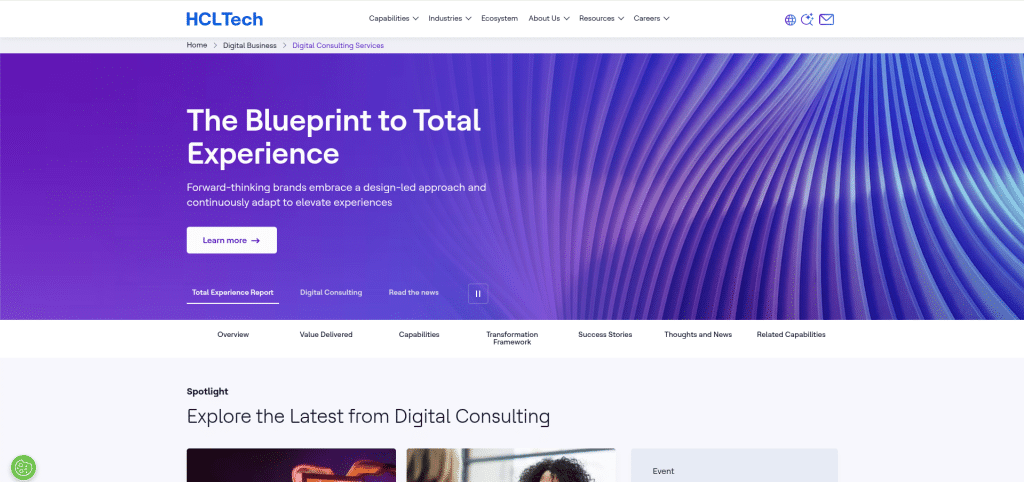
- Publications and Research: HCLTech regularly produces whitepapers, research reports, and points of view on emerging trends. The HCLTech Digital Consulting group, for instance, published a global research report in 2024 titled “The Blueprint to Total Experience”, studying how companies integrate customer, employee, and user experience – this kind of intellectual asset positions HCL consultants as experts in the “Total Experience (TX)” domain, influencing how clients approach their strategies. HCL executives also contribute articles to platforms like Forbes Technology Council and other industry publications on topics such as AI adoption, cloud economics, and sustainability in IT. These articles and HCL’s sponsored research (often done in collaboration with analyst firms like IDC or HfS Research) help shape the conversation in the tech industry.
- Academic and Industry Partnerships: To stay at the cutting edge, HCLTech has forged ties with academia and industry bodies. For example, HCL has sponsored research chairs at certain universities and partnered with IITs in India on joint innovation programs. It also actively participates in the World Economic Forum (WEF) – HCLTech has been a strategic partner to the WEF and often showcases its tech innovations at Davos and WEF’s Centre for the Fourth Industrial Revolution. In industry consortiums (like the TM Forum for telecom, or Automotive Grade Linux for auto industry software), HCL experts contribute to developing new standards and frameworks. This involvement not only gives HCL insights to bring to clients but also allows it to influence industry standards – a hallmark of thought leadership.
- HCLTech Labs and IP Creation: HCLTech’s dedicated R&D arm, HCLTech Labs, drives much of its innovation in emerging tech. The labs focus on areas like Artificial Intelligence, Automation (RPA/AIOps), Quantum computing, and next-gen enterprise software. Notable outputs include the DRYiCE™ software products (for autonomic computing and AI-led service management) and various “ADvantage” frameworks as mentioned earlier. By developing its own IP and software (e.g., HCL has over the years created products in security, collaboration, and marketing domains), HCL not only generates revenue from licensing but also demonstrates technical thought leadership – showing that it’s not just a services follower, but also a tech creator. A striking example was the acquisition and subsequent development of IBM’s software products like Unica, AppScan, and Notes/Domino: HCL took on the challenge of reinvigorating these products, and through HCLSoftware it introduced new versions with modern enhancements. The industry watched closely as HCL, an outsourcing firm, successfully ran a products business – and this story has been featured in business media as an innovative pivot for an IT services company.
- Global Digital Innovation Hubs: HCLTech has launched innovation hubs in various regions (often in collaboration with clients or local governments). For instance, HCL has a Cybersecurity Fusion Center in Dallas, an IoT COLLAB in Seattle, and fintech innovation labs in London and Singapore. These hubs host workshops, hackathons, and “innovation days” where HCL and client teams brainstorm solutions to business problems using new technologies. The outcomes (new prototypes, frameworks, or solution concepts) often become showcase case studies that HCL presents in industry events. By jointly innovating with clients, HCL positions itself as a partner driving co-creation – a thought leadership angle that moves beyond vendor-supplier dynamics.
- Social Responsibility and Tech for Good: In terms of broader thought leadership, HCLTech also contributes ideas on how technology can address societal challenges. Through its CSR and programs like HCL Foundation and partnerships (e.g., with the United Nations), HCL is involved in initiatives like skill development, environmental sustainability, and healthcare access. The company has published insights on sustainable technology practices (like green data centers, using AI for climate data analysis, etc.). By advocating for responsible tech and showcasing projects where HCL solutions had a social impact (for example, building a platform for a government to distribute benefits more efficiently, or using analytics to improve agriculture outcomes for farmers), HCL adds a human dimension to its innovation narrative. Leaders from HCL often speak on such topics, further solidifying the firm’s image as a forward-looking, conscientious innovator.
- Awards and Recognitions: HCLTech’s thought leadership is frequently validated by industry recognitions. The company and its leaders have won awards such as Forbes “World’s Most Innovative Companies” list appearances, rankings in Gartner Magic Quadrants as Leaders for various service lines, and awards for its HR and sustainability practices. Each award or positive analyst report (e.g., HCL being named a Leader in Digital Transformation Services by Forrester, or receiving a high rating in Everest Group’s PEAK matrix for banking IT consulting) is promoted by HCL to reinforce its authoritative stance in those domains. These accolades and the underlying case studies often become content for webinars, keynote addresses, and panel discussions where HCL execs share best practices.
In essence, HCLTech demonstrates thought leadership not by pure academic theory, but by pragmatic innovation – its contributions are rooted in real-world execution, whether it’s a unique management philosophy like EFCS or a cutting-edge AI solution for a client. This resonates well with the firm’s clientele (typically pragmatic technology leaders themselves), and it has helped HCL build trust as an innovator that delivers tangible value. By 2025, HCL is seen as an exemplar of how a services company can transform itself through innovation and, in turn, guide global clients on their own transformation journeys.
High-Impact Consulting and Transformation Projects
Over the decades, HCLTech (and its consulting division) has been involved in numerous transformative projects worldwide. Some of the distinctive, high-impact engagements the firm is recognized for include:
- Global Sports Digital Transformation – Manchester United Partnership (2015): HCLTech became the official digital technology partner for the iconic football club Manchester United. In this high-visibility engagement, HCL’s consulting and engineering teams developed a comprehensive digital platform to enhance the fan experience for over 659 million fans worldwide. This included revamping Man Utd’s website and mobile app, creating personalized content delivery for fans, and building analytics-driven fan engagement tools. The project showcased HCL’s ability to handle a complex digital transformation with millions of end-users, tight deadlines (aligning with football seasons), and the cultural sensitivity of a global fanbase. It stands as a marquee case of HCL enabling an organization to connect with its customers (fans) in a radically new way using technology. Executives often cite this as a proof-point of HCL’s digital consulting prowess in the media and entertainment domain.
- Major Telecom Network Modernization – Verizon Deal (2023): In 2023, HCLTech signed a landmark $2.1 billion contract with Verizon Business to manage and transform its network infrastructure services. This multi-year deal is one of the largest ever for HCL and for the IT services industry. Under this engagement, HCL’s consulting experts in telecom are tasked with streamlining Verizon’s network operations, introducing automation (through AIOps tools like DRYiCE), and improving service quality for Verizon’s enterprise customers. HCL is essentially running critical network platforms and simultaneously reengineering them for the 5G era. The scale – spanning thousands of sites and critical nationwide services – and the strategic importance (network uptime is vital) make it a high-impact project. HCL’s successful onboarding and ongoing execution of this deal have earned it recognition as a trusted partner in the telecom sector, boosting its credibility for handling large-scale managed transformations.
- SAP-led Business Transformation for Enterprises: Thanks to the HCL Axon heritage, HCL has led many large SAP implementation projects that were in fact full business transformations. One notable example (circa early 2010s) was a multi-country SAP rollout for a Fortune 500 consumer goods manufacturer (name confidential, but widely referenced in SAP circles) where HCL Axon consultants redesigned the company’s global supply chain and finance processes. The project involved harmonizing operations across North America, Europe, and Asia, touching tens of thousands of employees and suppliers. HCL deployed a team of business consultants and SAP experts to standardize processes, implement SAP ECC (later upgraded to S/4HANA), and manage change in various local subsidiaries. The outcome was a more efficient, globally unified operation and significant cost savings in procurement and inventory. The client publicly acknowledged HCL’s role in not just IT implementation but also in achieving business KPIs improvement, underscoring HCL’s strength in ERP-enabled transformation.
- Digital Banking Transformation: HCLTech has undertaken critical projects in the banking sector, such as modernizing core banking for a large Asian bank and implementing a digital lending platform for a major European bank. In one engagement, HCL’s consulting team helped an Indian private bank move from legacy core systems to a modern core banking solution while simultaneously introducing a new mobile banking app and digital channels. This multi-layered program required deep domain consulting (to reimagine banking products for the digital age), enterprise architecture expertise, and rigorous data migration planning. The transformation enabled the bank to launch new products faster and improved customer satisfaction through better digital interfaces. HCL won industry awards for this project, and it’s often cited in case studies about successful core banking modernization. Similarly, HCL’s wealth management consulting (augmented by the Confinale acquisition) helped a Swiss wealth manager automate its advisory processes – a project that was recognized in banking tech forums.
- Healthcare and Life Sciences Innovation: HCLTech’s notable work in life sciences includes a project with a global pharmaceutical company to implement a unified R&D data platform. HCL consultants with domain knowledge in clinical research helped design a data lake that combined research data, clinical trial results, and real-world patient data. This enabled the pharma client to apply AI/ML algorithms for drug discovery and pharmacovigilance (drug safety). The project was complex, involving compliance with stringent regulations (FDA, EMA), integration of siloed systems, and change management among scientists and researchers. The success of this program established HCL’s reputation in the life sciences consulting space, demonstrating it could blend deep industry consulting (understanding of R&D processes) with cutting-edge technology (big data and AI). Another impactful initiative was HCL’s partnership with a leading medical devices manufacturer to set up a Global Engineering Center: HCL’s engineering consultants and designers collaborated to accelerate product development for high-tech medical devices, shortening development cycles by 20%. This co-engineering model in a regulated industry showcased HCL’s consulting in product innovation and was featured in an HBR case study on globalized R&D.
- Public Sector Digital Platform – India and Beyond: HCL has played a key role in government digital initiatives. For example, HCL was instrumental in developing part of India’s UIDAI Aadhaar project (the world’s largest biometric citizen ID program), where it helped with the application support and infrastructure for enrollment and authentication services. Handling authentication requests of over a billion transactions required immense scalability planning and optimization consulting. The success of Aadhaar’s tech backbone owes in part to vendors like HCL, and this project highlighted HCL’s ability to deliver mission-critical, nation-scale solutions. Internationally, HCL also worked on a European government’s tax modernization program, where its consultants helped migrate legacy tax systems to a new digital platform, improving service to millions of citizens. The complexity of ensuring data accuracy, security, and minimal downtime in such public systems meant that HCL’s meticulous planning and execution were crucial – an achievement that got noticed in public sector IT forums.
- Notable Innovation Partnerships: HCLTech often engages in projects that push technological frontiers. One example is HCL’s collaboration with an aerospace giant (like Airbus) wherein HCL engineers and consultants co-developed an avionics software subsystem for new aircraft, meeting strict safety standards (DO-178C). While primarily an engineering service, it involved substantial consulting around process certification and industry compliance. Another example is a joint initiative with IBM: after HCL acquired IBM’s software products, it worked closely with IBM (as a partner rather than client) to ensure existing IBM customers transitioned smoothly to HCL’s support and development. This required consulting engagements with dozens of Fortune 500 companies using those products, advising them on future roadmaps and instilling confidence in HCL’s stewardship. The seamless transition and subsequent client satisfaction in product support were a huge credibility boost, showcasing HCL’s consulting-led approach to product management.
Each of these projects and partnerships has been high-impact—either due to their massive scale, technological complexity, or strategic significance. HCLTech is often willing to jointly invest and co-innovate in such engagements (for instance, setting up dedicated innovation teams or risk-reward commercial models), which has resulted in win-win outcomes and long-term client relationships. Many clients have publicly lauded HCL for being “more than a vendor” – highlighting how HCL’s consulting teams understand their business and proactively drive improvements. These success stories feed into HCL’s business development as well; case studies from one industry are presented to new clients in another, demonstrating transferable best practices (e.g., using a retail case study to inspire an e-commerce overhaul for a CPG client).
By 2025, HCLTech’s consulting and transformation track record spans everything from IT mega-deals to niche strategic advisories. The common thread is that HCL’s teams have delivered tangible business outcomes – whether it’s new revenue streams for a client, significant cost reductions, improved end-customer experience, or a faster innovation cycle. This solid delivery reputation, combined with the firm’s innovative culture and global reach, firmly establishes HCLTech Consulting as a trusted partner for enterprises seeking to navigate the complex digital landscape.
Consulting Firm Profiles:
- Accenture
- Accordion Consulting
- Advisory Board
- AlixPartners
- Alvarez and Marsal
- Altman Solon Consulting
- Analysis Group
- Ankura Consulting Group
- Archstone Consulting (Acquired by The Hackett Group, Inc)
- Arthur D. Little
- Arthur J. Gallagher & Co.
- Arcadis
- Aon Consulting Services
- Arup Group
- Atos Group and Atos Consulting
- Bain & Company
- Baker Tilly International
- Bates White Economic Consulting
- BDO Consulting
- BearingPoint
- Berkeley Research Group
- BNP Paribas CIB Consulting & Transformation
- Booz Allen Hamilton
- Boston Consulting Group
- Bridgespan Group
- Capco Consulting
- Capgemini
- Capgemini Invent
- Carpedia International Consulting
- CGI Inc.
- Charles River Associates (CRA)
- Chemonics International Inc.
- ClearView Healthcare Partners
- Coalition Greenwich
- Cognizant Technology Solutions
- Compass Lexecon
- Computer Sciences Corporation (CSC) and Evolution into DXC Technology
- Cornerstone Research
- Corporate Executive Board (CEB)
- Crowe Global and Crowe LLP
- Dalberg Global Development Advisors
- Deloitte
- DGC Partners LLC
- dss+ (Formerly DuPont Sustainable Solutions)
- Environmental Resources Management (ERM)
- Everest Group (acquired by Wavestone)
- EVERSANA and EVERSANA CONSULTING
- EXL Service
- EY Consulting
- EY-Parthenon
- FTI Consulting
- FTI Delta (formerly Delta Partners)
- Forvis Mazars
- Galt & Company (acquired by AlixPartners)
- Gartner Inc. and Gartner Consulting
- GEP Worldwide
- ghSMART Consulting
- Grant Thornton Consulting – U.S. and Global
- Guidehouse
- Hay Group (acquired by Korn Ferry)
- HCL Axon Consulting
- HCLTech Consulting
- HDR, Inc.
- Health Advances Consulting
- Hewitt Associates (acquired by Aon)
- Hitachi Consulting (acquired by Hitachi Vantara)
- HP Enterprise Services Consulting (acquired by Hewlett Packard Enterprise)
- Horváth & Partners Consulting
- Huron Consulting Group
- IDEO
- IBM Consulting
- Infosys Ltd and Infosys Consulting
- Information Services Group (ISG) Consulting
- IQVIA Consulting Business
- INSIGHT2PROFIT Consulting
- Ipsos Consulting
- Jacobs Solutions Consulting
- John Wood Group PLC
- Kantar
- Kearney
- Korn Ferry
- KPMG
- Kroll (formerly Duff and Phelps)
- Kurt Salmon (acquired by Accenture)
- Larx Advisors Consulting
- Launch Consulting Group
- Leidos
- L.E.K. Consulting
- LTIMindtree
- Maine Pointe Consulting (acquired by SGS Group)
- Marakon Consulting
- Marsh & McLennan
- Mars & Co
- Mastercard Advisors and Mastercard Data & Services Division
- McKinsey & Company
- Mercer Consulting
- Metyis
- Miller Heiman Group
- Mitchell Madison Group
- Monitor Deloitte
- Mott MacDonald
- Navigant Consulting (acquired by Guidehouse)
- NERA Economic Consulting
- Newton Consulting Partners
- North Highland Consulting
- NTT DATA Consulting and NTT DATA Inc
- OC&C Strategy Consultants
- Oliver Wyman
- PA Consulting
- Palm Tree LLC
- Parsons Corporation
- Partners in Performance (acquired by Accenture)
- Point B Inc.
- Pointe Advisory
- Porsche Consulting
- ProcureAbility
- Propeller Consulting LLC
- Protiviti
- PRTM Consulting (acquired by PwC)
- Putnam
- PwC Consulting and Strategy&
- Ramboll
- RAND Corporation
- Riveron Consulting
- RGP Global Consulting Firm
- Roland Berger
- RSM International
- Schlumberger Business Consulting (acquired by Accenture)
- Science Applications International Corporation (SAIC)
- ScottMadden Consulting
- Simon-Kucher & Partners
- Slalom Consulting
- SSA & Company
- Stantec
- Strategy& (PwC)
- St. Onge Company
- Syneos Health Consulting
- SynFiny Advisors
- Targus Management Consulting AG
- Tata Consultancy Services
- Teneo Consulting
- Tetra Tech Consulting
- The Brattle Group
- The Cambridge Group
- The Chartis Group
- The Hackett Group
- Tompkins Solutions
- TriVista Consulting
- Visa Consulting & Analytics (VCA)
- Wavestone Consulting
- West Monroe Partners
- Willis Towers Watson Consulting
- Wilson Perumal & Company
- Wipro Consulting
- Worley
- WSP Global
- Xynteo
- ZS
