
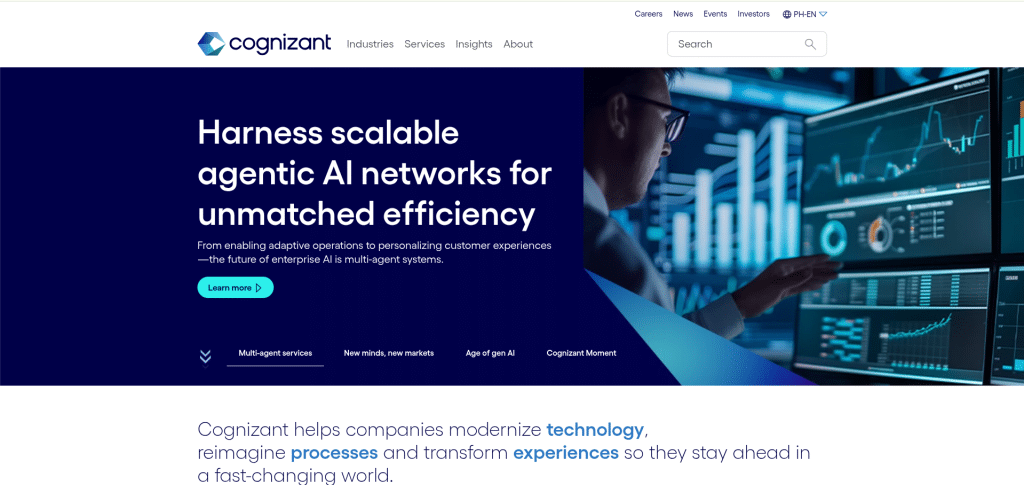
Cognizant Technology Solutions is a leading multinational provider of information technology (IT) services, consulting, and business process outsourcing (BPO) solutions. Established in 1994 as an in-house technology unit of Dun & Bradstreet, Cognizant became an independent company in 1996 and is headquartered in Teaneck, New Jersey, USA.
Company Overview and History
Cognizant Technology Solutions is an Indian-American multinational IT services company founded in 1994 as an in-house technology unit of Dun & Bradstreet. Initially named Dun & Bradstreet Satyam Software, it began by handling large-scale IT projects and later started serving external clients by 1996. After a series of restructurings and a 1998 IPO, Cognizant became a public company and moved its headquarters to the United States. The company rapidly expanded beyond application development into business process outsourcing (BPO) and consulting services in the 2000s. By the mid-2000s, Cognizant had established a dedicated management consulting practice (Cognizant Consulting) to complement its IT services. Unlike standalone consultancies, Cognizant embeds consultants across its industry-focused vertical units (e.g. financial services, healthcare) and horizontal practice areas (e.g. analytics, mobile, testing). These consultants collaborate with technical teams to provide strategic advice and digital transformation roadmaps for clients, forming an organization-wide Cognizant Consulting team. This structure ensures the consulting and digital transformation divisions are tightly integrated with Cognizant’s broader delivery organization rather than operating as siloed units. Cognizant’s consulting arm has become one of the industry’s largest MBA recruiters, underscoring the firm’s commitment to bringing business advisory talent into its technology projects.
Management Consulting and Digital Transformation Services
Service Offerings: Cognizant’s consulting and digital transformation services span a wide range of capabilities aimed at helping clients modernize their businesses. Key management consulting offerings include strategy consulting, operating model design, process re-engineering, and program management for large transformations. For example, Cognizant’s Enterprise Process Consulting practice optimizes business processes to increase speed-to-market and efficiency. Its Transformation Management services provide end-to-end orchestration of complex change initiatives in close coordination with client stakeholders. Cognizant also offers technology modernization consulting, advising organizations on leveraging new technologies (like cloud or analytics) to solve critical business challenges and upskilling client teams in the process.
Beyond traditional management consulting, Cognizant has extensive digital transformation services. This includes digital strategy development, customer experience redesign, cloud migration guidance, artificial intelligence (AI) and data analytics consulting, and enterprise application modernization. Cognizant’s Digital Experience practice, for instance, helps clients reinvent customer and employee journeys using industry-specific research and emerging technologies, covering areas like omnichannel customer experience, digital marketing, and e-commerce optimization. The company’s portfolio also features intelligent automation solutions (marketed as Cognizant Neuro) to transform business process workflows with AI-driven automation. In cloud consulting, Cognizant provides services such as Cloud Consult (strategy and design of cloud transformations), Cloud Migrate (planning and executing cloud migrations), and industry-tailored cloud solutions via partnerships with AWS and Microsoft. Overall, Cognizant’s consulting and digital service lines cover the full spectrum from high-level strategy through to implementation, often positioning the firm as a one-stop transformation partner that can plan, design, and execute digital initiatives. Notably, Cognizant has continuously invested in new capabilities (e.g. blockchain, Internet of Things, and AI) and made strategic acquisitions to enhance its consulting and digital offerings.
Industry Focus: Cognizant’s consulting and digital teams are organized to serve clients across all major industries, with particular strength in a few verticals. The company’s largest client segments are financial services (banking, capital markets, insurance) and healthcare, which together accounted for over 60% of revenue as of 2021. Cognizant consultants in banking and insurance focus on initiatives like core banking modernization, digital onboarding, and risk management strategies for financial institutions. In healthcare and life sciences, Cognizant provides consulting on healthcare IT modernization, patient experience, and integration of digital health ecosystems. Other key industries include products and resources (covering consumer goods, retail, manufacturing, and logistics) and communications, media & technology, each of which contributes a significant share of revenue. Cognizant’s consultants tailor solutions to industry-specific challenges: for example, improving supply chain resilience in manufacturing or enhancing customer personalization in retail. The firm’s broad industry expertise is evidenced by its service to over 20 different sectors, ranging from automotive and energy to education and public sector. This industry alignment allows Cognizant to bring domain-specific best practices and regulatory knowledge to its digital transformation projects. By combining deep sector know-how with technology solutions, Cognizant’s consulting division helps clients address the unique disruptions and opportunities of their industries—whether that’s telehealth in healthcare, fintech in banking, or Industry 4.0 in manufacturing.
Notable Strengths: Cognizant’s management consulting and digital practices have earned recognition from independent analysts. In 2023, ISG ranked Cognizant as a Leader in Business Consulting Services, highlighting strengths in its structured consulting approach, growth via acquisitions, and ability to execute complex digital consulting projects. Research firm HFS also commended Cognizant’s consulting arm for responding to enterprise demand with an “advisory-forward delivery model” and effective consulting playbooks for engaging C-suite stakeholders. These strengths reflect Cognizant’s emphasis on practical, results-driven consulting – the firm prides itself on blending bold ideas with hands-on solution design. As Cognizant’s own marketing puts it, their consultants aim to bridge the gap between strategy and execution with “bold thinking and practical know-how,” supporting clients through every step of transformation. In summary, Cognizant’s consulting and digital transformation offerings are comprehensive, covering strategy through operations, and are delivered with an industry-focused, technology-enabled approach that aligns closely with the company’s broader IT services portfolio.
Revenue, Workforce, and Global Presence
Cognizant has grown into one of the world’s largest professional services companies. The firm’s annual revenue was $19.42 billion in 2022, reflecting its substantial scale in IT and consulting services. This places Cognizant among the top IT services providers globally. In terms of workforce, Cognizant’s headcount reached 336,300 employees as of June 2024, a dramatic expansion from its 50-person start in 1994. These employees are spread across a robust global delivery network. Cognizant operates in over 40 countries worldwide, enabling it to service clients with a mix of onshore, near-shore, and offshore teams. The company has a particularly large presence in India (where a significant portion of its delivery centers and talent reside) and major offices across North America, Europe, Asia-Pacific, and Latin America. North America (especially the U.S.) historically generates the majority of Cognizant’s revenue, but the company also derives roughly one quarter of its business from international markets such as Europe. Cognizant’s client base includes 35% of the Fortune 500 and spans hundreds of multinational corporations. The firm’s broad global reach and large talent pool have been key to its ability to undertake massive digital transformation projects for clients around the world. Cognizant consistently ranks in the Fortune 500 list of largest U.S. companies (placing #213 in 2024) and has been on the list since 2011 as its revenues grew into the multi-billions. This financial and geographic scale gives Cognizant a significant delivery capability comparable to its largest competitors.
Competitive Positioning and Peers Comparison
Cognizant operates in a competitive landscape alongside other global IT consulting and outsourcing leaders. Notably, its main peers include Accenture, Tata Consultancy Services (TCS), Infosys, and Wipro, each with different strengths and market positioning. Below is a comparison of Cognizant with these rivals, examining relative size, service focus, and differentiation:
- Accenture: Accenture is the largest professional services firm globally, with $61.6 billion in revenue in 2022 and over 720,000 employees, far surpassing Cognizant’s size. Accenture’s competitive edge lies in its breadth of offerings – from high-end management consulting and strategy (through Accenture Strategy) to creative digital marketing services (via Accenture Song) – combined with extensive technology implementation capabilities. It serves clients in 120+ countries and has a long-established consulting pedigree. Cognizant, by contrast, has a more focused footprint (around 40 countries) and historically grew out of technology outsourcing. While both firms help enterprises with digital transformation, Accenture is often engaged for large-scale strategic overhauls and has a premium brand in boardroom consulting. Cognizant differentiates itself by offering consulting integrated with deep industry-specific IT expertise at a potentially lower cost. For example, Cognizant might pair domain consultants with offshore delivery teams to provide end-to-end solutions, whereas Accenture brings large onsite teams and a vast ecosystem of acquired specialist firms. In the market, Accenture is frequently seen as setting the benchmark for innovation investment and global reach, while Cognizant competes by being highly customer-centric and agile. Notably, employee reviews indicate Accenture outranks Cognizant on aspects like culture and career growth, suggesting Accenture’s strong brand extends to talent attraction as well. However, both companies are considered leaders in digital transformation; Cognizant often partners with clients’ IT and business units closely, leveraging its two-decade experience in managed services alongside consulting, whereas Accenture leverages its scale and research-driven methodologies.
- TCS (Tata Consultancy Services): TCS is Asia’s largest IT services firm and a direct competitor to Cognizant in many deals. TCS recorded about $25–27 billion in revenue in FY2022 (year ending March 2022) and had over 592,000 employees that year. By 2023, TCS crossed $27 billion in annual revenue and 600,000+ employees, roughly twice Cognizant’s workforce. TCS’s hallmark is its operational excellence, massive scale, and broad portfolio – it has a presence in over 50 countries and serves every major industry, much like Cognizant. One key difference is market focus: only about 26% of Cognizant’s revenue comes from outside the U.S., whereas TCS has a more geographically diversified business (only ~53% from North America, with strong Europe and emerging markets presence). TCS and Cognizant are often compared due to their Indian heritage and overlapping service lines (application development, outsourcing, consulting). TCS is known for its large long-term outsourcing contracts and a very stable leadership (backed by the Tata Group), which has resulted in steady growth. Cognizant, meanwhile, gained market share rapidly in the 2000s by being more aggressive and client-responsive (“customer-first” approach). Cognizant’s competitive advantage against TCS has often been its client engagement model – Cognizant pioneered a “Two-in-a-Box” model pairing onsite and offshore managers to closely align with client needs, which helped it win business from U.S. clients. TCS, on the other hand, leverages its sheer scale and delivery rigor (e.g., its ability to ramp thousands of engineers on a project quickly). In consulting and digital, both companies are ramping up: TCS has its consulting and interactive divisions but is sometimes perceived more as a technology executor. Cognizant strives to position itself as a co-innovator, blending consulting with execution. In summary, TCS often competes on reliability, scale, and cost-effectiveness, while Cognizant competes on agility, domain intimacy, and its U.S.-centric client relationships. Both rank among the top 5 global IT services providers by revenue and are frequently shortlisted together, with Cognizant generally being slightly smaller but very close to TCS in key verticals like banking and healthcare.
- Infosys: Infosys is another major India-founded IT services firm that is comparable to Cognizant in revenue size. In FY2023, Infosys reported about $18 billion in revenue and had approximately 343,000 employees globally, putting it in the same ballpark as Cognizant (which had ~$19B in 2022 revenue and 336k employees). Both companies generate the bulk of their business from North America and offer a mix of IT and consulting services. One distinction is service mix: Infosys has traditionally been revered for its engineering excellence and has developed proprietary software platforms (like the Finacle core banking system and other digital products). Cognizant, by contrast, has mostly focused on services and made fewer proprietary products, instead partnering with other software providers or acquiring niche firms. Infosys also operates a subsidiary, Infosys Consulting, which provides management consulting and was bolstered by the acquisition of Lodestone in 2012. Cognizant’s consulting division is similarly aimed at high-level advisory, but Infosys Consulting historically had a more separate branding. In recent years, the competition between Infosys and Cognizant has intensified, particularly in digital transformation deals. Cognizant held a slight lead in revenue, but Infosys has been growing steadily and often touts higher profit margins. In terms of competitive advantage, Infosys is known for its strong training programs and innovation in delivery (e.g., early adoption of AI in software development), whereas Cognizant is often praised for its strong client partnerships and domain-focused approach. Infosys has also diversified with proprietary AI and automation tools (like its Nia platform) to enhance consulting engagements, while Cognizant has invested heavily in acquisitions (e.g., buying TriZetto to deepen its healthcare domain expertise). The two firms often go head-to-head for contracts, and clients might view Infosys as slightly more technical and process-driven, and Cognizant as more flexible and business-oriented. Both rank just below TCS in the global pecking order, with Cognizant having initially surpassed Infosys in the 2010s, though the gap remains narrow.
- Wipro: Wipro is another peer in the IT services sector, though somewhat smaller in scale. For the year ended March 2023, Wipro reported $11.0 billion in revenue and about 234,000 employees as of early 2024. Historically, Wipro, Cognizant, and Infosys have competed closely, especially in areas like application services and business process services. Wipro’s key industries and global footprint are similar (strong in North America and Europe, with big clients in finance, energy, etc.), but Wipro has been perceived as trailing in growth in recent years. In response, Wipro launched a bold strategy to rejuvenate its offerings – notably, in 2021 Wipro acquired Capco, a global financial services consulting firm, for $1.45 billion to strengthen its management consulting capabilities in banking. This acquisition was one of Wipro’s largest and signaled a push into the kind of domain consulting that Cognizant and others offer. Cognizant, which had acquired healthcare consultancy TriZetto in 2014 and several smaller digital agencies, has likewise expanded its consulting via acquisitions but more incrementally. In terms of competitive positioning, Wipro is often strong in infrastructure management and engineering services, and it has a legacy of product R&D services. Cognizant, on the other hand, has a stronger profile in consulting-intensive digital transformation programs, especially in healthcare and retail. Wipro’s new leadership (since 2020) has been aiming to close the gap with faster growth and more consulting-led engagements, directly challenging Cognizant. From a client’s view, Wipro and Cognizant might both be evaluated for large IT outsourcing deals; Cognizant might edge out with its higher U.S. presence and consultative approach, whereas Wipro could leverage pricing and its growing consulting arm. Overall, Cognizant currently holds a revenue and scale advantage over Wipro, and is generally considered among the “Big 4” Indian-origin IT firms (TCS, Infosys, HCL, Wipro) where it often ranks second or third by revenue. Cognizant’s competitive advantage against Wipro lies in its established domain depth and a slightly broader digital services portfolio, while Wipro is working to differentiate through specialized consulting (Capco) and cloud capabilities.
Summary: In the global IT services market, Cognizant is a top-tier player (among the top 5 providers worldwide) but faces formidable competition. Accenture stands out as a much larger full-spectrum firm; TCS and Infosys are close rivals in offshore-centric services; and Wipro is a slightly smaller challenger investing heavily to grow. Cognizant’s market positioning emphasizes being a partner that offers both digital innovation and operational know-how, often highlighting its ability to “engineer modern businesses” by marrying consulting insights with technical execution. The firm’s differentiation often comes from its vertical specialization (especially in healthcare and financial services) and its client intimacy model. As the industry evolves, Cognizant is striving to increase its consulting-led engagements to compete more directly with Accenture and the consulting arms of peers – for instance, Cognizant announced in 2023 an ambition to double its consulting business in overseas markets to deepen its strategic relationships with clients. This indicates Cognizant’s recognition that high-value consulting services are crucial for competitive positioning against both traditional consultancies and IT outsourcers.
Career Paths and Promotion in Cognizant Consulting
Cognizant’s consulting division offers clear career progression steps similar to other large consulting firms, with a hierarchical structure of roles. While exact titles can vary, a typical career path in Cognizant Consulting starts at an entry-level position (often called Associate or Consultant, depending on experience). New graduates (especially those from undergraduate programs) may join as Associates, where they focus on business analysis and supporting client engagements. After gaining a few years of experience, high-performing associates are promoted to Senior Associate, a role involving greater responsibility in project delivery and possibly small team leadership. Promotion from Associate to Senior Associate generally requires around 2+ years of experience and solid performance ratings, according to employee discussions.
Beyond the senior associate level, the next step is often Consultant or Manager (the titling can overlap – some tracks use Consultant for someone managing workstreams, while others use Manager for those overseeing entire projects). As consultants gain expertise, they may advance to Senior Consultant, where they are leading significant portions of client engagements and providing thought leadership in their domain. The progression continues into principal-level roles: Cognizant uses titles like Principal Consultant or Engagement Manager for seasoned consultants who drive large projects or multiple accounts and often contribute to sales. From there, the path moves into leadership ranks such as Associate Director (also sometimes referred to as Senior Manager in consulting), then Director. Associate Directors and Directors in Cognizant Consulting are senior leaders who manage client relationships, lead practice areas or large programs, and mentor teams; these roles are roughly equivalent to non-equity partners or junior partners in a traditional consulting firm. Above the Director level, the career path can lead to titles like Vice President or Partner (Cognizant is a corporation, not a partnership, but top consulting executives often hold VP, Senior VP, or similar designations within the company).
Cognizant places a strong emphasis on merit-based promotion, though employees report that moving up can be competitive. Generally, promotions at junior levels occur every 2–3 years given strong performance, business need, and demonstration of consulting “pillar” skills (such as project execution, client management, and thought leadership). The company explicitly defines consulting excellence criteria – for example, Associate Directors are expected to excel in five pillars: project delivery, expertise, sales support, people development, and intellectual capital – to be considered for further elevation. Moreover, Cognizant’s large intake of MBAs means the consulting career track is structured to accommodate rapid advancement for high performers with advanced degrees. In fact, Cognizant is among the industry’s biggest MBA recruiters, and these MBA hires often enter at higher ranks (e.g. Senior Associate or Consultant) and have a defined fast-track to leadership. Overall, a career in Cognizant’s consulting division can progress from entry-level analyst through management and up to executive roles, with a promotion timeline and structure comparable to big consulting firms. The firm also provides career development programs – such as mentoring, training in its Digital Leadership Academy for rising talent, and global mobility opportunities – to support consultants in their growth.
Consultant Compensation at Different Levels
While exact compensation varies by country and year, publicly available data gives a picture of Cognizant’s consultant salaries in the United States. According to recent Glassdoor reports compiled in 2022, Cognizant’s consulting salaries are competitive with industry standards. Below are average annual base salary estimates for several consulting roles at Cognizant (U.S. figures):
- Associate (Consultant) – approximately $76,000 per year. This is an entry-level consultant salary for those just starting or with minimal experience.
- Senior Associate – around $93,000 per year. Senior Associates have a few years of experience or an MBA and take on greater project responsibilities. (Notably, some sources use the title “Consultant” in a similar pay band; Cognizant’s titling can overlap, as an experienced Associate might have similar pay to a junior Consultant.)
- Consultant (Mid-level) – around $94,000 per year on average. This title often corresponds to professionals managing parts of projects or specialized workstreams. (In some data, Consultants and Senior Associates were in a similar range, roughly in the low-to-mid $90Ks.)
- Senior Consultant – approximately $109,500 per year. Senior Consultants are typically team leads or subject matter experts with significant client-facing experience.
- Principal Consultant – approximately $198,700 per year. Principal Consultants are very senior individual contributors or engagement leaders, often equivalent to project directors or junior partners. Their compensation reflects both advanced expertise and leadership in revenue-driving engagements.
- Associate Director (Consulting) – approximately $169,400 per year. This level (also sometimes titled Senior Manager in internal terms) is an executive role involved in managing major accounts or practice areas. Interestingly, data shows Senior Business Consultant roles also averaging around $169,000, which suggests that senior domain experts and associate directors are in a similar compensation bracket.
It’s important to note these figures typically represent base salaries and do not include performance bonuses, profit-sharing, or other benefits. Consultants at higher levels (Principal, Director) may have a larger portion of variable pay or bonuses tied to project sales and delivery performance. Additionally, Cognizant offers typical benefits (health insurance, 401k, etc.) and, for senior positions, eligibility for stock awards. For context, Cognizant’s salaries are generally in line with other large IT consulting firms; for example, an Associate Director at Cognizant (roughly $170k base) is comparable to a Manager/Senior Manager at a Big 4 consulting firm in the U.S., while a Principal Consultant nearing $200k base is on par with some Director or junior partner positions in those firms. These compensation levels indicate that Cognizant invests in experienced consulting talent to support its advisory services. (All figures cited are from recent publicly reported averages and actual offers may vary by region and year.)
Recent Developments in Leadership and Strategy
Cognizant has undergone notable leadership changes and strategic shifts in the past few years, underscoring its focus on reinvigorating growth in consulting and digital services. In January 2023, Ravi Kumar S (Singisetti) was appointed as the new CEO of Cognizant, succeeding Brian Humphries. Ravi Kumar S joined from Infosys (where he was previously President) and his elevation to CEO marked a significant leadership transition, with industry observers noting his mandate to “unlock” Cognizant’s potential and accelerate growth. Alongside this change, Cognizant also brought in a new Chief Financial Officer (Jatin Dalal, formerly CFO of Wipro) in 2023, indicating a refresh at the top management level. Under the new leadership, Cognizant has signaled strategic adjustments: there is a heightened emphasis on expanding international business and deepening consulting-led engagements. In mid-2023, Cognizant announced an ambition to double its revenue from global (non-U.S.) markets in the coming years, aiming to grow faster in regions like Europe and Asia-Pacific. Part of this strategy involves bolstering the consulting practice to engage clients at a higher strategic level. Cognizant’s Global Growth Markets division set a goal to double consulting’s share to 9% of its international revenue, to drive more C-suite conversations and sole-sourced transformational projects. This represents a strategic shift to a more consulting-led go-to-market approach, moving Cognizant closer to the model of Accenture and other consulting-heavy peers in those regions.
Operationally, Cognizant has also made moves to refine its portfolio. In 2022, the company divested a smaller Finnish banking software unit (Oy Samlink) to Kyndryl, streamlining its focus on core digital services. Meanwhile, it has continued to invest in high-demand areas: for instance, Cognizant significantly ramped up its cloud services partnership ecosystem and capabilities in digital engineering. In 2023 and 2024, Cognizant announced partnerships and initiatives in emerging tech, such as a collaboration with Microsoft to extend services in Generative AI and AI-powered “copilot” solutions for clients. This aligns with the broader industry pivot to AI-driven transformation, and Cognizant is positioning itself to offer AI consultation and implementation as part of its digital offerings.
Another recent focus has been on improving internal efficiency and talent retention. Cognizant experienced elevated attrition in 2021–2022, which management has been addressing through salary adjustments and career development programs. The company also undertook some cost optimization and organizational simplification efforts (including trimming certain senior roles) to become more agile. In 2023, as global tech demand fluctuated, Cognizant showed signs of stabilizing its workforce and even made targeted layoffs in specific acquired units to integrate operations better. These operational tweaks are part of ensuring Cognizant remains competitive and profitable while it pursues its strategic goals in digital and consulting services.
Sources
The information above is compiled from recent analyses and credible reports, including the firm’s own publications and reporting by reputable outlets.
Consulting Firm Profiles:
- Accenture
- Accordion Consulting
- Advisory Board
- AlixPartners
- Alvarez and Marsal
- Altman Solon Consulting
- Analysis Group
- Ankura Consulting Group
- Archstone Consulting (Acquired by The Hackett Group, Inc)
- Arthur D. Little
- Arthur J. Gallagher & Co.
- Arcadis
- Aon Consulting Services
- Arup Group
- Atos Group and Atos Consulting
- Bain & Company
- Baker Tilly International
- Bates White Economic Consulting
- BDO Consulting
- BearingPoint
- Berkeley Research Group
- BNP Paribas CIB Consulting & Transformation
- Booz Allen Hamilton
- Boston Consulting Group
- Bridgespan Group
- Capco Consulting
- Capgemini
- Capgemini Invent
- Carpedia International Consulting
- CGI Inc.
- Charles River Associates (CRA)
- Chemonics International Inc.
- ClearView Healthcare Partners
- Coalition Greenwich
- Cognizant Technology Solutions
- Compass Lexecon
- Computer Sciences Corporation (CSC) and Evolution into DXC Technology
- Cornerstone Research
- Corporate Executive Board (CEB)
- Crowe Global and Crowe LLP
- Dalberg Global Development Advisors
- Deloitte
- DGC Partners LLC
- dss+ (Formerly DuPont Sustainable Solutions)
- Environmental Resources Management (ERM)
- Everest Group (acquired by Wavestone)
- EVERSANA and EVERSANA CONSULTING
- EXL Service
- EY Consulting
- EY-Parthenon
- FTI Consulting
- FTI Delta (formerly Delta Partners)
- Forvis Mazars
- Galt & Company (acquired by AlixPartners)
- Gartner Inc. and Gartner Consulting
- GEP Worldwide
- ghSMART Consulting
- Grant Thornton Consulting – U.S. and Global
- Guidehouse
- Hay Group (acquired by Korn Ferry)
- HCL Axon Consulting
- HCLTech Consulting
- HDR, Inc.
- Health Advances Consulting
- Hewitt Associates (acquired by Aon)
- Hitachi Consulting (acquired by Hitachi Vantara)
- HP Enterprise Services Consulting (acquired by Hewlett Packard Enterprise)
- Horváth & Partners Consulting
- Huron Consulting Group
- IDEO
- IBM Consulting
- Infosys Ltd and Infosys Consulting
- Information Services Group (ISG) Consulting
- IQVIA Consulting Business
- INSIGHT2PROFIT Consulting
- Ipsos Consulting
- Jacobs Solutions Consulting
- John Wood Group PLC
- Kantar
- Kearney
- Korn Ferry
- KPMG
- Kroll (formerly Duff and Phelps)
- Kurt Salmon (acquired by Accenture)
- Larx Advisors Consulting
- Launch Consulting Group
- Leidos
- L.E.K. Consulting
- LTIMindtree
- Maine Pointe Consulting (acquired by SGS Group)
- Marakon Consulting
- Marsh & McLennan
- Mars & Co
- Mastercard Advisors and Mastercard Data & Services Division
- McKinsey & Company
- Mercer Consulting
- Metyis
- Miller Heiman Group
- Mitchell Madison Group
- Monitor Deloitte
- Mott MacDonald
- Navigant Consulting (acquired by Guidehouse)
- NERA Economic Consulting
- Newton Consulting Partners
- North Highland Consulting
- NTT DATA Consulting and NTT DATA Inc
- OC&C Strategy Consultants
- Oliver Wyman
- PA Consulting
- Palm Tree LLC
- Parsons Corporation
- Partners in Performance (acquired by Accenture)
- Point B Inc.
- Pointe Advisory
- Porsche Consulting
- ProcureAbility
- Propeller Consulting LLC
- Protiviti
- PRTM Consulting (acquired by PwC)
- Putnam
- PwC Consulting and Strategy&
- Ramboll
- RAND Corporation
- Riveron Consulting
- RGP Global Consulting Firm
- Roland Berger
- RSM International
- Schlumberger Business Consulting (acquired by Accenture)
- Science Applications International Corporation (SAIC)
- ScottMadden Consulting
- Simon-Kucher & Partners
- Slalom Consulting
- SSA & Company
- Stantec
- Strategy& (PwC)
- St. Onge Company
- Syneos Health Consulting
- SynFiny Advisors
- Targus Management Consulting AG
- Tata Consultancy Services
- Teneo Consulting
- Tetra Tech Consulting
- The Brattle Group
- The Cambridge Group
- The Chartis Group
- The Hackett Group
- Tompkins Solutions
- TriVista Consulting
- Visa Consulting & Analytics (VCA)
- Wavestone Consulting
- West Monroe Partners
- Willis Towers Watson Consulting
- Wilson Perumal & Company
- Wipro Consulting
- Worley
- WSP Global
- Xynteo
- ZS
