
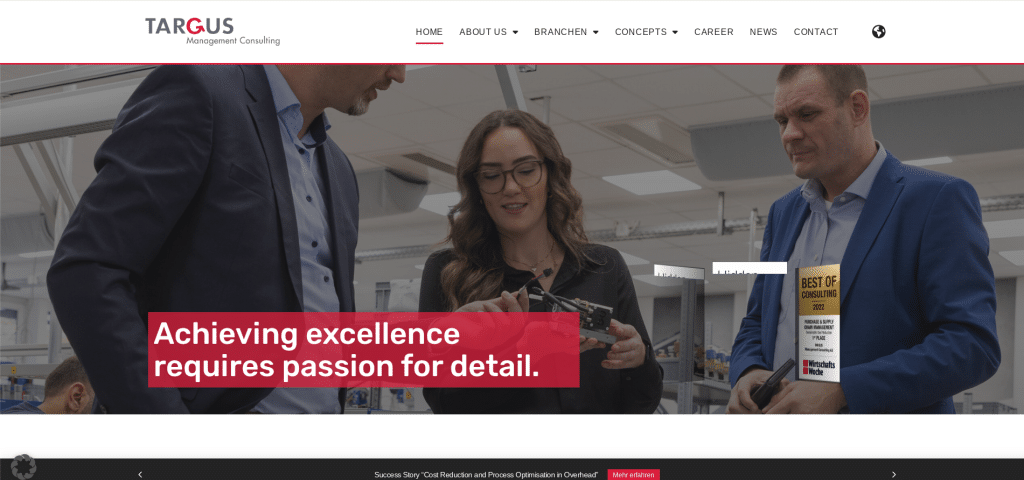
Targus Management Consulting AG is a German-based management consulting firm known for its data-driven, operations-focused consulting approach. Headquartered in Düsseldorf, Germany, Targus specializes in helping companies optimize performance, reduce costs, and increase efficiency through hands-on, implementation-oriented consulting services. The firm was founded in 2001 and primarily serves clients across Germany, Austria, Switzerland, and other European markets.
Targus is particularly noted for its “Data-Driven Consulting” methodology, which emphasizes measurable results, real-time analytics, and client-side collaboration. The firm’s services span across operations, supply chain optimization, procurement, R&D efficiency, product cost analysis, and restructuring. They work with both mid-sized companies and multinational corporations, particularly in industries such as automotive, manufacturing, mechanical engineering, and healthcare.
Unlike many traditional strategy consultancies, Targus takes a deeply operational and implementation-oriented approach, often embedding consultants directly into client teams to drive measurable improvements. Their consultants are typically engineers, economists, and industry specialists with a strong analytical mindset and practical expertise.
Historical Background and Evolution
Targus Management Consulting AG is a German-based consulting firm specializing in operational performance improvement. It was founded in 2001 near Düsseldorf, Germany by a small team of three entrepreneurs with a clear vision: to combine rigorous methodological excellence with hands-on implementation. From its inception, Targus focused solely on operations consulting, aiming to deliver solutions that truly work in practice rather than just on paper. Over the years, the firm has grown steadily from its startup roots into a recognized boutique consultancy with an international reach. Targus has maintained a moderate size (around 60+ consultants in recent years), which allows it to offer personalized service while tackling large-scale projects. The firm’s evolution has been marked by continuous refinement of its methods, expansion into new regions, and repeated industry accolades. For instance, Targus has consistently won “Hidden Champion” awards in consulting (in categories related to operational excellence) and multiple “Best of Consulting” awards in Germany for its project results. These honors reflect the firm’s successful engagements and client satisfaction. In the 2010s, Targus also began extending its footprint beyond Germany – establishing a presence in the United States – while leveraging its strong reputation across Europe. Despite its growth, the firm has stayed true to its founding principle: “Targus works.” This motto underlines its evolution as a consultancy that not only devises strategies but also ensures they are effectively implemented to produce measurable results.
Key Figures and Leadership
Throughout Targus’s development, several key figures have shaped its direction and success. Gerd Wehner, one of the co-founders, serves as Chairman of the Board and has been instrumental since the firm’s early days. He has often articulated Targus’s goal of becoming “the best management consulting company for operations functions,” emphasizing teamwork and lasting value for clients. Another co-founder, Paul Hülskemper, has played a dual role in both client work and internal development; he later became the Director of Human Resources, helping to build the firm’s team-oriented culture. Andreas Sans is a longtime leader at Targus (a member of the executive board) who joined the firm in its first years and brought experience from a larger consultancy. Sans is known for advocating the unique implementation-focused approach that differentiates Targus. Under his guidance, Targus has honed its reputation in operations consulting and expanded its methods toolbox.
In addition to the founders, Targus’s growth has been supported by other notable partners and managers. Dr. Martin Kneip, for example, is a partner credited with strengthening the firm’s expertise in product cost optimization and factory planning; he has a background in physics and industry leadership, which has enriched Targus’s analytical rigor. Dr. Stefan Maurer is another key figure who helped spearhead Targus’s expansion into North America. After leading numerous cost reduction and manufacturing optimization projects in Europe, he moved to the U.S. and took charge of Targus Group North America, serving as its CEO. Under Maurer’s leadership, Targus established a foothold in the U.S. market to serve clients globally. The firm operates as an AG (Aktiengesellschaft) with an executive board (“Vorstand”) that includes the likes of Wehner and Sans, and a group of partners who lead engagements. Despite its relatively flat hierarchy, Targus’s leadership emphasizes a collaborative, “friends as well as colleagues” ethos internally, which has been a hallmark since the founding team set the tone. Together, these key figures have guided Targus’s mission of delivering tangible operational improvements and have influenced its strategic decisions (such as what industries to focus on and how to maintain quality as the firm grows).
Industries and Sectors Served
Targus specializes in serving industrial and manufacturing sectors, primarily across Europe. The firm deliberately concentrates on companies that have complex operations and tangible value chains, rather than financial or purely service-oriented businesses. Key industries and sectors Targus serves include:
- Automotive Manufacturing – working with car and vehicle manufacturers and suppliers to improve production efficiency, supply chain, and project management (including engagements in areas like automotive R&D and cost reduction).
- Mechanical Engineering and Industrial Equipment – partnering with machinery makers, engineering firms, and capital equipment manufacturers (plant engineering, heavy machinery, etc.) to streamline their operations, from product development through factory output.
- Electrical/Electronics Engineering – assisting electronics and electrical equipment companies in optimizing their production processes, procurement of components, and quality control for better operational performance.
- Pharmaceuticals and Life Sciences – improving the operational effectiveness of pharma companies and medical device manufacturers, including production scale-up, supply chain reliability, and introduction of Industry 4.0 principles in regulated environments.
- Medtech and Healthcare Products – working with medical technology firms on efficient product development cycles, cost management, and lean production of medical devices or equipment.
- Chemicals and Materials Processing – helping chemical producers or metal processing companies (for example, a market leader in metal fabrication) to optimize plant operations, reduce overhead in administrative processes, and secure supply of raw materials.
- Project-Based Industries – supporting companies that deliver large-scale projects (such as shipbuilding, rail vehicle manufacturing, aerospace, or construction equipment) by improving project management, procurement, and cost controls to ensure timely delivery and budget adherence.
Across these sectors, Targus’s clients are often medium-sized to large enterprises (including market leaders in niche manufacturing segments as well as well-known global industrial corporations). The firm’s cross-industry experience allows it to transfer best practices from one sector to another, especially within the broad realm of engineering and production. Importantly, Targus explicitly does not focus on banking, insurance, or pure financial services – staying within their core competency of operations in product-driven businesses. Their consultants, most of whom have engineering or science backgrounds, are able to speak the language of these industries. This sector focus ensures that Targus teams are credible to client engineers and plant managers, and can tackle challenges ranging from factory-floor process issues to complex supply chain disruptions. While Europe (especially German-speaking countries) is the primary theater of operations, the firm’s expertise is applicable globally and they have supported client initiatives in other regions when needed (often as European clients expand internationally). Targus’s industry specialization is reflected in internal “industry teams” that develop sector-specific frameworks and screenings – for example, specialized diagnostics for the plastics processing industry or tailored solutions for automotive supply chains.
Consulting Methodologies and Distinctive Approach
Targus is distinguished by its methodical yet implementation-driven consulting approach, often summarized by the mantra: “as much analysis as necessary, as much implementation as possible.” The firm’s methodologies are built around achieving rapid, measurable improvements in clients’ operations while ensuring those improvements stick. Several core elements define the Targus approach:
- Customized “Pre-Project” Analysis: Before any full engagement, Targus typically conducts a thorough preliminary analysis (sometimes called a Vorprojekt or pre-project). In this phase, consultants work with the client to clarify goals, gather initial data, and diagnose key challenges. They often hold workshops and interviews on-site to understand the situation firsthand. The output is a tailored project proposal and roadmap that is highly specific to the client’s needs. This upfront diligence makes the subsequent project essentially “risk-free” for the client, as everyone agrees on realistic targets and a plan of action from the start. It also means Targus teams can hit the ground running with minimal ramp-up time.
- Data-Driven Insights: Given the technical expertise of Targus consultants (a large majority have engineering or scientific degrees, and many have prior industry experience or PhDs), the firm places a strong emphasis on data analysis and factual diagnosis. Whether it’s analyzing production downtime data, procurement spend, or R&D cycle times, Targus uses quantitative methods to pinpoint inefficiencies. They have proprietary analytical tools – for example, a “Rapid Plant Assessment (RPA)” tool that can evaluate a factory’s performance within minutes, and various benchmarking databases. This data-driven rigor ensures that any recommendations are backed by evidence and can be justified to a skeptical technical audience.
- Focus on Rapid Results: Targus projects are structured to deliver tangible improvements quickly, often achieving significant milestones in the first few months. The consultants prioritize identifying the “essential levers” – the relatively small number of changes that will yield the biggest impact on performance. By concentrating effort on these high-impact levers, Targus is able to generate quick wins and early ROI for the client. This might mean, for example, rapidly implementing a new scheduling system to boost plant output within weeks, or renegotiating key supplier contracts within the first 100 days to capture cost savings. Quick, visible results help build credibility and momentum for broader change. Targus even has a service offering called “Fast Turnaround,” indicating its ability to rapidly stabilize and improve operations in urgent situations (such as when a plant or project is in trouble).
- Hands-On Implementation and Collaboration: A hallmark of Targus’s methodology is that their consultants remain deeply involved through the implementation phase – they do not stop at delivering a PowerPoint strategy. Targus teams work on site with client employees at various levels (from top management to line operators) to put solutions into practice. They often form joint client-consultant teams, which fosters buy-in. The firm prides itself on “collaboration with respect” – meaning Targus consultants act as partners and equals, not as aloof advisors. They facilitate workshops, train client staff in new methods, and even help execute the changes on the ground. By embedding themselves in the client’s day-to-day operations, they can troubleshoot issues in real time and ensure that recommended changes are actually feasible and accepted by the workforce. This high-touch, collegial style has been frequently praised by clients for building trust and overcoming resistance to change. Internally, Targus calls its team members “Targonauts,” reflecting a close-knit, team-oriented approach to working alongside clients on a journey to results.
- Toolbox of Proven Methods: Over two decades, Targus has developed a rich Targus Toolbox – a suite of proprietary methodologies, best practices, and analytical tools refined from project to project. This toolbox includes techniques in lean manufacturing, Six Sigma, value stream mapping, and other classic operational excellence methods, but often with Targus’s own twist or customization. For example, Targus has a “Lean Overhead” approach specifically aimed at applying lean principles to administrative processes (reducing bureaucracy and non-value-added activities in back-office functions). They also have a Design-to-Cost framework and a Rapid Product Cost Assessment method for product engineering projects, allowing clients to quickly identify cost reduction opportunities in product design. Another framework is the “PLACE-Model” for optimizing global production footprints (deciding where to locate manufacturing based on multiple factors). The consultants are trained to select the right tools from this toolbox to match the client’s unique situation – hence the term “custom-tailored consulting” that Targus uses to describe its services. The methodology is never one-size-fits-all; it’s adapted so that the solution is realistic and “fits” the client organization.
- Result Tracking and Sustainability: Targus places heavy emphasis on ensuring that improvements are sustained after the consultants leave. During projects, they implement robust results controlling – setting up KPIs and regular progress reviews to monitor whether changes are achieving the promised outcomes. Clients receive frequent updates on progress toward goals (e.g. weekly or monthly KPI dashboards) to maintain transparency. Towards a project’s end, Targus often helps establish new internal processes or management systems so the client can continue to improve on their own. They may, for instance, train a group of client “change agents” or implement an ongoing performance management cadence. If desired, Targus can also provide follow-up support or periodic check-ins after the main project, to help the client overcome any setbacks. The overarching aim is sustainable change – making sure the gains (cost savings, efficiency improvements, etc.) endure long-term and that the client’s people have adopted new ways of working. Many of Targus’s clients are repeat customers, a sign that the improvements delivered were concrete and lasting enough to earn trust for future engagements.
In summary, the Targus consulting methodology is distinctive for balancing thorough analysis with aggressive implementation, being highly data-driven yet people-focused (change management through collaboration), and delivering rapid, visible performance gains that are sustainable. This approach has set Targus apart from more strategy-only consultancies and has become a selling point for the firm, encapsulated in their simple slogan: “Targus works.” (Meaning, their solutions actually work in practice.)
Service Lines and Areas of Expertise
Targus offers a range of consulting services all centered on improving the operational performance of organizations. Their service lines cover the entire value chain and support both targeted fixes and broad transformations. Key practice areas include:
- Operations & Productivity Improvement: This is Targus’s core focus. It involves optimizing manufacturing processes, enhancing productivity on the factory floor, and implementing Operational Excellence programs. Targus consultants might introduce lean manufacturing techniques, reduce equipment downtime (boosting OEE – Overall Equipment Effectiveness), streamline workflows, and improve quality control. They use tools like 5S, SMED (Single Minute Exchange of Die for quick changeovers), Total Productive Maintenance (TPM), and custom OPEX Toolboxes to deliver faster production throughput and higher efficiency. A typical project could be increasing a plant’s output capacity by double-digit percentages without major capital investment, simply by process improvements and better shop-floor management. They also handle statistical data analysis in operations to identify bottlenecks or root causes of performance issues.
- Supply Chain Management and Logistics: Targus helps companies strengthen their supply chains end-to-end. This can include procurement optimization, supplier management, logistics and distribution improvements, and network planning. Under procurement, Targus has offerings like Material Cost Management (systematically reducing direct material spend), Strategic Sourcing (developing product group strategies and supplier negotiations), and E-Procurement process implementation. They also conduct Procurement Scans to benchmark a client’s purchasing effectiveness and reorganize purchasing departments for better results. In logistics and supply chain, Targus might redesign a client’s manufacturing footprint or distribution network using models like their “PLACE-Model” for localization (to decide, for example, what production should occur in high-cost vs. low-cost countries). They also advise on Supply Chain Risk Management – a timely service given global supply disruptions – helping firms secure critical supply, diversify sources, and create contingency plans. Targus often works with companies to balance logistics costs with customer service levels, finding an optimal configuration of warehouses, factories, and suppliers that minimize cost while meeting demand. An example engagement could be optimizing a complex supply chain for a machinery manufacturer to cut lead times and buffer stocks, thus saving costs and improving delivery reliability.
- Product Cost Optimization & Value Management: Many of Targus’s projects focus on reducing the costs of products, both in design and production, without compromising performance. The firm provides Product Cost Management services that cut across departmental silos – involving R&D, engineering, purchasing, and manufacturing. Their approach often starts with a Rapid Product Cost Assessment, quickly identifying major cost drivers for a given product line. From there, they employ Design-to-Cost techniques (redesigning components for cheaper manufacturing or materials), Value Engineering (enhancing product value by aligning features with what customers truly pay for), and Product Value Optimization (balancing cost vs. customer value). Targus emphasizes cross-functional collaboration here: for example, getting engineers and buyers to work together to choose alternative materials or suppliers that meet specs at lower cost. They also factor in life-cycle costs and even sustainability metrics (such as carbon footprint) in defining “product value.” This holistic approach ensures that cost reductions are sustainable and do not erode the product’s quality or market appeal. Targus has published thought leadership in this area (e.g., a “Product Value Management” framework) and has won awards for its product cost optimization projects. One notable success was helping a manufacturer achieve significant cost savings on a new product by challenging every component’s cost and fostering cooperation between product development and procurement early in the design phase.
- Large-Scale Project & Program Management: In industries where companies undertake large, complex projects (like building heavy equipment, vehicles, or infrastructure components), Targus provides support to improve project execution. They set up or enhance Project Management Offices (PMO), implement multi-project management systems, and introduce methods for earned value tracking and progress measurement. For instance, an engagement might involve rescuing a delayed capital project by establishing stricter project controls, optimizing resource allocation, and coaching the client’s project managers. Targus consultants often step in to coordinate between engineering, procurement, and production departments on major projects, ensuring timeline and budget adherence. They bring tools to manage interfaces in product development and use techniques from agile project management when appropriate. This service line overlaps with their operations focus, as it ensures that one-off large projects (like developing a new vehicle model or constructing a production facility) are delivered efficiently.
- Business Transformation and Restructuring: Targus also advises companies undergoing majwor transformations, especially when operational turnaround is needed. Under its Restructuring offerings, the firm tackles Operational Turnaround (rapidly improving a struggling business unit or factory), Financial Restructuring support (though always with an operational angle, e.g., identifying cost-cutting opportunities and efficiency gains rather than purely financial engineering), and Organizational Restructuring (realigning roles and processes for a leaner operation). Targus’s approach to transformation is hands-on: for example, if a client needs to reduce overhead costs company-wide, Targus will help redesign processes and organizational structures, not just make recommendations. They ensure social considerations are addressed too (working with worker councils or unions early to maintain “peace” during restructuring, as noted in one of their success stories). In transformation programs, Targus often deploys what they call a “Roadmap to Success”, mapping out all value levers across the enterprise and tackling them systematically over a phased program. This can cover everything from R&D process changes to supply chain and back-office optimization as part of one holistic change initiative. A notable engagement in this realm as when Targus helped a European metal processing company trim down its administrative overhead by double-digit percentages while revamping core processes – effectively transforming the organizational efficiency without harming employee morale, an effort that earned industry recognition.
- Strategy and Organization (Operations Strategy): While Targus is not a classic strategy house, it does assist clients with strategic planning in areas tightly linked to operations. For example, Strategic Total Planning is one service where Targus helps a company develop a long-term plan for operational excellence – aligning operations strategy with business goals. This might involve capacity planning, make-or-buy strategy, or investment planning for technology and automation, ensuring the company’s operations can support future growth and market demands. They also sometimes advise on change management and cultural change as part of implementing new operational strategies. Similarly, in Sales & Marketing (which Targus refers to as “Distribution” or commercial excellence), the firm’s work might include optimizing service processes or implementing Value-Based Pricing strategies for industrial products (ensuring prices reflect the value delivered and costs). These are more specialized offerings and typically are pursued when there is a clear link to the operational side (for instance, pricing strategies that require understanding of cost structure, or aftersales service optimization that ties back to operations).
In summary, Targus’s service lines cover a comprehensive suite of operations consulting services: from factory floor improvements to supply chain redesign, from cost-cutting to broad transformations. What unites all these offerings is the focus on measurable performance improvement and the use of Targus’s systematic methods. Clients engage Targus either for targeted projects (like “help us reduce our product costs by 15%” or “improve productivity in Plant X”) or for end-to-end transformations (“help us overhaul how our operations work across the board”). In all cases, Targus provides both the conceptual solution and the implementation muscle to realize the solution.
Global Operations, Offices, and Key Regions
Targus is headquartered in Ratingen, Germany (a city in the Düsseldorf area). From this base in the heart of Germany’s industrial region, Targus serves clients across Germany, Austria, Switzerland (the DACH region) and more broadly throughout Europe. The firm’s consultants are accustomed to working in multiple European countries, and project teams will often travel to client sites in France, the Netherlands, Italy, Eastern Europe, or wherever needed within Europe’s manufacturing hubs. European operations are the core of Targus’s activity, aligning with the concentration of its client industries in those markets (e.g. German automotive, Swiss medtech, etc.).
In recent years, Targus has expanded its presence to North America. It has a U.S. subsidiary, Targus Group North America (TNA), which is a wholly-owned unit focusing on growing the firm’s business in the United States and Canada. The North American office is located in Madison Heights, Michigan, which is in the greater Detroit area – a strategic choice given the region’s automotive and manufacturing industries. Through this office, Targus is leveraging its European track record to serve clients in the U.S. with similar operational improvement needs. The U.S. team (including ex-pats like Dr. Stefan Maurer and locally hired consultants) works closely with their German colleagues to bring Targus methods to American manufacturing companies. They have targeted sectors like automotive suppliers and industrial firms in the Midwest and beyond. Targus’s involvement in the German-American business community (for example, membership in organizations like the German American Business Council in Boston) suggests they are actively networking to grow their U.S. footprint. While still relatively small in headcount in the U.S., this move indicates Targus’s ambition to operate truly globally, supporting multinational clients in both their European and American operations.
Aside from Germany and the U.S., Targus does not maintain numerous offices worldwide – it is not a large global firm with dozens of offices. Rather, it runs a two-office model (Germany and USA) and uses those as hubs to execute projects wherever the client requires. The consultants are typically mobile and work on-site at client facilities, so a lean office footprint has suited the firm’s style. Key regions of activity outside the home office include client manufacturing sites across Western and Central Europe (such as automotive plants in Central Europe, pharmaceutical labs in Belgium, etc.), as well as occasional projects in Asia or other regions if European clients have overseas divisions that need support. Targus’s ability to operate in English and German (and often other languages given its diverse team) allows it to seamlessly integrate in international environments.
In Europe, the firm is often regarded as a leading operations consultancy in the German Mittelstand segment (mid-sized industrial companies), but it also serves larger Fortune 500 manufacturers. It has built a reputation particularly in the German market, earning titles like “Hidden Champion” which indicate it is a top choice for operations consulting even if not a household name to the public. Targus’s physical proximity to many German industrial centers (Ruhr area, etc.) means quick access to clients. Meanwhile, the North American arm positions the firm to take on engagements with U.S.-based manufacturing companies or U.S. subsidiaries of European firms.
Overall, Targus’s global operations strategy is to maintain excellence in its core European base while selectively growing internationally where it can replicate its success. Rather than volume of offices, they focus on depth of expertise and will travel to client sites globally as needed. This nimble approach has enabled the firm to work in an “international context” without a huge organizational overhead. Clients in key regions know they can bring Targus consultants in, whether the project is in a German factory, a Scandinavian R&D center, or a North American supply chain.
Career Progression and Roles
Career progression at Targus Management Consulting follows a structured path common to many consulting firms, but with some unique twists given the firm’s operational focus and size. Targus offers roles from the entry level up through partner, with clear expectations and growth at each step:
- Analyst / Junior Consultant: Targus typically hires promising candidates straight out of university (often with master’s degrees in engineering, science, or business) into a junior consultant role. In fact, the firm has a distinctive “Double-Entry Program” for new graduates. Under this program, a new hire spends the first year as a regular consultant at Targus, learning the ropes on client projects, and then has the option to spend a second year working within one of Targus’s industrial client organizations. This unique setup allows young consultants to gain direct industry experience (immersing in a factory or engineering department of a client) before returning to consulting full-time. It reflects the firm’s belief that real industry exposure makes for better operations consultants. As a Junior Consultant or Analyst at Targus, one would typically support project workstreams: gathering and analyzing data, conducting time studies or process observations, preparing workshop materials, and contributing to solution development. Junior team members at Targus are given significant responsibility quickly – for example, they might lead an interview with a client’s production supervisor or map out a process flow within weeks of starting. The firm’s relatively flat hierarchy means juniors often interact directly with client stakeholders early on, accelerating their learning.
- Consultant / Associate: After proving themselves, junior consultants advance to a Consultant role (sometimes just called “Management Consultant” internally). Many hires actually start at this level if they join with prior experience or a PhD. Consultants at Targus are expected to independently handle parts of a project. They might, for example, own the analytics for a client engagement – such as running the model for a supply chain network optimization – or manage a sub-team focusing on one area (like the procurement workstream in a larger cost reduction project). They also begin to mentor newer hires. Given Targus’s focus on implementation, consultants at this level spend a lot of time on-site driving changes: conducting training sessions for client employees, monitoring pilot implementations of new processes, and solving day-to-day issues that arise. The progression from Consultant to Senior Consultant is typically based on demonstrated ability to deliver results and to earn the trust of both clients and the internal team.
- Project Manager / Senior Manager: As consultants gain experience (usually a few years in), they take on roles as Project Managers – leading entire consulting projects or significant project modules. A Project Manager (sometimes also titled Senior Consultant or Senior Manager) at Targus plans the project timeline, coordinates the team’s activities, and is the primary contact for the client’s project sponsor. They ensure that the project’s objectives (e.g. achieving a 20% productivity increase) are met on time. In practice, a Targus project manager might be simultaneously rolling up their sleeves in analysis and implementation and guiding team members – a dual role necessitated by the firm’s hands-on style. They learn to manage client expectations, report progress to client executives, and adjust the approach as needed to overcome obstacles. Because Targus teams are often small (maybe 2-5 people on a project), the Project Manager is deeply involved in content while also handling leadership duties. Senior Managers/Project Leaders also contribute to developing new business by ensuring successful projects (which lead to follow-on work or referrals) and occasionally assisting in proposal writing for new clients.
- Principal / Associate Partner (in larger firms) – In Targus’s context, the layer between Project Manager and Partner may not be very large due to the firm’s size. However, very experienced project leaders who consistently deliver exceptional results will start to take on a role akin to a Principal. These individuals oversee multiple projects or a program of projects at once, mentor several project managers, and begin to shape offerings. For instance, one might become the internal expert in “Pharma Operations” or “Cost Reduction” and develop new consulting tools or whitepapers in that domain. They also support the partners in sales efforts and in training junior staff. Targus has titles like Senior Manager or Director which might correspond to this level – people who are just a step below partner, often leading key accounts or regions (e.g., someone might head the U.S. consulting team without being a formal partner yet).
- Partner / Director: At the top of the career ladder, Targus’s partners are the firm’s owners and leaders. Partners are responsible for business development, client relationship management at the executive level, and overall project quality. They typically have decades of experience in industry and consulting. A partner at Targus will lead sales meetings, craft consulting proposals, and ensure the firm is meeting its growth and profitability goals. In delivery, partners stay involved by providing oversight to projects – they might attend important steering committee meetings with client CEOs or plant managers and offer strategic guidance to their teams. Because Targus emphasizes implementation, partners also maintain a pragmatic touch; they often personally engage in solving tough client problems and share their expertise (for example, a partner who is an expert in lean manufacturing might still go walk a factory floor to spot opportunities). Some partners, like Andreas Sans or Martin Kneip, also focus on thought leadership, developing new methodologies for the Targus toolbox. Additionally, Targus has an executive board, so certain partners hold management roles such as Board Member (executive management of the company, beyond just project work). The firm being an AG indicates that partners might also be shareholders and involved in governance. Reaching partner at Targus is a significant achievement and usually comes with a track record of delivering major results for clients, contributing to the firm’s intellectual capital, and demonstrating mentorship and leadership internally.
Career progression at Targus is known to be merit-based and relatively fast for high performers. Consultants with strong capabilities can rise to project lead roles in a few years. The firm’s culture encourages taking initiative – consultants are told that “everyone has the possibility to build their own area and contribute to the development of Targus,” meaning entrepreneurial thinking is valued. There is also an international aspect: high performers might get opportunities to support the U.S. expansion or other new markets. In terms of hierarchy, Targus maintains a flat organizational feel. Titles exist, but even junior team members work side by side with senior leaders in a non-bureaucratic way. Internal communication is informal and every team member is expected to voice ideas and challenge assumptions. This flat structure, combined with the challenging nature of the projects, creates a steep learning curve. Many Targus consultants note that they experience a “steep personal development” by working on diverse assignments and being given responsibility early.
Notably, Targus recognizes that consulting may not be a lifelong career for everyone – some team members eventually move into industry roles (leveraging the skills they gained). The leadership has explicitly stated that time at Targus is also an “investment in oneself,” as alumni often go on to take significant operational roles in industry. Nonetheless, the firm strives to retain talent by offering a good work-life balance for consulting (such as flexible arrangements, understanding the need for balance despite travel, etc.) and fostering a familial, team spirit. They want people who enjoy “working as friends” and achieving results as a team, and they aim to make Targus a rewarding long-term career, culminating in partnership for those who excel.
Compensation at Targus
Targus offers competitive compensation that is in line with other boutique consulting firms, with variations by role and geography. Publicly available information and employee feedback indicate that Targus’s pay packages include a base salary, performance-based bonuses, and additional perks such as a company car policy and travel allowances.
In Germany (home market), a new graduate entering Targus through the Double-Entry program (with a master’s degree) can expect an annual base salary in roughly the €50,000 range (Euro) as a starting point. This is considered a strong entry-level salary, and it often comes with annual increases and bonuses as performance warrants. If someone joins at a higher entry point – for example, with a PhD or a few years of industry experience – the starting salary is higher, often cited around €70,000 or more for those “experienced hires” into consultant roles. As consultants advance, their salaries climb significantly. A Senior Consultant or Project Manager at Targus can earn in the low to mid six-figures (in euros) when combining base and bonus, depending on success of projects and individual performance.
At the Partner or Director level, compensation includes profit-sharing and can reach high six-figure earnings (€200k–€300k+ per year). Partners benefit from the firm’s profitability, so in good years their compensation can be very rewarding. It’s noted in forum discussions that partner incomes at Targus might be around a few hundred thousand euros annually, plus any dividends if they hold equity.
Targus also provides several benefits that enhance the overall compensation: consultants often receive a daily per diem (tax-free allowance) for travel days, which can add a few hundred Euros to the paycheck each month given the frequent on-site work. There is also typically a company car or car allowance once consultants reach a certain level, which is a common perk in German consulting firms (and many Targus consultants are traveling to client sites by car). These benefits, along with paid expenses during travel, contribute to the overall financial attractiveness of the role.
In the United States, where Targus is building its presence, salary figures are generally higher in absolute terms to match the market. Glassdoor data suggests that a Consultant in the U.S. Targus office might have a total compensation in the range of $90,000 to $140,000 USD per year (including bonus). Senior Consultants or Project Managers in the U.S. could earn between roughly $130,000 and $190,000 USD annually. These ranges reflect the higher cost of labor in the U.S. consulting market and the need to be competitive to attract talent stateside. It’s likely that Targus North America offers packages comparable to other boutique ops consulting firms in the U.S., possibly with performance bonuses tied to project results. Being a smaller operation, there may also be incentive for U.S. team members in terms of rapid advancement and thus potential pay growth.
It’s important to note that exact salaries can vary year to year and depend on individual negotiation (though one source noted Targus has fairly fixed salary bands for each level to maintain internal equity). Employees have described the salaries as “absolutely competitive” especially given the firm’s size, and they highlight that big raises come with climbing the career ladder. The combination of base pay, bonuses, benefits, and the relatively lower cost of living when not traveling (for those based in more affordable cities) means Targus consultants are well-compensated. Moreover, the firm’s financial model rewards performance – if a project achieves great results and the firm does well, bonuses reflect that. Partners’ remuneration, of course, scales with the firm’s overall success.
Lastly, beyond pure salary, Targus provides professional development (training programs, etc.) and career opportunities that are part of the “value” of working there. Many employees note that the experience and skills gained (which can lead to lucrative industry jobs later or progression to partner internally) are a significant part of the reward of working at Targus, in addition to the direct pay.
Thought Leadership and Proprietary Frameworks
Despite being a boutique firm, Targus invests in thought leadership and has developed several proprietary frameworks and research-based methodologies. The firm’s deep specialization in operations means it often generates insights in that domain. Some key aspects of Targus’s thought leadership and intellectual capital include:
- Targus Toolbox: Over years of consulting engagements, Targus curated a set of proven methods and tools (known collectively as the Targus Toolbox). This includes templates, software tools, and frameworks that are continuously refined. For instance, they have a PCM (Product Cost Management) Toolbox for analyzing product costs from multiple dimensions (materials, labor, overhead, life-cycle costs, etc.) which incorporates both technical engineering knowledge and financial analysis. By applying these refined tools, Targus can quickly diagnose issues and design solutions. They often share non-proprietary portions of these approaches in conferences or publications, contributing to industry knowledge on how to achieve rapid cost savings or efficiency gains.
- “Targus works.” Philosophy: As a conceptual framework, the firm often communicates its approach under the tagline “Targus works.” This is more than marketing – it encapsulates a philosophy of practical, result-oriented consulting. The firm’s leaders have written or spoken about how true consulting value comes not from fancy reports but from solutions that function in the real world. In articles or interviews, Targus executives elaborate on case examples and principles that make consulting effective (like intensive collaboration and challenging the status quo within client organizations). This pragmatic philosophy itself has influenced other mid-sized consultancies aiming to differentiate from pure strategy players.
- Publications and Articles: Targus consultants and partners have contributed to professional journals and business media. For example, the firm published an “Ad Special” in Harvard Business Manager (HBM) – the German edition of Harvard Business Review – focusing on Product Value Management. In that piece, they discussed holistic approaches to reducing product and development costs while maintaining competitiveness, presumably sharing some of their framework on balancing cost vs. value vs. sustainability. Targus also frequently publishes short case studies and insights on its website’s news section. Topics have included securing supply chains in crises, the importance of cross-departmental collaboration for cost optimization, and tips for implementing Industry 4.0 in pharma manufacturing. By publishing these insights, Targus positions itself as a thought leader in operations improvement, contributing ideas to the broader business community and demonstrating expertise to potential clients.
- Awards and Independent Research Recognition: The fact that Targus has been repeatedly named a “Hidden Champion of Consulting” comes from independent surveys of client executives conducted by a German research institute. These surveys measure consultancies on various dimensions including thought leadership, methodical expertise, and performance. Targus’s strong showing (especially in categories like Operations, Purchasing, and Supply Chain) indicates that their methodologies and results are well-regarded. Additionally, winning “Best of Consulting” awards (by a major business magazine) for specific project work suggests that Targus is producing leading-edge solutions in those projects. Often, as part of those awards, case studies are evaluated – meaning Targus had to demonstrate innovative approaches and measurable impact. The accolades thus validate Targus’s proprietary approaches as being among best practices in the field.
- Frameworks and Branded Solutions: Targus has branded some of its in-house developed approaches. A few examples:
- “Roadmap to Success” – a structured approach for comprehensive operational transformation, ensuring all levers across R&D, procurement, production, and sales are optimized. This roadmap likely acts as a guideline for running large multi-faceted change programs.
- Lean Overhead – a concept and methodology for applying lean management to overhead functions (administration, support departments). Targus developed specific steps to identify waste in office processes, right-size organizations, and streamline workflows beyond the factory floor.
- PLACE-Model for localization – a decision-making framework that helps companies plan their production footprint globally by evaluating factors like Production costs, Logistics, Access to markets, Capabilities, and risks (perhaps an acronym forming “PLACE”). It provides a structured way to approach make-or-buy and where-to-produce decisions.
- TIP (Targus Improvement Program) – an internal training and employee development program for client staff. For instance, as part of sustaining change, Targus might institute a TIP where client employees learn continuous improvement skills and carry forward the initiatives. This could also refer to how Targus develops its own consultants (it was mentioned in some internal context).
- Rapid Plant Assessment (RPA) online tool – Targus created an online self-assessment tool that any factory manager can use to benchmark their plant’s efficiency in minutes. Offering such a tool publicly for free is both a marketing and thought leadership move, showcasing Targus’s expertise in what key indicators define a world-class plant. It helps spread their name and provides data that Targus can use in conversations with potential clients (who try the tool and see gaps they need help with).
- Collaborations and Academic Links: Many Targus consultants hold doctoral degrees and have done research in areas like operations research, supply chain management, or engineering. Some of their methodologies have academic roots that the firm then applied in practice. For example, one partner’s doctorate focused on supply chain risk management – those insights likely became part of Targus’s offerings for clients looking to build resilient supply chains. The firm stays current with the latest in operational strategy, often attending or sponsoring industry conferences (such as the BME Symposium on Purchasing and Logistics in Berlin, where Targus has presented on holistic procurement strategies). By engaging with academic and professional communities, Targus continuously updates its frameworks with cutting-edge ideas (like incorporating digital transformation/Industry 4.0 concepts into their operational excellence projects).
- Thought Leadership in Change Management: Targus often emphasizes the human side of implementation in its thought leadership. They have shared their experiences on how to mobilize an organization – for instance, ensuring employee acceptance, aligning management on the need for change, and maintaining open communication (with even worker councils) during tough restructuring. Their insights in this area contribute to best practices in change leadership for operations improvements. By highlighting success stories where they maintained “peace” with social partners while downsizing overhead, or where they achieved a cultural shift toward continuous improvement at a client, Targus demonstrates thought leadership beyond just the technical aspects – extending into effective change management frameworks.
Overall, Targus’s thought leadership is practical and focused on the niche of making strategy happen in operations. They may not publish glossy annual reports or macroeconomic studies like large consultancies, but within the operations management field they provide valuable, experience-based knowledge. Clients and industry peers respect Targus for its methodological depth – essentially, they’ve built a reputation as the go-to experts for how to implement complex operational changes successfully. This reputation is reinforced each time Targus shares a success story or a proven framework in public forums.
Notable Projects and Recognitions
Targus has been involved in numerous impactful projects across Europe and beyond, though due to client confidentiality the firm often describes them in general terms rather than naming the client. However, several engagements have stood out and contributed to the firm’s recognition:
- Overhead Cost Reduction for a Market Leader: One widely cited success story was with a European market-leading company in the metal processing industry. Over years of growth, this company had developed what Targus described as an “administrative fat cushion” – bloated indirect costs and inefficiencies in its back-office and support functions. Targus was brought in to trim and streamline the organization without harming the core business. Through a project that combined Lean Overhead techniques and fundamental process re-engineering, Targus consultants created transparency in the client’s entire overhead activities for the first time. They identified opportunities to reduce costs by a significant double-digit percentage. Importantly, these savings were not theoretical – they were immediately implemented during the project. Examples of changes included eliminating unnecessary internal reports, automating certain administrative tasks (like parts of payroll processing), and clarifying roles to remove duplicated efforts. They conducted numerous workshops to define concrete improvement measures, each with a clear owner, target state description, and quantified benefit. The result was a streamlined organization with much lower overhead costs and optimized processes, achieved within a relatively short time frame. This project not only delivered substantial financial benefit to the client, allowing them to stay competitive against global pressure, but it also won Targus an award in the “Best of Consulting” competition (judges recognized the excellence of the project in the category of restructuring or operations). The success was attributed to Targus’s mobilizing approach – involving employees and even the work council early on to maintain buy-in (so much so that the “peace” with employees was preserved despite cost-cutting). This engagement became a showcase for how to conduct cost transformation humanely yet effectively.
- Product Cost Optimization in Manufacturing: Targus has executed many projects focused on reducing product costs, and one notable engagement was for a manufacturer facing eroding margins due to high product costs and competition. Targus employed its Product Value Optimization methodology to dissect the product’s cost structure. They worked with cross-functional client teams to examine every component and feature of the product. By challenging specifications (asking, “Is this feature over-engineered for what the customer needs?”), bringing in suppliers to suggest cheaper alternative materials, and re-engineering some assemblies for easier manufacturing, the team achieved dramatic cost savings. In one case, Targus and the client identified savings on the order of 15-20% of unit cost for a flagship product – a huge win in a mature market. This was accomplished without sacrificing quality or functionality; in fact, some changes improved reliability while reducing cost. The client was able to either increase their margin or lower their price to gain market share, thanks to the cost reduction. This kind of project enhanced Targus’s reputation in the industrial goods sector, proving that their data-driven, interdisciplinary approach to product cost cutting can yield results that affect the company’s bottom line significantly. The firm often references such cases in their marketing (for instance, highlighting how inter-departmental cooperation – between R&D, purchasing, and production – was key to success, a pillar of Targus’s approach).
- Operational Turnaround of a Production Facility: In another notable engagement, Targus assisted a pharmaceutical company that was struggling with a new production line which had low yield and frequent downtime. The situation was critical as the product was in high demand but the output was bottlenecked. Targus deployed a team of operations experts and within a short “fast turnaround” project, they analyzed the production process, identified root causes of downtime (such as suboptimal maintenance routines and complex changeover procedures), and implemented quick fixes. They introduced a daily management system on the shop floor, retrained operators on best practices, and optimized the line layout. Within a few months, the production line’s output had significantly increased (reports suggest by around 25%), and defect rates dropped. This turnaround not only saved the client from a supply crisis but also impressed their corporate leadership, leading them to engage Targus for other plants. While specifics are confidential, Targus’s work in this area likely contributed to winning Hidden Champion recognition, since clients must have rated them highly for implementation effectiveness in operations.
- Supply Chain Risk Mitigation Program: During the recent period of global supply chain disruptions (such as material shortages and logistical delays), a number of companies sought Targus’s help to secure their supply chains. In one prominent project, an industrial manufacturer was heavily impacted by unreliable suppliers and volatile material prices. Targus conducted a rapid Supply Chain & Logistics Screening, mapping out the client’s entire supply network and pinpointing high-risk dependencies. They then guided a task force to address these risks: qualifying second-source suppliers for critical components, renegotiating contracts to include flexible terms, and adjusting inventory strategies (increasing safety stocks for some items while implementing kanban pull systems for others). They also improved the client’s supply chain monitoring by implementing key risk indicators and a war-room approach for critical items. As a result, the client was able to navigate the crisis with minimal production downtime, while some of their competitors had to halt production due to shortages. Targus’s involvement in such timely and mission-critical engagements bolstered its standing as an expert in supply chain management. The firm even published an article titled “Secure Your Supply to Remain Competitive,” presumably drawing on lessons from this and similar projects, thereby contributing thought leadership on how to handle supply chain crises.
- Digital Transformation in Operations (Pharma 4.0 Workshop): Targus has also been notable for integrating new trends like digitalization into its consulting. For instance, Targus consultants led workshops on “Pharma 4.0” (the application of Industry 4.0 digital technologies in pharma manufacturing) in collaboration with academic institutions. In these programs, they explored use cases such as digital tracking of production batches, predictive maintenance using IoT sensors, and advanced analytics for quality control. While not a single client project, this thought leadership engagement demonstrates Targus’s capability in digital operations. It shows that notable engagements aren’t only about client service but also about influencing the next generation of industry leaders (MBA students in this case) by sharing practical insights. This reinforces the firm’s reputation as forward-looking and knowledgeable in cutting-edge operational improvements.
In terms of recognition, beyond specific projects, Targus’s overall project portfolio has led to a few high-profile honors:
- They have been a Hidden Champion in consulting for multiple consecutive periods (the awards for 2020/21, 2022/23, 2024/25 in categories like “Business Performance in Operations and Purchasing”). This title is based on client satisfaction and market impact, indicating that across many projects, Targus is delivering outstanding results and is highly regarded in its niche.
- They have won the “Best of Consulting” award by WirtschaftsWoche (a German business magazine) several times in a row. Notably, they won five years running in certain categories, which is an exceptional track record. Categories likely included operations, supply chain, and restructuring. For example, one year they might have won for a project in “Operations Excellence for SMEs” and another year in “Supply Chain Management,” reflecting the breadth of their excellence. This consistent recognition puts Targus in a prestigious circle of consulting firms that have demonstrable project success validated by independent judges.
Consulting Firm Profiles:
- Accenture
- Accordion Consulting
- Advisory Board
- AlixPartners
- Alvarez and Marsal
- Altman Solon Consulting
- Analysis Group
- Ankura Consulting Group
- Archstone Consulting (Acquired by The Hackett Group, Inc)
- Arthur D. Little
- Arthur J. Gallagher & Co.
- Arcadis
- Aon Consulting Services
- Arup Group
- Atos Group and Atos Consulting
- Bain & Company
- Baker Tilly International
- Bates White Economic Consulting
- BDO Consulting
- BearingPoint
- Berkeley Research Group
- BNP Paribas CIB Consulting & Transformation
- Booz Allen Hamilton
- Boston Consulting Group
- Bridgespan Group
- Capco Consulting
- Capgemini
- Capgemini Invent
- Carpedia International Consulting
- CGI Inc.
- Charles River Associates (CRA)
- Chemonics International Inc.
- ClearView Healthcare Partners
- Coalition Greenwich
- Cognizant Technology Solutions
- Compass Lexecon
- Computer Sciences Corporation (CSC) and Evolution into DXC Technology
- Cornerstone Research
- Corporate Executive Board (CEB)
- Crowe Global and Crowe LLP
- Dalberg Global Development Advisors
- Deloitte
- DGC Partners LLC
- dss+ (Formerly DuPont Sustainable Solutions)
- Environmental Resources Management (ERM)
- Everest Group (acquired by Wavestone)
- EVERSANA and EVERSANA CONSULTING
- EXL Service
- EY Consulting
- EY-Parthenon
- FTI Consulting
- FTI Delta (formerly Delta Partners)
- Forvis Mazars
- Galt & Company (acquired by AlixPartners)
- Gartner Inc. and Gartner Consulting
- GEP Worldwide
- ghSMART Consulting
- Grant Thornton Consulting – U.S. and Global
- Guidehouse
- Hay Group (acquired by Korn Ferry)
- HCL Axon Consulting
- HCLTech Consulting
- HDR, Inc.
- Health Advances Consulting
- Hewitt Associates (acquired by Aon)
- Hitachi Consulting (acquired by Hitachi Vantara)
- HP Enterprise Services Consulting (acquired by Hewlett Packard Enterprise)
- Horváth & Partners Consulting
- Huron Consulting Group
- IDEO
- IBM Consulting
- Infosys Ltd and Infosys Consulting
- Information Services Group (ISG) Consulting
- IQVIA Consulting Business
- INSIGHT2PROFIT Consulting
- Ipsos Consulting
- Jacobs Solutions Consulting
- John Wood Group PLC
- Kantar
- Kearney
- Korn Ferry
- KPMG
- Kroll (formerly Duff and Phelps)
- Kurt Salmon (acquired by Accenture)
- Larx Advisors Consulting
- Launch Consulting Group
- Leidos
- L.E.K. Consulting
- LTIMindtree
- Maine Pointe Consulting (acquired by SGS Group)
- Marakon Consulting
- Marsh & McLennan
- Mars & Co
- Mastercard Advisors and Mastercard Data & Services Division
- McKinsey & Company
- Mercer Consulting
- Metyis
- Miller Heiman Group
- Mitchell Madison Group
- Monitor Deloitte
- Mott MacDonald
- Navigant Consulting (acquired by Guidehouse)
- NERA Economic Consulting
- Newton Consulting Partners
- North Highland Consulting
- NTT DATA Consulting and NTT DATA Inc
- OC&C Strategy Consultants
- Oliver Wyman
- PA Consulting
- Palm Tree LLC
- Parsons Corporation
- Partners in Performance (acquired by Accenture)
- Point B Inc.
- Pointe Advisory
- Porsche Consulting
- ProcureAbility
- Propeller Consulting LLC
- Protiviti
- PRTM Consulting (acquired by PwC)
- Putnam
- PwC Consulting and Strategy&
- Ramboll
- RAND Corporation
- Riveron Consulting
- RGP Global Consulting Firm
- Roland Berger
- RSM International
- Schlumberger Business Consulting (acquired by Accenture)
- Science Applications International Corporation (SAIC)
- ScottMadden Consulting
- Simon-Kucher & Partners
- Slalom Consulting
- SSA & Company
- Stantec
- Strategy& (PwC)
- St. Onge Company
- Syneos Health Consulting
- SynFiny Advisors
- Targus Management Consulting AG
- Tata Consultancy Services
- Teneo Consulting
- Tetra Tech Consulting
- The Brattle Group
- The Cambridge Group
- The Chartis Group
- The Hackett Group
- Tompkins Solutions
- TriVista Consulting
- Visa Consulting & Analytics (VCA)
- Wavestone Consulting
- West Monroe Partners
- Willis Towers Watson Consulting
- Wilson Perumal & Company
- Wipro Consulting
- Worley
- WSP Global
- Xynteo
- ZS
