
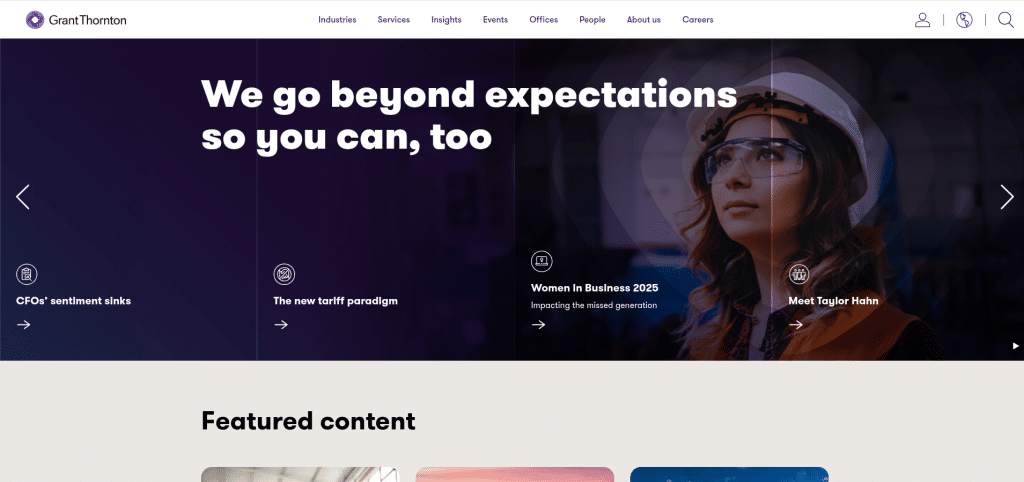
Grant Thornton Consulting is the advisory division of Grant Thornton LLP (U.S.) and Grant Thornton International Ltd, one of the world’s leading independent accounting and advisory networks. Founded in 1924, Grant Thornton has grown into a global organization with a presence in over 140 countries and more than 62,000 professionals worldwide.
Grant Thornton Consulting offers a broad suite of services including strategy and management consulting, technology transformation, cybersecurity, risk advisory, regulatory compliance, forensic accounting, and transaction advisory services. The firm serves clients across a variety of industries, with strong capabilities in sectors such as financial services, healthcare, manufacturing, public sector, and energy.
In the U.S., Grant Thornton LLP has built a strong reputation for its mid-market focus, combining the expertise and reach of a global firm with the personalized service of a boutique consultancy. The firm’s collaborative approach, deep industry knowledge, and emphasis on delivering measurable results have made it a trusted partner for organizations navigating growth, disruption, and regulatory complexities.
Globally, Grant Thornton Consulting leverages the strength of the Grant Thornton International network to deliver cross-border solutions and consistent service quality to multinational clients.
History and Evolution of Grant Thornton’s Consulting & Advisory Practice
Global Origins: Grant Thornton’s consulting and advisory capabilities have evolved over a century alongside its accounting roots. The global network traces its history to UK and U.S. firms founded in the early 20th century (Thornton & Thornton in 1904 in the UK, and Alexander Grant & Co in 1924 in the U.S.). These firms focused on audit and tax services for mid-sized clients. In 1980, a merger of Alexander Grant (U.S.) with Thornton Baker (UK) and other firms created Grant Thornton International. Initially, the emphasis was on assurance services, but by the late 20th century and into the 21st, member firms began expanding robust advisory practices to meet client demand for broader business counsel. As global markets grew more complex, Grant Thornton’s advisory services – including management consulting – became a core pillar alongside audit and tax.
U.S. Practice Development: In the United States, Grant Thornton LLP built its advisory arm to serve the mid-market companies traditionally underserved by the Big Four. Through the 1990s and 2000s, the U.S. firm steadily added consulting capabilities. Notably, after the early-2000s accounting reforms, Grant Thornton saw an opportunity to grow consulting services while larger firms restructured their advisory businesses. The firm made strategic acquisitions and hires to bolster expertise. For instance, in 2002 Grant Thornton absorbed several practices from the defunct Arthur Andersen, bringing in experienced consultants. In 2018, it acquired TayganPoint Consulting, a boutique management consultancy specializing in life sciences and business transformation, to deepen industry-specific consulting expertise. Concurrently, the firm strategically realigned its portfolio – in 2018 it divested its federal government consulting arm (Grant Thornton Public Sector Advisory) to Guidehouse, allowing greater focus on commercial and industry clients. These moves exemplified Grant Thornton’s intent to build a nimble, industry-focused consulting practice.
Recent Transformation: In the 2020s, Grant Thornton’s advisory business entered a new era of growth and integration. By FY2023 the U.S. firm’s revenues reached record levels (approximately $2.4 billion) with advisory services contributing a substantial share. In 2024, Grant Thornton U.S. took the innovative step of securing private equity investment from New Mountain Capital to accelerate its growth. This led to the creation of an alternative practice structure separating the attest (audit) side from a new consulting and advisory platform, Grant Thornton Advisors LLC. As part of this strategy, Grant Thornton U.S. merged with its Irish member firm in early 2025, uniting their advisory practices. The combined U.S.-Ireland operation now encompasses roughly 12,000 professionals and an annual revenue around $2.7 billion, operating under a more unified cross-border model. This “GT Advisors” platform has since begun to welcome other member firms (e.g. in Luxembourg, the Cayman Islands, and the UAE) into a globally integrated advisory unit. This evolution marks a significant shift for Grant Thornton’s consulting business – moving from a loose federation of independent country practices toward a more seamless global advisory organization. In summary, what began as a handful of consulting service offerings within an accounting firm has grown into a worldwide advisory network, with Grant Thornton today recognized as one of the leading consulting providers for mid-market clients internationally.
Service Lines and Offerings in Consulting & Advisory
Grant Thornton’s consulting and advisory services span a broad range of service lines, addressing strategic, operational, financial, and technological needs. Key practice areas within its management consulting and advisory portfolio include:
- Strategy and Transformation: Guiding companies in corporate strategy development, growth planning, and business model transformation. Consultants help clients with strategic planning, market entry, innovation strategy, and managing major change initiatives (such as post-merger integration or organizational restructuring).
- Operations and Performance Improvement: Streamlining processes and improving efficiency in core operations. This includes services like process re-engineering, lean six sigma implementations, supply chain optimization, cost management, and operational benchmarking to drive productivity and profitability.
- Technology Consulting: Helping organizations leverage technology for business value. Grant Thornton’s technology advisory teams assist with digital transformation roadmaps, IT strategy alignment with business goals, software selection (for ERP, CRM, etc.), and project management for system implementations. They also offer emerging technology guidance (such as cloud migration, data analytics, and RPA/automation) and have dedicated Workday and Oracle NetSuite practices for cloud ERP and finance transformation. Cybersecurity and privacy advisory is another important component, ensuring clients’ technology environments are secure and compliant.
- Risk Advisory and Compliance: Providing risk management consulting to strengthen governance and controls. This service line covers internal audit co-sourcing or outsourcing, enterprise risk management framework development, regulatory compliance consulting (e.g. SOX compliance, anti-fraud programs), and IT risk assurance. Grant Thornton helps companies identify and mitigate financial, operational, and technology risks. For example, the firm’s risk consultants might evaluate a client’s cybersecurity posture, assess third-party risks in the supply chain, or improve business continuity and disaster recovery plans. This category often encompasses forensic advisory and fraud investigation services as well, helping organizations respond to incidents and improve anti-corruption measures.
- Transaction Advisory Services (Deals): Assisting clients through mergers, acquisitions, and other transactions. Grant Thornton’s transaction advisory teams conduct financial due diligence for buyers or sellers, provide business valuation services, and support deal structuring. Post-merger integration consulting and carve-out assistance are also offered to ensure transactions realize their expected value. Additionally, the firm’s restructuring and turnaround specialists (sometimes called recovery and reorganization services) help underperforming or distressed companies with debt restructuring, performance improvement, or bankruptcy advisory when needed.
- Finance and Accounting Advisory: Supporting CFOs and finance functions with specialized advice. This can include technical accounting consulting (for complex accounting issues or transitions in accounting standards), financial management improvement (e.g. optimizing the finance close process, financial planning and analysis improvements), and treasury or cash management advisory. Grant Thornton often helps companies implement new accounting standards (such as revenue recognition or lease accounting rules) and improve internal financial reporting controls.
- Strategy and Business Consulting (Mid-market Focus): In many countries, Grant Thornton brands a core consulting offering as “Business Consulting” aimed at mid-sized businesses. This often integrates elements of strategy, operations, and technology for growing companies. Services might involve developing growth strategies for a family-owned business, improving customer experience for a mid-market retailer, or advising on international expansion for a rising tech company. What distinguishes Grant Thornton in this arena is its focus on practical, actionable advice tailored to mid-market and emerging growth clients, rather than purely theoretical strategy.
(Note: Grant Thornton’s taxonomy of services can vary by country. In some regions, offerings like human capital consulting or actuarial services may be provided, and advisory may be subdivided into “Business Consulting,” “Risk Consulting,” “Transaction Services,” etc. However, the categories above represent the major consulting and advisory lines across the global network.)
Industries Served Across the Global Network
Grant Thornton’s consulting practices serve clients across virtually all major industry sectors. As a global network with member firms in over 140 countries, Grant Thornton has developed industry-specific knowledge in numerous domains. Key industries served include:
- Financial Services: Banking, asset management, insurance, and fintech. (Advisors work on regulatory compliance, risk management, digital banking transformation, etc.)
- Healthcare and Life Sciences: Hospitals, healthcare systems, pharmaceutical and biotech firms, medical device companies. (Projects often involve healthcare operational efficiency, life sciences R&D portfolio management, and compliance with health regulations.)
- Consumer and Retail Products: Retail chains, consumer goods manufacturers, food and beverage companies. (Consulting on supply chain optimization, e-commerce strategy, customer experience, and inventory management.)
- Technology, Media, and Telecommunications (TMT): Tech startups, software companies, IT service providers, telecom operators, and media companies. (Advisory work includes growth strategy, scaling operations, cybersecurity, and navigating fast-changing digital markets.)
- Industrial and Manufacturing: Industrial products, automotive, aerospace, chemicals, and manufacturing firms. (Services include lean manufacturing initiatives, process improvement, Industry 4.0 adoption, and cost reduction programs.)
- Energy and Natural Resources: Oil & gas, mining, utilities, renewable energy companies. (Consulting on capital project management, sustainability strategy, efficiency improvements, and transitioning to cleaner energy models.)
- Real Estate and Construction: Real estate developers, construction contractors, engineering firms. (Advisory on project finance, risk management for large builds, and process improvements in project delivery.)
- Professional Services and Business Services: Law firms, engineering firms, consultancies, and other service providers. (Grant Thornton provides practice management consulting, financial management, and strategic planning for these organizations.)
- Public Sector and Not-for-Profit: Government agencies (local and national), NGOs, educational institutions, and nonprofits. (Services include performance improvement, public financial management, technology modernization for government, and strategy for nonprofit impact.) Even though Grant Thornton U.S. sold its federal consulting unit, many member firms globally continue to serve public sector clients, and the U.S. firm still advises state and local governments and education institutions.
- Private Equity: Grant Thornton advises private equity firms and their portfolio companies, providing transaction support (due diligence, valuation) and post-acquisition performance improvement across various industries.
- Transportation, Travel and Hospitality: Airlines, logistics companies, hotels, and tourism operators. (Consulting on operational efficiency, digital customer experience, and financial turnaround strategies in these sectors.)
Across its network, Grant Thornton often emphasizes the mid-market segment within these industries – i.e., companies that are sizable but not Fortune 100 multinationals. The firm’s consultants tailor solutions to the scale and unique challenges of mid-market clients, while also serving divisions of larger enterprises and public sector bodies. This industry-focused approach ensures that consulting teams bring relevant market insights and benchmarks (for example, specialists in healthcare regulatory compliance or retail supply chains) to each client engagement.
Consulting Methodologies and Distinctive Approaches
Grant Thornton’s consulting approach is characterized by a combination of technical rigor and a collaborative, client-centric style. While each project is tailored to the client, the firm employs several core methodologies and principles that define its work:
- “Practical Innovation” Philosophy: Grant Thornton consultants strive to deliver practical, actionable solutions rather than abstract advice. This means methodologies are applied with an understanding of each client’s real-world constraints. For instance, in strategy engagements, the team might use classic frameworks (like SWOT analysis or Porter’s Five Forces) but always coupled with pragmatic roadmaps and milestones that a mid-market client can execute. The firm often highlights that it provides “hands-on” support – its advisors work closely with client teams to implement recommendations and drive measurable results.
- Mid-Market Focus and Relationship-Driven Approach: A distinctive aspect of Grant Thornton’s methodology is its focus on mid-sized organizations and the importance of relationships. Consultants take a collaborative approach, often working on-site with clients and building trust at the executive level. Grant Thornton’s culture emphasizes values captured in the acronym CLEARR (Collaboration, Leadership, Excellence, Agility, Respect, Responsibility). These values translate into consulting engagements through close teamwork with clients, agility in adapting to client needs, and an emphasis on quality. Many clients choose Grant Thornton because its partners and directors maintain a high level of personal involvement, offering a more intimate advisory experience than some larger competitors.
- Structured Yet Flexible Methodologies: The firm utilizes established consulting methodologies across its service lines:
- In process improvement projects, teams may use Lean and Six Sigma techniques (e.g., value stream mapping, root cause analysis) to identify inefficiencies.
- For project management and IT implementations, Grant Thornton often employs Agile methodologies or hybrid Agile-Waterfall approaches, ensuring iterative delivery and client feedback loops.
- Risk assessments might follow industry-standard frameworks like COSO for internal controls or NIST for cybersecurity, adapted to the client’s context.
- Strategy projects might start with frameworks for market analysis and then move into Grant Thornton’s proprietary templates for strategic planning that align initiatives to financial goals.
- What differentiates the firm is how these tools are applied: with a focus on customization for the client’s size and industry. Grant Thornton’s consultants are trained to avoid one-size-fits-all solutions, instead right-sizing best practices for each engagement.
- Quality and Rigor: As a network originally rooted in audit, Grant Thornton brings an ethos of analytical rigor and risk awareness to consulting. Deliverables undergo quality review processes, and recommendations are backed by data analysis or benchmarking. The firm’s advisory practice often leverages its international knowledge base, drawing on insights from experts in 147 markets. For example, a consulting team in the U.S. might confer with colleagues in Europe or Asia on a global industry trend affecting a client. This global perspective, combined with local market knowledge, underpins the firm’s methodology for addressing complex, cross-border issues.
- Distinctive Tools and Frameworks: Over the years, Grant Thornton has developed some in-house tools and frameworks to support its consulting work. For instance, the firm’s “Growth Navigator” (an example framework name) is used in certain markets to help businesses assess seven drivers of sustainable growth, facilitating strategic discussions with clients. In risk advisory, Grant Thornton may use a “Digital Risk Assessment Framework” to evaluate an organization’s maturity in areas like cybersecurity, data governance, and privacy. Additionally, the network has invested in technology-enabled consulting solutions – such as data analytics platforms that can rapidly analyze a client’s financial and operational data to identify improvement opportunities. While these tools might not be as publicly branded as some larger firms’ frameworks, they reflect Grant Thornton’s commitment to innovation. The firm frequently partners with technology providers (for example, Microsoft and other tech firms) to incorporate cutting-edge analytics, automation, and AI into its consulting delivery. An example is Grant Thornton’s use of machine learning models to enhance fraud detection in forensic engagements, or deploying robotic process automation in finance transformation projects to show clients tangible efficiency gains.
In summary, Grant Thornton’s consulting methodology is distinguished by being holistic and client-focused. They combine the discipline of big-firm consulting frameworks with the flexibility and personal touch of a smaller advisor. Clients often cite the firm’s ability to “speak the language of mid-market business” – delivering sophisticated advice in a digestible, results-oriented manner – as a key differentiator. This balance of technical excellence and intuitive insight has become a hallmark of Grant Thornton’s advisory services worldwide.
Key Leadership in Consulting and Advisory
Grant Thornton’s consulting and advisory divisions are led by experienced professionals both in the United States and across its global network. Key leadership figures include:
- Peter Bodin – Global CEO, Grant Thornton International: Based in London, Peter Bodin has been the global chief executive overseeing the entire network (audit, tax, and advisory) and has championed the growth of advisory services worldwide. Under his leadership, the firm has pursued a strategy of “Growing Together” across member firms and has invested in innovation and quality in consulting. (Note: In April 2025, it was announced that Greg Keith, CEO of Grant Thornton Australia, will succeed Bodin as the next global CEO – marking a continued focus on dynamic growth in the advisory business.)
- Mike Ward – Global Head of Advisory Services: Mike Ward leads the Advisory practice for Grant Thornton International, setting the overall vision and standards for consulting service lines across member firms. With over 30 years of experience, he is responsible for driving collaboration among member firms in advisory work and developing global solutions. Ward’s role includes developing methodologies, ensuring service quality, and expanding offerings such as digital consulting or risk services throughout the network.
- Jim Peko – Chief Executive Officer (U.S.) and CEO of Grant Thornton Advisors LLC: Jim Peko is a key figure in Grant Thornton’s U.S. consulting business. Formerly the Chief Operating Officer of Grant Thornton’s advisory subsidiary, he became CEO of the U.S. firm in 2025, following a period of major strategic change. Peko oversees the U.S. operations overall but maintains a particular focus on the non-attest advisory platform (Grant Thornton Advisors). He has been instrumental in executing the firm’s new strategy of an integrated global advisory platform backed by private equity. Jim Peko’s background spans risk advisory and business consulting, and he is known for his emphasis on quality and “one-firm” service integration.
- Tom Puthiyamadam – National Managing Principal, Advisory Services (U.S.): A recent high-profile addition to Grant Thornton, Tom Puthiyamadam joined the U.S. firm in 2025 to lead its Advisory Services practice. He came with nearly 28 years of experience from PwC, where he led digital transformation consulting. Now at Grant Thornton, Puthiyamadam is responsible for the strategy, innovation, and growth of the U.S. advisory business. He heads a team that includes service line leaders in areas like strategy, technology, and risk. Under his leadership, the U.S. advisory group is doubling down on tech-centric consulting offerings and aiming to differentiate Grant Thornton in the market with cutting-edge solutions for clients. Tom sits on the Executive Committee of Grant Thornton Advisors LLC and is charged with driving the firm’s advisory growth agenda during this transformative period.
- Martin Shanahan – Head of Industry Practice (U.S. Advisory): Martin Shanahan oversees Grant Thornton Advisors’ industry programs, especially after the integration of the Ireland firm. Based jointly in San Francisco and Dublin, Shanahan drives strategy and operations for delivering industry-specific consulting services across the combined U.S.-Ireland platform. He joined Grant Thornton after leading Ireland’s investment development agency (IDA Ireland) and brings deep public and private sector experience. His role underscores Grant Thornton’s commitment to industry expertise in its consulting approach, ensuring that solutions are tailored to the nuances of sectors like technology, finance, life sciences, etc., on a multinational scale.
- Regional and Member Firm Leaders: In addition to the above, Grant Thornton’s consulting leadership extends to major regions:
- In the UK, Grant Thornton’s advisory practice is led by partners who specialize in areas like business risk and deals. For example, partners like David Dunckley (who was UK CEO) and others on the UK leadership team have influenced the advisory service line development in one of the network’s largest markets.
- In Asia-Pacific, leaders such as Vishesh C. Chandiok (CEO of Grant Thornton Bharat/India) have been notable for expanding consulting offerings in fast-growing economies. Grant Thornton India’s advisory arm, for instance, has grown under such leadership to cover services from IT consulting to government advisory.
- In the Middle East, Hisham Farouk, CEO of Grant Thornton UAE, has been pivotal. Under his guidance, the UAE firm’s advisory practice became one of the fastest-growing in the network and was the first in the region to join the new Grant Thornton Advisors platform in 2025.
- In Australia, Greg Keith (mentioned above as global CEO-elect) also has a consulting background and has driven significant growth in advisory services in the Australian firm.
Each of these leaders contributes to Grant Thornton’s consulting identity: entrepreneurial in spirit but grounded in quality. They often have diverse backgrounds (many spent decades at Big Four firms or industry roles before Grant Thornton) and are united by the mandate to grow the advisory business. The leadership teams regularly collaborate through global working groups to ensure that best practices and innovations in one country (for example, a successful approach in forensic analytics in the U.S. or a novel fintech consulting offering in the UK) are shared across the network. This collective leadership approach helps Grant Thornton’s consulting practice maintain consistent standards worldwide while encouraging innovation tailored to local market needs.
Global Footprint and Regional Consulting Hubs
Grant Thornton’s consulting capabilities are truly global, supported by the network’s broad geographic footprint. Grant Thornton International operates in 147 countries with over 72,000 employees (as of 2023), and its advisory professionals are distributed across all major economic centers. The global headquarters is in London, but the member firms are independent legal entities that coordinate under the Grant Thornton brand. Key aspects of the footprint and regional presence include:
- Major Office Locations: The U.S. firm (Grant Thornton LLP) is headquartered in Chicago and has approximately 60 offices across the United States, including major consulting hubs in New York City, Washington D.C., Atlanta, Dallas, San Francisco, and Los Angeles. These offices serve as bases for industry-focused teams (for instance, financial services consulting is heavily centered in New York, while technology consulting talent might be clustered in Silicon Valley and Dallas). In Europe, the London office of Grant Thornton UK is a major hub, along with significant offices in cities like Manchester. Grant Thornton member firms have strong presences in Paris, Berlin, Amsterdam, and other European capitals, often serving as regional hubs for EU-related advisory work. In Asia-Pacific, Grant Thornton’s large offices in Delhi, Mumbai, Shanghai, Beijing, Singapore, Tokyo, and Sydney anchor consulting services in those markets. Mumbai and Delhi (India) host large advisory teams, reflecting the rapid growth of consulting in South Asia. In the Middle East and Africa, hubs include Dubai (UAE) – which coordinates many projects in the Gulf region – as well as Johannesburg in Africa. Latin America’s regional consulting activity is centered in cities like Mexico City, São Paulo, and Buenos Aires, where member firms have their largest offices.
- Regional Consulting Hubs: To facilitate cross-border service, Grant Thornton often organizes regional hubs or centers of excellence. For example, the firm has an “International Business Centre” program: designated offices that coordinate international client work. A client of Grant Thornton in one country can be served by a coordinated team across borders via these centers. In consulting, this means a company expanding from, say, the U.S. to Asia can get integrated advice led by consultants in a U.S. hub in partnership with colleagues in an Asian hub. The new Grant Thornton Advisors platform launched in 2024-25 is further enhancing this integration – effectively creating multi-country consulting organizations (the U.S., Ireland, and UAE now operate in a more unified way). These integrated hubs aim to deliver seamless advisory services for multinational clients. For instance, the combined U.S.-Ireland advisory group can easily deploy consultants from Dublin or New York to work on a transatlantic project under one management structure.
- Global Reach with Local Expertise: Each member firm maintains local expertise in its country’s regulations, business culture, and market conditions. This is critical for consulting projects that require local nuance – such as navigating local regulatory compliance or understanding consumer behavior in a specific region. Grant Thornton’s consultants often work in cross-border teams when projects demand it. A major European manufacturing client might have a team led by Grant Thornton Germany, but with operational improvement specialists from the U.S. and supply chain experts from China collaborating. The network’s footprint enables such collaboration. Communication is facilitated by global methodologies and common training; for example, a risk advisory methodology developed by the global team ensures that an internal audit conducted by Grant Thornton in Malaysia follows similar standards as one in Canada.
- Size and Scale: Globally, Grant Thornton is the seventh-largest professional services network by revenue. Its scale means it can handle large, complex consulting engagements, yet the firm often highlights its “agility of a mid-tier advisor” as a competitive advantage. Unlike the Big Four, Grant Thornton’s offices in each country may be smaller in headcount, but they form a tight network. Many regional offices have specialized consulting centers of excellence – such as a Center for Cybersecurity in the United Kingdom, or a Public Sector advisory center in Canada – which not only serve local clients but also share knowledge globally.
In summary, Grant Thornton’s consulting reach is global, with major consulting hubs in North America, Europe, Asia-Pacific, and the Middle East. Clients benefit from local on-the-ground advisors in all key markets, backed by the resources of a 70,000+ strong international network. Whether a project is confined to one country or spans continents, Grant Thornton can field a team that combines international best practices with local market insight.
Career Path and Progression for Consultants
A career in Grant Thornton’s consulting/advisory practice offers a clear progression path from entry-level roles to senior leadership. The firm’s hierarchy and titles are similar to other large professional services firms, with a sequence of promotions that reflect increasing responsibility, technical skill, and leadership. Below is an overview of the typical career path (and role expectations) from an entry-level consultant up to Partner/Managing Director:
- Associate (Consultant) – Entry Level: New graduates or campus hires usually join as Associates (sometimes referred to as Consultants in advisory service lines). At this level, the primary role is to support project teams with research, analysis, and project execution tasks. Associates gather data, conduct analyses (such as financial modeling, process mapping, or market research), and assist in preparing presentations and reports. They work under the supervision of senior team members. They are expected to learn the firm’s methodologies and deliver quality work on sub-tasks of a project. An Associate will frequently interact with client staff for information gathering and must develop strong attention to detail and communication skills. Typically, employees remain in this role for 2–3 years as they build foundational consulting skills.
- Senior Associate (Senior Consultant): After demonstrating competence as an Associate, consultants are promoted to Senior Associate. Senior Associates take on more complex analytical work and begin to lead specific workstreams within a project. For example, in a process improvement project, a Senior Associate might lead the analysis of one department’s workflows, guiding one or two Associates in that mini-team. They have increased client contact, often presenting findings for their pieces of the project to client managers. Senior Associates also mentor junior staff and contribute to project planning with managers. They start developing project management skills and a deeper specialization (industry or service-line expertise). Many reach Senior Associate in about 2–3 years from their start (though high performers can be promoted faster). A Senior Associate is often in the role of “engagement lead” for smaller projects or internal initiatives, reporting to a Manager.
- Manager (Project Manager): Managers at Grant Thornton oversee entire projects or significant portions of large engagements. They are responsible for day-to-day project management: scoping work, assigning tasks to Associates and Senior Associates, and ensuring deliverables meet quality standards and deadlines. Managers are the primary point of contact for the client’s project lead. They facilitate meetings, provide updates, and address issues as they arise. In addition to execution, Managers have a role in business development – writing proposals, contributing to practice thought leadership, and identifying additional opportunities at their clients. Managers also handle team development responsibilities such as training juniors and providing performance feedback. Reaching the Manager level might take roughly 5–7 years from entry (though it can be faster or slower depending on individual progression). At this level, deep expertise is expected in one’s service area – for instance, a Manager in Risk Advisory may be highly knowledgeable about internal audit and compliance, while a Manager in Technology Consulting might be an expert in a certain software or tech domain.
- Senior Manager (Engagement Leader): Senior Managers operate at a step below the executive level. They typically lead multiple projects at once or one large, complex engagement. Senior Managers are trusted to manage relationships with client senior executives (such as VPs or CFOs). They set engagement budgets, guide the overall approach, and ensure client satisfaction across projects under their oversight. Internally, Senior Managers play a key part in practice leadership: they might head a specific service offering, drive recruitment in their team, or lead training initiatives. They are also significant contributors to sales, often leading proposal pitches and developing solutions for clients’ problems during the sales process. Promotion to Senior Manager can occur approximately 2–4 years after Manager (often around 7–9+ years into one’s career). Not everyone will advance beyond this level; it serves as a proving ground for those with not only consulting delivery excellence but also the ability to win business and lead large teams.
- Director / Managing Director (Executive Role): Grant Thornton uses the title “Managing Director” (MD) for senior leaders who are not equity partners but hold leadership status. In some cases, “Director” may be used interchangeably, particularly in non-U.S. member firms, but in the U.S. practice Managing Director is common. Professionals at this level are seasoned consultants (often 10-15 years experience) who oversee significant portions of the advisory practice. They may run a regional practice (e.g., head of Northeast Strategy Consulting) or an industry vertical (e.g., leader for Healthcare Advisory). Managing Directors lead project delivery at the highest level of complexity and are deeply involved in client relationship management, often serving as the account leader for key clients. They are expected to originate new business regularly – through both expanding existing client work and bringing in new clients. In terms of responsibility, MDs contribute to setting the strategic direction of the firm’s consulting offerings and ensure the quality and profitability of engagements in their purview. Many Managing Directors have teams of managers and staff reporting to them across multiple engagements. While similar to Partners in role, MDs typically do not have equity stake/ownership in the firm; this role often suits experienced experts or leaders hired laterally who contribute as firm leaders without going through the full partnership process. Some who achieve MD may remain in that role long-term, whereas others may continue on to become Partners if the firm’s structure allows.
- Partner (or Principal) – Owner and Senior Executive: Partners are the top of the hierarchy in Grant Thornton (as in all accounting/consulting partnerships). Partners hold equity in the firm and are owners of the business. Achieving partnership is a rigorous process that usually comes after 12+ years of demonstrated excellence (though the timeline varies; often 12–15 years from entry-level is a common range). Partners in the advisory practice are responsible for the overall success of the firm’s consulting business: they set strategy, make major decisions on investments and direction, and uphold the firm’s values and reputation. Client service remains a huge part of the role – Partners typically serve as executive sponsors on engagements, ensuring client executives are satisfied and that Grant Thornton is delivering value. They often step in to advise client CEOs or Boards on critical issues. However, much of a Partner’s work is in leadership and business generation. They must continually develop new business (a significant portion of their evaluation is based on revenue they bring in), foster key client relationships at the C-suite level, and collaborate with other Partners to cross-sell services (for instance, integrating audit, tax, and consulting offerings for a large client). Partners also mentor the next generation of leaders and make decisions on promotions to partnership. In Grant Thornton’s model, Partner compensation is typically profit-based – partners receive a share of the profits rather than a fixed salary, aligning their incentives with the firm’s success. Beyond client work, Partners in consulting may lead development of new service offerings or represent the firm in industry forums, contributing to thought leadership to raise Grant Thornton’s profile.
Throughout this career progression, Grant Thornton provides a “career continuum” of training and development. Early in one’s career, the focus is on building technical consulting skills and industry knowledge. As one advances, there is training on leadership, business development, and managing teams. The firm often assigns senior mentors to rising stars to help guide them toward partnership. Performance is reviewed annually (or more frequently), and promotion decisions are based on merit and business need. There is also an “up or out” expectation common to many consulting firms: those who do not continue to progress may be counseled to seek opportunities outside the firm after a certain tenure. However, Grant Thornton is known for a slightly more balanced lifestyle relative to some competitors, which can lead to a supportive environment for steady growth.
It’s worth noting that career paths can vary by country; for example, some Grant Thornton member firms might use titles like “Assistant Manager” or “Associate Director” at intermediate stages. But broadly, the path from Consultant to Partner holds, with increasing responsibility at each step. Ambitious individuals have a clear route to the top – but it requires consistent high performance, strong client results, and the ability to contribute to the firm beyond just billable work.
Compensation at Various Levels (Public Data)
Compensation for consultants at Grant Thornton is competitive with other mid-to-large professional services firms, though typically a bit below Big Four levels due to the mid-market focus. While exact figures vary by region and year, publicly available data and salary reports provide insight into typical ranges in the United States (which is one of the firm’s largest markets). Below are approximate annual total compensation figures for key levels in the U.S. advisory practice, based on recent data:
- Associate (Entry-Level Consultant): Around $75,000 – $90,000 per year total compensation. This usually comprises a base salary in the low-to-mid $70k range plus a small performance bonus. (In some higher-cost cities like New York or San Francisco, the range might skew toward the higher end or slightly above $80k base.)
- Senior Associate (Senior Consultant): Approximately $90,000 – $120,000 per year. Base salaries for senior associates can be in the high $80s to $100k, with bonuses making up the rest. Many reports peg the average Senior Associate salary around the low $100s (e.g., ~$100–110k). This reflects the greater experience and contribution at this level.
- Manager: Roughly $130,000 – $160,000 per year in total compensation. A Manager’s base salary might range from $120k to $140k, with potential bonuses of 10-20% bringing the total up. By this stage, individuals have significant responsibility, and their compensation starts to include more performance-based pay. Around $150k total is a typical mid-point for Managers in advisory services.
- Senior Manager: Approximately $160,000 – $190,000 (total). Base salaries for Senior Managers could be in the $150k+ range, and with bonuses, many see total comp in the high $100s. Because Senior Managers are critical to winning and delivering business, their bonuses as a percentage of salary are higher. It’s not uncommon for high-performing Senior Managers in major markets to near the $200k mark all-in.
- Managing Director / Director: This level sees a wider range because it often depends on individual performance and practice area. Generally, Managing Directors in Grant Thornton’s U.S. advisory practice might earn in the $250,000 to $350,000 range annually. Base salary might be around $200k+, with significant bonuses or profit-sharing elements pushing the total higher. Some MDs who lead large regions or practices can earn more (in the high $300s). Since MDs are considered part of the firm’s senior leadership, their compensation is closely tied to the firm’s financial results and their own business development success.
- Partner/Principal: As owners, Partners do not have a fixed “salary” – instead they receive a share of the firm’s profits (equity compensation). This means Partner pay can vary widely year to year and person to person. In profitable years, and for partners who manage big portfolios, total earnings can be quite high. It’s difficult to generalize, but equity partners in a firm like Grant Thornton might earn anywhere from $400,000 to over $1 million annually. Mid-level partners often fall in the lower end of that spectrum, whereas senior partners leading major business lines or regions could be in the high six or low seven figures. The variability is large: a partner’s draw depends on overall firm profit, their percentage share, and sometimes performance metrics. Additionally, new partners often buy into the partnership (contributing capital) and in return increase their share over time.
Note on geography and other factors: The above figures are mostly U.S.-focused and assume major metropolitan areas. In smaller cities or countries with lower cost of living, the numbers can be lower (adjusted for local market rates). Conversely, some specialized consulting roles (like IT consulting in high-demand skill areas) might command a premium. Also, these figures include bonus potential; an individual’s actual pay depends on meeting performance goals. Grant Thornton, like its peers, typically offers performance bonuses, profit-sharing for senior staff, and a range of benefits (health insurance, retirement contributions, etc.) which add to the total compensation value.
In recent years, Grant Thornton has also become more transparent about pay bands and has adjusted salaries upwards to remain competitive in attracting talent, especially given competition not just from other accounting firms but also industry and tech companies for consulting skill sets. For example, starting salaries for new consultants have been rising to ensure top graduates consider firms like Grant Thornton. The firm also participates in annual compensation surveys, and employees often share data on forums (such as Glassdoor or Reddit) that indicate Grant Thornton’s pay is on par with other national accounting/consulting firms, though typically slightly below Big Four averages at the junior levels and potentially narrowing the gap at certain senior levels due to profit-sharing.
Thought Leadership and Signature Frameworks
Grant Thornton’s consulting and advisory divisions contribute extensively to thought leadership in the business community. The firm regularly publishes research, insights, and frameworks that both demonstrate its expertise and provide value to clients and the broader market. Some of the major thought leadership contributions and signature frameworks/innovations developed by Grant Thornton include:
- International Business Report (IBR): This is Grant Thornton’s flagship annual research project on the mid-market. For over two decades, the International Business Report has surveyed thousands of business leaders across the globe to gauge their economic optimism, growth expectations, and challenges. The IBR provides indices and analysis on topics like global business optimism, investment plans, and constraints (such as regulation or talent shortages). It’s frequently cited in the press as a barometer of mid-market sentiment worldwide. Grant Thornton consultants use IBR findings to advise clients on trends (for example, if the IBR shows increasing optimism in a certain region or sector, clients may consider expansion there). The IBR data has also been the basis for more focused reports, such as exploring specific issues like trade policy impacts or technological change in the mid-market.
- Women in Business Report: Another well-known publication is Grant Thornton’s yearly “Women in Business” report, which tracks the progress of women in senior management globally. Now in its 20+ year, this report provides statistics on the percentage of women in executive roles in various countries and industries, and discusses the barriers and enablers for gender diversity in leadership. It has introduced frameworks for how organizations can improve gender diversity and is often referenced as a key piece of thought leadership in the diversity and inclusion arena. While not solely a “consulting framework,” it solidifies Grant Thornton’s reputation as an advisor on organizational culture and leadership diversity. The consulting practice often helps clients implement recommendations aligned with this thought leadership (for instance, advising on inclusion strategies or leadership development programs for women).
- Signature Methodologies in Advisory Services: Within specific consulting domains, Grant Thornton has developed proprietary frameworks. For example:
- In strategic planning, some member firms use the “Grant Thornton 6 Boxes Framework” (hypothetical name for illustration) which examines Strategy, People, Execution, Partners, Technology, and Finance as the six critical enablers for a company’s growth. This type of framework guides clients through a holistic assessment of their business.
- In enterprise risk management (ERM), Grant Thornton Advisors might use a tailored framework that aligns with COSO ERM principles but is simplified for mid-sized companies, helping clients implement practical risk management processes without unnecessary complexity.
- The firm’s Cybersecurity practice sometimes references a maturity model developed by Grant Thornton to help organizations identify their level of cyber readiness and outline a roadmap to reach the next maturity level.
- In financial transformation, Grant Thornton has a framework for the “Future of Finance,” outlining how to modernize a finance function (covering people, process, technology, and data) – this is often shared in whitepapers or at conferences by the firm’s experts.
- Innovations and Tools: Grant Thornton has been innovative in adopting technology within consulting engagements. One example is the development of “GT Analytics Labs,” a concept where the firm’s data scientists and consultants collaborate to produce advanced analytics solutions for clients. This has led to tools that can quickly perform tasks like churn analysis for a telecom client or anomaly detection in financial transactions for a banking client. Another innovation is Grant Thornton’s use of AI and machine learning in audit and forensic services – for instance, the firm created an AI-driven tool to read and analyze lease contracts for clients implementing new accounting standards, significantly speeding up what was previously a manual consulting task. Such tools, while initially built for internal efficiency, have been turned outward as value-adds in consulting projects (showcasing how technology can solve business problems).
- Thought Leadership Papers and Articles: Grant Thornton consultants and researchers produce a steady stream of white papers, articles, and studies on emerging business issues. Recent examples (circa 2024-2025) include thought leadership on “Technology Risk Trends for 2025” (outlining how boards and tech leaders should manage risks around cloud, AI, and cybersecurity), ESG (Environmental, Social, Governance) strategy (providing frameworks for integrating ESG into corporate strategy, aligning with global sustainability standards), and post-pandemic workforce strategies (advising clients on hybrid work models and workforce transformation). These publications often introduce models or step-by-step approaches. For instance, a thought leadership piece on digital transformation might outline Grant Thornton’s five-stage digital maturity model, which clients and readers can use to self-assess and identify next steps.
- Global Dynamism Index (GDI): Earlier in the 2010s, Grant Thornton garnered attention for the Global Dynamism Index, developed in collaboration with the Economist Intelligence Unit. This index ranked countries on attributes that foster a dynamic business growth environment (such as financing environment, labor market, technology infrastructure, etc.). While it was a point-in-time initiative, it exemplified Grant Thornton’s thought leadership in providing a framework for companies to evaluate which national markets were most conducive to growth. It served as a conversation starter for clients considering international expansion and highlighted Grant Thornton’s analytical capabilities.
- “Return on Culture” Study: Grant Thornton has also explored the linkage between company culture and financial performance. In a notable study, sometimes referenced as the “Return on Culture,” the firm analyzed how certain cultural factors (like employee engagement, values alignment, and leadership approach) correlated with business results. This thought leadership effort produced a framework that companies can use to assess and improve their organizational culture in a measurable way. It’s an example of innovative research that crosses into the consulting realm of organizational development and change management.
In addition to formal publications, Grant Thornton’s leaders frequently speak at industry conferences and contribute expert commentary in media. For instance, partners might author articles in the Harvard Business Review or speak on panels about risk management in the digital age. Such activities are part of the firm’s thought leadership presence and often introduce or reinforce frameworks the firm uses in its consulting practice.
The firm also places emphasis on innovation in service delivery. Internally, Grant Thornton encourages consultants to develop new solutions – there are innovation contests and incubation programs where teams can propose a new consulting service or digital tool. Successful ideas get investment and are developed into market offerings. A recent innovation from such efforts includes a cloud-based compliance monitoring tool that Grant Thornton now offers to clients on a subscription basis, showcasing a shift toward tech-enabled advisory products.
Consulting Firm Profiles:
- Accenture
- Accordion Consulting
- Advisory Board
- AlixPartners
- Alvarez and Marsal
- Altman Solon Consulting
- Analysis Group
- Ankura Consulting Group
- Archstone Consulting (Acquired by The Hackett Group, Inc)
- Arthur D. Little
- Arthur J. Gallagher & Co.
- Arcadis
- Aon Consulting Services
- Arup Group
- Atos Group and Atos Consulting
- Bain & Company
- Baker Tilly International
- Bates White Economic Consulting
- BDO Consulting
- BearingPoint
- Berkeley Research Group
- BNP Paribas CIB Consulting & Transformation
- Booz Allen Hamilton
- Boston Consulting Group
- Bridgespan Group
- Capco Consulting
- Capgemini
- Capgemini Invent
- Carpedia International Consulting
- CGI Inc.
- Charles River Associates (CRA)
- Chemonics International Inc.
- ClearView Healthcare Partners
- Coalition Greenwich
- Cognizant Technology Solutions
- Compass Lexecon
- Computer Sciences Corporation (CSC) and Evolution into DXC Technology
- Cornerstone Research
- Corporate Executive Board (CEB)
- Crowe Global and Crowe LLP
- Dalberg Global Development Advisors
- Deloitte
- DGC Partners LLC
- dss+ (Formerly DuPont Sustainable Solutions)
- Environmental Resources Management (ERM)
- Everest Group (acquired by Wavestone)
- EVERSANA and EVERSANA CONSULTING
- EXL Service
- EY Consulting
- EY-Parthenon
- FTI Consulting
- FTI Delta (formerly Delta Partners)
- Forvis Mazars
- Galt & Company (acquired by AlixPartners)
- Gartner Inc. and Gartner Consulting
- GEP Worldwide
- ghSMART Consulting
- Grant Thornton Consulting – U.S. and Global
- Guidehouse
- Hay Group (acquired by Korn Ferry)
- HCL Axon Consulting
- HCLTech Consulting
- HDR, Inc.
- Health Advances Consulting
- Hewitt Associates (acquired by Aon)
- Hitachi Consulting (acquired by Hitachi Vantara)
- HP Enterprise Services Consulting (acquired by Hewlett Packard Enterprise)
- Horváth & Partners Consulting
- Huron Consulting Group
- IDEO
- IBM Consulting
- Infosys Ltd and Infosys Consulting
- Information Services Group (ISG) Consulting
- IQVIA Consulting Business
- INSIGHT2PROFIT Consulting
- Ipsos Consulting
- Jacobs Solutions Consulting
- John Wood Group PLC
- Kantar
- Kearney
- Korn Ferry
- KPMG
- Kroll (formerly Duff and Phelps)
- Kurt Salmon (acquired by Accenture)
- Larx Advisors Consulting
- Launch Consulting Group
- Leidos
- L.E.K. Consulting
- LTIMindtree
- Maine Pointe Consulting (acquired by SGS Group)
- Marakon Consulting
- Marsh & McLennan
- Mars & Co
- Mastercard Advisors and Mastercard Data & Services Division
- McKinsey & Company
- Mercer Consulting
- Metyis
- Miller Heiman Group
- Mitchell Madison Group
- Monitor Deloitte
- Mott MacDonald
- Navigant Consulting (acquired by Guidehouse)
- NERA Economic Consulting
- Newton Consulting Partners
- North Highland Consulting
- NTT DATA Consulting and NTT DATA Inc
- OC&C Strategy Consultants
- Oliver Wyman
- PA Consulting
- Palm Tree LLC
- Parsons Corporation
- Partners in Performance (acquired by Accenture)
- Point B Inc.
- Pointe Advisory
- Porsche Consulting
- ProcureAbility
- Propeller Consulting LLC
- Protiviti
- PRTM Consulting (acquired by PwC)
- Putnam
- PwC Consulting and Strategy&
- Ramboll
- RAND Corporation
- Riveron Consulting
- RGP Global Consulting Firm
- Roland Berger
- RSM International
- Schlumberger Business Consulting (acquired by Accenture)
- Science Applications International Corporation (SAIC)
- ScottMadden Consulting
- Simon-Kucher & Partners
- Slalom Consulting
- SSA & Company
- Stantec
- Strategy& (PwC)
- St. Onge Company
- Syneos Health Consulting
- SynFiny Advisors
- Targus Management Consulting AG
- Tata Consultancy Services
- Teneo Consulting
- Tetra Tech Consulting
- The Brattle Group
- The Cambridge Group
- The Chartis Group
- The Hackett Group
- Tompkins Solutions
- TriVista Consulting
- Visa Consulting & Analytics (VCA)
- Wavestone Consulting
- West Monroe Partners
- Willis Towers Watson Consulting
- Wilson Perumal & Company
- Wipro Consulting
- Worley
- WSP Global
- Xynteo
- ZS
