
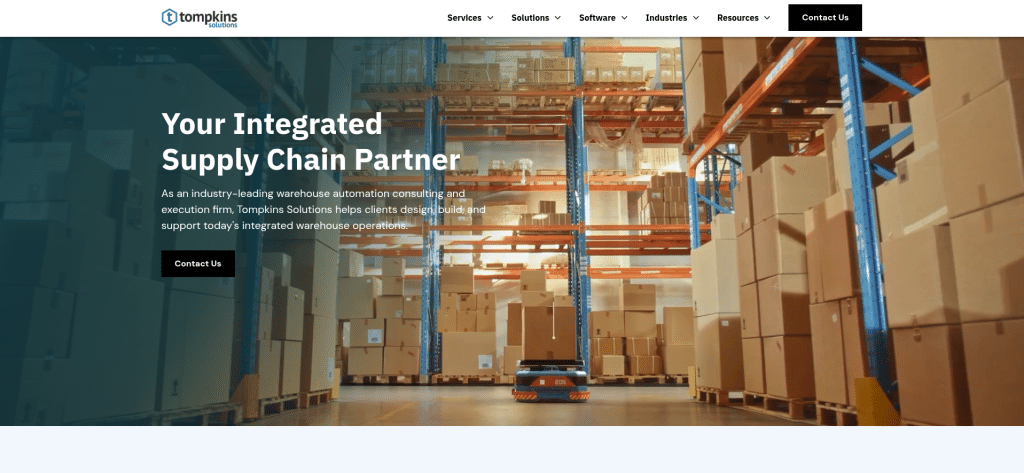
Tompkins Solutions is a supply chain and logistics consulting firm specializing in end-to-end supply chain strategy, warehouse design, automation, fulfillment, and omnichannel operations. Founded in 1975 by Dr. James A. Tompkins, the firm is headquartered in Raleigh, North Carolina, and has served a broad range of industries including retail, consumer products, manufacturing, life sciences, and e-commerce.
Tompkins Solutions is best known for its deep expertise in supply chain optimization, especially in the face of evolving customer expectations, digital commerce trends, and distribution challenges. The firm combines strategic consulting with implementation support, including warehouse management systems (WMS), robotics integration, and facility engineering.
A notable strength of Tompkins Solutions is its ability to align operations with business strategy, helping clients improve speed, reduce cost, and enhance flexibility across their supply chain networks. Their services often involve large-scale transformation efforts, including network design, distribution center automation, and technology modernization.
In recent years, the firm has also focused on digital supply chain transformation, helping businesses adapt to e-commerce growth and rising consumer demands through advanced fulfillment strategies and data-driven planning.
Founding and Evolution
Tompkins Solutions was founded in 1975 by Dr. James A. “Jim” Tompkins in Raleigh, North Carolina. Originally established as Tompkins Associates, the firm began as a niche supply chain consulting company focused on warehouse operations and logistics strategy. Throughout the 1980s and 1990s, Tompkins Associates grew steadily, expanding its services from warehouse layout and material handling consulting into broader supply chain strategy and distribution network design. By the early 2000s, the firm had gained a reputation for cutting-edge insights into supply chain trends, often helping clients adapt to globalization and the rise of e-commerce.
In 2012, reflecting its increasingly global scope, the company rebranded to Tompkins International. This change underscored the firm’s evolution from a regional consultancy into a global player working on end-to-end supply chain solutions across multiple continents. Under the Tompkins International banner, the firm broadened its capabilities by incorporating advanced technologies and international market expertise. It launched practices in areas like digital commerce and global supply chain expansion, aligning with clients’ needs to compete in a worldwide marketplace. During this period, Tompkins also opened offices in Europe and Asia, signaling its commitment to serve clients on a global scale.
Entering the 2010s and 2020s, Tompkins continued to evolve by developing new business units and solution offerings. In response to rapid market changes (such as the Amazon-driven e-commerce boom), the firm undertook a strategic realignment around 2019-2020, organizing into six integrated business units: Supply Chain Consulting, Material Handling Integration, Robotics, Applied Technologies, Fulfillment Services, and Digital Commerce. This “ecosystem” structure allowed Tompkins to offer comprehensive services—from high-level strategy down to implementing warehouse automation and even operating fulfillment centers. The firm also incubated new ventures, such as MonarchFx (launched in 2018 as an alliance to provide omni-channel fulfillment services) and Tompkins Robotics (which developed the innovative tSort robotic sortation system). These ventures demonstrated Tompkins’ willingness to push into new frontiers of supply chain technology and 4PL (fourth-party logistics) services.
In 2021, the company refreshed its brand identity to Tompkins Solutions, reflecting its emphasis on delivering integrated solutions (not just consulting advice) for supply chain challenges. Today, Tompkins Solutions provides end-to-end services including strategy consulting, engineering design, and the build-out of automation systems. The firm has thousands of successful projects to its name and continues to adapt through partnerships and acquisitions. For example, in early 2025 Tompkins Solutions announced a combination with MSI Automate, a warehouse automation provider, to deepen its robotics and intelligent software capabilities. The combined entity retained the Tompkins Solutions name and reinforced the company’s long-term evolution into a one-stop supply chain solutions provider. Over its five-decade history, Tompkins has grown from a small consulting shop into a multifaceted global firm at the forefront of supply chain innovation.
Key Leadership and Growth
Dr. James “Jim” Tompkins (Founder and Chairman) – Jim Tompkins is the founder of the firm and was the driving force behind its vision and growth for decades. With a doctorate in engineering, Jim brought academic rigor to practical supply chain problems. He served as CEO for much of the company’s history, establishing Tompkins as a thought leader in the industry. Under his leadership, the firm not only expanded globally but also became known for influential white papers and books on supply chain management. Jim Tompkins is widely recognized as an industry authority on logistics and has been at the forefront of major trends (from lean distribution in earlier years to e-commerce and omnichannel strategy more recently). Even after stepping back from day-to-day management, he remains Chairman and continues to influence the firm’s strategic direction. In recent years, he has also spearheaded Tompkins Ventures, a separate initiative that leverages a network of partners to help companies find supply chain solutions and investment – further cementing his role as a leading voice in the field.
Denny McKnight (Former President & CEO) – A pivotal figure in Tompkins’ development, Denny McKnight joined the company early in his career and was one of the first partners in the consulting practice. Over more than 30 years at Tompkins, Denny played a variety of leadership roles. He became President of Tompkins International in 2013, overseeing operations during a period of diversification and growth. Notably, he led the firm’s expansion into material handling integration, helping Tompkins start offering not just advice but also implementation of automation systems. Denny McKnight took on the CEO role in 2020, guiding the company through the turbulence of the COVID-19 pandemic era. Under his leadership, Tompkins achieved record revenues in 2021 as demand for supply chain services and warehouse solutions surged. He is credited with helping position the firm for the digital commerce age. Denny retired in early 2022 after a distinguished career, leaving behind a strong foundation for the next generation of leadership.
David Latona (President & CEO) – David Latona is the current President and CEO of Tompkins Solutions (assumed the role in February 2022). A seasoned supply chain professional with 35+ years of experience, Latona specializes in distribution center design and optimization. He joined Tompkins in the mid-2010s and quickly proved his leadership in the Material Handling Integration division. David Latona was instrumental in driving growth in Tompkins’ automation and integration services, helping the company deliver complex projects that combine software, robotics, and operational best practices. As CEO, Latona is focused on continuing the firm’s growth trajectory, fostering innovation, and maintaining Tompkins’ reputation for client service. Under his leadership, the firm has strengthened partnerships with technology providers and pursued strategic combinations (such as the MSI Automate merger in 2025) to broaden its solution offerings. Latona’s promotion to CEO marks a transition to a new generation of leadership, while upholding the firm’s core values established by Jim Tompkins.
Other Leadership and Key Personnel: Beyond the CEOs, Tompkins Solutions’ leadership team includes experts who have guided the firm’s practices and regional expansion. For instance, Steven Ganster led Tompkins’ expansion into Asia as Managing Director for the Asia-Pacific region in the 2010s, helping multinational clients enter and thrive in Asian markets. In Europe, Susan Evans served as Managing Director for EMEA, anchoring the firm’s presence and thought leadership in that region. Additionally, Tompkins has a cadre of Vice Presidents and Partners who head various domains – such as Supply Chain Consulting, Engineering, Robotics, and Sales. Individuals like Jon Johnson (appointed Chief Operating Officer in 2024) and Roy Smith (VP of Sales) have been brought on to strengthen operational execution and business development. The leadership team collectively brings decades of industry experience, blending long-tenured Tompkins veterans with fresh experts from industry. This stable yet dynamic leadership has been crucial in shaping Tompkins’ consulting methodologies, entering new industry verticals, and sustaining the firm’s innovative culture over the years.
Industries Served (Past and Present)
From its early years to today, Tompkins Solutions has served a wide array of industries – essentially any sector that relies on complex supply chain and distribution operations. Key industries the firm has focused on include:
- Retail (Brick-and-Mortar and Omnichannel): Retail has been a core focus for Tompkins since the beginning. Early on, the firm helped big-box and department store retailers improve their distribution centers and implement just-in-time inventory techniques. Over time, as retail evolved, Tompkins guided traditional brick-and-mortar chains to develop omnichannel capabilities – for example, designing systems for ship-from-store, click-and-collect, and efficient returns processing. The firm’s retail clients have included supermarkets, apparel chains, home goods stores, and other mass merchants seeking to optimize inventory across store networks and e-commerce channels.
- E-Commerce and Direct-to-Consumer: With the rise of online shopping, Tompkins became an early advisor in e-commerce fulfillment. Throughout the 2000s and 2010s, the firm worked with pure-play e-commerce companies and the e-commerce divisions of traditional retailers. Tompkins has designed fulfillment center networks to enable 1-2 day delivery nationwide, optimized last-mile delivery strategies, and implemented automation (like sortation robots and automated picking systems) tailored for high-volume parcel shipping. The firm’s insights – such as Jim Tompkins’ well-known analysis of “The Amazon Effect” – have been invaluable for companies looking to compete with or adapt to giants like Amazon and Alibaba. Today, supporting direct-to-consumer supply chains is one of Tompkins Solutions’ bread-and-butter competencies.
- Consumer Products and Manufacturing: Over its history, Tompkins has also served manufacturers and CPG (consumer packaged goods) companies needing efficient supply chain strategies. This includes helping food and beverage producers streamline their distribution (e.g. optimizing warehouse layouts for cold storage or automating beverage distribution centers) and assisting consumer electronics or apparel brands in managing global sourcing and distribution. In the manufacturing sector, the firm has offered consulting on plant warehousing, inbound material flow, and the integration of production with distribution (for example, ensuring factories can fulfill direct orders or feed retail channels promptly). By applying best practices in lean logistics and network optimization, Tompkins has helped producers reduce costs and respond faster to customer demand.
- Food & Beverage Supply Chains: The food and beverage industry has unique challenges like temperature-controlled logistics, expiration dating, and high throughput requirements. Tompkins Solutions has advised grocery chains, food distributors, and beverage companies on distribution center design, route optimization for food delivery, and inventory management to minimize spoilage. The firm has implemented solutions like automated storage & retrieval systems (AS/RS) in refrigerated warehouses and optimized the store replenishment process for supermarket chains. Given growing trends like fresh meal delivery and online grocery, Tompkins continues to help F&B clients modernize their fulfillment operations for speed and freshness.
- Pharmaceutical and Healthcare: Tompkins has extended its expertise to pharmaceutical distributors, medical device companies, and healthcare supply chains. Projects in this sector often involve ensuring regulatory-compliant storage, precise inventory tracking (for lot numbers and expirations), and high security. The firm has helped pharma clients revamp their distribution networks to support nationwide pharmacy deliveries and has worked with hospital systems to improve their internal supply logistics. Especially with the recent focus on healthcare supply resilience (for example, vaccine distribution and medical supply availability), Tompkins Solutions provides guidance on building agile and reliable healthcare logistics systems.
- Logistics Service Providers (3PL/4PL): In addition to end-product industries, Tompkins frequently works with third-party logistics (3PL) providers and other logistics companies. The firm has helped 3PLs design multi-client warehouses, evaluate where to open new distribution hubs, and implement technologies to better serve their customers. Tompkins’ own ventures, like the MonarchFx alliance, show its deep involvement in 4PL and logistics outsourcing models – essentially helping orchestrate networks of carriers, warehouses, and tech providers to deliver “supply chain as a service.” Over the years, many trucking firms, warehousing companies, and integrated logistics providers have sought Tompkins’ consulting to improve efficiency or to develop new service offerings in the face of market changes.
(Overall, Tompkins Solutions’ industry reach is broad. However, the common thread is that the firm specializes in industries with complex distribution and fulfillment needs. Whether it’s shipping apparel to stores, delivering groceries to homes, or distributing high-tech products globally, Tompkins has applied its supply chain expertise to drive improvements.)
Consulting Methodologies and Strategic Approaches
Tompkins Solutions is known for a structured yet flexible approach to solving supply chain challenges. The firm’s consulting methodology is often summarized as “Strategy, Structure, Implement (SSI)”. In practice, this means: first developing the right Strategy (clear goals, whether it be cost reduction, service improvement, entering a new market, etc.), then designing the optimal Structure (the supply chain design or solution blueprint – such as network layout, process flows, or system architecture), and finally driving through to Implementation (making the plan reality via project management, technology integration, and change management). This SSI framework ensures that recommendations are not just theoretical; they are actionable and carried through to results. Tompkins consultants focus on identifying the solution that provides the greatest value for the client’s specific needs, rather than a one-size-fits-all approach.
Several key principles define Tompkins’ strategic approach: end-to-end perspective, data-driven analysis, and innovation. The firm looks at supply chains holistically – from suppliers through to end customers – to avoid siloed optimizations. For example, a typical engagement might start with modeling the entire supply network and analyzing trade-offs (transportation costs vs. inventory levels vs. service speed) to find an optimal configuration. Tompkins leverages advanced analytical tools, proprietary models, and industry benchmarks to support these decisions. They are known for rigorous engineering analysis in warehouse design (e.g. using simulation and modeling for throughput calculations) combined with strategic consulting insight (e.g. understanding market trends and business strategy). This blend helps clients align their supply chain strategy with business goals.
Another hallmark of Tompkins’ approach is its integration of technology and automation early in the strategy process. Rather than treating technology as an afterthought, Tompkins considers how emerging solutions (robotics, AI, supply chain software) can address the client’s challenges from the outset. The firm often prototypes or tests concepts in its Innovation Lab – a dedicated environment to explore next-generation technologies (such as robotics for picking, automated sortation, warehouse control systems, and IoT devices for real-time tracking). By staying ahead on technology trends, Tompkins can recommend innovative yet practical solutions. For instance, as early as the mid-2010s, Tompkins was advocating for robotic goods-to-person systems and micro-fulfillment centers, which have since become industry best practices.
Tompkins Solutions also emphasizes partnership and client collaboration as part of its methodology. They often embed their consultants with client teams to co-develop solutions, ensuring knowledge transfer and buy-in. The firm’s culture is to act as a long-term “supply chain partner” rather than just an outside advisor. This is supported by their ability to carry projects through implementation: Tompkins doesn’t stop at giving a report – they can manage the project, integrate the new automation equipment or software, and even provide ongoing support to ensure the solution performs. This cradle-to-grave capability (strategy through execution and lifecycle support) is a distinguishing approach for Tompkins in the consulting landscape.
In summary, Tompkins’ methodologies are characterized by a mix of strategic consulting frameworks and engineering precision. Whether employing classic tools like process mapping, Six Sigma/Lean techniques for operations improvement, or using proprietary models for network optimization, the firm grounds its work in proven methods. At the same time, Tompkins encourages creative problem-solving – consultants are known to challenge the status quo of a client’s operations and propose out-of-the-box changes (for example, rethinking a distribution network from scratch or introducing automation in areas previously manual). This balance of disciplined methodology (SSI and data-driven analysis) with innovative thinking has earned Tompkins a reputation for delivering transformative yet achievable results for clients.
Global Operations and Geographic Footprint
Tompkins Solutions has established a global footprint to serve its clients wherever they operate. The company is headquartered in Raleigh, North Carolina, which remains its primary hub for leadership, corporate functions, and a large share of its consulting staff. However, over the decades the firm has expanded within North America and beyond:
- North America: In the United States, Tompkins has multiple office locations and project teams spread across key logistics regions. Besides Raleigh, the firm historically has had presence in cities like Atlanta, GA (a major logistics hub), Dallas, TX, and Irvine, CA, among others, to be close to client clusters. Tompkins’ consultants often work on-site at client facilities across the country, so the firm employs a geographically dispersed workforce with many working remotely or traveling frequently. In addition to the U.S., Tompkins serves Canada and Mexico from its North American operations – for example, optimizing distribution networks that span cross-border commerce. The North American practice constitutes the largest portion of the firm’s business, reflecting the sizable retail and e-commerce market domestically.
- Europe (EMEA): Tompkins International established a European presence to support multinational clients and tap into the European market’s needs. The firm opened offices in Western Europe (historically in the U.K. and possibly mainland Europe such as Belgium or Germany) and has had a Managing Director for EMEA overseeing projects across the region. Through these offices, Tompkins serves industries like fashion retail, automotive aftermarket, and pharmaceuticals in Europe. European projects often involve complexities such as multi-country distribution (dealing with different languages, regulations, and smaller geographies). Tompkins has helped clients establish pan-European distribution centers (for example, in hub locations like the Netherlands) and streamline their EU supply chains. The firm’s European consultants combine local market knowledge with Tompkins’ global methodologies, ensuring solutions fit the context (like EU customs regulations or the preference for sustainable logistics practices in Europe).
- Asia-Pacific: Tompkins Solutions has been active in Asia for many years, recognizing Asia’s critical role in global supply chains (both as a manufacturing source and a booming consumer market). The firm’s Asia-Pacific base has included an office in Shanghai, China (as China is a key market), and representation in other areas such as Southeast Asia. Under leaders like Steven Ganster, Tompkins advised Western companies entering or expanding in Asia – for instance, developing China distribution strategies, setting up Asia-Pacific regional distribution centers, and navigating local logistics infrastructure. Conversely, Tompkins also worked with Asian companies (including Chinese retailers and manufacturers) looking to optimize their supply chains or expand internationally. The Asia team has expertise in sourcing, manufacturing logistics, and e-commerce fulfillment (notably helping clients ride the wave of growth in China’s online retail). By having a presence in Asia, Tompkins can manage on-the-ground implementation, form partnerships with local providers, and keep abreast of market shifts (like the growth of regional hubs in Vietnam or India’s logistics modernization).
- Other Regions: While North America, Europe, and Asia are the primary regions, Tompkins has also executed projects in Latin America, the Middle East, and occasionally Africa through a combination of flying teams out and partnering with local consultants. The firm may not have permanent offices in all these regions, but it maintains a network of affiliates and partners. For example, Tompkins has collaborated with consulting partners in the Middle East and Australia to deliver projects under the Tompkins methodology. This flexible global delivery model allows Tompkins to support clients in emerging markets when needed (such as helping set up a new distribution center in Brazil or optimizing a supply chain in the Gulf region).
Today, Tompkins Solutions prides itself on being a global operations firm. It can coordinate multi-continent supply chain transformations, ensuring that a strategy developed in the U.S. can be executed seamlessly in Europe or Asia. Communication across offices is facilitated by modern collaboration tools and periodic global meetings, so best practices are shared worldwide. The geographic footprint also means career opportunities for staff to take on international assignments or transfers (e.g., a U.S. consultant spending a year in the London office, or an engineer from Asia working on a North American automation project). This global reach, combined with local expertise, is a key differentiator for Tompkins, enabling it to handle the complex, international nature of modern supply chains.
Career Progression and Roles at Tompkins
Tompkins Solutions offers clear career progression paths for its consultants and technical professionals, albeit in a mid-sized firm environment (the company has on the order of a few hundred employees, rather than thousands). The career ladder is designed to develop employees from entry-level roles into seasoned experts and leaders. A typical progression for the consulting track is as follows:
- Associate Consultant (Entry Level): Recent graduates or those with a couple of years of industry experience often join at the Associate Consultant level. In this role, individuals focus on analytical work – gathering data, running supply chain models, contributing to warehouse layouts, and supporting senior team members on projects. Associate Consultants at Tompkins learn the fundamentals of the firm’s methodologies (like the SSI approach) and gain exposure to different industries. They often rotate on several project teams to build a broad skill set. Over time, they take on more client-facing responsibilities, such as presenting parts of analyses or managing sub-tasks within a larger project.
- Consultant / Senior Consultant: After demonstrating proficiency (typically a few years in), Associates are promoted to Consultant, and later to Senior Consultant. Consultants at Tompkins handle larger portions of projects – for example, they might lead a workstream like conducting a distribution network analysis or designing a specific warehouse solution. Senior Consultants are expected to be more autonomous, often acting as deputy project managers. They interface regularly with client managers, present findings, and start contributing to solution design in addition to analysis. This level is about building depth of expertise; many Senior Consultants specialize in a domain (e.g., becoming the go-to person for slotting optimization, inventory strategy, or a particular software). Tompkins values hands-on experience, so by the time someone is a Senior Consultant, they likely have seen multiple types of warehouses, perhaps even participated in implementation supervision on-site.
- Project Manager / Engagement Manager: The next step is into formal project leadership. Project Managers (sometimes titled Engagement Managers) oversee entire consulting projects or significant implementation engagements. They are responsible for planning the project timeline, coordinating the team’s work, and being the primary day-to-day contact for the client. At Tompkins, a Project Manager might handle a project like “Design and Build a New Fulfillment Center for Client X,” coordinating between the strategy consultants, the engineering team, and any external vendors. They ensure the project delivers results on-time and on-budget. People in these roles develop strong leadership and client management skills. Internationally, Tompkins has opportunities for project managers to lead multi-country projects, which can broaden their experience (for example, managing a team split between U.S. and Europe to implement a global solution).
- Director / Vice President (Practice Leaders): Above the project management level, Tompkins has roles like Director or Vice President, which often involve managing a portfolio of projects or a practice area. These individuals may lead an industry vertical (e.g., Director of Retail Solutions) or a capability area (e.g., VP of Material Handling Integration). In addition to guiding multiple project teams, they take charge of business development – meeting potential clients, scoping new engagements, and contributing to the firm’s strategy. They are also mentors, developing the next generation of consultants. At Tompkins, Vice Presidents typically have deep expertise and are recognized thought leaders (they might publish articles or speak at conferences in their domain). Some VP roles are also geographic – for instance, a Managing Director for Asia would combine this level of seniority with regional oversight, ensuring the firm’s services align with local market needs.
- Partner / Executive Leadership: The top of the consulting career pyramid at Tompkins is the Partner level (though titles may vary, sometimes “Principal” or simply Senior Vice President in a corporate sense). Partners are the senior-most consultants who often have an equity stake or share in the firm’s success. They are responsible for major client relationships and often serve as the trusted advisor to C-suite executives of client organizations. Partners at Tompkins drive the company’s vision and service offerings – for example, a Partner might champion the development of a new robotics service line or spearhead entry into a new region. They collaborate to set firm-wide policies and strategy, alongside the CEO and executive team. Many Partners have been with Tompkins for a long time (as seen with Denny McKnight’s path to partnership and beyond), ensuring continuity of the firm’s culture and values. However, Tompkins also occasionally brings in outside experts directly into high positions when expanding a capability (for instance, hiring a known industry expert to lead the digital commerce practice as a Partner-level hire).
It’s important to note that Tompkins Solutions offers multiple career tracks beyond pure consulting. Given the company’s integration and technology orientation, there are roles for engineers, software specialists, and operations managers. A person might join as a Solutions Engineer focused on warehouse automation design (with a progression from junior engineer to senior engineer to engineering manager). Similarly, Tompkins employs software engineers and WMS/WCS specialists (especially within its Applied Technologies unit), who can progress to lead technology architect roles. There is also a Robotics team (under Tompkins Robotics) where specialists in robotics integration and product development have their own career path. Tompkins fosters collaboration between these tracks – for example, a project might have a consulting manager paired with an engineering manager to jointly deliver results, giving exposure and growth opportunities to both kinds of professionals.
For those interested in international careers, Tompkins provides paths to work abroad or on global projects. High-performing consultants in the U.S. might get the chance to transfer to the European office for a year or two, or vice versa, to broaden their experience. The firm’s moderate size means that career progression is merit-based and sometimes faster than at larger consultancies – talented individuals can take on significant responsibility early if they prove capable. However, because the firm is smaller than the mega-consultancies, there are fewer “layers” of hierarchy; this often translates to more direct mentorship from senior leaders and a collaborative team environment. Employees frequently cite the opportunity to wear many hats and see a project from concept through implementation as a rewarding aspect of Tompkins’ career progression model.
Compensation and Benefits
Tompkins Solutions offers competitive compensation packages that align with its consulting peers, though as a mid-sized firm (rather than a very large consultancy), its pay scales are tailored to its size and market niche. Base salaries increase significantly with each level of responsibility, and performance-based bonuses are a key component of total pay, especially from the consultant level upward. Below is an overview of typical compensation by level (figures are approximate and as of 2025, based on industry data and self-reported ranges):
- Associate Consultant (Entry Level): In the United States, associate consultants at Tompkins might have a base salary roughly in the range of $65,000 to $80,000 per year. Depending on individual performance and company profitability, they can earn an annual bonus of perhaps 5-10% of base pay. Total compensation thus might fall around the high-$60s to low-$80s in thousands USD for a new hire. Benefits at this level include health insurance, retirement plan contributions (e.g., a 401k with company match), and typically some support for travel expenses (as consultants travel to client sites). Even at the entry level, Tompkins may offer relocation assistance if needed and a modest sign-on bonus for top recruits.
- Consultant / Senior Consultant: For mid-level consultants, base salaries generally move into the low six figures. A Consultant could expect somewhere in the $85,000 to $110,000 base range, while a Senior Consultant might be in the $100,000 to $130,000 base range in the U.S. On top of this, annual bonuses are more substantial – often 10-20% of base, reflecting both individual performance and project success. Thus a high-performing Senior Consultant might see total compensation in the $120K–$150K+ range. At this stage, Tompkins also provides enhancements like paid professional development (funding for certifications or training workshops) and generous travel perks (frequent flyer status benefits, per diem allowances, etc., given the amount of travel consultants do). Health, dental, and vision insurance are standard, and time-off policies usually include a few weeks of vacation plus sick leave, with some flexibility to work remotely when not on-site with clients.
- Project Manager / Engagement Manager: As consultants rise to lead projects, their compensation increases to reflect greater responsibility. Project Managers at Tompkins often have base salaries roughly in the $110,000 to $150,000 range, depending on experience and the region. Performance bonuses can reach 20% or more of base pay, since successful project delivery is critical – that means total compensation can land in the mid to high $100Ks (for example, $140K–$180K is not uncommon). Additionally, individuals at this level might start to receive profit-sharing or larger bonus incentives tied to practice area results. Benefits continue as before, but Tompkins may also provide extra perks like company-paid laptops and mobile devices, a company credit card for travel, and expanded expense accounts to entertain clients or team gatherings. Work-life balance support, such as flexible scheduling between projects, becomes important at this level, and Tompkins has been noted to offer flexible work arrangements when possible (recognizing the intensity of project leadership roles).
- Directors, Vice Presidents, and Partners: Senior leaders at Tompkins (VPs, practice directors, and partners) command the highest compensation, on par with leadership roles in the industry. Base salaries for a Vice President or equivalent might start around $150,000 to $180,000, and for the most senior partners can exceed $200,000 in base. The bonus component is significant – often 25-40% (or more) of base pay, reflecting company performance, practice profitability, and new business brought in. It’s not unusual for a successful partner’s total annual compensation to reach $250,000 to $300,000+. In fact, according to some estimates, the top partners at Tompkins earn in the mid to high $200K range per year, and potentially higher in exceptional years. Equity or profit-sharing is often part of partner compensation, meaning they benefit directly from the firm’s overall financial success. At this leadership level, benefits may include enhanced retirement plans, profit distribution, and additional paid leave. Tompkins likely also covers professional association memberships and conference travel for its leaders (since they often speak at events). While partners work hard, they have more control over their schedules and might receive sabbaticals or extended time off periodically as a reward for long tenure.
Geographic Compensation Variances: Tompkins Solutions adjusts compensation to local markets for its international offices. U.S. salaries are generally the highest in nominal terms, reflecting the market and cost of living. In Europe, base salaries for consultants might be somewhat lower than U.S. equivalents when converted to USD (for example, a Senior Consultant in the UK might earn slightly less than one in the U.S.), but European packages often include other benefits such as more vacation days, statutory healthcare/pension contributions, and sometimes allowances for car or housing depending on the country. In Asia, compensation is aligned with regional norms – for instance, a consultant based in China or India would have a lower dollar-equivalent salary than a U.S. consultant, but that pay is competitive and often quite attractive in the local context. Tompkins may also pay premiums or hardship allowances for expatriate staff who relocate internationally to lead projects. The firm strives to maintain internal equity: performance bonuses and promotion criteria are standardized globally, even if the absolute pay numbers differ. As a result, all offices feel part of one firm, but pay is fair relative to local cost structures.
Benefits and Culture: Across all levels, Tompkins Solutions provides a comprehensive benefits package. Health insurance (medical, dental, vision) is a staple in the U.S., and international offices offer equivalent health coverage often through either private plans or national systems. A 401(k) retirement plan (with company matching contributions) is offered in the U.S., and similarly, pension or retirement schemes are supported in other countries as applicable. Employees enjoy paid time off that increases with tenure; senior staff can have several weeks of vacation. Tompkins also emphasizes work-life balance in what is traditionally a demanding consulting field. The company has implemented flexible work arrangements, such as work-from-home options and flexible hours, especially when employees are not at client sites. In fact, company reviews often highlight a supportive and flexible culture – management encourages taking time for family or personal needs, and there’s an understanding that while travel and deadlines are part of the job, personal well-being is important for long-term productivity.
Additional perks include: performance recognition programs (awards or bonuses for exceptional project results), coverage of certification or tuition for further education, and a collegial atmosphere with team outings and retreats (for example, Tompkins might organize an annual all-hands meeting or a holiday event where teams from different regions come together). The firm also has a practice of contributing to consultants’ continuous learning – giving access to online training platforms, sponsoring attendance at industry conferences like MODEX or CSCMP, etc. All these benefits are aimed at attracting and retaining top talent in a competitive field. By offering a mix of financial reward, career growth, and quality-of-life considerations, Tompkins Solutions positions itself as an employer of choice within supply chain consulting, both in the U.S. and in its international locales.
Thought Leadership and Innovation Initiatives
Thought leadership has always been a cornerstone of Tompkins Solutions’ identity. The firm and its leaders actively contribute to the intellectual advancement of supply chain management through publications, forums, and innovative initiatives:
- Publications and White Papers: Tompkins regularly publishes insightful white papers, research reports, and articles on emerging supply chain trends. Jim Tompkins himself authored or co-authored several influential works. For example, his book “No Boundaries” (published in the 2000s) explored supply chain excellence and became a reference for practitioners. A particularly famous thought piece by Jim was “The Amazon Effect”, a white paper (and accompanying video) in the mid-2010s that analyzed how Amazon was revolutionizing retail and what companies needed to do in response – this gained wide circulation in the industry. Tompkins Solutions continues this tradition; the firm’s consultants frequently write blog posts and contribute to industry journals on topics like omnichannel strategy, robotics in distribution, supply chain resilience, and more. These publications not only provide value to the industry at large but also showcase Tompkins’ forward-thinking approach, often attracting new business from companies that read their thought pieces.
- Supply Chain Leadership Forum (SCLF): Tompkins has long hosted an annual event known as the Supply Chain Leadership Forum, bringing together supply chain executives from various industries. Established over a decade ago, this forum is a venue for sharing best practices, benchmarking, and networking. Each year, the SCLF features keynote speakers both from Tompkins (often Jim Tompkins or the current CEO) and from industry (for instance, executives from major retailers or manufacturers). In past forums, high-profile speakers have included partners like Alibaba’s North America VP and other notable companies, indicating the level of discourse at these events. The forum covers the latest developments in logistics technology, strategy in the era of digital commerce, and case studies of successful transformations. It’s a showcase for Tompkins’ thought leadership as well as a learning opportunity for clients and partners. Even through 2020-2021, when in-person events were limited, Tompkins adapted by hosting virtual conferences and webinars to continue the knowledge exchange.
- Tompkins Supply Chain Consortium: Historically, Tompkins International ran a Supply Chain Consortium, which was a group of hundreds of companies that pooled data to benchmark performance metrics. Through this consortium, Tompkins gathered industry data on things like distribution costs, service levels, and best practices, and shared aggregated findings with members. This initiative positioned Tompkins as a hub for supply chain benchmarking knowledge. Consortium members would attend special sessions (often adjacent to the Leadership Forum) to discuss trends and anonymized metrics – providing valuable insights to participants and further establishing Tompkins as a thought leader with deep analytical resources.
- Innovation Lab: As part of its “Solutions” focus, Tompkins operates an Innovation Lab where new supply chain technologies are tested and demonstrated. This lab serves as an R&D center and a showroom. For example, Tompkins has used the Innovation Lab to refine its tSort robotic sortation system (developed by Tompkins Robotics) – testing throughput, integrating it with various software, and showcasing it to clients. The lab also explores emerging tools like vision systems for inventory, autonomous mobile robots for goods transport, AI-driven forecasting systems, and warehouse control software (Cornerstone WCS is one of Tompkins’ software offerings in this realm). By investing in a hands-on lab, Tompkins ensures its teams can confidently recommend technology to clients, having played with and validated these tools themselves. It also underscores the firm’s innovative ethos: clients visiting the lab can see live demonstrations of cutting-edge solutions, which helps demystify technology and build trust in Tompkins’ capabilities to implement them.
- Conferences and Speaking Engagements: Tompkins’ experts are frequently present at major industry conferences (such as MODEX, ProMat, CSCMP Edge, NRF Supply Chain, etc.). They often deliver presentations or sit on expert panels discussing topics like warehouse automation trends or strategies for supply chain agility. The firm sometimes sponsors such conferences, further boosting its visibility. In 2024, for instance, Tompkins Solutions showcased its innovative robotics and automation solutions at MODEX (a leading material handling expo), demonstrating live how their systems like tSort and their software can improve warehouse efficiency. These public engagements reinforce Tompkins’ position as a go-to authority on supply chain issues and keep the firm at the forefront of industry developments.
- Academic and Industry Collaboration: Tompkins Solutions also connects with academia and industry groups. Jim Tompkins, having an academic background, fostered relationships with universities (like NC State, where he once was a faculty member) to recruit talent and exchange ideas. The firm’s staff have taught courses or seminars at supply chain management programs, contributed chapters to academic books, and participated in think tanks. Tompkins is involved with professional bodies such as the Council of Supply Chain Management Professionals (CSCMP) and Warehousing Education and Research Council (WERC). By engaging in these communities, Tompkins both learns about the latest research and influences the practical training of new professionals. This thought leadership pipeline helps keep the firm’s methodologies fresh and grounded in the latest proven techniques.
- Tompkins Ventures and Partner Network: In recent years, the creation of Tompkins Ventures (led by Jim Tompkins) has extended the firm’s thought leadership into a new arena. Tompkins Ventures is a global network that matches companies with solutions and capital – effectively a consulting-advisory network that goes beyond traditional projects. It reflects an innovative approach to solving client challenges by connecting them with partners (for example, matching a retailer that needs robotics with a specific robotics startup, or finding an investor for a new supply chain tech solution). While Tompkins Ventures is structured as a separate entity, its existence highlights the entrepreneurial and forward-looking mindset of the Tompkins ecosystem. Insights and connections from Ventures often flow back into Tompkins Solutions, keeping the firm plugged into emerging trends (like reshoring strategies, supply chain finance, etc.).
Through these and other initiatives, Tompkins Solutions has positioned itself not just as a consulting vendor but as a thought leader and innovator in the supply chain world. Clients and industry peers look to Tompkins for guidance on “what’s next” – whether it’s reading their annual trends report or attending their forums. This continuous investment in thought leadership has enhanced the firm’s brand equity; many clients engage Tompkins because they’ve been influenced by the firm’s thought pieces or events before a project even begins.
Notable Projects and Recognitions
Over its long history, Tompkins Solutions has been involved in numerous high-profile projects and has earned recognition for its innovative work. While specific client names are often confidential, the firm is particularly known for several distinctive accomplishments:
- Pioneering Retail Distribution Center Designs: Tompkins has designed and optimized distribution centers for some of the world’s largest retailers. In one notable project, the firm helped a major big-box retailer completely redesign its distribution network to enable two-day e-commerce delivery across the United States. This involved selecting optimal locations for new fulfillment centers and implementing state-of-the-art automation inside them. The result was a network that could rival the speed of Amazon’s, and the project was cited in industry publications as a model for omnichannel retail distribution. Tompkins’ ability to marry strategy (where to locate DCs) with operational detail (how to lay out conveyor and picking systems inside the DC) was key to this success.
- Tompkins Robotics tSort Implementation: The development of the tSort robotic sortation system by Tompkins Robotics (a business unit of Tompkins) has been a game-changer in unit-sorting technology. One high-profile deployment of tSort was for a leading fashion retailer’s e-commerce fulfillment center. Tompkins handled the project end-to-end: consulting on the process flow, supplying the tSort robotics system, and overseeing installation and ramp-up. The success of this project – significantly improving order sortation speed and accuracy while reducing labor – garnered attention and won a 2020 “NextGen Supply Chain Solution” award for Tompkins Robotics. Today, tSort systems are used by multiple retailers and 3PLs for fast sortation of items, and Tompkins is known as a pioneer in practical robotics integration through this work.
- Omnichannel Transformation for Department Stores: In the mid-2010s, Tompkins worked with a traditional department store chain that was struggling to integrate online and in-store operations. Tompkins’ team crafted an omnichannel strategy that introduced ship-from-store capabilities, centralized e-commerce fulfillment, and a new inventory allocation system. They then guided the implementation: reconfiguring store backrooms for online order picking, launching a new distribution center dedicated to online orders, and training staff on omnichannel processes. This project was highly visible because it helped a legacy retailer achieve one of the fastest order fulfillment times in its segment, and it was highlighted at industry conferences as a case study in successful digital transformation. Tompkins Solutions became known for this kind of holistic retail makeover – not merely advising, but executing the changes needed on the ground.
- Global Supply Chain Expansion Projects: Tompkins has assisted companies in expanding to new markets through supply chain development. One example was a U.S.-based apparel brand entering the Chinese market. Tompkins’ Asia team conducted market entry planning, identified the need for a regional distribution center in East Asia, and designed the facility in China to serve both brick-and-mortar stores and online consumers. They also helped the client select local logistics partners and set up a returns management process suitable for the market. The success of this project (the client achieved rapid growth in Asia with an efficient supply chain from day one) made Tompkins a go-to consultant for companies pursuing international growth. It showcased Tompkins’ ability to handle cross-border complexities, from customs regulations to localization of delivery options.
- MonarchFx Fulfillment Network: The launch of the MonarchFx Alliance was itself a notable “project” in that it represented a bold, non-traditional move by a consulting firm. MonarchFx, initiated around 2018, aimed to create a national network of omnichannel fulfillment centers operated by a coalition of logistics partners under Tompkins’ orchestration. Tompkins brought together 3PLs, technology vendors, and real estate firms to offer retailers a plug-and-play fulfillment solution (essentially a 4PL service to compete with Amazon’s logistics). While MonarchFx was an ambitious venture and evolved over time, it demonstrated Tompkins Solutions’ innovative spirit. The effort received considerable press and was closely watched as an experiment in supply chain collaboration. It reinforced Tompkins’ image as more than just consultants – they were willing to step into the role of a solution provider and even an operator to drive industry change.
- Awards and Rankings: Tompkins Solutions and its leadership have received various accolades. Jim Tompkins, for instance, has been inducted into industry halls of fame (like the Supply Chain Pros to Know lists and similar honors) for his contributions. The firm’s projects have won awards such as Distribution Center of the Year (when a facility Tompkins designed for a client achieved exceptional performance metrics) and Supply Chain Innovation Awards at industry forums. Additionally, Tompkins Solutions often ranks in industry lists of top supply chain consultancies or top material handling system integrators. These recognitions underscore the firm’s impact and excellence.
- Client Longevity and Testimonials: Another testament to Tompkins’ high-profile work is the long-term relationships it has maintained with major companies. Many Fortune 500 clients have returned to Tompkins for multiple projects over decades. For example, a global food & beverage company that first hired Tompkins in the 1990s to optimize a regional warehouse later engaged them again for a global SAP supply chain software rollout, and yet again to design an automated mega-warehouse in the 2020s. These repeat engagements, often highlighted in Tompkins’ marketing materials, show that the firm delivers lasting value. Client executives frequently speak at Tompkins’ forums, giving testimonials about how a Tompkins project improved their business – such as reducing supply chain costs by double-digit percentages or enabling rapid growth through scalable infrastructure.
Consulting Firm Profiles:
- Accenture
- Accordion Consulting
- Advisory Board
- AlixPartners
- Alvarez and Marsal
- Altman Solon Consulting
- Analysis Group
- Ankura Consulting Group
- Archstone Consulting (Acquired by The Hackett Group, Inc)
- Arthur D. Little
- Arthur J. Gallagher & Co.
- Arcadis
- Aon Consulting Services
- Arup Group
- Atos Group and Atos Consulting
- Bain & Company
- Baker Tilly International
- Bates White Economic Consulting
- BDO Consulting
- BearingPoint
- Berkeley Research Group
- BNP Paribas CIB Consulting & Transformation
- Booz Allen Hamilton
- Boston Consulting Group
- Bridgespan Group
- Capco Consulting
- Capgemini
- Capgemini Invent
- Carpedia International Consulting
- CGI Inc.
- Charles River Associates (CRA)
- Chemonics International Inc.
- ClearView Healthcare Partners
- Coalition Greenwich
- Cognizant Technology Solutions
- Compass Lexecon
- Computer Sciences Corporation (CSC) and Evolution into DXC Technology
- Cornerstone Research
- Corporate Executive Board (CEB)
- Crowe Global and Crowe LLP
- Dalberg Global Development Advisors
- Deloitte
- DGC Partners LLC
- dss+ (Formerly DuPont Sustainable Solutions)
- Environmental Resources Management (ERM)
- Everest Group (acquired by Wavestone)
- EVERSANA and EVERSANA CONSULTING
- EXL Service
- EY Consulting
- EY-Parthenon
- FTI Consulting
- FTI Delta (formerly Delta Partners)
- Forvis Mazars
- Galt & Company (acquired by AlixPartners)
- Gartner Inc. and Gartner Consulting
- GEP Worldwide
- ghSMART Consulting
- Grant Thornton Consulting – U.S. and Global
- Guidehouse
- Hay Group (acquired by Korn Ferry)
- HCL Axon Consulting
- HCLTech Consulting
- HDR, Inc.
- Health Advances Consulting
- Hewitt Associates (acquired by Aon)
- Hitachi Consulting (acquired by Hitachi Vantara)
- HP Enterprise Services Consulting (acquired by Hewlett Packard Enterprise)
- Horváth & Partners Consulting
- Huron Consulting Group
- IDEO
- IBM Consulting
- Infosys Ltd and Infosys Consulting
- Information Services Group (ISG) Consulting
- IQVIA Consulting Business
- INSIGHT2PROFIT Consulting
- Ipsos Consulting
- Jacobs Solutions Consulting
- John Wood Group PLC
- Kantar
- Kearney
- Korn Ferry
- KPMG
- Kroll (formerly Duff and Phelps)
- Kurt Salmon (acquired by Accenture)
- Larx Advisors Consulting
- Launch Consulting Group
- Leidos
- L.E.K. Consulting
- LTIMindtree
- Maine Pointe Consulting (acquired by SGS Group)
- Marakon Consulting
- Marsh & McLennan
- Mars & Co
- Mastercard Advisors and Mastercard Data & Services Division
- McKinsey & Company
- Mercer Consulting
- Metyis
- Miller Heiman Group
- Mitchell Madison Group
- Monitor Deloitte
- Mott MacDonald
- Navigant Consulting (acquired by Guidehouse)
- NERA Economic Consulting
- Newton Consulting Partners
- North Highland Consulting
- NTT DATA Consulting and NTT DATA Inc
- OC&C Strategy Consultants
- Oliver Wyman
- PA Consulting
- Palm Tree LLC
- Parsons Corporation
- Partners in Performance (acquired by Accenture)
- Point B Inc.
- Pointe Advisory
- Porsche Consulting
- ProcureAbility
- Propeller Consulting LLC
- Protiviti
- PRTM Consulting (acquired by PwC)
- Putnam
- PwC Consulting and Strategy&
- Ramboll
- RAND Corporation
- Riveron Consulting
- RGP Global Consulting Firm
- Roland Berger
- RSM International
- Schlumberger Business Consulting (acquired by Accenture)
- Science Applications International Corporation (SAIC)
- ScottMadden Consulting
- Simon-Kucher & Partners
- Slalom Consulting
- SSA & Company
- Stantec
- Strategy& (PwC)
- St. Onge Company
- Syneos Health Consulting
- SynFiny Advisors
- Targus Management Consulting AG
- Tata Consultancy Services
- Teneo Consulting
- Tetra Tech Consulting
- The Brattle Group
- The Cambridge Group
- The Chartis Group
- The Hackett Group
- Tompkins Solutions
- TriVista Consulting
- Visa Consulting & Analytics (VCA)
- Wavestone Consulting
- West Monroe Partners
- Willis Towers Watson Consulting
- Wilson Perumal & Company
- Wipro Consulting
- Worley
- WSP Global
- Xynteo
- ZS
