
Origins and Founding (1990s)
The Hackett Group was originally established in 1991 as a specialist in benchmarking and best-practices research for corporate operations. The firm’s roots trace back to a small benchmarking consultancy that built a proprietary database of organizational performance metrics. In 1997, Ted A. Fernandez and David N. Dungan – both former senior partners at KPMG – co-founded a new advisory firm called Answerthink, Inc. in Miami, Florida. Answerthink acquired the original Hackett benchmarking organization in 1997, integrating its intellectual property and research capabilities. This combination laid the groundwork for a unique consulting model centered on empirical benchmarking data to drive performance improvement. Answerthink went public in 1998, providing capital to expand services and reach. Over the next decade, the firm grew its offerings beyond benchmarking into broader business consulting and technology implementation. In 2008, to leverage the strong brand of its research arm, Answerthink officially rebranded itself as The Hackett Group, Inc. (NASDAQ: HCKT). This name change reflected the firm’s identity as a global advisory and analytics company focused on enterprise performance.
Key Milestones and Evolution
- 1991: The original Hackett Group is founded, pioneering quantitative benchmarking of corporate functions (finance, HR, IT, etc.) and defining “world-class” performance standards.
- 1997: Ted Fernandez and David Dungan launch Answerthink and acquire The Hackett Group’s benchmarking business. The combined firm offers both best-practices intellectual capital and consulting services.
- 1998: The company completes its Initial Public Offering (IPO) on the NASDAQ, fueling expansion.
- 2000s: The Hackett Group (as Answerthink) broadens its capabilities. It develops a technology consulting wing (later known as Hackett Technology Solutions) to assist with ERP and other enterprise software implementations. In 2006, the firm acquires REL Consultancy, a specialist in working capital management, to strengthen its finance and cash flow improvement offerings.
- 2008: The company renames itself The Hackett Group to emphasize its core benchmarking brand. This year also marks an international push: the firm establishes an Asia-Pacific presence by opening an office in Australia, recognizing the demand from global clients in that region.
- 2009: Acquisition of Archstone Consulting – a major strategic milestone. Archstone Consulting, founded in 2003 and based in Stamford, CT, is a strategy and operations advisory firm with about 130 consultants across the U.S. and Europe. The Hackett Group acquires Archstone to enhance its expertise in strategy, operations, and CFO advisory services. This deal brings new industry-focused capabilities in consumer products, retail, manufacturing, life sciences (pharmaceutical), and utilities, complementing Hackett’s functional focus. Archstone also adds depth in supply chain and procurement consulting and bolsters Hackett’s enterprise performance management (EPM) and finance transformation practices (Archstone had strong capabilities in CFO-level solutions and was experienced with Oracle Hyperion implementations). The integration of Archstone in 2009 accelerates The Hackett Group’s evolution from a niche benchmarking firm into a full-service global consultancy. Archstone’s CEO, Todd Lavieri, joins Hackett’s leadership (leading industry programs and strategic accounts) and Archstone’s parent investor, Lake Capital, gains a board seat – reflecting the importance of this merger.
- 2010s: The Hackett Group continues to evolve as a global enterprise performance improvement expert. It leverages its expanded benchmarking data and Archstone’s industry knowledge to deliver holistic transformation projects. The firm launches new offerings in global business services (shared services design, outsourcing advisory) to help clients streamline back-office operations. In the mid-2010s, Hackett invests heavily in digital transformation capabilities – helping clients modernize processes with cloud-based ERP and EPM systems, data analytics, and emerging automation technologies. In 2017, Hackett introduced a Digital Transformation Platform and related tools to accelerate performance improvement initiatives. The firm also grows its managed services and offshoring support, establishing global delivery centers for implementation and benchmarking analysis (including a significant team in India – see Global Operations below).
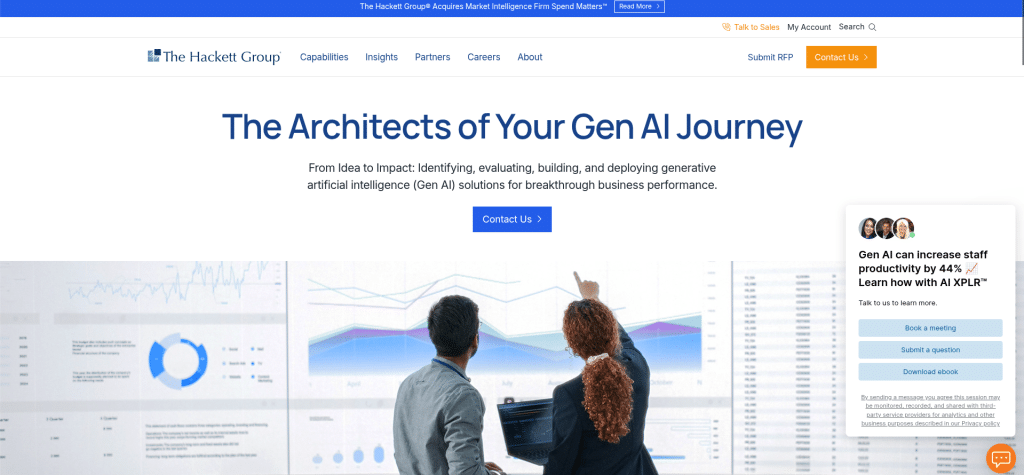
- 2020s: The Hackett Group pivots further toward technology-enabled transformation and intelligent automation. It develops expertise in robotic process automation (RPA) and intelligent process automation, embedding these into its performance optimization projects for finance, HR, and procurement functions. By the mid-2020s, Hackett positions itself as a leader in digital enterprise consulting, including strategy for Artificial Intelligence (AI) adoption. In 2023–2024 the firm launched “Gen AI” consulting services, guiding enterprises on leveraging generative AI in corporate functions. In 2025, The Hackett Group acquired Spend Matters, a market intelligence and research platform in the procurement and supply chain domain, to bolster its thought leadership and data assets in those areas. Throughout its history, Hackett’s mission has consistently been to help organizations achieve “world-class” (now “Digital World Class®”) performance levels in efficiency, effectiveness, and customer service by combining data-driven insights with practical transformation expertise.
Services and Consulting Methodologies
The Hackett Group is renowned for its benchmarking-based consulting approach. At the heart of its methodology is a proprietary benchmarking database built from thousands of engagements and performance studies since the early 1990s. This repository captures quantitative metrics and best practices across finance, human resources, IT, procurement, supply chain, and other support functions. Hackett’s consultants use this data to identify performance gaps for client organizations and to prioritize improvement initiatives. The concept of “World-Class” performance – defined by top-quartile metrics among peer companies – is a hallmark of Hackett’s approach. The firm helps clients benchmark themselves against these standards and then provides a roadmap of how to reach world-class levels through process changes, organizational redesign, and technology.
Key consulting services and methodologies include:
- Business Benchmarking & Process Analysis: Hackett’s flagship offering is quantitative benchmarking of processes (e.g. cost per invoice in finance, span of control in HR, IT cost ratios, etc.). The firm collects detailed operational data from clients and compares it against its database to pinpoint areas of inefficiency or opportunity. This analytical, fact-based methodology underpins nearly all of Hackett’s advisory work, ensuring recommendations are grounded in empirical evidence.
- Enterprise Performance Optimization: Building on the benchmarking diagnosis, Hackett provides enterprise performance improvement consulting. This involves redesigning processes, implementing best practices, and realigning organizational structures for greater efficiency and effectiveness. For example, in finance and accounting, Hackett might help a client standardize its accounting processes across business units, reduce manual effort by introducing automation, or reorganize the finance function into a shared services model. In procurement, consultants might identify savings opportunities through strategic sourcing and better spend analytics. The firm’s methodology often includes developing a business case for change using the benchmark data (showing potential cost savings or service improvements), then guiding the implementation of changes to realize those gains.
- Digital Transformation and Technology Enablement: Recognizing technology as a key enabler of process improvement, The Hackett Group has a robust digital transformation practice. This includes strategy and implementation support for Enterprise Resource Planning (ERP) systems, Enterprise Performance Management (EPM) solutions, and other enterprise applications. Hackett is an official partner for major software such as Oracle and SAP, and it has dedicated groups for Oracle Cloud applications, SAP S/4HANA, as well as Coupa (procurement) and OneStream (financial consolidation). The firm’s consultants work on ERP optimization projects – for instance, helping clients deploy a new ERP module or migrate to a cloud-based financial system – with an emphasis on aligning the technology to best practice processes. Hackett’s methodology ensures that IT projects are not just technical upgrades, but drivers of broader efficiency and performance improvement. In the 2020s, Hackett has further expanded into intelligent automation (deploying RPA, machine learning, and AI solutions). It offers Intelligent Automation assessments and roadmaps, helping organizations apply bots and algorithms to tasks in accounting, HR onboarding, procurement transactions, etc., thereby reducing manual effort and error. By 2025, Hackett also provides Gen AI strategy consulting, advising executives on how generative AI can be used in areas like customer service, software development, knowledge management, and decision support within the enterprise.
- Executive Advisory and Intellectual Property Programs: In addition to project-based consulting, The Hackett Group runs executive advisory programs. These are subscription-based services where C-suite leaders (like CFOs, CIOs, CPOs) get ongoing access to Hackett’s research, benchmarking insights, peer learning opportunities, and expert advisors. Through offerings such as the Hackett Executive Advisory program, clients participate in tailored research studies, receive quarterly analysis on performance trends, and attend member-only workshops or roundtables. This advisory model allows Hackett to maintain long-term relationships with client executives beyond one-off projects, positioning the firm as a trusted counsel on continuous improvement.
- Strategic Cost Reduction and Outsourcing Advice: Particularly during economic downturns or major restructurings, Hackett is known for helping organizations take out cost while optimizing service. Using its benchmarks, Hackett identifies cost inefficiencies in SG&A functions and develops strategies to reduce overhead (for example, consolidating redundant operations or automating routine tasks). The firm also advises on shared services and outsourcing/offshoring decisions – areas where it has deep experience. Hackett can assist a client in evaluating whether to build a centralized Global Business Services center or to outsource certain processes to third-party providers. The firm’s data on world-class cost structures often guides these decisions.
Overall, The Hackett Group’s consulting style is data-driven and pragmatic. It couples analytical rigor (through benchmarks and frameworks) with implementation know-how. Methodologies like its “Voice of World-Class” (identifying what top performers do differently) and the Hackett Value Grid (balancing efficiency and effectiveness improvements) are used to ensure clients not only cut costs but also improve quality. In recent years, Hackett has packaged some of its methodologies into cloud-based tools – for example, Quantum Leap® is a framework/tool that allows clients to model performance improvement scenarios and track progress toward targets. The firm’s new AI XPLR™ platform is another example: it’s an interactive tool introduced in 2024 that helps companies explore use cases for AI and measure readiness for AI initiatives, reflecting Hackett’s commitment to marrying IP (intellectual property) with consulting delivery.
Industry Coverage and Functional Specialties
The Hackett Group serves a broad spectrum of industries while maintaining a focus on improving corporate functional areas within organizations. Rather than limiting itself to one sector, Hackett’s client base includes Global 1000 companies across many industries, notably:
- Manufacturing & Consumer Products: Many of Hackett’s clients are large manufacturers (industrial goods, automotive, consumer packaged goods, etc.) seeking to streamline supply chain, procurement, and finance operations. For example, Hackett has worked with manufacturers to implement just-in-time financial processes and optimize procurement spend.
- Life Sciences and Pharmaceuticals: Through the Archstone acquisition and subsequent projects, Hackett gained significant expertise in life sciences. It advises pharmaceutical and biotech companies on improving their R&D support functions, global supply chains for drug manufacturing, and finance compliance processes. The firm’s benchmarks in areas like procurement and quality control have been valuable for life sciences clients facing strict regulatory and cost pressures.
- Financial Services: Banks, insurance companies, and financial institutions engage The Hackett Group to improve operations in finance, IT and risk management. For instance, Hackett might help a global bank reengineer its finance reporting process or evaluate the efficiency of its IT organization against industry peers. The firm’s services around data management and regulatory compliance (such as optimizing the finance function to meet reporting requirements) are highly relevant in this sector.
- Utilities and Energy: Hackett has served utility companies (electric, gas, etc.) particularly in improving asset management processes, customer billing operations, and back-office services. Archstone’s presence in the utilities sector complemented Hackett’s abilities to advise on operational efficiency in a traditionally regulated industry.
- Retail and Consumer Services: Retailers have engaged Hackett to optimize procurement and supply chain efficiency, especially in times of margin pressure. Additionally, Hackett’s HR and payroll function benchmarks help retail and hospitality companies manage large, distributed workforces more effectively.
- Public Sector: While primarily focused on corporate clients, Hackett has also worked with government agencies and education or nonprofit institutions. In these engagements, the firm applies its best practice frameworks to public-sector finance, procurement, and IT, aiming to improve efficiency and service delivery for taxpayers and stakeholders.
Across these industries, The Hackett Group’s strength lies in its functional specialization. The firm is organized around and particularly adept in improving support functions and back-office operations, such as:
- Finance and Accounting: This is a core focus area. Hackett helps CFOs achieve world-class finance performance – lowering the cost of finance as a percentage of revenue while improving accuracy and insight. Typical projects include financial process automation, redesigning the budgeting and forecasting cycle, improving working capital (e.g., optimizing payables and receivables processes, a capability enhanced by the REL acquisition), and implementing finance analytics or EPM systems. Hackett’s benchmarks for finance (like cost per invoice, days sales outstanding, etc.) are industry standards.
- Procurement and Sourcing: Hackett’s Procurement practice assists Chief Procurement Officers in transforming procurement into a strategic function. The firm advises on spend analysis, category management, supplier relationship management, and adoption of eProcurement tools. It also has deep knowledge in supplier diversity programs and procurement benchmark metrics (e.g., procurement operating cost, spend under management, etc.). With the Spend Matters acquisition in 2025, Hackett now also offers rich market intelligence on procurement technology solutions and supplier marketplaces, further cementing its expertise in this area.
- Human Resources: Hackett’s HR practice works with CHROs to optimize the delivery of HR services. Projects often involve transitioning to HR shared services, implementing Human Capital Management (HCM) systems (such as Workday or Oracle HCM Cloud), and improving talent management processes. Hackett’s benchmarking covers metrics like HR-to-employee ratios, time to hire, and training investment, which guide clients in improving efficiency while maintaining employee engagement and compliance.
- Information Technology: CIOs engage The Hackett Group to benchmark IT spend and service levels and to guide IT transformations. Hackett’s IT practice addresses issues like IT organizational design (centralized vs. decentralized), application portfolio rationalization, and the shift to cloud infrastructure. The firm also counsels IT leaders on emerging practices such as agile development, and it provides benchmarks on IT cost breakdowns, system availability, and cybersecurity maturity. With digital transformation as a key theme, Hackett often works at the intersection of IT and business, ensuring technology investments deliver measurable business value.
- Global Business Services (GBS) and Shared Services: Many Hackett engagements involve helping large companies set up or improve centralized service delivery organizations. By consolidating finance, HR, procurement, or IT support into global or regional centers, companies can often cut costs and standardize processes. Hackett’s consultants advise on the design of these shared service centers, location strategy (onshore vs. offshore mix), and governance models. They bring benchmarks showing how top-tier companies organize their GBS and what efficiency gains are achievable. Hackett is also experienced in outsourcing advisory – helping clients decide which processes to outsource and selecting the right BPO providers – although the firm itself remains vendor-agnostic and does not directly provide outsourcing services (aside from its own managed services in select IT areas).
- Supply Chain Operations: While Hackett is primarily known for back-office excellence, it also has capabilities in supply chain and operations improvement, especially for product companies. This includes assessing the efficiency of processes like order fulfillment, logistics, and inventory management. Archstone Consulting’s legacy gave Hackett a foothold in supply chain consulting, and the firm continues to serve supply chain leaders by benchmarking metrics like order cycle times, supply chain cost as a percentage of sales, and forecast accuracy.
In summary, The Hackett Group prides itself on a cross-industry reach with a functional focus. Its consultants often partner with C-level executives – CFOs, CIOs, CPOs, CHROs – and operational leaders to drive improvements in internal operations regardless of the industry context. This broad exposure, along with data from hundreds of companies, enables Hackett to cross-pollinate ideas and best practices from one sector to another.
Global Presence and Operations
Though headquartered in Miami, Florida, The Hackett Group operates as a global consultancy with offices and teams across North America, Europe, and Asia-Pacific. As of 2025, the firm maintains about 7 main office locations worldwide and delivers projects in dozens of countries. Key locations include:
- United States: The U.S. is the largest region for Hackett. Aside from its Miami corporate headquarters, the firm has a major consulting office in Atlanta, Georgia (a hub for many of its consultants and executives). Additionally, many team members are spread across other cities (New York, Philadelphia, Chicago, etc.) working remotely or on client sites, given the firm’s clients are nationwide.
- Europe: The Hackett Group has a strong presence in Europe with regional headquarters in London, United Kingdom, and an office in Frankfurt, Germany (serving as a Continental Europe base). These offices originated from the firm’s organic growth and the integration of Archstone’s European operations. The London office services financial services and global clients in the UK and Western Europe, while Frankfurt supports the firm’s German and European Union clients. (In the past, Hackett also had personnel in the Netherlands via Archstone’s team in Amsterdam, ensuring coverage in the Benelux region.)
- Asia-Pacific: Hackett formally entered the Asia-Pacific market in 2008 by establishing operations in Australia. Initially led by a regional Managing Director based in Sydney, the firm served clients in Australia and Southeast Asia, leveraging its global expertise. Over time, The Hackett Group’s Asia presence has been anchored by its Indian operations. The firm runs a major global delivery center in Hyderabad, India, where a substantial number of its employees are based. This India hub provides support in benchmarking data analysis, software development (for Hackett’s internal platforms and client solutions), and low-cost consulting delivery for implementation projects. Hackett’s India team allows the firm to offer an offshore delivery model, blending on-site consultants at the client with remote experts to optimize cost and efficiency. Apart from India and Australia, Hackett serves Asia-Pacific clients in regions like Singapore, China, and Japan typically through a mix of flying in experts from other offices or collaborating with local partners, since the firm’s own physical offices in Asia may be limited.
- Latin America & Canada: To support clients in the Americas outside the U.S., Hackett opened a delivery center in Montevideo, Uruguay. This center often provides nearshore support for North American and Latin American projects, particularly Spanish-language capabilities and cost-effective consulting for U.S. clients with Latin American operations. In Canada, Hackett’s presence includes an office in Saint John, New Brunswick, which likely functions as a consulting and support location for Canadian clients and nearshore work (potentially a legacy of a past acquisition or client demand in that region).
In total, The Hackett Group has roughly 1,500 employees worldwide (as of 2024–2025). This headcount includes experienced consultants, subject matter experts, technology implementation specialists, researchers/analysts, and support staff. The workforce is diverse and globally distributed: a significant portion operate in the U.S. and Western Europe serving clients on-site, while a sizeable contingent works from India and Uruguay in delivery and support roles. The firm’s international model enables 24/7 project support and cost flexibility, which is especially valuable for technology implementation and data-heavy benchmarking projects. English is the primary business language of the firm, but many consultants are multilingual, reflecting the global client base (with major clients in Europe, Latin America, and Asia that require local language and cultural knowledge).
Hackett’s global delivery model emphasizes consistency and quality across borders. The firm uses common methodologies and training worldwide, ensuring that a finance transformation project in Asia uses the same benchmark standards and tools as one in the Americas. Internal collaboration is facilitated by the Hackett Connect™ platform (a proprietary collaboration and knowledge-sharing system for Hackett employees and clients). Additionally, the firm hosts an annual Best Practices Conference in both North America and Europe, which not only serves clients (as a forum to learn about the latest trends) but also brings together Hackett’s own global team, reinforcing a unified culture and approach.
Organizational Structure and Leadership (as of 2025)
The Hackett Group’s organizational structure combines executive leadership with practice-based and regional management. At the top, the firm is led by its co-founder and long-serving chief executive:
- Ted A. Fernandez – Chairman & Chief Executive Officer (CEO): Fernandez co-founded the firm in 1997 and has been CEO since its inception as Answerthink. Under his stewardship, Hackett transitioned from a startup advisory outfit into a publicly traded global firm. As CEO, Ted Fernandez drives the company’s vision, strategy, and major investments (such as new service lines in AI or acquisitions like Archstone and Spend Matters). He is known for his background in strategic consulting (ex-KPMG partner) and for championing the use of metrics and intellectual property in consulting. Even after nearly three decades at the helm, Fernandez remains actively involved in guiding Hackett’s offerings toward the evolving needs of executives in the digital era.
- David N. Dungan – Vice Chairman & Chief Operating Officer (COO): David Dungan is the other co-founder, partnering with Fernandez since 1997. He serves as COO and Vice Chairman of the Board. In this role, Dungan oversees the firm’s operations, service delivery quality, and internal processes. He has been instrumental in scaling the company’s consulting teams and integrating acquisitions. Dungan also takes a lead role in client relationship management for strategic accounts, leveraging his decades of experience. His tenure and continued presence (like Fernandez’s) provide continuity in Hackett’s culture and approach.
- Robert A. Ramirez – Chief Financial Officer (CFO) & Executive Vice President of Finance: Robert Ramirez has been Hackett’s CFO since 2007. He manages the firm’s financial strategy, investor relations (since HCKT is a public company), and global financial operations. Ramirez’s responsibilities include budgeting, financial planning, and ensuring profitable growth. Under his financial leadership, Hackett has maintained a stable balance sheet and has been able to return value to shareholders through dividends while investing in growth areas.
These three individuals (Fernandez, Dungan, Ramirez) form the core executive team with very long tenures, ensuring stable leadership. Surrounding them is a wider leadership group that handles specific areas:
- Practice Leaders: The Hackett Group has leaders for each major practice area or functional domain. For example, there are Managing Directors or Practice Principals heading Finance Transformation, HR Advisory, Procurement & Supply Chain, Application Consulting (Oracle/SAP), etc. These leaders are often industry veterans or promoted from within Hackett’s ranks, responsible for thought leadership and delivery excellence in their domains. They ensure that, say, the finance practice keeps evolving with new regulations and technologies (like cloud EPM or AI in finance). One notable practice leader is the head of the Benchmarking & Research division, who curates Hackett’s benchmarking studies and intellectual property – effectively the guardian of Hackett’s famous database.
- Regional and Client Service Leaders: Hackett also designates geographic leaders. An Executive Vice President for the Americas oversees North and Latin American consulting operations, while a counterpart might oversee European operations. (For instance, an executive named Jason Balogh has been noted as EVP for Americas.) These executives coordinate sales, staffing, and client service across offices in their region, making sure the firm’s global resources are utilized effectively for clients. There may also be country managers or directors for key markets (e.g., the Managing Director for Hackett’s U.K. office, or the leader for the Germany/Austria/Switzerland region).
- Industry Sector Leaders: Since the Archstone acquisition, Hackett sometimes aligns senior leaders to specific industries. For example, a leader might focus on the Consumer Products and Retail sector, ensuring tailored solutions for those clients. Similarly, someone might head the Public Sector or Financial Services segment. These industry leaders work alongside the functional practice leaders to customize Hackett’s offerings to industry-specific challenges (like regulatory compliance in banking or supply chain resilience in manufacturing).
- Board of Directors: The Hackett Group’s board (as of 2025) is chaired by Ted Fernandez and includes both internal executives and independent directors. A notable board member added post-Archstone was Terry Graunke (from Lake Capital), bringing an investor’s perspective. The board provides governance, guiding the firm’s strategy and ensuring accountability to shareholders. Many board members are seasoned business leaders or former consultants who contribute strategic guidance and oversight.
- Organizational Culture: Hackett’s structure is relatively lean for a consulting firm; with ~1500 employees, layers of management are fewer than in larger firms. The organization encourages cross-collaboration – consultants often work across practice areas (e.g., a finance transformation project may involve IT and HR specialists). The firm’s size allows senior leaders to stay accessible: Managing Directors and even the COO or CEO are known to engage directly on key client projects or attend important deliverable meetings, giving clients a sense of personal attention from the top. Internally, Hackett places a strong emphasis on knowledge development and training. The Hackett Institute, an in-house education and certification arm, reports into the leadership structure to ensure consultants continuously develop skills and are certified in Hackett’s methodologies and in relevant technologies (e.g., Oracle certifications or Six Sigma).
In summary, the leadership team as of 2025 is a mix of founding visionaries (Fernandez and Dungan), long-standing executives (Ramirez, etc.), and newer leaders who have expertise in digital, industry verticals, and global account management. This blend supports Hackett’s aim to remain innovative while drawing on a stable foundation of experience.
Career Progression and Compensation
Working at The Hackett Group offers a career path similar to many consulting firms, albeit in a mid-sized, specialized environment. Career progression typically follows a tiered path:
- Entry-Level and Junior Consultants: Fresh graduates or those with a couple of years of experience may join as Associate Consultants or Analysts (title may vary). At this level, staff focus on data gathering (often working with Hackett’s benchmarking tools), creating analysis under guidance, and supporting workstreams on client projects. After demonstrating capability (typically 2-3 years), they progress to Consultant. Consultants take on more client-facing responsibilities, manage sections of projects, and contribute insights based on Hackett’s methodologies. They are often the ones crunching performance data and interviewing client personnel to map processes.
- Senior Consultant and Manager Levels: A high-performing consultant might be promoted to Senior Consultant, usually a role requiring more project leadership and subject-matter expertise. Senior Consultants at Hackett often lead significant workstreams or smaller engagements, mentor junior staff, and interface regularly with mid-level client managers. The next step is Manager (sometimes termed Consulting Manager or Project Manager). Managers oversee entire projects or multiple workstreams, manage client relationships on a day-to-day basis, and are accountable for delivering results. They also play a big role in coaching team members and ensuring the quality of deliverables aligns with Hackett standards. Typically, obtaining an MBA or equivalent experience can accelerate a consultant to enter at Senior Consultant or Manager level; Hackett, like many firms, recruits MBA graduates often into the Senior Consultant rank.
- Director and Principal: Above the manager level, roles transition to executive responsibilities. Senior Managers or Directors (the titling can vary; Hackett sometimes uses “Director” for those leading multiple projects or larger accounts) are involved in business development (proposal writing, selling new work) in addition to project oversight. They manage large client accounts or portfolios of engagements, and they contribute to thought leadership (e.g., by authoring Hackett research papers or presenting at conferences). The pinnacle of the consulting track is the Principal (also sometimes called Vice President or Partner in other firms). Principals at The Hackett Group are senior leaders who own major client relationships and drive practice growth. They are responsible for sales targets, practice innovation, and often manage a team of directors and managers. Principals are the closest to a “partner” equivalent in Hackett’s corporate structure – they often have a say in strategic decisions and may receive equity or stock incentives as part of compensation. Some principals might take on titles like “Global Practice Leader” or “Managing Director” for a service line or region, reflecting both client and internal leadership roles.
Throughout this progression, The Hackett Group encourages skill development and offers training. The Hackett Institute provides consultants with professional development courses and even external certifications (for example, training in Lean Six Sigma, or certification in cloud software platforms). This helps consultants build both their consulting toolkits and technical know-how in areas Hackett specializes in.
In terms of compensation, The Hackett Group positions itself competitively, though generally its pay scales are closer to Big Four or mid-tier consulting levels rather than the very top strategy firms. As of the mid-2020s:
- U.S. Salaries: An entry-level Associate Consultant in the United States might have a starting base salary around $70,000 to $80,000 (plus any small bonus). However, many junior hires at Hackett have some prior experience, so often the starting point is the Consultant level. A Consultant in the U.S. can earn on the order of $100,000 – $120,000 base salary, with perhaps 10-15% bonus potential. Moving up, Senior Consultants tend to be in the mid $100Ks (e.g. $130,000 – $150,000 base), reflecting their increased responsibility. Managers often see base salaries in the range of $160,000 – $185,000, along with larger bonus eligibility (20%+ of base). When reaching Director or Principal levels, base salaries typically exceed $200,000 and can approach the mid-$200K’s, with total compensation (including annual bonuses or profit-sharing) potentially in the high six-figures. In exceptional cases for top-performing Principals, total comp can even reach around or above half a million dollars when bonuses and stock grants are included, though such figures are tied to significant business generated. As a reference point, Hackett’s executive leadership (CEO, COO) have compensation that is heavily performance-based, with CEO total compensation in some years exceeding $1M largely through bonuses and stock; this aligns incentives at the top with company performance.
- International Salaries: Outside the U.S., compensation is adjusted for local market economics and cost of living. In Western Europe (e.g., London or Frankfurt), base salaries are generally a bit lower in USD equivalent than U.S. salaries, but still attractive relative to local benchmarks. A consultant in London might earn, for example, around £60,000-£70,000 (which is roughly $80K-$90K), and a manager perhaps £100K ($130K) base, with bonuses on top. In India, where Hackett has a large workforce, salaries are significantly lower in absolute terms but competitive for the region’s tech/consulting sector. An entry-level consultant in India might earn on the order of INR 1,000,000 – 1,500,000 per year (approximately $15K-$20K USD), and a seasoned Senior Consultant or Manager in India could make somewhere in the range of INR 2,000,000 to 3,000,000+ ($25K-$40K USD). These disparities reflect differences in local purchasing power and the firm’s leveraging of global delivery costs. The firm does ensure, however, that Indian staff also receive performance bonuses and opportunities for promotion, and some high performers in offshore locations have pathways to transfer to onshore roles or assume global positions.
- Benefits and Work-Life: Hackett offers a typical benefits package including healthcare, retirement plan (with company match on 401(k) in the US, for example), and paid time off. Travel is a part of the consulting lifestyle at Hackett, though given the operational nature of projects, travel might be project-dependent (some projects can be done remotely or from a shared service center, while others require consultants at client site weekly). Work hours can be demanding during peak project phases, but Hackett’s slightly smaller size sometimes means slightly less travel than the biggest firms – consultants often work remotely or from a Hackett office when not at client site, leveraging digital collaboration tools. The firm has been noted in employee reviews for a collegial atmosphere and opportunities to take on responsibility, but also feedback has noted that career progression criteria were not always as formalized as in larger firms. Hackett has been addressing this by developing clearer promotion frameworks and providing mentorship so that consultants understand how to advance.
- Career Path Variations: Unlike some firms that have an “up or out” policy, The Hackett Group tends to be a bit more flexible. While advancement is encouraged, the firm allows consultants to specialize and stay longer at certain levels if that suits their career goals (for instance, someone might remain a highly skilled Senior Consultant or Solution Architect without immediately pursuing manager promotion, especially in the technology implementation tracks). The firm also hires experienced industry practitioners into consulting roles (for example, an experienced procurement manager from industry might be hired directly as a Senior Consultant or Principal to bring real-world expertise to clients). This means the team is a blend of career consultants and subject experts, enriching the mentorship pool for younger consultants.
Overall, a career at The Hackett Group offers the chance to work with top-tier clients on improvement initiatives, with a compensation package that rewards performance and progression. While not the absolute highest in the consulting world, the pay is strong and coupled with the firm’s size and specialization, consultants often find they can take on significant responsibilities early in their careers. The firm’s global footprint also provides opportunities for international experience – high performers sometimes get chances to participate in overseas engagements or even relocate to different offices as the business needs. In summary, Hackett’s career and compensation structure is designed to attract and retain talent who are passionate about enterprise performance improvement, offering them growth, competitive pay, and a rich learning environment.
Intellectual Property and Thought Leadership
A defining feature of The Hackett Group is its rich base of intellectual property, which it continuously develops and leverages to provide thought leadership in the realm of enterprise performance. Central to this is the Hackett Benchmarking & Best Practices Database – an ever-growing repository of detailed process metrics and best practices collected from over 30 years of studies. This database covers nearly every aspect of back-office and some front-office operations, from finance transaction processing costs to IT staffing ratios to procurement cycle times. It is often considered the gold standard for benchmarking in corporate functions. Hackett publishes findings from this repository in various forms, contributing significantly to industry knowledge:
- Benchmarking Reports and the “Book of Numbers”: Historically, Hackett produced an annual compilation of key benchmark findings often referred to as the “Book of Numbers.” This report highlights the performance differentials between average companies and “world-class” companies (as defined by Hackett’s top performers in the database). It provides quantifiable targets – e.g., showing that a world-class HR organization might operate at half the cost per employee of a typical HR group, or that top-quartile finance departments close their books in 4 days versus the average 8 days. These reports are highly anticipated by operations executives as they distill the state of efficiency and effectiveness in enterprise functions.
- White Papers and Research Insights: The Hackett Group regularly releases white papers, research briefs, and point-of-view articles on emerging trends. Examples include studies like “CFO Agenda for the Next Year”, “Digital World Class: How Digital Transformation Elevates Performance”, “The Future of Procurement”, and similar topics. These pieces often draw on Hackett’s empirical research (for instance, surveying hundreds of executives and analyzing benchmark data) to provide insights and recommended actions. Hackett’s thought leadership often appears in specialized publications or online on their website, addressing questions like how automation is affecting finance, how the role of the CIO is changing, or what differentiates companies that excel in customer-to-cash processes.
- The Hackett Institute and Certifications: The firm extends its thought leadership into capability building through The Hackett Institute. This is an education and certification arm that offers training programs for both clients and Hackett’s own staff. For example, Hackett Institute runs courses leading to designations like Certified Enterprise Analytics Professional (CEAP) or Certified GBS Professional, which are credentials recognized in the industry. The curriculum is based on Hackett’s best practices and is delivered via e-learning and workshops. By educating professionals on world-class practices, Hackett not only helps spread its philosophies but also entrenches its methodologies as standard in client organizations.
- Client Conferences and Workshops: The Hackett Group hosts several events that showcase its thought leadership. An annual Hackett Best Practices Conference is a marquee event where hundreds of client executives gather (usually in both the U.S. and Europe editions). At these conferences, Hackett presents its latest research findings, case studies from client transformations, and facilitates peer-to-peer discussions. Common themes include digital transformation successes, advanced analytics in shared services, or case studies of “journeys to world-class.” The firm also conducts regular Executive Advisory Council meetings and function-specific roundtables (for example, a gathering of CFOs or CIOs from Hackett’s client community) to discuss trends and share experiences under Hackett’s facilitation. These in-person and virtual events reinforce Hackett’s position as a thought leader and create a community of practitioners aligned with Hackett’s frameworks.
- Publications and Media: Hackett’s experts are frequently quoted in industry media and publications. For instance, Hackett’s research on IT spending or working capital might be referenced in business news articles. The firm occasionally collaborates with media outlets to release joint insights (for example, a study with a finance magazine on the changing role of the controller). Additionally, Hackett produces its own podcasts and video series in which senior Hackett advisors discuss topics like AI in HR or the outlook for global business services. This multi-channel thought leadership strategy ensures that Hackett’s name is associated with cutting-edge yet practical insights on improving business operations.
- Proprietary Frameworks and Tools: Over the years, The Hackett Group has developed branded frameworks that encapsulate its approach. One key framework is the “Digital World Class” standard – essentially an updated lens on what world-class performance means in an era of cloud systems and automation. Hackett defines Digital World Class performance metrics that factor in the efficiencies gained from technology; they regularly publish statistics showing how companies adopting advanced digital tools have an even higher bar for excellence (for example, a world-class digitally enabled finance organization might operate at 40% lower cost than peers, compared to a 20% gap in earlier years). Another tool is Hackett’s Value Matrix, which helps plot initiatives on a grid of benefit vs. effort to help clients prioritize changes. The AI XPLR™ tool introduced in 2024 is an interactive framework that lets companies assess and prioritize AI use cases – a proprietary methodology Hackett uses in AI strategy engagements. Similarly, Quantum Leap® is both a concept and a tool that helps model the step-change improvements possible through transformation, setting stretch targets for clients. These frameworks are underpinned by Hackett’s data and are continuously refined as new best practices emerge.
In essence, The Hackett Group’s thought leadership is a major part of its identity. By codifying best practices and sharing knowledge generously (both to paying clients and publicly), Hackett not only differentiates itself from competitors but also creates market demand for its services – as executives read Hackett’s reports and realize gaps in their own operations, they often turn to Hackett for help in closing those gaps. The firm’s intellectual capital – its benchmarking data, its research studies, and its methodologies – is arguably its most valuable asset, and Hackett invests significantly to maintain its position at the forefront of enterprise performance knowledge.
Signature Projects and Notable Client Impact
Over the years, The Hackett Group has been involved in numerous high-impact projects that showcase its expertise in digital transformation, ERP optimization, and back-office efficiency. While specific client names are often confidential, the firm is known for certain types of signature engagements and achievements:
- Global Finance Transformation for a Fortune 100 Company: Hackett has repeatedly been called upon by large, complex organizations (Fortune 100 companies including those in manufacturing, technology, and consumer goods) to overhaul their finance function. In one illustrative project, Hackett partnered with a multinational manufacturer to transform its record-to-report process. The company had decentralized finance teams in dozens of countries, leading to inconsistent processes and slow closing cycles. Hackett’s team performed a baseline benchmark, finding the client was taking nearly twice as long as world-class peers to close the books and had 30% higher finance costs. Through a multi-year initiative, Hackett helped design a finance shared services center in a low-cost location, implement a unified SAP S/4HANA ERP system, and deploy best practices in management reporting. The result was a reduction of the financial close from 10 days to 5 days, a headcount reduction and redeployment of 20% in finance (with those resources re-skilled to more analytical roles), and annual savings in the tens of millions of dollars. This kind of project exemplifies Hackett’s bread-and-butter: using technology and process improvement to achieve back-office excellence at scale.
- ERP Optimization and Cloud Migration: The Hackett Group has led projects specifically aimed at ERP optimization, such as helping clients migrate from legacy on-premise systems to modern cloud-based suites. For example, Hackett worked with a global life sciences firm to optimize its ERP and EPM landscape. The client, after a series of acquisitions, had multiple ERP systems and inefficient reporting. Hackett’s specialists conducted an assessment and recommended a migration to a single cloud ERP platform (Oracle Cloud ERP) integrated with a cloud EPM solution for consolidation and planning. Acting as the implementation partner, Hackett’s team (including its Hackett Technology Solutions experts from the Oracle practice) guided the system configuration based on best practices – simplifying chart of accounts, automating workflows, and embedding analytics dashboards. Post-implementation, the client saw significantly improved data consistency, the ability to produce on-demand financial analytics (something that previously took days of manual effort), and lower IT maintenance costs by retiring numerous legacy systems. Hackett’s role combined technical know-how with process redesign, ensuring the new system was truly leveraged to improve performance, not just a like-for-like swap.
- Digital Transformation of Procurement and Supply Chain: In the retail and consumer products sector, Hackett has executed projects focusing on end-to-end procurement optimization and supply chain efficiency. One notable engagement involved a large retail chain aiming to reduce procurement costs and modernize its sourcing approach. Hackett’s consultants began by benchmarking the retailer’s procurement function, revealing that only about 50% of spend was under management and cycle times for sourcing events were much longer than best practices. The team implemented a series of changes: introducing a Coupa e-procurement system for better spend visibility and control, training the procurement staff in advanced category management techniques, and helping establish a centralized procurement center of excellence. Additionally, they incorporated supplier performance management dashboards (leveraging Hackett’s metrics for procurement effectiveness). As a result, the client increased spend under management to around 80%, negotiated significant supplier savings (several percent of addressable spend, amounting to many millions of dollars), and improved procurement’s internal customer satisfaction by speeding up purchasing processes. This kind of project highlights Hackett’s ability to blend technology (Coupa implementation by Hackett’s team) with process improvement and capability building in a functional area like procurement.
- Back-Office Shared Services and Outsourcing Roadmap: Hackett is particularly known for its work in helping companies create efficient back-office shared services. For instance, a global energy company engaged Hackett to design a roadmap for consolidating its fragmented HR, finance, and IT support spread across different business units. Hackett’s team performed a best practice assessment and developed a phased strategy to establish a Global Business Services (GBS) organization. They outlined which processes could be moved to a shared model or even outsourced, performed location analysis (onshore vs. offshore center locations), and defined service level agreements based on Hackett benchmark quartiles. Over the course of implementation, Hackett assisted in setting up a new GBS center in India for transactional processes and a regional center in Eastern Europe for multilingual support. The firm’s guidance on governance and change management helped the client transition over 1,000 roles into the new model with minimal disruption. Ultimately, the energy company realized operational cost reductions of about 25% in the in-scope functions and improved key performance metrics (for example, employee query resolution times in HR improved by utilizing self-service tools and a follow-the-sun support model). This signature strength in shared services design is something Hackett has replicated for many organizations, often being seen as a go-to advisor for back-office consolidation projects.
- Rapid Performance Assessment and Turnaround: There have been cases where organizations in a cost crisis or undergoing restructuring needed very fast diagnostics and action. Hackett has teams that conduct “Rapid Performance Assessments” – essentially quick but thorough benchmarks – to identify quick wins. For example, Hackett was brought in by a technology company facing profit pressures to quickly find cost-saving opportunities in SG&A functions. In a span of 4 weeks, Hackett benchmarked the company’s finance, HR, and IT costs against the Hackett database and identified that the IT function was over-resourced and under-automated compared to peers. Hackett recommended immediate actions like renegotiating vendor contracts, eliminating redundant IT applications, and streamlining finance approvals that were causing costly delays. Many of these were implemented within a few months, achieving a rapid cost reduction of several million dollars. Subsequently, Hackett helped the client with a longer-term roadmap to ensure sustainable efficiency. Such high-speed, data-driven advisory support is a trademark of Hackett’s responsiveness, especially valued by executives during mergers, acquisitions, or economic downturns.
- Innovation and AI in the Enterprise: As businesses look to adopt AI and advanced analytics, Hackett has started to build a portfolio of projects guiding these initiatives. While this is a newer area, one example by 2025 includes Hackett working with a global financial services firm to integrate intelligent automation and AI into their finance operations. Hackett’s advisory team helped identify use cases such as automated invoice processing using OCR and machine learning, AI-driven forecasting for revenues, and a chatbot for internal IT support. They utilized the Hackett ZBRAIN™ and AI XPLR™ frameworks to assess the client’s readiness and potential value from these use cases. A roadmap was developed, and Hackett supported pilot implementations – e.g., deploying an AI model to predict late payments and prioritize collection efforts, which improved cash flow. The project underscored Hackett’s evolution into digital and AI advisory. The impact for the client was not just cost savings but also new capabilities (like predictive insights) that improved decision-making.
These examples illustrate the range of The Hackett Group’s distinctive work. Common threads in these signature projects are: data-driven decision making, a focus on tangible performance metrics, and holistic change (people, process, and technology). Clients often note that Hackett’s recommendations come with quantified backing – for instance, if Hackett suggests automating a process, they will typically estimate the efficiency gain and benchmark how others have succeeded doing it. This practical, numbers-oriented ethos has led to The Hackett Group’s reputation: it may not be the largest consultancy, but it brings a fact-based confidence to its projects that yields trust and lasting improvements. Many Hackett projects result in ongoing relationships, where the firm might first perform a benchmark, then help implement changes, and later come back to measure progress – forming a cycle of continuous improvement.
In terms of recognition, The Hackett Group’s client work has earned industry accolades. The firm often publishes client success stories where companies that achieved world-class performance (with Hackett’s help) are recognized. Hackett also gives out Hackett Best Practices Awards to honor organizations that have transformed their operations – these awards, decided by Hackett’s analysts, highlight the innovative work of both the clients and the consulting team behind the scenes. This further cements Hackett’s position as a leader in driving the conversation on how enterprises can modernize and excel.
Consulting Firm Profiles:
- Accenture
- Accordion Consulting
- Advisory Board
- AlixPartners
- Alvarez and Marsal
- Altman Solon Consulting
- Analysis Group
- Ankura Consulting Group
- Archstone Consulting (Acquired by The Hackett Group, Inc)
- Arthur D. Little
- Arthur J. Gallagher & Co.
- Arcadis
- Aon Consulting Services
- Arup Group
- Atos Group and Atos Consulting
- Bain & Company
- Baker Tilly International
- Bates White Economic Consulting
- BDO Consulting
- BearingPoint
- Berkeley Research Group
- BNP Paribas CIB Consulting & Transformation
- Booz Allen Hamilton
- Boston Consulting Group
- Bridgespan Group
- Capco Consulting
- Capgemini
- Capgemini Invent
- Carpedia International Consulting
- CGI Inc.
- Charles River Associates (CRA)
- Chemonics International Inc.
- ClearView Healthcare Partners
- Coalition Greenwich
- Cognizant Technology Solutions
- Compass Lexecon
- Computer Sciences Corporation (CSC) and Evolution into DXC Technology
- Cornerstone Research
- Corporate Executive Board (CEB)
- Crowe Global and Crowe LLP
- Dalberg Global Development Advisors
- Deloitte
- DGC Partners LLC
- dss+ (Formerly DuPont Sustainable Solutions)
- Environmental Resources Management (ERM)
- Everest Group (acquired by Wavestone)
- EVERSANA and EVERSANA CONSULTING
- EXL Service
- EY Consulting
- EY-Parthenon
- FTI Consulting
- FTI Delta (formerly Delta Partners)
- Forvis Mazars
- Galt & Company (acquired by AlixPartners)
- Gartner Inc. and Gartner Consulting
- GEP Worldwide
- ghSMART Consulting
- Grant Thornton Consulting – U.S. and Global
- Guidehouse
- Hay Group (acquired by Korn Ferry)
- HCL Axon Consulting
- HCLTech Consulting
- HDR, Inc.
- Health Advances Consulting
- Hewitt Associates (acquired by Aon)
- Hitachi Consulting (acquired by Hitachi Vantara)
- HP Enterprise Services Consulting (acquired by Hewlett Packard Enterprise)
- Horváth & Partners Consulting
- Huron Consulting Group
- IDEO
- IBM Consulting
- Infosys Ltd and Infosys Consulting
- Information Services Group (ISG) Consulting
- IQVIA Consulting Business
- INSIGHT2PROFIT Consulting
- Ipsos Consulting
- Jacobs Solutions Consulting
- John Wood Group PLC
- Kantar
- Kearney
- Korn Ferry
- KPMG
- Kroll (formerly Duff and Phelps)
- Kurt Salmon (acquired by Accenture)
- Larx Advisors Consulting
- Launch Consulting Group
- Leidos
- L.E.K. Consulting
- LTIMindtree
- Maine Pointe Consulting (acquired by SGS Group)
- Marakon Consulting
- Marsh & McLennan
- Mars & Co
- Mastercard Advisors and Mastercard Data & Services Division
- McKinsey & Company
- Mercer Consulting
- Metyis
- Miller Heiman Group
- Mitchell Madison Group
- Monitor Deloitte
- Mott MacDonald
- Navigant Consulting (acquired by Guidehouse)
- NERA Economic Consulting
- Newton Consulting Partners
- North Highland Consulting
- NTT DATA Consulting and NTT DATA Inc
- OC&C Strategy Consultants
- Oliver Wyman
- PA Consulting
- Palm Tree LLC
- Parsons Corporation
- Partners in Performance (acquired by Accenture)
- Point B Inc.
- Pointe Advisory
- Porsche Consulting
- ProcureAbility
- Propeller Consulting LLC
- Protiviti
- PRTM Consulting (acquired by PwC)
- Putnam
- PwC Consulting and Strategy&
- Ramboll
- RAND Corporation
- Riveron Consulting
- RGP Global Consulting Firm
- Roland Berger
- RSM International
- Schlumberger Business Consulting (acquired by Accenture)
- Science Applications International Corporation (SAIC)
- ScottMadden Consulting
- Simon-Kucher & Partners
- Slalom Consulting
- SSA & Company
- Stantec
- Strategy& (PwC)
- St. Onge Company
- Syneos Health Consulting
- SynFiny Advisors
- Targus Management Consulting AG
- Tata Consultancy Services
- Teneo Consulting
- Tetra Tech Consulting
- The Brattle Group
- The Cambridge Group
- The Chartis Group
- The Hackett Group
- Tompkins Solutions
- TriVista Consulting
- Visa Consulting & Analytics (VCA)
- Wavestone Consulting
- West Monroe Partners
- Willis Towers Watson Consulting
- Wilson Perumal & Company
- Wipro Consulting
- Worley
- WSP Global
- Xynteo
- ZS
