
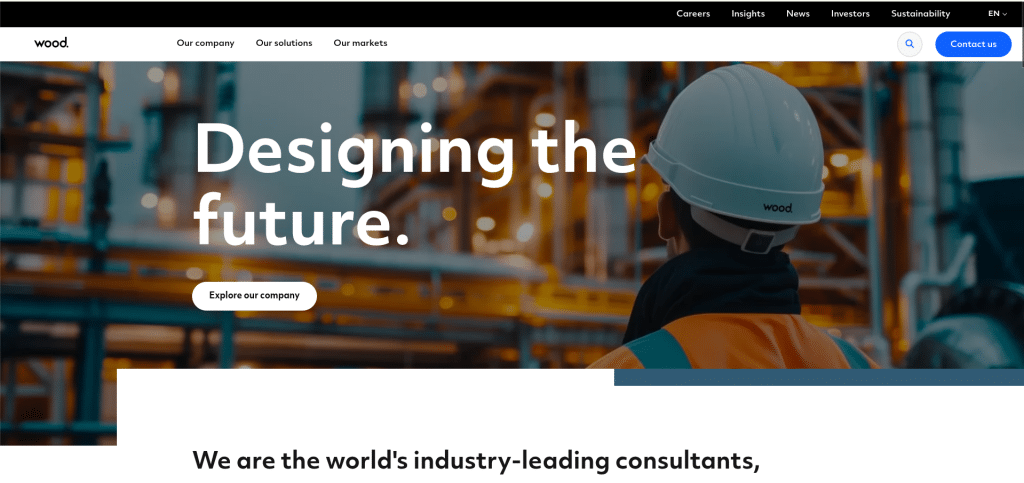
John Wood Group PLC (branded simply as Wood) is a global leader in engineering, consulting, and technical services for energy and industrial markets. Headquartered in Aberdeen, Scotland, Wood has operations in over 60 countries and employs approximately 35,000 people worldwide. The company delivers a broad range of services – from strategic advisory and consulting through engineering design, project delivery, and asset operations – with annual revenues around $6 billion. Wood is publicly traded on the London Stock Exchange (FTSE 250) and has evolved into a key player supporting the energy industry’s transition toward cleaner and sustainable solutions.
History and Evolution
Wood’s origins trace back to 1912, when its founder William Wood established a marine engineering and fishing business in Aberdeen. For decades, the Wood family ran maritime and ship repair operations. In the 1960s, Sir Ian Wood (William’s grandson) joined the family firm and soon identified opportunities in the burgeoning North Sea oil industry. Under Ian Wood’s leadership, the company pivoted from fishing into oilfield services. In 1973 it formed an alliance to provide offshore oil rig support, and by 1982 John Wood Group was formally established as a dedicated oil and gas services company.
Throughout the 1980s and 1990s, Wood Group expanded aggressively. It entered the subsea engineering arena by acquiring J.P. Kenny (a specialist in underwater pipelines) in 1993, and broadened its international footprint into regions like Latin America and Russia. The late 1990s and early 2000s saw acquisitions of U.S.-based engineering firms such as Mustang Engineering and Alliance Engineering, bringing capabilities in deepwater platform design and onshore plant engineering. In 2002, Wood Group listed on the London Stock Exchange, marking its transition to a public company.
During the 2000s, Wood continued to grow and streamline its portfolio. It became a leading contractor for onshore oil facilities in the UK and globally. In 2011, the company sold its well-support division to GE and simultaneously acquired PSN (Production Services Network) – a move that greatly expanded Wood’s offshore maintenance and operations business. By this time Wood Group was organized into three main divisions: Engineering & Production Facilities (designing and operating oil and gas assets) and Gas Turbine Services (maintaining industrial gas turbines for power and oil companies).
To diversify beyond oil & gas, Wood pursued strategic acquisitions in the mid-2010s. In 2015 it bought Kelchner, adding heavy civil construction capabilities, and acquired The Infinity Group to enter downstream petrochemicals and refining services. The most transformative step came in 2017, when Wood Group merged with Amec Foster Wheeler, a major British engineering firm. This merger (upon which the combined entity rebranded simply as “Wood”) roughly doubled the company’s size and added new sectors such as environmental consulting, infrastructure engineering, mining, clean energy, and power generation to its portfolio. It marked Wood’s evolution from primarily an oilfield services contractor into a broader engineering and consultancy organization serving “energy and industrial markets” worldwide.
Post-merger, Wood faced the challenge of integrating businesses and reducing debt from the Amec Foster Wheeler acquisition. From 2018 onward, the company underwent significant restructuring and strategic refocusing. It divested non-core units to streamline operations and strengthen its balance sheet. For example, in 2020 Wood sold its nuclear energy services division to Jacobs Engineering, and it also exited its legacy industrial turbine JV (EthosEnergy). In 2022, Wood completed the sale of its entire Environment & Infrastructure (E&I) consulting business – which had been inherited from Amec – to WSP Global for $1.9 billion. These divestitures were aimed at focusing Wood on higher-margin consulting, engineering, and energy solutions, particularly in energy transition and decarbonization fields.
By 2023, Wood emerged as a leaner company centered on its core strengths in energy and materials. The firm sharpened its strategic direction toward energy transition, digitalization, and industrial consulting. It actively repositioned itself from a traditional oil & gas service provider to a provider of “engineering solutions to the world’s most complex challenges” with an emphasis on sustainability. In early 2023, Wood attracted takeover interest from private equity (including an unsolicited approach by Apollo Global Management), reflecting its sector value. Although those talks did not result in a deal, in 2024–2025 Wood continued to explore strategic options to raise capital and fuel growth. As of 2025, Wood’s board had indicated openness to a potential acquisition by a UAE-based engineering group (Sidara) to bolster the company’s financial base. Through all these changes, Wood has continuously adapted its business model – from its 1912 marine roots, to a 1980s oilfield specialist, and now to a diversified consulting and engineering enterprise at the forefront of the energy transition.
Leadership and Key Figures
The growth and direction of Wood Group have been shaped by several notable leaders over its history:
- Sir Ian Wood – Grandson of the founder, Sir Ian is arguably the figure most synonymous with the company’s rise. He served as chief executive from 1967 to 2006 and as chairman from 1982 until 2012. Under his stewardship, Wood Group grew from a local marine services firm into an international oil & gas services contractor. Sir Ian’s vision to enter the North Sea oil support sector and his deal-making in acquisitions set the foundation for Wood’s global expansion. He remains a respected elder statesman in the industry even after retirement.
- Allister Langlands – A long-serving Wood Group executive, Langlands was CEO from 2007 to 2012 after Sir Ian stepped back from day-to-day management. He guided the company through its initial public offering and early expansion in the mid-2000s, and later became chairman after Sir Ian’s retirement.
- Bob Keiller – Formerly the CEO of PSN, Bob Keiller joined Wood Group when PSN was acquired in 2011. He took over as Wood Group CEO in late 2012. Keiller, an acclaimed entrepreneur, was instrumental in integrating Wood’s new operations and maintenance division and sustaining growth through a challenging oil market. He led until 2015, overseeing the acquisitions that paved the way for the Amec Foster Wheeler deal.
- Robin Watson – CEO from January 2016 through mid-2022, Watson had risen through Wood’s ranks and previously led its engineering division. He steered the company through the transformative Amec Foster Wheeler merger in 2017, making Wood a much larger and broader business. Robin Watson’s tenure focused on merger integration, cost synergies, and navigating a downturn in oil prices and pandemic-era headwinds. He also initiated Wood’s pivot toward renewables and low-carbon solutions. Watson announced his retirement in 2022.
- Ken Gilmartin – Appointed Chief Executive Officer in July 2022, Ken Gilmartin is leading Wood’s current strategic phase. Gilmartin brought 25+ years of industry experience (having previously been a senior executive at Jacobs). Since taking the helm, he has brought a “clarity and focus” to Wood’s strategy, emphasizing a client-centric approach and refocusing on high-growth sectors. Gilmartin’s agenda includes improving Wood’s financial performance, expanding its consulting offerings, and capitalizing on opportunities in energy transition and digital services. Under his leadership, the company has aimed to build momentum after restructuring, and he has been vocal about positioning Wood as a premium, differentiated engineering consultancy for the new energy future.
- Other Key Leaders – In addition to the CEOs, Wood’s direction is guided by an experienced board and executive team. Roy Franklin (a veteran of the oil industry) has served as Chairman of the Board, providing governance during the recent turnaround. Longtime CFO David Kemp has also played a crucial role in Wood’s portfolio optimization and financial strategy, especially in executing asset sales and debt reduction. The broader leadership group includes experts heading Wood’s regional businesses and service lines – for example, presidents for the Americas, Europe, and Growth & Emerging regions, as well as leaders for its Consulting, Projects, and Operations segments. These individuals drive strategy execution on the ground and often represent Wood in industry forums and client relationships.
Industries and Markets Served
Wood’s portfolio spans a wide array of industries globally. The company leverages its engineering heritage and consulting expertise to serve clients across the energy sector and other industrial and infrastructure markets. Key industries and markets Wood serves include:
- Oil & Gas: Historically the core of Wood Group’s business, oil and gas remains a major focus. Wood provides services across the entire oil & gas value chain – upstream exploration and production, offshore and onshore field development, midstream pipelines and terminals, liquefied natural gas (LNG) facilities, and downstream refineries and petrochemical plants. It has been involved in engineering and maintaining hundreds of offshore platforms (e.g. in the North Sea, Gulf of Mexico, Middle East) and supports onshore shale and conventional fields worldwide. In the downstream and chemicals arena, Wood’s process engineers and consultants help design and optimize refineries, gas processing plants, and chemical manufacturing sites. Decades of oilfield experience have made Wood a go-to partner for national and international oil companies seeking to enhance production, improve safety, and extend the life of their assets.
- Renewable Energy: Wood has expanded significantly into renewable and clean energy industries. The company works on wind energy projects (both onshore wind farms and offshore wind installations), providing services from feasibility studies and environmental consulting to detailed engineering of turbine foundations and grid connection systems. Wood is also active in solar power, supporting large-scale solar photovoltaic farm development and integration. Additionally, Wood’s renewable energy consulting covers emerging areas like hydrogen and energy storage – for example, it has been selected as a lead engineering consultant for one of Europe’s largest green hydrogen production projects. By applying its engineering know-how to renewables, Wood helps developers and utilities bring low-carbon energy projects to fruition at scale.
- Power Generation and Utilities: In the power sector, Wood serves conventional and alternative generation needs. The company has experience with thermal power plants (gas-fired, coal, cogeneration) through services like plant engineering, emissions reduction retrofits, and efficiency upgrades. Wood also engages in nuclear power services – historically providing engineering support and decommissioning services for nuclear facilities (though its core nuclear consulting arm was divested in 2020). For electric utilities and grids, Wood offers services in transmission & distribution engineering, grid modernization, and the integration of renewable energy into power networks. Its teams have worked on high-voltage transmission line projects, substations, and interconnectors around the world. Wood’s involvement in power and utilities often ties into its energy transition mission: helping modernize energy infrastructure for reliability and lower-carbon performance.
- Chemicals & Downstream Industries: Wood’s expertise extends to the chemicals and petrochemicals industry. Following the acquisition of Amec Foster Wheeler and Infinity Group, Wood now designs and consults on facilities producing chemicals, fertilizers, polymers, and other industrial products. It provides process engineering, safety consulting, and project delivery for chemical plants and industrial processing facilities. This includes working on complex projects like ethylene crackers, specialty chemical units, and pharmaceutical ingredient plants. Wood also supports clients in the refining sector (upgrading refineries, integrating biofuels, improving energy efficiency) and the mining & minerals sector (through services for mine infrastructure, mineral processing plants, and materials handling facilities). In essence, Wood covers the “materials” side of its tagline “energy and materials,” serving industries that transform raw resources into valuable products.
- Infrastructure and Built Environment: Through legacy operations of Amec, Wood has been active in infrastructure, transportation, and environmental projects. For example, the company’s experts have worked on highways, bridges, rail and transit systems, and airport infrastructure, often providing project management, engineering, and environmental permitting services. Wood has delivered complex civil projects such as design-build bridge replacements in the US, high-voltage power line corridors in Canada, and flood protection systems. In the municipal infrastructure realm, Wood has handled water/wastewater treatment engineering, urban development planning, and resilience projects for cities. Environmental services have also been a significant part of Wood’s portfolio – including environmental impact assessments, remediation of contaminated sites, ecological restoration projects, and regulatory compliance consulting. (Notably, Wood’s dedicated environmental consulting division was sold in 2022, but the company still retains environmental expertise within its project teams to support integrated solutions.) Overall, in the built environment sector, Wood’s role has been to plan and deliver sustainable infrastructure that aligns with community and environmental needs.
- Defense, Manufacturing and Other Industries: Beyond the primary sectors above, Wood has undertaken work in defense and government sectors (e.g. servicing defense facilities and testing sites), in manufacturing (providing industrial engineering and automation solutions for factories), and in life sciences (through designing research labs or pharmaceutical production facilities). These areas are generally smaller portions of Wood’s business but demonstrate the breadth of its technical consulting capability. The common thread is applying engineering and management expertise to solve complex problems, whether it’s a petrochemical plant revamp or an aerospace test facility upgrade.
- Digital Transformation (Cross-Industry): A crucial offering that cuts across all industries Wood serves is digital transformation. Wood helps clients leverage technology and data to modernize their operations. This includes implementing advanced analytics, digital twins of industrial assets, automation and control systems, and enterprise asset management software. For instance, Wood’s consultants deploy asset performance management (APM) solutions that use AI and machine learning to predict equipment failures and optimize maintenance schedules in oil & gas facilities or power plants. They also design digital dashboards and control centers for real-time monitoring of complex operations (pipelines, electrical grids, etc.). Wood partners with technology firms to bring the latest digital tools to its clients – for example, collaborating with software companies on cloud-based platforms and with equipment vendors on IoT (Internet of Things) solutions. By integrating digital innovation into traditional engineering, Wood enables clients in all sectors to improve efficiency, safety, and sustainability through data-driven decisions.
Consulting and Advisory Service Lines
Wood’s service offerings include a robust suite of consulting and advisory practices. These services are delivered by specialized teams of consultants, engineers, and scientists, and often complement the company’s project execution capabilities. Key consulting and advisory service lines at Wood include:
- Technical Consulting & Engineering Advisory: At its core, Wood provides technical consulting services to solve engineering challenges and optimize asset designs. This can involve conceptual and feasibility studies for new projects, front-end engineering and design (FEED) of facilities, process simulation and modeling, and bespoke technical problem-solving. Wood’s deep bench of subject-matter experts (in areas like subsea engineering, process chemistry, structural design, etc.) offer advisory support to clients during early project phases or for troubleshooting operational issues. For example, a client may engage Wood to consult on the best design for an offshore platform extension, to evaluate the integrity of an aging pipeline, or to advise on selecting new process technology for a plant expansion. This technical consulting is often highly specialized and backed by decades of engineering know-how.
- Energy Strategy and Energy Transition Advisory: Wood offers management consulting and strategic advisory services focused on energy markets and the energy transition. This line of service helps governments, utilities, and private companies make high-level decisions about energy policy, investments, and decarbonization strategies. Consultants in this practice might work on energy market analysis, scenario planning (e.g. how to reach net-zero emissions by 2050), renewable energy integration plans, and advising on portfolio shifts from fossil fuels to renewables. In addition, Wood provides advisory on emerging energy opportunities such as hydrogen economy development, carbon capture utilization and storage (CCUS) deployment, and electrification initiatives. These engagements go beyond pure engineering – they require understanding economic drivers, regulatory landscapes, and new business models in the evolving energy sector. Wood’s long experience in traditional energy combined with its growing expertise in renewables positions it well to counsel clients navigating the transition to cleaner energy.
- Environmental and Sustainability Consulting: Until recently, Wood had a very large environmental consulting arm (bolstered by Amec’s legacy). While that standalone unit was divested, the company still retains considerable capability in environmental and sustainability consulting integrated within projects. This includes services such as environmental impact assessments (EIAs) for proposed developments, environmental permitting and compliance advice, sustainability strategy consulting, and ecological services. Wood’s environmental consultants have tackled assignments like climate change risk assessments for infrastructure, designing sustainability frameworks for industrial clients, air quality and emissions studies, and remediation planning for polluted sites. A growing focus is on sustainability consulting – helping organizations set and achieve sustainability goals, implement ESG (Environmental, Social, Governance) practices, and improve the overall environmental footprint of projects. For instance, Wood might advise a mining company on how to restore ecosystems after mine closure, or help a city develop a sustainable urban planning roadmap. Even post-divestiture, Wood’s commitment to sustainability means these advisory competencies remain a part of its holistic service offering.
- Asset Performance Management and Operations Consulting: Many of Wood’s consulting services revolve around optimizing the performance of existing assets – whether an oil platform, a power station, or a manufacturing plant. Under this service line, Wood provides Asset Performance Management (APM) and reliability consulting. This involves analyzing asset data and maintenance practices to improve reliability, reduce downtime, and extend asset life. Wood’s consultants conduct maintenance strategy reviews, implement predictive maintenance systems, and offer expertise in asset integrity management (for example, corrosion engineering for pipelines or structural integrity for offshore rigs). The company also offers operations consulting such as operational readiness reviews (making sure new facilities are ready to start up safely and efficiently), process optimization studies (to debottleneck production processes and save costs), and turnaround planning for plant maintenance shutdowns. A hallmark offering in this area is Wood’s digital toolsets – the company often deploys software and analytics (sometimes proprietary tools or those from partners) to continuously monitor asset health and advise clients on proactive interventions. By marrying engineering knowledge with data insights, Wood’s asset performance consultants help clients achieve higher uptime, safety, and profitability from their operations.
- Project Management and Project Services: Project management is both a core competency and a specific service that Wood provides. Internally, Wood prides itself on its ability to manage large-scale engineering projects from concept through commissioning. Externally, it offers project management consultancy to clients who need experienced teams to plan and oversee capital projects on their behalf. Wood’s project management services cover the full project lifecycle: initial project scoping and cost estimating, risk management and scheduling, procurement and contractor management, through to construction oversight and handover. The company has a standardized project delivery process and “right-sizing” methodology that it applies to ensure projects are executed efficiently and predictably. Wood’s project managers are trained in best practices (many are PMP-certified or similar) and utilize modern project controls systems to track progress, budget, and quality. They also employ robust change management techniques to handle scope variations with minimal disruption. Whether acting as an Owner’s Engineer or providing an integrated EPCm (Engineering, Procurement, and Construction management) service, Wood’s project management consultants aim to deliver projects on time, on budget, and to the required specifications. This service line is valued by clients undertaking complex projects who may not have the in-house capacity or expertise to manage all aspects themselves – for example, a utility building a new power plant might hire Wood to manage contractors and ensure technical compliance throughout the project.
- Other Advisory Services: Beyond the main categories above, Wood also offers niche consulting services such as digital consulting (advising on digital strategy, data architecture, and cybersecurity for industrial operations), organizational and training consulting (helping clients develop their technical workforce and safety culture), and commercial consulting (for instance, contract and supply chain management advisory on large projects). Furthermore, through its Professional Services unit, Wood even provides recruitment and staffing solutions – helping clients source technical talent and manage project staffing, which is a complementary consulting service in the project world. These additional advisory offerings round out Wood’s position as an end-to-end service provider, covering not just the technical design of assets but the people, processes, and technology needed to support those assets over time.
Consulting Methodologies and Delivery Models
Wood differentiates itself by combining high-end consulting insight with hands-on engineering and implementation capability. The firm’s consulting methodologies and delivery models reflect this integrated approach:
- Integrated Consulting-Engineering Teams: Wood often deploys multidisciplinary teams that include strategy consultants alongside veteran engineers and project managers. This integrated model means that recommendations are both practical and actionable. Rather than a consultancy that hands over a report and leaves, Wood can carry ideas through to execution. For example, a Wood advisory engagement on optimizing an LNG facility’s efficiency might involve management consultants, process engineers, and digital specialists working in tandem to analyze data and then implement equipment changes or software solutions. Clients benefit from a “one-stop-shop” delivery model – the same firm can advise on what to do and also execute how to do it.
- Stage-Gated Project Methodology: Drawing from its engineering heritage, Wood employs structured project delivery frameworks. In consulting engagements tied to capital projects, it uses stage-gate processes (Concept, Feasibility, FEED, Detailed Design, etc.) to ensure rigor at each decision point. At each stage, Wood’s consultants use standardized tools to evaluate economic feasibility, technical risk, and safety implications. This methodology provides clients with clear deliverables and off-ramps if a project is not viable. It’s a disciplined approach that marries consulting foresight with project management discipline.
- “Right-Sizing” and Lean Delivery: Wood emphasizes tailoring its approach to the scale and complexity of each client’s problem – an approach internally referred to as “right-sizing.” This means deploying the appropriate level of resources and processes so that smaller projects are not overburdened and large projects are properly structured. Wood’s consulting methodology often incorporates lean principles – focusing on delivering value efficiently and eliminating wasteful steps. For instance, in its project management practice, Wood has developed consistent protocols to ensure every project (large or small) benefits from lessons learned on others, while still being customized to client needs. This yields consistency in quality without a one-size-fits-all rigidity.
- Digital Tools and Data-Driven Insights: A cornerstone of Wood’s delivery model in recent years is the heavy use of digital technology to enhance consulting outcomes. The firm uses a variety of internally developed and third-party software tools for analysis, design, and collaboration. Examples include advanced simulation software, digital twin models of facilities, and cloud-based project management dashboards. Wood’s project managers use real-time progress tracking systems with key performance indicators (KPIs) to monitor and compare project performance across its portfolio, enabling continuous improvement. On the consulting side, data analytics and AI algorithms are increasingly embedded in Wood’s methodology – for example, using machine learning to identify patterns in maintenance data or to run optimization scenarios in a refinery consulting study. By grounding its advice in solid data, Wood brings a level of quantitative rigor to consulting engagements. The firm often showcases predictive models or visualizations to clients so that recommendations are transparent and evidence-based.
- Client Collaboration and Co-location: Wood’s delivery model stresses close partnership with clients. In many consulting engagements, Wood personnel will work on-site with the client’s team or even co-locate for the project duration. This hands-on, collaborative style helps in knowledge transfer and ensures that recommendations account for the client’s internal realities. Wood consultants frequently facilitate workshops, design thinking sessions, and “master planning” exercises with client stakeholders to collectively chart the path forward. The methodology is not one of simply delivering a report, but rather co-creating solutions with the client. This approach also helps drive change management – by involving client teams early and often, Wood makes it more likely that the client will adopt and implement the solutions developed.
- Global Knowledge, Local Delivery: As a global company, Wood leverages a vast knowledge network. Its consulting methodologies encourage drawing on global best practices and subject experts from any region, while delivering services through local teams who understand the regional context. For example, a sustainability consulting project in the Middle East might involve energy transition experts from the UK and solar specialists from Asia working with Wood’s local Gulf-region office. The firm has knowledge-sharing platforms internally to disseminate its methodologies, technical standards, and lessons learned from projects around the world. This model ensures consistency in quality and access to cutting-edge expertise, irrespective of where a project is located. At the same time, local delivery teams adapt solutions to fit local regulations, culture, and market conditions, which is crucial for effectiveness.
In summary, Wood’s consulting and delivery approach is characterized by structured yet flexible methods, an emphasis on implementing what is recommended, and heavy use of technology and global expertise. These methodologies allow Wood to tackle complex, multi-faceted challenges — whether it’s decarbonizing an industrial cluster or executing a mega-project — with confidence that outcomes will be reliable and beneficial for the client.
Global Operations and Regional Presence
Wood’s operations are truly global, with major regional hubs and project offices across all continents. The company organizes its business to serve clients locally while drawing on global resources. Below is a breakdown of Wood’s regional presence and operations:
- North America: This is one of Wood’s largest regional markets, bolstered by multiple acquisitions of U.S. and Canadian firms over the years. Wood has a strong presence in the United States, with major offices in Houston, Texas (a key center for oil & gas engineering and project management), and in other energy hubs like Calgary (Canada), Denver, and Pittsburgh. In North America, Wood executes a large volume of work in shale oil & gas developments, Gulf of Mexico offshore projects, and the Canadian oil sands. It also supports U.S. pipeline networks, LNG export terminals on the Gulf Coast, and downstream refining and petrochemical complexes (for example, along the U.S. Gulf Coast and in Alberta’s industrial heartland). Beyond oil and gas, Wood in North America is active in renewable energy projects (wind farms in the Midwest and solar installations in the Southwest), as well as infrastructure and environmental services (including government projects for agencies like the U.S. Army Corps of Engineers). The region’s significance to Wood is also reflected in its workforce – a substantial portion of Wood’s employees are based in the U.S. and Canada, making North America a critical engine for the company’s revenue.
- United Kingdom & Europe: As Wood’s home base, the UK (especially Scotland and England) remains a vital region. In Aberdeen, Wood supports many North Sea offshore platforms and onshore terminals, continuing its legacy in the UK Continental Shelf oil & gas industry. London and Aberdeen also serve as corporate and engineering centers for European operations. Across Europe, Wood is involved in North Sea decommissioning projects, engineering for new North Sea developments (including emerging opportunities West of Shetland), and providing consulting on North Sea transition deals (like repurposing oil infrastructure for carbon capture and storage). In continental Europe, Wood has offices and projects in countries such as Norway (offshore engineering support), Italy and Spain (where it has executed refining and petrochemical projects, and now renewable energy projects), and Poland and Romania (natural gas and pipeline work). With the Amec Foster Wheeler heritage, Wood also inherited a footprint in mining and environmental projects in places like Finland and the CIS countries. The company’s European teams have been increasingly pivoting to energy transition work – for instance, Wood’s engineers in the Netherlands and Germany are involved in hydrogen and offshore wind developments in the North Sea. Wood Europe also engages in infrastructure consulting (some legacy rail and civil projects in the UK) and is often tapped for its environmental consulting expertise on EU projects. Overall, Europe is both a market for Wood’s services and a source of much of its engineering talent, with centers of excellence in the UK that support global projects.
- Middle East and North Africa (MENA): Wood has a long-standing presence in the Middle East, serving the major national oil companies and petrochemical players in the region. It has offices or joint ventures in key locations like the United Arab Emirates (UAE), Saudi Arabia, Kuwait, and Oman. In the UAE and Saudi Arabia especially, Wood’s operations are significant – the company has executed large refinery upgrades, gas processing plants, and advised on massive offshore developments in the Persian Gulf. Wood often functions as a PMC (Project Management Consultant) on megaprojects for clients such as Saudi Aramco, ADNOC (Abu Dhabi National Oil Co.), and other Gulf state enterprises. In addition to oil & gas, Wood’s Middle East teams are now increasingly involved in mega-projects for energy transition, like designing large solar power installations in the desert, planning green hydrogen facilities (for example, NEOM in Saudi Arabia has ambitious hydrogen plans which companies like Wood are eyeing), and implementing carbon capture at industrial sites. The company also engages in infrastructure projects in MENA, including environmental management for new cities and development of utilities. In North Africa, Wood has done work in countries like Algeria and Egypt, mainly in the oil/gas and petrochemicals sector. Operating in MENA means Wood often adapts to local partnership requirements (having local subsidiaries or alliances) and invests in local talent development, aligning with the region’s push for localization. The result is a strong brand recognition for Wood across the Middle East as a reliable Western engineering consultant with decades of on-ground experience.
- Asia-Pacific (APAC): Wood’s APAC region encompasses operations in Asia and Australasia. In Asia, Wood has a presence in key markets like Malaysia, Singapore, China, and India. For instance, Kuala Lumpur serves as a hub for Southeast Asian oil & gas engineering – Wood supports Malaysia’s offshore projects and provides consulting to PETRONAS and other regional players. Singapore often functions as a base for petrochemical and refining consulting, given its major chemicals hub. Wood has executed projects for refineries in Thailand, Indonesia, and Vietnam as well. The company also taps into India’s large engineering talent pool: Wood has engineering centers in India (such as in Chennai or Mumbai) that contribute design work and support global projects, as well as catering to India’s growing domestic energy needs (like refinery expansions and renewable energy planning). In East Asia, Wood has been involved in Chinese petrochemical projects and LNG import terminals, as well as supplying specialty engineering (through partnerships) to Japan and South Korea’s energy companies. In Australia and New Zealand, Wood carries forward the legacy of Amec’s strong presence in mining and minerals. It provides engineering and project management for major mining operations in Western Australia and Queensland, covering iron ore, coal, and lithium projects. Additionally, Wood is active in Australia’s oil & gas sector (for example, supporting big LNG projects in Australia and Papua New Guinea). The Australian renewable energy market (like utility-scale solar and wind, and emerging hydrogen projects) is also a focus for Wood’s consulting arm. Across Asia-Pacific, Wood often deals with diverse regulatory environments and cultural contexts, but its broad service range – from offshore platform know-how to environmental consulting – allows it to secure work in many countries. APAC remains a growth region with rising demand for energy infrastructure, so Wood’s local offices and project teams are geared toward capturing that growth.
- Latin America: Wood’s presence in Latin America is comparatively smaller but still notable in certain countries. The company has been active in oil & gas projects in places like Brazil, Mexico, and Colombia. In Brazil, Wood (through legacy companies like Mustang and J.P. Kenny) has contributed to offshore engineering in the pre-salt oil fields and provided subsea pipeline expertise for Petrobras projects. In Mexico, Wood has supported offshore platform re-developments in the Bay of Campeche and is involved in consultancy as Mexico liberalizes parts of its energy sector. Colombia was one of Wood’s early international expansions (back in the 1990s), and it continues to do work there, such as pipeline engineering across the Andes and facility upgrades for Ecopetrol. Beyond oil and gas, Wood has performed mining and infrastructure consulting in Chile and Peru (leveraging global mining expertise for copper and gold projects in the Andes). The company also sees opportunities in renewable energy in Latin America – for instance, solar and wind projects in Chile, or geothermal prospects in Central America – and can offer technical consulting for those. Operating in Latin America often means competitive tenders against other global firms and adapting to local content requirements. Wood typically secures contracts where advanced engineering or project management capability is needed, aligning with international standards. Latin America overall is a region where Wood participates selectively, often via project-based teams, rather than having as dense a permanent footprint as in other regions. However, it remains an important part of Wood’s global map, especially as countries there invest in energy and infrastructure development.
Across all these regions, Wood maintains a philosophy of global expertise, delivered locally. The company’s network of offices around the world enables quick mobilization of teams to project sites and fosters strong relationships with local clients. Meanwhile, its centralized knowledge systems and global business units ensure that no matter where a project is, it can draw on the best practices and experts from across the company. This global operating model has been critical to Wood’s ability to work on complex, far-flung projects – from Arctic gas facilities to tropical solar farms – with a consistent level of quality and safety.
Notable Projects and Achievements
Over its long history, Wood has amassed a portfolio of high-profile projects and distinctive work across various industries. The following are a few examples of work for which Wood is particularly known:
- North Sea Oil Platforms: Wood built much of its reputation on the North Sea, having supported a large proportion of the UK’s offshore oil platforms. For decades, the company has been the lead engineering contractor and duty-holder for platforms in fields such as Brent, Forties, and others. It has performed countless modifications, life extensions, and maintenance campaigns in the harsh North Sea environment. This extensive experience in offshore engineering and asset integrity – ensuring that aging platforms continue to produce safely – is a signature achievement for Wood. In essence, Wood’s involvement has been critical in sustaining the UK’s oil & gas production, and it’s estimated that a significant share of North Sea installations have at some point been under Wood’s care for engineering or operations support.
- Global LNG Projects: Wood has played a key role in the development of liquefied natural gas (LNG) infrastructure worldwide. The company’s engineers and consultants have contributed to the design and optimization of LNG liquefaction plants and regasification terminals in multiple countries. For example, Wood performed engineering design for expansions of major LNG export facilities in Qatar (the world’s largest LNG producer), provided expertise for Australian LNG megaprojects like those in Western Australia and Darwin, and supported North American LNG export terminals in the U.S. and Canada. Collectively, it is said that Wood has had a hand in projects accounting for roughly 30% of the world’s LNG production capacity – a testament to its deep domain knowledge in gas processing and cryogenic facilities. This track record includes solving complex challenges such as debottlenecking LNG trains, improving liquefaction efficiency, and ensuring safety in these massive installations. Wood’s imprint on the global LNG industry is a point of pride and distinguishes it as a top consultant in the gas sector.
- Green Hydrogen and Carbon Capture Pioneering: In line with the energy transition, Wood has secured roles on some of the largest and most innovative low-carbon projects. Notably, Wood was selected as the owner’s engineer for a world-leading green hydrogen project in Spain, which aims to be one of Europe’s biggest green hydrogen plants. In this role, Wood provides technical oversight and assurance on behalf of the project owner, leveraging its process engineering expertise to make hydrogen production from renewable energy a reality at scale. Similarly, Wood has been heavily involved in carbon capture, utilization, and storage (CCUS) projects. The company has done engineering and advisory work for carbon capture installations on power plants and industrial sites (for example, in the UK and Canada), and is developing hub-scale CCUS concepts. According to company highlights, Wood’s CCUS contributions could increase global carbon capture capacity significantly (by double-digit percentages), showcasing leadership in this emerging field. These projects are often first-of-a-kind, and Wood’s involvement demonstrates its commitment to breaking ground in sustainable technologies.
- Major Infrastructure and Environmental Projects: Through its environment and infrastructure practice, Wood (especially via legacy Amec Foster Wheeler) delivered several high-profile public projects. For instance, Wood managed the complex replacement of a highway bridge in Colorado (USA) under an accelerated schedule while maintaining traffic flow – using innovative construction methods that earned industry recognition. In another example, Wood executed the Prime Hook National Wildlife Refuge Tidal Marsh Restoration in Delaware, a large ecological restoration project to rehabilitate 4,000 acres of damaged coastal wetlands. This project involved dredging channels, reestablishing tidal flows, and planting millions of native grasses, representing one of the largest habitat restoration efforts on the U.S. East Coast. The success of Prime Hook, completed on time and within budget, highlighted Wood’s capabilities in design-build delivery and environmental engineering. Additionally, Wood has been part of critical power infrastructure projects such as the Labrador-Island Link – a 1,100 km high-voltage transmission line in Canada connecting remote hydroelectric power to population centers. Wood provided geotechnical and materials engineering on that challenging project, which involved subsea cable crossings and harsh climates. These examples illustrate Wood’s versatility – one week its team might be ensuring a city’s lights stay on by building transmission lines, and the next week restoring a marsh or constructing a highway overpass. Each project, though diverse, has bolstered Wood’s reputation for tackling tough technical challenges in service of society.
- Asset Integrity and Disaster Response: Wood has also been recognized for stepping up during industry crises or special situations. A notable case was after the 2010 Deepwater Horizon incident in the Gulf of Mexico – Wood’s experts (particularly from its subsidiary J P Kenny) were called upon to assist in the forensic analysis and risk assessments for offshore drilling operations post-incident, helping regulators and operators improve safety standards. Wood has been involved in decommissioning projects for old oil infrastructure, ensuring safe dismantling and environmental protection (like the ongoing North Sea decommissioning wave). Furthermore, Wood’s consulting teams have helped restore operations quickly after natural disasters; for example, after hurricanes damage Gulf Coast energy facilities, Wood is often among the contractors enlisted to assess damage, repair critical systems, and get plants running again. The ability to respond under pressure and apply deep technical knowledge to stabilize or improve situations has earned Wood trust among industry stakeholders and governments alike.
These highlights are just a few among thousands of projects Wood has executed. Others could be mentioned – from designing cutting-edge pharmaceutical production facilities, to improving the efficiency of a series of North American power plants, to contributing specialized pipeline expertise on an Arctic gas project. The common theme is that Wood is frequently found behind the scenes of mega-projects and vital infrastructure, providing the expertise and management needed to ensure success. This rich project legacy not only demonstrates Wood’s capabilities but also feeds its institutional knowledge for future endeavors.
Career Progression for Consultants at Wood
Wood offers a variety of career paths for professionals in consulting and engineering, with clear progression from entry-level roles to senior leadership. While specific titles can vary by region and division, the typical career progression for a consultant in Wood might follow these stages:
- Graduate/Entry-Level Roles: Many new hires join Wood as graduate trainees, junior engineers, or Graduate Consultants as part of early-career programs. At this entry stage, individuals usually have a recent university degree (in engineering, science, or a relevant discipline) and are developing foundational skills. Graduate consultants and junior engineers work under the guidance of experienced staff on project tasks such as data analysis, basic design calculations, modeling, and report writing. Wood often provides structured training, mentorship, and job rotations to help entry-level employees gain exposure to different areas. This period is about building technical proficiency, learning industry standards (for example, safety practices), and understanding Wood’s project delivery processes.
- Consultant / Engineer: After a couple of years, those who started as graduates typically move into core contributor roles – often titled simply Consultant (for advisory-focused staff) or Engineer (for technical design staff), depending on the track. At this level, individuals handle more independent responsibility. For instance, a Consultant might serve as a project analyst or junior project manager on a consulting engagement, interfacing with clients for data gathering and contributing sections to deliverables. An Engineer II or similar might own specific design packages or perform complex analyses with minimal supervision. They begin to develop specialization in a certain domain (e.g. pipeline engineering, environmental permitting, or energy economics). It’s common to spend a few years in these roles honing expertise and demonstrating the ability to lead small teams or workstreams.
- Senior Consultant / Senior Engineer: The next step up is a senior-level individual contributor role. Senior Consultants and Senior Engineers are experienced professionals who lead significant portions of projects and often mentor juniors. In consulting, a Senior Consultant might act as deputy project manager or lead consultant on mid-sized engagements – crafting methodologies, delivering client presentations, and ensuring quality of analyses. In engineering functions, a Senior Engineer could be a lead discipline engineer on a project (for example, the lead structural engineer for an offshore platform design, overseeing a team of designers and drafters). At this senior stage, individuals are expected to handle complex tasks independently, check the work of others, and contribute to proposals and business development by virtue of their growing reputation. Many also start to broaden their skill set in project management or a secondary technical area. Achieving the “Senior” title usually requires not just technical competence but also consistent performance and initiative.
- Principal Consultant / Lead Engineer: Moving into the principal level is a significant career milestone at Wood. Principal Consultants (or sometimes titled Lead Consultants or Principal Advisors) and Principal Engineers are recognized experts and leaders within their domain. They often serve as project managers or technical leads on major projects. A Principal Consultant in Wood’s advisory services might manage a complex multi-million dollar consulting project, coordinating interdisciplinary teams and being the primary point of contact for the client’s senior executives. They also contribute to thought leadership, perhaps publishing papers or speaking at conferences in their area of expertise (such as a Principal Consultant for carbon management who is known in the industry). A Principal or Lead Engineer might hold the responsibility of a Discipline Manager on mega-projects – for example, overseeing all process engineering across a large refinery project – or act as a subject matter authority company-wide (like the go-to person for pipeline integrity issues). At this level, employees also play a role in coaching and developing talent behind them. They have typically 10-20 years of experience and combine deep technical knowledge with strong project execution skills. The Principal level is often the gateway to higher management if one chooses that path, or it can be a prestigious terminal role for those who prefer the technical track.
- Management and Leadership Roles: Beyond the principal level, many professionals move into broader management responsibilities. Project Managers and Project Directors at Wood run large projects or portfolios of projects – these could be people who came up through either the consulting or engineering ranks. Their focus shifts to project delivery oversight, financial performance, client relationships, and team management. Similarly, Department Managers or Team Leaders head internal groups (such as leading the process safety department or managing the regional consulting practice). At the next tier, Directors or Vice Presidents (titles vary) take on leadership of entire service lines, sectors, or geographic regions. For example, Wood might have a Director of Consulting for the Americas, or a Vice President of Renewable Energy Services, who oversees strategy, sales, resourcing, and execution quality for that segment. These leadership roles involve setting business strategy, engaging in key client negotiations, and ensuring that their part of the organization meets targets and upholds Wood’s standards.
- Executive Leadership: The topmost career levels at Wood are the corporate executive roles – the C-suite and executive committee. This includes positions like Chief Executive Officer (CEO), Chief Operating Officer (COO), Chief Financial Officer (CFO), and other C-level or Executive Presidents overseeing major divisions. Reaching this level is relatively rare and usually comes after a distinguished career of leading large parts of the business. These individuals are responsible for company-wide direction, investor relations, and major strategic decisions. Often they have rotated through multiple regions or service lines on their way up, giving them a broad perspective. It’s worth noting that Wood’s executives often started much lower on the ladder – for example, several of its CEOs (like Robin Watson) began as engineers or project managers and climbed up through demonstrating leadership in progressively bigger roles.
Career progression at Wood is not strictly linear or time-based; individuals can accelerate by taking on challenging assignments or pursuing in-demand technical niches. The company also values lateral development – an engineer might move into a consulting role or vice versa, and high performers are given opportunities to expand their skills. International mobility is another feature: Wood encourages capable employees to take postings abroad to gain global experience, which often helps in career advancement.
In terms of career development support, Wood provides professional training programs, supports chartership and certifications (for example, helping engineers become chartered or project managers get PMI certification), and has mentoring schemes. There is also an emphasis on safety leadership at all levels – a core part of career growth in Wood is demonstrating commitment to health, safety, and environmental (HSE) best practices, as this is integral to leadership roles in the engineering sector.
To summarize, a new graduate can envision a path from learning the ropes as a junior consultant or engineer, to eventually leading marquee projects or business lines as a seasoned executive – all within Wood. The firm’s diverse operations mean there are multiple paths upward (technical expert route, project management route, client-facing consulting route, etc.), allowing individuals to align their career with their strengths and interests.
Compensation in Consulting Roles
Wood aims to offer competitive compensation to attract and retain talent, though pay levels can vary widely by region, role, and experience. Publicly available data and industry reports give some insight into compensation for consulting-oriented roles at Wood:
- Entry-Level Salaries: New graduates and junior consultants/engineers at Wood typically receive starting salaries in line with local market rates for engineering firms. For example, in the United Kingdom an entry-level graduate consultant might earn on the order of £30,000 – £35,000 per year as a base salary, whereas in the United States a new hire in a similar role might start around $60,000 – $80,000 per year. These figures can fluctuate with economic conditions and degree qualifications, but they represent a typical range for early-career technical staff in a large engineering consultancy.
- Mid-Level Professionals: As consultants gain experience (say moving into the 5-8 year experience range or attaining a Senior Consultant title), compensation grows significantly. In major markets like the U.S., a mid-level Consultant or Senior Consultant at Wood can earn a total package in the low to mid six-figures (USD). Salary data from Glassdoor and similar sources suggest base salaries for a mid-level Consultant in the U.S. are often around $90,000 – $120,000, with potential bonuses or profit-sharing taking total pay above $100k. In the UK or Europe, a Senior Consultant might earn roughly £50,000 – £70,000 base salary, with additional bonus potential. These levels reflect the technical expertise and project responsibilities expected of mid-career staff.
- Principal and Lead Consultants: At the Principal Consultant or Lead Engineer level, compensation tends to be substantially higher to reflect these individuals’ critical value to the company. In North America, a Principal Consultant at Wood can have a base salary well into the six figures – often around $140,000 – $180,000 – and with bonuses and long-term incentives, total annual compensation might reach the $150k–$200k+ range. For particularly specialized principals or those leading large programs, it can be higher. In the UK, a principal-level person might see base pay in the range of £80,000 – £100,000+, again often supplemented by performance bonuses or stock shares. These employees are leaders in generating business and delivering complex projects, and their pay is calibrated accordingly.
- Management and Executive Compensation: Those who move into management roles (project directors, department heads) often receive a combination of salary and incentive pay. It’s not unusual for a Project Director or Department Manager in a high-cost country to have a salary in the low six figures plus a bonus tied to project profitability or business unit performance. At the executive level (VPs, C-suite), compensation packages include high base salaries, annual bonuses, and sometimes equity or stock awards. For instance, a Wood executive might have a base salary in the hundreds of thousands of dollars or pounds, with significant bonuses if the company meets targets. Top executives’ compensation is disclosed in company reports; while figures change year to year, the CEO’s total compensation is typically in the seven figures when including all incentives, which is standard for a company of Wood’s size.
It’s important to note that Wood’s pay is generally competitive within the engineering consulting industry, but it may differ from pure financial or management consulting firms. Typically, engineering-focused firms like Wood offer solid salaries, robust benefits (health insurance, retirement plans, etc.), and perks like offshore allowances or hardship pay for remote assignments. However, their base salaries might be lower than those at strategy consulting firms or investment banks at equivalent levels – a reflection of different industry economics. Employees often find that Wood provides strong career stability, interesting work, and global opportunities, which are part of the overall compensation equation beyond just salary.
In addition to direct pay, Wood’s compensation philosophy includes recognition and rewards for performance. High performers can receive promotions (with corresponding pay raises) relatively quickly, and there are often spot bonuses or awards for exceptional contributions to safety, innovation, or client satisfaction. The company has also embraced more flexible benefits in recent years, such as options for extended leave, support for further education (with sponsorship for Master’s degrees or MBAs in some cases), and enhanced family benefits, which all contribute to the value proposition of a career at Wood.
One should remember that exact pay figures can change over time and by location – for instance, a consultant in Houston might command a different salary than one in Mumbai due to cost-of-living differences. Wood regularly benchmarks its salaries and adjusts to remain an attractive employer in each regional talent market.
Thought Leadership and Innovation Initiatives
Wood is not only an execution-focused firm but also actively engages in thought leadership, industry innovation, and partnerships to advance knowledge and drive progress in its fields. The company’s initiatives in sustainability, innovation, and research are integral to its brand and strategy:
- Sustainability Leadership: Sustainability is at the core of Wood’s purpose as it transitions from traditional energy into new energy solutions. The company has made public commitments to supporting a lower-carbon future – both through the projects it undertakes for clients and in its own operations. Wood publishes an annual Sustainability Report outlining its environmental and social performance, climate action strategy, and contribution to the UN Sustainable Development Goals. Internally, Wood has set goals such as reducing its corporate carbon footprint and achieving carbon neutrality in its operations (with targets around 2050 or sooner, in line with industry peers). The company demonstrates sustainability leadership by integrating sustainable design principles into its engineering standards – for instance, prioritizing energy efficiency, minimal waste, and biodiversity protection in project plans. Wood also emphasizes safety, ethics, diversity and inclusion as part of its sustainability agenda, recognizing that good governance and people practices are key to long-term success. In 2021, Wood launched initiatives to educate all employees on sustainability concepts and empowered them to propose sustainable innovations for client projects. This all-of-company approach ensures that sustainability isn’t confined to a niche team but is championed by consultants and engineers across the organization.
- Innovation and Digital Initiatives: Wood encourages a culture of innovation, investing in new technologies and creative solutions that can give it and its clients a competitive edge. One example is Wood’s development of digital tools like “GoTechnology”, a digital project completions and handover platform that leverages real-time data to improve how industrial facilities are commissioned and brought online. The company has also been early to adopt digital twin technology for complex facilities – creating virtual replicas of physical assets that allow for simulation and predictive analytics. Recognizing the potential of artificial intelligence, Wood’s Innovation teams are exploring AI and machine learning applications in asset management (for predictive maintenance and anomaly detection) and in energy systems modeling (to optimize, say, the integration of renewables in a microgrid). The company often runs internal innovation challenges and incubators to surface ideas from its workforce. One tangible outcome was Wood’s own remote operations solutions, which were accelerated during the COVID-19 pandemic: engineers used augmented reality and remote monitoring so that work on sites could continue with fewer personnel on the ground. Wood has been acknowledged for its digital innovation by independent analysts – for example, the firm was recognized by Verdantix (an industry research firm) in 2024 as a leader in digital services for asset management. Such accolades affirm Wood’s progress in blending digital tech with its traditional services.
- Strategic Partnerships: Collaboration is a key part of Wood’s innovation strategy. The company forms partnerships with technology firms, academic institutions, and industry organizations to jointly develop new solutions. For instance, Wood entered a partnership with Aspen Technology (AspenTech), a leading industrial software provider, to deliver optimized asset performance solutions. By combining Wood’s domain expertise in asset maintenance with AspenTech’s AI-driven software, the partnership offers clients improved reliability and efficiency in manufacturing operations. Another notable partnership is with Microsoft – Wood has worked with Microsoft’s Azure cloud and AI platforms to build sustainability and carbon tracking solutions for industrial clients, demonstrating how cloud technology can help monitor and reduce emissions in real time. In the renewable energy realm, Wood collaborates with turbine manufacturers and research institutes to refine designs for next-generation wind and solar farms (ensuring Wood’s engineers are at the cutting edge of new tech). Additionally, Wood often teams up with other engineering firms or local partners in large consortia to bid for mega-projects; these collaborations allow pooling of expertise and fulfilling local content requirements. By forging these alliances, Wood stays connected to emerging trends and can offer more holistic solutions than it could alone.
- Published Research and Insights: As a thought leader, Wood actively shares knowledge through various channels. The company’s Insights website features articles, white papers, and case studies authored by Wood experts on topics ranging from “The rise of digital twins in energy” to “Roadmaps for decarbonising industrial clusters.” These publications position Wood’s consultants and technical specialists as authoritative voices in their fields. Wood also contributes to scientific and industry journals – for example, its environmental scientists might publish in environmental engineering magazines, and its oilfield experts often present papers at conferences like the Society of Petroleum Engineers (SPE) forums. Moreover, Wood hosts webinars and podcasts to discuss industry challenges and innovations. In recent years it launched a podcast series where Wood leaders and guest experts talk about issues like the future of hydrogen or strategies for resilient infrastructure in the face of climate change. By disseminating this thought leadership content, Wood not only adds value for clients and the broader community but also builds its brand as a forward-thinking, knowledge-driven organization.
- Industry Leadership and Advocacy: Wood personnel take on active roles in professional bodies and global initiatives. Company representatives sit on industry committees for organizations such as the Energy Institute, American Petroleum Institute (API), and International Petroleum Industry Environmental Conservation Association (IPIECA), where they help shape industry standards on safety and sustainability. Wood has also been involved in government advisory panels – for instance, Sir Ian Wood himself led a landmark UK government review on maximizing North Sea oil recovery, reflecting the company’s influence in policy circles. In the sustainability domain, Wood supports and sometimes leads collaborative efforts: it aligns with the goals of the Paris Climate Agreement and participates in sector-wide coalitions to reduce emissions (like Oil & Gas Climate Initiative projects, via clients). Wood’s Technology & Innovation Directors often attend and speak at marquee events (such as CERAWeek, World Energy Congress, COP climate conferences) to share Wood’s perspectives on the energy transition and the role of engineering in solving global challenges. By engaging at this level, Wood helps drive the conversation on transitioning to a sustainable future.
- Educational and Community Initiatives: Thought leadership at Wood isn’t confined to high-level research; it also manifests in community engagement and education. The company runs outreach programs with universities – offering internships, sponsoring research projects, and even developing curriculum content in areas like renewable energy engineering. This not only nurtures the next generation of engineers and consultants but also keeps Wood connected with cutting-edge academic research. In communities where Wood operates, it often holds knowledge-sharing workshops. For instance, Wood’s environmental experts might hold a community forum on coastal resilience if they are working in a region vulnerable to climate change, thereby educating and involving the public. Wood employees are encouraged to volunteer and contribute expertise to social causes, reinforcing the company’s image as a responsible corporate citizen.
Consulting Firm Profiles:
- Accenture
- Accordion Consulting
- Advisory Board
- AlixPartners
- Alvarez and Marsal
- Altman Solon Consulting
- Analysis Group
- Ankura Consulting Group
- Archstone Consulting (Acquired by The Hackett Group, Inc)
- Arthur D. Little
- Arthur J. Gallagher & Co.
- Arcadis
- Aon Consulting Services
- Arup Group
- Atos Group and Atos Consulting
- Bain & Company
- Baker Tilly International
- Bates White Economic Consulting
- BDO Consulting
- BearingPoint
- Berkeley Research Group
- BNP Paribas CIB Consulting & Transformation
- Booz Allen Hamilton
- Boston Consulting Group
- Bridgespan Group
- Capco Consulting
- Capgemini
- Capgemini Invent
- Carpedia International Consulting
- CGI Inc.
- Charles River Associates (CRA)
- Chemonics International Inc.
- ClearView Healthcare Partners
- Coalition Greenwich
- Cognizant Technology Solutions
- Compass Lexecon
- Computer Sciences Corporation (CSC) and Evolution into DXC Technology
- Cornerstone Research
- Corporate Executive Board (CEB)
- Crowe Global and Crowe LLP
- Dalberg Global Development Advisors
- Deloitte
- DGC Partners LLC
- dss+ (Formerly DuPont Sustainable Solutions)
- Environmental Resources Management (ERM)
- Everest Group (acquired by Wavestone)
- EVERSANA and EVERSANA CONSULTING
- EXL Service
- EY Consulting
- EY-Parthenon
- FTI Consulting
- FTI Delta (formerly Delta Partners)
- Forvis Mazars
- Galt & Company (acquired by AlixPartners)
- Gartner Inc. and Gartner Consulting
- GEP Worldwide
- ghSMART Consulting
- Grant Thornton Consulting – U.S. and Global
- Guidehouse
- Hay Group (acquired by Korn Ferry)
- HCL Axon Consulting
- HCLTech Consulting
- HDR, Inc.
- Health Advances Consulting
- Hewitt Associates (acquired by Aon)
- Hitachi Consulting (acquired by Hitachi Vantara)
- HP Enterprise Services Consulting (acquired by Hewlett Packard Enterprise)
- Horváth & Partners Consulting
- Huron Consulting Group
- IDEO
- IBM Consulting
- Infosys Ltd and Infosys Consulting
- Information Services Group (ISG) Consulting
- IQVIA Consulting Business
- INSIGHT2PROFIT Consulting
- Ipsos Consulting
- Jacobs Solutions Consulting
- John Wood Group PLC
- Kantar
- Kearney
- Korn Ferry
- KPMG
- Kroll (formerly Duff and Phelps)
- Kurt Salmon (acquired by Accenture)
- Larx Advisors Consulting
- Launch Consulting Group
- Leidos
- L.E.K. Consulting
- LTIMindtree
- Maine Pointe Consulting (acquired by SGS Group)
- Marakon Consulting
- Marsh & McLennan
- Mars & Co
- Mastercard Advisors and Mastercard Data & Services Division
- McKinsey & Company
- Mercer Consulting
- Metyis
- Miller Heiman Group
- Mitchell Madison Group
- Monitor Deloitte
- Mott MacDonald
- Navigant Consulting (acquired by Guidehouse)
- NERA Economic Consulting
- Newton Consulting Partners
- North Highland Consulting
- NTT DATA Consulting and NTT DATA Inc
- OC&C Strategy Consultants
- Oliver Wyman
- PA Consulting
- Palm Tree LLC
- Parsons Corporation
- Partners in Performance (acquired by Accenture)
- Point B Inc.
- Pointe Advisory
- Porsche Consulting
- ProcureAbility
- Propeller Consulting LLC
- Protiviti
- PRTM Consulting (acquired by PwC)
- Putnam
- PwC Consulting and Strategy&
- Ramboll
- RAND Corporation
- Riveron Consulting
- RGP Global Consulting Firm
- Roland Berger
- RSM International
- Schlumberger Business Consulting (acquired by Accenture)
- Science Applications International Corporation (SAIC)
- ScottMadden Consulting
- Simon-Kucher & Partners
- Slalom Consulting
- SSA & Company
- Stantec
- Strategy& (PwC)
- St. Onge Company
- Syneos Health Consulting
- SynFiny Advisors
- Targus Management Consulting AG
- Tata Consultancy Services
- Teneo Consulting
- Tetra Tech Consulting
- The Brattle Group
- The Cambridge Group
- The Chartis Group
- The Hackett Group
- Tompkins Solutions
- TriVista Consulting
- Visa Consulting & Analytics (VCA)
- Wavestone Consulting
- West Monroe Partners
- Willis Towers Watson Consulting
- Wilson Perumal & Company
- Wipro Consulting
- Worley
- WSP Global
- Xynteo
- ZS
