


1. What Is the War‑Gaming / Competitive Simulation Framework?
War‑Gaming—also called Competitive Simulation—is a structured exercise where cross-functional teams role‑play your company, key competitors, and critical external stakeholders (platforms, regulators, retailers, partners) through a sequence of realistic market “rounds.” The aim is to anticipate how rivals and gatekeepers will respond to your moves, stress‑test plans under pressure, and pre‑decide playbooks and triggers.
In marketing and external competitive analysis, war‑gaming translates strategy into action by simulating price moves, product launches, channel shifts, messaging battles, and policy changes. By practicing the contest before it happens, leadership can choose moves with the best payoff‑to‑risk ratio and avoid avoidable price wars or channel retaliation.
Consultants and executives commonly run war‑games before major launches, pricing resets, market entries, or when a powerful platform or regulator can shape outcomes. The output is not theater; it is a tighter plan, sharper contingencies, and faster execution when events unfold.
2. Origin and Background
Origin: Unknown; competitive simulations adapted from military war games have been in corporate strategy and consulting practice since at least the 1980s, and grew in use through the 1990s–2000s alongside scenario planning and red‑teaming methods.
Why it was created: leaders repeatedly underestimated competitor and gatekeeper reactions, turning smart ideas into costly misfires. War‑gaming brought a disciplined, experiential way to anticipate reactions, expose blind spots, and align cross‑functional teams before committing spend.
How it became known: through business schools, strategy literature on competitive dynamics, and consulting playbooks that institutionalized simulations and “red team/blue team” formats as standard pre‑launch diligence.
3. How the War‑Gaming / Competitive Simulation Framework Works
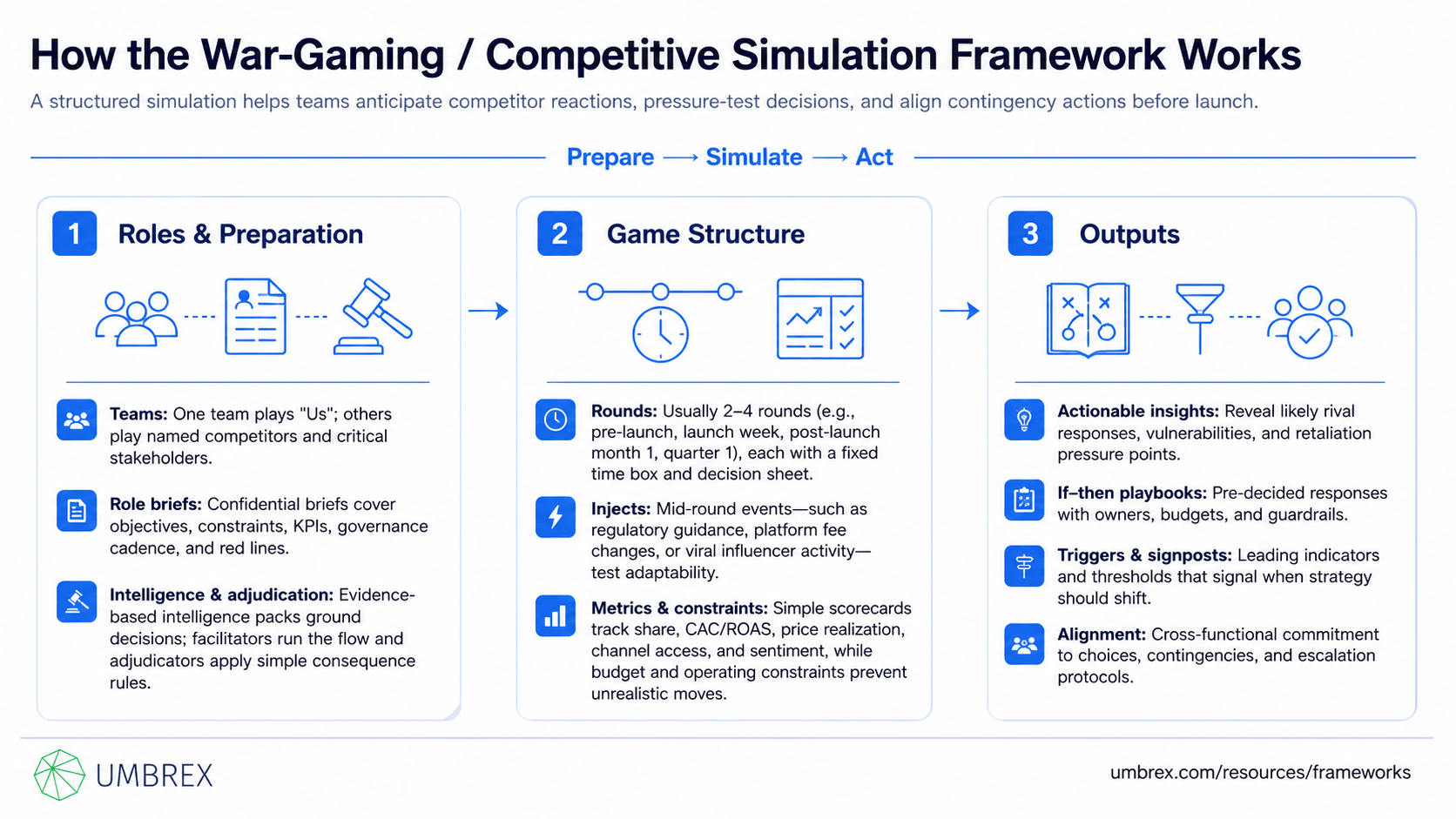
War‑gaming combines evidence‑based role briefs with facilitated rounds of decision‑making and adjudication. Each round simulates a time step (days to months), with teams submitting moves, receiving “intelligence,” and experiencing consequences. The logic rests on three elements:
Roles and Preparation
- Teams: One team plays “Us.” Others play named competitors and critical stakeholders (e.g., a major retailer, a platform gatekeeper, a regulator, a trade group, a dominant supplier). Each team gets a confidential role brief describing objectives, constraints, KPIs, governance cadence, and red lines.
- Intelligence packs: Evidence‑based dossiers with recent pricing, channel policies, margin pools, public statements, resource constraints, and known response patterns. These keep role‑play grounded in reality.
- Facilitators and adjudicators: Neutral facilitators manage time and flow; adjudicators apply simple rules to calculate consequences (e.g., price cuts impact margin and channel posture; platform policy changes alter conversion economics).
Game Structure
- Rounds: Typically 2–4 rounds (e.g., Pre‑launch, Launch Week, Post‑launch Month 1, Quarter 1). Each round has a fixed time box (60–90 minutes) and defined decision sheets.
- Injects: Realistic events inserted mid‑round (e.g., a regulator issues guidance, a platform adjusts fees, an influencer video goes viral). Injects test adaptability and pre‑agreed triggers.
- Metrics and constraints: Simple scorecards track share shifts, CAC/ROAS, price realization, channel access, and brand sentiment. Budget and operational constraints prevent “magic wand” moves.
Outputs
- Actionable insights: Patterns in how and where rivals hit back; vulnerabilities; channels/platforms likely to retaliate; messages that hold or fold under pressure.
- If–then playbooks: Pre‑decided responses to likely competitor and platform moves with owners, budgets, and guardrails.
- Triggers and signposts: Leading indicators to watch and thresholds that shift strategy (e.g., “If Platform X reduces targeting precision, reallocate 15% to retail media within 30 days”).
- Alignment: Cross‑functional commitment to specific choices, contingencies, and escalation protocols.
4. When to Use War‑Gaming
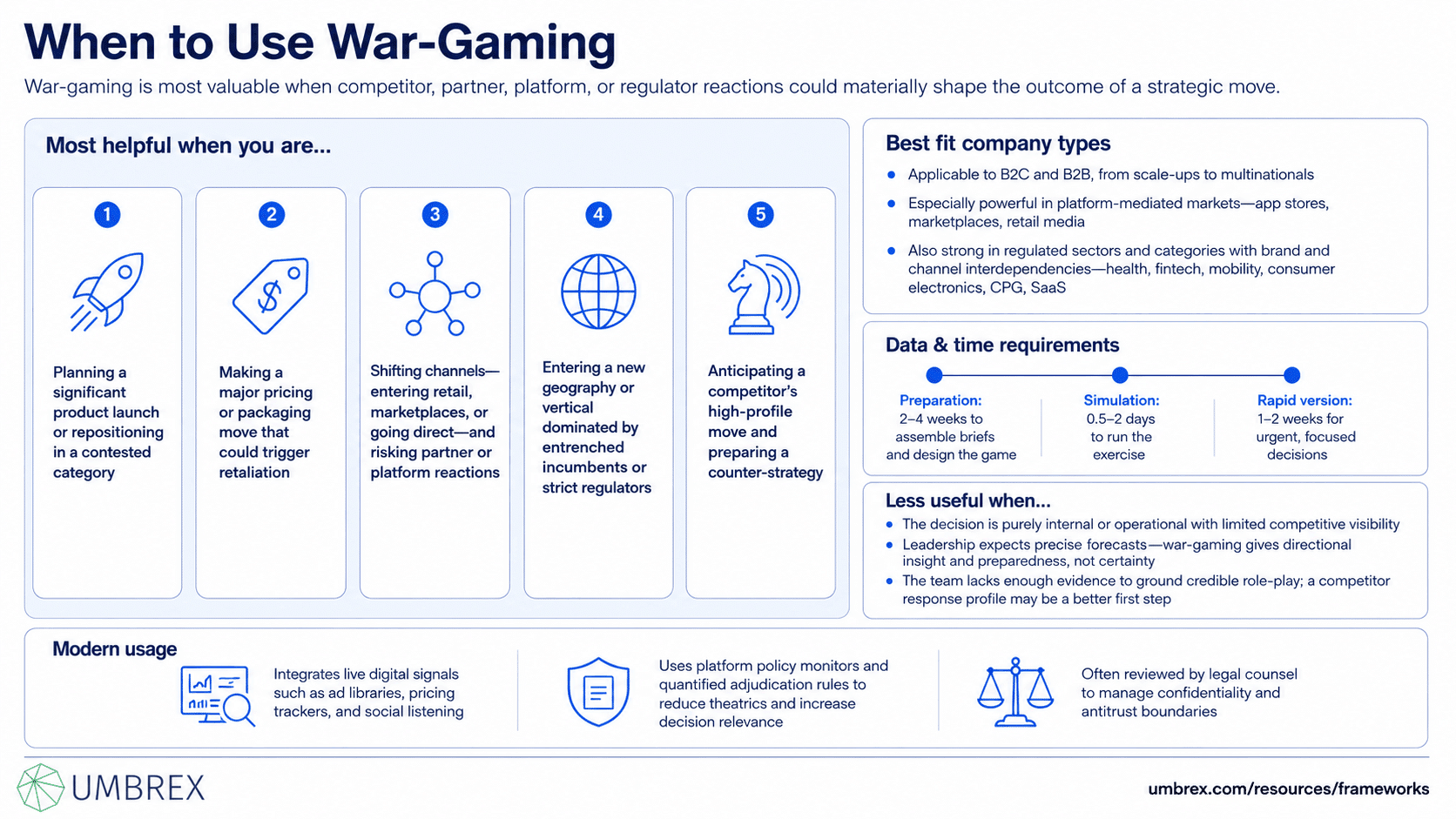
Most helpful when you are:
- Planning a significant product launch or repositioning in a contested category.
- Making a major pricing or packaging move that could trigger retaliation.
- Shifting channels (e.g., entering retail/marketplaces, going direct), risking partner or platform reactions.
- Entering a new geography or vertical dominated by entrenched incumbents or strict regulators.
- Anticipating a competitor’s high‑profile move and preparing your counter‑strategy.
Company types: Applicable to B2C and B2B, scale‑ups and multinationals alike. Especially powerful in platform‑mediated markets (app stores, marketplaces, retail media), regulated sectors (health, fintech, mobility), and categories with strong brand and channel interdependencies (consumer electronics, CPG, SaaS).
Data and time requirements: Preparation typically takes 2–4 weeks to assemble briefs and design the game; the simulation itself runs 0.5–2 days. A rapid, focused war‑game can be prepared in 1–2 weeks for urgent decisions.
Less useful when:
- The decision is purely internal or operational (e.g., creative A/B test) with limited competitive visibility.
- Leadership expects precise forecasts. War‑gaming provides directional insight and preparedness, not certainties.
- The team lacks the evidence base to ground credible role‑play; consider a competitor response profile first.
Modern usage: Contemporary simulations integrate live digital signals (ad libraries, pricing trackers, social listening), platform policy monitors, and quantified adjudication rules to reduce theatrics and increase decision relevance. Legal counsel often reviews scope to manage confidentiality and antitrust boundaries.
5. How to Apply War‑Gaming: Step‑by‑Step
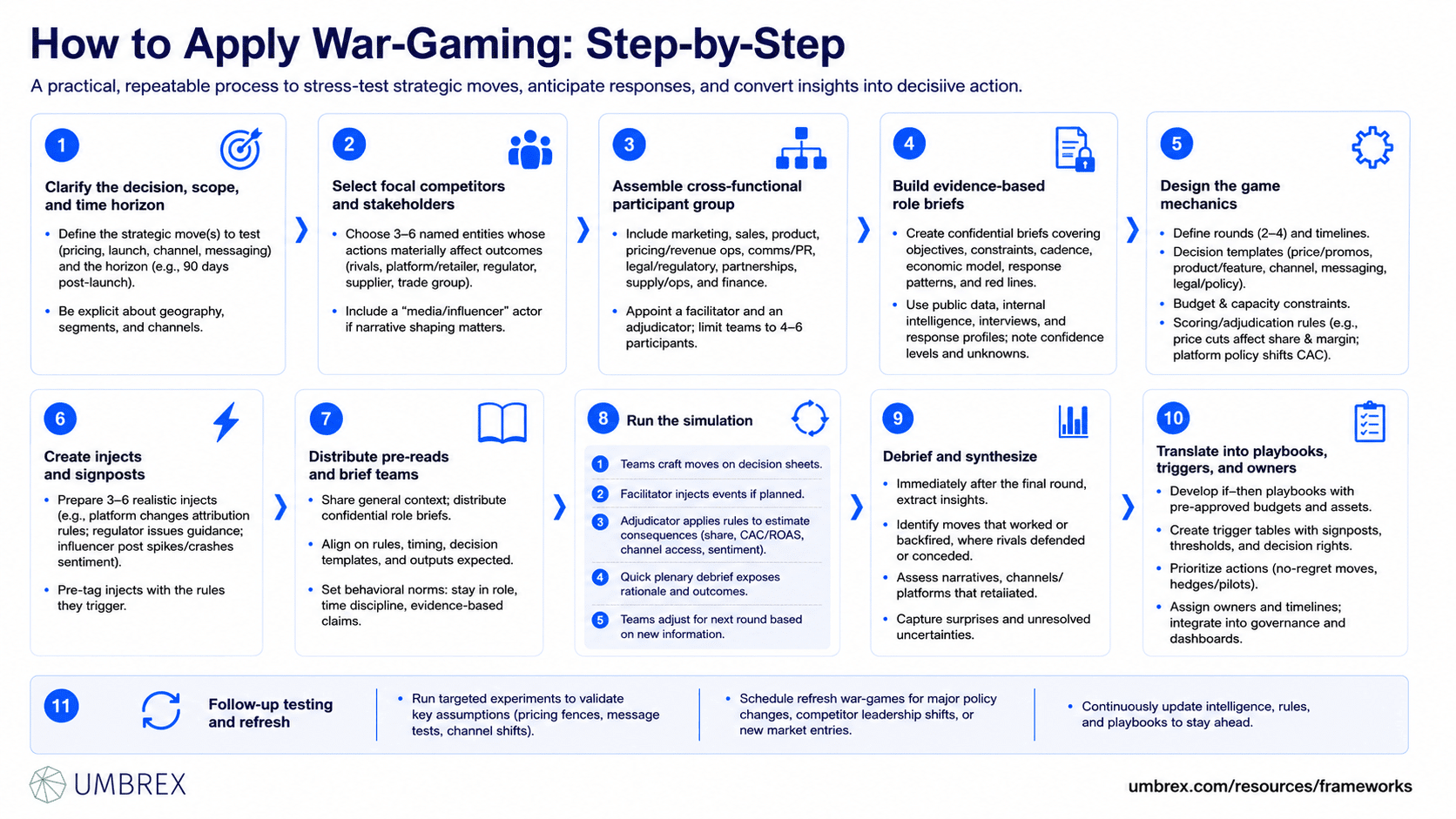
- Clarify the decision, scope, and time horizon
Define the strategic move(s) to test (pricing, launch, channel, messaging) and the horizon (e.g., 90 days post‑launch). Be explicit about geography, segments, and channels. The tighter the question, the more actionable the output.
- Select focal competitors and stakeholders
Choose 3–6 named entities whose actions materially affect outcomes: main rivals, a platform or retailer, a regulator or standards body, a key supplier, or a trade group. Include a “media/influencer” actor if narrative shaping matters. Avoid diluting the game with too many marginal players.
- Assemble a cross‑functional participant group
Include marketing (brand, growth, channel), sales, product, pricing/revenue ops, comms/PR, legal/regulatory, partnerships, supply/ops, and finance. Appoint a facilitator and an adjudicator. Limit each team to 4–6 participants for speed.
- Build evidence‑based role briefs
For each team, create a confidential brief covering objectives, constraints, decision cadence, economic model (simple guardrails), historic response patterns, and red lines. Use public data, internal intelligence, expert interviews, and competitor response profiles. Note confidence levels and unknowns.
- Design the game mechanics
Define:
– Rounds (2–4) and their timelines.
– Decision templates (price/promos, product/feature, channel allocation, messaging/PR, legal/policy maneuvers).
– Budget and capacity constraints (to prevent unrealistic moves).
– Scoring/adjudication rules (e.g., price cuts affect share and margin; retail media spend moves visibility; platform policy changes shift CAC).
- Create injects and signposts
Prepare 3–6 realistic injects (e.g., a platform changes attribution rules; a regulator issues draft guidance; an influencer post spikes or crashes sentiment). Pre‑tag injects with the rules they trigger to speed adjudication.
- Distribute pre‑reads and brief teams
Share general context with all participants; distribute confidential role briefs to each team. Align on rules, timing, decision templates, and outputs expected. Set behavioral norms (stay in role, time discipline, evidence‑based claims).
- Run the simulation
For each round:
1) Teams craft moves on decision sheets.
2) Facilitator injects events if planned.
3) Adjudicator applies rules to estimate consequences (share shifts, CAC/ROAS changes, channel access, sentiment).
4) Quick plenary debrief exposes rationale and outcomes.
5) Teams adjust for next round based on new information.
- Debrief and synthesize
Immediately after the final round, extract insights: which moves consistently worked or backfired; where rivals defended or conceded; which narratives resonated; which channels/platforms retaliated. Capture surprises and unresolved uncertainties.
- Translate into playbooks, triggers, and owners
Convert insights into:
– If–then playbooks with pre‑approved budgets and assets (offers, creative, PR).
– Trigger tables with signposts, thresholds, and decision rights.
– A prioritized action list (no‑regret moves, hedges/pilots).
Assign owners and timelines; integrate into governance and dashboards.
- Follow‑up testing and refresh
Run targeted experiments to validate key assumptions (pricing fences, message tests, channel shifts). Schedule refresh war‑games for major policy changes, competitor leadership shifts, or new market entries.
6. Example: War‑Gaming in Action
Context: A $900M global connected‑fitness company plans to launch a premium strength device with a $39/month content subscription in two European markets. Leadership worries about retaliation from a platform ecosystem (mobile OS + fitness app), a premium incumbent, and retailer gatekeepers; regulators are scrutinizing claims and data privacy.
Objective: Choose launch pricing, channel mix (D2C vs. retail partners), and messaging, and prepare counterplays to likely reactions.
Design: Five teams: “Us,” Competitor A (premium incumbent), Competitor B (platform ecosystem bundle), Major Retailer R, and Regulator/Consumer Watchdog. Three rounds: Pre‑launch (T‑2 months), Launch Month, and Quarter 1. Injects included a platform attribution change and a draft regulator guidance on health claims.
Highlights:
- Round 1 (Pre‑launch): “Us” planned a €39 subscription and €1,599 device price, heavy retail media, and early reviews via influencers. Competitor A prepared a content bundle and loyalty credits; B planned a 6‑month platform bundle discount. Retailer R demanded exclusivity for end‑caps. Regulator signaled stricter claim substantiation.
- Inject: Platform B announced changes reducing third‑party attribution; adjudication increased CAC for D2C paid social by 12% unless first‑party data capture improved.
- Round 2 (Launch): “Us” shifted 15% spend from social to retail media and email/SMS, introduced a “Founders Bundle” with accessories (value, not price cuts), and published transparent data privacy FAQs. A launched loyalty credits; B rolled out the bundle promo plus prominent app‑store merchandising; R withheld exclusivity but offered promotional slots for higher co‑op spend.
- Inject: Draft guidance on health claims required additional substantiation; adjudication delayed certain ad claims, pushing teams to emphasize user stories and third‑party validations.
- Round 3 (Quarter 1): “Us” expanded creator partnerships and in‑store demos; introduced a mid‑tier content plan to fence price‑sensitive users. A accelerated feature parity; B extended the bundle promo another month. Retailer R negotiated longer‑term co‑op for sustained end‑caps.
Outcomes and decisions:
- No‑regret moves: Launch with value‑add bundles versus price cuts; shift 15–20% budget to retail media and creator partnerships; pre‑publish data privacy and claim substantiation to pre‑empt watchdog critiques.
- Triggers: If platform B extends bundle promos beyond 60 days, launch a vertical‑specific offer through partner gyms; if regulator final guidance limits specific claims, pivot share of creative to performance metrics validated by third‑party labs.
- Channel posture: Declined retailer exclusivity; negotiated co‑op tied to merchandising KPIs. Increased first‑party data capture (in‑store QR trials) to mitigate attribution policy changes.
Result: The launch proceeded with disciplined pricing and contingency plans. When the platform extended bundle promos, the team activated the partner gym offer and protected CAC within 7% of plan. A regulatory clarification arrived; because claims were pre‑vetted, no relabeling was needed. The company hit 92% of subscription attach targets in Quarter 1 without a price war.
7. Strengths and Limitations
Strengths
- Anticipatory advantage: Reveals likely rival and gatekeeper responses before committing spend.
- Decision speed and alignment: Builds cross‑functional muscle memory and pre‑approved playbooks.
- Blind‑spot detection: Surfaces channel/platform retaliation, regulatory friction, and narrative weaknesses.
- Practical stress test: Converts abstract strategy into concrete moves, metrics, and trade‑offs.
Limitations
- Preparation intensity: Requires time and evidence to build credible briefs; weak prep yields theatrics.
- Subjectivity and bias: Participants may project their logic onto rivals; facilitators must enforce evidence and constraints.
- Static rules risk: Overly rigid adjudication can miss non‑linear dynamics (network effects, black‑swan events).
- Confidentiality/compliance: Requires careful handling of sensitive data and antitrust guidance.
8. Common Pitfalls (and How to Avoid Them)
- Vague objectives and scope
What goes wrong: The game meanders; outputs are generic.
Avoid: Start with a sharp decision statement, clear horizon, and specific moves to test.
- Teams role‑playing themselves
What goes wrong: “Competitors” act like your company, not like rivals with different constraints.
Avoid: Use evidence‑based briefs and appoint participants without strong prior biases to play rivals.
- Too many players, too little time
What goes wrong: Complexity overwhelms; learning drops.
Avoid: Limit to 3–6 critical entities; use 2–4 rounds with tight time boxes.
- No adjudication logic
What goes wrong: Outcomes feel arbitrary; teams disengage.
Avoid: Pre‑agree simple rules linking moves to consequences; use ranges, not false precision.
- Ignoring platforms and regulators
What goes wrong: Gatekeeper actions blindside plans.
Avoid: Assign teams to play key platforms/retailers/regulators; include policy and channel injects.
- Great session, no follow‑through
What goes wrong: Insights die in slides; no triggers or owners.
Avoid: Convert outcomes into if–then playbooks with budgets, owners, and dashboards the same week.
- Compliance missteps
What goes wrong: Sharing sensitive, current competitive data or coordinating market behavior.
Avoid: Use public/ethically sourced data; involve legal; avoid discussing real‑time competitor pricing intentions among competitors.
9. How War‑Gaming Relates to Other Frameworks
- Porter’s Five Forces: Five Forces explains structural profitability; war‑gaming tests how named rivals and gatekeepers might behave within that structure when you move.
- STEEP/PESTEL: Macro scans identify external drivers (regulation, technology, social shifts). War‑games operationalize their impact via injects and rule changes.
- Competitor Response Profiles: Profiles predict likely rival plays. War‑gaming exercises those predictions under pressure and sequences counterplays.
- Issue Impact–Uncertainty Matrix: Use it to prioritize which uncertainties merit hedges. War‑gaming then rehearses those hedges and defines triggers.
- Scenario Planning: Scenarios explore alternative futures; war‑gaming simulates interactions within a scenario to refine tactics and governance.
- Value Net/Ecosystem Mapping: Maps complements and gatekeepers; war‑gaming assigns roles to those actors and tests coalition strategies.
- Pricing and Positioning Tools (e.g., Competitive Positioning Map): Positioning maps set your stance; war‑gaming evaluates competitor responses to that stance and the durability of pricing power.
Choosing tools: Use Five Forces and STEEP/PESTEL for context; competitor response profiles to assemble evidence; war‑gaming to practice interactions and harden plans; scenario planning to ensure robustness over time.
10. Key Takeaways
- War‑Gaming is a structured simulation where teams play your company, rivals, and gatekeepers to anticipate responses and pre‑decide playbooks.
- It is most valuable before major launches, pricing shifts, channel moves, and market entries—especially in platform‑mediated or regulated markets.
- Success depends on evidence‑based briefs, simple adjudication rules, realistic injects, and disciplined conversion to triggers, owners, and budgets.
- War‑gaming complements macro scans, Five Forces, competitor profiles, and scenario planning; together they create resilient strategies.
- Avoid common pitfalls: vague scope, self‑referential role‑play, weak adjudication, ignoring platforms/regulators, and lack of follow‑through.
11. FAQs About War‑Gaming / Competitive Simulation
Is war‑gaming still relevant in fast‑moving digital and platform markets?
Yes—arguably more so. Platforms and algorithms change quickly, and gatekeeper reactions can reshape CAC, visibility, and compliance overnight. Modern war‑games use live digital signals and policy monitors, with injects that mimic real platform dynamics.
How is war‑gaming different from scenario planning?
Scenario planning explores alternative macro futures and strategic options. War‑gaming simulates interactive moves among named actors within those futures. Think of scenarios as the stage and script outline; war‑gaming is the rehearsal that reveals timing and tactics.
How long does a typical war‑game take to prepare and run?
Preparation: 2–4 weeks to build briefs, rules, and injects. Execution: a half‑day to two days depending on complexity. A rapid version can be built in 1–2 weeks for urgent decisions.
Who should participate?
Cross‑functional leaders and operators from marketing, sales, product, pricing/revenue ops, partnerships, comms/PR, legal/regulatory, supply/ops, and finance. Include external experts when feasible, and use neutral facilitators/adjudicators.
Do we need specialized software?
No. Many effective war‑games run on structured templates and simple adjudication spreadsheets. Software can help with multi‑round tracking, but discipline in design and facilitation matters far more than tools.
How do we avoid bias and theatrics?
Ground roles in evidence, set constraints and scoring rules, assign participants to play unfamiliar roles, and use an independent facilitator. Capture assumptions and confidence levels; validate critical ones with follow‑up tests.
Any compliance considerations?
Yes. Involve legal early. Use public or ethically sourced data; avoid sharing competitively sensitive, current information across market participants; and do not use the exercise to coordinate market behavior.
