

1. What Is the Centralized vs Decentralized vs Hybrid Marketing Structure Framework?
The Centralized vs Decentralized vs Hybrid Marketing Structure Framework is a practical lens for deciding how to organize marketing across an enterprise. It compares three archetypes—centralized (one core team sets direction and executes), decentralized (each business unit or market runs its own marketing), and hybrid (a federated model that blends central standards and services with local execution)—to align structure with strategy.
As an organization, capability & transformation framework, it helps leaders make explicit choices about where decisions live, how budgets and people are allocated, what gets standardized, and what stays closest to customers. It’s particularly valuable for companies balancing scale and brand consistency with speed and market relevance.
Consultants and executives commonly use this framework when a new CMO arrives, after mergers, during globalization/regionalization, or when performance variability suggests the current structure is misaligned. The framework provides clear trade-offs and a common vocabulary for designing the marketing operating model.
2. Origin and Background
Origin: Unknown; in use since at least the 1990s. The centralized–decentralized spectrum has long been a staple in organization design across functions, including Marketing. As global brands expanded and digital complexity grew, hybrid or federated variants became prevalent to balance control with agility.
The framework was created to solve a recurring problem: companies either centralize for efficiency and consistency but lose local responsiveness, or decentralize for speed and relevance but suffer duplication, inconsistent brand expression, and fragmented technology. A structured comparison helps leaders choose a model aligned to strategy, risk, and capability realities.
It became widely known through consulting work, business school curricula, and internal playbooks, often combined with decision-rights tools (RAPID), responsibility matrices (RACI), and supporting models like centers of excellence (CoEs) and global–regional–local designs.
3. How the Centralized vs Decentralized vs Hybrid Framework Works
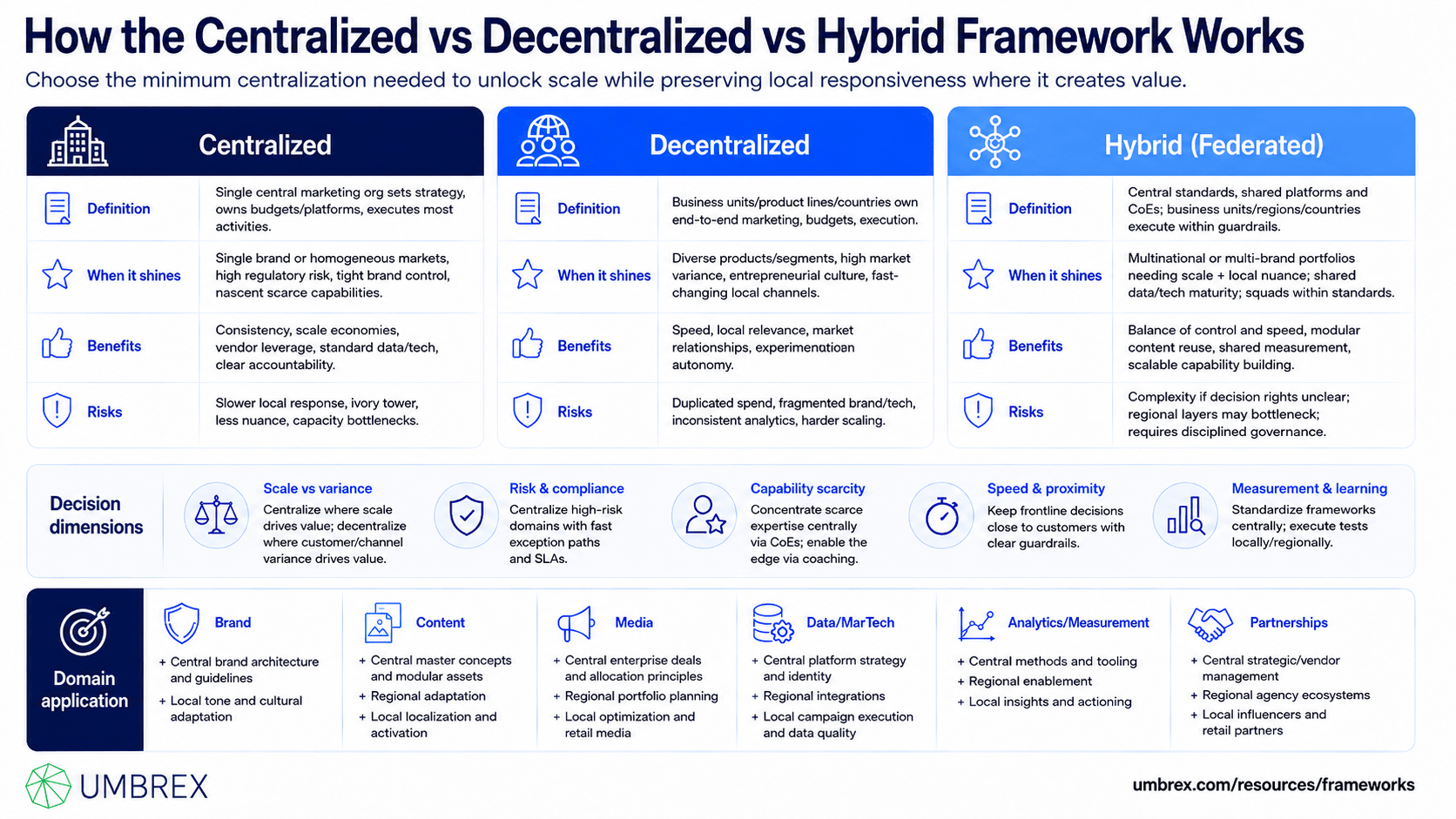
The framework compares three structural archetypes across key marketing domains (brand, content, media, data/MarTech, analytics/measurement, and partnerships) and organizational levers (decision rights, budgets, talent, processes, and platforms). The core logic is to choose the minimum centralization needed to unlock scale benefits while preserving local responsiveness where it creates value.
The three archetypes
- Centralized
- Definition: A single, central marketing organization sets strategy, owns budgets and platforms, and executes most activities.
- When it shines: Single-brand or narrow portfolio; homogeneous customer needs across markets; high regulatory risk; need for tight brand control; nascent capabilities requiring concentrated talent.
- Benefits: Consistency, economies of scale, stronger vendor leverage, standardized data/tech, clearer accountability.
- Risks: Slower local response, potential “ivory tower,” less cultural nuance, bottlenecks if central capacity is constrained.
- Decentralized
- Definition: Business units, product lines, or countries own end-to-end marketing, including budgets and execution.
- When it shines: Diverse products and segments; high market variance; entrepreneurial culture; fast-changing local channels (e.g., retail media by market).
- Benefits: Speed, local relevance, strong market relationships, experimentation autonomy.
- Risks: Duplicated spend, fragmented brand and tech stacks, inconsistent analytics, harder to scale best practices.
- Hybrid (Federated)
- Definition: A blend: central teams set standards, own shared platforms, and provide services (often via CoEs), while business units/regions/countries execute within guardrails.
- When it shines: Multinational or multi-brand portfolios needing both scale and local nuance; digital maturity requires shared data/tech; cross-functional squads operate within standards.
- Benefits: Balance of control and speed, modular content reuse, shared measurement, scalable capability building.
- Risks: Complexity if decision rights are unclear; regional layers can become bottlenecks; requires disciplined governance.
Decision dimensions
- Scale vs. variance: Where scale and standardization drive value (e.g., identity, data models, brand identity, platform architecture), centralize. Where customer or channel variance drives value (e.g., offers, retail media), decentralize.
- Risk and compliance: Centralize high-risk domains (claims, privacy, consent) with fast exception paths and SLAs.
- Capability scarcity: Concentrate scarce expertise (e.g., marketing analytics, experimentation, advanced MarTech) centrally through CoEs; enable the edge via training and coaching.
- Speed and proximity: Keep frontline decisions (PR, local partnerships, in-market activation) close to customers with clear guardrails.
- Measurement and learning: Standardize frameworks (MMM/attribution, experimentation protocols) centrally; execute tests locally/regionally.
Applying by domain
- Brand: Centralized brand architecture and guidelines; local tone and cultural adaptation.
- Content: Central master concepts and modular assets; regional adaptation; local localization and activation.
- Media: Central enterprise deals and allocation principles; regional portfolio planning; local optimization and retail media.
- Data/MarTech: Central platform strategy and identity; regional integrations; local campaign execution and data quality.
- Analytics/Measurement: Central methods and tooling; regional enablement; local insights and actioning.
- Partnerships: Central strategic/vendor management; regional agency ecosystems; local influencers and retail partners.
4. When to Use the Framework
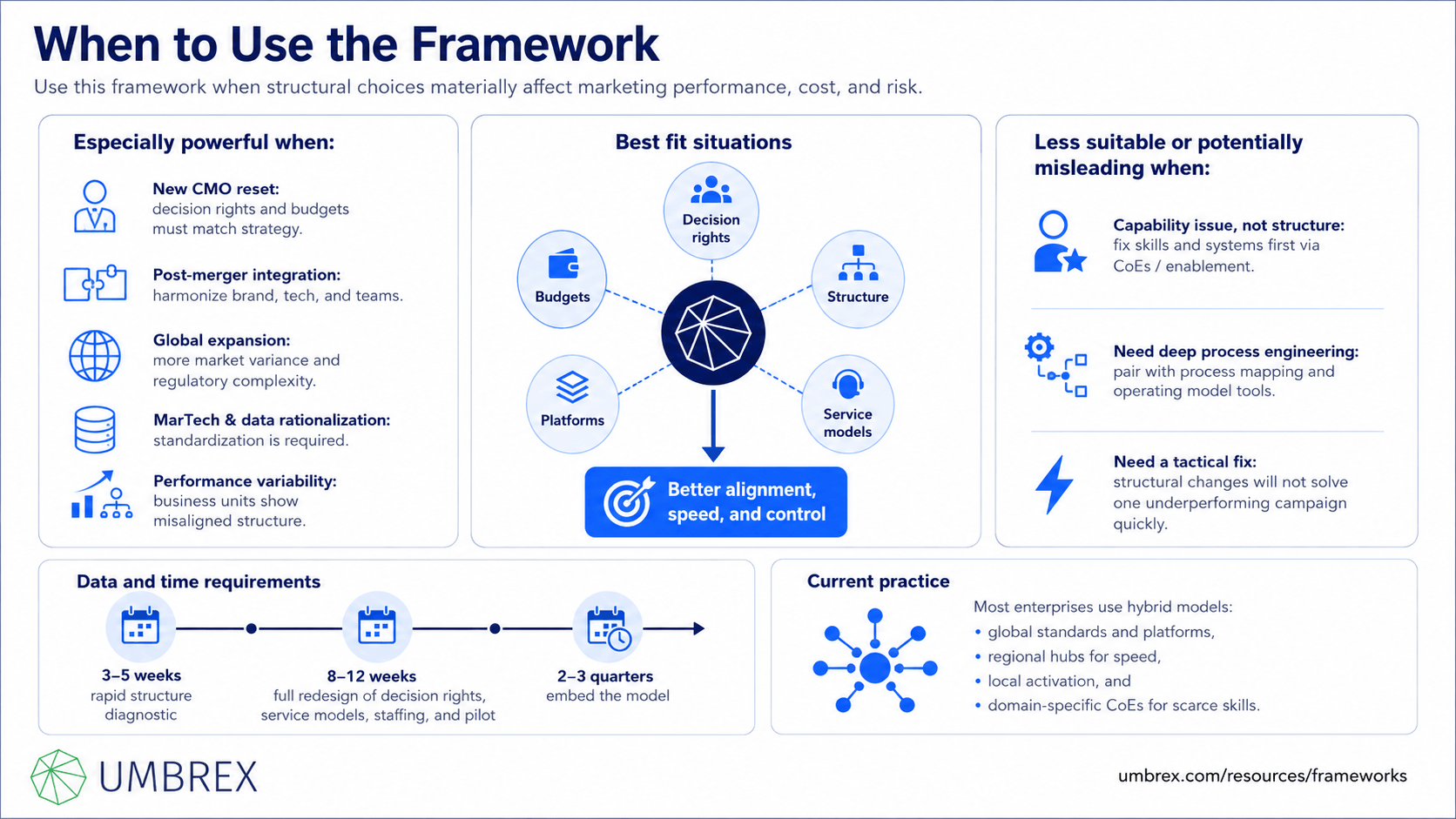
Use this framework when you are facing structural choices that materially affect marketing performance, cost, and risk.
Especially powerful when:
- A new CMO needs to reset decision rights and budgets to match strategy.
- Post-merger integration requires harmonizing brand, tech, and teams.
- Global expansion introduces greater market variance and regulatory complexity.
- MarTech rationalization and data strategy require standardization.
- Performance variability across business units suggests misaligned structure.
Less suitable or potentially misleading when:
- The core issue is capability, not structure; fix skills and systems first (e.g., via CoEs, enablement).
- You require deep process engineering; pair with process mapping and operating model tools to get to execution detail.
- You need a tactical fix for a single campaign; structural changes won’t deliver immediate results.
Data and time requirements: A rapid structure diagnostic can be done in 3–5 weeks. A full redesign (including decision rights, service models, staffing, and pilot) typically takes 8–12 weeks to design and 2–3 quarters to embed.
Current practice: Most enterprises adopt hybrid models with global standards and platforms, regional hubs for speed, local activation, and domain-specific CoEs to concentrate scarce skills.
5. How to Apply the Framework: Step-by-Step
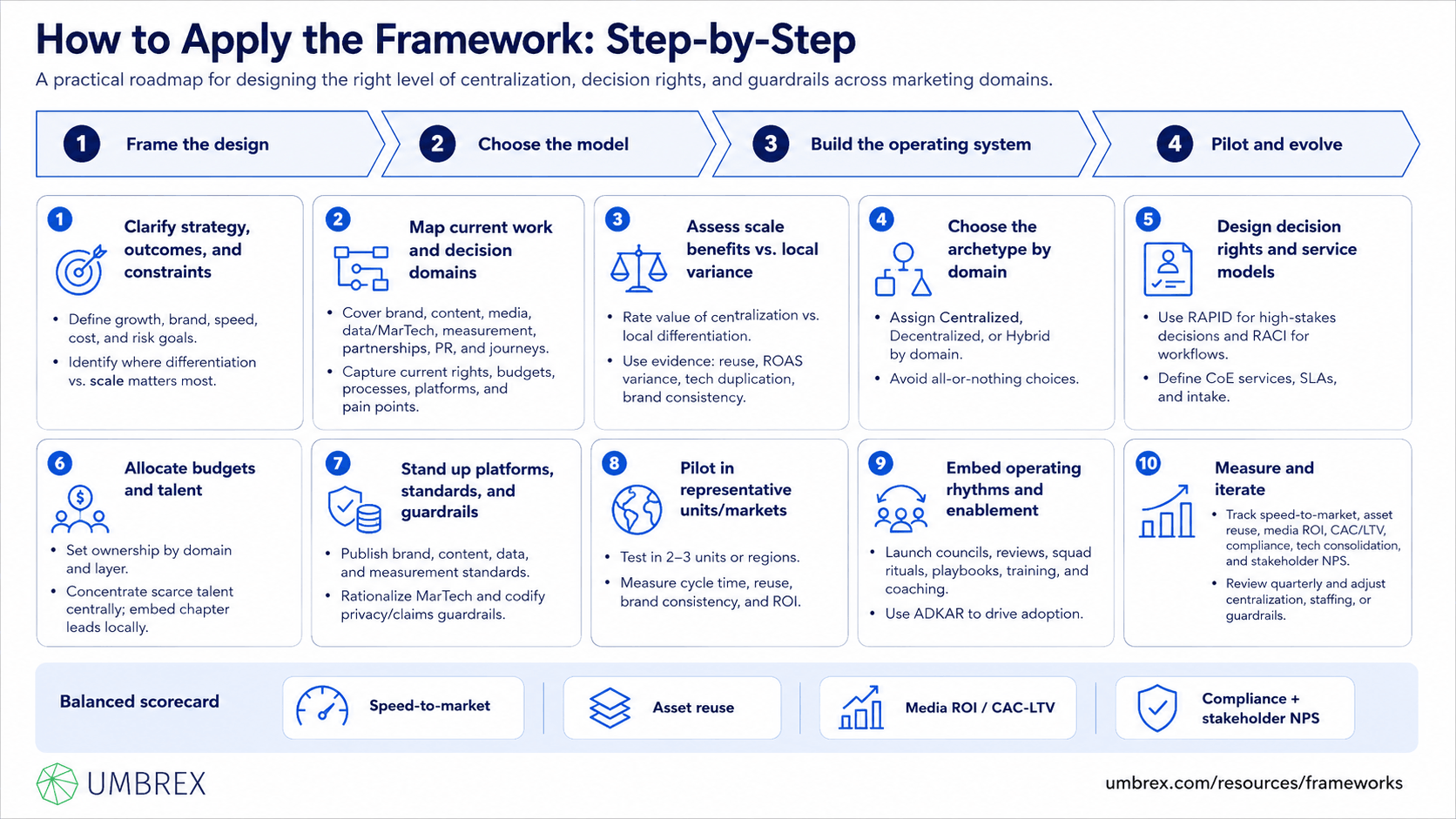
- Clarify strategy, outcomes, and constraints
Define what the structure must enable: growth objectives, brand ambition, speed-to-market targets, cost and risk constraints. Identify where differentiation vs. scale efficiency matters most (e.g., personalization at scale, retail media, brand stewardship).
- Map current work and decision domains
List key domains: brand/portfolio, content, media, data/MarTech, measurement, partnerships, PR, and customer journeys. For each, map current decision rights, budgets, processes, and platforms. Capture pain points (duplication, delays, inconsistency).
- Assess scale benefits vs. local variance
For each domain, rate the value of centralization (scale, consistency, risk control) against the need for local differentiation (culture, channels, competition). Use evidence: asset reuse rates, media ROAS variance, tech duplication, brand consistency scores.
- Choose the archetype by domain
Assign Centralized, Decentralized, or Hybrid to each domain. Avoid “all-or-nothing.” Example: centralize data/MarTech strategy and identity; hybrid for content and media; decentralize PR and retail partnerships.
- Design decision rights and service models
Use RAPID to assign who recommends, agrees, decides, inputs, and performs for high-stakes decisions (e.g., brand exceptions, data usage, media reallocation). Translate into RACI for key workflows. Define central services (CoEs) with SLAs and an intake process.
- Allocate budgets and talent
Determine budget ownership by domain and layer (global/regional/local). Establish portfolio councils for dynamic reallocation. Concentrate scarce talent centrally (analytics, experimentation) and embed chapter leads to support local teams.
- Stand up platforms, standards, and guardrails
Publish brand, content, data, and measurement standards; implement a DAM with shared taxonomy; rationalize MarTech; codify privacy and claims guardrails with fast exception paths and SLAs.
- Pilot in representative units/markets
Test the design in 2–3 business units or regions. Measure cycle time, reuse, brand consistency, and ROI. Refine decision rights, services, and SLAs before scaling.
- Embed operating rhythms and enablement
Establish quarterly investment councils, monthly portfolio reviews, and weekly squad/campaign rituals. Launch enablement (playbooks, training, coaching) aligned to the new structure. Use ADKAR to drive adoption.
- Measure and iterate
Track a balanced scorecard: speed-to-market, asset reuse, media ROI, CAC/LTV, brand compliance, tech consolidation, stakeholder NPS. Review quarterly and adjust centralization levels, staffing, or guardrails as conditions evolve.
6. Example: The Framework in Action
Context: A $1.8B global B2B industrial company operated with fully decentralized regional marketing. Results varied widely: duplicated technology, inconsistent brand expression, and slow adoption of digital. The new CMO aimed to improve brand consistency, reduce cost-to-create by 20%, and increase digital pipeline contribution by 30% within 18 months.
Approach: Applying the framework, the team assessed scale vs. variance by domain.
- Brand: Centralized brand architecture and identity; regions retained industry-specific messaging with pre-approved ranges.
- Content: Hybrid. A central content CoE created master narratives and modular assets; regions adapted technical proofs and local case studies.
- Media: Hybrid. Central enterprise search/social agreements and allocation principles; regions planned channels; locals optimized account-based plays.
- Data/MarTech: Centralized platform strategy (MAP, CDP), identity, consent; regions handled integrations; locals executed campaigns.
- Measurement: Central methods (MMM/attribution) and experimentation protocols; regions trained practitioners; locals ran tests.
Governance and services: RAPID defined decisions for brand exceptions and data usage. RACIs clarified campaign workflows. A content and analytics CoE offered services with SLAs and a transparent intake. Portfolio councils reallocated 15% of spend quarterly based on performance.
Outcomes: Within 12 months, asset reuse rose from 22% to 58%, cost-to-create fell 24%, and digital pipeline contribution increased 37%. Brand compliance incidents dropped by 50%. Tech duplication decreased as two regional MAPs were sunset. Local teams reported faster activation with better tools and templates, while central teams saw higher consistency and measurable ROI.
7. Strengths and Limitations
Strengths
- Clarifies trade-offs and aligns structure to strategy rather than defaulting to extremes.
- Provides a domain-by-domain approach, enabling nuanced hybrid designs.
- Enables cost and quality improvements via shared platforms, standards, and services while preserving local speed.
- Creates a common language for decision rights, budgets, and talent allocation.
- Scales capabilities through CoEs and standard measurement, increasing learning velocity.
Limitations
- High-level by design; requires complementary tools (RAPID, RACI, process maps) to get to day-to-day behaviors.
- Hybrid models can become complex and bureaucratic without clear guardrails and SLAs.
- Structure alone cannot fix weak capabilities or poor leadership behaviors; enablement and incentives must match.
- Attribution of impact to structural changes can be diffuse; needs disciplined measurement and storytelling.
8. Common Pitfalls (and How to Avoid Them)
- All-or-nothing centralization
What goes wrong: Over-centralization slows local response; over-decentralization fragments brand and tech.
How to avoid: Decide by domain using evidence on scale benefits vs. variance; hybridize where appropriate.
- Ambiguous decision rights
What goes wrong: Endless escalation and rework.
How to avoid: Use RAPID for key decisions and RACI for workflows; document and publish SLAs and escalation paths.
- “Ivory tower” centers
What goes wrong: Standards without services; locals bypass the center.
How to avoid: Establish CoEs with service catalogs, intake, and coaching; measure user NPS and adoption.
- Unfunded mandates
What goes wrong: Central standards with no budget for platforms or enablement.
How to avoid: Align budgets with ownership; create portfolio councils for reallocation; define chargeback where needed.
- Static design
What goes wrong: Structure drifts out of alignment as markets and capabilities evolve.
How to avoid: Run quarterly reviews; adjust centralization levels, staffing, and guardrails based on performance.
- Ignoring regulatory nuance
What goes wrong: Compliance breaches or over-cautious delays.
How to avoid: Centralize standards with fast exception paths; embed privacy/claims reviewers with SLAs.
- Technology sprawl
What goes wrong: Duplicate tools, inconsistent data.
How to avoid: Centralize platform strategy and identity; allow justified exceptions with integration standards.
- Underpowered regional layer
What goes wrong: Regions become bottlenecks or add little value.
How to avoid: Give regions clear mandates (coordination, adaptation, allocation) and resource appropriately; measure SLA adherence.
9. How This Framework Relates to Other Frameworks
This structural framework fits within a broader operating model toolkit.
- McKinsey 7S Framework: Use 7S to ensure alignment across strategy, structure, systems, skills, staff, style, and shared values. The central–decentral spectrum primarily affects structure and systems; 7S highlights cultural and leadership implications.
- Marketing Operating Model 4‑Box: Translate structural choices into Governance (decision rights, SLAs), Processes (campaign/content workflows), and Capabilities (CoEs, talent and tech). The 4‑Box is the “how” behind the structure.
- Global–Regional–Local Model: A practical instantiation of hybrid structures across geographies; clarifies who sets standards, adapts, and activates.
- Marketing CoE Model: Concentrate scarce expertise centrally to set standards and enable the edge—key to making hybrid work.
- RAPID and RACI: Define decision rights (RAPID) and execution responsibilities (RACI) to prevent hybrid models from becoming ambiguous.
- Agile Marketing (Pods/Squads/Tribes): Organize teams around outcomes within your chosen structure; chapters/CoEs maintain standards across squads.
- ADKAR Change Management: Drive adoption of new roles, standards, and ways of working; reinforce behavior change.
10. Key Takeaways
- Centralized, decentralized, and hybrid are archetypes—design by domain based on scale benefits vs. need for local differentiation.
- Hybrid is common but only effective with clear decision rights, service models (CoEs), shared platforms, and SLAs.
- Structure is not a silver bullet; pair with governance, processes, capabilities, and change management to realize benefits.
- Measure what matters: speed-to-market, asset reuse, media ROI, CAC/LTV, brand consistency, and tech consolidation.
- Treat structure as a living design; pilot, measure, and iterate as markets and capabilities evolve.
11. FAQs About the Centralized vs Decentralized vs Hybrid Marketing Structure Framework
Is hybrid always the best choice?
Not by default. Hybrid is powerful when you need both scale and local relevance, but it adds complexity. Decide by domain: centralize where scale and risk control matter; decentralize where local differentiation drives value; use hybrid where both do.
How do we decide what to centralize vs decentralize?
Assess scale benefits (consistency, cost, risk) versus local variance (customer, channel, regulatory). Use evidence (reuse rates, ROI variance, tech duplication) and codify decisions with RAPID and RACIs for clarity.
Where should budgets sit in a hybrid model?
Often a mix: central funds platforms, master assets, and enterprise initiatives; regions manage portfolio allocations; locals manage activation. Use portfolio councils to reallocate based on performance.
How long does a restructure take?
Design in 8–12 weeks (including decision rights and service models), followed by 2–3 quarters to embed through pilots, enablement, and operating rhythms. Benefits typically appear after the first pilot waves.
Can smaller companies use this framework?
Yes—with a lighter touch. Centralize standards and platforms; keep execution close to the customer. Use simple guardrails, a small CoE or chapter model, and avoid adding layers that don’t add value.
