

1. What Is the ADKAR Change Management Model?
The ADKAR Change Management Model is a practical framework that guides individuals and organizations through the human side of change. ADKAR is an acronym for the five building blocks of successful change: Awareness, Desire, Knowledge, Ability, and Reinforcement. It focuses on what people need to adopt new ways of working, rather than only on project plans or organizational charts.
In the Organization, Capability & Transformation category—especially in Marketing—ADKAR helps leaders translate strategic shifts (e.g., moving to digital, in-housing media, rolling out a new MarTech stack, or adopting agile) into real behavior change. It provides a simple, evidence-based sequence for diagnosing where adoption is stuck and what specific interventions will move people forward.
Consultants and executives commonly use ADKAR during transformations to ensure that technology, process, and operating model changes are actually adopted by the teams who must live with them. It complements strategy and operating model frameworks by addressing the human adoption required to realize benefits.
2. Origin and Background
ADKAR was developed by Jeff Hiatt, founder of Prosci, a change management research and training firm. Prosci introduced the model in the late 1990s based on research into why projects succeed or fail from a people-adoption standpoint. The framework was further popularized through Prosci’s training programs and Hiatt’s 2006 book, “ADKAR: A Model for Change in Business, Government and our Community.”
ADKAR was created to solve a persistent problem: organizations invest heavily in new strategies and systems, but benefits are lost when people do not adopt new behaviors. Rather than treating change as a communications exercise or a project milestone, ADKAR defines the specific human outcomes that must be achieved for change to stick.
It became widely known through practitioner training, business school curricula, and extensive use in enterprise transformations across functions—including Marketing, where the pace of technology and operating model change is particularly high.
3. How the ADKAR Change Management Model Works
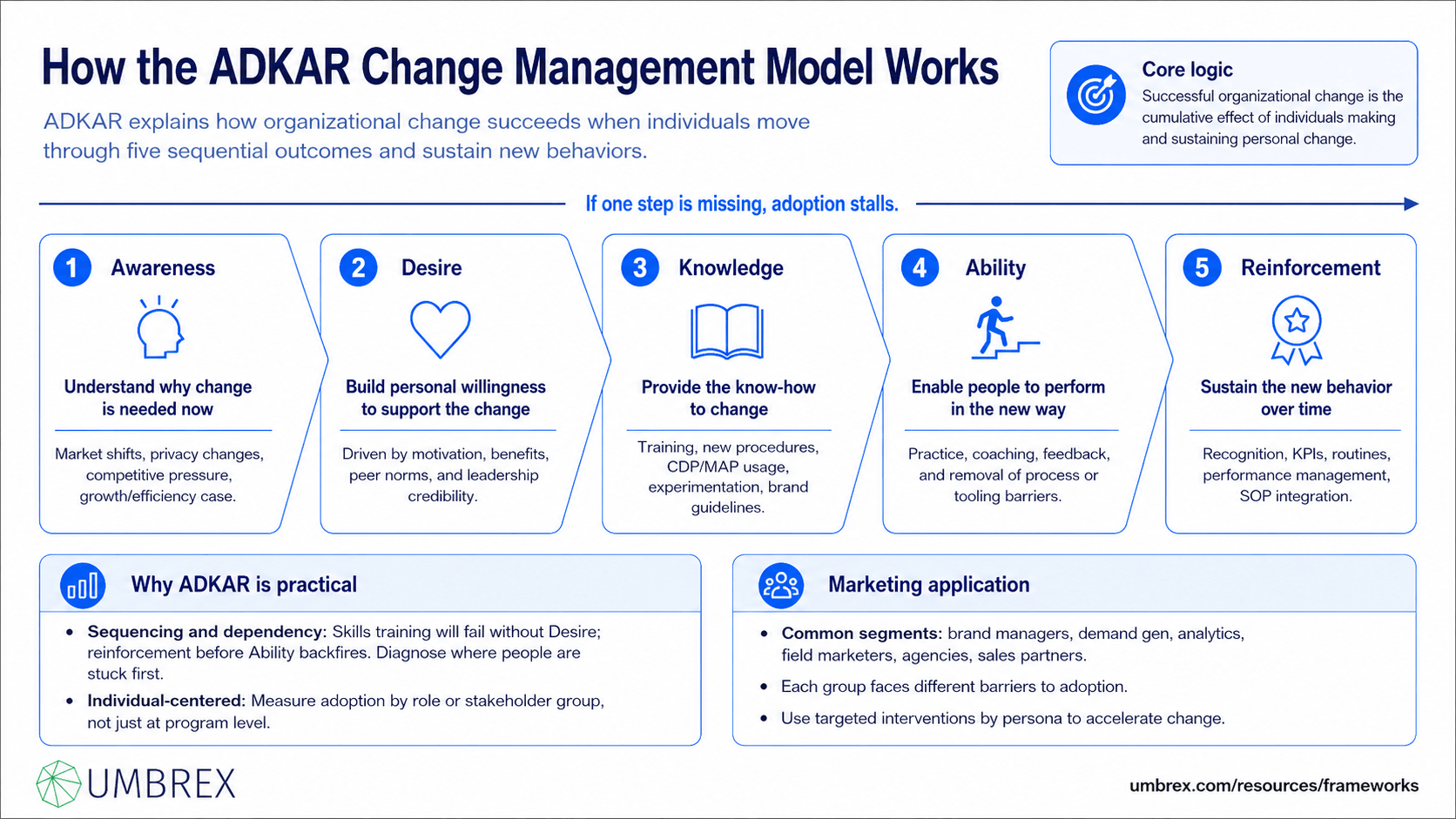
ADKAR’s core logic is straightforward: successful organizational change is the cumulative effect of individuals making and sustaining personal change. Each person must progress through five outcomes, broadly in sequence. If one is missing, adoption stalls.
- Awareness: Understanding the business reasons for the change—why it is necessary now and what happens if we do not change. In Marketing, this often means clarity on market dynamics (e.g., privacy shifts, media fragmentation, competitive moves) and the growth or efficiency case for change.
- Desire: The personal willingness to participate and support the change. This is influenced by intrinsic motivation, perceived benefits, peer norms, and leadership credibility. Desire cannot be mandated; it must be cultivated.
- Knowledge: The information, training, and know-how needed to change—what to do differently. Examples include new campaign operating procedures, how to use a CDP or MAP, experimentation methods, or new brand guidelines.
- Ability: The demonstrated capability to perform in the new way in real conditions. Ability requires practice, feedback, coaching, and removal of obstacles (process friction, role ambiguity, tooling gaps).
- Reinforcement: Mechanisms that sustain the change. This includes recognition, performance management, KPIs, leadership routines, and integration into standard operating procedures.
Two practical features make ADKAR especially usable:
- Sequencing and dependency: There is a natural order. Teaching skills (Knowledge) will not work if people lack Desire; reinforcing a behavior that is not yet feasible (no Ability) backfires. Diagnose where people are stuck and target that element first.
- Individual-centered diagnostics: ADKAR is not just conceptual—it encourages measurement at the persona or stakeholder-group level. Marketing transformations often segment by role (e.g., brand managers, demand gen, analytics, field marketers, agencies, sales partners) because each faces different adoption barriers.
4. When to Use the ADKAR Change Management Model
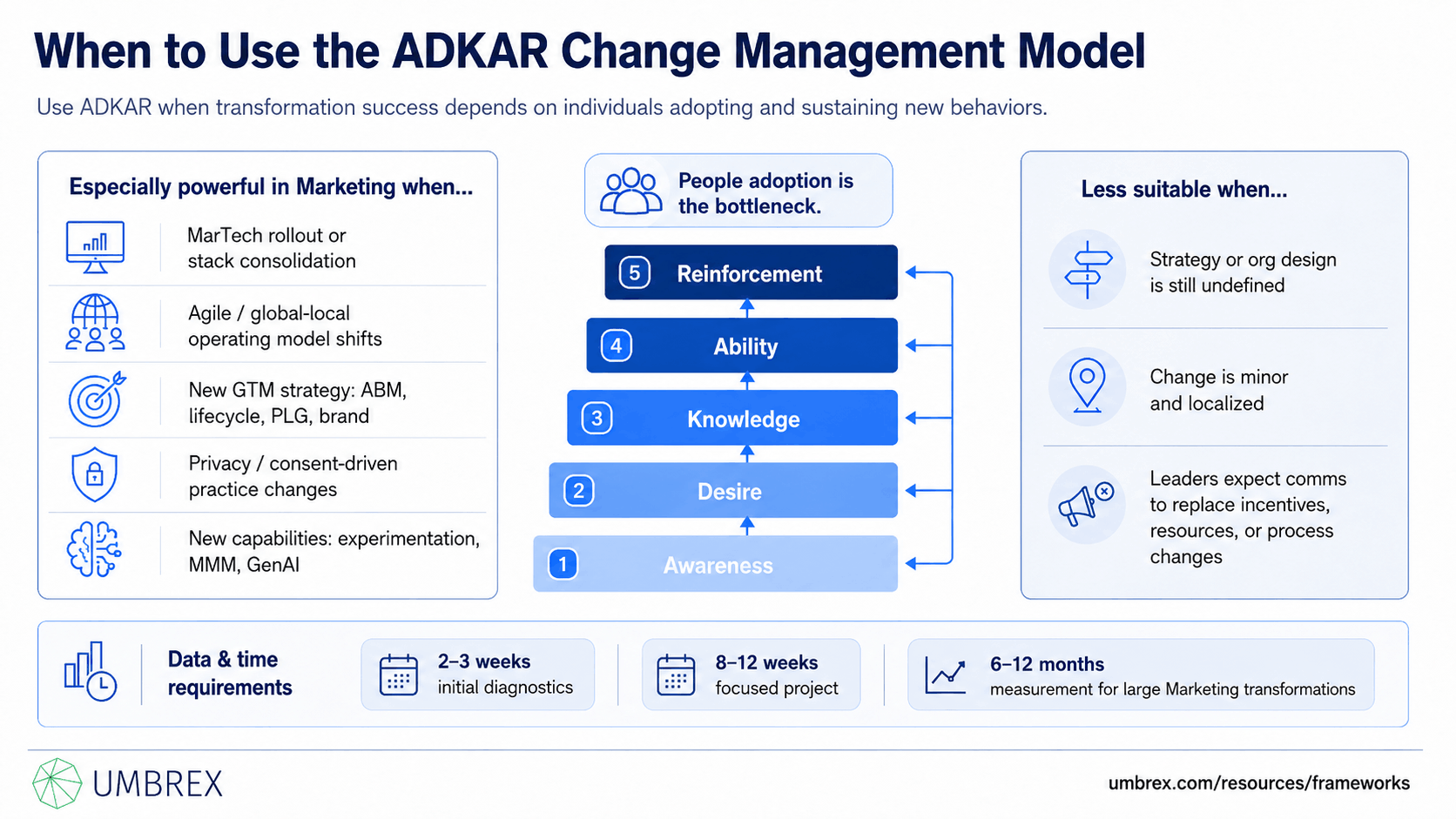
Use ADKAR whenever your success hinges on people adopting new behaviors, especially when the change is complex or touches multiple teams.
Especially powerful in Marketing when:
- Rolling out new MarTech (MAP, CDP, DCO, attribution platforms) or consolidating stacks after M&A.
- Shifting operating model (e.g., moving to agile marketing squads, establishing global/local brand governance, in-housing media and creative).
- Changing go-to-market strategy (e.g., adopting ABM, lifecycle automation, product-led growth, or new brand positioning).
- Responding to regulatory changes (e.g., privacy and consent) that alter data and targeting practices.
- Building new capabilities (e.g., experimentation, MMM, generative AI in content and personalization).
Less suitable or potentially misleading when:
- You are designing strategy or operating model from scratch. ADKAR focuses on adoption, not strategic analysis or org design. Pair it with strategy and org frameworks (e.g., STP/4Ps, 7S, Star Model).
- The change is a minor, localized tweak with low human-impact; a lightweight communication or SOP update may suffice.
- Leaders expect a “communications campaign” to substitute for incentives, resources, and process changes. ADKAR will highlight gaps, but leadership must be willing to address them.
Data and time requirements: A focused ADKAR effort can be integrated into a 8–12 week project, with initial diagnostics in 2–3 weeks. For large-scale Marketing transformations, expect ongoing ADKAR measurement and iteration for 6–12 months as capabilities mature.
5. How to Apply the ADKAR Change Management Model: Step-by-Step
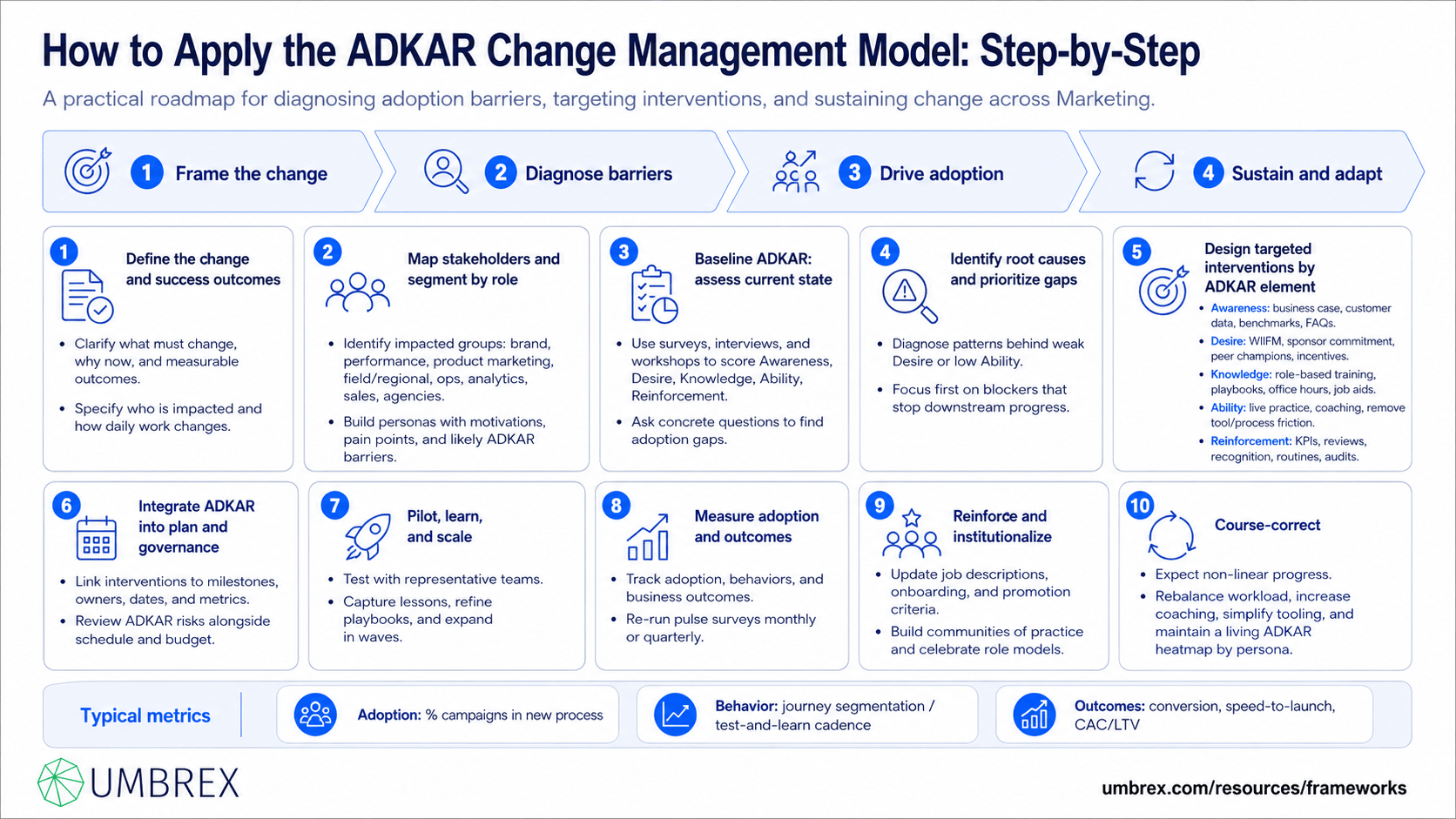
- Define the change and success outcomes
Articulate the case for change in business terms: what must change, why now, and the measurable outcomes (e.g., “reduce CAC by 15%, increase qualified pipeline by 30% via ABM and lifecycle automation in 12 months”). Specify who is impacted and how their day-to-day will change.
- Map stakeholders and segment by role
Identify impacted groups (brand, performance, product marketing, field/regional, marketing ops, analytics, sales, agencies). Create personas that capture their motivations, pain points, and likely ADKAR barriers. For example, field marketers may fear loss of autonomy (Desire), while analytics teams need new data schemas (Knowledge/Ability).
- Baseline ADKAR: assess current state
Use short surveys, interviews, and workshops to score each group on the five ADKAR elements. Ask concrete questions:
“Do you understand why we’re changing targeting practices?” (Awareness)
“Are you personally willing to adopt the new campaign process?” (Desire)
“Do you know how to build a journey-based program in the new MAP?” (Knowledge)
“Have you successfully executed one end-to-end?” (Ability)
“Are new behaviors recognized and measured?” (Reinforcement) - Identify root causes and prioritize ADKAR gaps
Analyze patterns. For instance, strong Awareness but weak Desire often signals credibility or incentive issues; low Ability despite training indicates process friction or insufficient coaching. Prioritize gaps that block downstream progress.
- Design targeted interventions by ADKAR element
- Awareness: Executive narratives linking strategy to personal impact; customer-backed data; competitive benchmarks; town halls; leader toolkits; FAQs addressing “what if we don’t.”
- Desire: WIIFM (“what’s in it for me”) by persona; visible sponsor commitment; quick wins; peer champions; aligning incentives and recognition; involving teams in solution co-design to increase ownership.
- Knowledge: Role-based training; SOPs and playbooks; shadowing; sandbox environments; office hours; job aids; certification pathways.
- Ability: Hands-on practice in live campaigns; side-by-side coaching; simplification of processes; removing tool friction; clear decision rights; checklists and quality bars; feedback loops.
- Reinforcement: Updated KPIs and OKRs; performance reviews reflecting new behaviors; recognition programs; leadership routines (e.g., weekly business reviews); audits to prevent regression; embedding changes into hiring and onboarding.
- Integrate ADKAR into the project plan and governance
Link each intervention to project milestones (e.g., training scheduled before pilot launch; coaching during first two sprints). Assign owners, dates, and metrics. Ensure the steering committee reviews ADKAR risks alongside schedule and budget.
- Pilot, learn, and scale
Run targeted pilots with representative teams. Measure ADKAR progression and business outcomes. Capture lessons, refine playbooks, and scale in waves. Use “champions” from early waves to coach later ones.
- Measure adoption and outcomes
Track leading and lagging indicators:
Adoption (e.g., percent of campaigns built in the new process; number of certified users),
Behavior (e.g., test-and-learn cadence, journey-based segmentation usage),
Outcomes (e.g., conversion rates, speed-to-launch, CAC/LTV).
Re-run ADKAR pulse surveys monthly or quarterly to spot regressions. - Reinforce and institutionalize
Update job descriptions, onboarding, and promotion criteria. Build communities of practice. Celebrate role models. Review metrics in leadership routines. Address backsliding quickly with coaching or process tweaks.
- Course-correct
Expect non-linear progress. If Desire drops due to change fatigue, slow the rollout and rebalance workloads. If Ability lags, increase coaching and simplify tooling. Keep a living ADKAR heatmap by persona to guide adjustments.
6. Example: ADKAR in Action
Context: A $500M B2B software company is migrating to a unified MAP+CDP and adopting an account-based, journey-led marketing model. The goal is to boost qualified pipeline by 30% and reduce campaign cycle times by 25% in 12 months.
Problem: Early training was completed, but adoption stalled. Regions kept using legacy tools; field marketers resisted centralized content standards; analytics was overloaded. Leadership worried the investment would not pay off.
Applying ADKAR:
- Awareness: The CEO and CMO presented a compelling case: declining email deliverability, privacy constraints, and rising CAC demanded a new approach. They shared competitive benchmarks and customer pain points showing relevance gaps.
- Desire: Role-specific “what’s in it for me” messages were crafted. Field marketers saw faster go-live and better MQL quality; content teams gained clearer briefs; SDRs saw improved targeting. Quick-win pilots delivered visible wins in two regions, and champions shared stories.
- Knowledge: Introduced role-based curricula (admin, campaign builder, analytics consumer), SOPs, and a playbook for journey design. Office hours and a sandbox allowed safe practice.
- Ability: Cross-functional pods executed two end-to-end journeys under coach supervision. Process bottlenecks (creative intake, legal review) were streamlined. Decision rights clarified who approves audiences and content.
- Reinforcement: KPIs changed—percent of campaigns on the new stack, test cadence per pod, and MQL-to-SQL conversion. Managers recognized teams in weekly business reviews; performance objectives were updated; legacy tools were sunset on a clear timetable.
Outcomes: Within nine months, 82% of campaigns ran on the new process; cycle time fell 28%; qualified pipeline rose 33% in target segments. ADKAR pulse surveys showed strong Awareness and Desire, with Ability improving steadily as coaching continued. The transformation sustained because reinforcement mechanisms remained in place.
7. Strengths and Limitations
Strengths
- Simplifies complexity into a clear, sequential checklist of human adoption outcomes.
- Provides a diagnostic lens to pinpoint why adoption is stuck and what to do next.
- Scales from small teams to enterprise programs and is role-focused, which suits Marketing’s diverse functions.
- Complements strategy and operating model tools by addressing the people side required for benefits realization.
- Creates a common language among executives, PMO, HR, and functional leaders.
Limitations
- Not a strategy or org design tool; it must be paired with frameworks that define what to change.
- The sequence can appear linear; in reality, change is iterative and messy—practitioners must revisit steps.
- Risks becoming a “check-the-box” exercise if leaders do not adjust incentives, resources, and processes.
- Measurement of Desire and Reinforcement relies on proxies; requires thoughtful survey design and behavioral metrics.
8. Common Pitfalls (and How to Avoid Them)
- Treating ADKAR as a communications plan
What goes wrong: Heavy on Awareness, light on Desire, Knowledge, Ability, and Reinforcement. Adoption stalls after launch.
How to avoid: Design interventions across all five elements, with owners, timelines, and metrics linked to the project plan.
- Skipping the baseline assessment
What goes wrong: Teams invest in training (Knowledge) when the real barrier is skepticism (Desire) or process friction (Ability).
How to avoid: Run quick ADKAR surveys and interviews per persona; act on the biggest bottleneck first.
- Confusing Knowledge with Ability
What goes wrong: People pass training but can’t perform in real conditions.
How to avoid: Pair training with coached practice, simplified processes, and tool configuration that supports the new way of working.
- Assuming Awareness creates Desire
What goes wrong: Leaders explain the business case but ignore personal incentives, workload, and loss aversion.
How to avoid: Tailor “what’s in it for me” messages and adjust incentives, recognition, and involvement to build genuine buy-in.
- One-size-fits-all messaging
What goes wrong: Different roles hear the same story; some disengage.
How to avoid: Segment by role and region; use peer champions to deliver relevant proof points.
- Under-engaging sponsors and middle managers
What goes wrong: Frontline hears mixed messages; change loses momentum.
How to avoid: Equip sponsors with talking points and cadence; hold managers accountable for coaching and reinforcement.
- Training before process and tools are ready
What goes wrong: Knowledge decays; credibility suffers.
How to avoid: Align training with tool availability and process readiness; schedule practice close to go-live.
- No reinforcement mechanisms
What goes wrong: Teams revert to old habits under pressure.
How to avoid: Update KPIs, reviews, rituals, and governance; sunset legacy tools and processes on a clear timetable.
- Not integrating with the PMO
What goes wrong: Change activities are disconnected from delivery milestones.
How to avoid: Embed ADKAR metrics and actions into the project plan, risk logs, and steering routines.
9. How the ADKAR Model Relates to Other Frameworks
ADKAR complements, rather than replaces, strategy and operating model frameworks. It focuses on individual adoption; other tools address where to play, how to organize, and how to execute.
- McKinsey 7S Framework: Use 7S to design a coherent operating model (strategy, structure, systems, skills, staff, style, shared values). Use ADKAR to drive the human adoption required to make that design real.
- Galbraith’s Star Model: Star guides operating model choices (processes, rewards, people). ADKAR ensures people actually shift behaviors within that model.
- Kotter’s 8-Step Process: Kotter describes organization-level stages (create urgency, build coalition, etc.). ADKAR translates these into individual-level outcomes; many programs use both—Kotter for the change journey, ADKAR for adoption diagnostics.
- Bridges’ Transition Model: Bridges focuses on the psychological transition (ending, neutral zone, new beginning). ADKAR provides actionable levers to move people through those phases.
- OKRs / OGSM: These translate strategy into targets and metrics. Pair with ADKAR to reinforce behaviors via objectives, scorecards, and performance reviews.
- Agile/Lean practices: Agile governs how work is delivered. ADKAR increases the odds that teams embrace agile rituals and mindsets, not just the terminology.
- STP/4Ps and Customer Journey Mapping: Market-facing choices and experience designs come first; ADKAR helps equip and motivate teams to execute them consistently.
In practice, a typical sequence is: strategy and operating model (e.g., STP/4Ps, 7S) → program design and delivery plan → ADKAR diagnostics and interventions → execution, measurement, and reinforcement.
10. Key Takeaways
- ADKAR (Awareness, Desire, Knowledge, Ability, Reinforcement) is a people-centered framework for achieving lasting change.
- It is most valuable when strategic marketing shifts depend on new behaviors across diverse roles and partners.
- Diagnose and act in sequence: fix the binding constraint (e.g., Desire or Ability) before investing elsewhere.
- ADKAR does not design strategy or org; pair it with operating model and execution frameworks.
- Reinforcement—through KPIs, incentives, and leadership routines—is essential to prevent backsliding.
- Integrate ADKAR into the PMO and measure adoption alongside business outcomes for sustained impact.
11. FAQs About the ADKAR Change Management Model
Is ADKAR still relevant today?
Yes. With rapid shifts in data privacy, MarTech, and customer expectations, Marketing transformations succeed or fail on adoption. ADKAR’s simple, role-focused approach makes it highly relevant in modern, cross-functional environments.
How is ADKAR different from Kotter’s 8 Steps?
Kotter outlines organization-level stages for leading change; ADKAR focuses on the individual-level outcomes required for adoption. Many teams use Kotter to structure the change journey and ADKAR to diagnose and close adoption gaps within each stage.
Can small or early-stage companies use ADKAR?
Absolutely. For startups, a lightweight ADKAR assessment and targeted actions (e.g., concise case for change, hands-on training, quick reinforcement) can accelerate adoption without heavy process.
How long does it take to apply ADKAR in a real project?
Initial diagnostics can be done in 2–3 weeks. For larger transformations, expect several waves over 6–12 months, with continuous reinforcement to sustain behavior change.
How do we measure ADKAR without over-surveying?
Pulse a short, role-based survey monthly or quarterly, triangulated with behavioral metrics: usage of new tools, process adherence, cycle times, quality metrics, and outcome KPIs. Use interviews selectively for depth where scores stall.
Does ADKAR work in agile environments?
Yes. Embed ADKAR into sprint rituals: Awareness and Desire through sprint goals and demos; Knowledge via enablement sessions; Ability through coached sprints; Reinforcement with sprint reviews, retrospectives, and team-level OKRs.
