

1. What Is the Data Maturity Model for Marketing Analytics?
The Data Maturity Model for Marketing Analytics is a structured framework used to assess how well a marketing organization leverages data—across strategy, people, processes, and technology—to measure performance and drive decisions. It defines a progression of capability levels, from ad hoc reporting to fully integrated, predictive, and automated decisioning. The goal is to diagnose today’s state, agree on an ambition, and chart a practical roadmap that moves the organization toward higher business impact from data.
This is a measurement, analytics, and performance management framework. It is commonly used by consultants and executives during marketing transformations, to guide investments (e.g., CDP, attribution, MMM), to align teams on what “good” looks like, and to track progress over time with tangible milestones.
In simple terms: the model clarifies what capabilities you need to consistently turn data into better marketing outcomes—what to build first, what to build next, and how to know you are improving. It replaces abstract aspirations (“become data-driven”) with concrete levels and evidence-based criteria.
2. Origin and Background
- Origin: Unknown; in use since at least the 2000s. Maturity models have deep roots in software and process improvement (e.g., CMMI) and were adapted widely to analytics and marketing as digital data proliferated.
- Popularization: The idea of analytics maturity was popularized through consulting practices, industry analysts, and academics (e.g., Thomas Davenport’s “Competing on Analytics,” early analyst firm maturity models). Marketing-specific versions became prevalent in the 2010s with the rise of martech stacks, attribution, and first-party data.
- Purpose: Created to address a recurring challenge: organizations over-invested in tools without the operating model, data foundations, or measurement practices to realize value. A maturity model provides a common language and a sequenced path to capability building.
- Diffusion: The model is now a staple in marketing transformations, operating model redesigns, and performance management programs across industries.
3. How the Data Maturity Model for Marketing Analytics Works
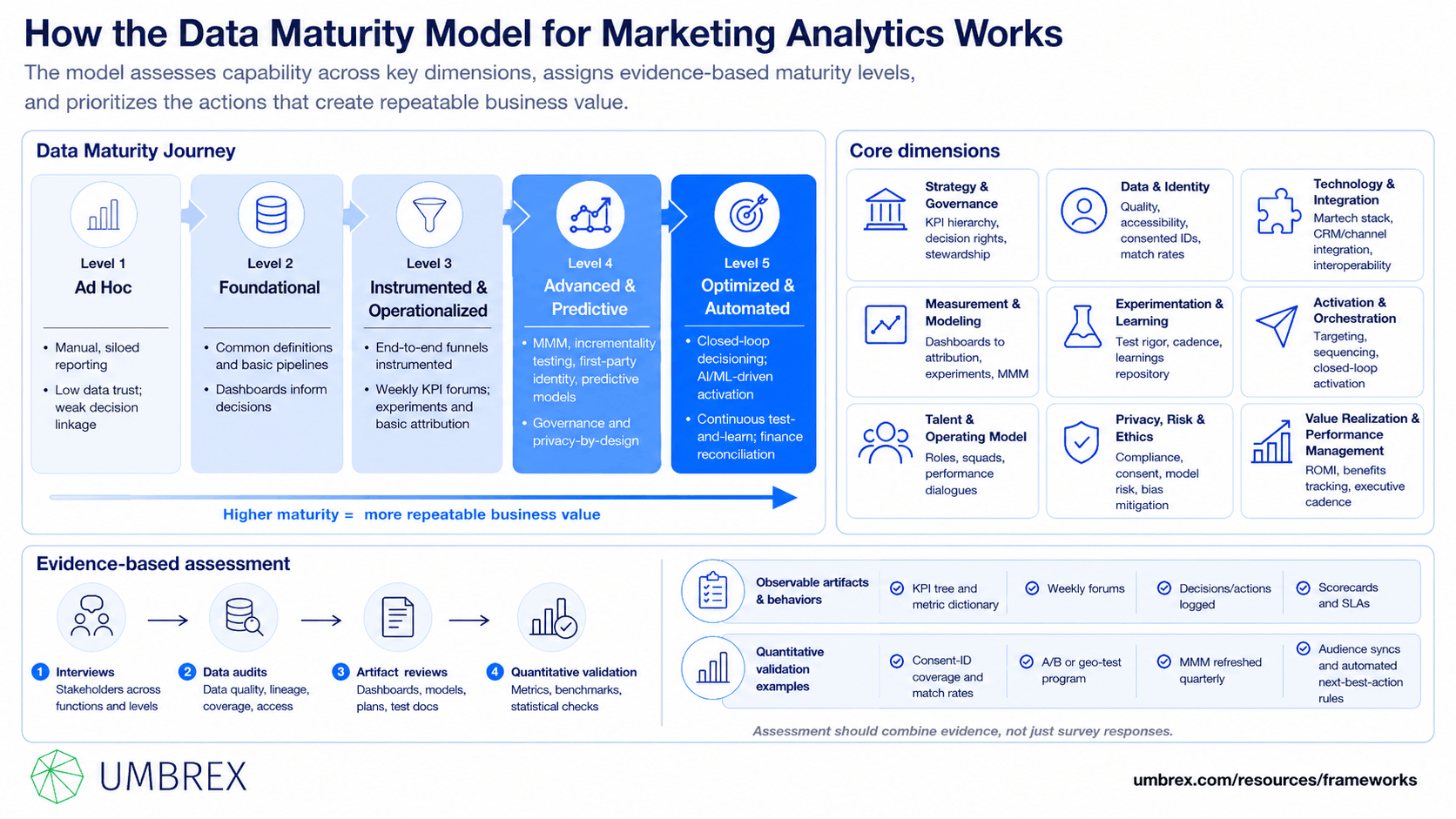
The model breaks marketing analytics capability into a small set of dimensions and defines levels of maturity for each. Teams assess themselves against observable criteria (evidence), identify gaps, and plan actions to progress. Importantly, maturity is not a trophy—higher levels should demonstrate higher, more repeatable business value.
Typical maturity levels
- Level 1 – Ad Hoc: Reporting is manual and siloed. Limited trust in data. Little linkage to decisions.
- Level 2 – Foundational: Common definitions and basic pipelines exist. Dashboards track outcomes and key drivers. Decisions are informed but not systematically optimized.
- Level 3 – Instrumented & Operationalized: End-to-end funnels are instrumented; standardized dashboards and KPIs support weekly decision forums. Experiments and basic attribution supplement judgment.
- Level 4 – Advanced & Predictive: Robust measurement (e.g., MMM, incrementality testing), integrated identity/first-party data, and predictive models inform budgeting, targeting, and creative. Governance and privacy-by-design are embedded.
- Level 5 – Optimized & Automated: Closed-loop decisioning across channels; real-time activation and personalization driven by AI/ML; continuous test-and-learn; value tracking and finance reconciliation are standard.
Core dimensions
- Strategy & Governance: Clarity of marketing objectives, KPI hierarchy, decision rights, and governance (metric dictionary, change control, stewardship).
- Data & Identity: Data quality, accessibility, first-party data capture, identity resolution, consent management, and enrichment.
- Technology & Integration: Martech stack (analytics, CDP, tag management, BI), integration across channels and CRM, real-time capabilities, interoperability.
- Measurement & Modeling: From descriptive dashboards to causal measurement (experiments, holdouts), attribution, and marketing mix modeling (MMM) with calibrated lag structures.
- Experimentation & Learning: Test design rigor, experimentation cadence, repository of learnings, and application to decisions.
- Activation & Orchestration: Ability to translate insights into targeting, creative, and sequencing across channels; closed-loop between analytics and activation platforms.
- Talent & Operating Model: Roles (marketing ops, data science, analytics translators), cross-functional squads, and performance dialogues that turn insight into action.
- Privacy, Risk & Ethics: Compliance (GDPR/CCPA), consent and preference management, model risk controls, and bias mitigation.
- Value Realization & Performance Management: Linkage to financial outcomes, ROMI tracking, benefits realization, and executive cadence.
Evidence-based assessment
Each level per dimension is defined by observable artifacts and behaviors. Examples:
- Strategy & Governance: Documented KPI tree and metric dictionary; weekly performance forums; decisions and actions logged.
- Data & Identity: Percent of traffic/users with consented IDs; match rates; accuracy/latency SLAs; data quality scorecards.
- Measurement & Modeling: Presence of A/B testing program, geo-experiments, MMM refreshed quarterly, incrementality testing for key channels.
- Activation & Orchestration: Number of audiences synced across channels; real-time decisioning for key journeys; automated next-best action rules.
The assessment is not a survey alone. It combines interviews, data audits, artifact reviews, and, where possible, quantitative validation (e.g., model accuracy, forecast error, impact of tests).
4. When to Use the Data Maturity Model for Marketing Analytics
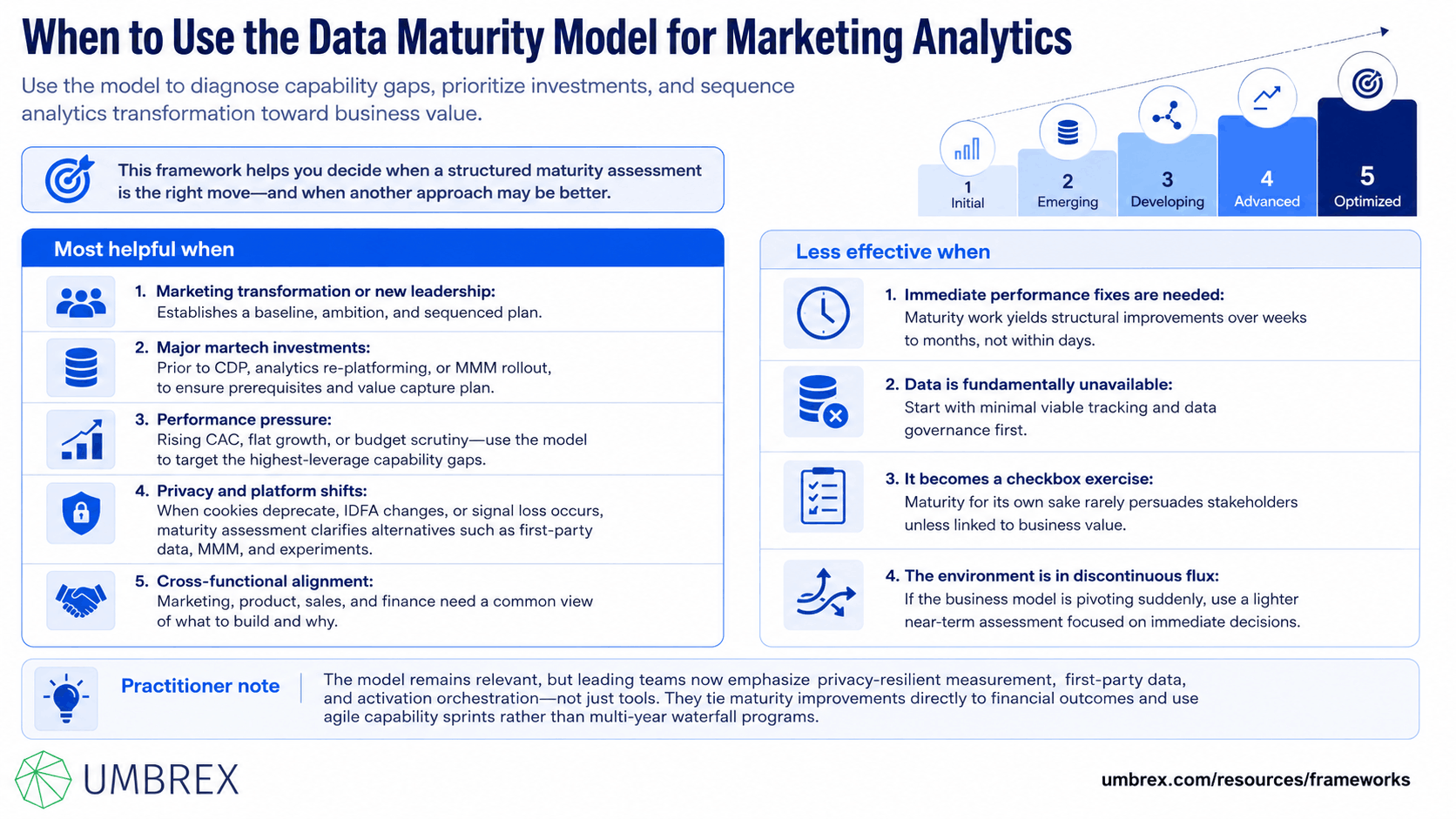
Situations where this framework is most helpful:
- Marketing transformation or new leadership: Establishes a baseline, ambition, and sequenced plan.
- Major martech investments: Prior to CDP, analytics re-platforming, or MMM rollout, to ensure prerequisites and value capture plan.
- Performance pressure: Rising CAC, flat growth, or budget scrutiny—use the model to target the highest-leverage capability gaps.
- Privacy and platform shifts: When cookies deprecate, IDFA changes, or signal loss occurs, maturity assessment clarifies alternatives (first-party data, MMM, experiments).
- Cross-functional alignment: Marketing, product, sales, and finance need a common view of what to build and why.
It is less effective when:
- You need immediate performance fixes within days; maturity work yields structural improvements over weeks to months.
- Data is fundamentally unavailable (e.g., no instrumentation). Start with minimal viable tracking and data governance first.
- It becomes a checkbox exercise divorced from business value. Maturity for its own sake rarely persuades stakeholders.
- The environment is in discontinuous flux (e.g., sudden business model pivot); in such cases, run a lighter assessment focused on near-term decisions.
Practitioner note: The model remains relevant, but usage has evolved. Leading teams put more emphasis on privacy-resilient measurement (experiments, MMM), first-party data, and activation orchestration, not just tools. They tie maturity improvements directly to financial outcomes and use agile “capability sprints” rather than multi-year waterfall programs.
5. How to Apply the Data Maturity Model: Step-by-Step
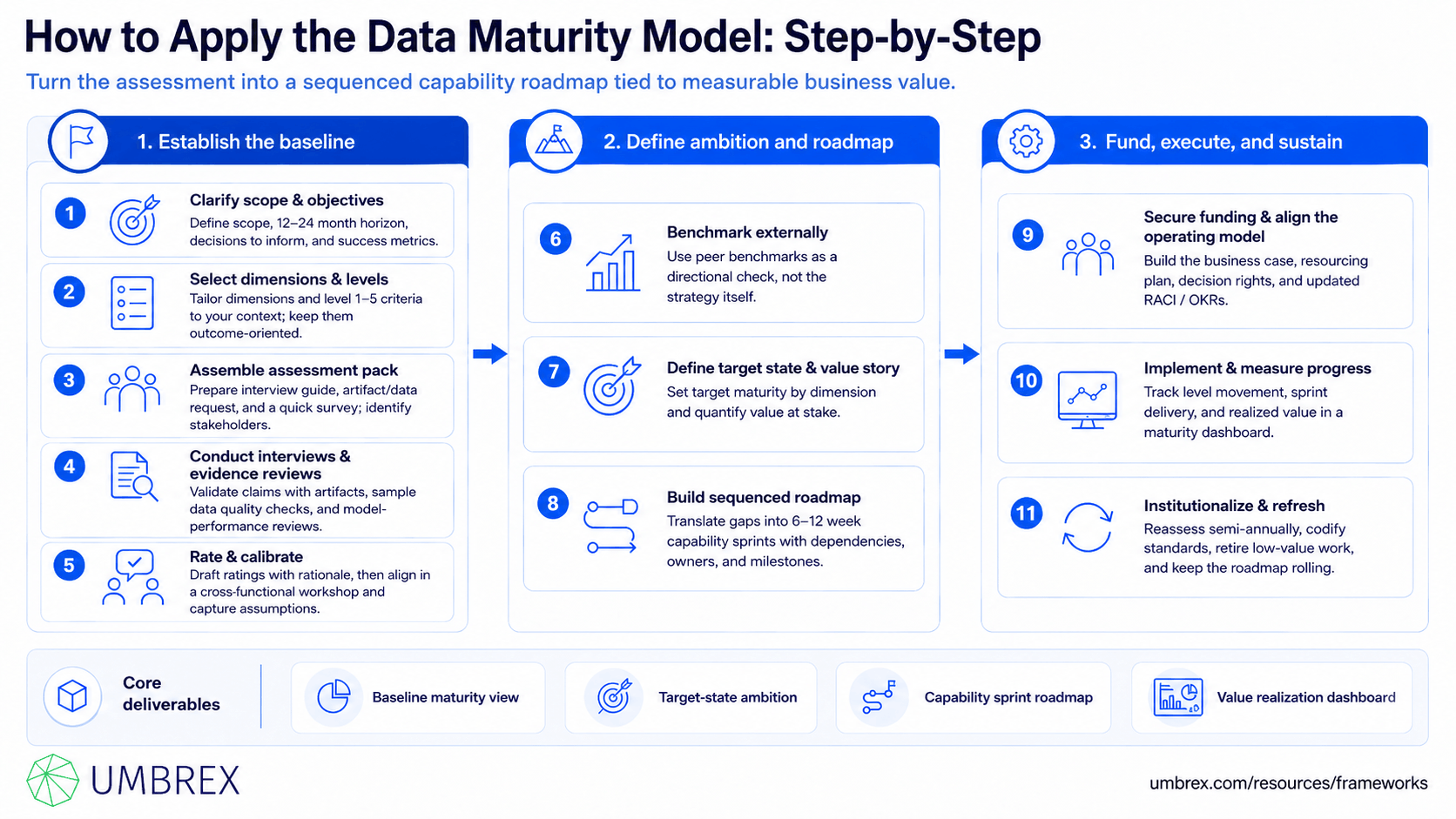
- Clarify scope and objectives.
Define what part of the business is in scope (global vs. region, B2B vs. B2C lines), the time horizon (12–24 months), and what decisions the assessment should inform (e.g., FY budget allocation, CDP investment, team redesign). Agree on success metrics for the program (e.g., % improvement in forecast accuracy, CAC, or revenue lift from personalization).
- Select dimensions and level definitions.
Adopt a standard set of dimensions (see section 3) and tailor descriptions to your context. Write plain-language criteria and evidence for levels 1–5 per dimension. Keep it outcome-oriented (what the business can do), not tool-oriented (what you bought).
- Assemble the assessment pack.
Prepare an interview guide, a data and artifact request (dashboards, KPI dictionaries, model documentation, audience catalogs, consent records), and a quick survey to capture perceptions and pain points. Identify stakeholders across marketing, analytics, product, IT, data governance, and finance.
- Conduct interviews and evidence reviews.
Run structured interviews (30–60 minutes) focused on decisions, cadences, pain points, and examples of data driving action. Review artifacts and validate claims. Where possible, test a sample of data quality and model performance to corroborate maturity levels.
- Rate each dimension and calibrate in a workshop.
Draft preliminary ratings with rationale and evidence. Host a calibration workshop with cross-functional leaders to challenge scores and align on a fair, defensible baseline. Capture dissent and assumptions explicitly.
- Benchmark externally where useful.
Compare to industry peers or anonymized benchmarks to contextualize the baseline. Use benchmarks as a directional check, not a crutch—your ambition should reflect strategy, not averages.
- Define the target state and value story.
Set target levels per dimension tied to business outcomes. Articulate the value at stake (e.g., expected ROMI lift from MMM-informed budgeting; revenue uplift from next-best-action personalization; cost avoidance from better data quality). Prioritize based on impact and feasibility.
- Build a sequenced roadmap.
Translate gaps into “capability sprints” of 6–12 weeks. Sequence dependencies: data and identity first, then measurement and experimentation, then advanced activation. Include enablers (governance, talent). Define owners, milestones, and success metrics per sprint.
- Secure funding and align operating model.
Package the roadmap with a business case and resourcing plan (internal roles, external partners, tech). Clarify decision rights and forums (weekly performance review, monthly modeling council). Update RACI and KPIs in OKRs to reflect new capabilities.
- Implement and measure progress.
Stand up a maturity dashboard that tracks level movement, sprint delivery, and value realized (e.g., incremental revenue, CAC reduction). Review in the same cadence as performance results to reinforce the link between capability and outcomes.
- Institutionalize and refresh.
Reassess maturity semi-annually or after major changes. Retire activities with low value, codify standards (metric dictionary, experimentation playbook), and keep the roadmap rolling with a balanced portfolio of foundational and value-creating initiatives.
What “good” looks like by level (selected examples)
- Level 2 (Foundational): A single KPI dictionary; executive dashboard with targets; basic channel ROI; standardized UTM and tag governance; weekly performance huddles.
- Level 3 (Operationalized): End-to-end funnel visibility; lead-to-revenue reconciliation; core experiments running every week; attribution model informing budget discussions; CDP or identity solution integrated with primary channels.
- Level 4 (Advanced): MMM with quarterly refresh and scenario planning; robust holdout/incrementality testing; first-party audiences at scale; next-best action for priority journeys; model monitoring and governance; privacy-by-design processes embedded.
- Level 5 (Optimized): Automated budget reallocation guided by MMM + experiments; real-time decisioning across touchpoints; creative optimization with AI; benefits realization tracking reconciled to finance.
6. Example: The Model in Action
Context: A $1.2B omnichannel specialty retailer faced rising CAC and inconsistent results across paid social, search, and email. Cookie deprecation reduced the effectiveness of retargeting. The new CMO needed a plan to rebuild measurement and personalization capabilities over 12 months.
Application: The team ran a maturity assessment across the nine dimensions. Baseline scores clustered at Level 2–3: strong dashboards and weekly cadence (Level 3), but limited first-party identity (Level 2), ad-hoc testing (Level 2), and no MMM (Level 1). Data quality issues (product catalog and offline sales reconciliation) hampered confidence in channel ROI.
Roadmap: The target state set Level 4 for Measurement & Modeling and Data & Identity within 12 months. The sequenced sprints were:
- Sprint 1 (8 weeks): Instrumentation uplift and data quality remediation; launch metric dictionary and governance; improve offline-online reconciliation.
- Sprint 2 (10 weeks): Stand up a CDP with consent management; build core first-party audiences; integrate with paid media and email platforms.
- Sprint 3 (12 weeks): Establish experimentation program (design standards, tooling, repository); run a backlog of 10 tests on pricing and creative.
- Sprint 4 (12 weeks): Deploy MMM with quarterly refresh; design budget reallocation playbook using MMM + incrementality tests.
- Sprint 5 (10 weeks): Roll out next-best action personalization on the web and email for top customer journeys.
Outcomes: Within six months, the retailer improved match rates for identifiable customers from 28% to 61%, reduced data latency from 72 to 6 hours, and increased test velocity from 1 to 6 experiments per week. MMM-informed budget shifts moved 15% of spend from low-incremental channels to higher-performing ones, reducing blended CAC by 12% and lifting revenue by 5% versus the prior year baseline. The organization advanced to Level 4 in Measurement & Modeling and Level 3–4 across most other dimensions, with a clear path to further gains.
7. Strengths and Limitations
Strengths
- Clarity and alignment: Creates a shared language for capabilities, gaps, and priorities across marketing, analytics, IT, and finance.
- Sequenced, value-based roadmap: Helps avoid tool-first approaches by sequencing foundations, measurement, and activation around business impact.
- Evidence-based management: Anchors maturity in observable practices and artifacts, reducing opinion-based debates.
- Adaptable: Works across B2B, B2C, and subscription models; can scale from lightweight to enterprise-grade assessments.
- Performance connection: Ties capability progress to lagging outcomes (revenue, CAC, CLV), reinforcing investment discipline.
Limitations
- Risk of checklists: If misused, it becomes a compliance exercise disconnected from decisions and outcomes.
- Context sensitivity: “Best practice” levels may not fit all business models, data realities, or regulatory constraints.
- Static snapshots: Annual assessments can lag reality; fast-moving markets require more frequent refresh and agile delivery.
- Attribution pitfalls: Overconfidence in models (MMM, MTA) without experiments can misguide investment; maturity must include causality checks.
- Talent bottlenecks: Tools without the right skills and operating model will not deliver value, regardless of maturity scores.
8. Common Pitfalls (and How to Avoid Them)
- Starting with tools, not outcomes
What goes wrong: CDP or analytics re-platforms fail to pay back.
Avoid it: Anchor the target state in explicit business use cases (e.g., reduce CAC by X%, lift retention by Y%) and sequence capabilities accordingly.
- Inflated self-assessment
What goes wrong: Overstated maturity leads to under-investment in foundations.
Avoid it: Require evidence (artifacts, metrics, model performance) and run cross-functional calibration workshops.
- Conflating reporting with analytics maturity
What goes wrong: Polished dashboards mask weak measurement or data quality.
Avoid it: Assess measurement rigor (experiments, MMM), data lineage, and reconciliation to finance—not just visualization.
- Ignoring privacy and consent
What goes wrong: Capabilities that cannot be lawfully or ethically operated at scale.
Avoid it: Embed privacy-by-design and consent management as core dimensions; involve legal early.
- Spreading too thin
What goes wrong: Many initiatives, few completed; no measurable value.
Avoid it: Focus on 3–5 capability sprints at a time with clear owners and KPIs; stage dependencies.
- No link to value realization
What goes wrong: Stakeholder fatigue and budget cuts.
Avoid it: Track benefits (incremental revenue, CAC reduction) and reconcile to finance; make wins visible.
- One-size-fits-all levels
What goes wrong: Pursuing “Level 5” where it’s unnecessary or impractical.
Avoid it: Tailor ambition by segment, region, or product; pursue “fit-for-purpose” maturity where value is highest.
9. How the Data Maturity Model Relates to Other Frameworks
- Balanced Scorecard and OKRs: These set strategic objectives and key results. The maturity model ensures you have the data and analytics capabilities to measure and achieve them. Use BSC/OKRs to define outcomes; use the maturity model to build the capability backbone.
- Leading vs Lagging Indicators: Leading/lagging clarifies what to measure and manage. The maturity model ensures you can measure those indicators reliably and act on them (data quality, cadence, governance).
- Funnel/AARRR frameworks: Funnels define stages of the customer journey. The maturity model ensures instrumentation, analytics, and activation across those stages are robust.
- Marketing Mix Modeling (MMM) and Attribution: These are specific measurement methods that typically sit at Level 4 of Measurement & Modeling. The maturity model helps decide when you are ready to implement them and how to embed them into decisions.
- Experimentation (A/B testing, geo tests): Experimentation frameworks provide causal evidence. The maturity model institutionalizes them (cadence, tooling, repository, governance).
- Data governance frameworks (e.g., DAMA-DMBOK): Governance defines how data is managed enterprise-wide. The maturity model adapts governance to marketing’s needs (metric dictionary, consent, lineage) and links it to performance.
- North Star Metric (NSM): NSM provides a unifying outcome. The maturity model decomposes the capability build required to reliably move and forecast the NSM.
Choice guidance: Use strategy frameworks to define where to play and how to win. Use the Data Maturity Model to ensure your measurement and analytics capabilities can support that strategy and scale value creation.
10. Key Takeaways
- The Data Maturity Model for Marketing Analytics assesses how well you turn data into better marketing decisions and outcomes across strategy, data, tech, measurement, and operating model.
- It defines clear levels (Ad Hoc to Optimized) with evidence-based criteria, enabling honest baseline, ambition setting, and a sequenced, value-backed roadmap.
- Focus on capability sprints that build foundations (data, identity, governance), causality (experiments, MMM), and activation (orchestration, personalization).
- Tie maturity progress to financial impact; track benefits alongside level movement to sustain sponsorship.
- Avoid checklists and tool-first approaches—prioritize the few capabilities that unlock the most value for your context.
11. FAQs About the Data Maturity Model for Marketing Analytics
Is the Data Maturity Model still relevant in a privacy-constrained, AI-enabled world?
Yes. If anything, it is more essential. Signal loss and AI proliferation raise the premium on strong foundations (first-party data, consent, governance), causal measurement (experiments, MMM), and disciplined operating models to ensure AI is accurate, ethical, and value-adding.
How is this different from a general “digital maturity” model?
Digital maturity spans products, channels, and operations. The Data Maturity Model for Marketing Analytics focuses specifically on the capabilities needed to measure, model, and activate marketing performance. It goes deeper on data, measurement, and decisioning tied to growth and ROMI.
Can small or early-stage companies use this framework?
Absolutely. Keep it lightweight: assess a subset of dimensions, aim for Level 2–3 where it matters most (instrumentation, dashboards, basic experimentation), and defer advanced modeling until you have sufficient data volume and channel complexity.
How long does a maturity assessment take?
A focused assessment typically takes 3–6 weeks end-to-end: 1 week to design and gather artifacts, 1–2 weeks of interviews and analysis, and 1–2 weeks to calibrate, define the target state, and build the roadmap. Enterprise-scale efforts can take longer, especially with global stakeholders.
When are we ready for MMM or advanced attribution?
When you have stable definitions and instrumentation, sufficient historical data (ideally 18–24 months for MMM), a culture of experimentation to validate recommendations, and an operating cadence that uses model outputs in budgeting decisions. Use the maturity model to confirm prerequisites and plan for adoption and governance.
