

1. What Is the Account‑Based Marketing (ABM) Framework?
Account‑Based Marketing (ABM) is a focused, cross‑functional go‑to‑market approach that treats a defined set of high‑value accounts as markets of one (or small clusters). Instead of casting a wide net, ABM aligns marketing, sales, and channel teams to orchestrate personalized outreach and programs that progress specific accounts from awareness to revenue—and then to expansion.
In the pricing, channel, and sales context, ABM is an operating framework: it connects targeting (which accounts), messaging (business outcomes and value case), routes to market (direct and partner), and commercial architecture (price metrics, tiers, fences) into coordinated “plays.” Done well, ABM raises win rates, average selling price (ASP), and pocket price realization while shortening cycles and reducing discounting.
Executives adopt ABM to focus scarce resources on the accounts that matter most—strategic enterprises, top partner ecosystems, and key buying centers—using data, intent signals, and value‑based narratives to prioritize, personalize, and measure.
2. Origin and Background
Origin: The term “Account‑Based Marketing” is widely credited to ITSMA (Information Technology Services Marketing Association) circa 2004. ABM practices were popularized through B2B marketing thought leadership and, from the mid‑2010s, by marketing technology vendors and practitioners as data, ad targeting, and sales/marketing platforms matured.
Why it was created: Traditional broad‑based demand generation underperformed in complex enterprise buying, where committees, long cycles, and bespoke needs dominate. ABM provided a way to concentrate effort on the right logos, orchestrate multi‑threaded engagement, and connect programs to pipeline and revenue at the account level.
How it spread: Through early ITSMA casework, practitioner books and conferences, and the rise of tools for firmographic targeting, intent data, and account‑level measurement. Today, ABM is a standard pillar for enterprise and upper mid‑market go‑to‑market teams, often integrated with strategic selling, value‑based pricing, and partner co‑marketing.
3. How the ABM Framework Works
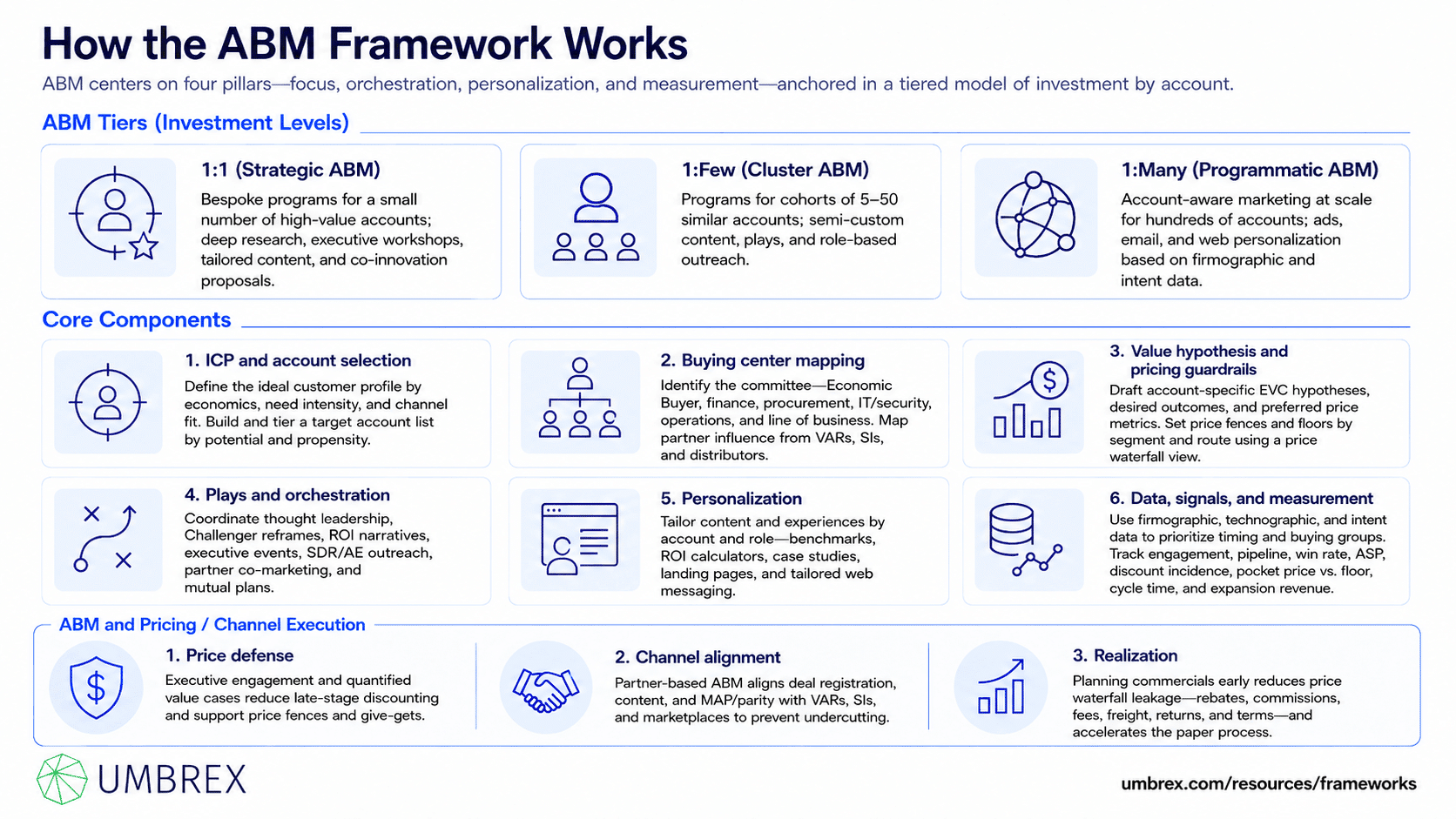
ABM centers on four pillars: focus, orchestration, personalization, and measurement—anchored in a tiered model of investment by account.
ABM Tiers (Investment Levels)
- 1:1 (Strategic ABM): Bespoke programs for a small number of high‑value accounts (often linked to KAM). Deep research, executive workshops, tailored content, and co‑innovation proposals.
- 1:Few (Cluster ABM): Programs tailored to cohorts of 5–50 similar accounts (by industry, use case, or buying center). Semi‑custom content and plays.
- 1:Many (Programmatic ABM): Account‑aware marketing to a larger set (hundreds) with personalization at scale—ads, website, and email tailored by firmographic/intent data.
Core Components
- ICP and account selection: Define your ideal customer profile by economics (LTV, margin, price realization), need intensity, and channel fit. Build a target account list (TAL) and tier it by potential and propensity.
- Buying center mapping: Identify the committee (Economic Buyer, finance, procurement, IT/security, operations, line of business) and their priorities and response modes. Map partners (VARs/SIs/distributors) that influence the account.
- Value hypothesis and pricing guardrails: Draft account‑specific hypotheses on economic value (EVC), desired outcomes, and preferred price metrics (users, transactions, locations, % of savings). Define price fences (term/volume/compliance) and floors by segment/route (price waterfall view).
- Plays and orchestration: Design multi‑touch sequences combining thought leadership, problem reframes (Challenger), ROI narratives (SPIN/solution selling), executive events, and partner co‑marketing. Align SDR/AE outreach, partner involvement, and marketing touches with mutual plans.
- Personalization: Tailor content and experiences to the account and role (industry benchmarks, ROI calculators, case studies, landing pages, website messaging, and ads). For 1:1, co‑create business cases and roadmaps.
- Data and signals: Use firmographic, technographic, and intent data to prioritize timing, identify topics of interest, and spot buying groups. Sequence plays based on signal strength and stage progression.
- Measurement and governance: Track account engagement, pipeline created/influenced, win rate, ASP, discount incidence, pocket price vs. floor, cycle time, and expansion revenue—by tier and route to market.
ABM and Pricing/Channel Execution
- Price defense: ABM’s value cases and executive engagement (Economic Buyer) reduce late‑stage discounting and support price fences and give‑gets.
- Channel alignment: Partner‑based ABM (PBM) targets accounts jointly with VARs/SIs/marketplaces, aligning deal registration, content, and MAP/parity to prevent undercutting.
- Realization: By planning commercials early (metrics, tiers, terms), ABM reduces price waterfall leakage (rebates, commissions, fees, freight, returns, terms) and accelerates paper process.
4. When to Use the ABM Framework
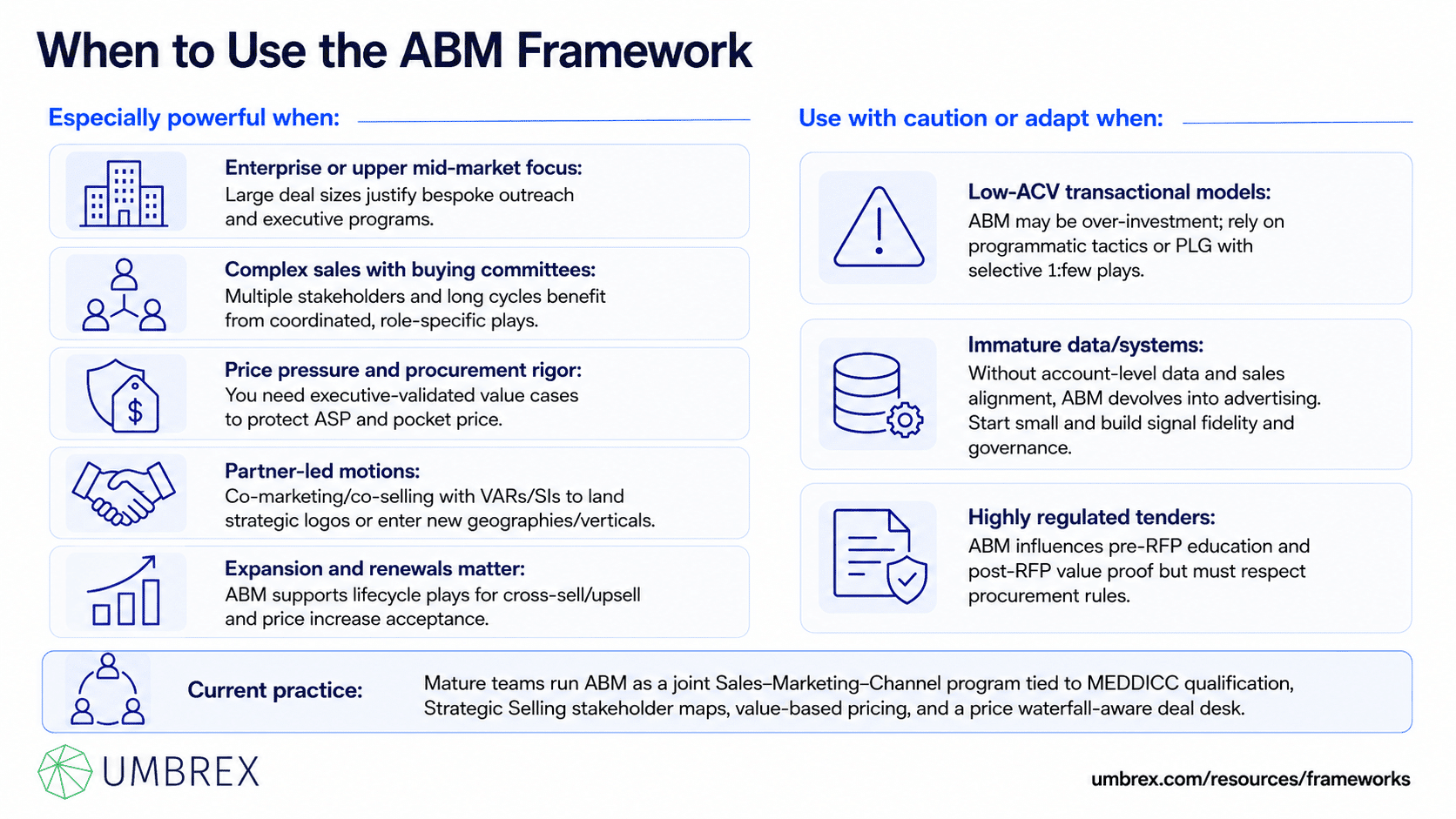
Especially powerful when:
- Enterprise or upper mid‑market focus: Large deal sizes justify bespoke outreach and executive programs.
- Complex sales with buying committees: Multiple stakeholders and long cycles benefit from coordinated, role‑specific plays.
- Price pressure and procurement rigor: You need executive‑validated value cases to protect ASP and pocket price.
- Partner‑led motions: Co‑marketing/co‑selling with VARs/SIs to land strategic logos or enter new geographies/verticals.
- Expansion and renewals matter: ABM supports lifecycle plays for cross‑sell/upsell and price increase acceptance.
Use with caution or adapt when:
- Low‑ACV transactional models: ABM may be over‑investment; rely on programmatic tactics or PLG with selective 1:few plays.
- Immature data/systems: Without account‑level data and sales alignment, ABM devolves into advertising. Start small and build signal fidelity and governance.
- Highly regulated tenders: ABM influences pre‑RFP education and post‑RFP value proof but must respect procurement rules.
Current practice: Mature teams run ABM as a joint Sales–Marketing–Channel program tied to MEDDICC qualification, Strategic Selling stakeholder maps, value‑based pricing, and a price waterfall‑aware deal desk.
5. How to Apply the ABM Framework: Step‑by‑Step
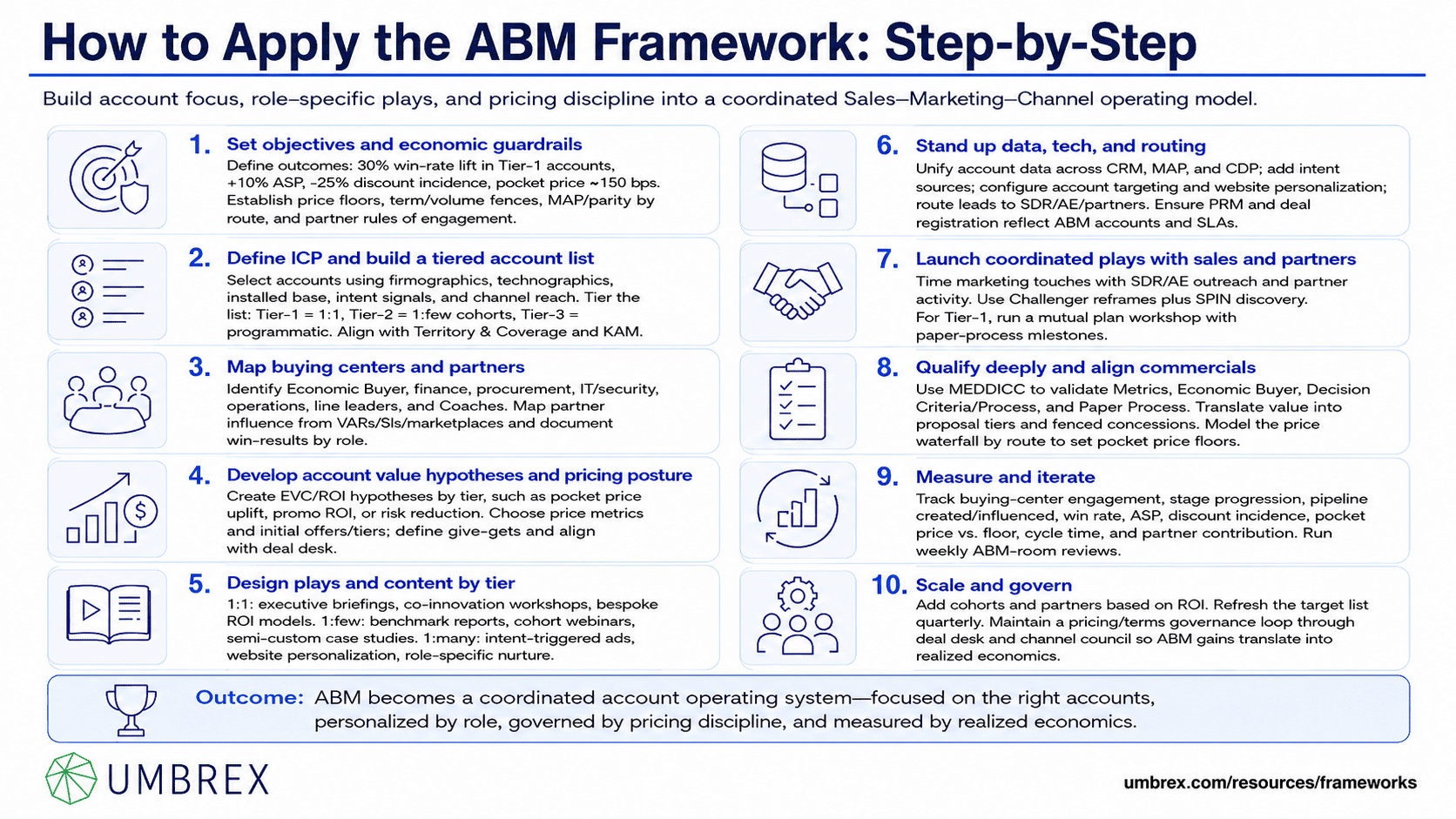
- Set objectives and economic guardrails
Define outcomes (e.g., 30% win‑rate lift in Tier‑1 accounts, +10% ASP, −25% discount incidence, pocket price +150 bps). Establish guardrails: price floors, term/volume fences, MAP/parity by route, and rules of engagement with partners.
- Define ICP and build a tiered account list
Use firmographics, technographics, installed base, intent signals, and channel reach to select accounts. Tier them: Tier‑1 (1:1), Tier‑2 (1:few cohorts), Tier‑3 (programmatic). Publish the list and align with Territory & Coverage and KAM.
- Map buying centers and partners
Identify Economic Buyer, finance, procurement, IT/security, operations, line leaders, and potential Coaches. Map partner influence (preferred VARs/SIs/marketplaces). Document win‑results per role and partner value.
- Develop account value hypotheses and pricing posture
Create EVC/ROI hypotheses per tier (e.g., pocket price uplift, promo ROI, risk reduction). Choose price metrics (per user, per transaction, per site, % of savings) and define initial offers/tiers and give‑gets (term for discount, compliance for credits). Align with deal desk.
- Design plays and content by tier
1:1: executive briefings, co‑innovation workshops, bespoke ROI models. 1:few: industry benchmark reports, cohort webinars, semi‑custom case studies. 1:many: intent‑triggered ads, website personalization, role‑specific nurture. Build partner co‑marketing kits where relevant.
- Stand up data, tech, and routing
Unify account data (CRM + MAP + CDP), add intent sources, configure ad platforms for account targeting, enable website/account personalization, and set lead routing to SDR/AE/partners. Ensure PRM and deal registration reflect ABM accounts and SLAs.
- Launch coordinated plays with sales and partners
Time marketing touches with SDR/AE outreach and partner activities. Use talk tracks (Challenger reframe + SPIN discovery) and joint emails. For Tier‑1, run a mutual plan workshop to define milestones, including paper process timing.
- Qualify deeply and align commercials
Use MEDDICC to validate Metrics, Economic Buyer, Decision Criteria/Process, and Paper Process. Translate value into a proposal with price metrics, tiers, and fenced concessions. Model the price waterfall by route to set pocket price floors.
- Measure and iterate
Track account engagement (reach in buying center), stage progression, pipeline created/influenced, win rate, ASP, discount incidence, pocket price vs. floor, cycle time, and partner contribution. Run weekly “ABM room” reviews; optimize targeting, content, and plays.
- Scale and govern
Add cohorts and partners based on ROI. Refresh the target list quarterly. Keep a pricing/terms governance loop (deal desk, channel council) to ensure ABM gains translate into realized economics.
6. Example: ABM in Action
Company: “VectorSense,” a $250M industrial IoT and analytics provider for continuous manufacturing, selling direct and through systems integrators (SIs).
Challenge: Win strategic logos in specialty chemicals and reduce discounting. Despite strong pilots, deals stalled with procurement; ASP drifted down; pocket price eroded 120 bps via services discounts and extended payment terms.
ABM program:
- Objectives: Close 8 Tier‑1 accounts in 12 months; increase ASP 12%; reduce discount incidence 25%; pocket price +150 bps.
- Account selection & tiers: 35 Tier‑1 (1:1) global accounts; 80 Tier‑2 (1:few) in two sub‑verticals; 300 Tier‑3 programmatic.
- Value hypotheses: 2–4% throughput gain, 15–25% unplanned downtime reduction, 10–15% scrap reduction—translating to $8–15M annual value per flagship plant. Pricing metric: per‑site platform fee + per‑line usage; fenced term discounts for 36‑month commitments.
- Plays: Executive benchmark briefings (CFO/COO), reliability workshops (Ops/Engineering), and cyber validation (CISO). Co‑marketing with two SIs for three Tier‑1 accounts each; strict deal reg and MAP-like parity on public pricing.
- Commercial posture: Proposal templates with Good–Better–Best bundles; term discounts fenced to multi‑plant rollout and data sharing; implementation credits tied to uptime KPIs. Price waterfall modeled to include SI margins and services, with pocket price floors enforced in CPQ.
Results (9 months): 9 Tier‑1 wins (target 8); win rate +31 pts in Tier‑1; ASP +13%; pocket price +160 bps. Discount incidence fell 28% as Economic Buyers endorsed EVC. Paper process cycle time dropped 20% due to early InfoSec/legal engagement. SI‑sourced pipeline +42%; no partner conflicts due to deal reg SLAs and parity rules.
7. Strengths and Limitations
Strengths
- Focus where value resides: Concentrates resources on high‑impact accounts, improving win rate, ASP, and price realization.
- Cross‑functional orchestration: Aligns marketing, sales, channel, and deal desk around value cases and paper process—reducing late‑stage discounts.
- Personalization at scale: Tiered model balances bespoke engagement with programmatic efficiency.
- Partner leverage: PBM co‑selling/co‑marketing extends reach and credibility while protecting MAP/parity and pocket price.
Limitations
- Data and alignment dependent: Poor target selection, weak sales participation, or shallow personalization turns ABM into expensive advertising.
- Time to impact: Enterprise cycles mean 1–2 quarters before pipeline impact and longer for revenue; stakeholders must commit.
- Over‑investment risk: Too many Tier‑1 accounts dilute effort; governance is required to keep tiers tight.
- Compliance and privacy: Account‑level targeting and data use must meet legal and platform rules; governance is non‑optional.
8. Common Pitfalls (and How to Avoid Them)
- Confusing ABM with display advertising
What goes wrong: Broad ads with minimal personalization; no sales follow‑through.
How to avoid: Build joint plays with SDR/AE steps and partner involvement; require account plans and value hypotheses. - Too many target accounts
What goes wrong: Thinned resources; superficial outreach.
How to avoid: Limit Tier‑1; use 1:few and programmatic for the long tail; graduate accounts based on signals. - Weak buying center coverage
What goes wrong: Great marketing to end users; finance/procurement block on price.
How to avoid: Map stakeholders; tailor content to CFO, procurement, IT/security; secure Economic Buyer engagement early. - Unquantified value
What goes wrong: Price debate dominates; discounts rise.
How to avoid: Build EVC using the customer’s numbers; align with finance; tie concessions to fences (term/volume/compliance). - Ignoring the paper process
What goes wrong: Legal/security delays force end‑of‑quarter concessions.
How to avoid: Time‑box Paper Process in mutual plans; launch redlines early; track progress in deal reviews. - Channel misalignment
What goes wrong: Partners undercut or feel sidelined; conflict erupts.
How to avoid: Co‑plan PBM, enforce deal reg and MAP/parity, and align incentives to sell‑through and pocket price. - Vanity metrics
What goes wrong: Celebrating clicks/impressions; pipeline and revenue lag.
How to avoid: Instrument to pipeline, win rate, ASP, discount incidence, pocket price, and cycle time by tier.
9. How ABM Relates to Other Frameworks
- Territory & Coverage: ABM focuses coverage on priority accounts; territories operationalize ownership and routing.
- KAM (Key Account Management): ABM fuels land and early expansion; KAM governs multi‑year joint plans, pricing, and service for strategic accounts.
- MEDDICC / MEDDPICC: ABM programs should progress Metrics, Economic Buyer engagement, Decision Criteria/Process, and Paper Process—turning engagement into qualified pipeline.
- Strategic Selling (Miller–Heiman): Use stakeholder maps to design ABM plays; ABM content should address each influence’s win–results.
- Challenger / SPIN / Solution Selling: Provide the conversation arc and value tools within ABM plays to reframe, discover, and quantify value.
- Value‑Based Pricing & EVC: ABM enables earlier EVC alignment with Economic Buyers; proposals then convert value into price metrics and fences.
- Price Waterfall & Fences: Model pocket price by route; ABM’s early commercial posture and give–gets reduce leakage and enforce floors.
- Channel Conflict / Omnichannel: PBM integrates partners with parity/MAP, deal reg, and promo calendars to avoid undercutting across routes.
- Sales Funnel: ABM should be integrated across Lead→Qualified→Proposal→Close stages with evidence gates, not run as a parallel track.
10. Key Takeaways
- ABM focuses your commercial engine on a defined set of high‑value accounts with tiered personalization—raising win rate, ASP, and price realization.
- It works when marketing, sales, channel, and deal desk co‑design plays tied to value hypotheses, stakeholder maps, and paper process timelines.
- ABM supports value‑based pricing: early EVC alignment and Economic Buyer engagement reduce discounting and protect pocket price.
- Partner‑based ABM (PBM) extends reach and credibility, but requires strict deal reg, MAP/parity, and fenced concessions.
- Measure what matters: account progression, pipeline/revenue by tier, ASP, discount incidence, pocket price vs. floors, and cycle time—not just clicks.
11. FAQs About the ABM Framework
Is ABM just targeted advertising?
No. Ads can be a component, but ABM is orchestration across marketing, sales, and partners—grounded in account selection, buying center coverage, value hypotheses, and coordinated plays that lead to qualified pipeline and revenue.
How many accounts should be in Tier‑1?
As few as you can serve deeply—typically 10–50, depending on resources and ACV. Use 1:few and programmatic for broader reach and graduate accounts as signals and ROI justify.
What tools are required?
Start with CRM and MAP integrated to account objects, intent data for prioritization, and an ad platform for account targeting. Add website personalization, a CDP, and PRM for partner PBM as you scale. The operating model matters more than the stack.
How does ABM help pricing?
ABM aligns Economic Buyers to quantified Metrics (EVC) early, supports selection of value‑aligned price metrics, and enforces price fences and floors through deal desk governance—reducing late‑stage discounts and pocket price leakage.
How long until results?
A focused pilot can produce pipeline within 8–12 weeks; revenue impact typically follows in 2–3 quarters for enterprise cycles. Expect faster gains for expansion/renewal plays and 1:few cohorts.
Can SMBs use ABM?
Yes—with a lighter touch. Use 1:few programmatic ABM to prioritize high‑potential SMB clusters and personalize by industry/use case. Keep plays efficient and tie them to inside sales and self‑serve upgrades.
What is Partner‑Based ABM (PBM)?
PBM is ABM co‑designed and executed with partners (VARs/SIs/marketplaces). Target accounts jointly, align content and offers, enforce deal registration and MAP/parity, and measure sell‑through and pocket price realization—not just sourced leads.
