

1. What Is the BANT Qualification Framework?
The BANT Qualification Framework is a simple, fast way to determine whether an opportunity merits pursuit by assessing four elements: Budget, Authority, Need, and Timing. It helps sales, channel, and pricing teams prioritize scarce resources on winnable, valuable deals—and deprioritize those that are unlikely to close or will only close at destructive discounts.
In the pricing, channel, and sales context, BANT is an execution framework: it steers discovery and pipeline triage so that opportunities align with value-based pricing, deal-desk guardrails, and partner strategies. Used well, it reduces discounting and “last-week-of-quarter” fire drills by aligning early on value, decision power, and buying process milestones.
Consultants and executives use BANT because it is teachable, measurable, and scalable across direct and indirect routes to market. It establishes a common language for SDRs, AEs, partners, and deal desks—so that pipeline quality, not just quantity, drives predictable, profitable growth.
2. Origin and Background
Origin: BANT is widely attributed to IBM’s sales organization in the mid-20th century as a practical qualification checklist for enterprise technology deals. Over time, it spread across industries and was adapted into many modern qualification frameworks.
Why it was created: As buying committees and procurement processes formalized, sales teams needed a repeatable way to verify that an opportunity had the essentials—budget access, a decision-maker, a real business problem, and a realistic timeline—before investing heavily.
How it became known: Through enterprise sales practice, training programs, and its inclusion in CRM methodologies. Many organizations use BANT as a baseline, then extend it with additional dimensions (e.g., MEDDICC) without abandoning the core logic.
3. How the BANT Qualification Framework Works
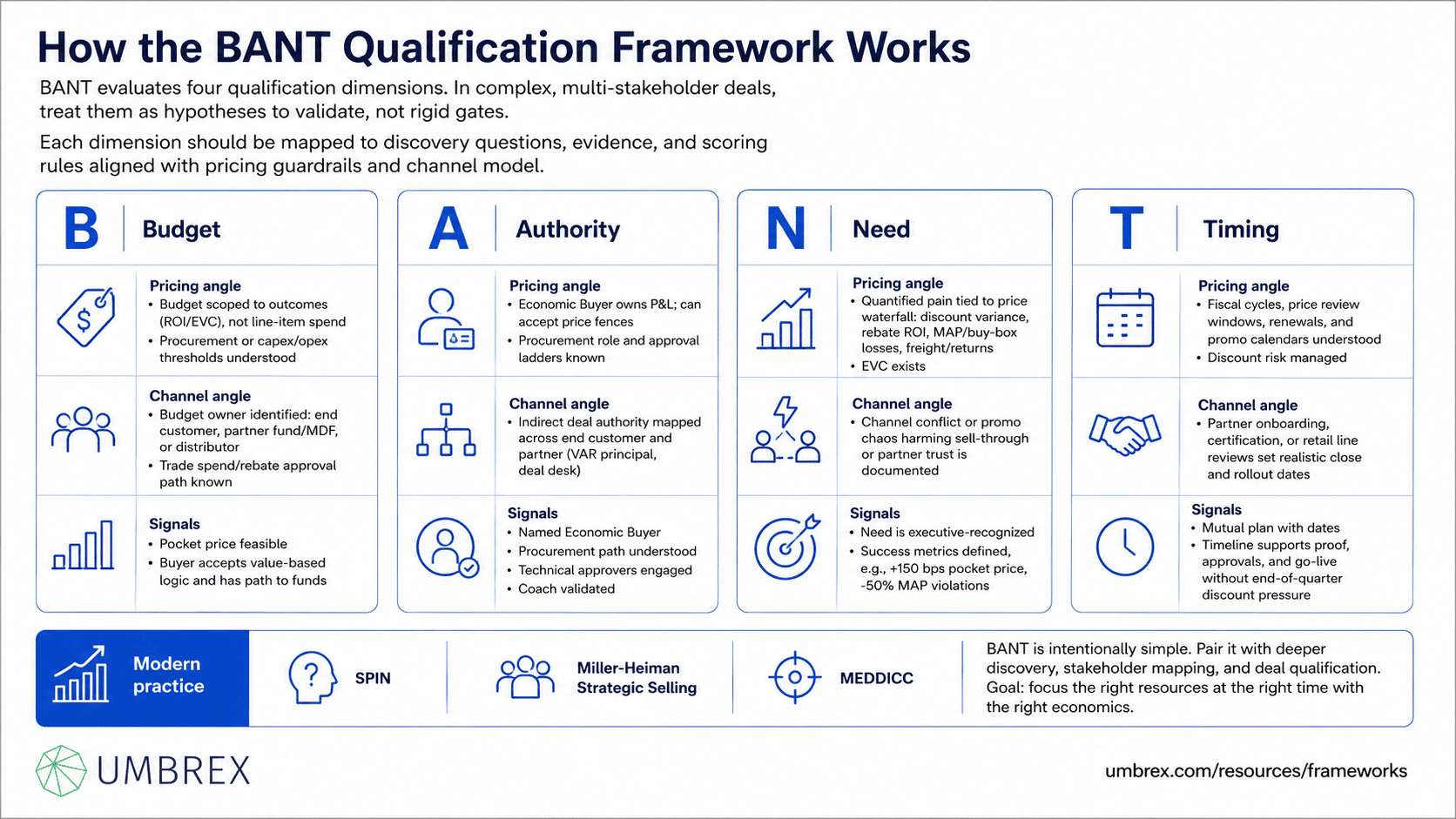
BANT evaluates four qualification dimensions. In complex, multi-stakeholder deals, treat them as hypotheses to validate, not rigid gates. Each dimension should be mapped to specific discovery questions, evidence, and scoring rules aligned with your pricing guardrails and channel model.
The Four Elements (with pricing/channel examples)
- Budget: Is funding available and aligned to the size and structure of your solution?
- Pricing angle: Is budget scoped to outcomes (ROI/EVC) rather than line-item spend? Are there thresholds that trigger procurement or capex vs. opex preferences?
- Channel angle: Does the budget sit with the end customer, a partner program fund (MDF), or a distributor? Who approves trade spend or rebates?
- Signals: Target pocket price is feasible within the price corridor; buyer accepts value-based pricing logic and has path to funds.
- Authority: Who decides, who influences, and who can block?
- Pricing angle: Identify the Economic Buyer who owns P&L and can accept price fences (term/volume, compliance). Confirm procurement’s role and approval ladders.
- Channel angle: In indirect deals, map authority across the end customer and the partner (VAR principal, deal desk).
- Signals: Named Economic Buyer, procurement path understood, technical approvers engaged; coach validated.
- Need: What business outcomes are required, and how urgent are they?
- Pricing angle: Quantified pain tied to the price waterfall (discount variance, rebate ROI, MAP/buy-box losses, freight/returns). A clear Economic Value to the Customer (EVC) exists.
- Channel angle: Documented channel conflict or promo chaos harming sell-through or partner trust.
- Signals: Need is executive-recognized; success metrics defined (e.g., +150 bps pocket price, −50% MAP violations).
- Timing: What events, milestones, and processes govern the decision and implementation?
- Pricing angle: Fiscal cycles, price review windows, contract renewals, or promotional calendars that influence the timeline and discount risk.
- Channel angle: Partner onboarding, certification, or retail line reviews that set realistic close and rollout dates.
- Signals: Documented mutual plan with dates; timeline supports proof, approvals, and go-live without end-of-quarter discounting pressure.
On its own, BANT is intentionally simple. In modern practice, it is paired with deeper discovery (SPIN), stakeholder mapping (Miller–Heiman Strategic Selling), and deal qualification (MEDDICC). The goal is not to gatekeep, but to focus the right resources at the right time with the right economics.
4. When to Use the BANT Qualification Framework
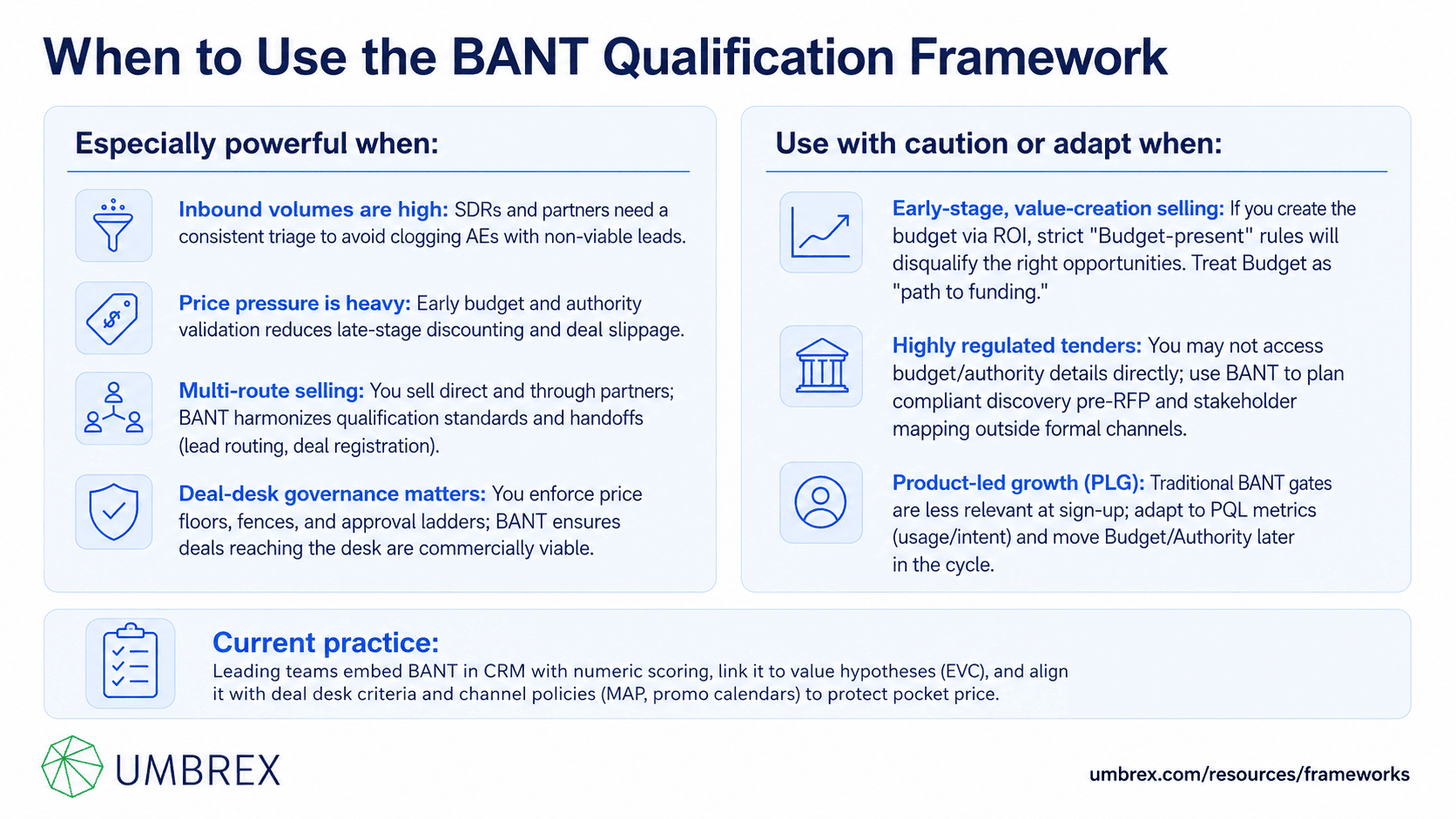
Especially powerful when:
- Inbound volumes are high: SDRs and partners need a consistent triage to avoid clogging AEs with non-viable leads.
- Price pressure is heavy: Early budget and authority validation reduces late-stage discounting and deal slippage.
- Multi-route selling: You sell direct and through partners; BANT harmonizes qualification standards and handoffs (lead routing, deal registration).
- Deal-desk governance matters: You enforce price floors, fences, and approval ladders; BANT ensures deals reaching the desk are commercially viable.
Use with caution or adapt when:
- Early-stage, value-creation selling: If you create the budget via ROI, strict “Budget-present” rules will disqualify the right opportunities. Treat Budget as “path to funding.”
- Highly regulated tenders: You may not access budget/authority details directly; use BANT to plan compliant discovery pre-RFP and stakeholder mapping outside formal channels.
- Product-led growth (PLG): Traditional BANT gates are less relevant at sign-up; adapt to PQL metrics (usage/intent) and move Budget/Authority later in the cycle.
Current practice: Leading teams embed BANT in CRM with numeric scoring, link it to value hypotheses (EVC), and align it with deal desk criteria and channel policies (MAP, promo calendars) to protect pocket price.
5. How to Apply the BANT Qualification Framework: Step-by-Step
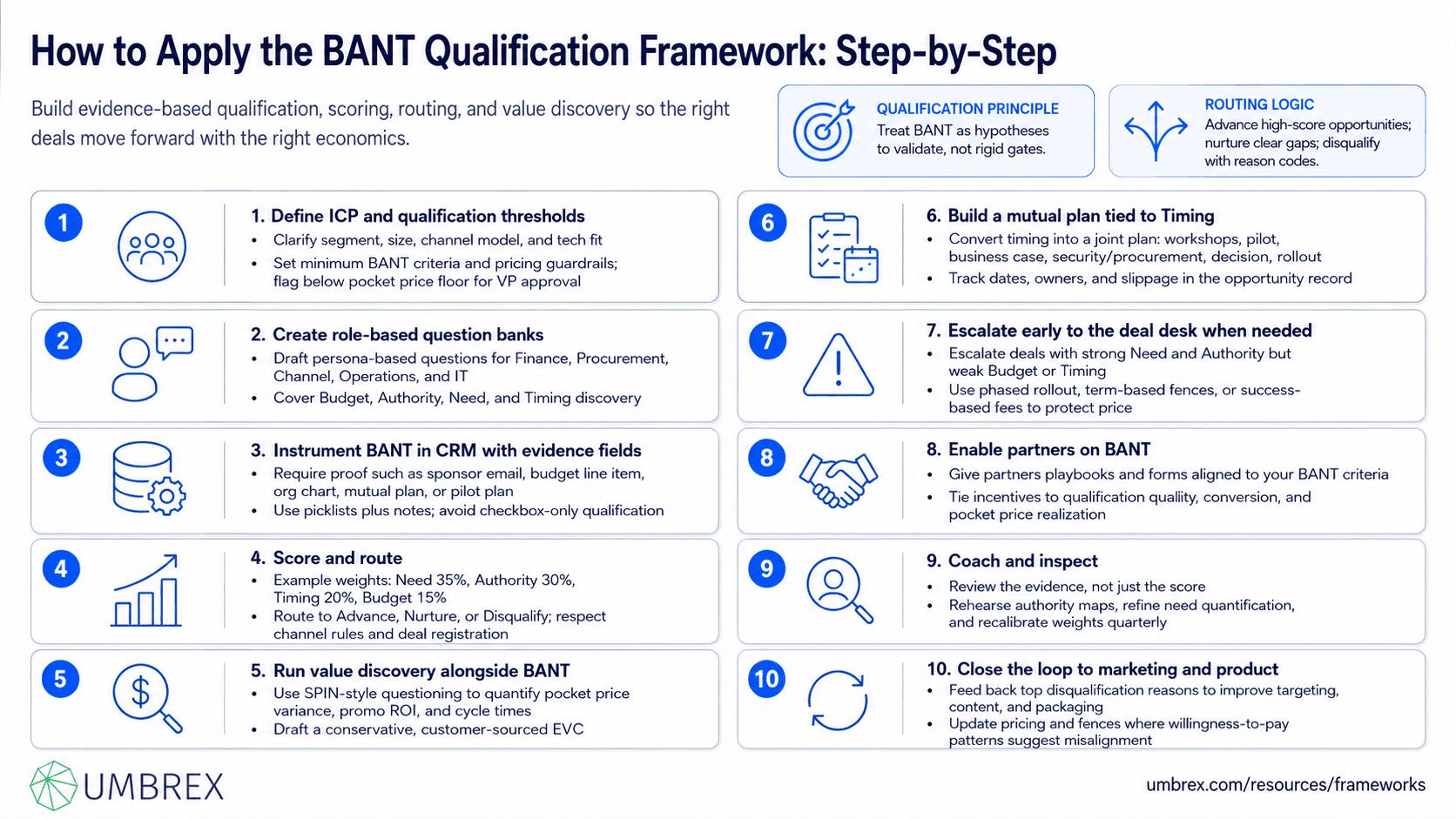
- Define ICP and qualification thresholds
Clarify your ideal customer profiles (segment, size, channel model, tech fit) and the thresholds for a “qualified” opportunity. Set minimum criteria for each BANT dimension, tied to pricing guardrails (e.g., opportunities below pocket price floor require VP approval and must be flagged in CRM).
- Create role-based question banks
Draft discovery questions for SDRs/AEs by persona (finance, procurement, channel, operations, IT). Examples:
- Budget: “How do you evaluate ROI for trade spend or pricing tools?” “Is funding consolidated at corporate or by channel/region?”
- Authority: “Who signs off on pricing and promotion governance?” “How does procurement engage—thresholds, committees?”
- Need: “Where do you see leakage in your price waterfall—discounts, rebates, freight, payment terms?” “How do MAP/buy-box violations affect sell-through?”
- Timing: “What fiscal or line review milestones should we align to?” “When do you set promo calendars and price floors for the year?”
- Instrument BANT in CRM with evidence fields
For each BANT element, require a note or attachment that documents evidence (email from sponsor, budget line item, org chart, mutual plan, pilot plan). Use picklists and free text for nuance; discourage “checkbox” behavior by requiring specifics.
- Score and route
Assign weights (e.g., Need 35%, Authority 30%, Timing 20%, Budget 15% for value-creation motions). Use thresholds to:
- Advance to AE or partner (score ≥ X).
- Park in nurture with clear gaps (score Y–X-1).
- Disqualify with reason codes (score < Y).
Align routing rules with channel policies: partner-originated deals with good BANT get deal registration and enablement; direct deals in partner territories follow the agreed rules to avoid conflict.
- Run value discovery alongside BANT
Use SPIN-style questioning to quantify implications (pocket price variance, promo ROI, cycle times). Draft a preliminary EVC—conservative, customer-sourced—so the budget conversation moves from “how much do you have?” to “what share of captured value is fair?”
- Build a mutual plan tied to Timing
Convert Timing into a joint project plan: stakeholder workshops, pilot, business case review, security/procurement, executive decision, and rollout. Attach the plan to the opportunity record; update dates and owners. Use this to detect slippage and requalify.
- Escalate early to the deal desk when needed
Route deals that show Authority and Need but weak Budget/Timing to enable creative structures (phased rollout, term-based price fences, success-based fees) that protect price while de-risking the purchase.
- Enable partners on BANT
Provide partner playbooks and forms mirroring your BANT criteria. Tie partner incentives to qualification quality (conversion to stage 3+, pocket price realization), not just sourced volume. Require documentation for Budget/Authority to reduce downstream friction.
- Coach and inspect
In weekly pipeline reviews, inspect BANT evidence, not just scores. Rehearse Authorization maps, refine Need quantification, and update Timing plans. Track conversion rates by BANT score and recalibrate weights quarterly.
- Close the loop to marketing and product
Feedback top disqualification reasons (e.g., “no executive sponsor,” “budget not aligned to ROI”) to adjust targeting, content, and product packaging. Update pricing and fences where patterns suggest misalignment with willingness to pay.
6. Example: BANT in Action
Company: “RevNetics,” a $180M SaaS platform for price waterfall analytics, MAP/buy-box monitoring, and promotion governance. Routes to market: direct enterprise sales and a certified VAR network.
Problem: Pipeline was up 40% YoY but win rates fell; discount incidence rose; many late-stage deals stalled at procurement or slipped a quarter. Channel partners complained about leads with no decision power.
Applying BANT:
- ICP and thresholds: Defined three ICPs (consumer electronics, appliances, specialty retail suppliers). Weighted BANT as Need 35, Authority 30, Timing 20, Budget 15. Required named Economic Buyer and quantified leakage (≥100 bps pocket price upside) to pass stage 2.
- Question bank and enablement: Built persona-specific question sets. For Budget, AEs asked about ROI governance: “How do you approve trade spend or pricing tools—what threshold triggers CFO review?” For Authority, mapped procurement thresholds and security reviews up front.
- CRM instrumentation: Added evidence fields; opportunities without a mutual plan date for “Executive value review” could not advance to stage 3.
- Partner alignment: Required partner-submitted BANT forms for deal registration; provided training. Tied partner rebates to opportunity quality (stage 3 conversion) and pocket price realization.
- Deal desk integration: Created playbooks for low-Budget/high-Need opportunities (phased rollout, term discounts fenced to MAP compliance, success milestones).
Results (12 weeks): Stage 2→3 conversion improved from 42% to 61%; average selling price increased 7% as “budget-only” leads were deprioritized or reframed via EVC. Late-stage slip rate fell 23%. Partner win rates rose 11 pts. Overall pocket price uplift improved by 120 bps due to fewer end-of-quarter concessions and better Authority validation.
Example opportunity: A $900M home goods brand with rampant coupon leakage and MAP violations. Initial Budget: “We didn’t plan for this.” BANT flagged strong Need and Authority (CFO and channel SVP engaged), Timing aligned to fiscal planning. RevNetics co-built an EVC showing $4–6M annual impact. Deal closed at near-list with a 36-month term and phased rollout; concession: implementation credits tied to MAP compliance milestones (price fence).
7. Strengths and Limitations
Strengths
- Speed and clarity: Gives SDRs, AEs, and partners a common yardstick for triaging opportunities quickly.
- Commercial discipline: Aligns early to value-based pricing, approval ladders, and price fences; reduces late-stage discounting.
- Scalable and measurable: Easy to embed in CRM with scoring and evidence, enabling coaching and continuous improvement.
- Channel friendly: Standardizes qualification across direct and partner routes; reduces channel conflict and rework.
Limitations
- Over-simplification risk: Complex deals require deeper stakeholder mapping (Strategic Selling) and qualification (MEDDICC); BANT alone may miss politics and criteria.
- Budget bias: Over-fixating on present budget disqualifies true value-creation opportunities; reframe as “path to funding.”
- Binary misuse: Treating BANT as a pass/fail checklist encourages “happy ears” or premature disqualification; use weighted scoring and evidence.
- Authority ambiguity: “Signing power” is often distributed; failing to multi-thread beyond a friendly contact is risky.
8. Common Pitfalls (and How to Avoid Them)
- Budget fixation
What goes wrong: Disqualifying deals without allocated budget—despite strong ROI.
How to avoid: Treat Budget as “credible path to funding.” Build an EVC early; align with finance; use phased rollouts to fit fiscal windows. - Shallow Authority mapping
What goes wrong: Over-reliance on a champion; procurement blocks late.
How to avoid: Identify Economic Buyer, procurement thresholds, and technical approvers. Use a simple org-and-influence map; validate with a coach. - Unquantified Need
What goes wrong: Soft pain fails to justify price; deal devolves to discounting.
How to avoid: Tie Need to price waterfall metrics (discount variance, rebate ROI, MAP/buy-box, freight/returns); quantify with customer data. - Fuzzy Timing
What goes wrong: Slippage, quarter-end concessions, missed partner windows.
How to avoid: Build a mutual plan with milestones aligned to fiscal cycles, security reviews, retail line reviews; requalify on changes. - Checkbox behavior
What goes wrong: Scores without evidence; pipeline inflation.
How to avoid: Require proof (emails, meeting notes, mutual plan) for each BANT element in CRM; manager inspection culture. - Channel misalignment
What goes wrong: Partners pass poorly qualified leads; direct team reworks or conflicts.
How to avoid: Mirror BANT for partners; tie deal registration and incentives to qualification quality and pocket price realization.
9. How BANT Relates to Other Frameworks
- SPIN Selling: SPIN provides the questioning structure to uncover Situation, Problem, Implication, and Need–Payoff. Use SPIN to deepen BANT’s Need and to inform Budget via quantified implications.
- Challenger Sale: Challenger reframes the status quo with insight; BANT confirms Budget/Authority/Timing before deeper investment. Use Challenger to catalyze Need where complacency exists.
- Miller–Heiman Strategic Selling: Strategic Selling maps all buying influences and plans access. Pair it with BANT to ensure stakeholder coverage behind the “Authority” box.
- MEDDICC: A more detailed qualification lens (Metrics, Economic Buyer, Decision criteria/process, Identify pain, Champion, Competition). Many teams use BANT for early triage and MEDDICC for stage 2+ rigor.
- Solution Selling: Converts Need into solution architecture and ROI/TCO/EVC; BANT sets the gates to justify building the business case.
- Value-Based Pricing & EVC: Use EVC to transform Budget from “allocated spend” to “share of value created.” BANT ensures this logic is accepted by Authority within the Timing window.
- Price Waterfall: BANT’s Need should be anchored in where value leaks today; Budget/Authority should accept the commercial architecture that protects pocket price.
- Price Fences & Deal Desk: As you qualify, pre-negotiate give–gets (term, volume, compliance). BANT ensures stakeholders can accept fences and timelines.
- Channel Conflict & Omnichannel: Harmonize BANT across direct/partner routes; align Timing with retail calendars and partner onboarding to avoid conflict.
Practical sequence: Triage with BANT → Discover with SPIN → Reframe with Challenger → Map stakeholders with Strategic Selling → Qualify deeply with MEDDICC → Price with VBP/EVC → Protect with Price Waterfall and Fences.
10. Key Takeaways
- BANT—Budget, Authority, Need, Timing—is a fast, scalable way to qualify opportunities and prioritize resources.
- In pricing/channel contexts, use BANT to align early on value, decision power, and buying process—reducing late-stage discounts and slippage.
- Treat Budget as a “path to funding,” not a binary gate; quantify Need with price waterfall metrics; map Authority beyond a single champion; turn Timing into a mutual plan.
- Instrument BANT in CRM with evidence and scoring; align with deal desk guardrails and partner programs to protect pocket price.
- Pair BANT with SPIN/Challenger/Strategic Selling/MEDDICC for end-to-end rigor from discovery to value-based pricing and disciplined close.
11. FAQs About the BANT Qualification Framework
Is BANT outdated?
No—when adapted. Traditional “must-have budget now” thinking is too rigid for value-creation sales. Modern practice treats Budget as a credible path to funding anchored in ROI/EVC, while Authority, Need, and Timing still provide essential signal on deal quality.
How is BANT different from MEDDICC?
BANT is a lightweight triage tool; MEDDICC is a comprehensive qualification framework (metrics, decision criteria/process, champion, competition). Many teams use BANT early (stage 1–2) and MEDDICC as rigor increases (stage 2+).
Can SMB or PLG motions use BANT?
Yes, with simplification. Emphasize Need and Timing at sign-up; move Budget/Authority later when upgrading or expanding. For SMB, use a short scorecard and automate routing to sales only when scores exceed your threshold.
How do we assess Budget without asking “what’s your budget?”
Ask about ROI governance and funding pathways: “How are investments like this justified?” “Who signs off at this spend level?” Use a conservative EVC and show payback to secure a budget line.
How long does it take to implement?
A basic rollout (question banks, CRM fields, scoring, enablement) can be done in 2–4 weeks. Expect 1–2 quarters to see improvements in conversion, ASP, and discount incidence as managers coach to evidence, not checkboxes.
How should partners use BANT?
Provide a partner-ready BANT form and training; tie deal registration and rebates to qualification quality (stage conversion, pocket price realization). Align Timing with partner onboarding and retail calendars to avoid conflict.
What metrics show BANT is working?
Stage conversion rates, late-stage slip rate, ASP and discount incidence, pocket price vs. list, deal cycle time, partner win rates, and the correlation between BANT score and win probability. Review quarterly and recalibrate weights.
