

1. What Is the SPIN Selling Model?
The SPIN Selling Model is a structured questioning framework that helps sales professionals lead high-value conversations, diagnose real customer needs, and build a compelling economic case for change. SPIN is an acronym for four types of questions—Situation, Problem, Implication, and Need–Payoff—that, when sequenced well, shift the dialogue from features and price to outcomes and ROI.
In the pricing, channel, and sales context, SPIN is an execution framework for consultative selling. It elevates discussions beyond list prices and discounts by uncovering pains, quantifying economic implications, and linking your offer to measurable benefits. Used consistently, SPIN supports value-based pricing, protects pocket price (after rebates, commissions, and fees), and improves win rates with fewer concessions.
Consultants and executives value SPIN because it’s practical, research-backed, and adaptable across routes to market—direct enterprise sales, partner-led channels, and inside sales—particularly where buying decisions are complex and multi-stakeholder.
2. Origin and Background
Origin: The SPIN Selling Model was developed by Neil Rackham and his team at Huthwaite International. It was introduced widely in the landmark 1988 book “SPIN Selling,” based on extensive observation and analysis of thousands of B2B sales calls.
Why it was created: Rackham’s research found that the behaviors that worked in small, transactional sales often failed in large, consultative deals. Top performers asked fewer “feature” questions and more high-quality discovery questions that led customers to articulate and value their own needs. SPIN codified that behavior into a repeatable pattern.
How it became known: Through Rackham’s publications, training programs, and adoption by sales organizations worldwide. It remains a foundational sales methodology taught in sales enablement and MBA programs and frequently adapted into modern, hybrid selling motions.
3. How the SPIN Selling Model Works
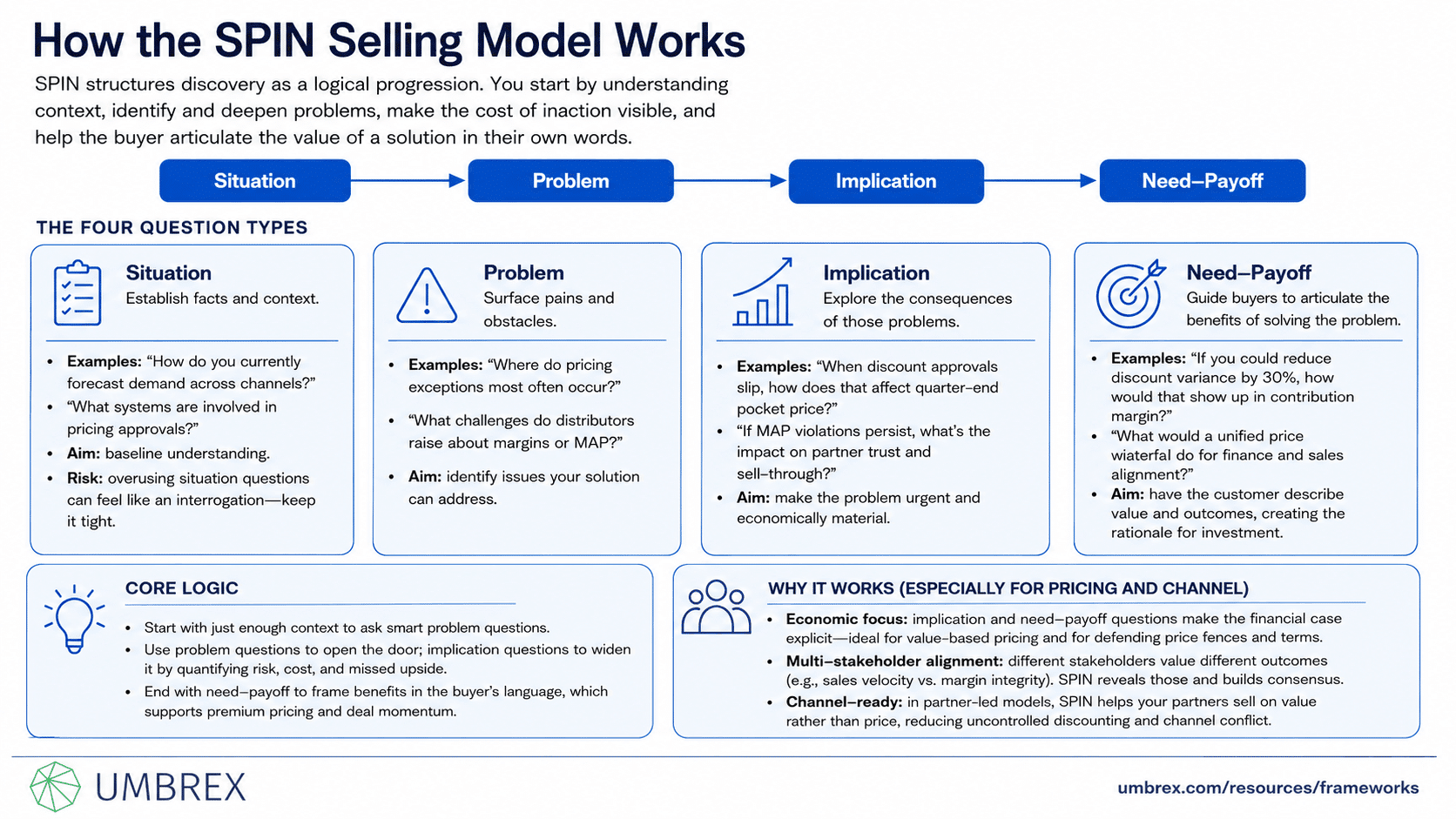
SPIN structures discovery as a logical progression. You start by understanding context, identify and deepen problems, make the cost of inaction visible, and help the buyer articulate the value of a solution in their own words.
The Four Question Types
- Situation: Establish facts and context. Examples: “How do you currently forecast demand across channels?” “What systems are involved in pricing approvals?” Aim: baseline understanding. Risk: overusing situation questions can feel like an interrogation—keep it tight.
- Problem: Surface pains and obstacles. Examples: “Where do pricing exceptions most often occur?” “What challenges do distributors raise about margins or MAP?” Aim: identify issues your solution can address.
- Implication: Explore the consequences of those problems. Examples: “When discount approvals slip, how does that affect quarter-end pocket price?” “If MAP violations persist, what’s the impact on partner trust and sell-through?” Aim: make the problem urgent and economically material.
- Need–Payoff: Guide buyers to articulate the benefits of solving the problem. Examples: “If you could reduce discount variance by 30%, how would that show up in contribution margin?” “What would a unified price waterfall do for finance and sales alignment?” Aim: have the customer describe value and outcomes, creating the rationale for investment.
Core Logic
- Start with just enough context to ask smart problem questions.
- Use problem questions to open the door; implication questions to widen it by quantifying risk, cost, and missed upside.
- End with need–payoff to frame benefits in the buyer’s language, which supports premium pricing and deal momentum.
Why It Works (Especially for Pricing and Channel)
- Economic focus: Implication and need–payoff questions make the financial case explicit—ideal for value-based pricing and for defending price fences and terms.
- Multi-stakeholder alignment: Different stakeholders value different outcomes (e.g., sales velocity vs. margin integrity). SPIN reveals those and builds consensus.
- Channel-ready: In partner-led models, SPIN helps your partners sell on value rather than price, reducing uncontrolled discounting and channel conflict.
4. When to Use the SPIN Selling Model
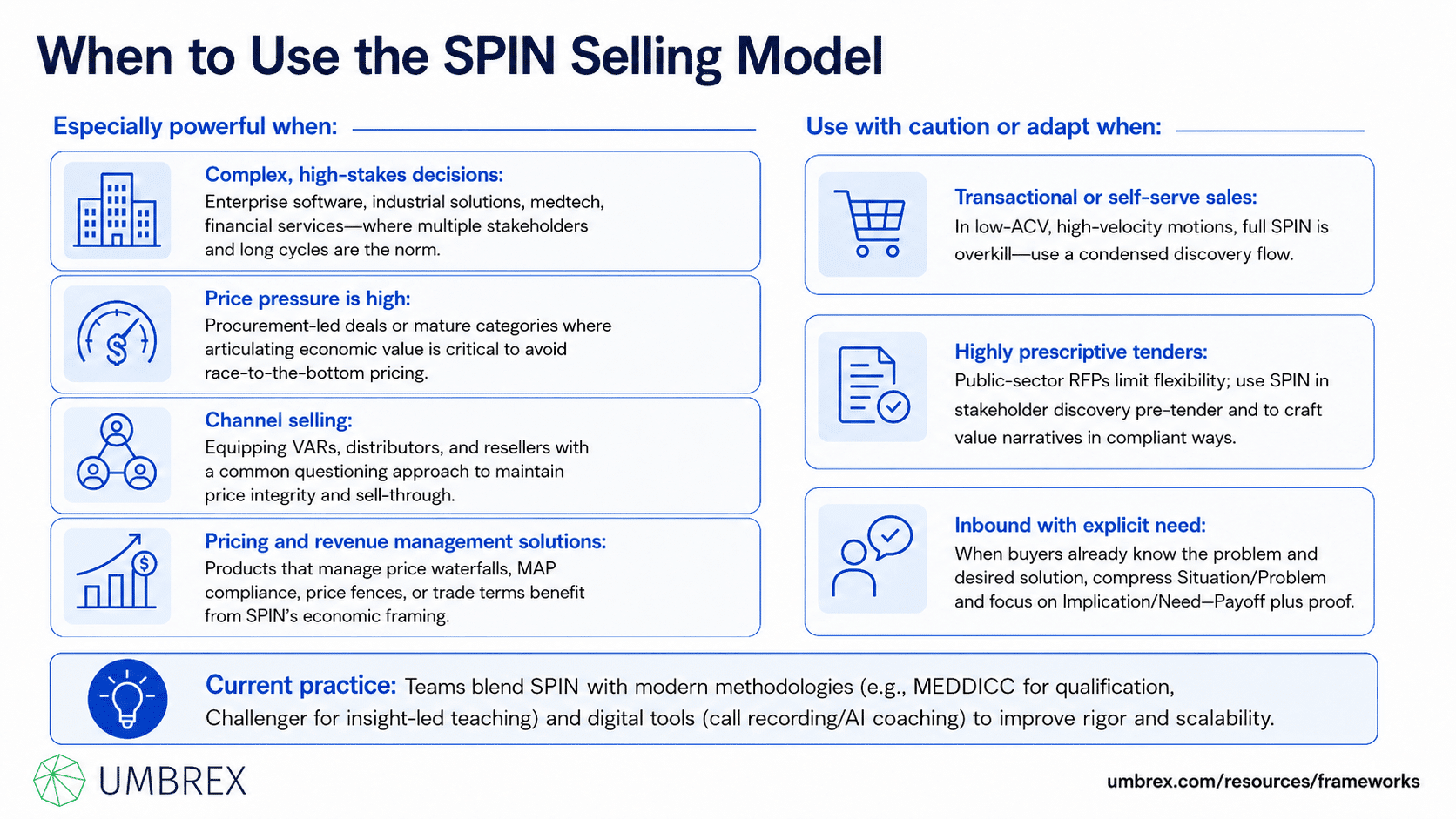
Especially powerful when:
- Complex, high-stakes decisions: Enterprise software, industrial solutions, medtech, financial services—where multiple stakeholders and long cycles are the norm.
- Price pressure is high: Procurement-led deals or mature categories where articulating economic value is critical to avoid race-to-the-bottom pricing.
- Channel selling: Equipping VARs, distributors, and resellers with a common questioning approach to maintain price integrity and sell-through.
- Pricing and revenue management solutions: Products that manage price waterfalls, MAP compliance, price fences, or trade terms benefit from SPIN’s economic framing.
Use with caution or adapt when:
- Transactional or self-serve sales: In low-ACV, high-velocity motions, full SPIN is overkill—use a condensed discovery flow.
- Highly prescriptive tenders: Public-sector RFPs limit flexibility; use SPIN in stakeholder discovery pre-tender and to craft value narratives in compliant ways.
- Inbound with explicit need: When buyers already know the problem and desired solution, compress Situation/Problem and focus on Implication/Need–Payoff plus proof.
Current practice: Teams blend SPIN with modern methodologies (e.g., MEDDICC for qualification, Challenger for insight-led teaching) and digital tools (call recording/AI coaching) to improve rigor and scalability.
5. How to Apply the SPIN Selling Model: Step-by-Step
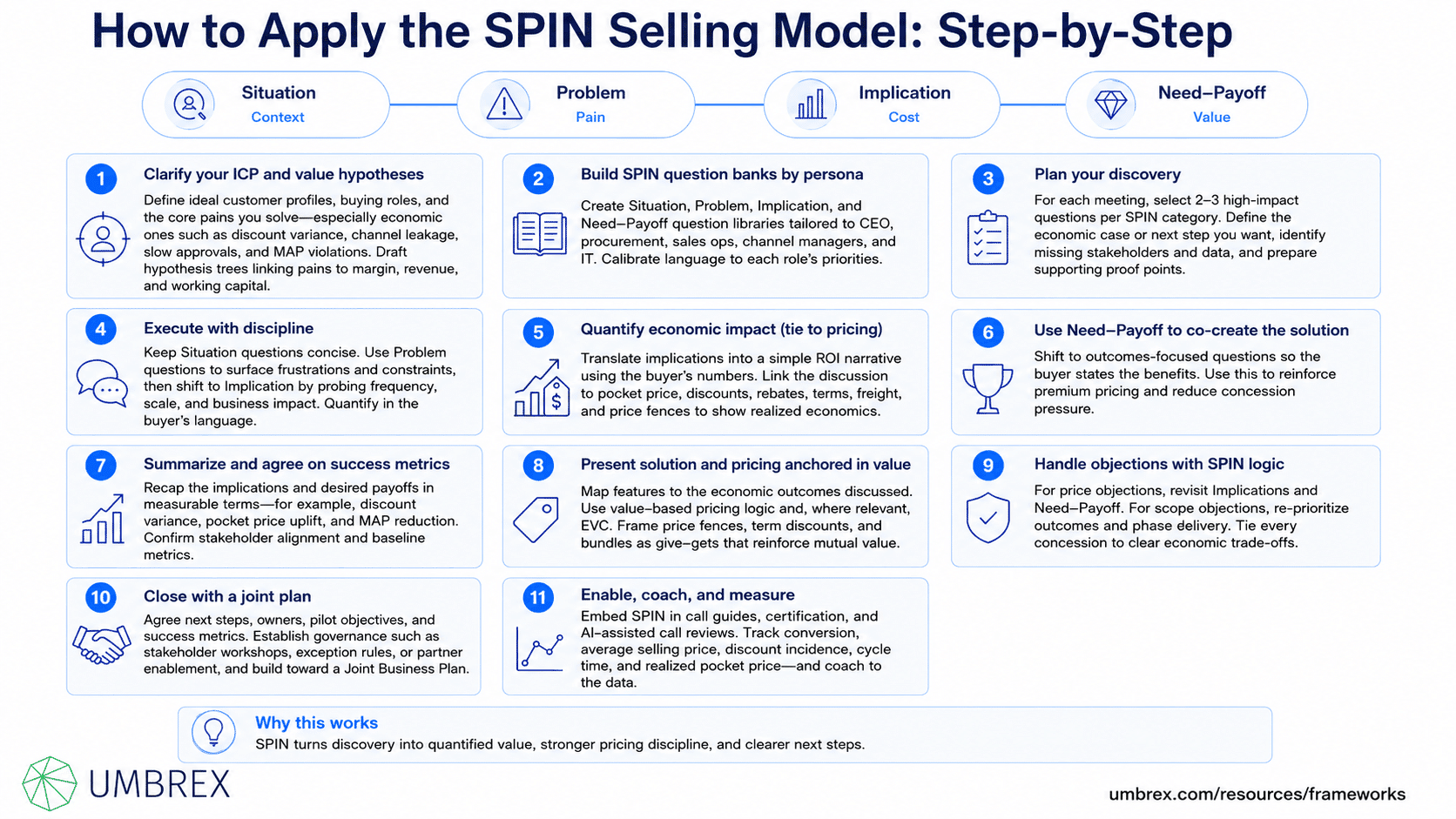
- Clarify your ICP and value hypotheses
Define ideal customer profiles, buying roles, and core pains you solve—particularly economic ones (e.g., discount variance, channel leakage, slow approvals, MAP violations). Draft hypothesis trees linking pains to value drivers (margin, revenue, working capital).
- Build SPIN question banks by persona
Create a library of Situation, Problem, Implication, and Need–Payoff questions tailored to CFO, procurement, sales ops, channel managers, and IT. Calibrate language to each role’s priorities (e.g., “pocket price” for finance; “win rate and cycle time” for sales).
- Plan your discovery
For each meeting, select 2–3 high-impact questions per SPIN category. Set a goal: what economic case or next step do you want? Identify gaps in stakeholders and data. Prepare relevant proof (case studies, benchmarks) to support Implication quantification.
- Execute with discipline
Ask Situation questions succinctly (you can research many answers). Use Problem questions to surface frustrations and constraints. Transition to Implication by exploring frequency, scale, and business impact: “How often?” “What’s the cost when this occurs?” Quantify in the buyer’s terms.
- Quantify economic impact (tie to pricing)
As implications emerge, translate them into a simple ROI narrative. Use their numbers: “A 2-point pocket price uplift on $50M is $1M.” Link to the price waterfall (discounts, rebates, terms, freight) and price fences (term/volume behaviors) to show how your approach improves realized economics.
- Use Need–Payoff to co-create the solution
Shift to outcomes: “If exceptions were approved in 24 hours, how would that affect quarter-end?” “What would consistent MAP do for partner relationships?” Encourage the buyer to state the benefits—this sets the stage for premium pricing and lower concession pressure.
- Summarize and agree on success metrics
Recap the implications and desired payoffs in measurable terms (e.g., “Reduce discount variance by 30%, pocket price +150 bps, MAP violations −60%”). Confirm stakeholder alignment and capture baselines for future QBRs and case studies.
- Present solution and pricing anchored in value
Map features to the economic outcomes discussed. Use value-based pricing logic (and EVC, if appropriate) to justify price and terms. Introduce price fences (e.g., term discounts tied to compliance, bundle elements) as give–gets that reinforce mutual value.
- Handle objections with SPIN logic
Price objections: revisit Implications and Need–Payoff—“Which benefits would we sacrifice to meet that price?” Scope objections: re-prioritize outcomes and phase delivery. Always tie concessions to economic trade-offs.
- Close with a joint plan
Agree on next steps, owners, and milestones: stakeholder workshops, pilot objectives, success metrics, and governance (e.g., deal desk for exceptions, partner enablement if indirect). Build toward a Joint Business Plan for key accounts.
- Enable, coach, and measure
Embed SPIN in enablement: call guides, certification, AI-assisted call reviews coded to SPIN stages. Track conversion, average selling price, discount incidence, cycle time, and realized pocket price. Coach to the data.
6. Example: SPIN Selling in Action
Company: “MarginPilot,” a B2B SaaS provider of price waterfall analytics and discount governance. Selling to a $700M industrial manufacturer with global distributors.
Problem: The prospect’s finance team reported shrinking margins despite 3% list price increases. Sales blamed competition; distributors pushed for deeper rebates; MAP violations were common on marketplaces.
SPIN Application:
- Situation: Mapped current approval process (email + spreadsheets), discount tiers, trade spend, and MAP policy enforcement. Identified that pocket price reporting lagged by six weeks and varied by region.
- Problem: Sales leaders admitted discount variance and late-quarter “fire drills.” Channel managers cited buy-box losses and partner frustration due to inconsistent enforcement. Finance lacked real-time pocket price visibility.
- Implication: Quantified that each 1-point pocket price variance equaled ~$5.5M annual profit impact. Late approvals caused deal slippage, creating end-of-quarter discount escalations. MAP violations reduced sell-through and damaged retailer relationships.
- Need–Payoff: CFO stated: “If we could cut variance by 30% and see pocket price daily, we’d gain 150–200 bps. Aligning MAP would also stabilize partner sell-through and reduce end-of-quarter discounts.” Sales: “Faster approvals would shorten cycles.” Channel: “Consistent enforcement would rebuild partner trust.”
Outcome: MarginPilot proposed a program priced at $480k annually, anchored to a conservative EVC of $6–8M from pocket price uplift and reduced promo leakage. Price fences included a term discount tied to MAP compliance metrics and a multi-division rollout schedule. Procurement pushed for a 20% discount; the team revisited Implications and maintained price with a phased deployment give–get. Result: 36-month agreement with executive sponsorship, monthly QBRs, and documented pocket price uplift of 160 bps by month 9.
7. Strengths and Limitations
Strengths
- Elevates the conversation: Moves from features and prices to economics and outcomes—ideal for value-based pricing and pocket price protection.
- Builds consensus: Structured questioning surfaces cross-functional needs and secures multi-stakeholder alignment.
- Repeatable and coachable: Clear stages support enablement, call scoring, and continuous improvement.
- Channel adaptable: Equips partners to sell on value, reducing uncontrolled discounting and channel conflict.
Limitations
- Time- and skill-intensive: Requires preparation and listening; poorly executed SPIN can feel interrogative.
- Not ideal for simple transactions: Over-engineered for low-ACV or self-serve motions—streamline for speed.
- Risk of rigidity: Treating SPIN as a script undermines authenticity; the best sellers adapt the flow to the conversation.
- Digital hybrid considerations: Remote and asynchronous interactions require complementary content and data capture to sustain momentum.
8. Common Pitfalls (and How to Avoid Them)
- Too many Situation questions
What goes wrong: Buyers feel interrogated and lose patience.
How to avoid: Research beforehand; ask only what you can’t know; quickly transition to Problem questions. - Jumping to pitch too soon
What goes wrong: You present before buyers feel understood; price pressure escalates.
How to avoid: Complete Problem and Implication exploration; let buyers articulate Need–Payoff first. - Failing to quantify implications
What goes wrong: “Soft” pain fails to justify premium pricing.
How to avoid: Translate issues into financial terms (margin, revenue, working capital). Tie to the price waterfall. - One-size-fits-all questions
What goes wrong: Irrelevant questions for technical or executive audiences.
How to avoid: Tailor SPIN to personas; emphasize economic/strategic angles for executives, operational for users. - Ignoring multiple stakeholders
What goes wrong: You win with one role but lose the committee.
How to avoid: Map the buying center; run SPIN with finance, procurement, line-of-business, IT, and channel teams. - No linkage to pricing and terms
What goes wrong: Great discovery but discounting persists.
How to avoid: Convert Need–Payoff to value-based pricing, price fences, and give–gets in the proposal. - Weak follow-through
What goes wrong: Insights aren’t captured; the deal stalls.
How to avoid: Summarize SPIN outcomes in a mutual plan with metrics, owners, and timelines.
9. How the SPIN Selling Model Relates to Other Frameworks
- Value-Based Pricing (EVC): SPIN creates the raw material (problems, implications, outcomes) for EVC, justifying premium pricing and protecting pocket price.
- Price Waterfall: Use SPIN to uncover where discounts, rebates, and terms leak value; then show how your solution or approach improves realization.
- Price Fences: Need–Payoff informs which fences (term/volume, SLA tiers) the buyer values—supporting give–gets that don’t collapse architecture.
- MEDDICC / Qualification: Pair SPIN’s discovery with MEDDICC to confirm metrics, economic buyer, and decision criteria; SPIN fills in the “M” (metrics) and “I” (implication/value).
- Challenger: Challenger’s insight-led teaching can precede SPIN to reframe thinking; SPIN then personalizes and quantifies value with the buying team.
- KAM (Key Account Management): Use SPIN at the outset of a key account cycle to shape joint business plans and commercial architecture.
- Channel Conflict / Omnichannel: SPIN reveals channel-specific pains (MAP, buy-box, rebate ROI), informing coordinated policies in complex go-to-market designs.
Choosing the stack: Use Challenger to open, SPIN to discover and quantify, MEDDICC to qualify, EVC/Value-Based Pricing to set price, and the Price Waterfall to protect realization.
10. Key Takeaways
- SPIN—Situation, Problem, Implication, Need–Payoff—is a research-backed questioning framework for consultative, high-value sales.
- Its power lies in quantifying implications and having buyers articulate Need–Payoff, creating the economic case for value-based pricing and fewer discounts.
- Tailor SPIN by persona and channel; use it to align multi-stakeholder buying teams and partners around measurable outcomes.
- Convert SPIN insights into proposals with price fences, give–gets, and pocket price guardrails to protect realized margins.
- Avoid over-interrogation, premature pitching, and unquantified pain; coach with call reviews and track impact on ASP, discount incidence, and cycle times.
11. FAQs About the SPIN Selling Model
Is SPIN still relevant today?
Yes. In complex B2B and channel sales, the core challenge remains: uncovering and quantifying value across stakeholders. SPIN provides a practical, coachable way to do that. Modern teams combine it with MEDDICC, Challenger, and digital tools for call analysis and enablement.
How is SPIN different from Challenger or MEDDICC?
SPIN is a questioning structure for discovery; Challenger is an insight-led approach to reframe thinking; MEDDICC is a qualification framework. Many top teams use Challenger to teach, SPIN to discover and quantify, and MEDDICC to ensure deal quality.
Can inside sales or partners use SPIN?
Absolutely. Inside sales should use a streamlined SPIN to qualify and quantify quickly. For partners, SPIN provides a shared language to sell on outcomes, reducing discounting and channel conflict.
How long does it take to implement?
A focused rollout—question banks, call guides, coaching, and basic certification—can launch in 4–8 weeks. Expect 1–2 quarters to see improvements in ASP, discount incidence, and cycle time as managers coach to SPIN consistently.
What are examples of strong Need–Payoff questions?
“If you could see pocket price daily by customer and SKU, how would that change decisions at month-end?” “If MAP violations dropped 60%, what would be the effect on partner sell-through and rebate spend?” These prompt buyers to articulate benefits in economic terms.
Does SPIN work with procurement-led buyers?
Yes—but you must quantify implications in procurement’s language (total cost of ownership, risk, compliance, working capital) and structure give–gets (term/volume) that tie to measurable outcomes. SPIN helps avoid purely price-led negotiations.
