

1. What Is the Revenue Management Levers Framework (Price, Capacity, Yield)?
The Revenue Management Levers Framework is a practical way to orchestrate the three core drivers of revenue in businesses with time- or capacity-constrained inventory: Price, Capacity, and Yield. It brings discipline to how you set and change prices, allocate limited capacity across products and channels, and shape demand mix to maximize contribution—day by day, even minute by minute.
It is a pricing, channel, and sales execution framework. Unlike pure strategy tools that determine overall positioning, this framework governs the operational decisions that convert demand variability into profit: which units to sell, at what price, through which channels, and to whom, subject to constraints.
Consultants and executives use it widely in sectors like airlines, hotels, car rental, live events, logistics, advertising inventory, and any business with perishable or time-bound capacity (delivery windows, service appointments, compute capacity with SLAs). Done well, it raises revenue per available unit without more supply—often the highest-ROI lever in constrained environments.
2. Origin and Background
Origin: Revenue management as a discipline grew from airline “yield management” in the late 1970s–1980s and spread to hotels and other capacity-constrained industries. The specific “Price–Capacity–Yield” lever framing is widely used in practice; precise authorship is unknown.
Why it was created: Deregulated, competitive markets with fixed, perishable capacity (seats on a flight; nights in a hotel) demanded a way to match prices and availability to volatile, segmented demand. By managing fare classes, overbooking, and length-of-stay controls, pioneers unlocked significant revenue gains without adding assets.
How it became known: Through industry practice, academic research in operations research and econometrics, and the codification of tools (forecasting systems, inventory controls, dynamic pricing engines) embedded in commercial software platforms and revenue operations teams.
3. How the Revenue Management Levers Framework Works
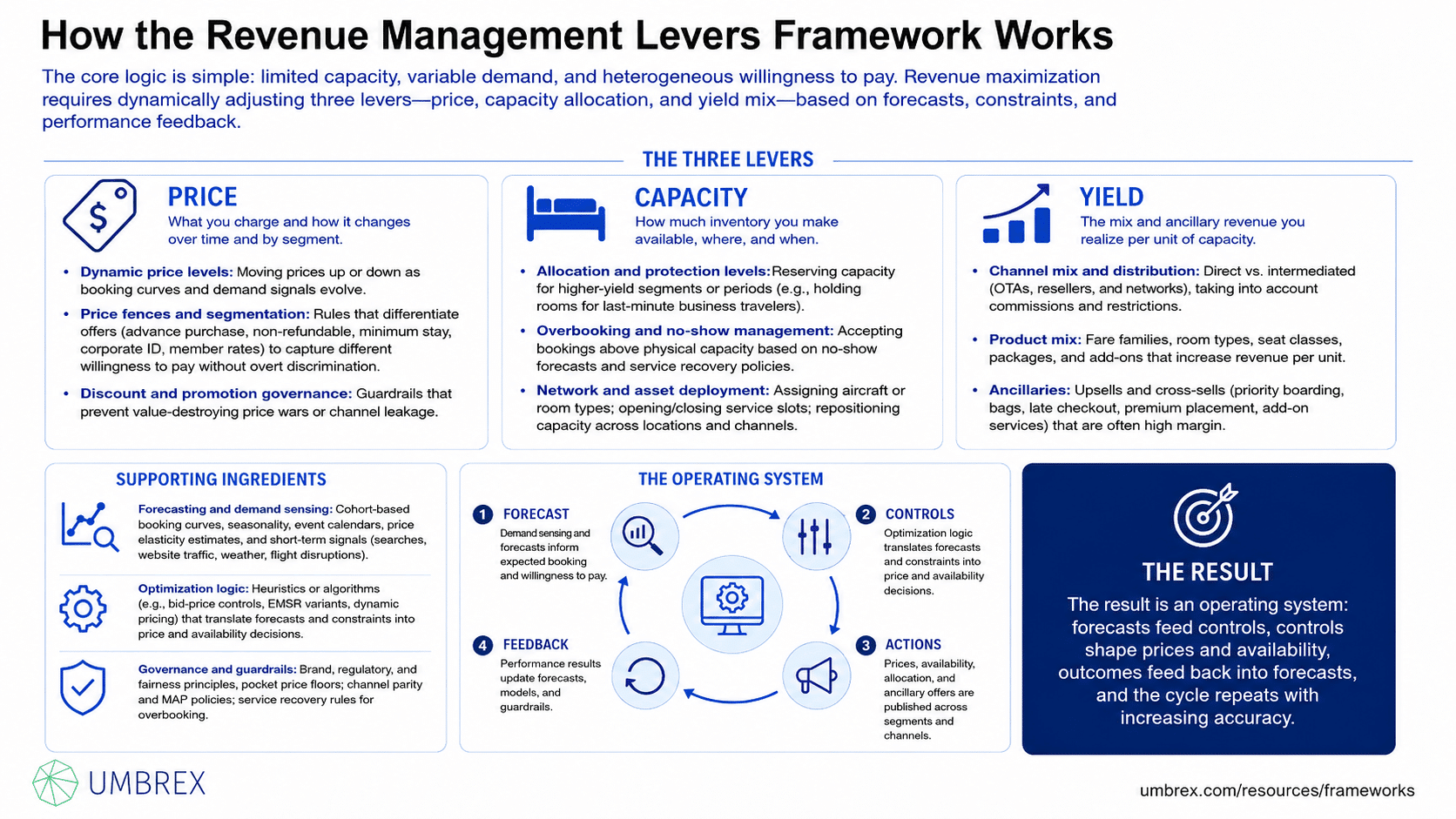
The core logic is simple: limited capacity, variable demand, and heterogeneous willingness to pay. Revenue maximization requires dynamically adjusting three levers—price, capacity allocation, and yield mix—based on forecasts, constraints, and performance feedback.
The Three Levers
- Price: What you charge and how it changes over time and by segment.
- Dynamic price levels: Moving prices up or down as booking curves and demand signals evolve.
- Price fences and segmentation: Rules that differentiate offers (advance purchase, non-refundable, minimum stay, corporate ID, member rates) to capture different willingness to pay without overt discrimination.
- Discount and promotion governance: Guardrails that prevent value-destroying price wars or channel leakage.
- Capacity: How much inventory you make available, where, and when.
- Allocation and protection levels: Reserving capacity for higher-yield segments or periods (e.g., holding rooms for last-minute business travelers).
- Overbooking and no-show management: Accepting bookings above physical capacity based on no-show forecasts and service recovery policies.
- Network and asset deployment: Assigning aircraft or room types; opening/closing service slots; repositioning capacity across locations and channels.
- Yield: The mix and ancillary revenue you realize per unit of capacity.
- Channel mix and distribution: Direct vs. intermediated (OTAs, resellers, ad networks), taking into account commissions and restrictions.
- Product mix: Fare families, room types, seat classes, packages, and add-ons that increase revenue per unit.
- Ancillaries: Upsells and cross-sells (priority boarding, bags, late checkout, premium placement, add-on services) that are often high margin.
Supporting Ingredients
- Forecasting and demand sensing: Cohort-based booking curves, seasonality, event calendars, price elasticity estimates, and short-term signals (searches, website traffic, weather, flight disruptions).
- Optimization logic: Heuristics or algorithms (e.g., bid-price controls, EMSR variants, dynamic pricing) that translate forecasts and constraints into price and availability decisions.
- Governance and guardrails: Brand, regulatory, and fairness principles; pocket price floors; channel parity and MAP policies; service recovery rules for overbooking.
The result is an operating system: forecasts feed controls, controls shape prices and availability, outcomes feed back into forecasts, and the cycle repeats with increasing accuracy.
4. When to Use the Revenue Management Levers Framework
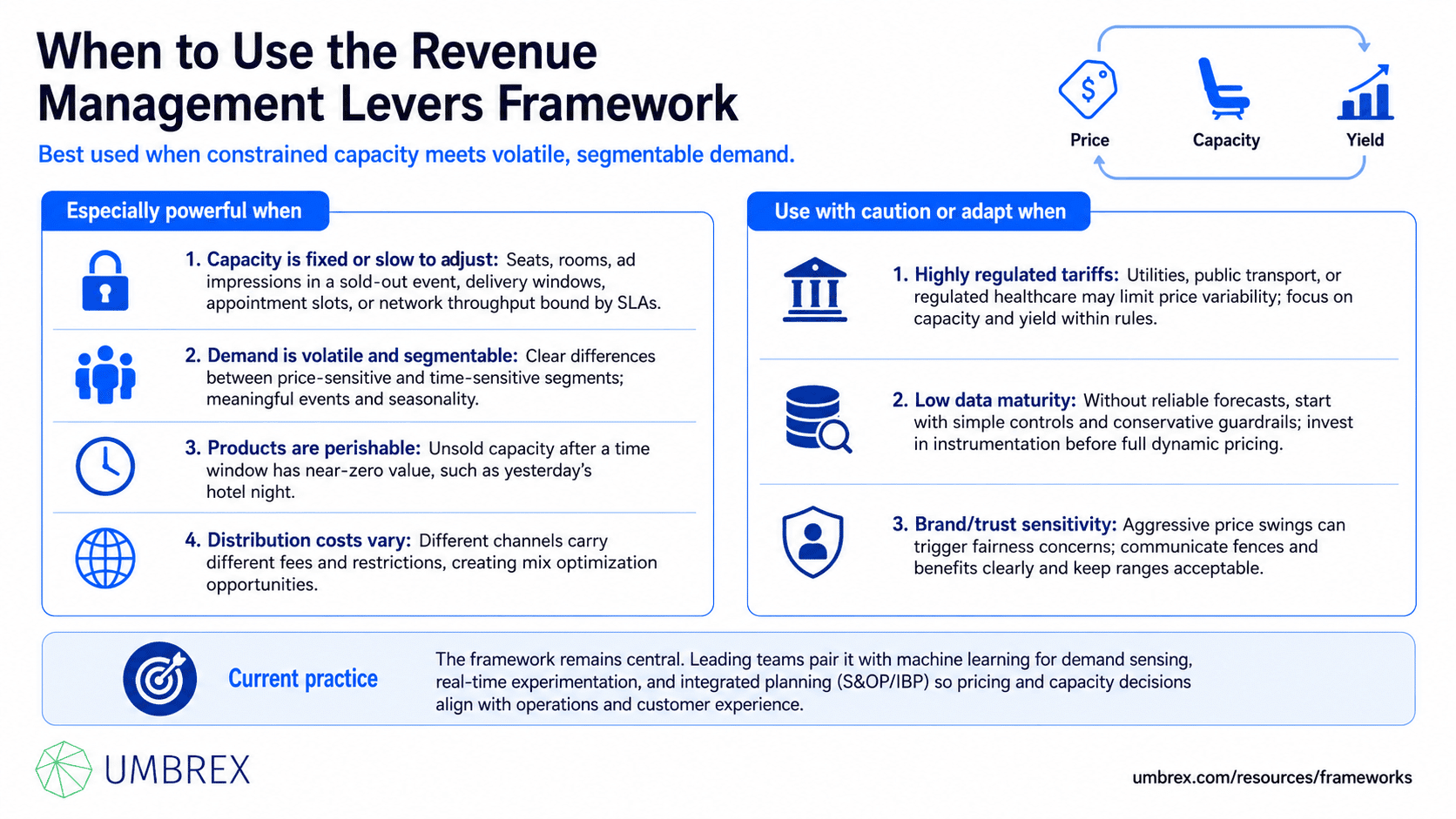
Especially powerful when:
- Capacity is fixed or slow to adjust: Seats, rooms, ad impressions in a sold-out event, delivery windows, appointment slots, or network throughput bound by SLAs.
- Demand is volatile and segmentable: Clear differences between price-sensitive and time-sensitive segments; meaningful events and seasonality.
- Products are perishable: Unsold capacity after a time window has near-zero value (yesterday’s hotel night).
- Distribution costs vary: Different channels carry different fees and restrictions, creating mix optimization opportunities.
Use with caution or adapt when:
- Highly regulated tariffs: Utilities, public transport, or regulated healthcare may limit price variability; focus on capacity and yield (mix, ancillaries) within rules.
- Low data maturity: Without reliable forecasts, start with simple controls and conservative guardrails; invest in instrumentation before full dynamic pricing.
- Brand/trust sensitivity: Aggressive price swings can trigger fairness concerns; communicate fences and benefits clearly, keep ranges within acceptable norms.
Current practice: The framework remains central. Leading teams pair it with machine learning for demand sensing, real-time experimentation, and integrated planning (S&OP/IBP) so pricing and capacity decisions align with operations and customer experience.
5. How to Apply the Revenue Management Levers Framework: Step-by-Step
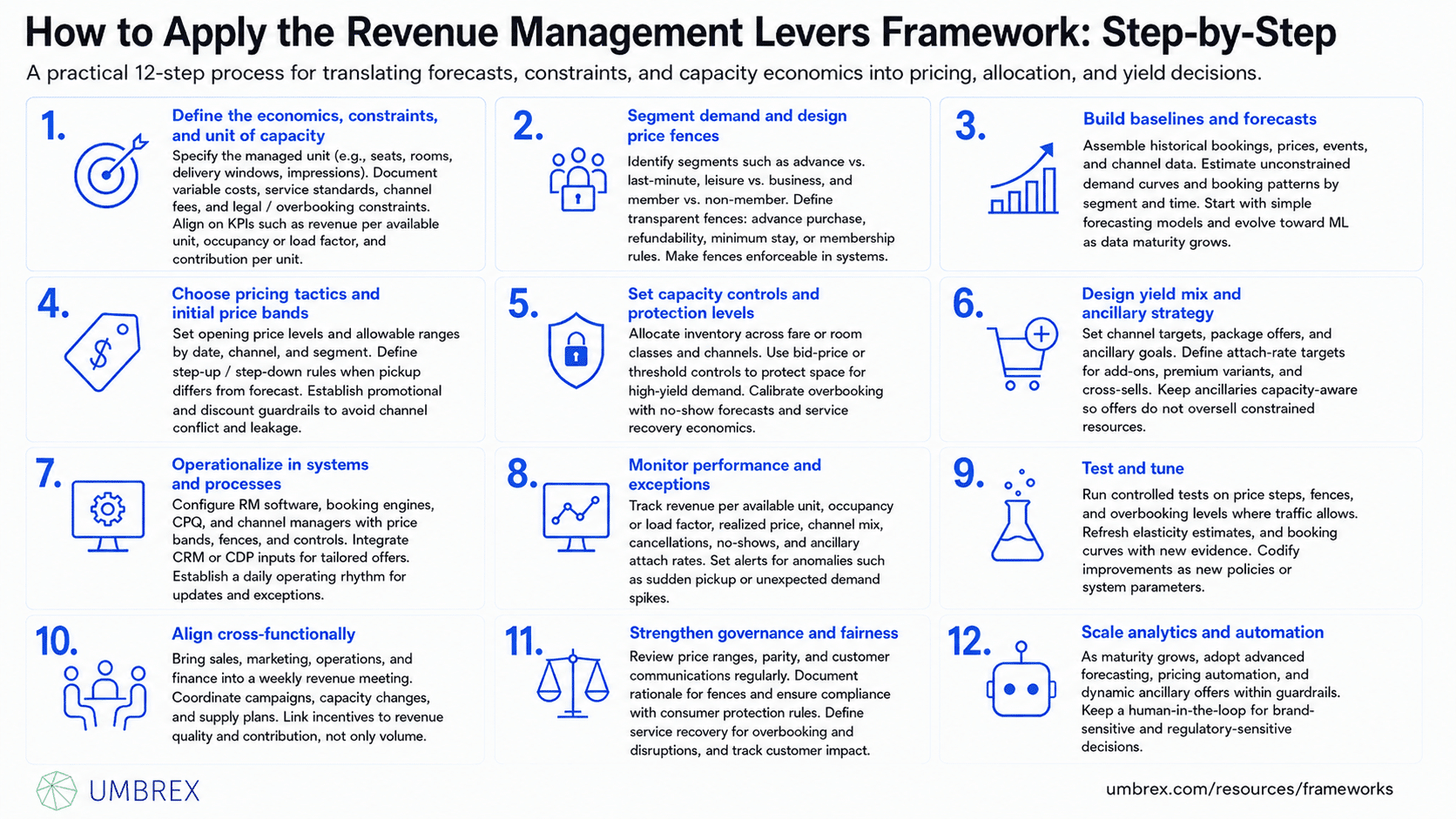
- Define the economics, constraints, and unit of capacity
Specify the “available unit” you’re managing (seats per flight, rooms per night, 30-minute delivery windows, ad impressions). Document variable costs, service standards, legal/regulatory constraints, overbooking policy, and channel fees. Align on primary KPIs (e.g., revenue per available unit, load factor/occupancy, contribution per unit) and guardrails (brand, fairness, regulatory).
- Segment demand and design price fences
Identify distinct segments (advance planners vs. last-minute, leisure vs. business, member vs. non-member). Define fences that separate willingness to pay—advance purchase rules, refundability, minimum stay, membership. Make fences transparent and enforceable in systems.
- Build baselines and forecasts
Assemble historical bookings, prices, events, and channel data. Estimate unconstrained demand curves and booking patterns by segment and date/time. Use simple models initially (moving averages, seasonal indices) and evolve to ML as data allow. Include uncertainty ranges to avoid overconfidence.
- Choose pricing tactics and initial price bands
Set opening price levels and allowable ranges by date/channel/segment. Define rules for step-ups/step-downs (e.g., when pick-up exceeds forecast by X%, raise by Y%). Establish promotional and discount guardrails to prevent channel conflict and price waterfall leakage.
- Set capacity controls and protection levels
Allocate inventory across fare/room classes and channels. Use bid-price or threshold controls to protect capacity for high-yield demand. Calibrate overbooking levels using no-show forecasts and service recovery economics.
- Design yield mix and ancillary strategy
Define channel targets (direct vs. intermediated), package offers, and ancillaries. Set attach-rate goals for add-ons, cross-sells, and premium variants. Ensure ancillaries are capacity-aware (e.g., avoid overselling late checkout when occupancy is high).
- Operationalize in systems and processes
Configure RM software, booking engines, CPQ (if B2B), and channel managers with price bands, fences, and capacity controls. Integrate with CRM/CDP to tailor offers by segment. Establish a daily rhythm for updates and exception handling.
- Monitor performance and exceptions
Track KPIs: revenue per available unit, occupancy/load factor, average realized price, channel mix, cancellation/no-show rates, overbooking bumps/denials, ancillary attach rates. Set alerts for anomalies (e.g., sudden pickup without known events).
- Test and tune
Run controlled tests on price steps, fences, and overbooking levels where feasible (A/B on channels with sufficient flow). Update elasticity estimates and booking curves. Codify improvements as new policies or system parameters.
- Align cross-functionally
Bring sales, marketing, operations, and finance into a weekly revenue meeting. Coordinate campaigns and events, adjust capacity (e.g., add flights/rooms, open more delivery slots), and reconcile forecasts with supply plans. Link incentives to revenue quality (pocket price, contribution), not just volume.
- Strengthen governance and fairness
Review price ranges, parity, and customer communications regularly. Document rationale for fences; ensure compliance with consumer protection rules. Define service recovery for overbooking and disruptions; measure customer impact (complaints, NPS).
- Scale analytics and automation
As maturity grows, adopt advanced forecasting (e.g., demand decomposition with exogenous variables), reinforcement learning for pricing within guardrails, and dynamic ancillary offers. Keep a human-in-the-loop for brand and regulatory-sensitive decisions.
6. Example: The Framework in Action
Company: “MetroStay,” a 150-property limited-service hotel chain concentrated in secondary business markets.
Problem: Occupancy averaged 72%, but RevPAR lagged peers by 8%. Heavy reliance on OTAs (online travel agencies) and indiscriminate discounts depressed net revenue. Corporate segments complained about inconsistent availability; weekend leisure demand was volatile.
Application:
- Segmentation and fences: Clarified segments (corporate negotiated, BAR/leisure, OTA, member/direct). Introduced non-refundable advance purchase rates (7/14/21 days), member-only rates on direct, and fenced late checkout to premium tiers.
- Forecasting: Built property-level booking curves with event calendars (conventions, sports). Identified shoulder nights with underpriced inventory and peak nights with late surges.
- Pricing and bands: Established property-specific price corridors with daily bands and automated step-ups tied to pickup. Replaced blanket %-off with controlled price ladders and minimum/maximum guardrails per night and segment.
- Capacity controls: Implemented protection levels for corporate negotiated rates on weekdays, reduced OTA availability on expected sell-out nights, and introduced conservative overbooking based on no-show patterns (~2–4% with service recovery playbook).
- Yield and channel mix: Pushed direct bookings via member rates and email offers; set OTA contribution caps per property. Bundled parking and breakfast on weekends to raise average rate. Introduced paid early check-in/late checkout dynamically based on occupancy forecast.
- Governance: Weekly revenue call per cluster; dashboards with RevPAR index, channel mix, average realized rate, and service recovery metrics. Legal reviewed parity and disclosure standards.
Results (90 days): RevPAR +7.5% vs. prior year (same-store), with occupancy steady at 72–73%. Average realized rate +6.2%; OTA mix reduced from 46% to 34%, lifting net revenue after commissions. Ancillary revenue per occupied room +18% (late checkout, parking bundles). Bumps/denials under 0.2% of stays with high recovery NPS. Corporate availability SLA compliance improved from 81% to 94% on weekdays.
Follow-on: MetroStay expanded price band automation to resort properties, rolled out event-driven pricing templates, and introduced a quarterly fairness review of price dispersion by channel and customer segment.
7. Strengths and Limitations
Strengths
- Monetizes perishable capacity: Raises revenue per available unit without adding assets.
- Balances price, availability, and mix: Avoids overreliance on discounting by coordinating capacity and yield decisions.
- Data-driven and iterative: Forecast–optimize–learn cycle compounds gains over time.
- Channel-aware: Improves net revenue by shifting mix toward lower-cost distribution and higher-margin ancillaries.
Limitations
- Requires data and systems: Weak forecasting or poor data capture undermines decisions.
- Customer perception risk: Large or opaque price swings can erode trust; fairness and communication matter.
- Organizational complexity: Sustained impact needs cross-functional alignment and incentive redesign.
- Regulatory and contractual constraints: Parity clauses, MAP, and consumer protection rules limit freedom; governance is essential.
8. Common Pitfalls (and How to Avoid Them)
- Misdefining the capacity unit
What goes wrong: Optimizing the wrong “denominator” (e.g., seats but ignoring aircraft swaps; delivery slots without courier constraints).
How to avoid: Align the unit with operational reality; include practical constraints (turn times, staffing, SLAs). - Price-only focus
What goes wrong: Frequent discounting trains customers and depresses net revenue after commissions.
How to avoid: Coordinate price with capacity controls and channel mix; set floors and use fences to segment without blanket discounts. - Static controls
What goes wrong: Unchanged protection levels and price bands ignore evolving demand patterns.
How to avoid: Refresh forecasts frequently; set dynamic rules and review weekly. - Poor overbooking discipline
What goes wrong: Service failures and compensation costs offset revenue gains.
How to avoid: Base overbooking on robust no-show models; define recovery playbooks and measure guest impact. - Channel cannibalization
What goes wrong: Lower-margin channels capture demand you could have served directly.
How to avoid: Control availability by channel, offer member-only value, and enforce parity/guardrails. - Ignoring ancillaries
What goes wrong: Leave high-margin revenue on the table; suboptimal yield per unit.
How to avoid: Design and test ancillary offers tied to occupancy/availability signals. - Weak fairness and compliance
What goes wrong: Customer backlash, regulatory scrutiny, and PR risk.
How to avoid: Keep fences transparent, ranges reasonable, and disclosures clear. Conduct periodic fairness reviews. - Incentives misaligned
What goes wrong: Teams optimize for volume or occupancy at the expense of revenue quality.
How to avoid: Tie incentives to net revenue and contribution, with channel and ancillary targets.
9. How the Revenue Management Levers Framework Relates to Other Frameworks
- Value-Based Pricing (VBP): VBP sets strategic pricing relative to customer value; RM executes price changes tactically by time/segment within that strategy to maximize realized revenue.
- Good–Better–Best (GBB): GBB defines the product tiers; RM manages availability and price gaps across tiers by date/channel to optimize mix and protect fences.
- Price Waterfall: The waterfall ensures pocket price realization after commissions and fees; RM uses it as a guardrail when choosing channels, discounts, and promotions.
- Promotional Mechanics: RM determines when (and if) to run offers based on demand; promotional mechanics define how to structure them for incremental profit.
- Psychological Pricing: Presentation tactics (anchors, framing) improve uptake of RM-driven price steps without eroding brand trust.
- S&OP/IBP (Sales & Operations Planning): RM decisions must align with capacity planning and service levels; these planning frameworks synchronize revenue choices with supply.
- OODA/Agile experimentation: Provide the operating cadence to test price bands, fences, and capacity controls safely, speeding learning.
Choosing the stack: Use VBP/GBB to set the strategic canvas; apply RM to execute daily price, capacity, and yield choices; enforce economics with the Price Waterfall; present offers with psychological pricing; and coordinate with S&OP to ensure delivery.
10. Key Takeaways
- The Revenue Management Levers Framework orchestrates Price, Capacity, and Yield to maximize revenue from perishable or constrained inventory.
- Success depends on solid forecasts, clear fences, disciplined capacity controls, and channel-aware yield tactics—governed by brand and compliance guardrails.
- Start simple (price bands, basic protection levels) and iterate; layer in automation and ML as data maturity grows.
- Measure what matters: revenue per available unit, realized price, mix, and net contribution after channel costs—not just occupancy or volume.
- Avoid pitfalls: price-only tactics, static controls, channel cannibalization, and fairness missteps; align cross-functional incentives to revenue quality.
11. FAQs About the Revenue Management Levers Framework
Is revenue management only for airlines and hotels?
No. Any business with perishable or time-bound capacity can benefit: live events, rental and mobility services, logistics/delivery slots, advertising inventory, appointment-driven services, even cloud/compute with SLA capacity constraints. The levers are the same; context and guardrails differ.
What’s the difference between yield management and revenue management?
Yield management historically focused on maximizing revenue per unit through price and inventory controls (fare classes, length-of-stay). Revenue management is broader: it includes channel and product mix, ancillaries, and often integrates with marketing and capacity deployment decisions.
How do we start if our data is limited?
Begin with simple booking curves, event calendars, and price bands. Set basic protection levels for high-yield demand, and implement conservative overbooking only if you can recover service problems well. Instrument data collection as you go and evolve models over time.
What tools do we need?
At minimum: a booking/ordering system that supports price bands, fences, and channel controls; a forecasting dashboard; and routine reporting on revenue, occupancy/load, and channel mix. Over time, add RM software with optimization (bid-price, dynamic pricing), a CDP/CRM for segmentation, and experimentation tools.
How do we avoid customer backlash to dynamic pricing?
Keep ranges reasonable, communicate fences transparently (e.g., non-refundable advance rates), avoid “gotchas,” and apply consistent rules. Pair price moves with value (benefits, flexibility). Monitor complaints and NPS; intervene if sentiment deteriorates.
How long until we see impact?
With focused effort, properties or routes often see measurable RevPAR/RASM uplift within 8–12 weeks from basic price bands and capacity controls. Larger gains accrue over 3–6 months as forecasts improve, channels rebalance, and ancillaries ramp.
