

1. What Is the Psychological Pricing Tactics Framework?
The Psychological Pricing Tactics Framework is a practical toolkit for shaping how customers perceive and respond to prices—without changing the underlying economics of the offer. It draws on well-established behavioral principles to present prices, packages, and comparisons in ways that reduce friction, clarify value, and nudge customers toward choices that fit their needs and your commercial goals.
It is a pricing, channel, and sales execution framework. Whereas strategy frameworks decide what to charge and how value should be captured, psychological pricing governs how prices are communicated and structured across ecommerce pages, retail shelves, sales quotes, and promotional materials.
Consultants and executives use this framework to improve conversion, average order value (AOV), and mix—especially in direct-to-consumer, subscription, and transactional B2B contexts—while maintaining brand trust and regulatory compliance. Done well, it provides quick, measurable gains; done poorly, it erodes credibility and invites regulatory risk.
2. Origin and Background
Origin: Unknown; in use since at least the early 20th century. Retailers have long used endings like .99 and tiered offers to influence perception.
Modern practice is informed by behavioral economics and consumer psychology, particularly work on heuristics, framing, and prospect theory from the late 20th century onward. Over time, these insights were operationalized through marketing research, pricing studies, and ecommerce experimentation platforms, making psychological pricing part of standard commercial toolkits.
Why it was created: Traditional cost-plus or competitor-matching does not address how buyers actually experience prices. Psychological tactics bridge that gap by presenting economically equivalent prices in ways that feel more acceptable or compelling, improving uptake without sacrificing margins.
3. How the Psychological Pricing Tactics Framework Works
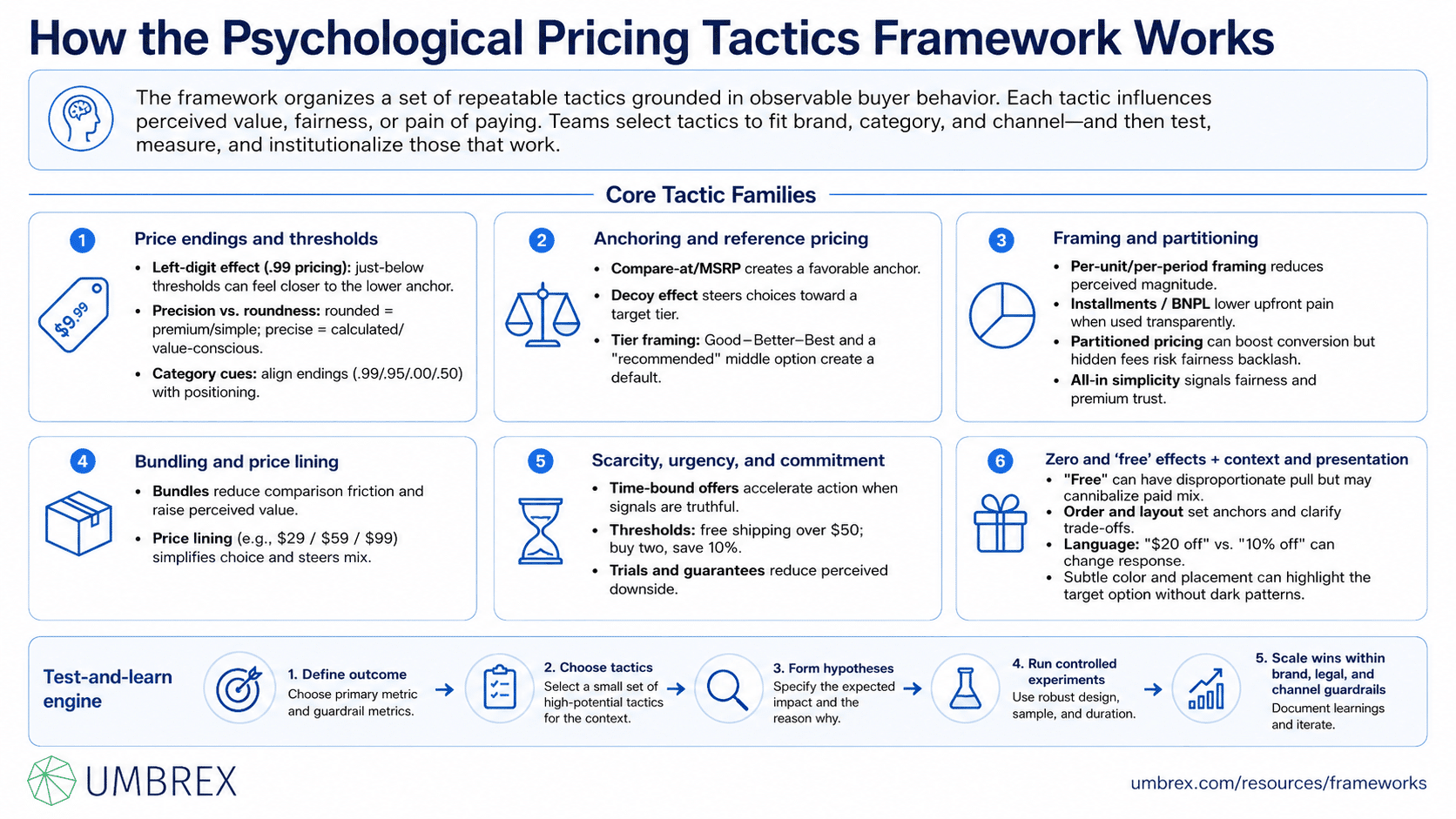
The framework organizes a set of repeatable tactics grounded in observable buyer behavior. Each tactic influences perceived value, fairness, or pain of paying. Teams select tactics to fit brand, category, and channel—and then test, measure, and institutionalize those that work.
Core Tactic Families
- Price endings and thresholds
- Left-digit effect (“.99” pricing): Prices just below thresholds (e.g., $19.99) are perceived closer to the lower anchor ($19) than the higher one ($20).
- Precision vs. roundness: Rounded prices (e.g., $200) feel premium and simple; precise prices (e.g., $197) can signal calculation and value consciousness—useful in negotiations or B2B quotes.
- Category cues: Some categories signal value with .99/.95 and premium with .00/.50; align endings with positioning.
- Anchoring and reference pricing
- Compare-at/MSRP: Showing a higher credible reference price sets an anchor that makes the actual price feel favorable.
- Decoy effect: Introducing an inferior, similarly priced option can steer choices to a target tier.
- Tier framing: Presenting Good–Better–Best with a “recommended” middle option creates a natural anchor and default.
- Framing and partitioning
- Per-unit/per-period framing: Expressing price as “$1.20/day” or “$0.35 per serving” reduces perceived magnitude.
- Installments and BNPL: Breaking a total into smaller payments lowers upfront pain; must be used transparently.
- Partitioned pricing: Separating base price and fees (e.g., shipping) can boost conversion but risks fairness backlash if fees feel hidden.
- All-in simplicity: A single all-inclusive price signals fairness and premium positioning; often better for brand trust.
- Bundling and price lining
- Bundles: Grouping complementary items at a single price reduces comparison friction and increases perceived value.
- Price lining: Offering a few standardized price points (e.g., $29 / $59 / $99) simplifies choice and steers mix.
- Scarcity, urgency, and commitment
- Time-bound offers: Deadlines and limited-time pricing increase action, particularly when paired with clear, truthful inventory or time signals.
- Thresholds: “Free shipping over $50” nudges basket size; “Buy two, save 10%” encourages quantity.
- Trials and guarantees: Risk reversals (free trials, money-back) reduce perceived downside, making a given price more acceptable.
- Zero and “free” effects
- Zero-price premium: “Free” has a disproportionate pull (e.g., free add-on, free tier) and can reframe value, but must avoid cannibalizing paid mix.
- Context and presentation
- Order and layout: Showing higher-priced options first sets a higher anchor; side-by-side comparisons clarify trade-offs.
- Language: “Save $20” vs. “10% off”—absolute savings often feel larger at lower price points, percentage at higher.
- Color and placement: Subtle, consistent visual cues can highlight the target option without resorting to dark patterns.
The engine behind the framework is test-and-learn: define the outcome (e.g., conversion, AOV), select tactics with clear hypotheses, implement controlled experiments, and scale wins—always within brand, legal, and channel guardrails.
4. When to Use the Psychological Pricing Tactics Framework
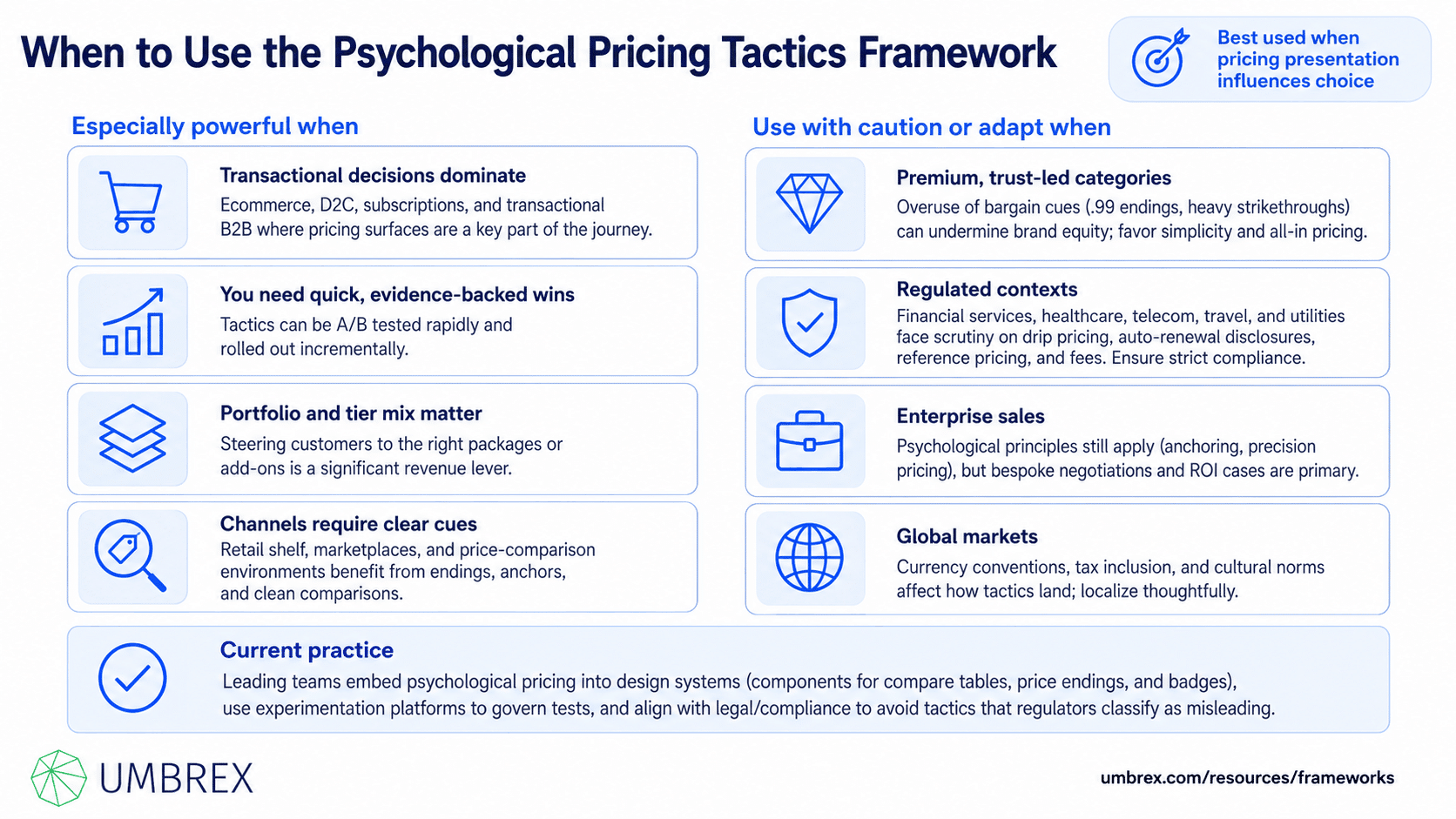
Especially powerful when:
- Transactional decisions dominate: Ecommerce, D2C, subscriptions, and transactional B2B where pricing surfaces are a key part of the journey.
- You need quick, evidence-backed wins: Tactics can be A/B tested rapidly and rolled out incrementally.
- Portfolio and tier mix matter: Steering customers to the right packages or add-ons is a significant revenue lever.
- Channels require clear cues: Retail shelf, marketplaces, and price-comparison environments benefit from endings, anchors, and clean comparisons.
Use with caution or adapt when:
- Premium, trust-led categories: Overuse of bargain cues (.99 endings, heavy strikethroughs) can undermine brand equity; favor simplicity and all-in pricing.
- Regulated contexts: Financial services, healthcare, telecom, travel, and utilities face scrutiny on “drip pricing,” auto-renewal disclosures, reference pricing, and fees. Ensure strict compliance.
- Enterprise sales: Psychological principles still apply (anchoring, precision pricing), but bespoke negotiations and ROI cases are primary.
- Global markets: Currency conventions, tax inclusion, and cultural norms affect how tactics land; localize thoughtfully.
Current practice: Leading teams embed psychological pricing into design systems (components for compare tables, price endings, and badges), use experimentation platforms to govern tests, and align with legal/compliance to avoid tactics that regulators classify as misleading.
5. How to Apply the Psychological Pricing Tactics Framework: Step-by-Step
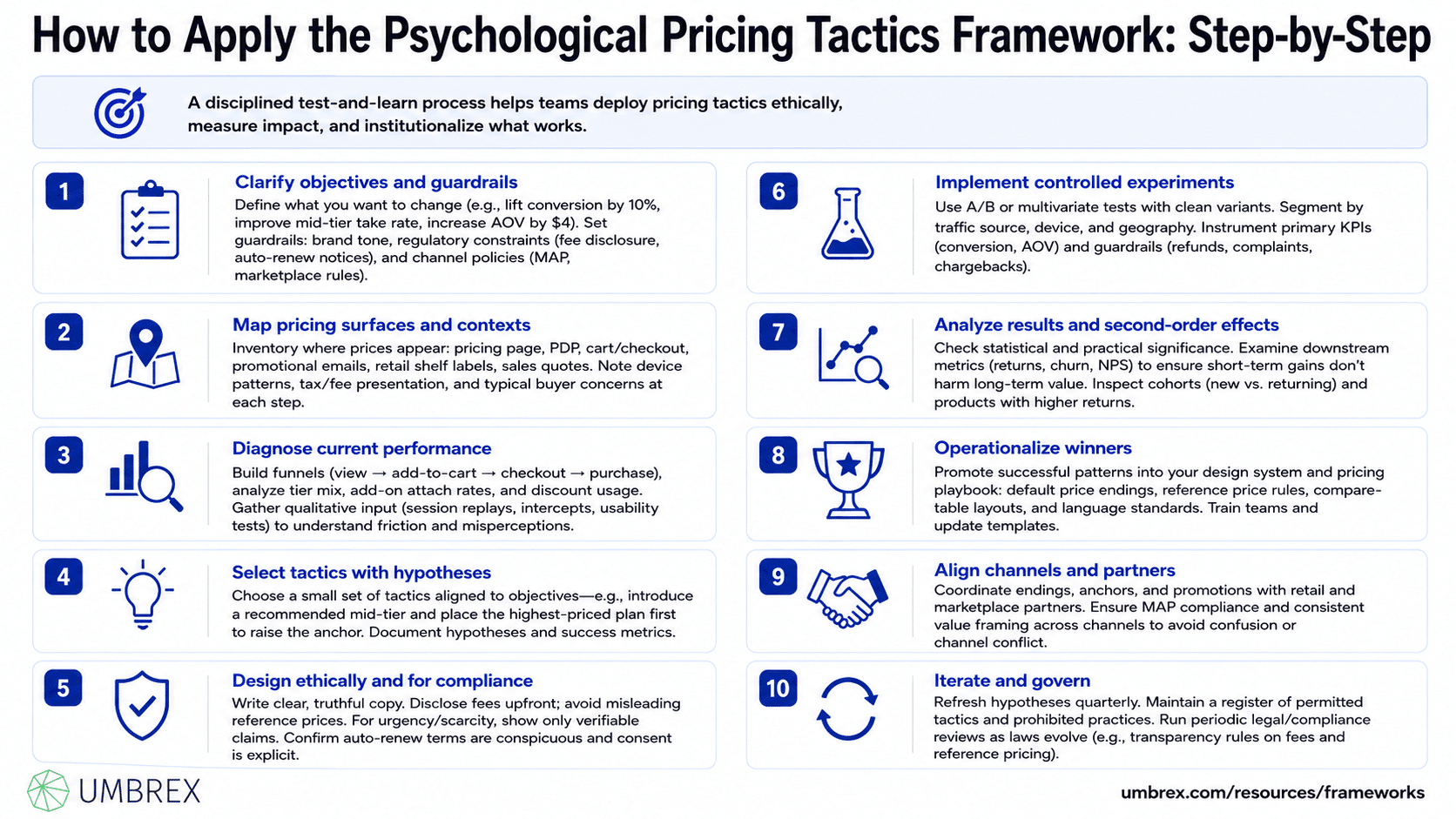
- Clarify objectives and guardrails
Define what you want to change (e.g., lift conversion by 10%, improve mid-tier take rate, increase AOV by $4). Set guardrails: brand tone, regulatory constraints (fee disclosure, auto-renew notices), and channel policies (MAP, marketplace rules).
- Map pricing surfaces and contexts
Inventory where prices appear: pricing page, PDP, cart/checkout, promotional emails, retail shelf labels, sales quotes. Note device patterns, tax/fee presentation, and typical buyer concerns at each step.
- Diagnose current performance
Build funnels (view → add-to-cart → checkout → purchase), analyze tier mix, add-on attach rates, and discount usage. Gather qualitative input (session replays, intercepts, usability tests) to understand friction and misperceptions.
- Select tactics with hypotheses
Choose a small set of tactics aligned to objectives—e.g., “Introduce a ‘recommended’ mid-tier and place the highest-priced plan first to raise the anchor; expected effect: +8–12 pts mid-tier selection.” Document hypotheses and success metrics.
- Design ethically and for compliance
Write clear, truthful copy. Disclose fees upfront; avoid misleading reference prices. For urgency/scarcity, show only verifiable claims. Confirm auto-renew terms are conspicuous and consent is explicit.
- Implement controlled experiments
Use A/B or multivariate tests with clean variants. Segment by traffic source, device, and geography. Instrument primary KPIs (conversion, AOV) and guardrails (refunds, complaints, chargebacks).
- Analyze results and second-order effects
Check statistical and practical significance. Examine downstream metrics (returns, churn, NPS) to ensure short-term gains don’t harm long-term value. Inspect cohorts (new vs. returning) and products with higher returns.
- Operationalize winners
Promote successful patterns into your design system and pricing playbook: default price endings, reference price rules, compare-table layouts, and language standards. Train teams and update templates.
- Align channels and partners
Coordinate endings, anchors, and promotions with retail and marketplace partners. Ensure MAP compliance and consistent value framing across channels to avoid confusion or channel conflict.
- Iterate and govern
Refresh hypotheses quarterly. Maintain a register of permitted tactics and prohibited practices. Run periodic legal/compliance reviews as laws evolve (e.g., transparency rules on fees and reference pricing).
6. Example: Psychological Pricing Tactics in Action
Company: “PeakFuel,” a $130M D2C sports nutrition brand selling drink mixes and recovery bars through its website and marketplaces.
Problem: Traffic was healthy, but PDP-to-cart conversion lagged and the mix skewed to single SKU purchases despite volume economics. The brand sought to lift conversion and AOV without aggressive discounting that would erode margins or upset retail partners.
Application of the framework:
- Objectives and guardrails: +10% conversion, +$5 AOV; preserve price integrity (no “fake” strikethroughs), ensure marketplace parity, and avoid drip pricing.
- Diagnostics: Analysis showed strong first-time traffic from paid social on mobile. Add-to-cart dropped at shipping disclosure. Single-unit purchases dominated, with low attach of bundles.
- Tactics selected:
- Anchoring and tier framing: Introduced a 1-unit, 3-unit, and 6-unit bundle with a “Most Popular” tag on 3 units. Displayed the 6-unit price first to set a higher anchor, then the 3-unit as recommended.
- Per-serving framing: Converted prices to a per-serving view alongside the total, highlighting “$0.96/serving” for 3-unit bundles.
- Threshold incentives: “Free shipping over $50” badge on PDP and cart; 3-unit bundle priced at $54.99 to naturally qualify.
- Endings and precision: Shifted from .00 to .99 for single units (value cue) and kept bundles at .99 to maintain consistency; limited precision to two decimals.
- Guarantee framing: Prominent 30-day satisfaction guarantee near price to reduce perceived risk.
- Experimentation: A/B tests on PDP layout and cart thresholds across 200k sessions. Guardrails tracked refunds, complaints, and marketplace price parity.
Results (6 weeks): PDP-to-cart conversion rose 12%; AOV increased $6.40; 3-unit bundle mix grew from 21% to 44%; refund and complaint rates remained stable. Marketplace sales were unaffected due to aligned list prices and consistent bundles.
Follow-on actions: PeakFuel codified the compare-table component and price framing in its design system, trained CX agents to reinforce per-serving value in chats, and collaborated with retail partners to feature the 3-pack as the default in-store display.
7. Strengths and Limitations
Strengths
- Fast, testable impact: Many tactics can be implemented and measured quickly, delivering measurable conversion and mix improvements.
- Enhances clarity: Good framing reduces confusion and helps customers self-select the right option.
- Channel-friendly: Tactics work across ecommerce, retail, and sales quotes with appropriate tailoring.
- Portfolio leverage: Supports tiering, bundling, and add-on strategies, amplifying the value of pricing and packaging decisions.
Limitations
- Not a substitute for strategy: Tactics cannot fix weak product-market fit or poor value; they optimize presentation, not substance.
- Trust sensitivity: Overuse or misleading implementation damages brand and invites regulatory scrutiny.
- Heterogeneous effects: What works in one category, brand position, or country may backfire in another; testing and localization are essential.
- Short-term bias risk: Some tactics lift first-purchase conversion but may hurt long-term retention if perceived as gimmicky.
8. Common Pitfalls (and How to Avoid Them)
- Misusing reference prices
What goes wrong: Strikethroughs based on inflated or rarely used prices erode trust and may violate laws.
How to avoid: Use truthful, recent reference prices; document basis and time windows. - Drip pricing and hidden fees
What goes wrong: Surprises at checkout depress conversion and invite regulatory action.
How to avoid: Disclose total cost early; prefer all-in pricing or clear, upfront partitioning. - One-size-fits-all endings
What goes wrong: Applying .99 everywhere cheapens premium brands.
How to avoid: Align endings with positioning; test .00 or .50 for premium, .99/.95 for value lines. - Overwhelming choice
What goes wrong: Too many tiers/options create paralysis.
How to avoid: Use Good–Better–Best and price lining; highlight one recommended option. - Manufactured scarcity
What goes wrong: Fake countdowns or “only 2 left!” erode credibility.
How to avoid: Use real, auditable scarcity signals or avoid them entirely. - Ignoring channel rules
What goes wrong: Tactics that break MAP or marketplace parity trigger penalties.
How to avoid: Align with partner policies; frame value via bundles or services rather than price alone. - Testing without guardrails
What goes wrong: Conversion gains offset by higher returns or complaints.
How to avoid: Track quality metrics (refunds, chargebacks, NPS) alongside revenue metrics. - Neglecting international norms
What goes wrong: Decimal separators, tax inclusion, and currency conventions confuse buyers.
How to avoid: Localize formats, tax treatment, and psychological thresholds by market.
9. How Psychological Pricing Relates to Other Frameworks
- Value-Based Pricing (VBP) and EVC: VBP determines what you should charge based on economic value; psychological pricing optimizes how that price is presented to maximize acceptance and conversion.
- Good–Better–Best (GBB): GBB sets your tier structure; psychological tactics (anchors, “recommended” tags, decoys) guide customers to the right tier and protect fences.
- Price Waterfall: The waterfall ensures price realization across discounts and terms; psychological tactics reduce the need for ad hoc discounts by improving perceived value.
- Van Westendorp and Gabor–Granger: Research methods set perception ranges and demand curves; use them to inform price levels before applying psychological presentation tactics.
- Price Corridor of the Mass (Blue Ocean): Sets adoption-focused price bands for new categories; psychological tactics help communicate that price compellingly at launch.
- OODA/Agile experimentation: Provide the operating cadence to test, learn, and scale psychological pricing variants safely and quickly.
Choosing the sequence: Set price strategy with VBP/GBB, validate levels with research (PSM/Gabor–Granger), enforce realization with the Price Waterfall, and apply psychological tactics to present prices compellingly across channels.
10. Key Takeaways
- Psychological pricing optimizes how prices are presented to influence perception and choice; it complements, not replaces, pricing strategy.
- Use tactic families—endings, anchors, framing, bundling, scarcity, zero/free, and context—selected for brand, category, and channel.
- Test rigorously with clear hypotheses and guardrails; track quality metrics (refunds, complaints) alongside conversion and AOV.
- Stay ethical and compliant: avoid misleading reference prices, hidden fees, and manufactured scarcity; localize for market norms.
- Institutionalize what works via design systems, sales playbooks, and partner alignment to sustain gains and protect brand trust.
11. FAQs About the Psychological Pricing Tactics Framework
Is psychological pricing manipulative?
It can be if used deceptively. The goal should be to reduce friction and clarify value—not to mislead. Use truthful anchors, transparent fees, and fair comparisons. Ethical guardrails and compliance reviews are essential.
Do .99 price endings still work?
Often, yes—especially in value-oriented retail and ecommerce. But impact varies by category and brand. Premium brands frequently perform better with rounded endings (.00) and all-in simplicity. Test within your context.
Can these tactics work in B2B?
Yes, with adaptation. Anchoring, tier framing, precision pricing, and commitment devices (e.g., annual terms with guarantees) are effective. Transparency and ROI narratives matter more than charm pricing in enterprise contexts.
What are the biggest legal risks?
Misleading reference prices, hidden fees (“drip pricing”), unclear auto-renew terms, and false scarcity claims are frequently scrutinized by regulators. Keep documentation for reference prices, disclose total costs early, and ensure consent mechanisms are explicit.
How do we localize psychological pricing?
Follow local conventions (decimal separators, thousand markers), show tax-in vs. tax-ex per market norms, and calibrate thresholds to local purchasing power. Some regions favor .95 endings; others prefer round numbers. Validate with local testing.
How quickly can we see results?
Many teams see directional results within 2–4 weeks of well-designed A/B tests on high-traffic pages. Full rollout and institutionalization typically take 1–3 months, depending on channel complexity and compliance reviews.
Should we use urgency and scarcity tactics?
Only if they’re accurate and brand-appropriate. Genuine deadlines or limited inventory can help customers decide; manufactured scarcity damages trust and can violate consumer protection rules.
