

1. What Is the Good–Better–Best Pricing Ladder?
The Good–Better–Best (GBB) Pricing Ladder is a simple but powerful way to structure your offer into three clear tiers that match different customer needs and willingness to pay. “Good” delivers the essential value at an accessible price; “Better” adds meaningful enhancements for mainstream users; and “Best” offers the full solution for customers with the highest needs or willingness to pay. By guiding customers up a value ladder, GBB increases choice clarity, improves monetization, and raises average revenue per customer without alienating price‑sensitive buyers.
GBB is a pricing and packaging framework used across consumer, B2B, and channel contexts. It sits at the intersection of pricing strategy and product/offer design, shaping how you bundle features, set price gaps, and create “fences” that separate tiers. The aim is to capture more value from customers who benefit more—while still serving entry‑level demand—by making trade‑offs explicit and intuitive.
Consultants and executives use GBB frequently because it provides a common language for product, marketing, sales, and channel teams. It is straightforward to design, easy to test, and tends to outperform one‑size‑fits‑all offers in categories with heterogeneous needs.
2. Origin and Background
Origin: Unknown; in use since at least the mid‑20th century. The pattern was popularized by consumer marketers and retailers and later adopted widely in services, technology, and subscription businesses.
GBB emerged to solve a practical problem: single price points either left value on the table (for higher‑need customers) or priced out entry‑level demand. By offering a tiered structure with clear value and price steps, companies could improve conversion and mix without undue complexity. The approach became common through consumer goods (e.g., appliances, autos, hospitality), then spread to software and telecom as packaging and subscriptions matured.
3. How the Good–Better–Best Pricing Ladder Works
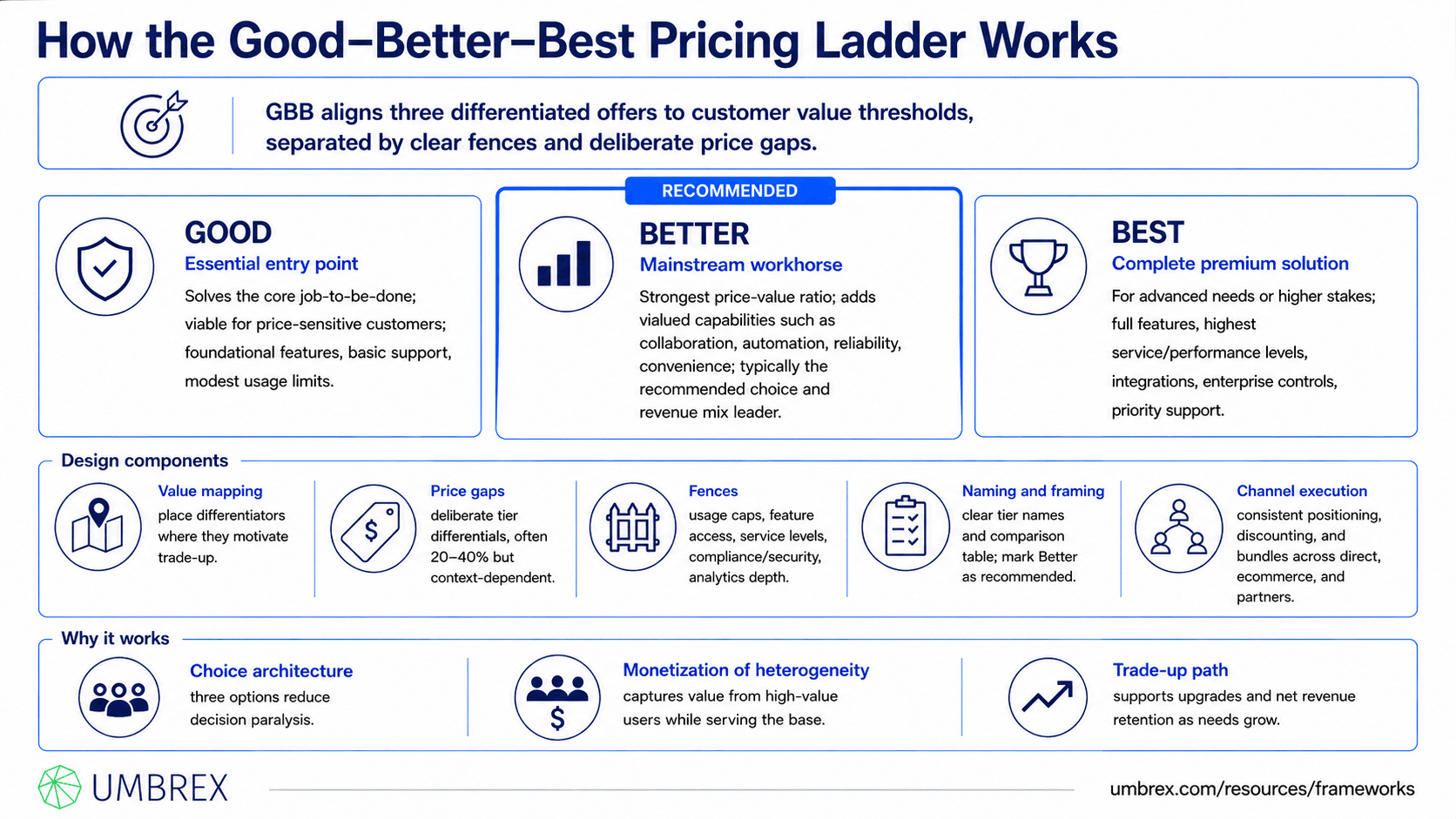
GBB works by aligning three differentiated offers to distinct customer value thresholds and willingness to pay, separated by clear “fences” (capabilities, performance levels, service levels, or usage limits) and deliberate price gaps. The structure simplifies decision‑making for buyers and creates an intentional path to trade up.
The Three Tiers (Spell‑out of GBB)
- Good: The essential solution that solves the core job‑to‑be‑done with minimal frills. It should be viable on its own for price‑sensitive customers and serve as an honest entry point—not a crippled version. Think: foundational features, basic support, and modest usage limits.
- Better: The mainstream workhorse with the most attractive price‑value ratio. It adds capabilities that most target users value (collaboration, automation, reliability, convenience) and is typically the recommended choice. Often the revenue mix leader.
- Best: The complete solution for customers with advanced needs, high stakes, or a preference for premium experiences. It includes the full set of features, highest performance or service levels, integration/enterprise controls, and priority support.
Design Components
- Value mapping: Identify which features, performance levels, or services create material value for distinct segments. Place differentiators where they most motivate trade‑up.
- Price gaps: Set deliberate differentials between tiers (commonly ~20–40% from Good→Better and Better→Best, but context‑dependent) to position “Better” as compelling and “Best” as aspirational yet attainable for high‑value segments.
- Fences: Define clear, fair boundaries that separate tiers: usage caps, performance thresholds, feature access, service levels, compliance/security, analytics depth, or customization. Good fences are easy to explain and hard to arbitrage.
- Naming and framing: Use tier names and comparisons that convey value without confusing the customer (e.g., Basic/Pro/Enterprise). Provide side‑by‑side comparison tables and an explicit “recommended” tag for Better.
- Channel execution: Ensure the ladder is consistently implemented across direct sales, ecommerce, and partners—so positioning, discounting, and bundles reinforce the architecture rather than undermine it.
Why It Works
- Choice architecture: Three options balance simplicity and flexibility, helping customers self‑select based on needs and budget with less paralysis than larger menus.
- Monetization of heterogeneity: Different customers value different things; GBB lets you capture surplus from higher‑value users while still serving the base.
- Trade‑up path: As needs grow (usage, complexity, stakes), customers have a ready upgrade path, supporting net revenue retention in subscriptions.
4. When to Use the Good–Better–Best Pricing Ladder
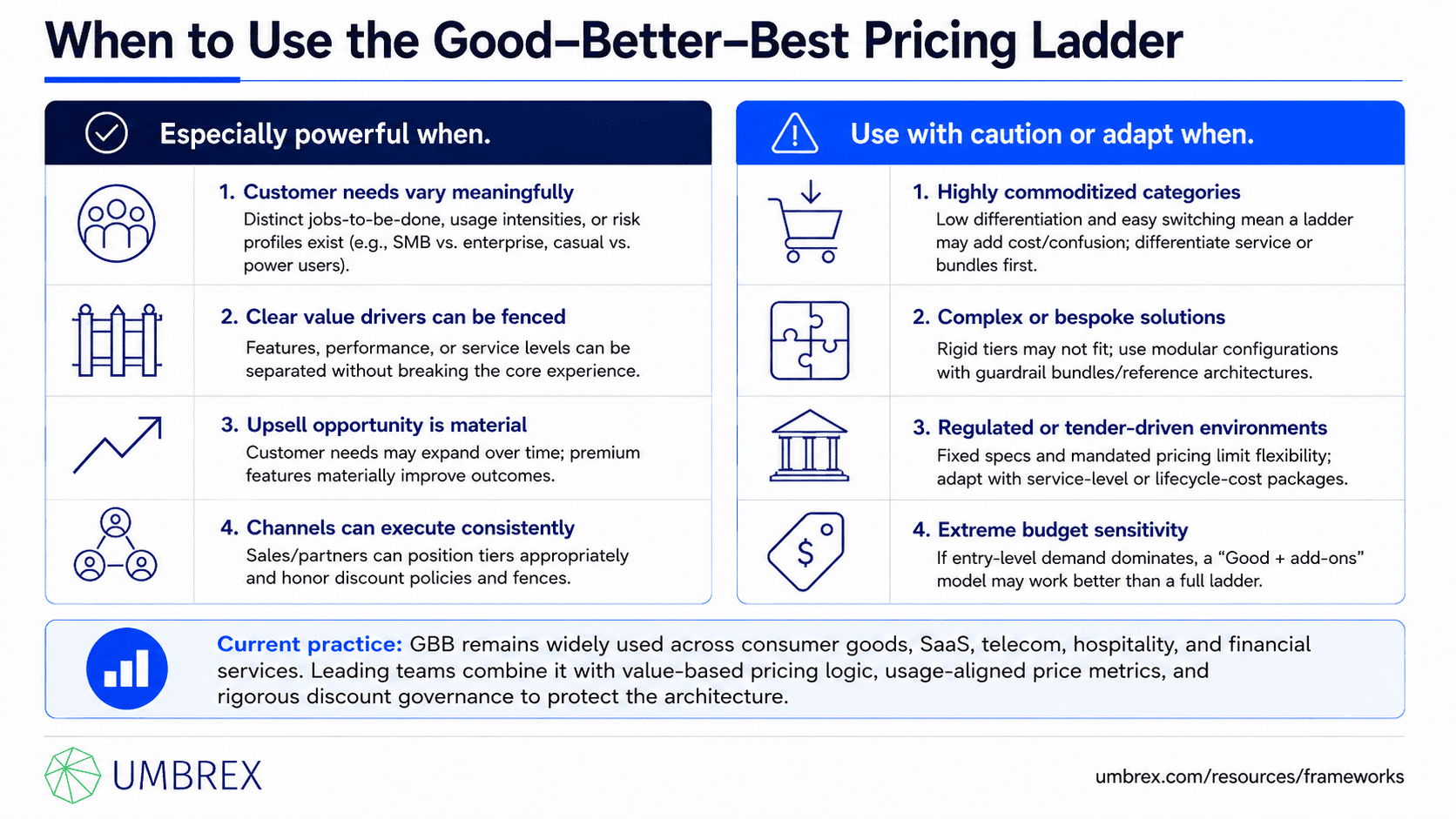
Especially powerful when:
- Customer needs vary meaningfully: Distinct jobs‑to‑be‑done, usage intensities, or risk profiles exist (e.g., SMB vs. enterprise, casual vs. power users).
- Clear value drivers can be fenced: Features, performance, or service levels can be separated without breaking the core experience.
- Upsell opportunity is material: You expect customer needs to expand over time, or premium features materially improve outcomes.
- Channels can execute consistently: Sales/partners can position tiers appropriately and honor discount policies and fences.
Use with caution or adapt when:
- Highly commoditized categories: If differentiation is low and switching is easy, a ladder may add cost and confusion without improving mix; focus on service or bundle differentiation first.
- Complex or bespoke solutions: In heavy enterprise services, rigid tiers may not fit; consider modular configurations with guardrail bundles and reference architectures.
- Regulated or tender‑driven environments: Fixed specs and mandated pricing limit tier flexibility; adapt with service level options or lifecycle cost packages.
- Extreme budget sensitivity: If the category is dominated by entry‑level demand, a “Good + add‑ons” model may be more practical than a full ladder.
Current practice: GBB remains widely used across consumer goods, SaaS, telecom, hospitality, and financial services. Leading teams combine it with value‑based pricing logic, usage‑aligned price metrics, and rigorous discount governance to protect the architecture.
5. How to Apply the Good–Better–Best Pricing Ladder: Step‑by‑Step
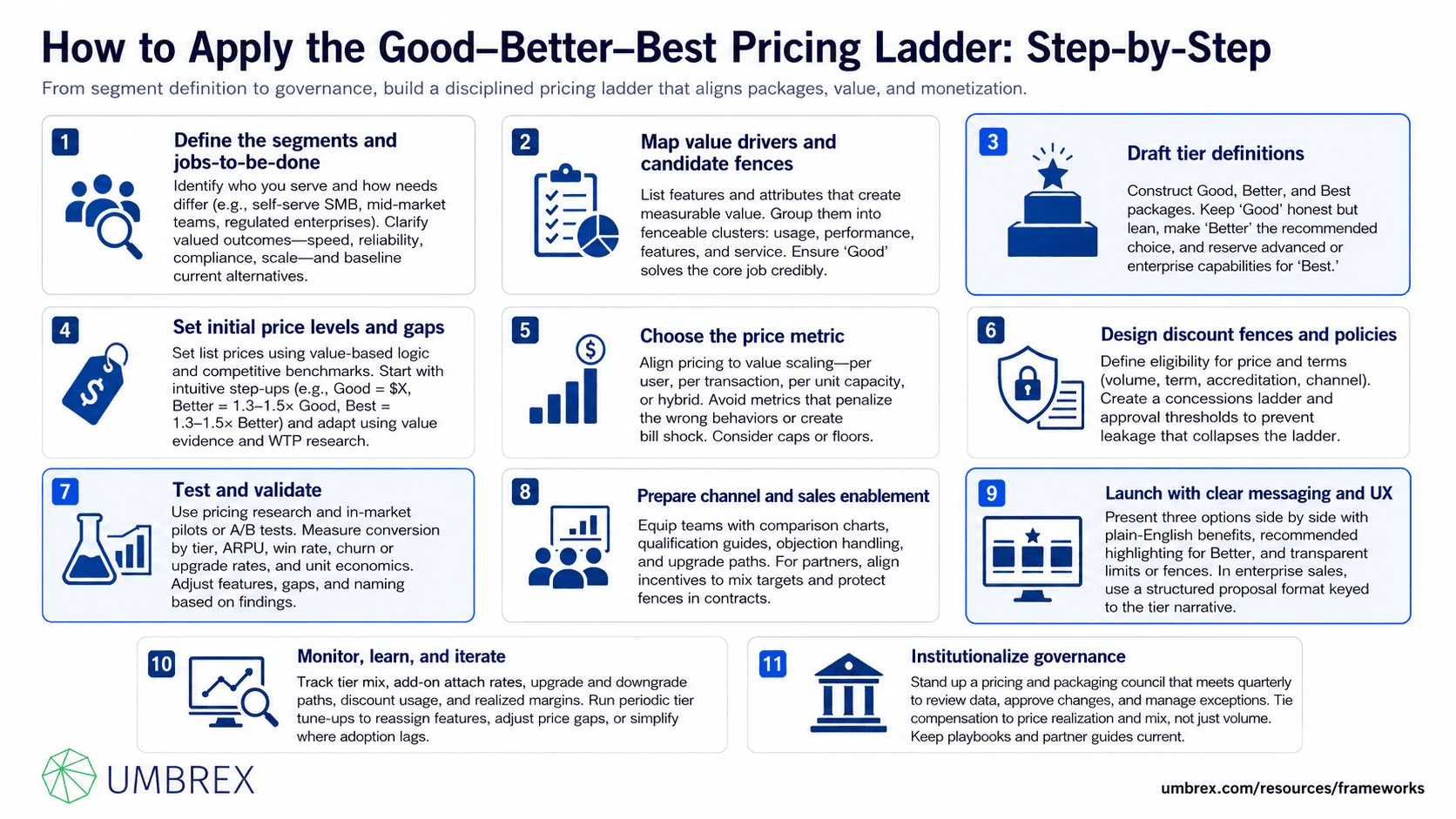
- Define the segments and jobs‑to‑be‑done
Identify who you serve and how their needs differ (e.g., self‑serve SMB, mid‑market teams, regulated enterprises). Articulate the outcomes each segment values (speed, reliability, compliance, scale) and baseline their current alternatives.
- Map value drivers and candidate fences
List features and attributes that drive measurable value. Group them into fenceable clusters: usage (seats, transactions), performance (limits, throughput), features (automation, analytics, integrations), and service (SLA, support). Ensure “Good” solves the core job credibly.
- Draft tier definitions
Construct Good, Better, Best packages. Keep “Good” honest but lean; make “Better” the recommended choice with a strong value‑price balance; reserve advanced/enterprise capabilities for “Best.” Validate that each tier has a coherent story in plain language.
- Set initial price levels and gaps
Establish list prices using value‑based logic and competitive benchmarks. Start with intuitive step‑ups (e.g., Good = $X, Better = 1.3–1.5× Good, Best = 1.3–1.5× Better) and adapt based on value evidence, category norms, and willingness‑to‑pay research.
- Choose the price metric
Align the pricing metric to value scaling—per user, per transaction, per unit capacity, or hybrid (platform fee + usage). Avoid metrics that penalize the wrong behaviors or create bill shock. Consider caps/floors to maintain predictability.
- Design discount fences and policies
Define who qualifies for which price and under what conditions (volume, term, accreditation, channel). Create a concessions ladder (e.g., term discounts before price cuts) and approval thresholds to prevent leakage that collapses the ladder.
- Test and validate
Use pricing research (e.g., discrete choice/conjoint for trade‑offs; Van Westendorp for ranges) and in‑market A/B tests or pilots. Measure conversion by tier, average revenue per user, win rate, churn/upgrade rates, and unit economics. Adjust features, gaps, and naming based on findings.
- Prepare channel and sales enablement
Equip teams with comparison charts, qualification guides (“who is each tier for?”), objection handling, and upgrade paths. For partners, align incentives to mix targets and protect fences in contracts.
- Launch with clear messaging and UX
On digital surfaces, present three options side‑by‑side with plain‑English benefits, prominent “recommended” highlighting for Better, and transparent limits/fences. In enterprise sales, use a structured proposal format keyed to the tier narrative.
- Monitor, learn, and iterate
Track tier mix, attach rates for add‑ons, upgrade/downgrade paths, discount usage, and realized margins (pocket price after waterfall effects). Run periodic “tier tune‑ups” to reassign features, adjust price gaps, or simplify where adoption lags.
- Institutionalize governance
Stand up a pricing/packaging council that meets quarterly to review data, approve changes, and manage exceptions. Tie compensation to price realization and mix, not just volume. Keep documentation, playbooks, and partner guides current.
6. Example: Good–Better–Best in Action
Company: “RelayWave,” a $220M SaaS provider of customer messaging for ecommerce brands. Historically sold a one‑size plan with bolt‑ons; growth in ARPU had stalled and discounting was rampant.
Problem: SMBs balked at the base price because they used only email broadcasts, while larger brands demanded advanced automation and privacy controls but negotiated steep discounts. The single plan created confusion, long sales cycles, and poor upgrade paths.
Applying GBB:
- Segmentation and value map: Three segments emerged—Launch (SMB self‑serve), Growth (mid‑market with omnichannel needs), and Scale (enterprise with compliance, SLA, and deep analytics requirements). Key value drivers: deliverability, automation depth, channels supported (email/SMS/push), and governance.
- Tier design:
- Good (Launch): Core email campaigns, basic templates, 50k sends/month, standard support.
- Better (Growth): Omnichannel journeys (email+SMS), behavioral triggers, A/B testing, 500k sends/month, integrations with top ecommerce platforms, business‑hours support. Marked “Most Popular.”
- Best (Scale): Advanced orchestration, predictive send‑time optimization, SSO/SCIM, audit logs, dedicated IPs, custom SLA, and priority support.
- Price levels and metric: Platform fee + usage blocks. Better priced ~40% above Good; Best ~35% above Better, with dedicated IPs and SLA fenced at Best. Volume/term discounts replaced ad hoc concessions; credits for seasonal peaks introduced.
- Channel enablement: Self‑serve site showed a clean comparison with Better preselected; sales playbooks emphasized qualification criteria and upgrade triggers (e.g., SMS adoption, compliance needs). Partner contracts updated to protect fences.
- Testing: A/B ran across inbound funnel traffic (pricing page variants) and sales pilots with mid‑market accounts; tracked tier mix, win rates, ARPU, and discount frequency.
Results over 90 days: Tier mix shifted to 18% Good / 57% Better / 25% Best (from a flat single plan). New logo ARPU rose 22%; discount incidence fell from 46% to 21%; sales cycle for mid‑market shortened by 9 days. Upgrade rate from Better→Best hit 12% by month 3 as brands adopted SMS and advanced governance. Gross margin improved by 2 points due to better fence alignment and reduced custom exceptions.
Follow‑on actions: RelayWave simplified add‑ons by bundling deliverability features into Best, introduced a quarterly “tier tune‑up,” and aligned partner incentives to a target mix (≥70% of bookings in Better/Best).
7. Strengths and Limitations
Strengths
- Monetizes heterogeneous demand: Captures more value from customers who benefit more while preserving access for price‑sensitive segments.
- Simplifies choice: Three clear options reduce decision friction and shorten sales cycles, especially with a well‑positioned “recommended” tier.
- Supports upgrades and retention: Provides a natural path to trade up as needs evolve, lifting net revenue retention in subscriptions.
- Aligns cross‑functional teams: Creates a shared structure for product, marketing, sales, and channel execution.
Limitations
- Risk of cannibalization: Poor fences or overly generous “Good” tiers can depress mix and margins.
- Complexity creep: Too many features or confusing differences across tiers lead to paralysis and operational burden.
- Channel leakage: Undisciplined discounting and partner exceptions can collapse the ladder in market.
- Not a substitute for differentiation: GBB won’t fix weak value—tiers must reflect real, segment‑specific benefits.
8. Common Pitfalls (and How to Avoid Them)
- Overloading the mid‑tier
What goes wrong: “Better” becomes a dumping ground, erasing reasons to buy “Best.”
How to avoid: Reserve a small set of high‑value drivers (e.g., compliance, advanced analytics, premium support) for “Best.” Review feature placement quarterly. - Vague or unfair fences
What goes wrong: Customers perceive artificial limitations; support burden rises.
How to avoid: Use fences tied to real cost or value (usage, performance, service level). Explain them transparently. - Price gaps too narrow or too wide
What goes wrong: Too narrow → everyone buys the cheapest tier; too wide → trade‑up stalls.
How to avoid: Start with 20–40% step‑ups and test. Calibrate to observed trade‑up elasticity and competitive norms. - Discount policies that collapse tiers
What goes wrong: Field discounts effectively give “Best” at “Better” prices.
How to avoid: Set floors, require give‑gets (e.g., term), and monitor pocket price. Make exceptions visible and scarce. - Incoherent naming and messaging
What goes wrong: Customers don’t understand differences; sales spends time translating.
How to avoid: Use plain tier names, side‑by‑side comparisons, and a “recommended” label for the mid‑tier. - Too many tiers or options
What goes wrong: Choice overload; operational complexity in billing, SKUs, and support.
How to avoid: Stick to three core tiers; move edge cases to add‑ons or services. - Ignoring usage and outcomes
What goes wrong: Tiers don’t scale with value; either leave money on the table or create bill shock.
How to avoid: Align price metrics with usage/outcomes; add caps or tiers that scale smoothly. - “Good” that isn’t good enough
What goes wrong: Entry tier fails the core job; conversion suffers; negative reviews rise.
How to avoid: Make “Good” viable and honest; trade‑up should be motivated by incremental value, not frustration.
9. How the Good–Better–Best Pricing Ladder Relates to Other Frameworks
- Value‑Based Pricing (VBP): GBB is the architecture; VBP is the logic. Use VBP and EVC (Economic Value to the Customer) to decide which features belong in each tier and where to set price gaps that reflect value differences.
- Price Waterfall: GBB sets list tiers; the waterfall reveals how discounts, rebates, and terms affect pocket price. Use it to protect realized margins and prevent ladder collapse.
- Conjoint/Discrete Choice and Van Westendorp: Research tools to estimate willingness to pay and feature trade‑offs. Apply them to validate tier design and price levels.
- Bundling/Unbundling: GBB is a structured bundle approach. Use unbundling to create add‑ons for edge cases while keeping the core tiers clean.
- Freemium vs. Paid Tiers: Freemium can be a pre‑“Good” acquisition tactic. If used, ensure the free tier doesn’t undermine the “Good” tier’s viability and that upgrade triggers are clear.
- Channel and Trade Terms Frameworks: Align partner margins, MDF, and promotions to reinforce the ladder and maintain consistent positioning across routes to market.
Choosing among tools: Use VBP/EVC to quantify value; GBB to package it; research to validate it; and the price waterfall to realize it in market. Where needs are highly bespoke, consider modular architectures with GBB‑like guardrails.
10. Key Takeaways
- Good–Better–Best structures your offer into three clear tiers that align to different needs and willingness to pay, improving conversion and monetization.
- Design around value: choose fair fences, set deliberate price gaps, and keep “Better” the recommended workhorse while reserving high‑value capabilities for “Best.”
- Anchor price levels with value‑based logic and validate via research and in‑market tests; adjust tiers, features, and gaps as data accumulates.
- Protect the architecture with disciplined discount policies, clear messaging, and consistent channel execution.
- The biggest risks are cannibalization through weak fences, mid‑tier bloat, and complexity that confuses customers and sales.
11. FAQs About the Good–Better–Best Pricing Ladder
Is the GBB Pricing Ladder still relevant?
Yes. It remains a go‑to architecture across consumer and B2B markets because it balances simplicity with monetization. Modern practice pairs GBB with value‑based pricing, usage‑aligned metrics, and tight discount governance.
How big should the price gaps be between tiers?
There’s no universal rule, but 20–40% step‑ups between tiers are common starting points. Calibrate to your value differences, competitive context, and observed trade‑up behavior through research and tests.
What’s the difference between GBB and freemium?
GBB is a paid tiering strategy; freemium is an acquisition tactic that offers a free entry version. You can use both, but ensure the free tier doesn’t cannibalize “Good” and that upgrade triggers are clear and value‑based.
Can B2B and enterprise solutions use GBB?
Absolutely. For enterprise, “Best” often fences compliance, security, integrations, analytics, and premium support. Where needs are highly bespoke, use GBB‑inspired guardrail bundles with modular add‑ons.
How do we prevent discounting from collapsing the ladder?
Set price floors and approval thresholds, require give‑gets (e.g., term/volume), and monitor pocket price with a price waterfall. Make exceptions visible and rare; align partner incentives to protect mix.
How often should we revisit tiers and pricing?
Review quarterly for minor tuning (feature placement, messaging) and semiannually or annually for price level updates. Trigger off data: tier mix drift, upgrade rates, discount incidence, and competitive moves.
