

1. What Is the Freemium Conversion Funnel Framework?
The Freemium Conversion Funnel Framework is a structured way to design, measure, and improve how effectively a free product tier converts users to paid plans—without compromising user trust or unit economics. It maps the full freemium journey from top-of-funnel signup through activation on free, paywall exposure, upgrade intent, paid conversion, and expansion/retention. It specifies the objectives, levers, and KPIs at each stage and provides a disciplined experimentation cadence to increase conversion and lifetime value (LTV) while controlling free-tier costs.
In digital, ecommerce, growth, and product contexts—especially product-led growth (PLG)—freemium can be an efficient demand engine. But it only works when the free tier delivers real value fast and the upgrade path is tied to success moments through clear, fair value fences. The framework aligns product, growth, pricing, and sales-assist on one scoreboard and backlog to compound gains quarter after quarter.
Used well, it becomes an operating model: a clear funnel definition, stage KPIs and guardrails, instrumented data flows, a prioritized test backlog (pricing, packaging, paywalls, onboarding, lifecycle), and governance that links decisions to economics (LTV/CAC and payback).
2. Origin and Background
Origin: Unknown; in use since at least the 2010s as freemium spread across SaaS and mobile apps. Practitioners codified “free-to-paid” funnels as PLG matured, drawing on conversion optimization, pricing/packaging, and lifecycle design.
Why it was created: Freemium promised reach, but many organizations saw low conversion, rising COGS, and cannibalization. A structured funnel helped teams move beyond generic best practices to stage-specific objectives, metrics, and experiments that improved both conversion and economics.
How it spread: Through SaaS/PLG playbooks, mobile monetization literature, experimentation platforms, and casework demonstrating that freemium succeeds when activation, value fences, and paywalls are engineered and measured systematically.
3. How the Freemium Conversion Funnel Works
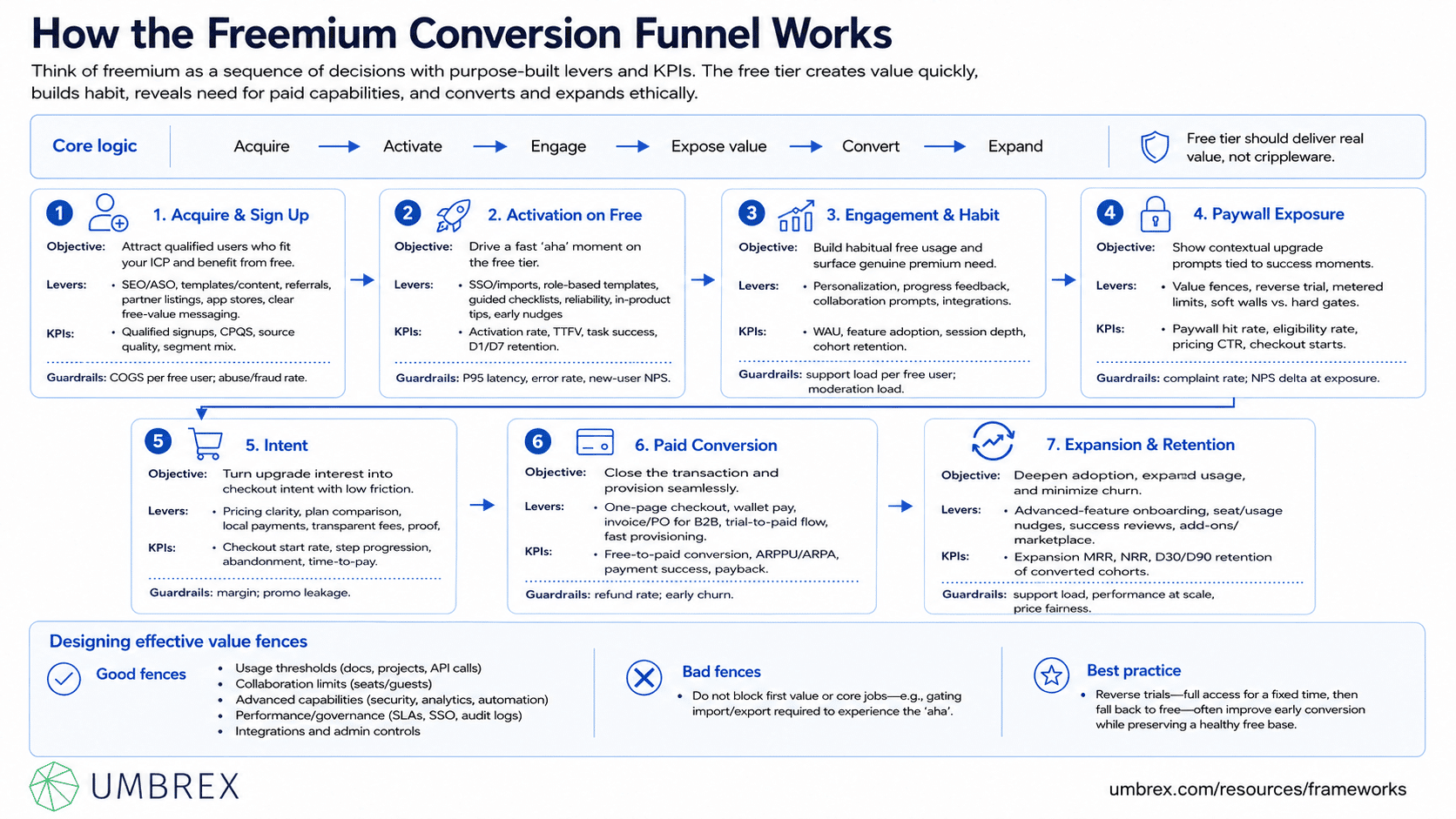
Think of freemium as a sequence of decisions with purpose-built levers and KPIs. The free tier exists to create value quickly, build habit, and reveal need for paid capabilities at the right time—then convert and expand ethically.
Stages, objectives, levers, and KPIs
- Acquire & Sign Up (top-of-funnel free)
- Objective: Attract qualified users who fit your ICP and will benefit from the free tier.
- Levers: SEO/ASO, templates/content, referral loops, partner listings, app store placements; clear messaging about free value.
- KPIs: Qualified signups/installs, cost per qualified signup (CPQS), source mix quality, device/geo/segment mix; guardrails: COGS per free user, abuse/fraud rate.
- Activation on Free (time-to-first-value)
- Objective: Ensure new users achieve the “aha” outcome quickly on the free tier.
- Levers: SSO/imports, role-based templates, guided checklists, performance/reliability, in-product tips, early-life lifecycle nudges.
- KPIs: Free activation rate, time-to-first-value (TTFV), task success, Day 1/7 retention; guardrails: P95 latency, error rates, NPS for new users.
- Engagement & Habit (sustained free use)
- Objective: Build habitual usage that reveals genuine need for premium features or limits.
- Levers: Personalization, progress feedback, collaboration prompts, integrations; ensure the free tier’s ongoing value is real, not crippleware.
- KPIs: Weekly active users (WAU), feature adoption on free, session depth, cohort retention curves; guardrails: support load per free user, content moderation where relevant.
- Paywall Exposure (value fences)
- Objective: Present clear, contextual upgrade prompts tied to success moments—where paid features unlock next-level outcomes.
- Levers: Value fences (usage caps, collaboration seats, advanced features, security/compliance, SLAs), reverse trial, metered limits, soft walls (preview) vs. hard gates.
- KPIs: Paywall hit rate, eligibility rate (users who cross a fence), click-through to pricing, self-serve checkout starts; guardrails: complaint rate about paywalls, negative NPS deltas at exposure.
- Intent (checkout start & plan selection)
- Objective: Convert interest into purchase with minimal friction and transparent value.
- Levers: Pricing/packaging clarity, plan comparison, localized payment options, tax/fee transparency, discounts with guardrails, proof (case studies).
- KPIs: Checkout start rate, step-to-step progression, abandonment rate, time-to-pay from first paywall; guardrails: margin, promo leakage.
- Paid Conversion
- Objective: Close the transaction and provision seamlessly; avoid buyer’s remorse.
- Levers: One-page checkout, Apple/Google/Shop Pay, invoice/PO for B2B, trial-to-paid flows, success-state confirmation, fast provisioning.
- KPIs: Free-to-paid conversion rate (cohort), ARPPU/ARPA, payment success, payback; guardrails: refund rate, early churn (first 30/60 days).
- Expansion & Retention
- Objective: Drive adoption depth and up-tier/usage expansion; minimize churn.
- Levers: In-product education, advanced feature onboarding, seat/usage nudges, success reviews (for high-value cohorts), add-on marketplaces.
- KPIs: Expansion MRR, NRR, D30/90 retention of converted cohorts; guardrails: support load, performance under scale, perceived price fairness.
Designing effective value fences
- Good fences align with value realization: usage thresholds (documents, projects, API calls), collaboration (seats/guests), advanced capabilities (security, analytics, automation), performance (limits, SLAs), governance (SSO, audit logs), and integrations.
- Bad fences break core jobs or block first value (e.g., gating import/exports needed to experience the “aha”).
- Reverse trials (full access for a fixed time, then fall back to free) often yield higher early conversion while still seeding a healthy free base.
4. When to Use the Freemium Conversion Funnel Framework
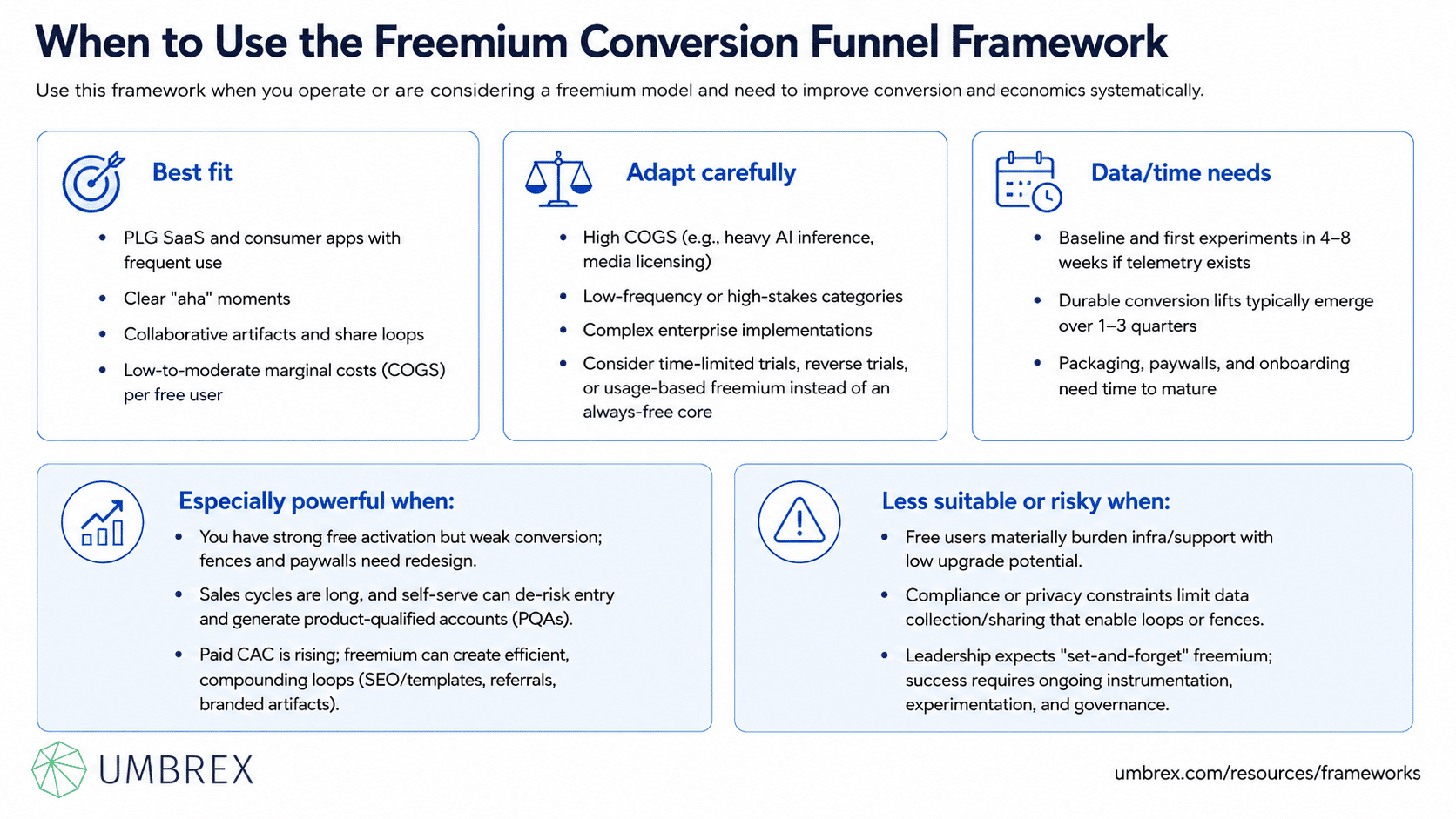
Use this framework when you operate or are considering a freemium model and need to improve conversion and economics systematically.
- Best fit: PLG SaaS and consumer apps with frequent use, clear “aha” moments, collaborative artifacts, share loops, and low-to-moderate marginal costs (COGS) per free user.
- Adapt carefully: High COGS (e.g., heavy AI inference, media licensing), low-frequency/high-stakes categories, or complex enterprise implementations. Consider time-limited trials, reverse trials, or usage-based freemium instead of an always-free core.
- Data/time needs: A baseline and first experiments in 4–8 weeks if telemetry exists. Durable conversion lifts typically emerge over 1–3 quarters as packaging, paywalls, and onboarding mature.
Especially powerful when:
- You have strong free activation but weak conversion; fences and paywalls need redesign.
- Sales cycles are long, and self-serve can de-risk entry and generate product-qualified accounts (PQAs).
- Paid CAC is rising; freemium can create efficient, compounding loops (SEO/templates, referrals, branded artifacts).
Less suitable or risky when:
- Free users materially burden infra/support with low upgrade potential.
- Compliance or privacy constraints limit data collection/sharing that enable loops or fences.
- Leadership expects “set-and-forget” freemium; success requires ongoing instrumentation, experimentation, and governance.
5. How to Apply the Freemium Conversion Funnel Framework: Step-by-Step
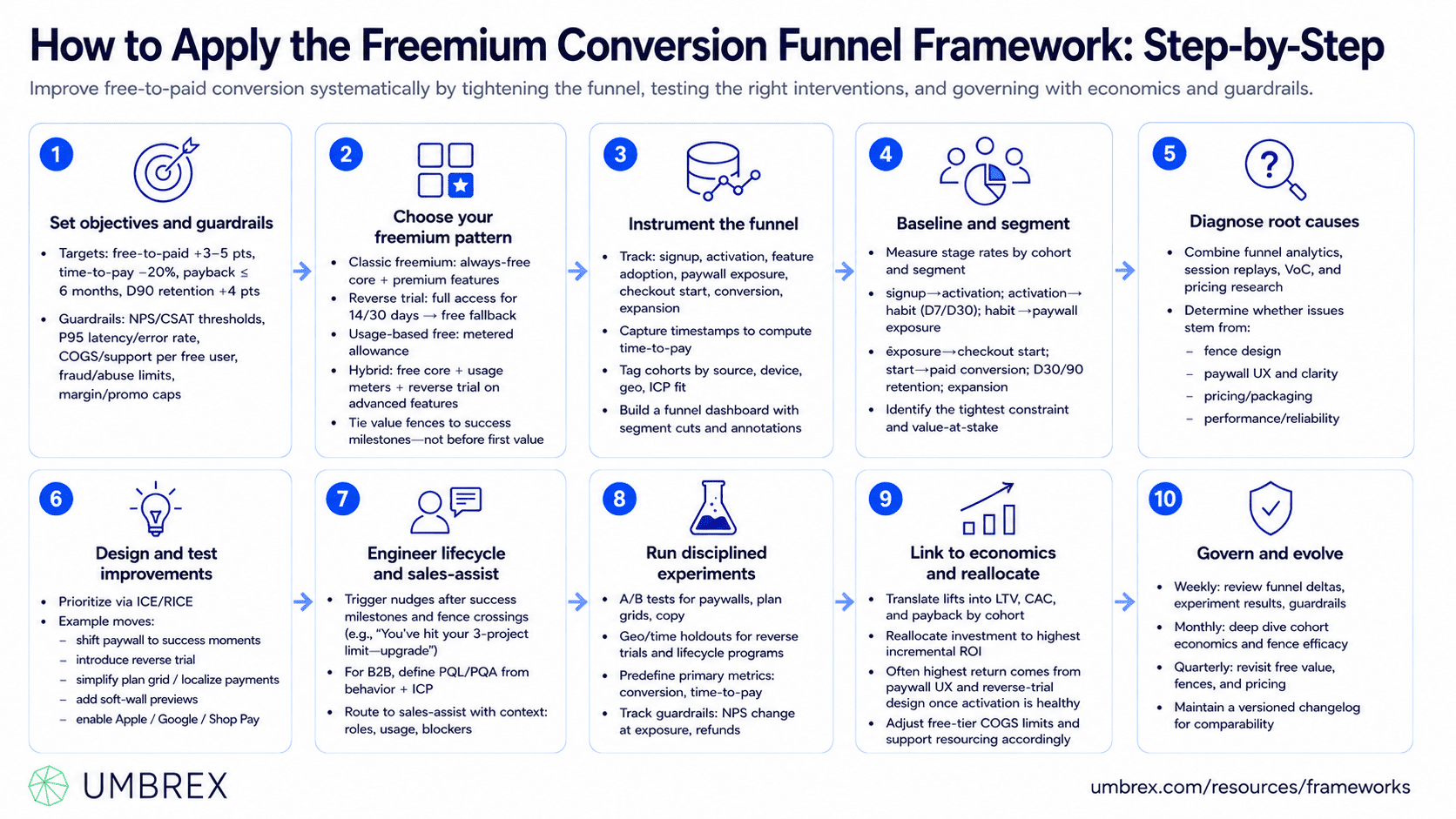
- Set objectives and guardrails
Define targets (e.g., free-to-paid +3–5 pts, time-to-pay −20%, payback ≤ 6 months, D90 retention +4 pts). Set hard guardrails: NPS/CSAT thresholds, P95 latency/error rate, COGS/support per free user, fraud/abuse limits, margin/promo caps.
- Choose your freemium pattern
Decide among:
– Always-free core + premium features (classic freemium)
– Reverse trial (full access for 14/30 days → free fallback)
– Usage-based free (metered allowance)
– Hybrid: free core + usage meters + reverse trial on advanced features
Document value fences tied to success milestones—not before first value.
- Instrument the funnel
Implement clean events for signup, activation, feature adoption, paywall exposure, checkout start, conversion, expansion; capture timestamps to compute time-to-pay. Tag cohorts by source, device, geo, ICP fit. Build a funnel dashboard with segment cuts and annotations.
- Baseline and segment
Measure stage rates by cohort and segment: signup→activation, activation→habit (D7/D30), habit→paywall exposure, exposure→checkout start, start→paid conversion, D30/90 retention of converts, expansion. Identify the tightest constraint and value-at-stake.
- Diagnose root causes
Combine funnel analytics with session replays, VoC (micro-surveys at paywall), and pricing research. Determine if issues are (a) fence design (misaligned, too early/late), (b) paywall UX and clarity, (c) pricing/packaging, or (d) performance/reliability.
- Design and test improvements
Write hypotheses in standard form and prioritize via ICE/RICE. Examples:
– Move paywall to the moment users save/share/export (success), not during setup.
– Introduce reverse trial for new users; after trial, clearly show what remains free.
– Simplify plan grid; add seat/usage calculators; localize pricing and payments.
– Add “soft wall” preview of premium results to demonstrate value.
– Enable Apple/Google/Shop Pay to reduce payment friction.
- Engineer lifecycle and sales-assist
Trigger nudges after success milestones and fence crossings (e.g., “You’ve hit your 3-project limit—upgrade to keep collaborating”). For B2B, define PQL/PQA from behavior + ICP and route to sales-assist with context (roles, usage, blockers).
- Run disciplined experiments
A/B tests for paywalls, plan grids, copy; geo/time holdouts for reverse trials and lifecycle programs. Predefine primary metrics (conversion, time-to-pay) and guardrails (NPS change at exposure, refunds).
- Link to economics and reallocate
Translate lifts into LTV, CAC, and payback by cohort. Reallocate investment toward the stage with highest incremental ROI (often paywall UX and reverse-trial design once activation is healthy). Adjust free-tier COGS limits and support resourcing accordingly.
- Govern and evolve
Weekly: review funnel deltas, experiment results, guardrails. Monthly: deep dive cohort economics and fence efficacy. Quarterly: revisit free value, fences, and pricing based on behavior and market shifts; maintain a versioned changelog for comparability.
6. Example: Freemium Funnel in Action
Context: “SketchFlow,” a PLG design-collaboration app (SMB→mid-market), offered an always-free core with premium collaboration and export features. Free activation was strong, but free-to-paid conversion stalled at 2.8%; D90 retention for converts was uneven. Infra costs for free users were trending up.
Baseline (mobile/web combined): Signup→free activation 62%; D7 retention 38%; paywall exposure among active free users 24%; exposure→checkout start 10%; start→paid 52%; net free-to-paid 2.8%; D90 retention for converts 71%; support tickets per 1k free users rising; payback 8.7 months.
Diagnosis: Replays and VoC showed paywalls appeared during first project setup (too early), not after users shared/exported (success). Plan grid was complex; pricing lacked localized options. No reverse trial; many users never experienced premium exports or real-time multiuser editing.
Interventions (prioritized with RICE):
- Shift paywall to post-share/export; add “soft wall” preview of premium export quality.
- Introduce a 14-day reverse trial: full premium on signup → fall back to a clearly valuable free plan with documented limits.
- Simplify plan grid; add seat/usage calculators; localize pricing; offer Apple/Google Pay.
- Lifecycle nudges tied to success milestones (first export, first invite, three collaborators active).
- PQL/PQA: ICP fit + 3 active collaborators + export usage → route to sales-assist with a governance & security pack.
- Infra guardrails: throttle free rendering queues at peak; cache previews; expand abuse/fraud checks.
Results (10 weeks):
- Paywall exposure among active free users rose to 37% (better timing); exposure→checkout start increased to 17% (+7 pts).
- Free-to-paid (90-day cohort) increased from 2.8% → 5.1% (+2.3 pts). Time-to-pay fell 23%.
- D90 retention for converts improved to 76% (fewer “regret” upgrades); refund rate stable.
- Self-serve accounted for 64% of new ARR (from 45%); sales-assist win rate improved on PQAs.
- Infra cost per free MAU stabilized; support tickets per 1k free users −18% via clearer fences and docs.
- Economics: LTV/CAC improved from 2.7 → 3.5; payback from 8.7 → 6.0 months.
7. Strengths and Limitations
Strengths
- Efficient demand generation: Low-friction entry grows the addressable base and fuels growth loops (templates, UGC, referrals).
- Sales acceleration: Product-qualified accounts shorten cycles and improve win rates.
- Learning velocity: Telemetry from free users informs onboarding, pricing, and packaging rapidly.
- Defensibility: Habitual free usage and community increase switching costs for competitors.
Limitations
- COGS/support burden: Free users can stress infra and teams if not managed with guardrails.
- Monetization complexity: Poorly designed fences or paywalls either block value or fail to drive upgrades.
- Cannibalization risk: Free tier can undercut paid demand without clear value fences.
- Abuse/fraud: Free access can attract bots, spam, or misuse; requires detection and limits.
8. Common Pitfalls (and How to Avoid Them)
- Crippleware free tier
What goes wrong: Users never reach first value; word-of-mouth stalls; brand suffers.
Avoid: Ensure free delivers the core job’s “minimum successful outcome;” gate advanced/scale features, not first value.
- Early or irrelevant paywalls
What goes wrong: Frustration; low exposure→intent rate.
Avoid: Trigger paywalls at success moments (export/share/collaborate thresholds), with “soft wall” previews and clear next-step value.
- Overcomplicated plan grids
What goes wrong: Decision paralysis and abandonment.
Avoid: 3–4 clear tiers, plain-language benefits, calculators, localized pricing, and default recommendations by persona.
- Vanity activation metrics
What goes wrong: High “activation” that doesn’t predict upgrades or retention.
Avoid: Define activation as an outcome correlated with retention/revenue; validate via cohort analysis.
- Ignoring infra/support economics
What goes wrong: Rising free COGS destroy payback.
Avoid: Track cost/MAU, apply rate limits/caching/queues; invest in docs/community; retire abusers.
- Dark patterns
What goes wrong: Short-term conversion, long-term churn/refunds and reputational damage.
Avoid: Transparent pricing, clear renewal terms, easy cancel/downgrade; monitor refunds/complaints as guardrails.
- No sales-assist integration
What goes wrong: Enterprise-ready free teams don’t convert; money left on the table.
Avoid: Define PQAs; pipe telemetry to CRM; equip reps with product context and security/ROI packs.
9. How the Freemium Conversion Funnel Relates to Other Frameworks
- Product-Led Growth (PLG): Freemium is a core PLG entry motion. The funnel provides the measurement and experimentation spine for converting free to paid within PLG.
- AAARRR/AARRR: Freemium spans Acquisition → Activation (on free) → Revenue (upgrade) → Retention → Referral. Use AAARRR to track lifecycle; use the freemium funnel for stage-specific levers.
- North Star Metric (NSM): Choose an NSM that reflects delivered value (e.g., “weekly active teams with collaborative sessions”). Make free activation and upgrade rates key inputs; guard with NPS/latency/margin.
- HEART: Use Task Success (activation), Adoption/Engagement (habit), Retention, and Happiness as diagnostic inputs to the freemium funnel.
- LIFT & Conversion Funnel Optimization: Apply LIFT (Value, Relevance, Clarity, Anxiety, Distraction, Urgency) to paywalls and plan grids; use funnel diagnostics to fix leaks at exposure→intent→paid.
- Lean Analytics Stages: Validate Empathy and Stickiness (free retention) before pushing Virality and Revenue/Scale; adjust fences as you progress.
- Growth Loops: Freemium amplifies loops (templates→SEO, share links, referrals). Track loop coefficients and cycle time alongside funnel KPIs.
10. Key Takeaways
- Freemium works when the free tier delivers first value fast and paywalls are tied to success moments via fair value fences.
- Manage the freemium funnel end-to-end: activation on free → habit → paywall exposure → intent → paid conversion → expansion/retention—measured by a single, instrumented scoreboard.
- Prioritize experiments on fences, paywalls, plan grids, reverse trials, and lifecycle nudges; validate with disciplined A/B and holdout tests.
- Protect guardrails: NPS/CSAT, performance, margin, promo leakage, COGS/support per free user, and abuse/fraud.
- Link decisions to economics (LTV/CAC, payback) by cohort; reallocate investment to the tightest constraint each quarter.
11. FAQs About the Freemium Conversion Funnel Framework
Is freemium right for us?
It’s a fit when users can reach first value quickly, marginal costs per free user are manageable, and clear value fences exist (advanced features, collaboration, scale, governance). If COGS are high or usage is infrequent/complex, consider a time-limited or reverse trial instead.
What’s a good free-to-paid conversion benchmark?
It varies by category and pricing. Many healthy freemium SaaS motions see 2–10% conversion in the first 90 days for qualified cohorts; mobile consumer subscriptions can range higher with trials. Focus on improving your cohorts over time and on payback/LTV—not a generic benchmark.
How do we choose value fences?
Gate by value, not by “gotchas.” Use usage limits (projects, API calls), collaboration/seats, advanced capabilities (automation, analytics), performance/SLAs, and enterprise governance (SSO, audit). Validate that fences appear after first value and correlate with willingness to pay.
Freemium vs. reverse trial: which is better?
Reverse trials often convert early cohorts better (users experience premium value) while still leaving a free plan. Classic freemium can maximize reach and loops. Many teams run hybrid: reverse trial for new users + durable free core afterward.
How long to see results?
With instrumentation in place, you can run paywall/plan experiments within weeks and see directional lifts. Durable conversion and retention gains typically compound over 1–3 quarters as you iterate fences, pricing, and onboarding.
What tech stack do we need?
Product analytics with clean event schemas/cohorts; experimentation/feature flags; billing/checkout and payments (supporting wallets/local methods); CRM that ingests product telemetry for PQAs; lifecycle orchestration (email/push/in-app). Add anti-abuse tooling for free tiers.
How do we prevent cannibalization?
Ensure paid tiers provide meaningful, non-commodity value (scale, advanced features, governance). Review downgrades, refunds, and NPS around paywalls; adjust fences and pricing. Where enterprise is material, align sales-assist to PQAs and offer enterprise-only capabilities.
How do we control free-tier costs?
Track COGS/support per free MAU; use caching, queues, and rate limits; automate onboarding/help; retire abusive accounts. Periodically prune inactive free users (with transparent comms) to reduce load.
