

1. What Is the Hooked Model (Trigger–Action–Variable Reward–Investment)?
The Hooked Model is a product design framework for building habit-forming digital experiences. It describes a four-step loop—Trigger → Action → Variable Reward → Investment—that, when repeated, increases the likelihood users return on their own (without paid prompts) and integrate a product into their routines.
In digital, ecommerce, growth, and product contexts, Hooked helps teams design features and journeys that reduce friction for the next desired behavior, deliver rewarding outcomes, and accumulate “stored value” so the product gets better with use. The aim is not just more clicks; it’s creating a reliable habit loop that aligns with real user value and healthy economics (activation, retention, LTV).
Used responsibly, Hooked is a practical way to convert intent into repeat behavior (e.g., reading, tracking, planning, collaborating, checking a balance). It is most powerful when coupled with ethical guardrails and a clear Jobs-to-Be-Done: help people achieve their goals with less effort over time.
2. Origin and Background
The Hooked Model was articulated by Nir Eyal in the 2014 book “Hooked: How to Build Habit-Forming Products.” It synthesizes ideas from behavioral psychology (e.g., B.F. Skinner’s variable reinforcement), BJ Fogg’s Behavior Model (motivation, ability, prompt), and practical product management patterns from the smartphone era.
Why it was created: Many digital products struggled with retention despite initial interest. Hooked provided a simple loop and vocabulary to design for repeat engagement—without relying solely on paid reacquisition.
How it spread: Widely adopted by product teams, growth practitioners, and startups; incorporated into courses, accelerators, and consulting toolkits. It is commonly applied alongside AARRR, JTBD, and Fogg/COM‑B to connect design choices with measurable retention outcomes.
3. How the Hooked Model Works
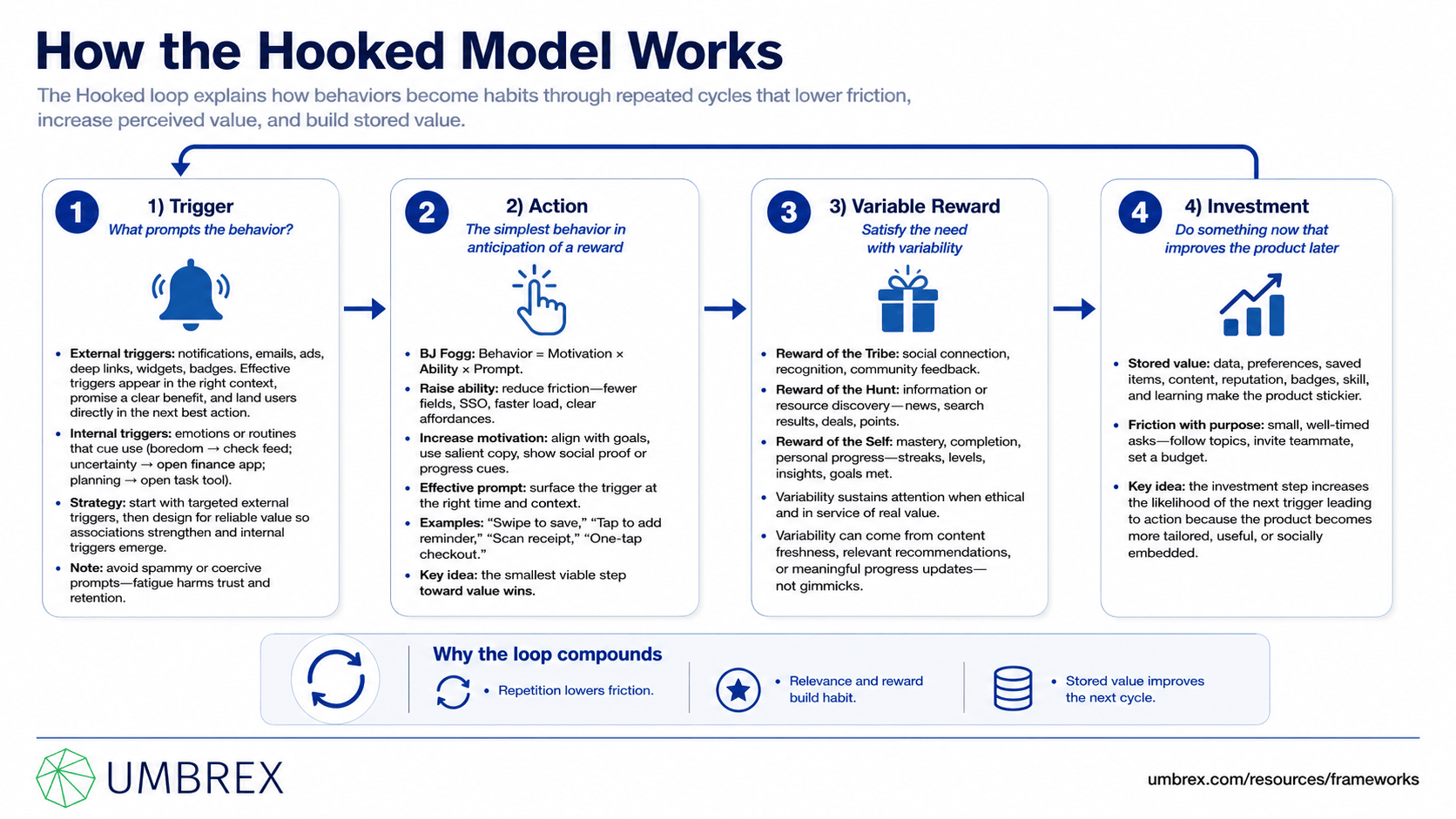
The Hooked loop explains how behaviors become habits through repeated cycles that lower friction, increase perceived value, and build stored value.
1) Trigger: What prompts the behavior?
- External triggers: Notifications, emails, ads, deep links, widgets, badges. Effective triggers appear in the right context, promise a clear benefit, and land users directly in the next best action.
- Internal triggers: Emotions or routines that cue use (boredom → check feed; uncertainty → open finance app; planning → open task tool). Internal triggers form when users associate the product with relief or progress.
Strategy: Start with targeted external triggers, then design for reliable value so the association strengthens and internal triggers emerge. Avoid spammy or coercive prompts—fatigue harms trust and retention.
2) Action: The simplest behavior in anticipation of a reward
- Per BJ Fogg, Behavior = Motivation × Ability × Prompt. To increase action:
- Raise ability: Reduce friction (fewer fields, SSO, faster load, clear affordances).
- Increase motivation: Align with goals, use salient copy, show social proof or progress cues.
- Effective prompt: Ensure the trigger surfaces at the right time and context.
Examples: “Swipe to save,” “Tap to add reminder,” “Scan receipt,” “One-tap checkout.” The smallest viable step toward value wins.
3) Variable Reward: Satisfy the need with variability
- Reward of the Tribe: Social connection, recognition, community feedback (likes, comments, upvotes).
- Reward of the Hunt: Information or resource discovery (news feed, search results, deals, points).
- Reward of the Self: Mastery, completion, personal progress (streaks, levels, insights, goals met).
Variability matters because unpredictability sustains attention—when ethical and in service of real value. Variability can be content freshness, relevant recommendations, or meaningful progress updates—not gimmicks.
4) Investment: Do something now that improves the product later
- Stored value: Data (preferences, saved items), content (playlists, docs), reputation (ratings, badges), and skill/learning make the product stickier with each use.
- Friction with purpose: Small, well-timed asks (follow topics, invite teammate, set a budget) increase the odds of future triggers and better rewards.
Key idea: The investment step increases the likelihood of the next trigger leading to action—because the product is more tailored, useful, or socially embedded.
4. When to Use (and Not Use) the Hooked Model
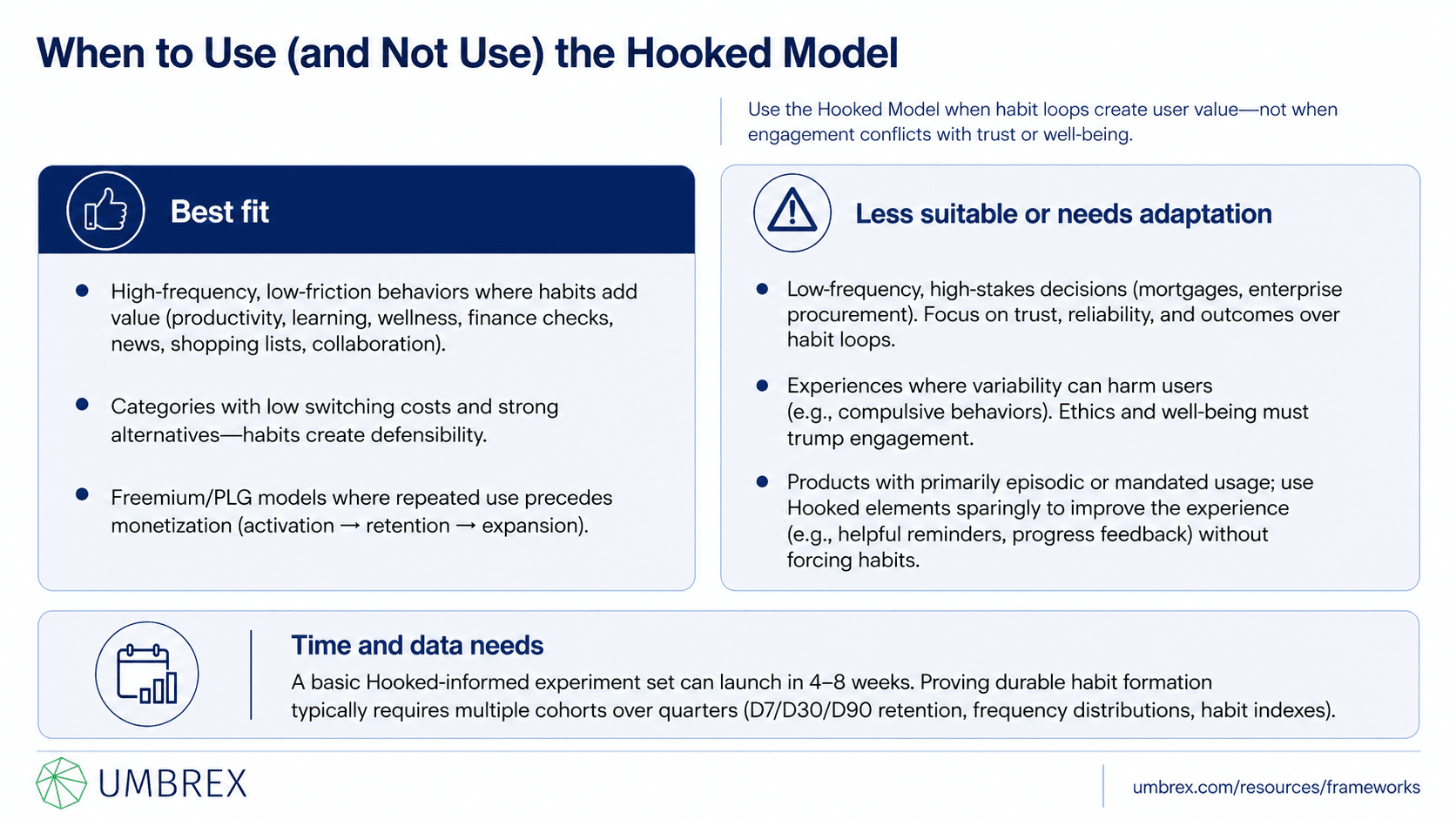
Best fit:
- High-frequency, low-friction behaviors where habits add value (productivity, learning, wellness, finance checks, news, shopping lists, collaboration).
- Categories with low switching costs and strong alternatives—habits create defensibility.
- Freemium/PLG models where repeated use precedes monetization (activation → retention → expansion).
Less suitable or needs adaptation:
- Low-frequency, high-stakes decisions (mortgages, enterprise procurement). Focus on trust, reliability, and outcomes over habit loops.
- Experiences where variability can harm users (e.g., compulsive behaviors). Ethics and well-being must trump engagement.
- Products with primarily episodic or mandated usage; use Hooked elements sparingly to improve the experience (e.g., helpful reminders, progress feedback) without forcing habits.
Time and data needs: A basic Hooked-informed experiment set can launch in 4–8 weeks. Proving durable habit formation typically requires multiple cohorts over quarters (D7/D30/D90 retention, frequency distributions, habit indexes).
5. How to Apply the Hooked Model: Step-by-Step
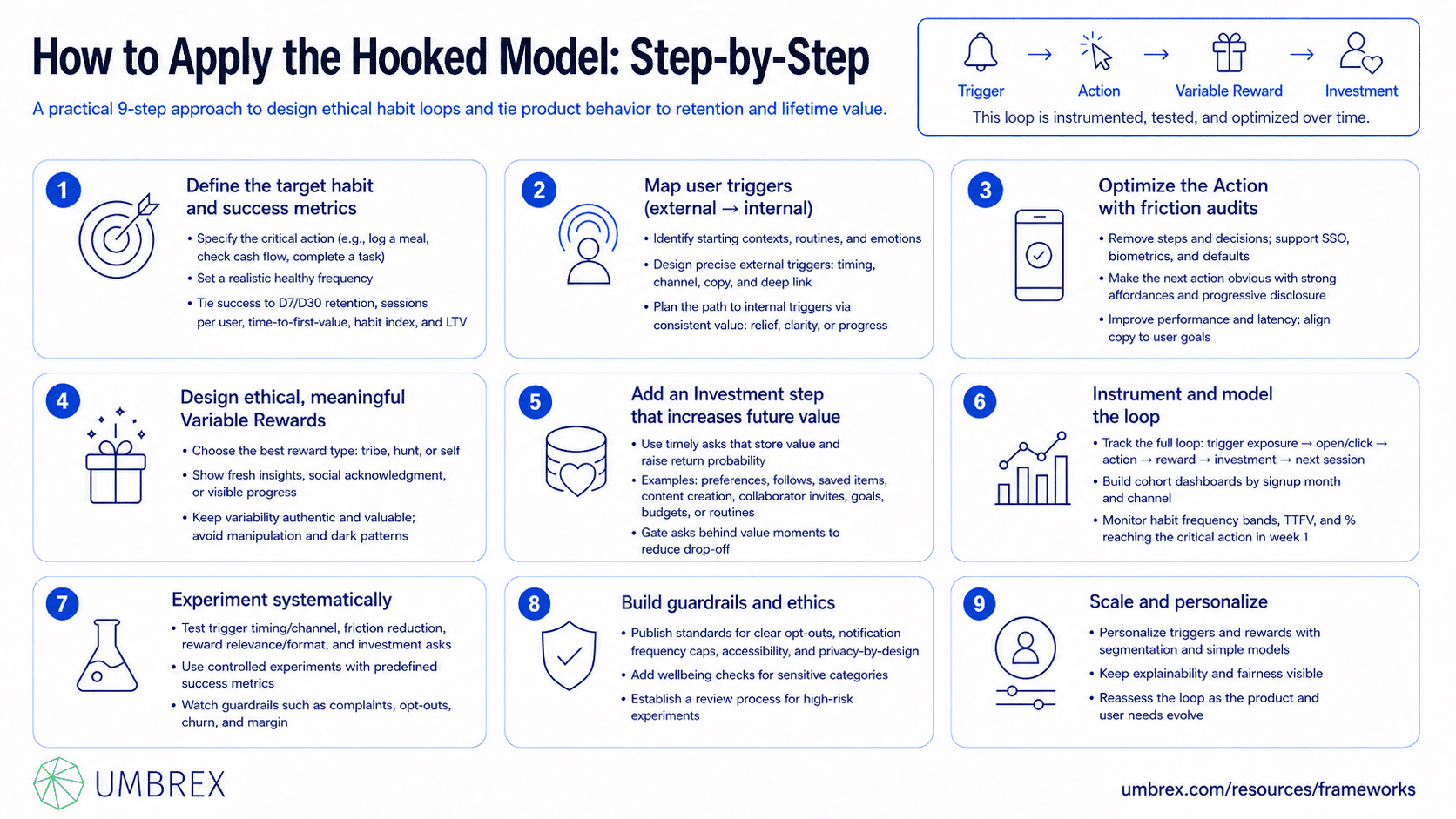
- Define the target habit and success metrics
Specify the “critical action” (e.g., “log a meal,” “check cash flow,” “complete a task”). Choose a realistic frequency (“How often should a healthy user do this?”) and tie success to retention/LTV (D7/D30 retention, sessions per user, time-to-first-value, habit index).
- Map user triggers (external → internal)
List starting contexts and emotions. Design precise external triggers (timing, channel, copy, deep link). Plan the path toward internal triggers: what consistent value will users associate with your product (relief, clarity, progress)?
- Optimize the Action with friction audits
For the critical action, remove friction ruthlessly:
– Reduce steps and decisions; support SSO, biometrics, defaults.
– Make the next action obvious; use affordances and progressive disclosure.
– Improve performance (latency matters). Test copy that aligns with user goals.
- Design ethical, meaningful Variable Rewards
Choose the reward type (tribe/hunt/self) that fits the job-to-be-done:
– Show fresh, relevant content or insights (hunt).
– Provide social acknowledgment or help (tribe).
– Visualize progress and mastery (self).
Keep variability authentic, not manipulative; avoid dark patterns.
- Add an Investment step that increases future value
Identify small, timely asks that store value and raise return probability:
– Preference settings, follows, or saved items (better recommendations).
– Creating content or inviting collaborators (network effects).
– Setting goals, budgets, or routines (progress tracking).
Gate asks behind value moments to avoid drop-off.
- Instrument and model the loop
Track: trigger exposure → click/open → action completion → reward consumption → investment event → next session. Build cohort dashboards (signup month, channel) with habit frequency bands and leading indicators (TTFV, % hitting critical action in week 1).
- Experiment systematically
Run controlled tests on:
– Trigger timing/channel and deep links.
– Action friction (fields removed, layout simplification).
– Reward relevance/format (recommendation algorithms, progress visuals).
– Investment asks (what/when/how framed).
Predefine success and guardrails (complaints, opt-outs, churn, margin).
- Build guardrails and ethics
Publish standards: clear opt-outs, notification frequency caps, accessibility, privacy-by-design, avoidance of dark patterns, wellbeing checks for sensitive categories. Establish a review for high-risk experiments.
- Scale and personalize
As signals grow, personalize triggers and rewards via segmentation and simple models (no need for heavy AI initially). Keep explainability and fairness in view. Reassess the loop as product and user needs evolve.
6. Example: Hooked in Action
Context: “FinWell,” a $35M ARR consumer budgeting app, had solid acquisition but weak month‑2 retention. Users cited “too much effort” and limited insight after setup.
Application:
- Target habit: Open app 5–7 times per week to review spend, categorize transactions, and check upcoming bills.
- Trigger: External—weekly bill reminders and “new transactions to review” push, deep-linking to the review screen. Goal—build internal trigger: “uncertainty about money → check FinWell for clarity.”
- Action: Reduced onboarding fields via open banking; auto-categorized 80% of transactions; one-tap confirm for categories; SSO and Face ID login.
- Variable reward: “Today’s insight” card shows spend anomalies, savings opportunities, or progress to goal; occasional micro‑rewards (e.g., “You saved $42 vs. last week”).
- Investment: After a rewarding insight, prompt to set a savings goal or rule (“round‑up to save”), follow merchants for deal alerts, or add categories—improves future recommendations.
Outcomes (8 weeks, controlled rollout): Time‑to‑first‑value dropped from 3 days to same‑day for 62% of new users. The share who completed “review 10 transactions” in week 1 rose from 27% to 44%. D30 retention increased by 7.5 pts; weekly active days per retained user rose from 3.2 to 4.1. Complaint rate about notifications fell after adding frequency caps and “snooze,” and NPS improved by 6 points among month‑2 users.
7. Strengths and Limitations
Strengths
- Clarity: A simple loop and vocabulary that unites product, design, and growth around behavior change.
- Retentive by design: Focuses on reducing friction, delivering value quickly, and storing value to raise return probability.
- Measurable: Maps well to cohort analytics and habit metrics; testable via controlled experiments.
- Scalable: Works for PLG, consumer apps, and ecommerce journeys; adaptable across features.
Limitations
- Ethical risk: Poorly applied, variable rewards and triggers can drift into manipulation; trust and wellbeing suffer.
- Not a strategy: Hooked is a design loop, not positioning or product‑market fit; without real value, habits won’t stick.
- Category dependence: Low-frequency or high-stakes products won’t benefit much from habit loops; focus on reliability and outcomes.
- Over‑notification: External triggers are easy to abuse; fatigue drives churn and regulatory risk.
8. Common Pitfalls (and How to Avoid Them)
- Chasing engagement over value
What goes wrong: Frequent prompts and gamification without meaningful outcomes.
Avoid: Anchor rewards in real progress (insights, completion, community help). Measure retention and LTV, not just clicks.
- Overusing notifications
What goes wrong: Users mute or churn; deliverability tanks.
Avoid: Frequency caps, user preferences, quiet hours, and trigger relevance. Deep-link to next best action.
- Skipping the Investment step
What goes wrong: No stored value; habits don’t form.
Avoid: After value moments, ask for small contributions that personalize and improve future use (follows, goals, saved items).
- Ignoring friction in the critical action
What goes wrong: Users never reach the reward.
Avoid: Ruthless friction audits; reduce steps; improve performance; make affordances obvious.
- Gimmicky variability
What goes wrong: Novelty fades; trust erodes.
Avoid: Tie variability to content freshness, relevance, and genuine progress—not randomness for its own sake.
- One-size-fits-all triggers
What goes wrong: Mis-timed prompts miss context; fatigue rises.
Avoid: Segment timing and channel; let users set preferences; respect intent signals.
- No ethical guardrails
What goes wrong: Reputational or regulatory issues.
Avoid: Establish a review for sensitive designs; publish standards (no dark patterns, easy opt-out, transparency).
9. How the Hooked Model Relates to Other Frameworks
- Fogg Behavior Model / COM‑B: Hooked’s “Action” aligns with Fogg’s B=MAP (motivation, ability, prompt) and COM‑B (Capability, Opportunity, Motivation). Use these to diagnose action failures.
- Habit Loop (Cue–Routine–Reward): Hooked extends the classic loop with “Investment,” explaining how products get better with use and increase future engagement.
- AARRR (Pirate Metrics): Hooked primarily improves Activation and Retention (and indirectly Revenue, Referral). Use AARRR for the scoreboard; Hooked for the behavioral design.
- See–Think–Do–Care / RACE: Hooked sits inside Act/Convert/Engage stages—design triggers/actions on PDPs, app flows, and lifecycle messages that lead to repeat value.
- Jobs-to-Be-Done (JTBD) and Kano: JTBD defines real outcomes; Kano helps prioritize features that deliver must‑haves and delighters. Hooked operationalizes behavior around them.
- North Star Metric / HEART: Use a North Star tied to sustained value (e.g., “weekly completed plans per active user”) and HEART (Happiness, Engagement, Adoption, Retention, Task success) to ensure Hooked designs improve user wellbeing.
10. Key Takeaways
- The Hooked Model’s four steps—Trigger, Action, Variable Reward, Investment—explain how products create healthy, repeat behaviors.
- Reduce friction for the critical action, deliver meaningful (not gimmicky) variable rewards, and ask for small investments that store value and improve future experiences.
- Design external triggers that evolve toward internal triggers by consistently delivering value; avoid notification fatigue and dark patterns.
- Measure habit formation with cohorts and frequency bands (D7/D30 retention, sessions per user, habit index), not vanity metrics.
- Hooked is a design tool, not a substitute for product‑market fit or ethics; pair it with JTBD, AARRR, and a North Star Metric.
11. FAQs About the Hooked Model
Is the Hooked Model manipulative?
It can be if misused. Applied ethically, Hooked helps reduce friction and deliver real value at the right time. Establish guardrails: consent and preferences, frequency caps, clear opt‑outs, avoid dark patterns, and prioritize wellbeing. Measure long‑term retention/LTV and user satisfaction, not just short‑term engagement.
How do we measure whether a habit has formed?
Use cohort retention (D7/D30/D90), frequency distributions (e.g., % of users achieving target weekly actions), time-to-first-value, and a habit index (e.g., 4+ sessions/week for 3 consecutive weeks). Monitor reduction in reliance on external triggers over time.
Does Hooked work in B2B?
Yes—especially for PLG or daily-use tools (collaboration, dev ops, analytics). Triggers can be workflow cues or notifications; rewards include progress, insights, and team acknowledgment; investments are content creation, integrations, and teammate invites. For sales‑led enterprise, apply Hooked to end‑user adoption and admin workflows post‑sale.
How long before we see impact?
You can improve action completion and time-to-first-value within weeks. Durable retention gains typically require multiple iterations over 1–3 quarters as cohorts cycle and internal triggers strengthen.
What if our product lacks “variable rewards” like a social feed?
Variable rewards aren’t limited to feeds. Useful variability includes fresh insights, evolving recommendations, progress milestones, or community help. Focus on relevance and progress; avoid randomness that doesn’t serve the job-to-be-done.
How do we avoid over‑notifying?
Let users set preferences; enforce quiet hours and frequency caps; trigger only when there is clear, immediate value; deep-link to the next best action; and track opt‑out/complaint rates as guardrails.
