
1. What Is the Relationship Marketing Ladder (Stranger–Acquaintance–Friend–Partner)?
The Relationship Marketing Ladder is a customer relationship framework that describes how interactions with individuals or accounts deepen over time, moving from minimal familiarity to strategic partnership. The classic rungs are: Stranger → Acquaintance → Friend → Partner. Each rung reflects increased mutual knowledge, trust, commitment, and value exchange.
In customer, service, CRM, and CX contexts, the ladder is a simple way to align marketing, sales, product, and service activities around relatonship depth—not just transactions. It shifts the question from “How many leads or customers do we have?” to “Where are they on the ladder, what would it take to move them up, and what is the economic payoff?”
Consultants and executives use the ladder to design lifecycle communications, account plans, and service models that match relationship stage, and to prioritize investments in experiences and capabilities that enable progression—e.g., from basic awareness to trusted advisor status.
2. Origin and Background
Origin: Unknown; in use since at least the 1990s. The ladder draws on relationship marketing scholarship (e.g., Berry’s work in the 1980s and subsequent buyer–seller relationship stage models) and has been popularized in sales training, CRM practice, and business education. The specific “Stranger–Acquaintance–Friend–Partner” phrasing appears in practitioner literature and coursework, with variations across industries.
Why it was created: To give organizations a clear, intuitive model for evolving beyond transactional selling and one-off service interactions toward deeper, trust-based relationships that yield higher lifetime value for both parties.
How it spread: Through CRM implementations, account management methods, and CX programs that required a practical, plain-English way to describe relationship depth and orchestrate stage-appropriate plays.
3. How the Relationship Marketing Ladder Works
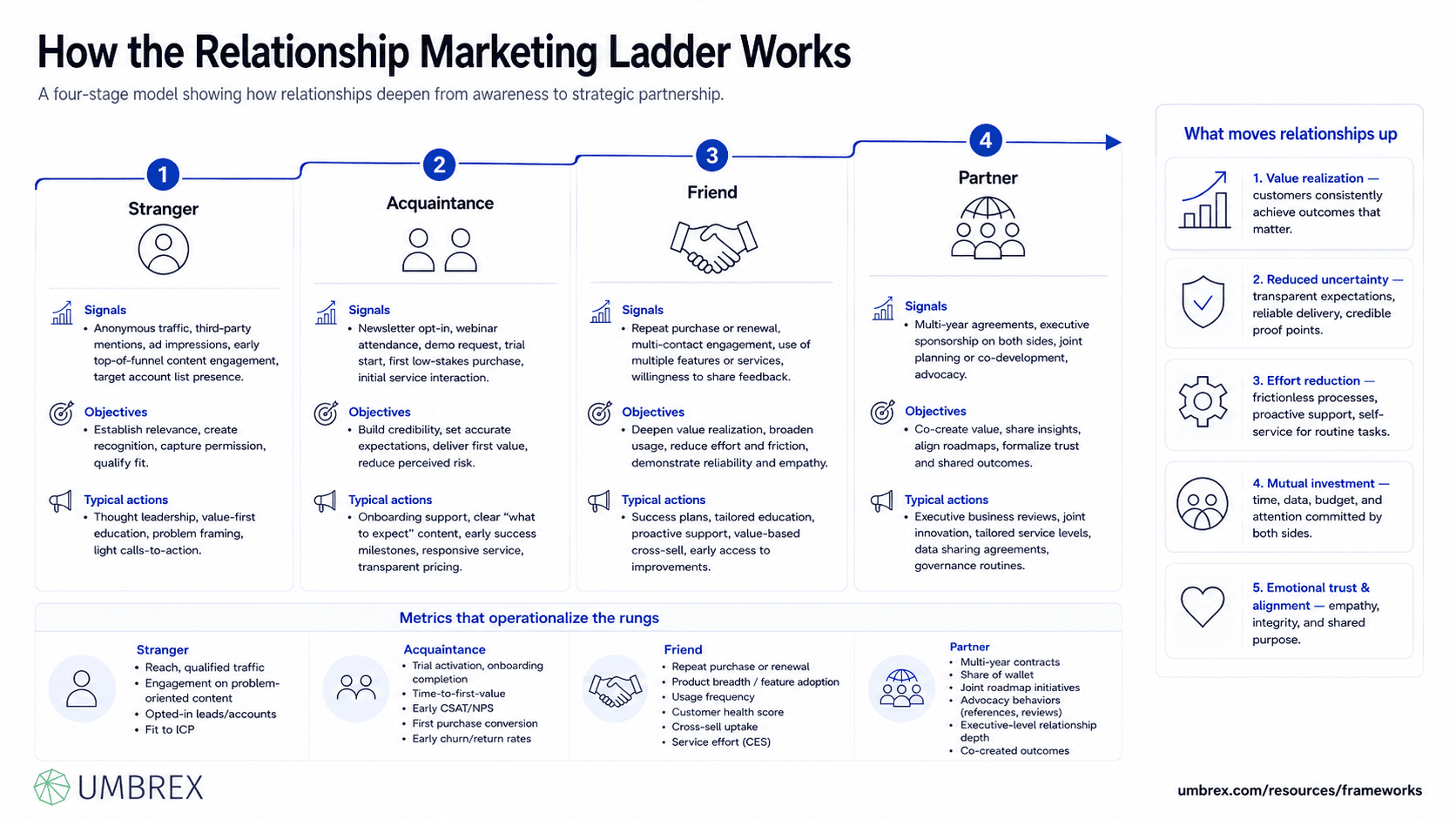
The ladder posits that customers progress through four qualitatively different stages. Advancement is driven by experiences delivering value, reducing uncertainty, and aligning incentives—not by time alone. Each rung should be defined with observable signals, corresponding objectives, and stage-appropriate actions.
The rungs, defined with signals and objectives
- Stranger: No direct relationship; limited awareness.
- Signals: Anonymous traffic, third-party mentions, ad impressions, early engagement with top-of-funnel content, presence on a target account list.
- Objectives: Establish relevance, create recognition, capture permission (opt-in), qualify fit.
- Typical actions: Thought leadership, value-first education, problem framing, light calls-to-action that earn attention without hard sell.
- Acquaintance: Basic awareness and initial two-way contact.
- Signals: Newsletter opt-in, webinar attendance, demo request, trial start, first purchase of a low-stakes item, initial service interaction.
- Objectives: Build credibility, set accurate expectations, deliver first value, reduce perceived risk.
- Typical actions: Onboarding support, clear “what to expect” content, early success milestones, responsive service, transparent pricing.
- Friend: Repeat engagement and emerging trust.
- Signals: Repeat purchase or subscription renewal, multi-contact engagement in B2B, use of multiple features or services, willingness to share feedback.
- Objectives: Deepen value realization, broaden usage, reduce effort and friction, demonstrate reliability and empathy.
- Typical actions: Success plans, tailored education, proactive support, value-based cross-sell, early access to improvements.
- Partner: Strategic, mutual commitment and co-creation.
- Signals: Multi-year agreements, executive sponsorship on both sides, joint planning or co-development, advocacy (references, case studies), mutual investments.
- Objectives: Co-create value, share insights, align roadmaps, formalize trust and shared outcomes.
- Typical actions: Executive business reviews, joint innovation, tailored service levels, data sharing agreements, mutual marketing, governance routines.
What moves relationships up the ladder
- Value realization: The customer consistently achieves outcomes that matter to them.
- Reduced uncertainty: Transparent expectations, reliable delivery, and credible proof points shrink perceived risk.
- Effort reduction: Frictionless processes, proactive support, and self-service for routine tasks.
- Mutual investment: Time, data, budget, and attention committed by both sides signal commitment and align incentives.
- Emotional trust and alignment: Empathy, integrity, and shared purpose build resilience during setbacks.
Metrics that operationalize the rungs
- Stranger: Reach, qualified traffic, engagement on problem-oriented content, opted-in leads/accounts, fit to Ideal Customer Profile (ICP).
- Acquaintance: Trial activation, onboarding completion, time-to-first-value, early CSAT/NPS, first purchase conversion, early churn/return rates.
- Friend: Repeat purchase or renewal, product breadth/feature adoption, usage frequency, customer health score, cross-sell uptake, service effort (CES).
- Partner: Multi-year contracts, share of wallet, joint roadmap initiatives, advocacy behaviors (references, reviews), executive-level relationship depth, co-created outcomes.
4. When to Use the Relationship Marketing Ladder
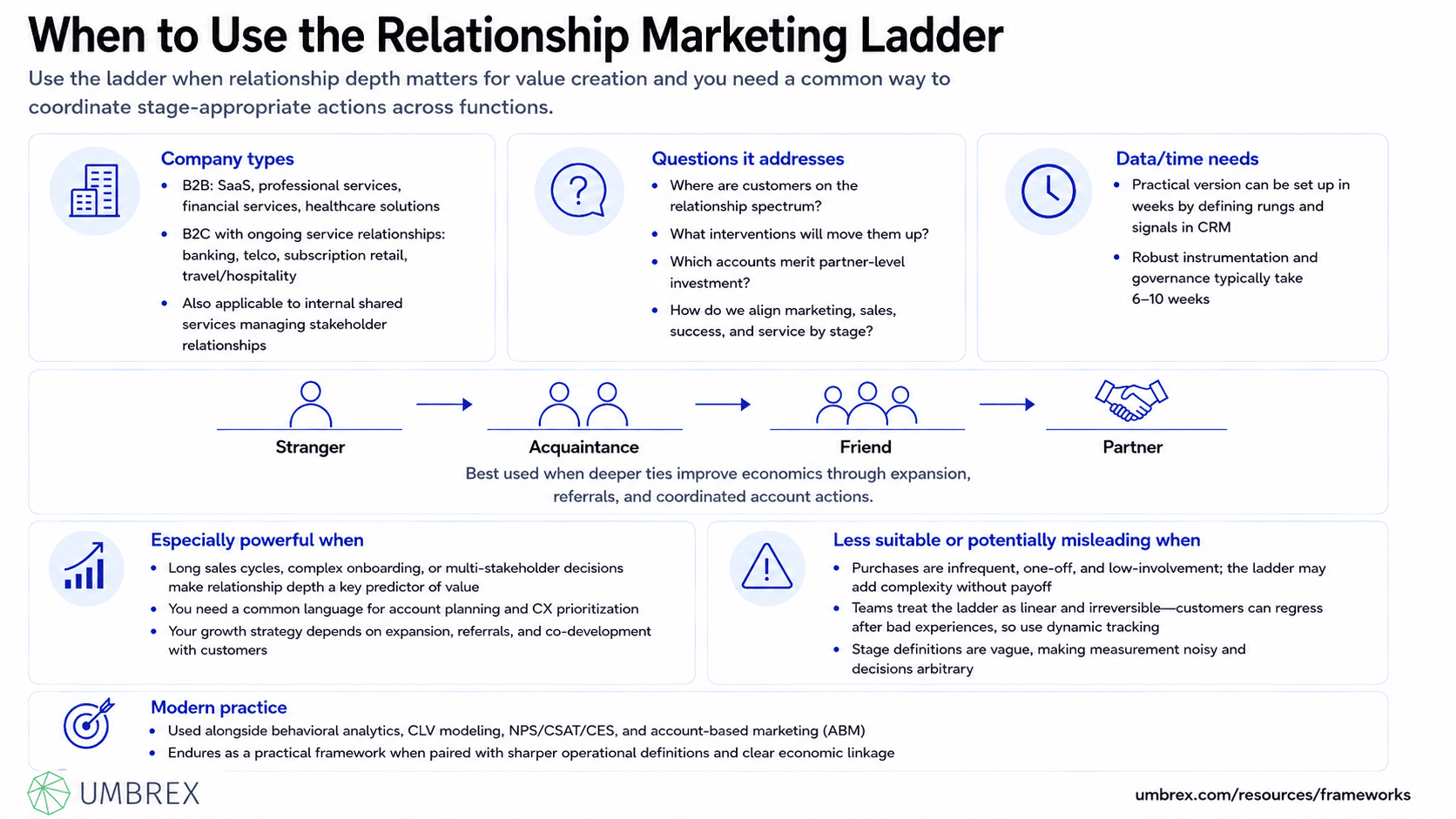
The ladder is most useful when you need a simple, cross-functional way to describe relationship depth, coordinate stage-appropriate activities, and focus investment where deeper ties will improve economics.
- Company types: B2B (SaaS, professional services, financial services, healthcare solutions), and B2C categories with ongoing service relationships (banking, telco, subscription retail, travel/hospitality). Also applicable to internal shared services managing stakeholder relationships.
- Questions it addresses: Where are customers on the relationship spectrum? What interventions will move them up? Which accounts merit partner-level investment? How do we align marketing, sales, success, and service by stage?
- Data/time needs: You can stand up a practical version in weeks by defining rungs and signals in your CRM, then iterating. Robust instrumentation and governance typically take 6–10 weeks.
Especially powerful when:
- Long sales cycles, complex onboarding, or multi-stakeholder decisions make relationship depth a key predictor of value.
- You need a common language for account planning and CX prioritization.
- Your growth strategy depends on expansion, referrals, and co-development with customers.
Less suitable or potentially misleading when:
- Purchases are infrequent, one-off, and low-involvement; the ladder may add complexity without payoff.
- Teams treat the ladder as linear and irreversible—customers can regress after bad experiences; use dynamic tracking.
- Stage definitions are vague, making measurement noisy and decisions arbitrary.
Modern practice uses the ladder alongside behavioral analytics, CLV modeling, NPS/CSAT/CES, and account-based marketing (ABM). The framework has endured but is applied with sharper operational definitions and economic linkage.
5. How to Apply the Relationship Marketing Ladder: Step-by-Step
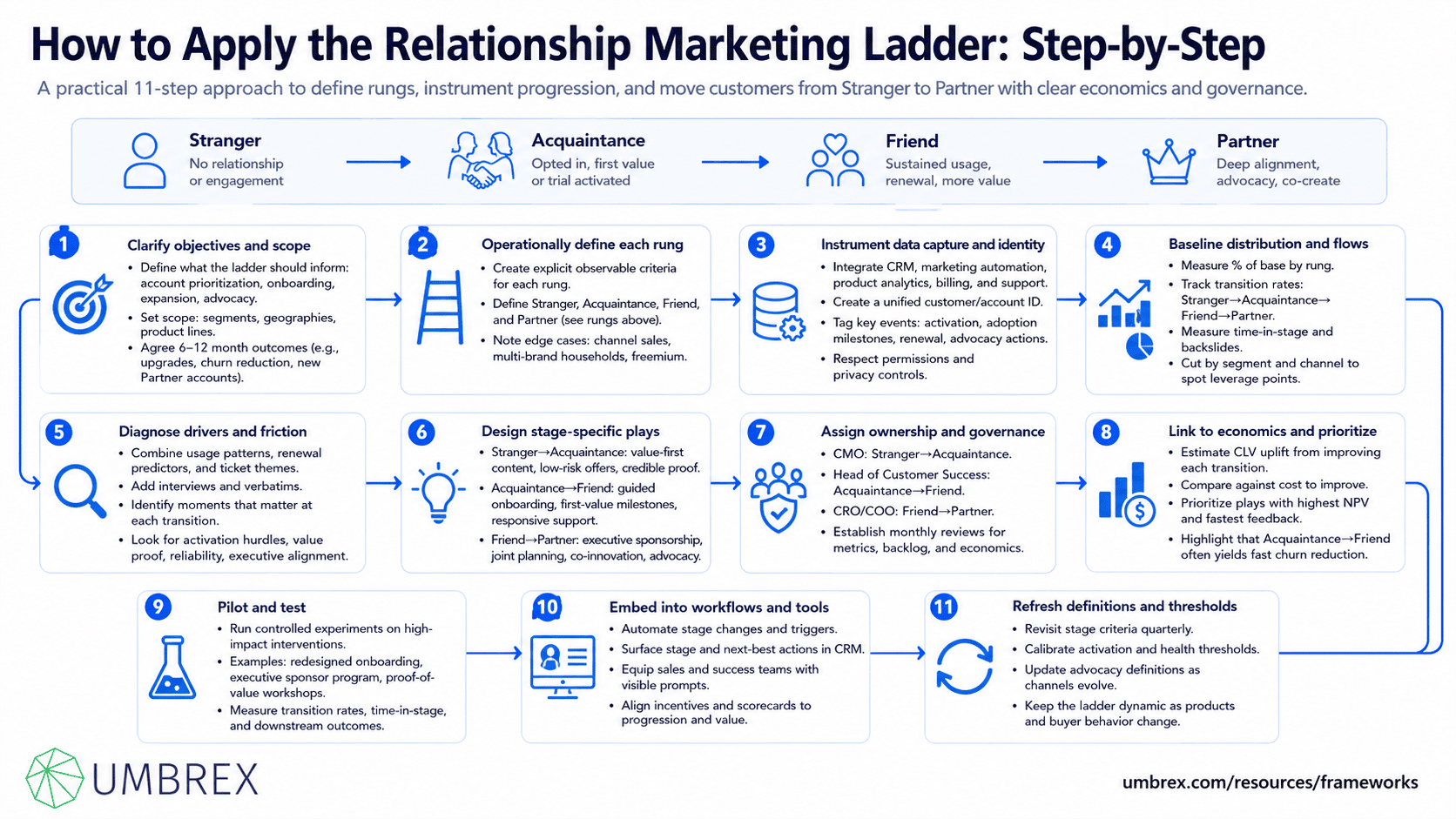
- Clarify objectives and scope
Decide what you want the ladder to inform—e.g., account prioritization, onboarding improvements, expansion plays, or advocacy. Define scope (segments, geographies, product lines) and the 6–12 month outcomes (e.g., +15% upgrades, −200 bps churn in Friend stage, 50 new Partner-level accounts).
- Operationally define each rung
Translate the four rungs into explicit, observable criteria. For example:
– Stranger: no PII captured; or ICP-qualified account with no engagement in 6 months.
– Acquaintance: opted-in lead; or first purchase; or trial activated and onboarding started.
– Friend: renewal ≥1; or breadth ≥2 products; or weekly active usage above threshold for 3 months.
– Partner: multi-year agreement; executive sponsor on both sides; joint initiatives or advocacy (e.g., referenceable case study).
Document edge cases (channel sales, multi-brand households, freemium) and avoid ambiguous proxies (“good relationship”) without proof behaviors.
- Instrument data capture and identity
Integrate CRM, marketing automation, product analytics, billing, and support systems. Create a unified customer/account ID. Tag key events (activation, adoption milestones, renewal, advocacy actions). Ensure permissions and privacy controls are respected.
- Baseline distribution and flows
Quantify: percentage of base at each rung, transition rates (Stranger→Acquaintance→Friend→Partner), time-in-stage, and backslides (Friend→Acquaintance via inactivity or complaints). Analyze by segment and channel to spot leverage points.
- Diagnose drivers and friction
Combine quantitative analysis (usage patterns, renewal predictors, ticket themes) with qualitative insight (interviews, verbatims). Identify the “moments that matter” at each transition—activation hurdles, value proof moments, executive alignment, proof of reliability.
- Design stage-specific plays
– Stranger→Acquaintance: Value-first content, “try without risk” offers, clear expectation-setting, credible proof (reviews, case studies), and conversion paths optimized for quality not just volume.
– Acquaintance→Friend: Guided onboarding, first-value milestones, success plans, responsive support, early-warning risk signals, and price/packaging that encourages breadth.
– Friend→Partner: Executive sponsorship, joint planning, co-innovation pilots, tailored SLAs, governance routines, and formalized advocacy programs.
- Assign ownership and governance
Give each transition an executive owner (e.g., CMO for Stranger→Acquaintance, Head of Customer Success for Acquaintance→Friend, CRO/COO for Friend→Partner). Establish monthly reviews to track stage metrics, backlog, and economics (CLV, churn, expansion).
- Link to economics and prioritize
Estimate the CLV uplift from improving each transition by X points and the cost to do so. Prioritize a portfolio of plays with the highest net present value and near-term feedback (e.g., accelerating Acquaintance→Friend often yields fast churn reduction).
- Pilot and test
Run controlled experiments on a few high-impact interventions (e.g., redesigned onboarding, executive sponsor program, proof-of-value workshops). Measure changes in transition rates, time-in-stage, and downstream outcomes (renewal, expansion, advocacy).
- Embed into workflows and tools
Automate stage changes and triggers (e.g., usage threshold met → prompt success plan review). Surface stage and next-best actions in CRM for sales and success teams. Align incentives and scorecards to progression and value, not just volume.
- Refresh definitions and thresholds
Revisit stage criteria quarterly as products, markets, and buyer behaviors evolve. Calibrate thresholds (activation, health) and expand advocacy definitions as new channels emerge.
6. Example: The Ladder in Action
Context: “InsightForge,” a $300M B2B analytics SaaS, had strong lead volume but mediocre conversion from trials to paid and a renewal dip in year one. Few customers served as references. The CEO wanted a plan to deepen relationships and grow expansion revenue.
Approach: The team implemented the Relationship Marketing Ladder with clear operational definitions:
- Stranger: ICP-fit account with no meaningful engagement in 6 months.
- Acquaintance: trial started or first paid tier; onboarding checklist initiated.
- Friend: renewed once or adopted 3+ core features with weekly active usage ≥ the health threshold for 12 weeks.
- Partner: joint roadmap workshop completed; executive sponsor on both sides; agreed to be a public reference or participate in a case study.
They instrumented stage changes in CRM, linked product analytics, and set ownership of transitions (Marketing → Sales for Stranger→Acquaintance; Customer Success for Acquaintance→Friend; Executive Account Team for Friend→Partner).
Insights:
- Only 38% of trials reached first-value within 14 days; those who did were 3.2x more likely to convert.
- Accounts without an executive sponsor by day 45 had 2x higher risk of non-renewal.
- Customers using two specific integrations were 2.7x more likely to expand.
Actions:
- Stranger→Acquaintance: Reworked value-first content and introduced “guided trial” with a sandbox and preloaded data; tightened targeting to ICP verticals; set clear timeline expectations on the website.
- Acquaintance→Friend: Launched a 14-day “first value” program with in-product walkthroughs, milestone nudges, and office-hours; assigned a named success manager to high-potential accounts; created a risk alert for no executive sponsor by day 45.
- Friend→Partner: Introduced quarterly executive business reviews, co-innovation workshops for top 10% of accounts, and a structured advocacy program (references, webinars) with recognition and early access to features.
Outcomes (two quarters): Trial-to-paid conversion improved from 21% to 33%; onboarding time-to-first-value dropped from 21 to 11 days. Year-one renewal rate increased by 6 points, with the largest gains in accounts hitting the “first value” milestone. The number of Partner-stage accounts doubled; reference coverage improved, boosting win rates in new pipeline. Expansion revenue grew 14% YoY in pilot segments, and the CFO reallocated budget from broad acquisition to onboarding and executive engagement.
7. Strengths and Limitations
Strengths
- Clarity: Four intuitive stages create a shared language across marketing, sales, product, and service.
- Actionable: Encourages stage-specific plays that align to measurable progression and value.
- Economic linkage: Natural fit with CLV; moving up the ladder correlates with higher retention, expansion, and advocacy.
- Scalable: Works for startups and enterprises; definitions can be made precise and instrumented in CRM and analytics.
Limitations
- Oversimplification risk: Real relationships are non-linear; the four rungs can mask nuance without segmentation and behavioral metrics.
- Ambiguity: Vague stage definitions undermine measurement and action.
- Resource intensity at the top: Partner-stage programs require executive attention and tailored investments; not every account merits it.
- Attitude–behavior gap: Customers may value you highly yet avoid public advocacy; don’t over-rely on advocacy as the sole Partner signal.
8. Common Pitfalls (and How to Avoid Them)
- Vague stage criteria
What goes wrong: Inconsistent classification makes dashboards and decisions unreliable.
How to avoid: Use observable behaviors (usage, renewal, sponsorship, advocacy) and codify edge cases.
- Treating the ladder as linear and irreversible
What goes wrong: Teams miss regression risk and recovery opportunities.
How to avoid: Track backslides and design save/recovery plays; manage time-in-stage.
- Over-investing in strangers, under-investing in acquaintances
What goes wrong: High top-of-funnel spend, weak onboarding; poor trial-to-paid and early churn.
How to avoid: Shift resources to first-value acceleration; measure Acquaintance→Friend conversion as a primary KPI.
- Declaring “partner” based on sentiment only
What goes wrong: “Happy” customers without formal commitment or advocacy; fragile relationships.
How to avoid: Require objective signals (multi-year commitment, joint initiatives, executive sponsor) for Partner stage.
- One-size-fits-all plays
What goes wrong: Generic outreach ignores segment needs; low conversion up the ladder.
How to avoid: Tailor by segment (vertical, size, persona) and by behavior (usage patterns, value drivers).
- Ignoring economics
What goes wrong: Investing partner-level resources in low-potential accounts.
How to avoid: Link ladder progression to CLV and prioritize accounts with the highest expected ROI.
9. How the Ladder Relates to Other Frameworks
- Loyalty Ladder (Prospect–Customer–Client–Advocate): Both model relationship depth. The Relationship Marketing Ladder emphasizes mutual commitment and partnership; the Loyalty Ladder emphasizes advocacy. Use them together: Friend/Partner often correlates with Client/Advocate.
- Customer Lifecycle (Acquire–Onboard–Develop–Retain–Win‑Back): Lifecycle outlines stages of engagement; the ladder describes depth of relationship. Map lifecycle transitions to ladder progression to design stage-specific plays.
- Customer Value Management (Acquire–Retain–Develop): CVM provides the economic prioritization; the ladder provides the relationship lens. Use CVM to choose where to invest to move accounts up the ladder profitably.
- Net Promoter System (NPS), CSAT, CES: Outcome metrics that indicate loyalty and effort. Use them to monitor health at Acquaintance/Friend levels and to qualify for Partner-stage investment.
- Journey Mapping and Moments of Truth: Journey maps find critical episodes; Moments of Truth focuses execution on them. Use these to design the experiences that enable upward progression on the ladder.
- Grönroos / SERVQUAL / RATER / Gaps Model: Quality frameworks diagnose why relationships stall (technical vs. functional quality, expectations vs. delivery). Fix basics to support movement from Acquaintance to Friend and beyond.
- Account-Based Marketing (ABM): ABM targets high-value accounts; the ladder helps define stage-specific ABM plays (e.g., executive engagement for Friend→Partner).
- Kano Model: Use to prioritize features/benefits that move customers from Friend to Partner by delivering must-haves and selective delighters.
10. Key Takeaways
- The Relationship Marketing Ladder (Stranger–Acquaintance–Friend–Partner) is a simple, powerful way to manage relationship depth and align cross-functional plays.
- Define each rung with observable signals, instrument stage transitions, and focus on the moments that move customers up—first value, reliability, executive alignment, and mutual investment.
- Link progression to economics (CLV, renewal, expansion, advocacy) and prioritize investments where the ROI is highest.
- Avoid common traps: vague definitions, linear assumptions, over-weighting top-of-funnel, and “partner” without proof.
- Combine with lifecycle, CVM, journey mapping, and quality frameworks to translate strategy into measurable outcomes.
11. FAQs About the Relationship Marketing Ladder (Stranger–Acquaintance–Friend–Partner)
Is the ladder linear? Do customers always move upward?
No. Customers can progress, pause, or regress based on experiences and changing needs. Track time-in-stage and backslides, and design recovery plays to re-establish trust and value.
How should we define “Partner” concretely?
Use objective signals such as multi-year agreements, executive sponsorship on both sides, joint planning or co-development, and advocacy commitments. Sentiment alone is insufficient—look for mutual investment and formalized alignment.
Can small or early-stage companies use the ladder?
Yes. Start with lightweight definitions and two or three stage-specific plays (e.g., guided onboarding, executive touch for top accounts). The advantage of small scale is speed—iterate monthly as you learn which signals best predict progression and value.
How do we measure success?
Track distribution by stage, transition rates, time-in-stage, and backslides—linked to CLV components (renewal, expansion, advocacy). Monitor Episode NPS/CSAT and effort (CES) at Acquaintance/Friend stages to identify friction.
What’s the difference between this ladder and the Loyalty Ladder?
They are closely related. The Relationship Marketing Ladder emphasizes mutual commitment (ending in partnership); the Loyalty Ladder emphasizes behavioral advocacy. In many contexts, “Partner” correlates with “Advocate,” but you should define both with stage-appropriate, observable signals.

