

1. What Are the First & Second Moments of Truth (FMOT / SMOT)?
The First and Second Moments of Truth are a practical way to focus on two decisive points in the customer journey where impressions harden and economics swing. FMOT stands for First Moment of Truth: the instant a shopper encounters your offer at the point of decision—historically the retail shelf, and today also the product detail page (PDP), app store listing, or checkout screen. SMOT stands for Second Moment of Truth: the experience in the first uses after purchase—unboxing, setup, onboarding, and early outcomes—which determines satisfaction, returns, and repeat behavior.
In customer, service, CRM, and CX work, FMOT/SMOT help teams align marketing, product, and operations around the interactions that most predict conversion and loyalty. FMOT is about visibility and clarity at the decision point; SMOT is about delivering on the promise with a frictionless, confidence-building first-use experience.
Consultants and executives use FMOT/SMOT to sharpen investment choices (packaging vs. PDP content vs. onboarding), set standards for execution at the shelf and in the product, and link those standards to measurable outcomes (conversion, returns, activation, NPS, CLV).
2. Origin and Background
The First and Second Moments of Truth were popularized by Procter & Gamble in the mid-2000s under CEO A.G. Lafley as part of a push to win at retail and build brands consumers love. P&G’s message was simple and resonant: win the shelf (FMOT) and win the first experience (SMOT), and you earn trust and repeat purchase. The concept permeated shopper marketing, retail execution, and early product usage design.
Why it was created: As retail became more competitive and assortments more crowded, P&G needed a disciplined way to align packaging, merchandising, and product experience. FMOT/SMOT provided a common language for brand, sales, R&D, and customer development teams to collaborate.
How it spread: Through CPG playbooks, retail partnerships, business school curricula, and consulting engagements. The idea was later extended by Google’s Zero Moment of Truth (ZMOT, 2011), which recognized that digital research often precedes FMOT, and by practitioners who apply FMOT/SMOT in e-commerce and software onboarding contexts.
3. How FMOT / SMOT Work
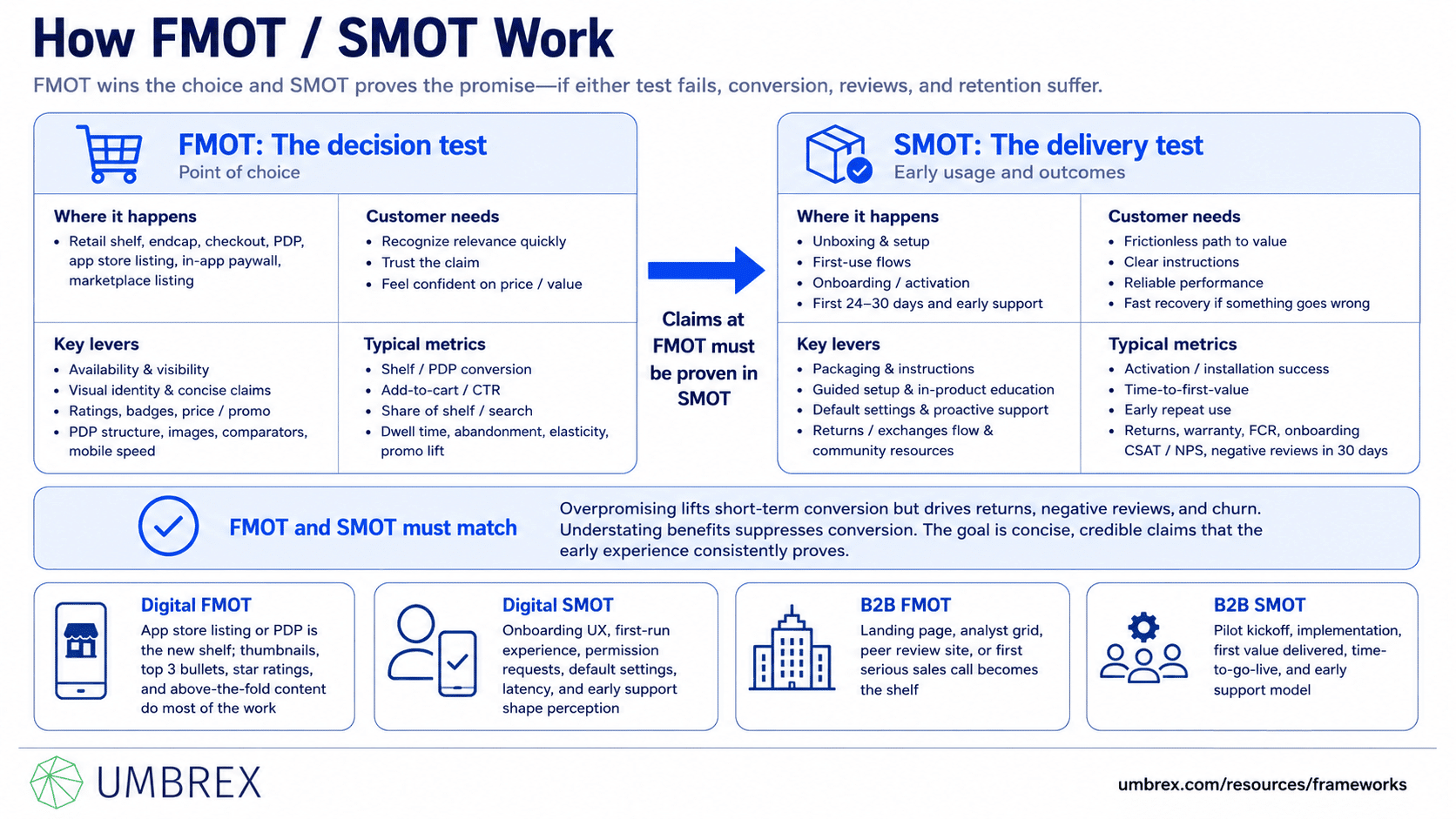
Think of FMOT and SMOT as two linked tests of your value proposition: the decision test and the delivery test. If you fail either, economics suffer.
FMOT: The decision test (point of choice)
- Where it happens: Retail shelf, endcap, checkout, product detail page, app store listing, in-app paywall, marketplace listing.
- What the customer needs: To quickly recognize relevance, trust the claim, and feel confident about the price/value trade-off—often within seconds.
- Key levers: Physical availability and visibility (facings, placement, search rank), visual identity, concise claims, social proof (ratings, badges), price/promo, packaging ergonomics, PDP structure (images, specs, comparators), page speed, and mobile-first design.
- Typical metrics: Conversion rate (shelf-to-basket, PDP-to-cart), add-to-cart rate, click-through rate, share of shelf/search, dwell time, abandonment, price elasticity, promo lift vs. baseline.
SMOT: The delivery test (early usage and outcomes)
- Where it happens: Unboxing and setup, first-use flows, onboarding tutorials, service activation, the first 24–30 days of use; early support interactions.
- What the customer needs: A frictionless path to value—clear instructions, reliable performance, and recovery if something goes wrong—so the product delivers on the promise set at FMOT.
- Key levers: Packaging and instructions, guided setup, in-product education, default settings, service responsiveness, defect rates, proactive support, fit/finish, returns/exchanges flow, community resources.
- Typical metrics: Activation/installation success, time-to-first-value, early repeat use, return/warranty rate, first-contact resolution, onboarding CSAT/NPS, ticket deflection, negative review rate within 30 days.
FMOT and SMOT must match
Claims and imagery that “sell the dream” at FMOT must be borne out in SMOT. Overpromising produces short-term lift and long-term damage—returns, negative reviews, and churn. Understating benefits reduces conversion. The art is concise, credible claims that your early experience consistently proves.
Digital and B2B adaptations
- Digital FMOT: The app store listing or PDP is the new shelf. Thumbnails, top 3 bullets, star ratings, and “above-the-fold” content do most of the work.
- Digital SMOT: Onboarding UX, first-run experience, permission requests, default settings, and latency. Early support (bot + human) shapes SMOT perception.
- B2B FMOT: The “shelf” is often a landing page, analyst grid, or a peer review site; a first call with sales can also be FMOT if it is the first serious evaluation moment.
- B2B SMOT: Pilot kickoff, implementation, first value delivered (e.g., first dashboard live), time-to-go-live, and early support model.
4. When to Use FMOT / SMOT
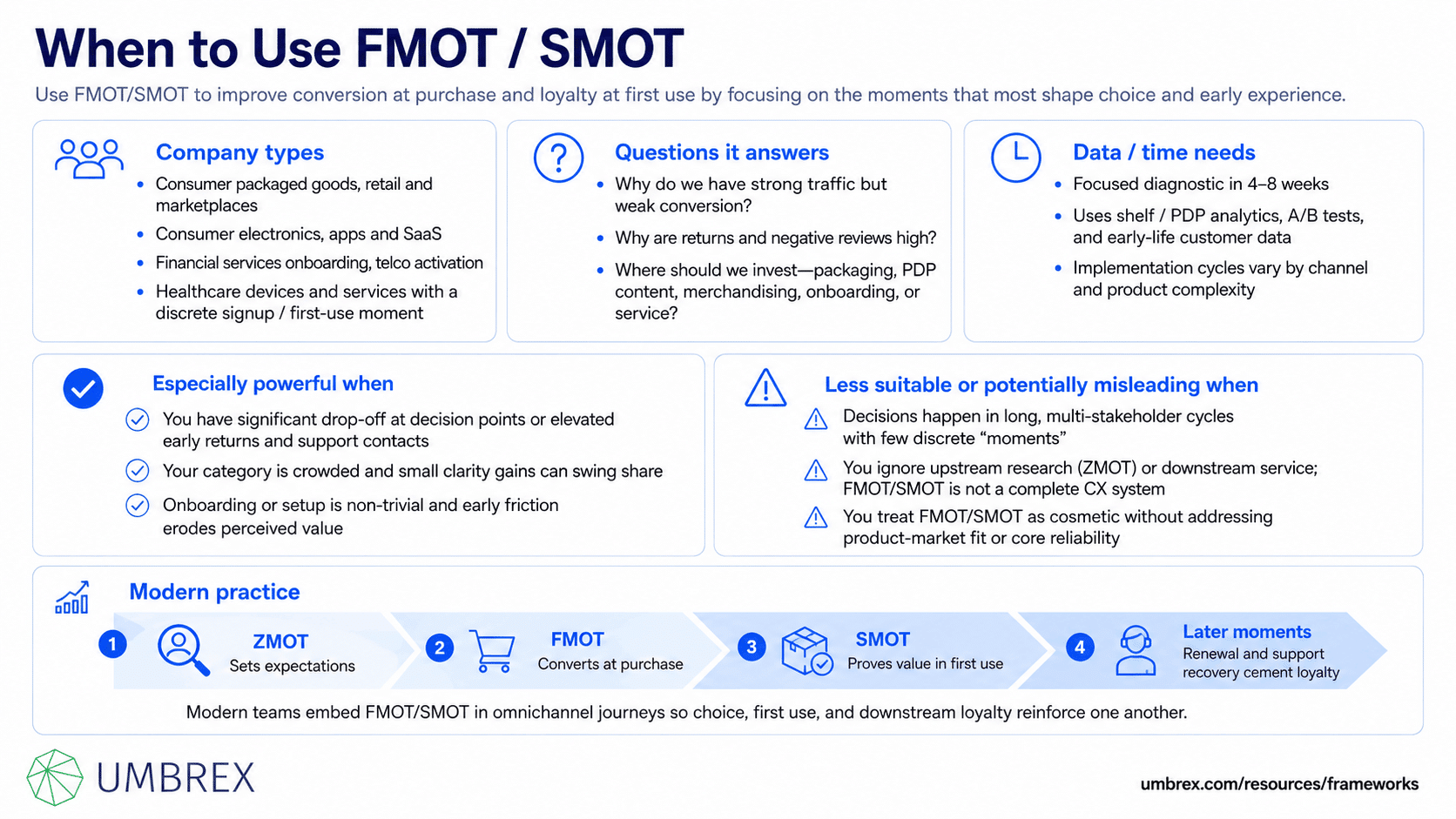
Use FMOT/SMOT when you need a simple, cross-functional way to raise conversion and loyalty by improving the moments that matter most at purchase and first use.
- Company types: Consumer packaged goods, retail and marketplaces, consumer electronics, apps and SaaS, financial services onboarding, telco activation, healthcare devices, and services with a discrete signup/first-use moment.
- Questions it answers: Why do we have strong traffic but weak conversion? Why are returns and negative reviews high? Where should we invest—packaging, PDP content, merchandising, onboarding, or service?
- Data/time needs: A focused FMOT/SMOT diagnostic can be done in 4–8 weeks using shelf/PDP analytics, A/B tests, and early-life customer data. Implementation cycles vary by channel and product complexity.
Especially powerful when:
- You have significant drop-off at decision points or elevated early returns and support contacts.
- Your category is crowded and small clarity gains can swing share.
- Onboarding or setup is non-trivial and early friction erodes perceived value.
Less suitable or potentially misleading when:
- Decisions happen in long, multi-stakeholder cycles with few discrete “moments” (FMOT/SMOT can still help, but you’ll also need a broader journey lens).
- You ignore upstream research (ZMOT) or downstream service; FMOT/SMOT is not a complete CX system.
- You treat FMOT/SMOT as cosmetic (packaging or copy tweaks) without addressing product-market fit or core reliability.
Modern practice embeds FMOT/SMOT in omnichannel journeys: ZMOT sets expectations, FMOT converts, SMOT proves value, and later moments (renewal, support recovery) cement loyalty.
5. How to Apply FMOT / SMOT: Step-by-Step
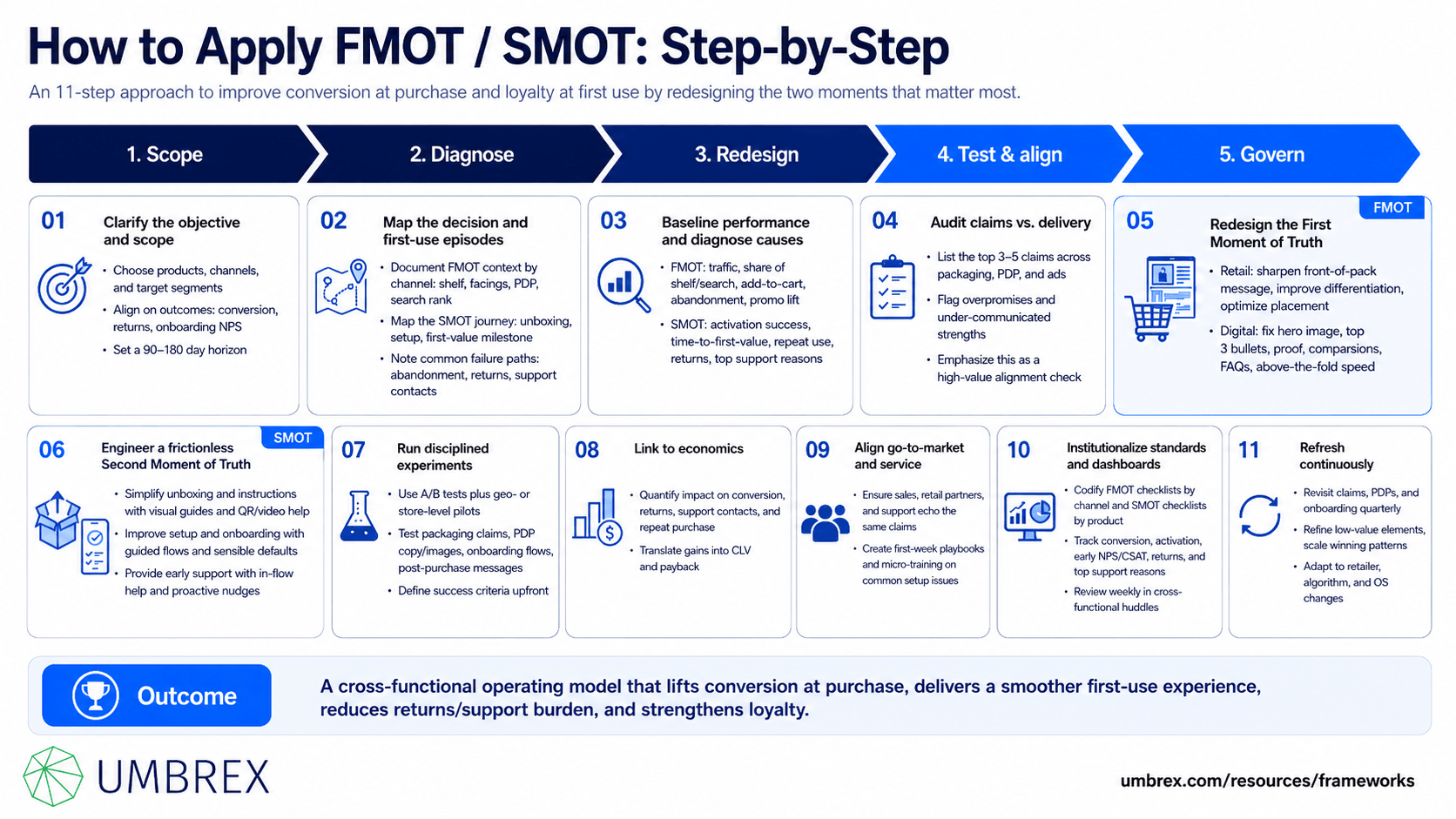
- Clarify the objective and scope
Decide which product(s), channels (retailers, D2C, marketplaces, app stores), and segments you will address. Align on target outcomes (e.g., +300 bps PDP conversion, −20% returns, +10 points onboarding NPS) and a 90–180 day horizon.
- Map the decision and first-use episodes
For each channel, document the FMOT context (shelf position, facings, PDP layout, search rank) and the SMOT journey (unboxing, setup steps, first-value milestone). Include common failure paths (returns, setup abandonment, support contacts).
- Baseline performance and diagnose causes
Collect data:
– FMOT: traffic sources, search/share of shelf, PDP scroll depth, image engagement, add-to-cart, abandonment by element, promo lift vs. baseline.
– SMOT: activation success, time-to-first-value, early repeat use, return/warranty rates, top-5 support reasons, first-contact resolution, early NPS/CSAT.
- Audit claims vs. delivery
List the top 3–5 promises/claims (on packaging, PDP, ads). Verify whether early-use experience consistently meets them. Flag overpromises and under-communicated strengths. This alignment check is often the single most valuable exercise.
- Redesign the First Moment of Truth
Prioritize the handful of elements that move behavior:
– Retail: simplify front-of-pack message; improve differentiation; optimize facings/placement; add try-me displays or QR to demos.
– PDP/App store: hero image and first 3 bullets; proof (ratings, “most helpful” reviews, certifications); comparison tables; FAQs; above-the-fold speed.
- Engineer a frictionless Second Moment of Truth
Target the first 5–10 minutes/hours of ownership:
– Unboxing/Instructions: fewer steps, visual guides, QR to video, “what’s included” checklist.
– Setup/Onboarding: guided flows, sensible defaults, progressive disclosure; avoid early permission walls unless necessary.
– Early support: in-flow help, fast human fallback, proactive nudges; recovery playbook if setup stalls.
- Run disciplined experiments
Use A/B tests and geo or store-level pilots. Examples: alternative hero images/copy on PDP, packaging claim variants, onboarding flow variations, proactive post-purchase messaging. Define success criteria in advance.
- Link to economics
Quantify impact: incremental conversion, reduced returns, lower support contacts, increased repeat purchase. Translate into CLV and payback. This sustains prioritization and governance.
- Align go-to-market and service
Ensure sales, retail partners, and support agents echo the same claims and know the top setup pitfalls and fixes. Create “first-week” playbooks and micro-training for frontline teams.
- Institutionalize standards and dashboards
Codify a checklist for FMOT (per channel) and SMOT (per product). Build dashboards for PDP conversion, first-use activation, early NPS/CSAT, returns, and top support reasons. Review weekly in cross-functional huddles.
- Refresh continuously
Revisit claims, PDPs, and onboarding quarterly. Retire elements with diminishing returns; scale winning patterns; and adapt to retailer, algorithm, or OS changes.
6. Example: FMOT/SMOT in Action
Context: “Aurora Audio,” an $800M consumer electronics company, launched premium wireless earbuds across big-box retail, Amazon, and its D2C site. Traffic was strong, but PDP conversion lagged category leaders by 180 bps. Early returns (within 30 days) were 35% higher than target, driven by “fit” and “pairing issues” complaints.
Approach: The team ran an FMOT/SMOT diagnostic across channels.
- FMOT findings: Amazon PDP hero image prioritized lifestyle over product; top bullets buried key differentiators (multi-point pairing, battery life). Ratings were 4.1 with few “most helpful” reviews. Retail packaging listed seven claims in small type; competitors led with one bold claim.
- SMOT findings: Unboxing lacked a quick-start card; pairing required holding buttons for 5 seconds (not obvious); ear-tip sizing guidance was text-heavy; 28% of first support contacts occurred within 48 hours of purchase.
Actions:
- FMOT: Rebuilt PDP hero image to show case + buds + “36h battery • multipoint • ANC” in first frame; moved social proof (4.3 rating after review campaign) above the fold; added comparison table vs. two top competitors; created a “fit and comfort” explainer. Packaging was redesigned to a single bold promise on front, with icons for three secondary benefits.
- SMOT: Added a color quick-start card with three steps, QR to a 45-second setup video, and a sizing graphic; tweaked firmware to shorten pairing hold to 2 seconds with haptic feedback; pushed a proactive “need help?” SMS/email within 12 hours of activation linking to troubleshooting.
Results (10 weeks): Amazon PDP conversion rose by 220 bps; D2C by 160 bps. Early return rate fell 24%, driven by fewer “fit” and “pairing” issues. First 7-day support contacts per 1,000 units dropped 31%. Onboarding NPS increased by 9 points. Net impact: +$6.8M quarterly gross profit from conversion uplift and reduced returns, with a 6-week payback on content, packaging, and firmware investments.
7. Strengths and Limitations
Strengths
- Focus on decisive moments: Concentrates resources where they most affect conversion, returns, and early satisfaction.
- Cross-functional clarity: Creates a shared language for brand, product, sales, and service; aligns promises with delivery.
- Measurable and testable: Clear hypotheses and KPIs enable rapid experimentation and ROI tracking.
- Omnichannel applicability: Extends naturally from retail shelf to PDP/app store and from physical unboxing to digital onboarding.
Limitations
- Not the whole journey: Upstream research (ZMOT) and downstream service/loyalty still matter; FMOT/SMOT alone can create a myopic view.
- Risk of cosmetic fixes: Packaging or copy changes can’t compensate for poor product-market fit or reliability issues.
- Channel constraints: Retail facings, search algorithms, and marketplace policies limit control; requires partner management.
- Segment variability: What “wins” FMOT and SMOT differs by segment (e.g., novices vs. experts), requiring tailored approaches.
8. Common Pitfalls (and How to Avoid Them)
- Overpromising at FMOT
What goes wrong: Claims drive conversion but fail in early use, spiking returns and negative reviews.
How to avoid: Validate claims in real-world scenarios; align marketing with product and support; prefer precise, credible language.
- Neglecting onboarding (SMOT)
What goes wrong: Great PDP, poor first-week experience; customers churn or return.
How to avoid: Treat onboarding as part of the product; cut steps, offer guidance in-context, and enable quick recovery.
- Designing for your team, not the shopper
What goes wrong: Jargon-heavy claims and specs overwhelm.
How to avoid: Use shopper language; test comprehension; lead with one or two meaningful benefits.
- Ignoring channel differences
What goes wrong: Copy and assets cloned across retail, marketplace, and D2C fail to optimize each environment.
How to avoid: Build channel-specific FMOT playbooks (image stacks, bullets, badges, store locator, local proofs).
- Measuring the wrong KPIs
What goes wrong: Promo lift looks great while baseline conversion and returns worsen.
How to avoid: Track baselines and blended metrics (conversion, returns, early NPS, support volume) and isolate promo effects.
- Underestimating reviews
What goes wrong: Good PDP content loses to competitors’ stronger ratings and “most helpful” reviews.
How to avoid: Systematically solicit authentic reviews post-SMOT; respond publicly; fix root causes behind negatives.
- Skipping in-situ testing
What goes wrong: Lab-perfect packaging/PDP fails in the messy reality of stores and mobile SERPs.
How to avoid: Pilot in representative stores and live PDPs; use geosplit tests and mobile-first design reviews.
9. How FMOT/SMOT Relate to Other Frameworks
- Zero Moment of Truth (ZMOT – Google): ZMOT precedes FMOT; it’s the research moment where search, reviews, and social proof shape the shortlist. Use ZMOT to get into consideration, FMOT to convert, SMOT to validate and earn advocacy.
- Moments of Truth (Jan Carlzon): Carlzon’s lens emphasizes designing and empowering delivery during critical service episodes. FMOT/SMOT are two specific episodes; apply Carlzon’s empowerment and recovery principles to SMOT.
- Customer Lifecycle (Acquire–Onboard–Develop–Retain–Win‑Back): FMOT sits at acquisition; SMOT is onboarding. Use lifecycle metrics to manage progression beyond SMOT into development and retention.
- Grönroos Service Quality Model: FMOT sets expectations for technical (what) and functional (how) quality; SMOT tests both. Align claims with actual outcomes and interactions.
- SERVQUAL / RATER: Use these to measure perception gaps and diagnose which dimensions (e.g., Reliability, Responsiveness) are failing during SMOT, informing fixes.
- Kano Model: Use Kano to decide which features/benefits to highlight at FMOT and which delighters to showcase and deliver in SMOT, after basics are solid.
- AARRR and CLV: FMOT affects Acquisition; SMOT drives Activation and early Retention—major inputs to CLV. Prioritize FMOT/SMOT improvements with CLV modeling.
10. Key Takeaways
- FMOT (First Moment of Truth) is the point-of-decision; SMOT (Second Moment of Truth) is the first-use experience that proves the promise.
- Win FMOT with visibility, clarity, and credible proof; win SMOT with frictionless setup/onboarding, reliable performance, and fast recovery.
- Align claims and delivery—overpromising at FMOT will be punished in SMOT through returns, negative reviews, and churn.
- Measure what matters: PDP conversion, add-to-cart, activation, time-to-first-value, early NPS/CSAT, returns, and first-week support volume.
- Integrate with ZMOT (research) and lifecycle/quality frameworks to manage the full journey and economics (CLV, CAC, margin).
- Succeed with disciplined experimentation, channel-specific playbooks, and cross-functional governance spanning brand, product, and service.
11. FAQs About First & Second Moments of Truth (FMOT / SMOT)
Are FMOT and SMOT still relevant in digital?
Yes. The modern FMOT is often a PDP or app store listing; the modern SMOT is onboarding and first use. The principles—clarity at decision, frictionless delivery of value—translate directly, and are measurable via digital analytics.
How is FMOT different from ZMOT?
ZMOT is the pre-purchase research moment when customers consult search, reviews, and social proof to form a shortlist. FMOT occurs at the actual point of choice (shelf, PDP, app store). Winning ZMOT improves your odds at FMOT; they are complementary, not substitutes.
What should we measure to manage SMOT effectively?
Track activation/installation success, time-to-first-value, early repeat use, first-week support contacts and FCR, early NPS/CSAT, and returns/warranty rates. Segment by channel and cohort to pinpoint friction.
Can B2B and SaaS use FMOT/SMOT?
Absolutely. FMOT may be a landing page, analyst grid, or first discovery call; SMOT is pilot onboarding and time-to-value. The same logic applies: clarity and proof at decision, and an early experience that validates the promise.
How long does an FMOT/SMOT improvement program take?
You can diagnose and pilot changes in 4–8 weeks (e.g., PDP A/B tests, packaging claim variants, onboarding tweaks). Broader packaging or firmware changes may take 8–16 weeks. Expect measurable impact on conversion and early satisfaction within a quarter.
