

1. What Is Social Media Honeycomb Model (Kietzmann)?
The Social Media Honeycomb Model (Kietzmann) is a practical framework for understanding and designing social media strategies by focusing on the core functions that social platforms enable. It visualizes social media as seven “functional building blocks” arranged like a honeycomb: Identity, Conversations, Sharing, Presence, Relationships, Reputation, and Groups. Each block represents a capability that shapes the user experience and, by extension, how brands should engage.
In marketing terms, it is a communications, messaging, and content framework. Rather than starting with platform names or content formats, it starts with what social media does for people and communities. You then match your brand and objectives to the blocks that matter most, and craft content, moderation, and measurement around them.
This model is widely used by consultants and marketers to audit current social activities, design channel strategies, and align cross-functional teams (brand, product, customer support, risk) on the role each channel plays. It’s clear, adaptable, and platform-agnostic—equally useful whether you’re thinking about LinkedIn, TikTok, Reddit, YouTube, or emerging communities.
2. Origin and Background
Origin: The model was articulated and popularized by Jan H. Kietzmann, Kristopher Hermkens, Ian P. McCarthy, and Bruno S. Silvestre in the article “Social media? Get serious! Understanding the functional building blocks of social media,” published in Business Horizons in 2011.
Purpose: The authors set out to give managers a structured way to make sense of the fast-evolving social landscape—focusing not on technology or platform fads, but on enduring user functions that guide strategy, content, and governance choices.
Diffusion: It quickly became part of the marketing and digital strategy canon, taught in business schools and used broadly by consulting firms. Its simplicity and neutrality (no bias toward any specific platform) made it a common language across brand, communications, and product teams.
3. How Social Media Honeycomb Model (Kietzmann) Works
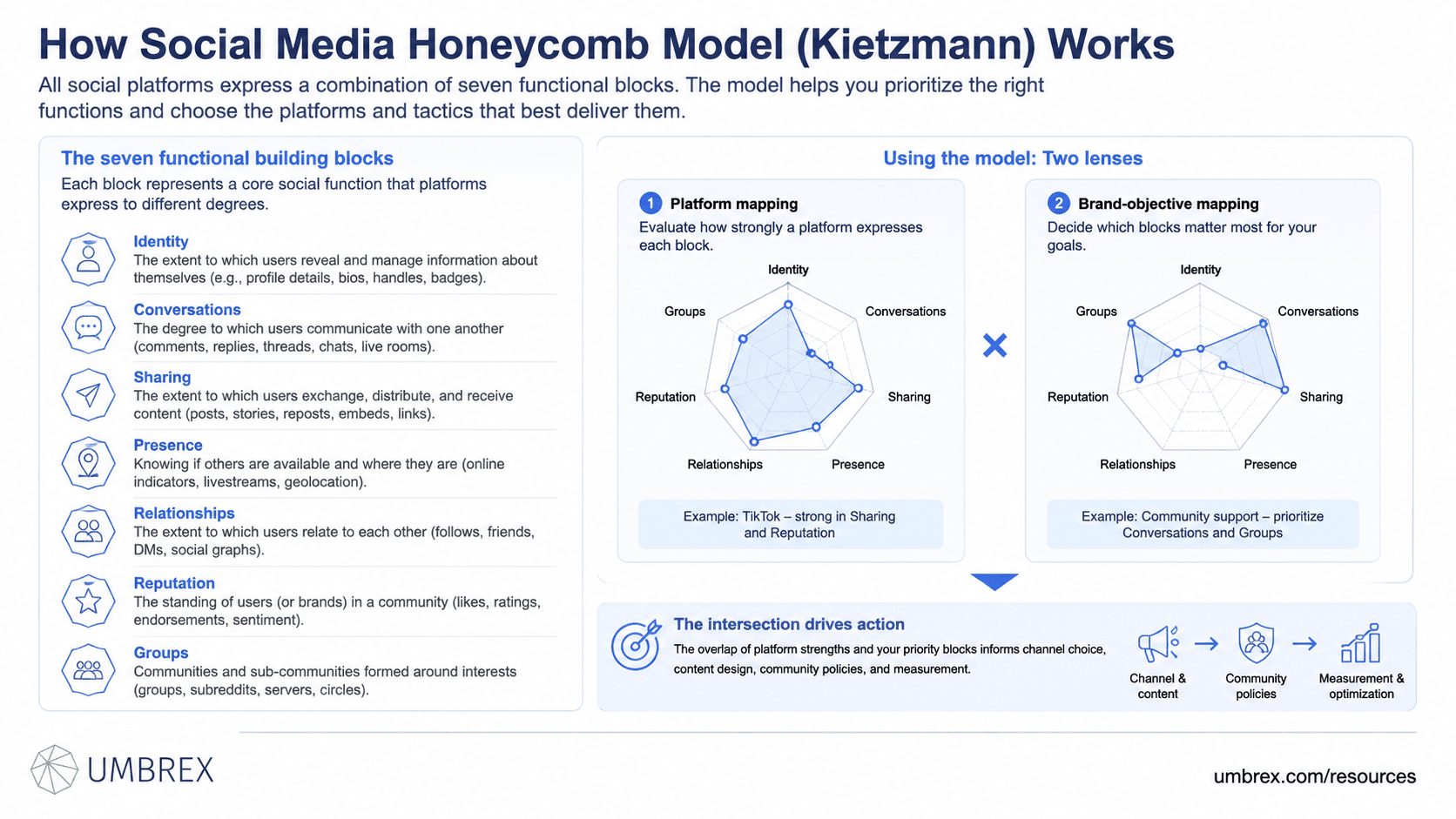
The core logic: all social platforms express a combination of seven functional blocks. No platform maximizes all seven; each emphasizes a different mix. The model helps you decide which blocks to prioritize given your objectives and which platforms and tactics best deliver those functions.
The seven functional building blocks
- Identity: The extent to which users reveal and manage information about themselves (e.g., profile details, bios, handles, badges). For brands, Identity touches brand voice, verification, and how you invite customers to express themselves.
- Conversations: The degree to which users communicate with one another (comments, replies, threads, chats, live rooms). This function underpins engagement strategies and community management.
- Sharing: The extent to which users exchange, distribute, and receive content (posts, stories, reposts, embeds, links). It shapes content formats, editorial cadence, and creative designed for spreadability.
- Presence: Knowing if others are available and where they are (online indicators, livestreams, geolocation). Presence informs real-time activations, live events, and time-sensitive interactions.
- Relationships: The extent to which users relate to each other (follows, friends, DMs, social graphs). This is pivotal for segmentation, influencer programs, and loyalty initiatives.
- Reputation: The standing of users (or brands) in a community (likes, ratings, endorsements, sentiment). Reputation management, social proof, and advocacy sit here.
- Groups: Communities and sub-communities formed around interests (groups, subreddits, servers, circles). Groups are essential for niche targeting, peer support, and co-creation.
Using the model involves two lenses:
- Platform mapping: Evaluate how strongly a platform expresses each block (e.g., TikTok: Sharing and Reputation; LinkedIn: Identity, Relationships, Reputation; Reddit: Groups, Conversations).
- Brand-objective mapping: Decide which blocks matter most for your goals (e.g., launch awareness: Sharing and Reputation; community support: Conversations and Groups).
The intersection of those two lenses informs channel choice, content design, community policies, and measurement. You can visualize it as a honeycomb with varying “cell sizes” (priority or intensity) for each block per platform.
4. When to Use Social Media Honeycomb Model (Kietzmann)
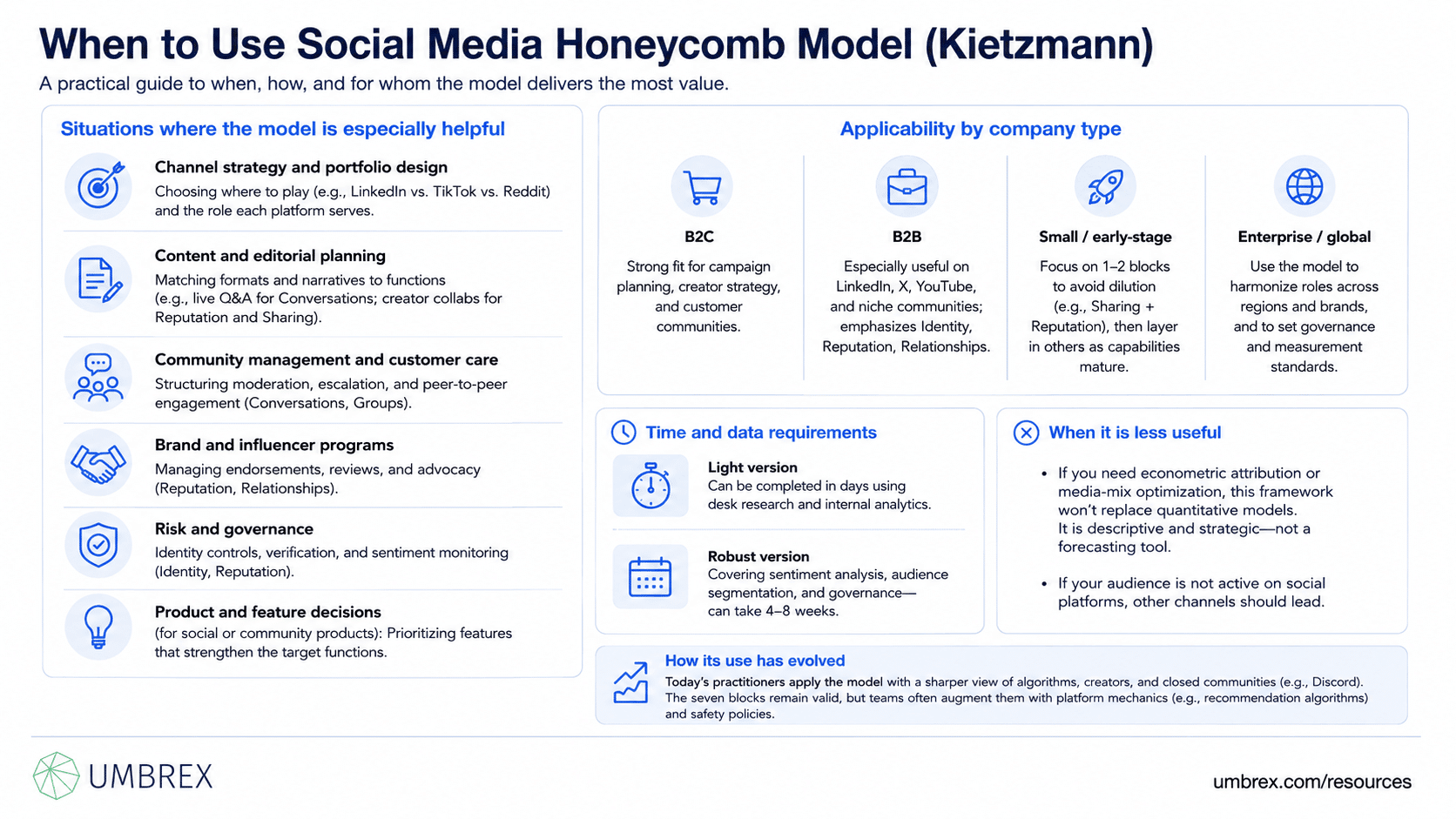
Situations where the model is especially helpful:
- Channel strategy and portfolio design: Choosing where to play (e.g., LinkedIn vs. TikTok vs. Reddit) and the role each platform serves.
- Content and editorial planning: Matching formats and narratives to functions (e.g., live Q&A for Conversations; creator collabs for Reputation and Sharing).
- Community management and customer care: Structuring moderation, escalation, and peer-to-peer engagement (Conversations, Groups).
- Brand and influencer programs: Managing endorsements, reviews, and advocacy (Reputation, Relationships).
- Risk and governance: Identity controls, verification, and sentiment monitoring (Identity, Reputation).
- Product and feature decisions (for social or community products): Prioritizing features that strengthen the target functions.
Applicability by company type:
- B2C: Strong fit for campaign planning, creator strategy, and customer communities.
- B2B: Especially useful on LinkedIn, X, YouTube, and niche communities; emphasizes Identity, Reputation, Relationships.
- Small/early-stage: Focus on 1–2 blocks to avoid dilution (e.g., Sharing + Reputation), then layer in others as capabilities mature.
- Enterprise/global: Use the model to harmonize roles across regions and brands, and to set governance and measurement standards.
Time and data requirements: A light version can be completed in days using desk research and internal analytics. A robust version—covering sentiment analysis, audience segmentation, and governance—can take 4–8 weeks.
When it is less useful: If you need econometric attribution or media-mix optimization, this framework won’t replace quantitative models. It is descriptive and strategic—not a forecasting tool. Also, if your audience is not active on social platforms, other channels should lead.
How its use has evolved: Today’s practitioners apply the model with a sharper view of algorithms, creators, and closed communities (e.g., Discord). The seven blocks remain valid, but teams often augment them with platform mechanics (e.g., recommendation algorithms) and safety policies.
5. How to Apply Social Media Honeycomb Model (Kietzmann): Step-by-Step
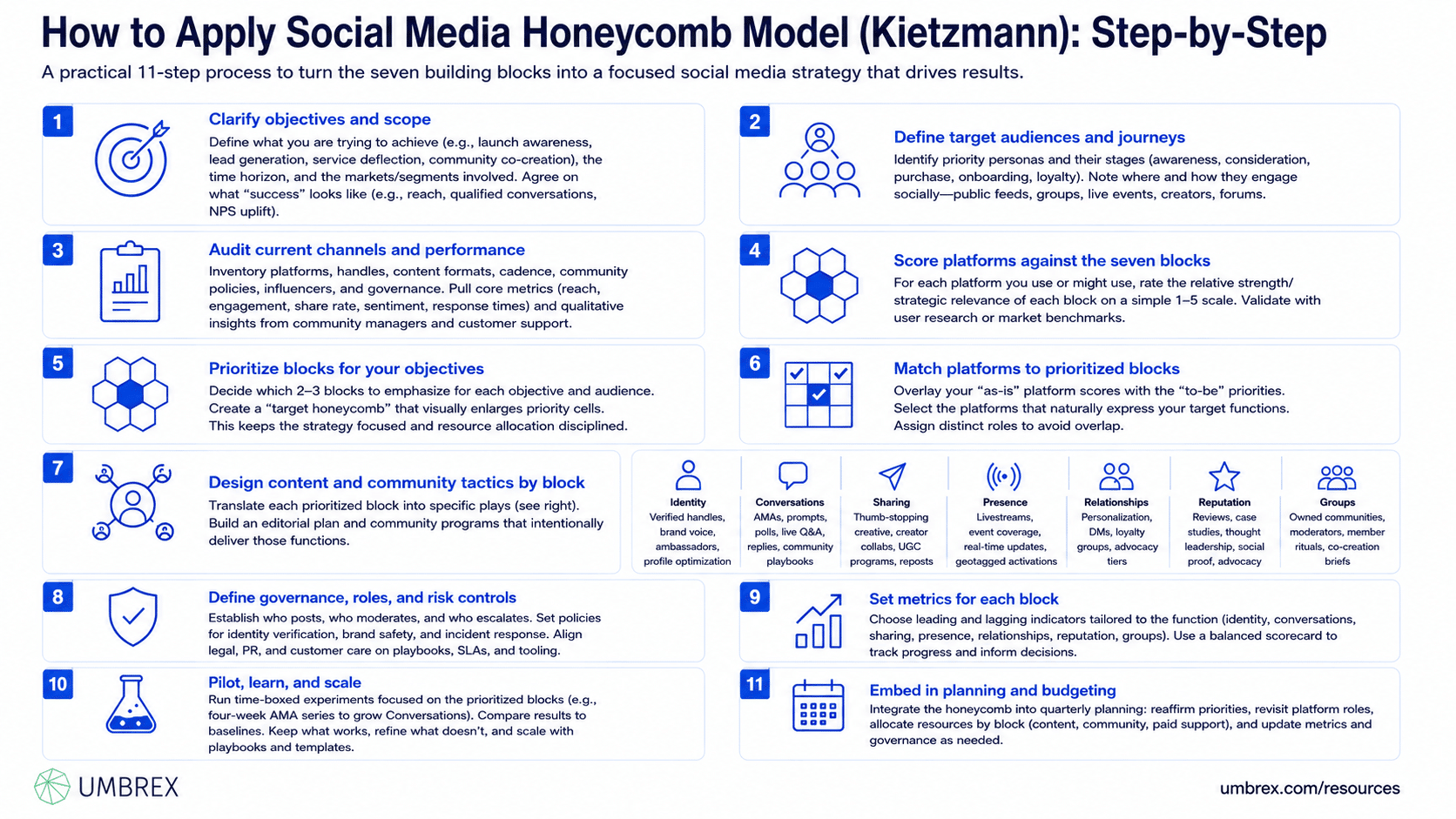
- Clarify objectives and scope
Define what you are trying to achieve (e.g., launch awareness, lead generation, service deflection, community co-creation), the time horizon, and the markets/segments involved. Agree on what “success” looks like at a high level (e.g., reach, qualified conversations, NPS uplift).
- Define target audiences and journeys
Identify priority personas and their stages (awareness, consideration, purchase, onboarding, loyalty). Note where and how they engage socially—public feeds, groups, live events, creators, forums.
- Audit current channels and performance
Inventory platforms, handles, content formats, cadence, community policies, influencers, and governance. Pull core metrics (reach, engagement, share rate, sentiment, response times) and qualitative insights from community managers and customer support.
- Score platforms against the seven blocks
For each platform you use or might use, rate the relative strength/strategic relevance of each block on a simple 1–5 scale. Example: TikTok (Sharing: 5, Reputation: 4, Conversations: 2, Groups: 1, Presence: 3, Relationships: 2, Identity: 2). Validate with user research or market benchmarks.
- Prioritize blocks for your objectives
Decide which 2–3 blocks to emphasize for each objective and audience. Create a “target honeycomb” that visually enlarges priority cells. This keeps the strategy focused and resource allocation disciplined.
- Match platforms to prioritized blocks
Overlay your “as-is” platform scores with the “to-be” priorities. Select the platforms that naturally express your target functions. Assign distinct roles to avoid overlap (e.g., YouTube for Sharing and Reputation; LinkedIn for Identity and Relationships; Reddit for Groups and Conversations).
- Design content and community tactics by block
Translate each prioritized block into specific plays:
- Identity: Verified handles, consistent brand voice, employee ambassadors, profile optimization.
- Conversations: AMAs, comment prompts, polls, live Q&A, proactive replies, community playbooks.
- Sharing: Thumb-stopping creative, creator collaborations, snackable clips, repost incentives, UGC programs.
- Presence: Livestreams, event coverage, real-time service updates, geotagged activations.
- Relationships: CRM-driven personalization, DMs for high-value prospects, loyalty groups, advocacy tiers.
- Reputation: Review management, case studies, thought leadership, social proof, employee advocacy.
- Groups: Owned communities (e.g., LinkedIn Groups, Discord), moderators, member rituals, co-creation briefs.
- Define governance, roles, and risk controls
Establish who posts, who moderates, and who escalates. Set policies for identity verification, brand safety, and incident response. Align legal, PR, and customer care on playbooks, SLAs, and tooling.
- Set metrics for each block
Choose leading and lagging indicators tailored to the function:
- Identity: Profile completeness, brand handle consistency, verified status, recall/association surveys.
- Conversations: Comment rate, conversation depth (reply chains), response time, topic diversity.
- Sharing: Share rate, saves, reposts, link CTR, content completion rate.
- Presence: Live viewers, peak concurrency, dwell time during events, attendance rates.
- Relationships: Follower quality (fit-to-ICP), DM response rate, CRM match rate, repeat engagement.
- Reputation: Sentiment, ratings, review velocity, influencer quality, brand lift.
- Groups: Membership growth, active members, post-to-comment ratio, retention/churn.
- Pilot, learn, and scale
Run time-boxed experiments focused on the prioritized blocks (e.g., four-week AMA series to grow Conversations). Compare results to baselines. Keep what works, refine what doesn’t, and scale with playbooks and templates.
- Embed in planning and budgeting
Integrate the honeycomb into quarterly planning: reaffirm priorities, revisit platform roles, allocate resources by block (content, community, paid support), and update metrics and governance as needed.
6. Example: Social Media Honeycomb Model (Kietzmann) in Action
Company: A $500M B2B software company entering the mid-market with a new analytics product.
Problem: The firm had an undifferentiated social presence, low engagement, and poor lead quality. Leadership was debating whether to double down on paid social or invest in organic communities. Sales wanted better thought leadership; support wanted to reduce inbound tickets.
Application of the honeycomb:
- Objectives defined as “credible awareness,” “conversation with mid-market buyers,” and “community-based onboarding.”
- Audiences segmented into data leaders, finance controllers, and IT admins. Journey mapping showed each persona used different platforms.
- Platform scoring highlighted: LinkedIn strong on Identity, Reputation, Relationships; YouTube strong on Sharing and Reputation; Reddit strong on Groups and Conversations; X moderate on Conversations and Presence.
- Priority blocks selected:
- Launch: Sharing and Reputation (to establish expertise at scale).
- Mid-funnel: Conversations and Relationships (to address objections and connect buyers to experts).
- Post-purchase: Groups and Conversations (peer support, tips, and co-creation).
- Tactics:
- YouTube: 6-part “Analytics in the Real World” series, clipped for snackable Sharing. Landing page CTAs for demos.
- LinkedIn: Executive-authored POVs, customer proof, employee advocacy to build Identity and Reputation.
- Reddit: Participation in relevant subreddits with strict non-promotional guidelines; monthly AMAs to grow Conversations and Groups.
- X: Live commentary during industry events (Presence) with links to deeper assets.
- Governance: SME enablement and moderation playbooks; escalation process for competitive threads; legal guidance on claims and reviews.
- Metrics: Share rate and completion (YouTube), sentiment and thought-leadership mentions (LinkedIn), AMA participation and solution adoption threads (Reddit), event engagement (X).
Outcomes: Within two quarters, share rates tripled on YouTube, LinkedIn engagement doubled, Reddit AMAs consistently attracted 300+ participants, and the inbound demo-to-close rate improved by 20%. Support tickets on basic setup questions dropped 12% as community answers filled the gap.
7. Strengths and Limitations
Strengths
- Clarifies roles across platforms: Moves teams beyond “post everywhere” to purposeful choices based on user functions.
- Creates a common language: Aligns marketing, product, PR, and support on what each channel is for.
- Focuses resources: Helps prioritize 2–3 blocks per objective, avoiding scattershot content.
- Platform-agnostic and durable: Remains relevant even as specific platforms rise and fall.
- Bridges strategy and measurement: Provides a direct line from function to KPI selection.
Limitations
- Descriptive, not predictive: It won’t forecast reach, conversions, or ROI; other models are needed.
- Static snapshot risk: Without regular updates, it can lag behind fast-moving platform mechanics and algorithms.
- Limited media mix guidance: Does not integrate paid, earned, owned dynamics (you can overlay, but it’s not built-in).
- Ambiguity across blocks: Boundaries blur (e.g., is a like Reputation or Conversations?), requiring clear operational definitions.
- Implementation not included: It informs governance but does not substitute for detailed moderation, escalation, or content ops.
8. Common Pitfalls (and How to Avoid Them)
- Trying to maximize all seven blocks at once
What goes wrong: Diluted strategy and strained resources. How to avoid: Prioritize 2–3 blocks per objective and assign clear platform roles.
- Starting with platforms, not functions
What goes wrong: Chasing trends and formats without a strategy. How to avoid: Score functions first; let platform choices follow.
- Vague or inconsistent block definitions
What goes wrong: Misaligned metrics and debates about success. How to avoid: Document operational definitions for each block and examples per platform.
- Ignoring governance and risk
What goes wrong: Brand safety incidents, slow responses, off-brand tone. How to avoid: Establish policies, role-based access, SLAs, and escalation paths up front.
- Underestimating Groups and communities
What goes wrong: Over-reliance on broadcast content; missed peer advocacy. How to avoid: Invest in community managers, rituals, and member value.
- Focusing on vanity metrics
What goes wrong: High reach, low business impact. How to avoid: Tie each block to meaningful KPIs (e.g., qualified conversations, sentiment, CRM match rates).
- One-and-done audits
What goes wrong: Strategy goes stale as algorithms and user behavior shift. How to avoid: Revisit the honeycomb quarterly; re-score platforms after major updates.
- Not integrating with the funnel or journey
What goes wrong: Mismatch between content and buyer needs. How to avoid: Map prioritized blocks to specific journey stages and personas.
9. How Social Media Honeycomb Model (Kietzmann) Relates to Other Frameworks
- PESO (Paid, Earned, Shared, Owned): PESO structures your channel mix; the honeycomb clarifies what your social “Shared” channels should do. Use PESO for media planning and the honeycomb to architect functions and content.
- AIDA or funnel models: Funnel stages describe customer progress; the honeycomb specifies the social functions that best support each stage (e.g., Sharing for Awareness, Conversations for Consideration, Reputation for Preference, Groups for Loyalty).
- Customer Journey Maps: Journey maps define needs and moments; the honeycomb translates those into platform roles and engagement tactics.
- Messaging House/Value Proposition Canvas: These craft the message; the honeycomb determines how and where that message should be delivered and socialized.
- Forrester Social Technographics or audience segmentation: Use these to understand audience behaviors (creators, critics, joiners), then apply the honeycomb to design the right functions and content for each segment.
- Platform strategy frameworks: If you build social features into your product, combine the honeycomb with network effects and governance models to prioritize features aligned to Identity, Relationships, or Groups.
When to choose the honeycomb vs. alternatives: If you need a practical guide to the role of social channels and the kind of engagement to pursue, use the honeycomb. If you’re allocating spend across paid and organic or modeling ROI, use PESO and attribution models alongside it.
10. Key Takeaways
- The Social Media Honeycomb Model (Kietzmann) explains social strategy through seven core functions: Identity, Conversations, Sharing, Presence, Relationships, Reputation, and Groups.
- Start with functions, not platforms. Prioritize 2–3 blocks that best serve your objectives and audiences.
- Map platforms to the blocks they naturally express, then design content, community tactics, and governance accordingly.
- Measure what matters for each block—tie function-specific KPIs to business outcomes, not vanity metrics.
- Revisit the honeycomb regularly to reflect changes in algorithms, audience behavior, and goals.
- The model is a powerful planning and alignment tool, but it’s descriptive—not a substitute for media mix modeling or rigorous attribution.
11. FAQs About Social Media Honeycomb Model (Kietzmann)
Is the Social Media Honeycomb Model still relevant today?
Yes. The seven functions remain durable even as platforms evolve. Practitioners typically augment the model with insights on algorithms, creators, and closed communities, but the honeycomb remains a reliable foundation for social strategy and governance.
How does the honeycomb differ from PESO?
PESO organizes channels by ownership and spend (paid, earned, shared, owned). The honeycomb organizes social by user functions. Use PESO for budgeting and channel allocation; use the honeycomb to decide what your social presence should do and how to measure it.
Can small or early-stage companies use this framework?
Absolutely. Start narrow: pick one or two blocks (e.g., Sharing and Reputation), define a simple content cadence, and establish basic community norms. Add more blocks as you gain resources and learning.
How long does it take to apply in practice?
A focused workshop plus a light audit can be done in 1–2 weeks. A more comprehensive effort—covering audience research, governance, and measurement design—typically runs 4–8 weeks depending on scope and markets.
How should we measure each block?
Tie metrics to the function: comment depth and response times for Conversations; share rate and completion for Sharing; sentiment and review velocity for Reputation; live viewers for Presence; CRM match rate for Relationships; profile consistency for Identity; active members and retention for Groups. Always connect these to business outcomes.
