

1. What Is Content Pillars & Topic Cluster Framework?
The Content Pillars & Topic Cluster Framework is a structured way to design, produce, and govern content around a small set of core themes (“pillars”) and the related subtopics (“clusters”) that support them. Each pillar represents a strategic theme your brand wants to own. Around each pillar, you publish a comprehensive “pillar page” and a network of cluster pieces (articles, videos, tools) that go deeper on specific questions. The cluster pieces interlink back to the pillar—and to each other—creating a clear information architecture for users and search engines.
This is a communications, messaging & content framework frequently used in content marketing, product marketing, and SEO. Consultants and content leaders rely on it to align editorial calendars to business priorities, boost organic discoverability, and improve conversion by matching content to audience intent across the full journey.
In plain language: pick the few topics where you must be the authority. Build one “hub” page per topic that answers the big questions. Surround it with focused content that answers specific questions and links back to the hub. The result is easier discovery, better user navigation, and a content system that compounds results over time.
2. Origin and Background
Origin: Unknown; in use since at least the 2010s.
Why it was created: Traditional content programs produced isolated articles and blogs that were hard to find and harder to maintain. As search engines and social platforms increasingly favored topic expertise and clear site structure, practitioners needed a way to organize content by audience intent rather than by publish date.
How it became widely known: Through SEO and content marketing communities, marketing technology platforms, and practitioner case studies that demonstrated how pillar–cluster structures improved visibility, engagement, and conversion while simplifying governance.
3. How Content Pillars & Topic Cluster Framework Works
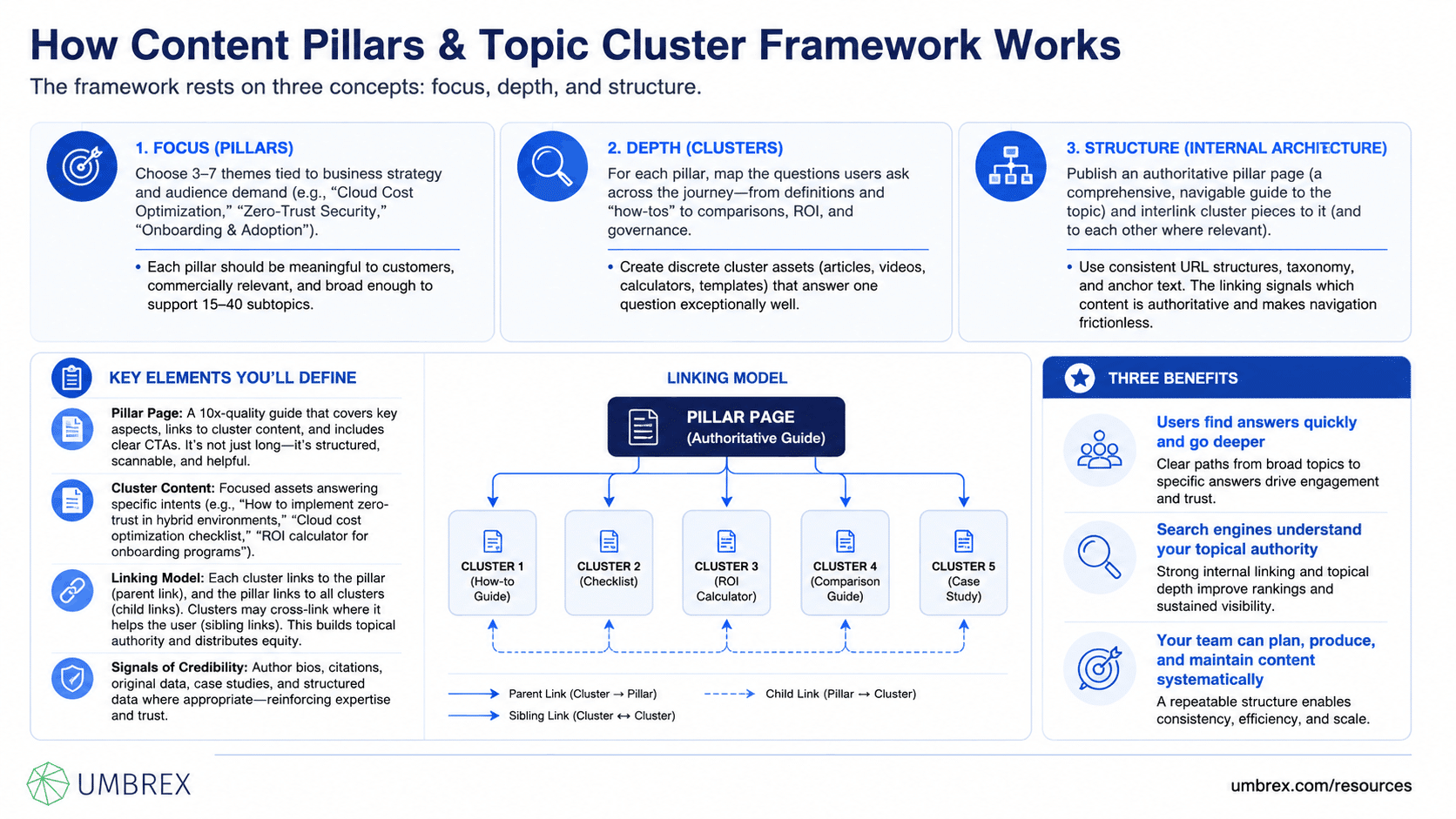
The framework rests on three concepts: focus, depth, and structure.
- Focus (Pillars): Choose 3–7 themes tied to business strategy and audience demand (e.g., “Cloud Cost Optimization,” “Zero-Trust Security,” “Onboarding & Adoption”). Each pillar should be meaningful to customers, commercially relevant, and broad enough to support 15–40 subtopics.
- Depth (Clusters): For each pillar, map the questions users ask across the journey—from definitions and “how-tos” to comparisons, ROI, and governance. Create discrete cluster assets (articles, videos, calculators, templates) that answer one question exceptionally well.
- Structure (Internal Architecture): Publish an authoritative pillar page (a comprehensive, navigable guide to the topic) and interlink cluster pieces to it (and to each other where relevant). Use consistent URL structures, taxonomy, and anchor text. The linking signals which content is authoritative and makes navigation frictionless.
Key elements you’ll define
- Pillar Page: A 10x-quality guide that covers key aspects, links to cluster content, and includes clear CTAs. It’s not just long—it’s structured, scannable, and helpful.
- Cluster Content: Focused assets answering specific intents (e.g., “How to implement zero-trust in hybrid environments,” “Cloud cost optimization checklist,” “ROI calculator for onboarding programs”).
- Linking Model: Each cluster links to the pillar (parent link), and the pillar links to all clusters (child links). Clusters may cross-link where it helps the user (sibling links). This builds topical authority and distributes equity.
- Signals of Credibility: Author bios, citations, original data, case studies, and structured data where appropriate—reinforcing expertise and trust.
Done well, this framework delivers three benefits: users find answers quickly and go deeper; search engines understand your topical authority; and your team can plan, produce, and maintain content systematically.
4. When to Use Content Pillars & Topic Cluster Framework
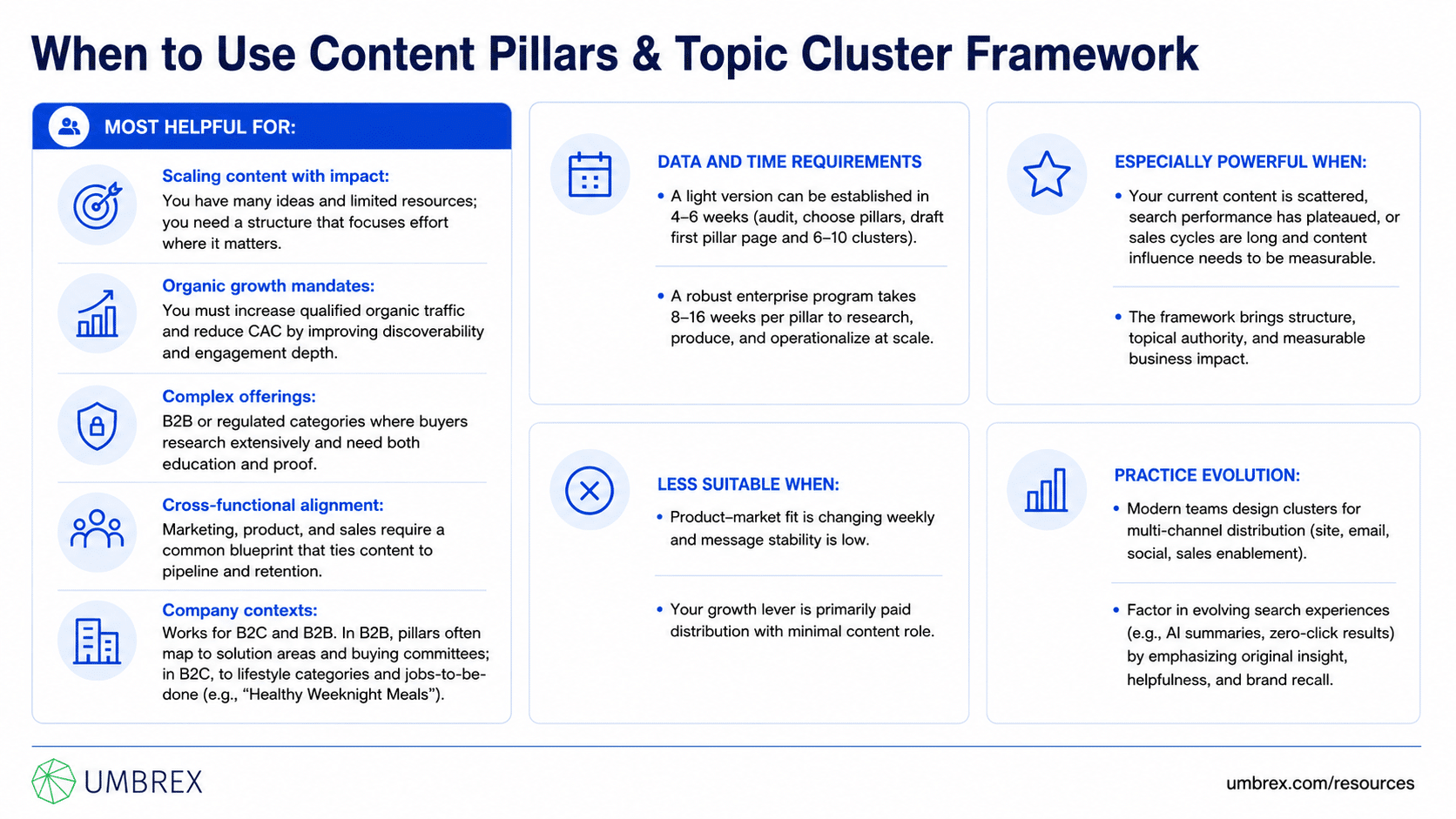
Most helpful for:
- Scaling content with impact: You have many ideas and limited resources; you need a structure that focuses effort where it matters.
- Organic growth mandates: You must increase qualified organic traffic and reduce CAC by improving discoverability and engagement depth.
- Complex offerings: B2B or regulated categories where buyers research extensively and need both education and proof.
- Cross-functional alignment: Marketing, product, and sales require a common blueprint that ties content to pipeline and retention.
Company contexts: Works for B2C and B2B. In B2B, pillars often map to solution areas and buying committees; in B2C, to lifestyle categories and jobs-to-be-done (e.g., “Healthy Weeknight Meals”).
Data and time requirements: A light version can be established in 4–6 weeks (audit, choose pillars, draft first pillar page and 6–10 clusters). A robust enterprise program takes 8–16 weeks per pillar to research, produce, and operationalize at scale.
Especially powerful when: Your current content is scattered, search performance has plateaued, or sales cycles are long and content influence needs to be measurable.
Less suitable when: Product–market fit is changing weekly and message stability is low; or when your growth lever is primarily paid distribution with minimal content role.
Practice evolution: Modern teams design clusters for multi-channel distribution (site, email, social, sales enablement) and factor in evolving search experiences (e.g., AI summaries, zero-click results) by emphasizing original insight, helpfulness, and brand recall.
5. How to Apply Content Pillars & Topic Cluster Framework: Step-by-Step
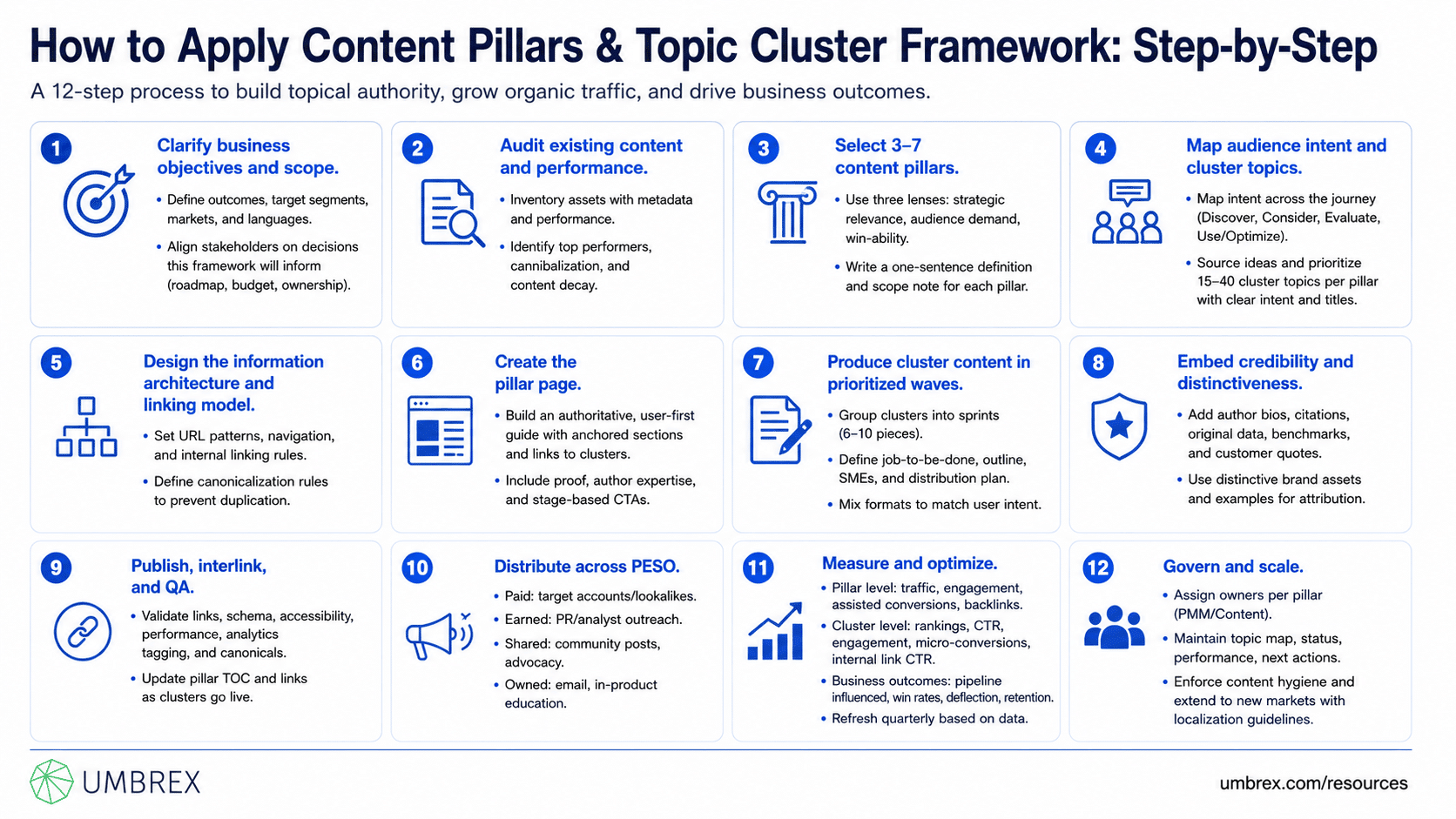
- Clarify business objectives and scope.
Define outcomes (e.g., organic pipeline +30%, self-serve onboarding adoption +20%, support deflection). Specify target segments, markets, and languages. Align stakeholders (Marketing, Product, Sales, SEO) on decisions this framework will inform (roadmap, budget, ownership).
- Audit existing content and performance.
Inventory assets with metadata: topic, format, audience, journey stage, performance (organic traffic, engaged sessions, conversions, backlinks), freshness, and quality. Identify top performers, cannibalization, and content decay.
- Select 3–7 content pillars.
Use three lenses:
- Strategic relevance: Tied to product priorities and revenue goals.
- Audience demand: Sufficient search and social interest; meaningful “jobs to be done.”
- Win-ability: Your right to win based on expertise, data, and differentiation.
Write a one-sentence definition per pillar and a brief scope note (in/out of scope).
- Map audience intent and cluster topics.
For each pillar, create an intent map across the journey (Discover, Consider, Evaluate, Use/Optimize). Source cluster ideas from:
- Customer interviews and support logs (real questions).
- Search data (queries, People Also Ask, related topics).
- Sales objections and win/loss insights.
- Regulatory and compliance FAQs (when relevant).
Prioritize 15–40 cluster topics per pillar, each with a clear intent and draft title.
- Design the information architecture and linking model.
Decide URL patterns (e.g., /pillar/cluster/), navigation (hub links), and internal linking rules (every cluster links to pillar; pillar links to all clusters; sibling cross-links when helpful). Define canonicalization rules to prevent duplication.
- Create the pillar page.
Draft an authoritative, user-first guide that:
- Introduces the topic in plain language and audience terms.
- Outlines major subtopics with anchored sections.
- Links to cluster content and relevant tools/resources.
- Includes proof (original data, case studies), author expertise, and CTAs tailored by stage.
Make it scannable (TOC, headings, visuals), fast, accessible, and updated as clusters launch.
- Produce cluster content in prioritized waves.
Group clusters into sprints (e.g., 6–10 pieces). For each, define the job-to-be-done, outline, sources, SMEs, and distribution plan (site, email, social, sales). Mix formats: articles, videos, templates, calculators, checklists, case studies.
- Embed credibility and distinctiveness.
Include author bios, citations, original charts, benchmarks, customer quotes, and practical examples. Use your distinctive brand assets (visuals, tone) so content is attributable even in “no-click” contexts.
- Publish, interlink, and QA.
Before publishing, validate: internal links (pillar ↔ cluster), schema/structured data (where relevant), accessibility, performance (Core Web Vitals), analytics tagging, and canonical tags. Update the pillar page TOC and links as clusters go live.
- Distribute across PESO.
Seed pillar launches with Paid (to target accounts or lookalikes), Earned (PR/analyst outreach if you have new data), Shared (community posts, employee advocacy), and Owned (email, in-product education). Align CTAs to move users deeper into the cluster.
- Measure and optimize.
Track at three levels:
- Pillar level: Non-brand organic traffic, engaged sessions, assisted conversions, backlinks/referring domains, time on pillar.
- Cluster level: Rankings for topic queries, CTR from SERP, engagement depth, micro-conversions (downloads, tool usage), internal link click-through.
- Business outcomes: Pipeline influenced, win rates for opportunities with content exposure, support deflection, retention/expansion content impact.
Refresh content quarterly based on decay, new insights, and performance.
- Govern and scale.
Assign owners per pillar (PMM/Content). Maintain a source-of-truth: topic map, status, performance, and next actions. Establish content hygiene (retire, consolidate, or update). Extend to new markets with localization guidelines.
6. Example: Content Pillars & Topic Cluster Framework in Action
Context: A $500M B2B SaaS company provides workforce management software to multi-site retailers. Organic pipeline has plateaued. Content is abundant but fragmented; sales complains about thin proof on ROI; support sees repetitive “how do I…” questions.
Pillars selected: “Labor Optimization,” “Store Operations Excellence,” “Compliance & Scheduling,” and “Frontline Engagement.”
Cluster mapping (sample for “Labor Optimization”):
- What is labor optimization? (definition + benefits)
- Forecast accuracy: methods and pitfalls
- Labor standards: how to create and maintain
- Scheduling algorithms: rule-based vs. machine learning
- Downtime and coverage: scenarios and calculators
- ROI model and business case template
- Case studies: big-box, specialty, QSR
- Compliance trade-offs (tie to scheduling laws)
Execution: The team built a 4,500-word pillar page for “Labor Optimization” with a TOC, visual frameworks, and CTAs to calculators and demos. They produced 18 cluster pieces in two sprints, including a downloadable business case template and a coverage gap calculator. Internal links connect every cluster to the pillar; the pillar cross-links clusters and related pillars (“Compliance & Scheduling”).
Distribution: Launch included an email to existing subscribers segmented by role (Ops vs. Finance), LinkedIn thought-leadership snippets, guest posts in retail trade media (Earned), and paid amplification to named accounts. Sales enablement packaged the ROI template and case studies for AEs; Customer Success used the “how-to” clusters to deflect support tickets.
Outcomes (two quarters):
- Non-brand organic traffic to labor-related content +72%.
- Time on pillar page 4:23 (up from 2:17 on prior content); internal link CTR from clusters to the calculator: 19%.
- Influenced pipeline attributed to the pillar and clusters: $38M (1.6x vs. prior half); opportunities with cluster exposure had a 9-point higher win rate.
- Support ticket deflection: “scheduling algorithm setup” articles reduced contacts by 22% in pilot regions.
- Three analyst mentions referencing the pillar as a resource, driving high-intent referral traffic.
7. Strengths and Limitations
Strengths
- Strategic focus: Concentrates effort on topics that matter to customers and the business, avoiding scattershot content.
- Discoverability and depth: Improves organic visibility and user navigation through clear architecture and helpful internal links.
- Compounding ROI: Pillars and clusters accrue value over time—backlinks, rankings, subscribers, and enablement utility.
- Operational clarity: Provides a roadmap for editorial planning, measurement, and governance across teams and markets.
Limitations
- Upfront investment: Pillar pages and first cluster waves require concentrated effort and SME access.
- Maintenance burden: Content decays; without updates and hygiene, authority erodes.
- Over-SEO risk: Over-indexing on keywords can create robotic content; human usefulness must lead.
- Finite capacity: Choosing too many pillars dilutes quality; trade-offs are required.
8. Common Pitfalls (and How to Avoid Them)
- Picking vague or oversized pillars.
What goes wrong: Pillars like “Digital Transformation” become unfocused and unmanageable.
How to avoid: Tie pillars to concrete jobs-to-be-done and product strengths; define clear scope and out-of-scope.
- Thin or encyclopedic pillar pages.
What goes wrong: Too shallow to be useful or too bloated to be readable.
How to avoid: Make pillars navigable guides with depth where it matters and links to clusters for detail; prioritize scannability and genuine help.
- Orphan clusters (no links).
What goes wrong: Users and search engines can’t find or value the content.
How to avoid: Enforce linking rules: cluster → pillar, pillar ↔ clusters, and smart sibling links.
- Intent mismatch.
What goes wrong: Educational queries get sales copy; conversion stalls.
How to avoid: Map each cluster to intent (informational, navigational, transactional) and write accordingly with stage-appropriate CTAs.
- Ignoring performance and accessibility.
What goes wrong: Slow, inaccessible pages reduce engagement and trust.
How to avoid: Optimize Core Web Vitals; ensure WCAG compliance; use alt text, captions, and proper contrast.
- Set-and-forget.
What goes wrong: Data and examples age; competitors overtake.
How to avoid: Quarterly reviews for refresh, consolidation, and expansion; track content decay.
- Overlapping topics causing cannibalization.
What goes wrong: Multiple articles compete for the same query; rankings suffer.
How to avoid: Consolidate near-duplicates; canonicalize; maintain a topic map to prevent duplication.
- No cross-functional linkage.
What goes wrong: Great content unused by Sales or Success.
How to avoid: Co-create with GTM teams; publish enablement kits; track content usage in deals and onboarding.
9. How Content Pillars & Topic Cluster Framework Relates to Other Frameworks
- Message House: Use the Message House to define core claims and proofs. The pillar–cluster framework expresses those messages across an organized content system.
- Content Marketing Matrix (Entertain, Inspire, Educate, Convince): Most pillar/cluster content sits in Educate and Convince. Add Entertain/Inspire assets to feed reach and memory, then route audiences into clusters for depth.
- 6Ms (Market, Mission, Message, Media, Money, Measurement): 6Ms sets objectives, audiences, channels, and KPIs; pillars/clusters operationalize the “Message” and “Media” planning for content.
- IMC and PESO/POEM: IMC orchestrates across channels; PESO/POEM define distribution. Pillars/clusters provide the content backbone these plans amplify.
- Hero’s Journey / Brand Narrative Arc / SB7: Narrative frameworks supply the story beats; pillars/clusters provide the library of assets to tell those stories at each stage.
- Jobs-to-Be-Done: JTBD informs pillar selection and cluster topics by anchoring on real user jobs and outcomes.
- SEO Topic Research and Technical SEO: Complementary practices that inform cluster prioritization and ensure crawlability, indexation, and performance.
10. Key Takeaways
- The Content Pillars & Topic Cluster Framework organizes content around a few strategic themes, each with an authoritative pillar page and a network of interlinked cluster assets.
- Choose 3–7 pillars tied to strategy, audience demand, and right-to-win; map 15–40 clusters per pillar across journey intents.
- Invest in structure: clear linking, consistent URLs, scannable design, author credibility, and helpful CTAs.
- Measure at pillar, cluster, and business levels—organic growth, engagement depth, assisted conversions, and influence on pipeline/retention.
- Govern as a living system: quarterly refreshes, content hygiene, and cross-functional enablement prevent decay and maximize ROI.
11. FAQs About Content Pillars & Topic Cluster Framework
How is this different from a traditional editorial calendar?
An editorial calendar schedules pieces by date. Pillars & clusters define the strategic architecture—what topics you’ll own, how assets interconnect, and how they compound. You still need a calendar, but it should serve the pillar roadmap, not the other way around.
How many pillars should we have?
Start with 3–7. Fewer than three can be too narrow; more than seven dilutes quality and governance. Add pillars only when existing ones are mature (pillar page + ~20 high-quality clusters with clear performance).
How long until we see results?
Early signals (engagement depth, internal link CTR, branded recall) appear within weeks. Meaningful organic growth typically builds over 8–16 weeks post-publication, compounding as clusters expand. Pipeline influence follows as Convince assets and enablement come online.
Does this still work with AI-powered search and zero-click results?
Yes—provided content is genuinely helpful, distinctive, and credible. Emphasize original data, clear structure, author expertise, and brand attribution (so exposure leads to recognition). Pillar pages remain effective destinations for deeper engagement and conversion.
Is this only for SEO?
No. While it improves organic visibility, the framework supports multi-channel goals: sales enablement, onboarding, support deflection, and brand authority. Distribute pillars/clusters via email, social, PR, and in-product education.
How do we measure ROI?
Track non-brand organic traffic and engaged sessions at pillar/cluster level; assisted conversions and opportunity influence; win rates and price realization for content-exposed deals; support ticket deflection; and subscriber growth. Use cohort and attribution analyses to link content exposure to outcomes.
What resources do we need?
A cross-functional core (Content/SEO, Product Marketing, Design, SMEs, Web/Analytics). For each pillar: a lead editor, SME contributors, and design/dev support for pillar pages and tools. Start small (one pillar), prove impact, then scale.
How should we localize pillars for new markets?
Keep the pillar spine (structure and main sections). Localize cluster topics, examples, compliance content, and keywords. Use native SMEs and ensure local CTAs and policies are accurate. Maintain consistent linking and taxonomy across locales.
