

1. What Is Brand Narrative Arc Framework?
The Brand Narrative Arc Framework is a structured way to craft and orchestrate a company’s story so it connects emotionally and logically with audiences across channels. It adapts classic narrative structure (setup, tension, resolution) to marketing and communications, defining who the story is about (usually the customer), what’s at stake, the role your brand plays, how the payoff is proven, and how the story unfolds over time.
This is a communications, messaging & content framework. Consultants and senior marketers use it to turn positioning and value propositions into a compelling, repeatable narrative that threads through brand campaigns, product launches, PR, sales enablement, and owned content. It complements planning tools by answering a central question: What story are we telling—consistently—so that every asset feels like a “chapter” of the same book?
In plain language: the framework ensures you don’t just list features or shout offers. You tell a coherent story with a human center and real stakes, show how your brand helps resolve the tension, prove it with evidence, and invite the audience into the next chapter.
2. Origin and Background
Origin: Unknown; in use since at least the 2000s. The approach draws on long-standing storytelling structures (e.g., three-act, hero’s journey) and the rise of “brand storytelling” in modern marketing.
Why it was created: As digital media fragmented attention, lists of features or disjointed slogans underperformed. Teams needed a repeatable way to make positioning emotionally resonant and memorable—anchoring communications in a story with a protagonist, tension, and resolution.
How it became widely used: Through brand strategy engagements, content marketing, and integrated campaign design where a single “narrative spine” must flex across Paid, Earned, Shared, and Owned channels (PESO) and across geographies and audiences.
3. How the Brand Narrative Arc Framework Works
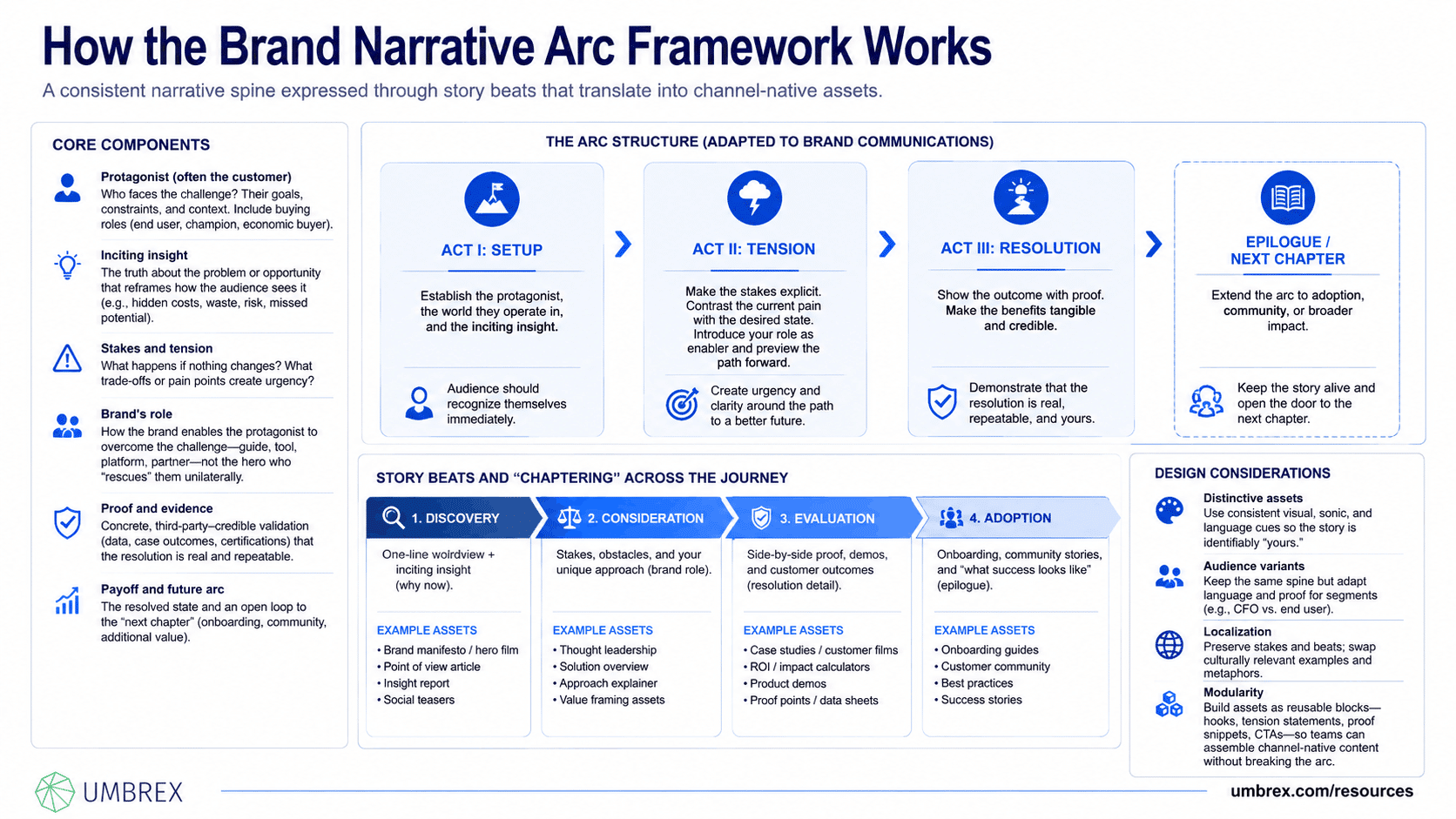
The core logic is to define a consistent narrative spine and express it as a series of “beats” that translate into channel-native assets. Most implementations cover three elements: the protagonist and stakes, the arc (setup–tension–resolution), and the proof-led payoff with a call to action.
Core Components
- Protagonist (often the customer): Who faces the challenge? Their goals, constraints, and context. In B2B, include buying roles (end user, champion, economic buyer).
- Inciting insight: The truth about the problem or opportunity that reframes how the audience sees it (e.g., hidden costs, waste, risk, missed potential).
- Stakes and tension: What happens if nothing changes? What trade-offs or pain points create urgency?
- Brand’s role: How the brand enables the protagonist to overcome the challenge—guide, tool, platform, partner—not the hero who “rescues” them unilaterally.
- Proof and evidence: Concrete, third-party–credible validation (data, case outcomes, certifications) that the resolution is real and repeatable.
- Payoff and future arc: The resolved state and an open loop to the “next chapter” (onboarding, community, additional value).
The Arc Structure (adapted to brand communications)
- Act I: Setup — Establish the protagonist, the world they operate in, and the inciting insight. Audience should recognize themselves immediately.
- Act II: Tension — Make the stakes explicit. Contrast the current pain with the desired state. Introduce your role as enabler and preview the path forward.
- Act III: Resolution — Show the outcome with proof. Make the benefits tangible and credible. Invite the audience to take the next step.
- Epilogue/Next Chapter — Extend the arc to adoption, community, or broader impact. This prevents one-off campaigns from feeling isolated.
Story Beats and “Chaptering” Across the Journey
- Discovery: One-line worldview + inciting insight (why now).
- Consideration: Stakes, obstacles, and your unique approach (brand role).
- Evaluation: Side-by-side proof, demos, and customer outcomes (resolution detail).
- Adoption: Onboarding, community stories, and “what success looks like” (epilogue).
Each beat translates into specific assets: a hero film or manifesto for Discovery, case films and calculators for Evaluation, onboarding guides and communities for Adoption. Over time, chapters accumulate into a recognizable, distinctive narrative that builds memory structures and trust.
Design Considerations
- Distinctive assets: Use consistent visual, sonic, and language cues so the story is identifiably “yours.”
- Audience variants: Keep the same spine but adapt language and proof for segments (e.g., CFO vs. end user).
- Localization: Preserve stakes and beats; swap culturally relevant examples and metaphors.
- Modularity: Build assets as reusable blocks—hooks, tension statements, proof snippets, CTAs—so teams can assemble channel-native content without breaking the arc.
4. When to Use the Brand Narrative Arc Framework
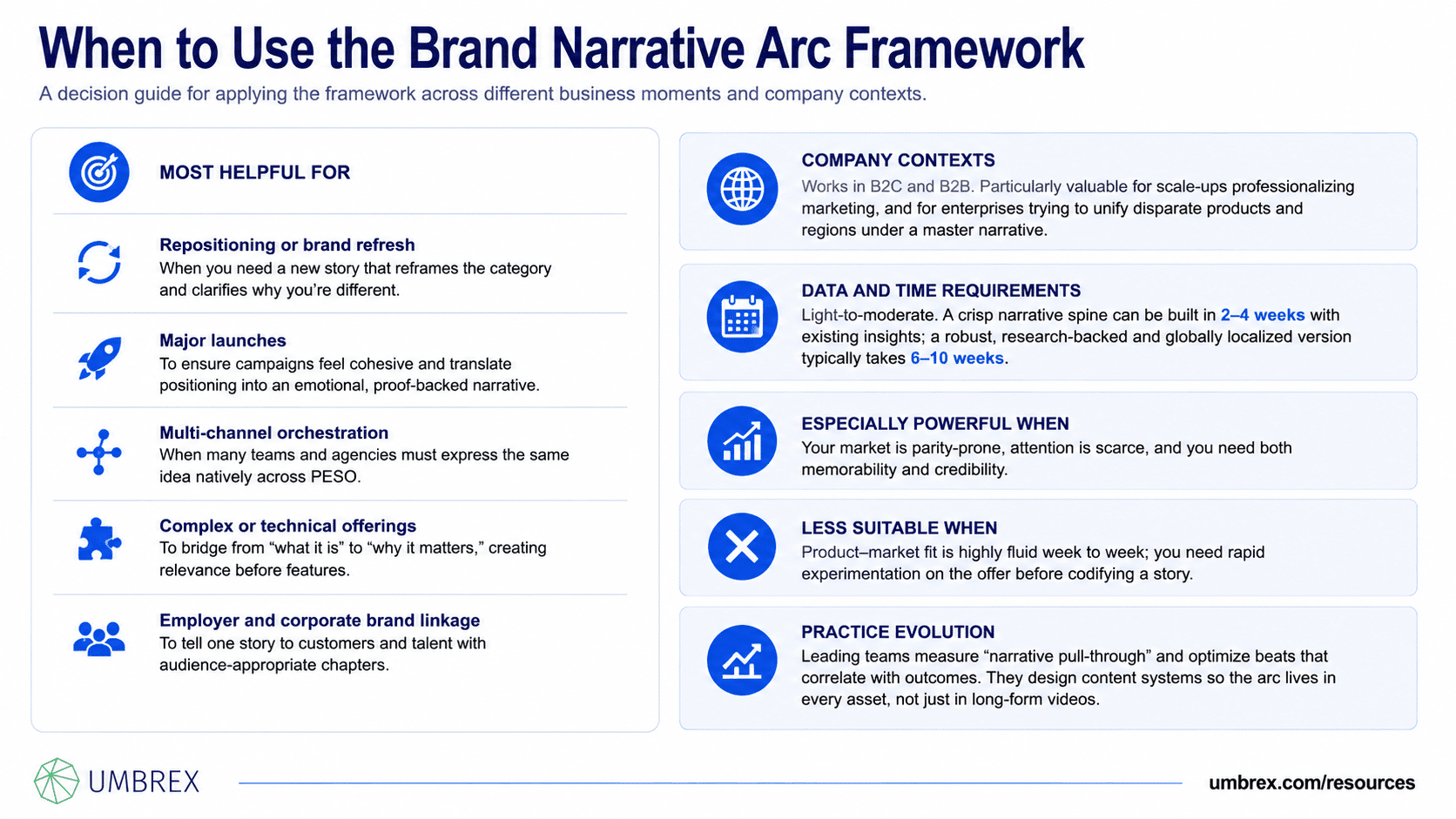
Most helpful for:
- Repositioning or brand refresh: When you need a new story that reframes the category and clarifies why you’re different.
- Major launches: To ensure campaigns feel cohesive and translate positioning into an emotional, proof-backed narrative.
- Multi-channel orchestration: When many teams and agencies must express the same idea natively across PESO.
- Complex or technical offerings: To bridge from “what it is” to “why it matters,” creating relevance before features.
- Employer and corporate brand linkage: To tell one story to customers and talent with audience-appropriate chapters.
Company contexts: Works in B2C and B2B. Particularly valuable for scale-ups professionalizing marketing, and for enterprises trying to unify disparate products and regions under a master narrative.
Data and time requirements: Light-to-moderate. A crisp narrative spine can be built in 2–4 weeks with existing insights; a robust, research-backed and globally localized version typically takes 6–10 weeks.
Especially powerful when: Your market is parity-prone, attention is scarce, and you need both memorability and credibility.
Less suitable when: Product–market fit is highly fluid week to week; you need rapid experimentation on the offer before codifying a story.
Practice evolution: Leading teams measure “narrative pull-through” and optimize beats that correlate with outcomes. They design content systems so the arc lives in every asset, not just in long-form videos.
5. How to Apply the Brand Narrative Arc Framework: Step-by-Step
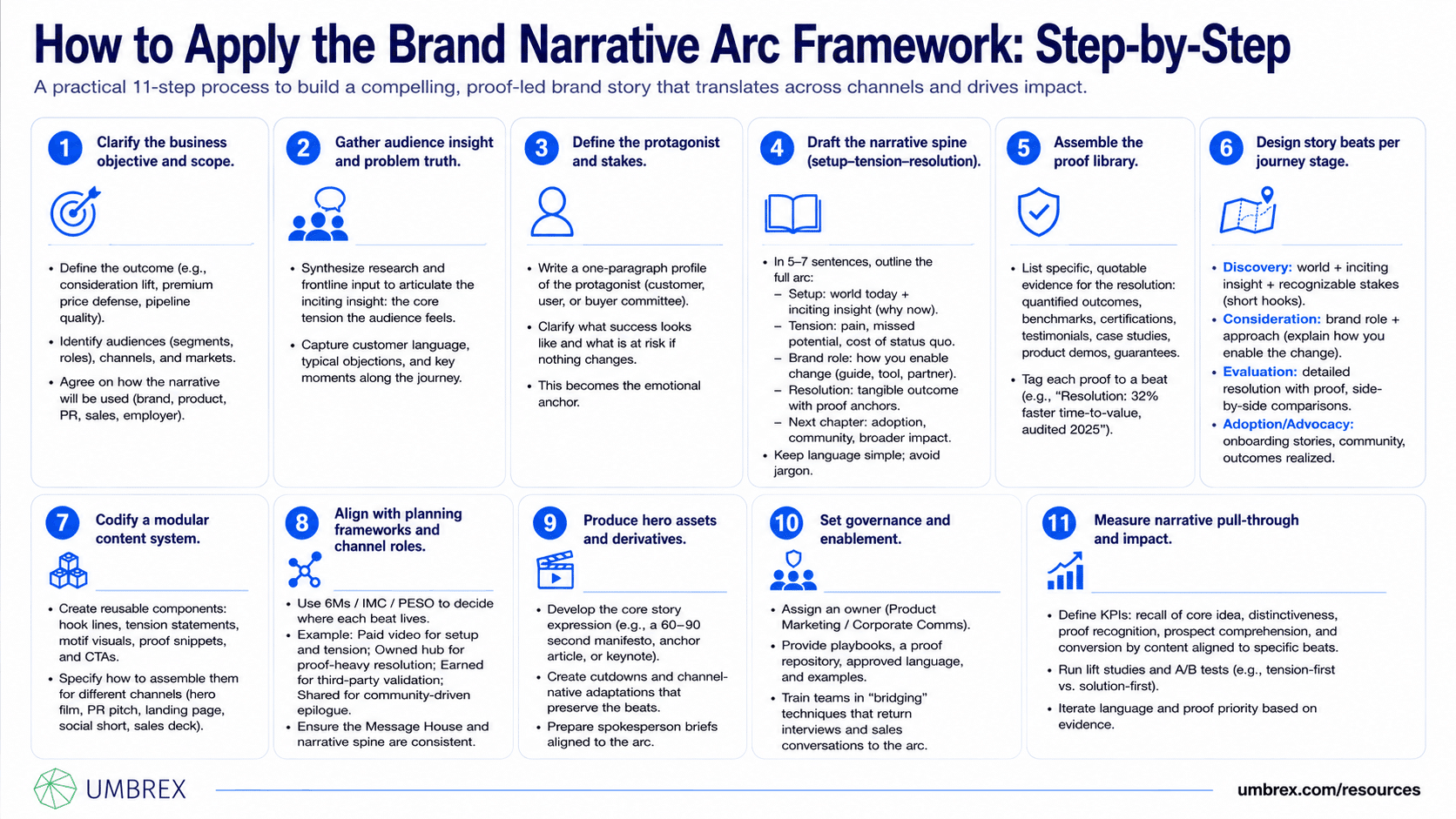
- Clarify the business objective and scope.
Define the outcome (e.g., consideration lift, premium price defense, pipeline quality), the audiences (segments, roles), and the channels and markets in scope. Agree on how the narrative will be used (brand, product, PR, sales, employer).
- Gather audience insight and problem truth.
Synthesize research and frontline input to articulate the inciting insight: the core tension the audience feels. Capture language customers actually use, typical objections, and moments that matter along the journey.
- Define the protagonist and stakes.
Write a one-paragraph profile of the protagonist (customer, user, or buyer committee). Clarify what success looks like and what is at risk if nothing changes. This becomes the emotional anchor.
- Draft the narrative spine (setup–tension–resolution).
In 5–7 sentences, outline the full arc:
- Setup: the world today + inciting insight (why now).
- Tension: the pain or missed potential and the cost of status quo.
- Brand role: how you enable change (guide, tool, partner), not as the “hero” but the enabler.
- Resolution: the tangible outcome, with proof anchors.
- Next chapter: adoption/community or broader impact.
Keep language simple and avoid internal jargon.
- Assemble the proof library.
List specific, quotable evidence for the resolution: quantified outcomes, benchmarks, certifications, testimonials, case studies, product demonstrations, and guarantees. Tag each proof to a beat (e.g., “Resolution: 32% faster time-to-value, audited 2025”).
- Design story beats per journey stage.
Map the spine to chapters:
- Discovery: world + inciting insight + recognizable stakes (short hooks).
- Consideration: brand role + approach (explain how you enable the change).
- Evaluation: detailed resolution with proof, side-by-side comparisons.
- Adoption/Advocacy: onboarding stories, community, outcomes realized.
Each beat should have exemplar copy and asset formats.
- Codify a modular content system.
Create reusable components: hook lines, tension statements, motif visuals, proof snippets, and CTAs. Specify how to assemble them for different channels (hero film, PR pitch, landing page, social short, sales deck).
- Align with planning frameworks and channel roles.
Use 6Ms/IMC/PESO to decide where each beat lives. For example: Paid video for setup and tension, Owned hub for proof-heavy resolution, Earned for third-party validation, Shared for community-driven epilogue. Ensure the Message House and narrative spine are consistent.
- Produce hero assets and derivatives.
Develop the core story expression (e.g., a 60–90 second manifesto, anchor article, or keynote). Create cutdowns and channel-native adaptations that preserve the beats. Prepare spokesperson briefs aligned to the arc.
- Set governance and enablement.
Assign an owner (Product Marketing/Corporate Comms). Provide playbooks, a proof repository, approved language, and examples. Train teams in “bridging” techniques that return interviews and sales conversations to the arc.
- Measure narrative pull-through and impact.
Define KPIs: recall of core idea, distinctiveness, proof recognition, prospect comprehension, and conversion by content aligned to specific beats. Run lift studies and A/B tests (e.g., tension-first vs. solution-first). Iterate language and proof priority based on evidence.
6. Example: Brand Narrative Arc Framework in Action
Context: A $600M B2C/B2B hybrid home energy company is launching a bundled “smart heat + solar + storage” offering. Prior campaigns emphasized product specs and rebates, yielding low comprehension and price discounting. The CEO wants a single story that moves mainstream households and builders beyond “another gadget” to “energy independence and comfort that pays back.”
Application:
- Protagonist and stakes: Homeowners with high, volatile energy bills and cold/hot rooms; builders facing stricter codes. Stakes: wasted money, discomfort, and rising grid instability.
- Inciting insight: Most homes lose energy through air leaks and poor controls—throwing money at a single device doesn’t fix the system.
- Narrative spine:
- Setup: “Your home isn’t inefficient by accident. It’s a system—leaks, loads, and habits—that no single device can solve.”
- Tension: “You pay for wasted energy every month, and heat waves and blackouts will make it worse.”
- Brand role: “We design and install a system—smart heat pump, solar, storage, and controls—that work together, tuned to your home.”
- Resolution: “Comfort in every room, bills cut up to 40%, with backup power when the grid fails—verified by third-party audits.”
- Next chapter: “App coaching and a community that shares savings and resilience tips.”
- Proof library: 38% average bill reduction across 1,200 homes; utility rebates and certifications; 4.8/5 customer ratings; code-compliant builder pilot cutting energy intensity by 45%.
- Beats by stage:
- Discovery: 30-second spot: family in a heat wave, utility bill spike, “system, not gadgets” hook.
- Consideration: Owned article and explainer animation on “How a whole-home system works,” plus builder-focused one-pager.
- Evaluation: Interactive calculator and case studies; third-party audit badge; local rebate finder.
- Adoption: Onboarding videos and community forum; “first 90 days to max savings” checklist.
- Channel roles (PESO): Paid CTV and online video seed the setup/tension; Earned local news features on resilience; Shared UGC “before/after” insulation tests; Owned hub for proof and calculators.
- Measurement: Distinctiveness and comprehension lift; audit badge recognition; calculator completion; conversion and average selling price vs. prior campaigns.
Outcomes (two quarters): Ad recall +16 points; comprehension of “whole-home system” +21 points; calculator completion rate 2.6x; average selling price +11% with lower promo dependency; Earned placements drove a 1.9x conversion lift on sessions exposed to third-party audits. The narrative arc became the corporate keynote and partner brief, unifying consumer and builder messaging.
7. Strengths and Limitations
Strengths
- Makes strategy memorable: Turns positioning into a human, high-stakes story that audiences recall and retell.
- Improves coherence: Creates a throughline so campaigns, PR, sales, and onboarding feel like chapters of one book.
- Balances emotion and proof: Uses tension and stakes to create relevance, then closes with credible evidence.
- Portable and modular: Scales across PESO channels and markets with consistent beats and adaptable proof.
Limitations
- Not a strategy by itself: It expresses positioning; it doesn’t choose target segments or set budgets.
- Risk of “brand as hero”: Over-centering the brand can make stories self-congratulatory and less persuasive.
- Time and craft: Strong arcs require tight writing, distinctive assets, and high-quality proof; shortcuts show.
- Potential for sameness: Without distinctiveness, many “purpose-led” narratives blend together.
8. Common Pitfalls (and How to Avoid Them)
- Brand as the hero.
What goes wrong: The story becomes self-focused; customers disengage.
Avoid it: Make the customer the protagonist; cast the brand as enabler/guide.
- No real tension.
What goes wrong: Low urgency and weak memory.
Avoid it: State clear stakes and the cost of inaction with specifics (money, time, risk).
- Hand-wavy resolution.
What goes wrong: Claims feel like hype; credibility erodes.
Avoid it: Anchor outcomes in independent proof (data, third-party validations, guarantees).
- Inconsistent beats across channels.
What goes wrong: Assets feel disconnected; reinforcement effects are lost.
Avoid it: Codify beats and provide modular components and examples for each channel.
- Trying to fit a full arc in every asset.
What goes wrong: Overstuffed, underperforming creative.
Avoid it: Assign one or two beats per asset based on stage and channel role.
- Ignoring audience and cultural nuance.
What goes wrong: Metaphors or stakes miss the mark or offend.
Avoid it: Keep the spine; localize examples and references; test with target segments.
- No governance or refresh cadence.
What goes wrong: Drift, dated proofs, and mixed messages.
Avoid it: Assign ownership, maintain a proof repository, and schedule quarterly reviews.
9. How the Brand Narrative Arc Framework Relates to Other Frameworks
- Message House: The Message House defines what you say (roof, pillars, proof). The Narrative Arc defines how you tell it (setup, tension, resolution) and in what sequence across the journey. Use both: the house anchors claims; the arc makes them compelling.
- 6Ms (Market, Mission, Message, Media, Money, Measurement): 6Ms sets objectives, audiences, channels, and KPIs. The arc informs the “Message” and guides asset creation for “Media,” with “Measurement” tracking narrative pull-through and impact.
- IMC and PESO: IMC orchestrates across teams and time; PESO structures channel types. The arc supplies the story beats that IMC/PESO deploy and amplify.
- DRIP (Differentiate, Remind, Inform, Persuade): DRIP clarifies asset jobs. Map beats accordingly: setup/tension for Differentiate, short mnemonic cues for Remind, proof-heavy resolution for Inform, risk reversal and CTAs for Persuade.
- 7Cs of Communication: Apply the 7Cs to each beat to ensure clarity, conciseness, concreteness, correctness, completeness, consideration, and courtesy.
- STP and Value Proposition: Segmentation and positioning inform protagonists, stakes, and the brand role; the arc expresses them in story form.
- Distinctive Brand Assets and Sensory Branding: Embed consistent visual/sonic cues across beats to build recognition and memory.
10. Key Takeaways
- The Brand Narrative Arc Framework turns positioning into a human, high-stakes story with setup, tension, and resolution—expressed in modular beats across the journey.
- Make the customer the protagonist; cast the brand as enabler. State clear stakes and prove the payoff with credible evidence.
- Chapter the arc by stage: hook and tension at Discovery, approach in Consideration, proof-heavy resolution at Evaluation, and onboarding/community as the next chapter.
- Codify beats, proofs, and channel-native templates so teams can execute consistently across PESO and regions.
- Measure narrative pull-through and impact; iterate language and proof priority based on recall, comprehension, and conversion.
11. FAQs About the Brand Narrative Arc Framework
Is a narrative arc still relevant when audiences skim?
Yes. The arc provides structure; you express it in short, modular beats. Lead with a hook (setup + tension) and land a single proof-backed payoff. Over time, repeated beats build a coherent story even in short formats.
How is this different from a Message House?
A Message House is a hierarchy of claims and proofs. The Narrative Arc is the sequence and emotional logic of how those claims are told across the journey. They are complementary: house for content, arc for structure and flow.
Do we have to use the hero’s journey?
No. The framework adopts broad narrative principles (setup–tension–resolution). You can tailor structures to your category (e.g., problem–insight–approach–proof) while preserving the core beats.
Can small companies use this framework?
Absolutely. Build a lightweight spine (five sentences), identify two or three proof anchors, and create a single hero asset with a few derivatives. This prevents message drift and accelerates asset creation.
How long does it take to build a narrative arc?
A crisp draft takes 2–4 weeks using existing insights. A robust version with research, proof generation, localization, and enablement typically takes 6–10 weeks, with ongoing refresh as new proofs emerge.
How do we measure success?
Track narrative pull-through (consistency across assets), recall of the core idea and proof, comprehension lift, distinctiveness, and conversion by beat exposure. Use lift studies, A/B tests, and cohort analyses to link beats to outcomes.
