

1. What Is Message House Framework?
The Message House Framework is a simple, visual way to codify your core narrative on a single page. It organizes a primary, overarching message (the “roof”), a small set of supporting pillars (3–4 key themes), and specific proof points (data, examples, quotes) that underpin each pillar (the “foundation”). Teams use it to ensure every communication—across marketing, PR, sales, investor relations, and internal channels—reinforces the same core story with credible evidence.
This is a communications planning and content framework within the “Communications, messaging & content frameworks” category. Consultants and senior marketers employ it to align stakeholders, brief agencies, train spokespeople, and keep complex programs consistent across markets and channels.
In plain terms: the Message House is your master narrative on one page. It tells everyone “what we’re saying” and “why it’s true,” so assets from the website to a sales deck to a press interview sound like the same company—and stand up to scrutiny.
2. Origin and Background
Origin: Unknown; in use since at least the 1990s. The structure emerged from corporate communications and PR practice as a practical alternative to sprawling messaging documents.
Why it was created: Organizations needed a concise, shared reference to prevent message drift across functions, regions, and channels—especially during launches, strategy shifts, and issues management. The “house” metaphor made the hierarchy intuitive and easy to remember.
How it became widely known: Through agency playbooks, communications training, and consulting toolkits. Over time, variants appeared (adding taglines, audience versions, FAQs), but the core structure—roof, pillars, foundation—remains consistent.
3. How the Message House Framework Works
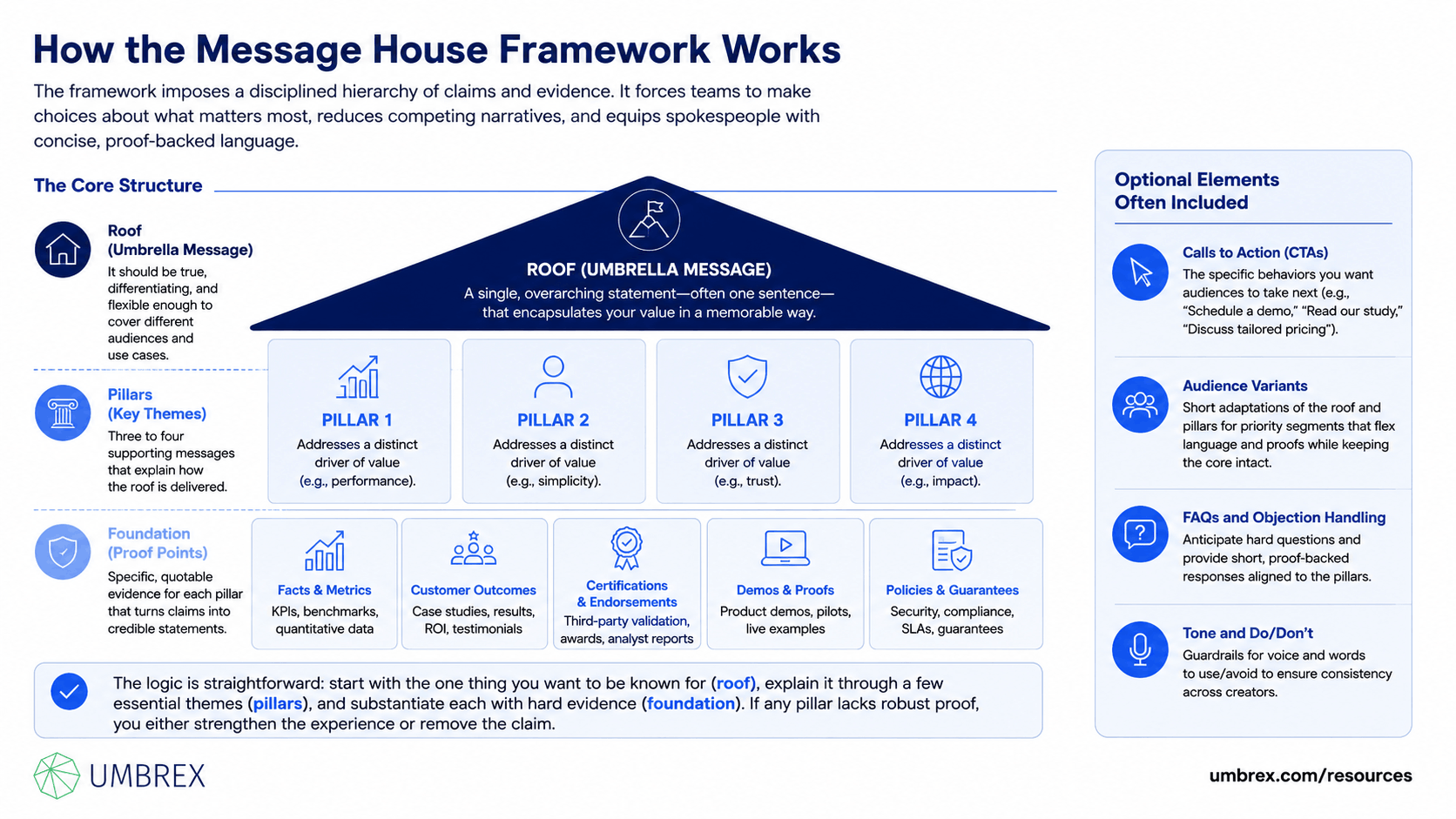
The framework imposes a disciplined hierarchy of claims and evidence. It forces teams to make choices about what matters most, reduces competing narratives, and equips spokespeople with concise, proof-backed language.
The Core Structure
- Roof (Umbrella Message): A single, overarching statement—often one sentence—that encapsulates your value in a memorable way. It should be true, differentiating, and flexible enough to cover different audiences and use cases.
- Pillars (Key Themes): Three to four supporting messages that explain how the roof is delivered. Each pillar addresses a distinct driver of value (e.g., performance, simplicity, trust, impact) and should be mutually reinforcing without overlap.
- Foundation (Proof Points): Specific, quotable evidence for each pillar: facts, metrics, customer outcomes, certifications, demos, third-party endorsements, and policies. This is what turns claims into credible statements.
Optional Elements Often Included
- Calls to Action (CTAs): The specific behaviors you want audiences to take next (e.g., “Schedule a demo,” “Read our study,” “Discuss tailored pricing”).
- Audience Variants: Short adaptations of the roof and pillars for priority segments (e.g., executive vs. technical buyer, consumers vs. partners) that keep the core intact but flex language and proofs.
- FAQs and Objection Handling: A brief annex that anticipates hard questions and provides short, proof-backed responses aligned to the pillars.
- Tone and Do/Don’t: Guardrails for voice and words to use/avoid to ensure consistency across creators.
The logic is straightforward: start with the one thing you want to be known for (roof), explain it through a few essential themes (pillars), and substantiate each with hard evidence (foundation). If any pillar lacks robust proof, you either strengthen the experience or remove the claim.
4. When to Use the Message House Framework
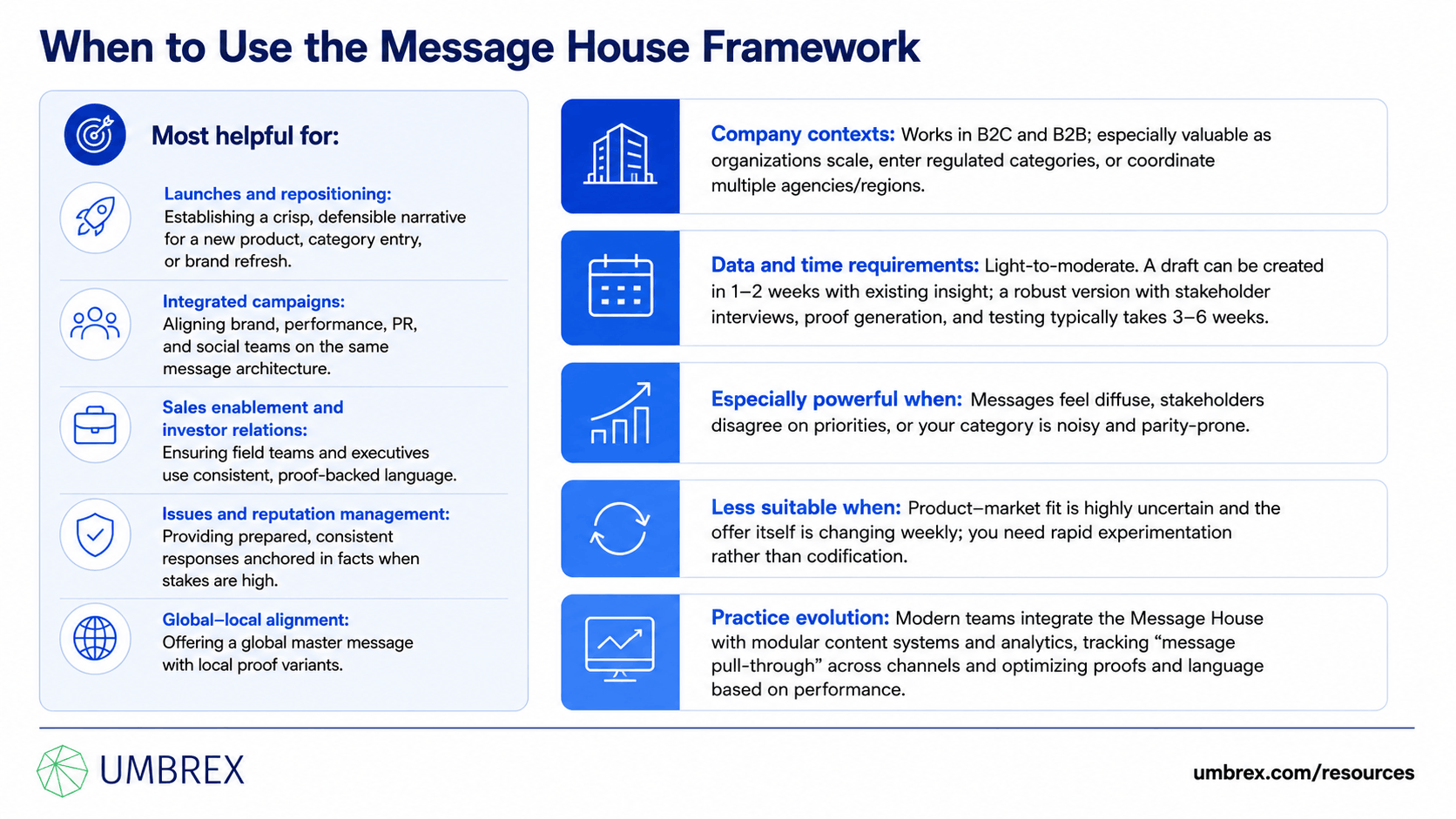
Most helpful for:
- Launches and repositioning: Establishing a crisp, defensible narrative for a new product, category entry, or brand refresh.
- Integrated campaigns: Aligning brand, performance, PR, and social teams on the same message architecture.
- Sales enablement and investor relations: Ensuring field teams and executives use consistent, proof-backed language.
- Issues and reputation management: Providing prepared, consistent responses anchored in facts when stakes are high.
- Global–local alignment: Offering a global master message with local proof variants.
Company contexts: Works in B2C and B2B; especially valuable as organizations scale, enter regulated categories, or coordinate multiple agencies/regions.
Data and time requirements: Light-to-moderate. A draft can be created in 1–2 weeks with existing insight; a robust version with stakeholder interviews, proof generation, and testing typically takes 3–6 weeks.
Especially powerful when: Messages feel diffuse, stakeholders disagree on priorities, or your category is noisy and parity-prone.
Less suitable when: Product–market fit is highly uncertain and the offer itself is changing weekly; you need rapid experimentation rather than codification.
Practice evolution: Modern teams integrate the Message House with modular content systems and analytics, tracking “message pull-through” across channels and optimizing proofs and language based on performance.
5. How to Apply the Message House Framework: Step-by-Step
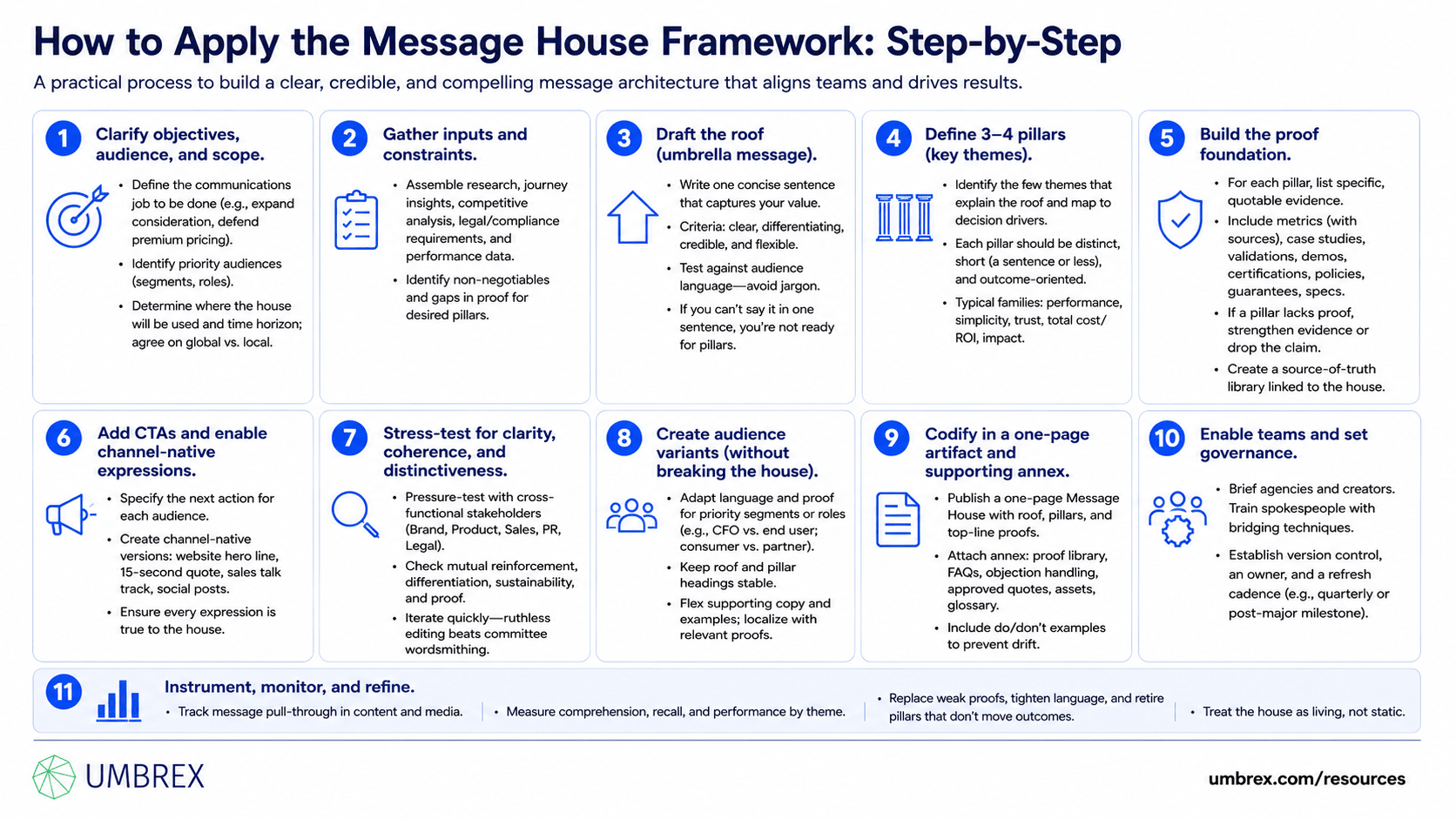
- Clarify objectives, audience, and scope.
Define the communications job to be done (e.g., expand consideration, defend premium pricing, win analyst shortlists), the priority audiences (segments, roles), and where the house will be used (press, site, sales, investor deck). Agree on a time horizon and what will be global vs. local.
- Gather inputs and constraints.
Assemble brand positioning, customer research, journey insights, competitive analysis, legal/compliance requirements, and performance data. Identify non-negotiables (regulated claims, terminology) and gaps (missing proof for desired pillars).
- Draft the roof (umbrella message).
Write one concise sentence that captures the essence of your value. Criteria: clear, differentiating, credible, and flexible. Test against audience language—avoid internal jargon. If you can’t say it in one sentence, you’re not ready for pillars.
- Define 3–4 pillars (key themes).
Identify the few themes that collectively explain the roof and map to audience decision drivers. Each pillar should be distinct, short (a sentence or less), and outcome-oriented. Typical families: performance/results, simplicity/time-to-value, trust/safety, total cost/ROI, societal impact.
- Build the proof foundation.
For each pillar, list specific, quotable evidence: metrics (with sources and dates), case studies, third-party validations, demos, certifications, product specs, policies, and guarantees. If a pillar lacks proof, either strengthen real-world evidence or drop the claim. Create a source-of-truth library linked to the house.
- Add CTAs and enable channel-native expressions.
Specify the next action for each audience (demo, assessment, trial, talk to sales, download). Draft channel-native versions: a website hero line, a 15-second spokesperson quote, a sales talk track, and social post variants—each true to the house.
- Stress-test for clarity, coherence, and distinctiveness.
With a small, cross-functional set of stakeholders (Brand, Product, Sales, PR, Legal), pressure-test the roof and pillars: Are they mutually reinforcing? Do they clearly differentiate from competitors? Are claims sustainable and proof-backed? Iterate quickly—ruthless editing beats wordsmithing by committee.
- Create audience variants (without breaking the house).
Adapt language and proof for priority segments or roles (e.g., CFO vs. end user; consumer vs. partner). Keep the roof and pillar headings stable; flex the supporting copy and examples. Localize carefully with culturally relevant proofs.
- Codify in a one-page artifact and supporting annex.
Publish a clean, single-page Message House with roof, pillars, and top-line proofs. Attach an annex: proof library with sources, FAQs/objection handling, approved quotes, visual assets, and a glossary. Include do/don’t examples to prevent drift.
- Enable teams and set governance.
Brief agencies and internal creators. Train spokespeople with bridging techniques tied to pillars. Establish version control, an owner (usually Product Marketing or Corporate Comms), and a refresh cadence (e.g., quarterly or post-major milestone).
- Instrument, monitor, and refine.
Track message pull-through in content and media, comprehension and recall in research, and performance by theme (e.g., which proof drives conversion). Replace weak proofs, tighten language, and retire pillars that don’t move outcomes. Treat the house as living, not static.
6. Example: Message House Framework in Action
Context: A $750M medtech company is launching a remote cardiac monitoring platform. Early drafts of messaging were feature-heavy, inconsistent across regions, and struggled with clinician trust and payer approval.
Application: The team built a Message House for three audiences: cardiologists, hospital administrators/payers, and patients (lightweight variant).
- Roof: “Earlier detection, fewer admissions—remote cardiac monitoring clinicians trust and patients prefer.”
- Pillars and foundation:
- Clinical performance: 29% faster detection of arrhythmias vs. Holter (peer-reviewed, 2025); 94% diagnostic yield in multi-center study.
- Workflow simplicity: 12-minute setup; auto-structured reports into EHR; 24/7 clinician hotline; integration certifications for Epic/Cerner.
- Patient adherence and experience: 87% wear-time adherence; water-resistant patch; multilingual onboarding; NPS +52 in pilot regions.
- Economics and access: DRG-level cost offsets from reduced readmissions; payer policy approvals in 18 states; outcomes-based pricing pilot.
- CTAs: “Book a clinical demo,” “Download the outcomes compendium,” “Join reimbursement webinar.”
- Audience variants: For payers, the roof emphasized “documented reductions in readmissions and total cost of care,” with heavier economic proofs. For patients, language shifted to “comfort, privacy, and faster answers,” with a clear consent/explanation of data use.
Outcomes (two quarters): Analyst coverage adopted the core pillars; sales talk tracks reflected the same language; demo-to-trial conversion rose from 28% to 41%; payer approvals accelerated with a standardized economics pack. Media interviews showed higher message pull-through, and content performance improved on pages organized by the four pillars.
7. Strengths and Limitations
Strengths
- Clarity and alignment: Creates a single source of truth so teams stop “freelancing” the story.
- Credibility: Forces proof-backed claims, reducing risk and increasing persuasion.
- Portability: Easy to brief, train, and adapt across channels and markets.
- Speed: Accelerates content creation and review cycles; reduces rework.
Limitations
- Abstraction risk: Without strong proofs, a well-written house becomes a wish list.
- Static snapshot: Markets move; a house can date quickly without a refresh cadence.
- Blandness danger: Over-consensus can water down distinctiveness; ruthless editing is required.
- Not a strategy or creative idea: It guides what to say, not who to target, where to show up, or the big creative platform.
8. Common Pitfalls (and How to Avoid Them)
- Too many pillars.
What goes wrong: The message becomes a laundry list; recall drops.
Avoid it: Cap at 3–4 pillars. If you have more, consolidate or demote to proof level.
- Vague claims without proof.
What goes wrong: Credibility erodes; legal risk rises.
Avoid it: Require at least two quotable proofs per pillar, with source and date.
- Jargon-heavy roof.
What goes wrong: Audiences don’t understand or care.
Avoid it: Use the audience’s words; test comprehension with non-experts.
- Mismatched audience variants.
What goes wrong: Local teams drift from the core; contradictions emerge.
Avoid it: Keep roof and pillar headings fixed; flex only supporting language and proofs.
- No CTA or next step.
What goes wrong: Engagement doesn’t convert to action.
Avoid it: Attach a clear, stage-appropriate CTA to each asset built from the house.
- Version chaos.
What goes wrong: Teams use outdated language and data.
Avoid it: Assign an owner, track versions, and set a standing quarterly review.
- House replaces real improvement.
What goes wrong: Messaging promises outrun product/service reality.
Avoid it: Use the house to highlight gaps; feed fixes into product and service roadmaps.
9. How the Message House Framework Relates to Other Frameworks
- 6Ms (Market, Mission, Message, Media, Money, Measurement): The House is the “Message” element. Use 6Ms to set objectives and channels; use the House to codify what you say and the proof behind it.
- IMC (Integrated Marketing Communications): IMC orchestrates activity across channels and teams; the House keeps the story consistent across those executions.
- PESO/POEM: Channel taxonomies. Build channel plans (Paid, Earned, Shared, Owned) using the House to ensure each channel expresses the same roof and pillars natively.
- DRIP (Differentiate, Remind, Inform, Persuade): DRIP clarifies each asset’s job; the House provides the content to fulfill those jobs with consistent, proof-backed claims.
- 7Cs of Communication: Apply the 7Cs to the House text to ensure clarity, conciseness, concreteness, correctness, completeness, consideration, and courtesy.
- Value Proposition and STP: Segmentation, targeting, and positioning inform the roof and pillars; the House operationalizes positioning into usable language and proofs.
10. Key Takeaways
- The Message House Framework distills your narrative into one roof, a few pillars, and hard proof—making communications consistent and credible.
- Cap pillars at 3–4 and require quotable, sourced proof for each; otherwise, fix the experience or drop the claim.
- Publish a one-page house with an annex (proof library, FAQs, quotes) and keep it version-controlled and refreshed.
- Use the House across PESO channels, sales, PR, and internal comms; adapt language by audience without changing the core.
- The House is a guide to what to say; pair it with planning and channel frameworks (6Ms, IMC, PESO) to decide where and how to say it—and how to measure impact.
11. FAQs About the Message House Framework
Is the Message House still relevant in a digital, always-on environment?
Yes. If anything, it’s more important. With many teams and channels, the House provides a single source of truth that speeds production, reduces rework, and improves consistency and performance.
How many pillars should a Message House have?
Three to four. That number is optimal for recall and for mapping to key decision drivers. If you need more, consolidate or demote to proof. Brevity sharpens strategy.
How is a Message House different from a value proposition?
A value proposition summarizes why you win for a given segment. A Message House turns that strategy into a usable hierarchy of claims and proof for communications across audiences and channels.
Can small or early-stage companies use a Message House?
Absolutely. Start lightweight: one roof, three pillars, and a handful of strong proofs. Update frequently as you learn from customers. It prevents early message drift and accelerates asset creation.
How long does it take to build a Message House?
A first draft can be done in 1–2 weeks using existing insights. A robust version—stakeholder alignment, proof generation, legal review, and audience variants—typically takes 3–6 weeks, with periodic refreshes thereafter.
How do we know if the Message House is working?
Track message pull-through (consistency across assets), comprehension and recall in research, content performance by theme, and downstream outcomes (conversion, win rates) tied to pillar-led content. Replace weak proofs and refine language based on evidence.
