

1. What Is Brand Experience Wheel?
The Brand Experience Wheel is a practical, visual framework that translates a brand’s strategy into a coherent end-to-end customer experience. It arranges the brand’s promise at the center and maps the specific cues, behaviors, and touchpoints that bring that promise to life across the customer journey—often using a wheel or hub-and-spoke layout. The outcome is a clear, shared blueprint for what customers should consistently see, hear, feel, and do at every interaction with the brand.
This is a marketing and brand management framework within the broader set of brand, architecture & equity tools. It is commonly used by consultants and brand leaders to connect the “brand on paper” (positioning, values) with the “brand in practice” (channels, people, product, service, environments). In short: it helps leaders make the brand tangible, operational, and repeatable.
For a busy executive, think of the Brand Experience Wheel as an operating system for your brand experience. It ensures that what you promise in strategy is consistently delivered in your product, your people, your communications, your environments, and your digital interfaces—so customers recognize you, trust you, and come back.
2. Origin and Background
Origin: Unknown; variants have been in use in brand and service design since at least the 1990s. The idea blends classic brand management (translating positioning into cues and codes) with customer experience and service design practices (journey mapping and service standards).
The Brand Experience Wheel was created to solve a persistent gap: brands often articulate compelling positioning but struggle to deliver a consistent experience across touchpoints, functions, and geographies. Agencies, in-house brand teams, and consultancies adopted the wheel as a simple, visual way to align cross-functional teams around the “signature” elements of the brand experience, and to embed those elements into operations and design systems.
It became widely used through brand refresh programs, retail and hospitality design, digital product design, and executive workshops that needed a single page to show how the brand becomes concrete at every moment that matters.
3. How Brand Experience Wheel Works
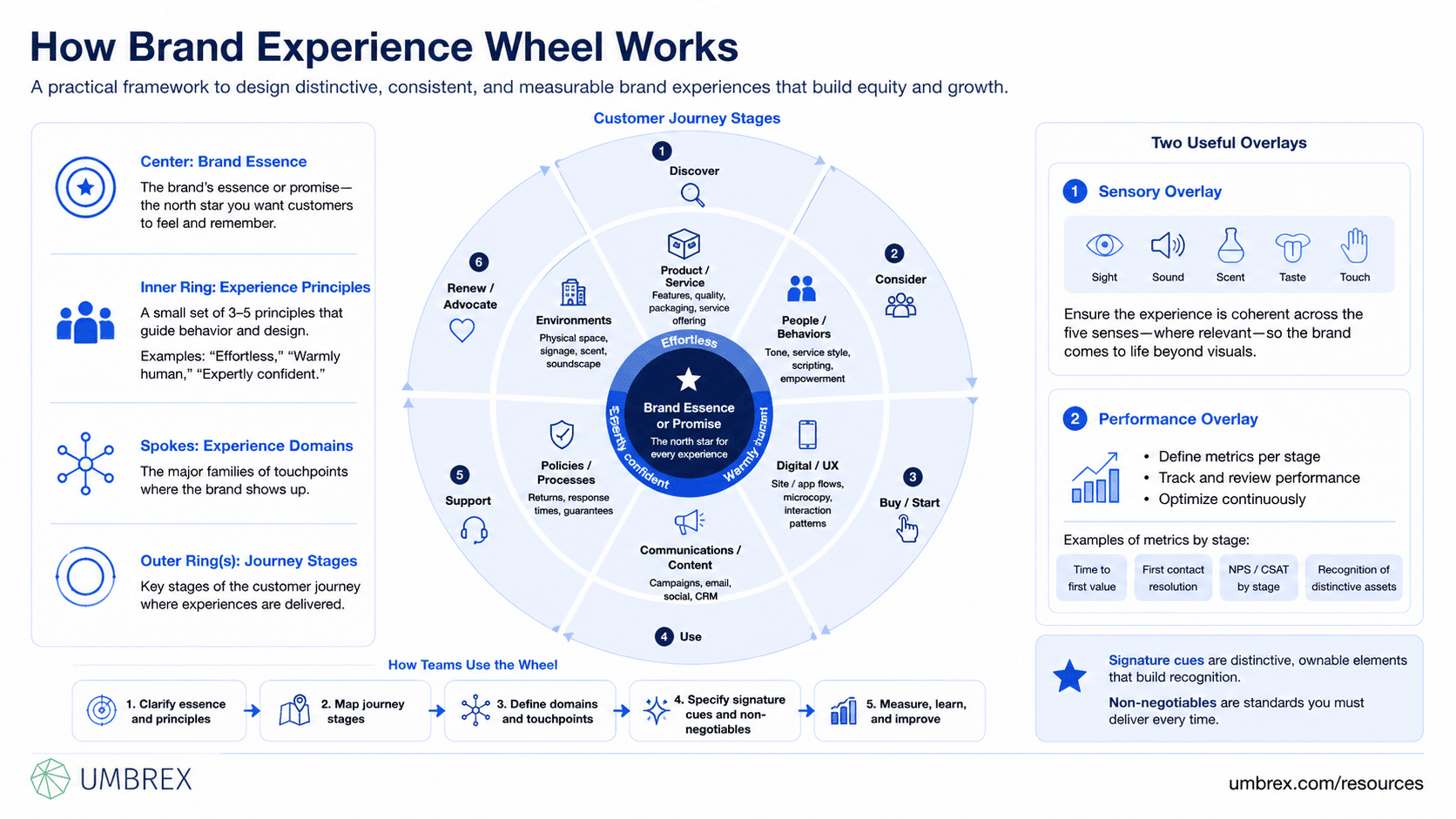
The framework is typically depicted as a wheel with concentric rings and spokes:
- Center: The brand’s essence or promise—the north star you want customers to feel and remember.
- Inner ring: A small set of experience principles (3–5 short statements that guide behavior and design—for example, “Effortless,” “Warmly human,” “Expertly confident”).
- Spokes (domains): The major families of touchpoints where the brand shows up. A common set is:
- Product/Service (features, quality, packaging, service offering)
- People/Behaviors (tone, service style, scripting, empowerment)
- Environments (physical space, signage, scent, soundscape)
- Digital/UX (site/app flows, microcopy, interaction patterns)
- Communications/Content (campaigns, email, social, CRM)
- Policies/Processes (returns, response times, guarantees)
- Outer ring(s): Customer journey stages (e.g., Discover, Consider, Buy/Start, Use, Support, Renew/Advocate).
Teams populate the wheel with “signature cues” and “non‑negotiables” that bring the brand to life at each intersection of journey stage and domain. Signature cues are distinctive, ownable elements (e.g., a greeting ritual, a sound, a color application, a pattern, a micro-interaction) that build recognition. Non-negotiables are standards you must deliver every time (e.g., “first response within 30 minutes,” “plain-language updates,” “friction-free returns”).
Two useful overlays
- Sensory overlay: Ensure the experience is coherent across the five senses—sight, sound, scent, taste, touch—where relevant. This prevents the brand from becoming “visual-only.”
- Performance overlay: Define metrics per stage (e.g., time to first value, first contact resolution, NPS/CSAT by stage, recognition of distinctive assets) so the wheel is measurable.
The core logic is straightforward: articulate the brand’s intent, define the principles that should govern decisions, identify where customers actually interact with you, and then specify the tangible cues and standards that will make the brand unmistakable and valuable at those moments—so the experience compounds into equity and growth.
4. When to Use Brand Experience Wheel
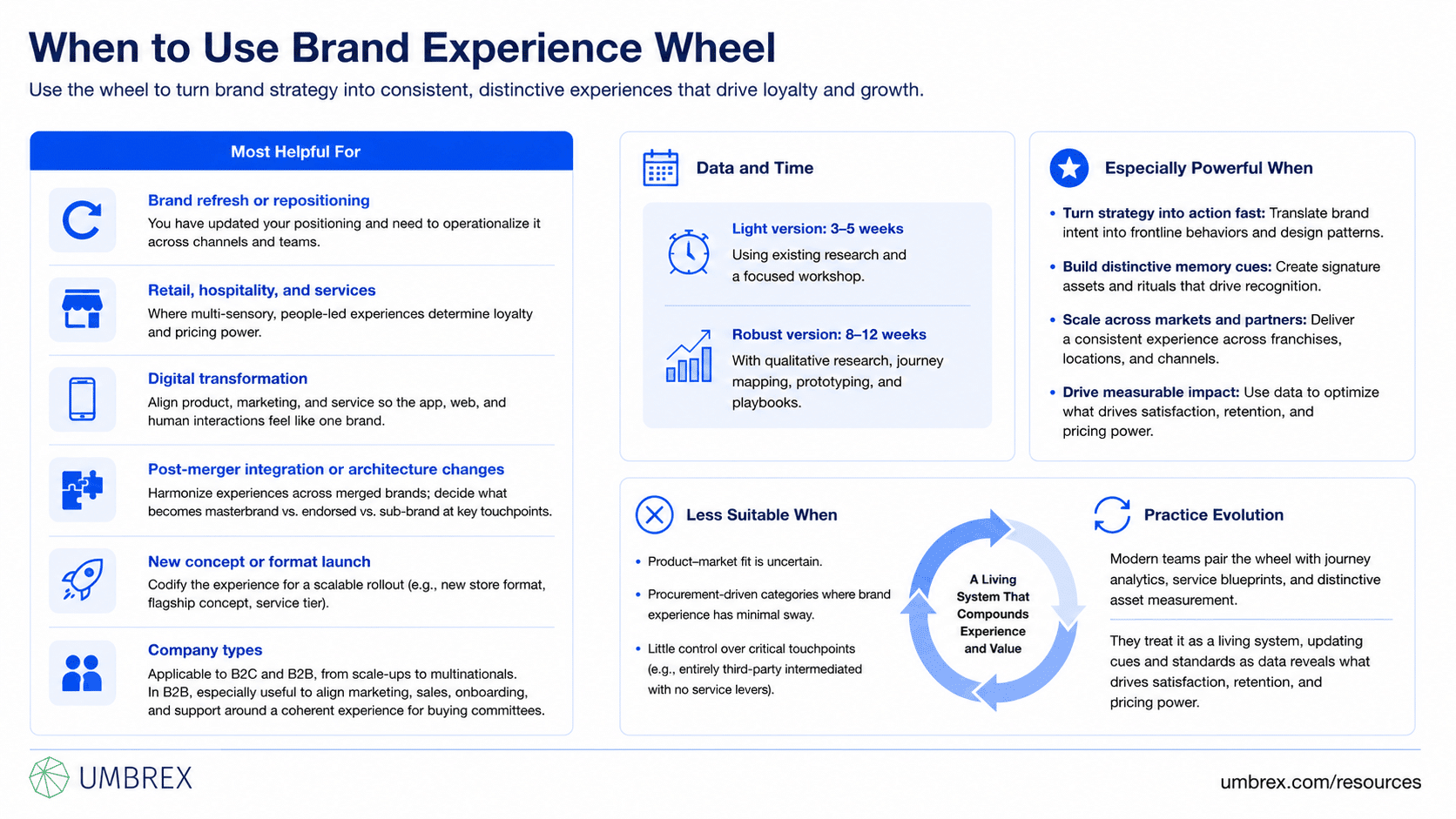
Most helpful for:
- Brand refresh or repositioning: You have updated your positioning and need to operationalize it across channels and teams.
- Retail, hospitality, and services: Where multi-sensory, people-led experiences determine loyalty and pricing power.
- Digital transformation: Align product, marketing, and service so the app, web, and human interactions feel like one brand.
- Post-merger integration or architecture changes: Harmonize experiences across merged brands; decide what becomes masterbrand vs. endorsed vs. sub-brand at key touchpoints.
- New concept or format launch: Codify the experience for a scalable rollout (e.g., new store format, flagship concept, service tier).
Company types: Applicable to B2C and B2B, from scale-ups to multinationals. In B2B, it is especially useful to align marketing, sales, onboarding, and support around a coherent experience for buying committees.
Data and time: A light version can be done in 3–5 weeks using existing research and a focused workshop. A robust version (with qualitative research, journey mapping, prototyping, and playbooks) typically takes 8–12 weeks.
Especially powerful when: You need to turn strategy into frontline behaviors and design patterns fast, build distinctive memory cues, or scale experience delivery across franchises/markets.
Less suitable when: Product–market fit is uncertain; procurement-driven categories where brand experience has minimal sway; or when there is little control over critical touchpoints (e.g., entirely third-party intermediated with no service levers).
Practice evolution: Modern teams pair the wheel with journey analytics, service blueprints, and distinctive asset measurement. They treat it as a living system, updating cues and standards as data reveals what drives satisfaction, retention, and pricing power.
5. How to Apply Brand Experience Wheel: Step-by-Step
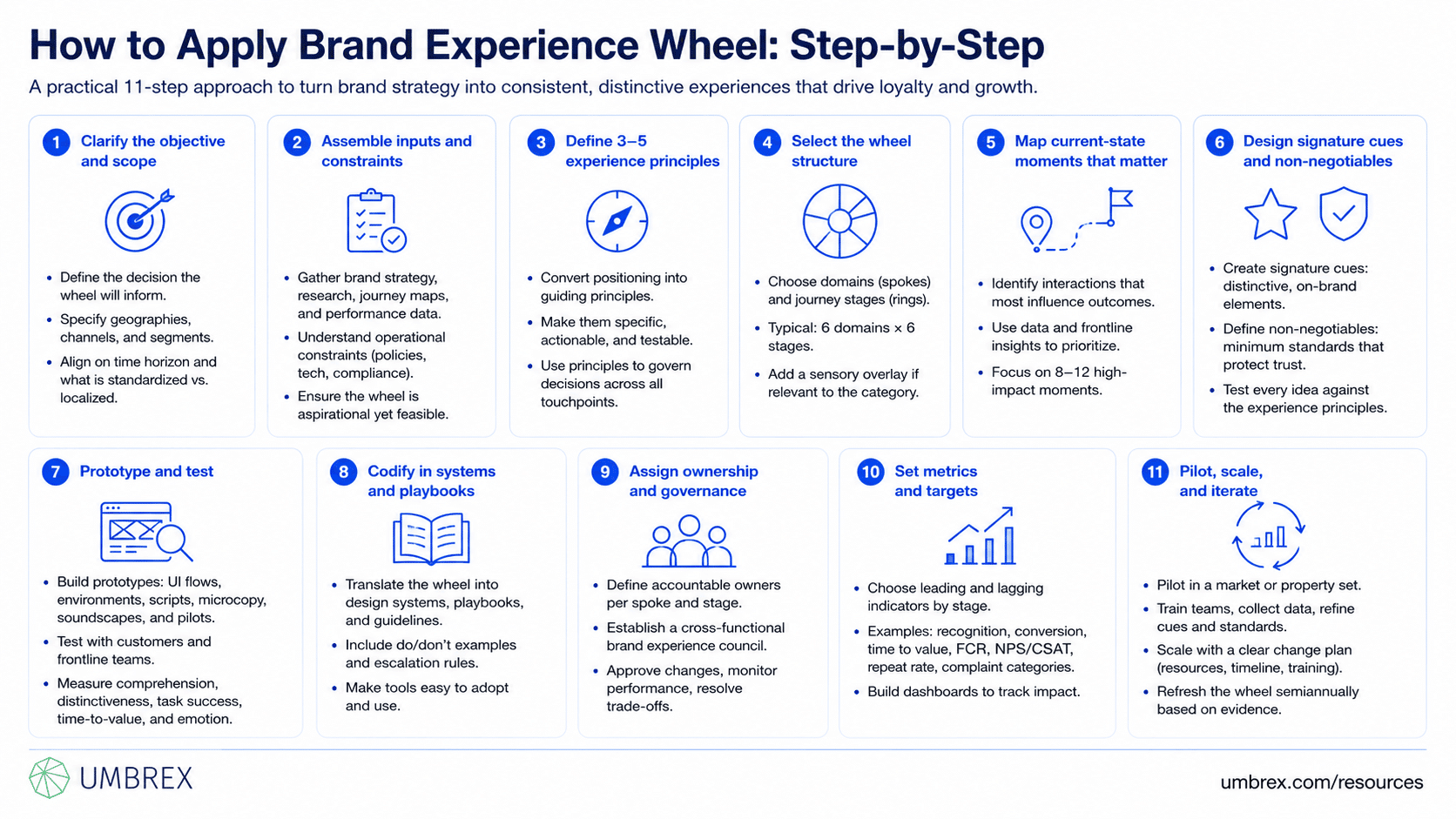
- Clarify the objective and scope.
Define what decision the wheel will inform: a full brand refresh, a new format, a specific journey (e.g., onboarding), or a portfolio harmonization. Specify the geographies, channels, and segments included. Align on the time horizon and what will be standardized globally vs. localized.
- Assemble inputs and constraints.
Gather brand strategy (purpose, positioning, personality), customer research (needs, pain points, jobs-to-be-done), current journey maps, performance metrics (NPS/CSAT, churn, conversion), and operational constraints (policies, technology, compliance). This ensures the wheel is aspirational yet feasible.
- Define 3–5 experience principles.
Convert positioning into guiding principles that are specific and testable (e.g., “Zero dead ends,” “Expert help in plain language,” “A touch of delight in every handoff”). These principles sit just inside the brand essence and govern decisions across touchpoints.
- Select the wheel structure.
Choose your spokes (domains) and rings (journey stages). A typical setup uses six domains—Product/Service, People, Environments, Digital/UX, Communications, Policies/Processes—against a six-stage journey: Discover, Consider, Start/Buy, Use, Support, Renew/Advocate. Add a sensory overlay if your category is physical or experiential.
- Map current-state moments that matter.
Identify the interactions that most influence choice, satisfaction, and loyalty. Use data (drop-offs, complaints, verbatims) and frontline input to prioritize 8–12 moments. This prevents the wheel from becoming a long wish list and focuses investment.
- Design signature cues and non-negotiables.
For each prioritized moment and domain, articulate:
- Signature cues: Distinctive, on-brand elements (e.g., a welcome ritual, an interface animation, a sound, a scent, a packaging flourish, a guarantee statement).
- Non-negotiables: Minimum standards that protect trust (e.g., response within 30 minutes, clear pricing, no dark patterns, accessibility compliance).
Use the experience principles to test each idea. If a cue does not amplify the principle, remove it.
- Prototype and test.
Build low- and high-fidelity prototypes: UI flows, environmental mock-ups, scripts, microcopy, soundscapes, service pilots. Test with customers and frontline staff. Measure comprehension, distinctiveness, task completion, time-to-first-value, and emotional response.
- Codify in systems and playbooks.
Translate the wheel into usable assets: a design system (components, motion, accessibility), service playbooks (scripts, empowerment rules), environmental guidelines (materials, lighting, scent, acoustics), and policy standards. Include “do/don’t” examples and escalation rules.
- Assign ownership and governance.
Define accountable owners per spoke and journey stage (e.g., Digital for onboarding UX; Operations for in-person service). Establish a cross-functional brand experience council to approve changes, monitor performance, and resolve trade-offs.
- Set metrics and targets.
Choose a small set of leading and lagging indicators by stage: recognition of distinctive assets, conversion, time to value, first contact resolution, NPS/CSAT, repeat rate, complaint categories. Build dashboards so teams can see the effect of cues and standards in market.
- Pilot, scale, and iterate.
Roll out the wheel in a pilot market or property set. Train teams, collect data, refine the cues and standards, and then scale with a clear change plan (capex/opex, timelines, training cadence). Refresh the wheel semiannually based on evidence.
6. Example: Brand Experience Wheel in Action
Context: A 60‑property boutique hotel brand had strong awareness but slipping guest satisfaction and inconsistent experiences across regions. The brand promise—“Welcome home to the city”—was clear on paper but uneven in practice.
Approach: The leadership team used the Brand Experience Wheel to operationalize the promise across the journey (Pre‑stay, Arrival, In‑stay, Departure, Post‑stay) and six domains (People, Environments, Digital/UX, Product/Service, Communications, Policies/Processes). Experience principles were set as “Warmly personal,” “Effortless,” and “Quietly local.”
Design highlights:
- Pre‑stay (Digital/UX, Communications): A simplified booking flow with transparent pricing; pre‑arrival note asking for preferences; neighborhood guide micro‑site curated by staff.
- Arrival (People, Environments): A signature greeting (“Welcome home”), a recognizable lobby scent and playlist, check‑in at a cafe‑style desk rather than a counter, and a small local treat as a welcome.
- In‑stay (Product/Service, Policies): “No dead ends” service rule—any staff can resolve common issues on the spot up to a set dollar limit; in‑room design standard (lighting warmth, materials, a locally sourced item).
- Departure (Digital/UX): One‑tap mobile checkout with a friendly thank‑you note using the guest’s name and a photo from their neighborhood guide selection.
- Post‑stay (Communications): A short, plain‑language survey tied to actionable items; an offer relevant to the neighborhood they visited.
Governance and measurement: Property GMs owned People and Environments spokes; Digital led Digital/UX; Brand led Communications. Targets included check‑in time (under 4 minutes), “recognition of signature cues” (scent and greeting) in surveys, and NPS by stage.
Outcomes (9 months): Arrival-stage NPS rose by 14 points; complaint volume fell 18%; occupancy improved 5% with stronger repeat bookings. Mystery shop scores showed consistent delivery of signature cues across 85% of properties. The wheel became the training backbone for new property openings.
7. Strengths and Limitations
Strengths
- Bridges strategy and execution: Turns positioning into behaviors, design, and standards that teams can implement.
- Creates distinctiveness: Codifies signature cues that build memory and recognition across channels and senses.
- Aligns cross‑functional teams: Provides a common map for marketing, product, operations, and HR to row in the same direction.
- Scales consistency: Useful for multi‑site, multi‑market brands that need repeatable experience without stifling local nuance.
- Measurable and governable: Encourages stage‑level KPIs and ownership, making the experience manageable rather than abstract.
Limitations
- Risk of superficiality: Without operational backing, the wheel can devolve into a “brand book” of aesthetics rather than a true operating model.
- Static snapshots: A single wheel can date quickly as products and channels evolve; it needs ongoing stewardship.
- Subjectivity in design: Deciding what is “signature” or “on‑brand” can be subjective without customer testing and metrics.
- Does not prove ROI alone: The wheel guides what to do, but you still need analytics to quantify financial impact and trade‑offs.
8. Common Pitfalls (and How to Avoid Them)
- Over‑indexing on visuals.
What goes wrong: Teams focus on logos and color while neglecting behavior, policy, sound, and service standards.
Avoid it: Use the six-domain structure and a sensory overlay; require at least one signature cue per domain at priority moments.
- Too many “signature” elements.
What goes wrong: The experience becomes cluttered and hard to deliver consistently.
Avoid it: Prioritize 6–10 high‑impact cues; set clear non‑negotiables and retire lower‑value ideas.
- No operational enablement.
What goes wrong: Frontline teams are expected to deliver without training, tools, or policy changes.
Avoid it: Pair each cue with scripts, empowerment rules, and systems updates; invest in training and coaching.
- Ignoring feasibility and compliance.
What goes wrong: Beautiful concepts fail in the real world or violate regulations.
Avoid it: Co‑design with Operations, Legal, and Risk; run pilots; include cost and compliance checks before scaling.
- One‑size‑fits‑all across markets.
What goes wrong: Cues that work in one culture feel off in another; adoption suffers.
Avoid it: Define what is global (non‑negotiables) vs. what is local (expressions); build localized menus of cues.
- No link to metrics.
What goes wrong: The wheel cannot defend investment or adapt based on results.
Avoid it: Attach stage‑level KPIs and experiment plans; track cue recognition and business outcomes.
- Treating it as a one‑off workshop.
What goes wrong: Energy fades; the wheel sits on a shelf.
Avoid it: Establish governance, update cadence, and budget to maintain and evolve the wheel.
9. How Brand Experience Wheel Relates to Other Frameworks
- Brand Positioning and Architecture: Positioning provides the center (essence/promise); the wheel operationalizes it. Architecture decisions (masterbrand vs. sub‑brands) inform how cues are shared or differentiated across portfolio elements.
- Customer Journey Mapping: Journey maps diagnose pain points and emotions across stages. Use them upstream to identify moments that matter; then use the wheel to specify the cues and standards you will implement at those moments.
- Service Blueprinting: The blueprint details the backstage processes and systems needed to deliver the cues defined in the wheel. Think of the wheel as “what we want the customer to experience,” and the blueprint as “how we will deliver it operationally.”
- Distinctive Brand Asset Measurement: Validates whether signature cues are recognized and attributed to your brand. Feed results into the wheel to refine which cues to codify or retire.
- Keller’s CBBE Pyramid: CBBE outlines how brands build salience, performance, imagery, judgments, and resonance. The wheel accelerates the middle layers—performance and imagery—by defining the experience that creates them.
- Jobs‑to‑Be‑Done: Use JTBD to understand what customers hire your brand to do; the wheel then designs experiences and cues that best fulfill those jobs.
- OKRs and CX Metrics (NPS/CSAT/CES): The wheel guides initiatives; OKRs and CX metrics track whether the initiatives drive the intended outcomes by stage.
10. Key Takeaways
- The Brand Experience Wheel turns brand strategy into a tangible, consistent experience across journey stages and touchpoint domains.
- Center on the brand promise, define a few experience principles, then codify signature cues and non‑negotiables where they matter most.
- Use cross‑functional ownership, playbooks, and stage‑level KPIs to shift from “brand book” to an operating model.
- Prioritize a handful of distinctive, test‑proven cues; don’t clutter the experience or over‑specify aesthetics.
- Pair the wheel with journey maps, service blueprints, and asset measurement to diagnose, design, and deliver at scale.
- Treat it as a living system—refresh as data and customer behavior evolve.
11. FAQs About Brand Experience Wheel
Is the Brand Experience Wheel still relevant in a digital‑first world?
Yes. If anything, it’s more relevant. Digital channels fragment experiences; the wheel aligns product, marketing, and service so the brand feels coherent across app, web, and human interactions—and codifies digital‑specific cues and standards.
How is it different from a customer journey map?
A journey map diagnoses the current experience and emotions; the Brand Experience Wheel prescribes the future experience—signature cues and non‑negotiables—by domain and stage. Use them together: map first to find the moments that matter, then design and implement with the wheel.
How many signature cues should we define?
Focus on 6–10 high‑impact cues across the journey, each tied to experience principles and proven in testing. More than that dilutes distinctiveness and is hard to operationalize consistently.
How long does it take to build and roll out a wheel?
A lean version can be created in 3–5 weeks leveraging existing insights. A robust program with prototyping, pilots, training, and playbooks typically runs 8–12 weeks for design, followed by phased rollout.
Can B2B companies use the Brand Experience Wheel?
Absolutely. The domains and stages map well to B2B (marketing, sales, onboarding, adoption, support, renewal). Signature cues might include sales behaviors, onboarding artifacts, success manager rituals, and data transparency standards.
Who should own the wheel?
Brand should steward it, but ownership is distributed: Product/Digital for UX, Operations for service standards, HR/L&D for behaviors, and Marketing for communications. A cross‑functional council maintains coherence and resolves trade‑offs.
