

What Is the Brand Stretch / Extension Matrix?
The Brand Stretch / Extension Matrix is a practical framework for evaluating and prioritizing growth moves that extend a brand beyond its current products or categories. It maps potential extensions based on two fundamental questions: (1) how far the opportunity is from today’s category, channels, and capabilities; and (2) how strong the perceived “fit” is between the brand’s meaning and the new space. The result is a simple, visual way to decide which moves should be branded as extensions, which require sub-brands or endorsements, and which should be launched as stand-alone brands—or not at all.
Within the Marketing function—specifically brand, architecture & equity work—the matrix helps leaders turn abstract growth ambition into a disciplined roadmap. It brings together customer insight, brand equity, operational feasibility, and economics to reduce risk of brand dilution while accelerating credible expansion.
In plain terms: the Brand Stretch / Extension Matrix tells you where your brand has permission to go, how to go there (architecture choice), and what to avoid. It is widely used by consultants and brand owners for category extension, innovation pipelines, and M&A brand decisions.
Origin and Background
Origin: Unknown; in use since at least the 1990s.
Academic research on brand extensions—most notably work in the late 1980s and early 1990s—established that perceived “fit” between the parent brand and the extension is a primary driver of consumer acceptance, and that poor fit can dilute equity. Over time, practitioners translated these insights into simple portfolio tools—matrices that cross the “distance” of the move with “fit/credibility”—to guide real-world decisions about how to brand extensions and how far to stretch without harming the core.
The framework became common through business schools, agency methodologies, and consulting practices because it bridges strategy (where to grow) and brand management (how to name and protect equity) in one artifact.
How the Brand Stretch / Extension Matrix Works
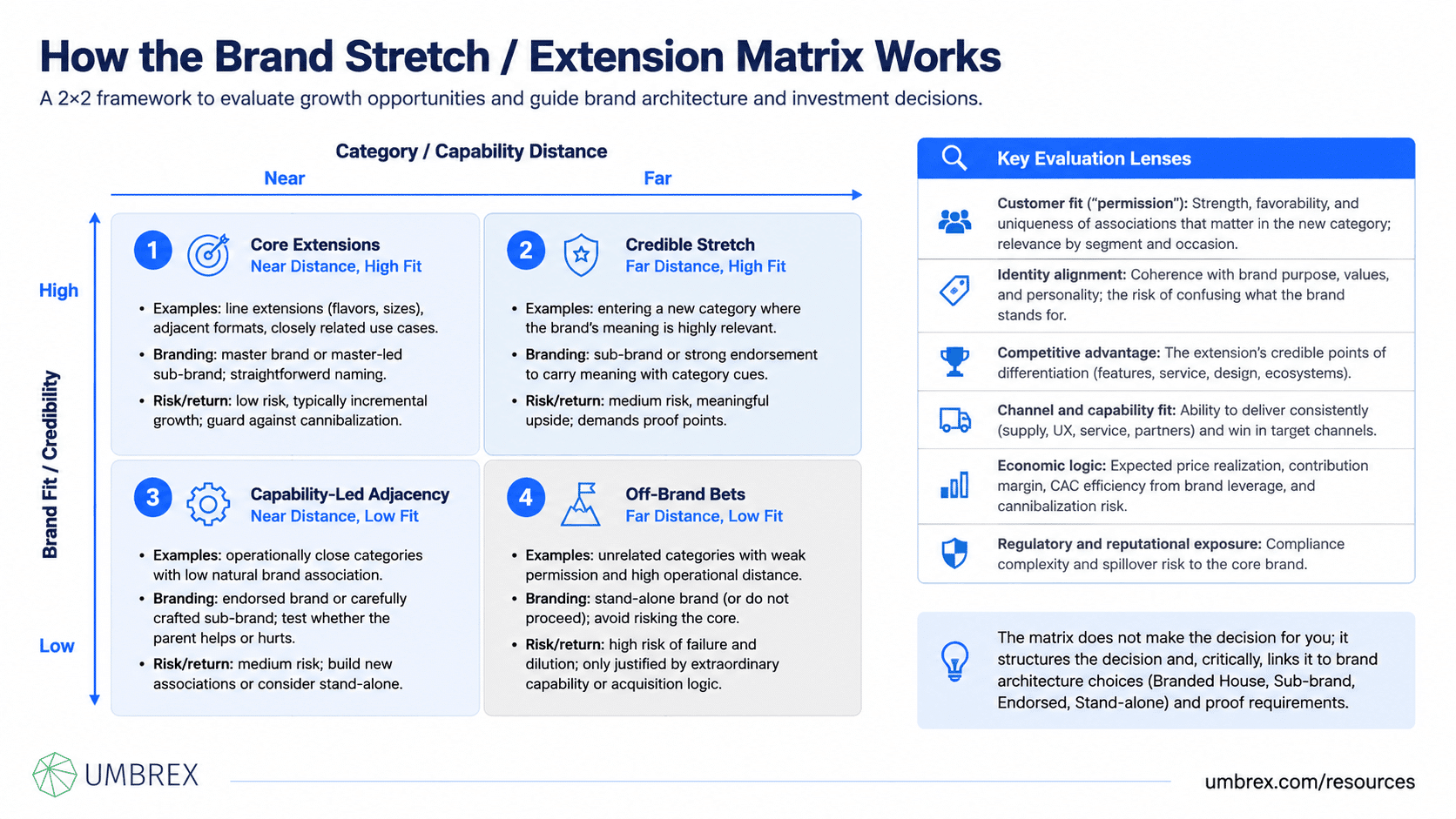
The matrix is typically a 2×2 with the following axes:
- X-axis: Category/Capability Distance — Near to Far. Captures how operationally similar the move is to today’s business—overlap in technology, supply chain, channels, regulatory context, and buyer ecosystem.
- Y-axis: Brand Fit/Credibility — High to Low. Captures how naturally the brand’s meaning, associations, and promises transfer to the new space—does the brand have “permission” in customers’ minds?
The Four Quadrants
- 1) Core Extensions (Near Distance, High Fit)
- Examples: line extensions (flavors, sizes), adjacent formats, closely related use cases.
- Branding guidance: master brand or master-led sub-brand; straightforward naming and identity transfer.
- Risk/return: low risk, typically incremental growth; guard against cannibalization.
- 2) Credible Stretch (Far Distance, High Fit)
- Examples: entering a new category where the brand’s meaning is highly relevant (e.g., a performance apparel brand into connected training apps).
- Branding guidance: sub-brand or strong endorsement to carry meaning while adding category-specific cues.
- Risk/return: medium risk, meaningful upside; demands proof points to convert fit into superiority.
- 3) Capability-Led Adjacency (Near Distance, Low Fit)
- Examples: operationally close categories where customers don’t naturally see the brand (e.g., a household cleaner brand entering air care without prior association).
- Branding guidance: endorsed brand or carefully crafted sub-brand to create distinct meaning; test whether the parent helps or hurts.
- Risk/return: medium risk; marketing must build new associations or consider stand-alone if parent equity is a liability.
- 4) Off-Brand Bets (Far Distance, Low Fit)
- Examples: unrelated categories with weak customer permission and high operational distance.
- Branding guidance: stand-alone brand (or do not proceed); avoid risking the core.
- Risk/return: high risk of failure and dilution; only justified by extraordinary capability or acquisition logic.
Key Evaluation Lenses
- Customer fit (“permission”): Strength, favorability, and uniqueness of associations that matter in the new category; relevance by segment and occasion.
- Identity alignment: Coherence with brand purpose, values, and personality; the risk of confusing what the brand stands for.
- Competitive advantage: The extension’s credible points of differentiation (features, service, design, ecosystem).
- Channel and capability fit: Ability to deliver consistently (supply, UX, service, partners) and win in target channels.
- Economic logic: Expected price realization, contribution margin, CAC efficiency from brand leverage, and cannibalization risk.
- Regulatory and reputational exposure: Compliance complexity and spillover risk to the core brand.
The matrix does not make the decision for you; it structures the decision and, critically, links it to brand architecture choices (Branded House, Sub-brand, Endorsed, Stand-alone) and proof requirements.
When to Use the Brand Stretch / Extension Matrix
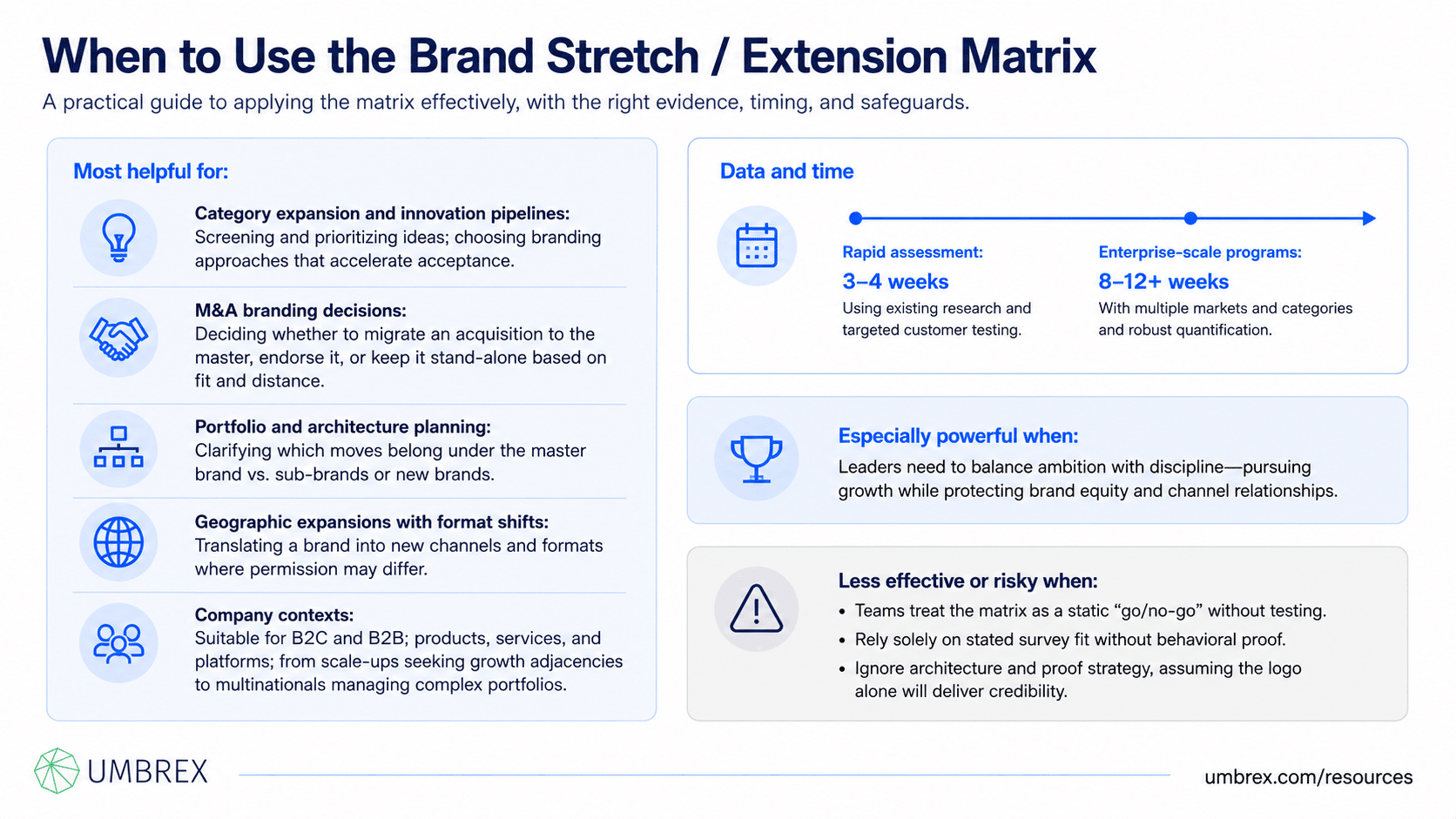
Most helpful for:
- Category expansion and innovation pipelines: Screening and prioritizing ideas; choosing branding approaches that accelerate acceptance.
- M&A branding decisions: Deciding whether to migrate an acquisition to the master, endorse it, or keep it stand-alone based on fit and distance.
- Portfolio and architecture planning: Clarifying which moves belong under the master brand vs. sub-brands or new brands.
- Geographic expansions with format shifts: Translating a brand into new channels and formats where permission may differ.
Company contexts: Suitable for B2C and B2B; products, services, and platforms; from scale-ups seeking growth adjacencies to multinationals managing complex portfolios.
Data and time: A rapid assessment can be done in 3–4 weeks using existing research and targeted customer testing. Enterprise-scale programs with multiple markets and categories typically run 8–12+ weeks with robust quantification.
Especially powerful when: Leaders need to balance ambition with discipline—pursuing growth while protecting brand equity and channel relationships.
Less effective or risky when: Teams treat the matrix as a static “go/no-go” without testing; rely solely on stated survey fit without behavioral proof; or ignore architecture and proof strategy, assuming the logo alone will deliver credibility.
How to Apply the Brand Stretch / Extension Matrix: Step-by-Step
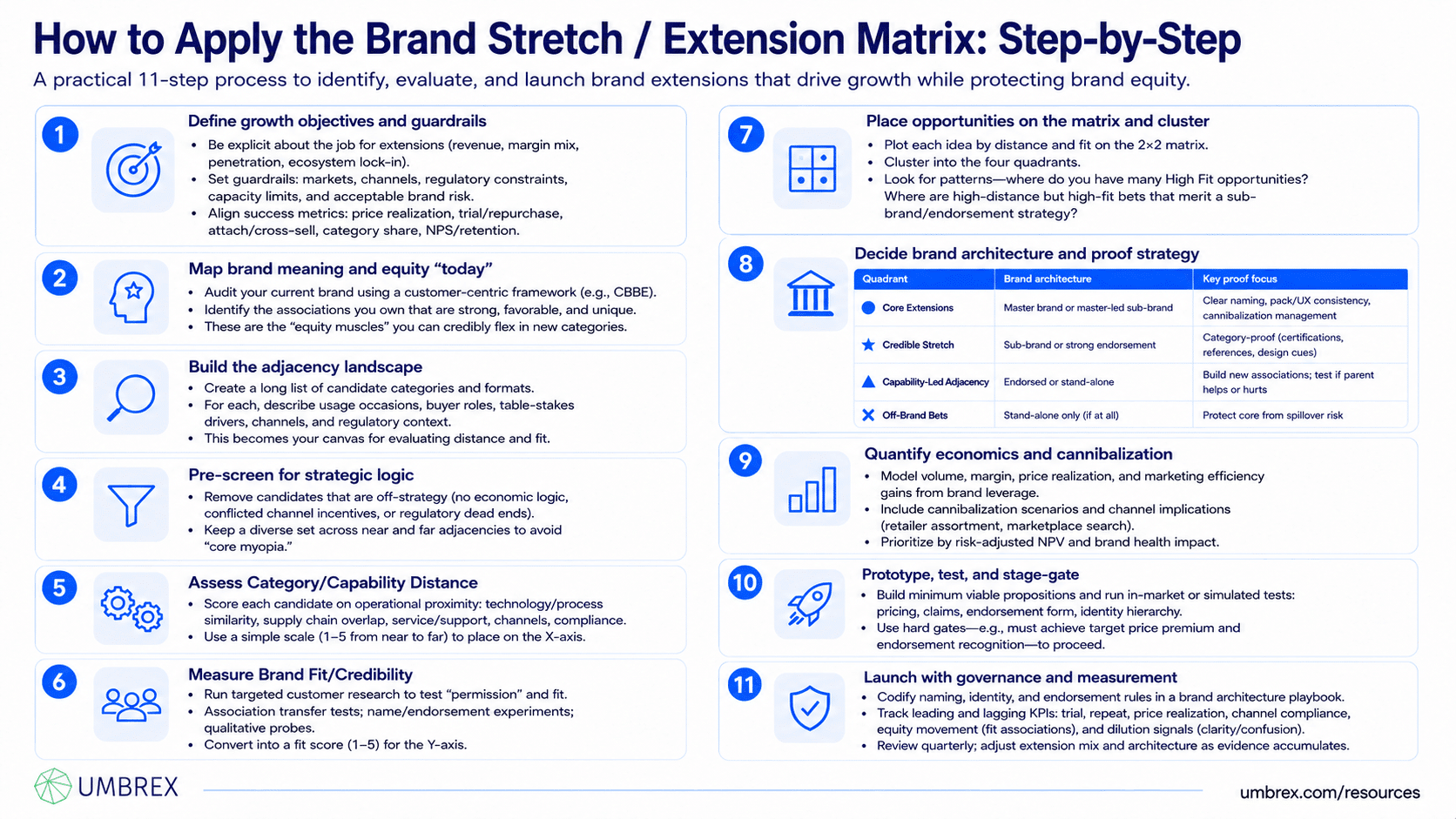
- Define growth objectives and guardrails
Be explicit about the job for extensions (revenue, margin mix, penetration of new segments, ecosystem lock-in). Set guardrails: markets, channels, regulatory constraints, capacity limits, and acceptable brand risk. Align success metrics: price realization, trial/repurchase, attach/cross-sell, category share, NPS/retention.
- Map brand meaning and equity “today”
Audit your current brand using a customer-centric framework (e.g., CBBE). Identify the associations you own that are strong, favorable, and unique. These are the “equity muscles” you can credibly flex in new categories.
- Build the adjacency landscape
Create a long list of candidate categories and formats. For each, describe usage occasions, buyer roles, table-stakes drivers, channels, and regulatory context. This becomes your canvas for evaluating distance and fit.
- Pre-screen for strategic logic
Remove candidates that are off-strategy (no economic logic, conflicted channel incentives, or regulatory dead ends). Keep a diverse set across near and far adjacencies to avoid “core myopia.”
- Assess Category/Capability Distance
Score each candidate on operational proximity: technology/process similarity, supply chain overlap, service and support requirements, channel relationships, and compliance. Use a simple scale (e.g., 1–5 from near to far) to place on the X-axis.
- Measure Brand Fit/Credibility
Run targeted customer research to test “permission” and fit. Methods include:
- Association transfer tests: does the brand’s meaning apply to the new drivers?
- Name/endorsement experiments: master brand vs. sub-brand vs. endorsed vs. stand-alone impact on preference and price.
- Qualitative probes: language, moments of truth, and what would make the brand credible “on day one.”
Convert into a fit score (1–5) for the Y-axis.
- Place opportunities on the matrix and cluster
Plot each idea by distance and fit. Cluster into the four quadrants. Look for patterns—where do you have many High Fit opportunities? Where are high-distance but high-fit bets that merit a sub-brand/endorsement strategy?
- Decide brand architecture and proof strategy
For each cluster, define how you will brand the move and what proof you need:
- Core Extensions: Master brand or master-led sub-brand; focus on clear naming, pack/UX consistency, and cannibalization management.
- Credible Stretch: Sub-brand or strong endorsement; require category-proof (certifications, reference customers, design cues) to convert fit into superiority.
- Capability-Led: Consider endorsed or stand-alone; build new associations deliberately, or pivot to a brand with better permission.
- Off-Brand Bets: Stand-alone only (if at all); protect the core from spillover risk.
- Quantify economics and cannibalization
Model expected volume, margin, price realization, and marketing efficiency gains from brand leverage. Include cannibalization scenarios and channel implications (retailer assortment, marketplace search). Prioritize by risk-adjusted NPV and brand health impact.
- Prototype, test, and stage-gate
Build minimum viable propositions and run in-market or simulated tests: pricing, claims, endorsement form, identity hierarchy. Use hard gates—e.g., must achieve target price premium and endorsement recognition—to proceed.
- Launch with governance and measurement
Codify naming, identity, and endorsement rules in a brand architecture playbook. Track leading and lagging KPIs: trial, repeat, price realization, channel compliance, equity movement (fit associations), and dilution signals (clarity/confusion). Review quarterly; adjust extension mix and architecture as evidence accumulates.
Example: The Matrix in Action
Context: “NorthPeak,” a $1.0B premium outdoor apparel brand, has high equity in “reliable performance in harsh conditions.” Growth in core jackets and base layers is slowing. The team is exploring connected wearables, hiking nutrition, and guided travel experiences.
Assessment:
- Connected Wearables (e.g., altitude and weather sensors in apparel):
- Distance: Medium–Far (new technology, after-sales support, different retail channels).
- Fit: High (brand stands for performance and safety in extreme conditions; tech can credibly extend that promise).
- Quadrant: Credible Stretch.
- Architecture: Sub-brand “NorthPeak Signal,” strongly linked to master; proof via independent durability tests and backcountry guide endorsements.
- Hiking Nutrition (bars/gels):
- Distance: Medium (new manufacturing and retail aisles, but shared occasions and users).
- Fit: Medium–Low (brand known for apparel, not food; “safety and performance” may transfer if product is superior).
- Quadrant: Capability-Led Adjacency.
- Architecture: Endorsed brand “TrailFuel by NorthPeak”; stand up distinct food credibility; add certifications and athlete nutrition proofs.
- Guided Adventure Travel:
- Distance: Far (service operations, liability, new channels).
- Fit: High (brand is trusted for extreme conditions; guidance and safety align strongly).
- Quadrant: Credible Stretch.
- Architecture: Sub-brand “NorthPeak Expeditions”; partner with established operators; demonstrate safety and environmental stewardship credentials.
- Lifestyle Homeware (sofas, decor):
- Distance: Far (different category, supply chain, retail).
- Fit: Low (outdoor performance meaning doesn’t translate to home decor).
- Quadrant: Off-Brand Bet.
- Architecture: Do not proceed under master; if pursued, consider separate brand to avoid dilution.
Actions and outcomes (12 months):
- Launch NorthPeak Signal with two hero SKUs; achieve target price premium (+12%) vs. tech-only rivals; category reviewers cite “trust in harsh conditions” as reason to buy.
- Pilot TrailFuel by NorthPeak in specialty outdoor stores; endorsement recognition reaches 60%; repeat lags target—decision to reformulate and add nutritionist endorsements before national rollout.
- Start NorthPeak Expeditions with limited departures and a waitlist; NPS 72 with strong social content fueling brand salience; apparel attach rate +8 points among expedition customers.
- Homeware concept shelved to avoid dilution.
Strengths and Limitations
Strengths
- Clarity on risk vs. reward: Separates operational distance from brand permission, preventing “near but off-brand” mistakes.
- Actionable link to architecture: Directly informs whether to use master brand, sub-brand, endorsement, or stand-alone.
- Customer-centered: Forces evidence-based assessment of fit rather than internal enthusiasm.
- Portfolio coherence: Helps avoid random extension creep; concentrates investment on credible, value-creating stretches.
- Speed and alignment: A simple visual tool that aligns marketing, product, finance, and channel partners quickly.
Limitations
- Static snapshot risk: Fit can change as culture and categories evolve; repeat assessments are required.
- Oversimplification: Two axes cannot capture all factors (e.g., ecosystem synergies, regulatory shifts); complement with deeper diligence.
- Measurement bias: Stated “permission” may not predict behavior; rely on experiments and in-market pilots.
- Category heterogeneity: “Distance” can vary by market and channel; a global average can mislead local decisions.
Common Pitfalls (and How to Avoid Them)
- Confusing operational proximity with customer permission
What goes wrong: Teams assume near manufacturing or channel equals brand fit; customers disagree.
Avoid it: Measure fit separately; test endorsement and naming effects on preference and price.
- Assuming the logo does the work
What goes wrong: Brand is stretched without credible proof; trial occurs, repeat doesn’t.
Avoid it: Define explicit proof requirements (certifications, references, design cues) pre-launch.
- Ignoring brand architecture implications
What goes wrong: Extensions use inconsistent naming/identity; equity fragments or confuses.
Avoid it: Decide master vs. sub vs. endorsed vs. stand-alone up front; codify rules in a playbook.
- Underestimating cannibalization and channel conflict
What goes wrong: Extensions steal from core SKUs or alienate partners.
Avoid it: Model cannibalization; design pack/price architecture and channel exclusives to minimize conflict.
- Global decisions, local realities
What goes wrong: A move that fits in one market fails in another with different norms and channels.
Avoid it: Assess distance and fit by region; allow localized architecture and rollouts.
- One-and-done evaluation
What goes wrong: Early success leads to faster, riskier stretches; dilution emerges later.
Avoid it: Revisit the matrix annually; monitor equity clarity and adjust pipeline accordingly.
- Over-indexing on “cool adjacencies”
What goes wrong: Leadership chases trend categories with weak economics or fit.
Avoid it: Apply a disciplined scorecard: fit, distance, advantage, economics, and brand health impact.
How the Brand Stretch / Extension Matrix Relates to Other Frameworks
- STP (Segmentation–Targeting–Positioning): STP defines who you serve and your promise. The matrix evaluates where that promise can credibly extend and how to brand the move.
- Brand Architecture (Corporate, Sub-Brand, Endorsed, Stand-alone): The matrix outputs directly feed architecture choices—master for Core Extensions, sub/endorsed for Credible Stretch, stand-alone for Off-Brand bets.
- Brand Relationship Spectrum: Provides the spectrum of linkage strength; the matrix indicates where on the spectrum each extension belongs.
- Keller’s CBBE / Brand Resonance: Use CBBE to audit current meaning and to design the associations and proofs the extension must build to achieve salience, judgments, feelings, and ultimately resonance.
- Brand Portfolio Roles (Driver, Endorser, Descriptor): After choosing architecture, assign roles at the moment of choice—who drives, who endorses, what stays a descriptor.
- Jobs to Be Done (JTBD): JTBD clarifies functional needs and occasions in the new category; the matrix evaluates whether your brand’s meaning aligns with those jobs.
- Ansoff Matrix (Product–Market): Ansoff frames strategic growth vectors; the Brand Stretch matrix adds brand fit and architecture guidance to operationalize the move.
Key Takeaways
- The Brand Stretch / Extension Matrix maps opportunities by operational distance and brand fit to prioritize credible growth and protect equity.
- Each quadrant implies a branding approach: master for core extensions, sub/endorsed for credible stretch, and stand-alone (or avoid) for off-brand bets.
- Measure customer permission empirically; operational proximity does not guarantee brand fit.
- Define proof requirements and architecture up front; the logo alone will not carry a weak extension.
- Revisit the matrix regularly and tailor by region/channel; fit and feasibility evolve with markets.
FAQs About the Brand Stretch / Extension Matrix
How is this different from the Ansoff Matrix?
Ansoff frames strategic growth (market vs. product). The Brand Stretch / Extension Matrix focuses on brand credibility and operational distance for specific extensions, and it links outcomes to brand architecture and proof strategies.
What’s the difference between a line extension and a category extension?
Line extensions are variants within the current category (flavors, sizes, formats)—typically Near Distance, High Fit. Category extensions enter a new category (often new channels, competitors). They can be credible stretch (High Fit, Far Distance) or off-brand depending on permission.
How do we measure “brand fit” objectively?
Use transfer tests and choice experiments comparing master, sub-brand, endorsed, and stand-alone naming. Track the impact on preference, price willingness, and perceived credibility, then corroborate with qualitative insight and pilot behavior.
When should we use a stand-alone brand instead of stretching the master?
When both fit and operational proximity are low, when the parent’s meaning harms credibility, or when regulatory/reputation risk is high. Stand-alone is also preferred for sharply different price tiers or conflicting positions.
How long does a rigorous extension evaluation take?
A focused, single-category assessment can be completed in 3–4 weeks using existing insight and targeted testing. Multi-category, multi-market programs with in-market pilots typically take 8–12+ weeks.
How do we avoid brand dilution while extending?
Choose opportunities with strong fit or build proof where fit is promising but unproven; use sub-brands/endorsement when appropriate; set guardrails on claims and design; monitor equity clarity and preference post-launch and adjust if dilution signals emerge.
