

What Is the Brand Wheel?
The Brand Wheel is a practical, compact framework for defining a brand’s positioning and identity in a single, coherent view. It arranges the core elements of a brand—proof points, benefits, personality and values—around a central “brand essence,” typically visualized as the hub of a wheel. The output becomes a one-page charter that guides product decisions, creative briefs, messaging, and experience design.
Within Marketing—specifically brand, architecture & equity work—the Brand Wheel is used by consultants, brand leaders, and agencies to move from strategy to execution with clarity. It forces prioritization, connects emotional and functional benefits to credible “reasons to believe” (RTBs), and ensures that every external expression is anchored in a distinctive, enduring core.
Executives value the Brand Wheel because it reduces complexity to a set of sharp, testable choices. Instead of long decks of adjectives, teams align on a handful of differentiating benefits and proof points that directly inform what to build, what to say, and what to measure.
Origin and Background
Origin: Unknown; in use since at least the 1990s.
The Brand Wheel emerged in agency and brand-planning practice as a way to summarize positioning and identity on a single page. It spread widely across consumer goods, services, and B2B markets because it bridged the gap between high-level strategy and practical creative briefs. Business schools and consulting firms adopted variants of the wheel in brand architecture and equity courses due to its simplicity and actionability.
Why it was created: Many organizations struggled with either overly abstract “brand essence” statements or scattered lists of features and taglines. The Brand Wheel was designed to integrate the emotional and functional—with evidence—so teams could make consistent choices across markets, channels, and time.
How the Brand Wheel Works
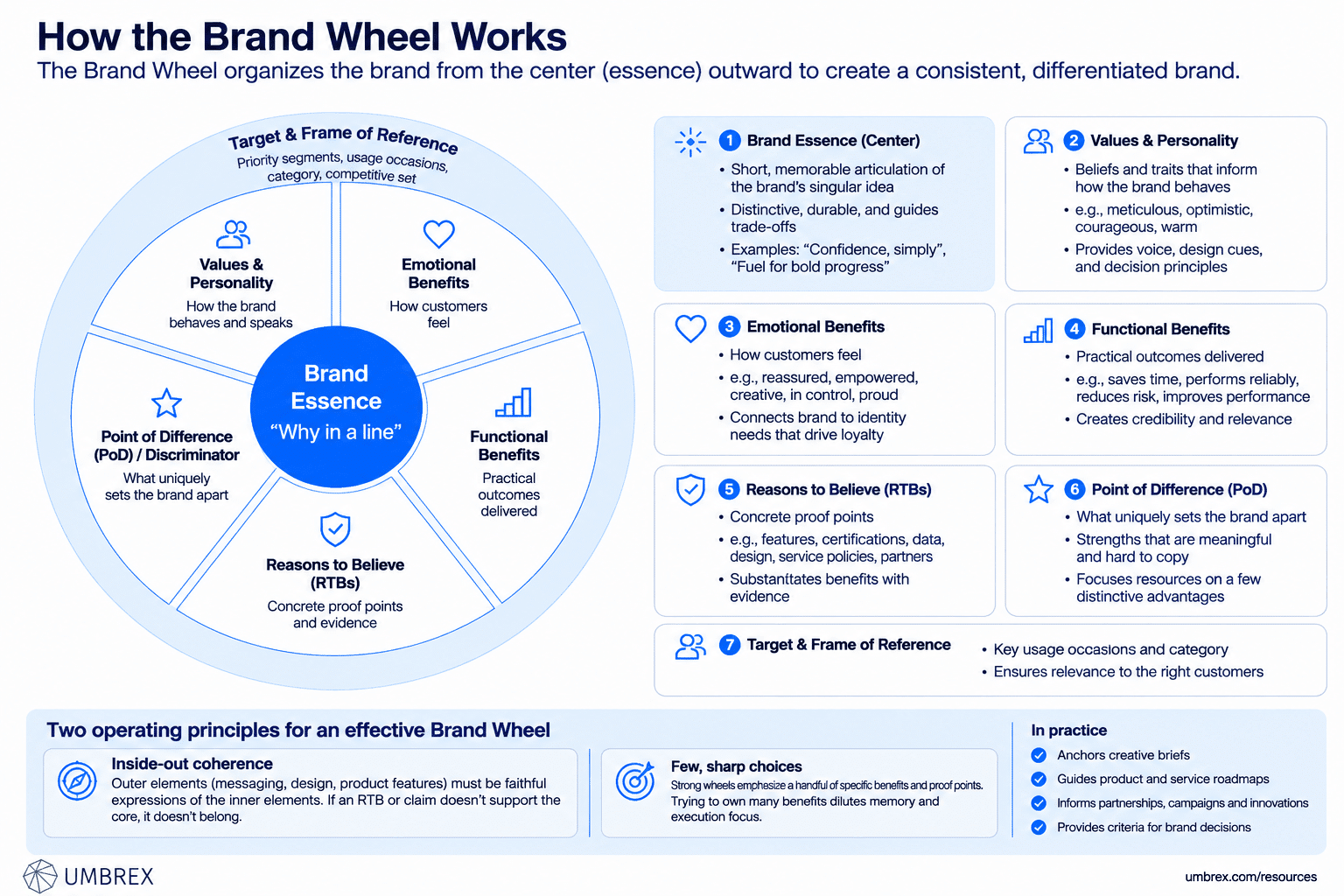
The Brand Wheel organizes the brand from the center (essence) outward through a small number of consistent building blocks. Terminology varies by company, but a widely used structure includes:
- Center (Hub): Brand Essence
- A short, memorable articulation of the brand’s singular idea—the “why in a line.” It should be distinctive, durable, and capable of guiding trade-offs.
- Examples (illustrative): “Confidence, simply,” “Fuel for bold progress,” “Care without compromise.”
- Spoke 1: Values & Personality
- The beliefs and character traits that inform how the brand behaves and speaks (e.g., meticulous, optimistic, courageous, warm).
- Purpose: Provide consistent voice, design cues, and decision principles; align internal culture with external promise.
- Spoke 2: Emotional Benefits
- How customers feel when they choose and use the brand (e.g., reassured, empowered, creative, in control, proud).
- Purpose: Connect the brand to identity needs and motivations that drive preference and loyalty.
- Spoke 3: Functional Benefits
- The practical outcomes delivered (e.g., saves time, performs reliably, reduces risk, improves performance).
- Purpose: Create credibility and relevance in the category’s key decision drivers.
- Spoke 4: Reasons to Believe (RTBs)
- Concrete proof points—features, standards, certifications, data, design signatures, service policies, partner endorsements.
- Purpose: Substantiate benefits with evidence customers can see and verify.
- Spoke 5: Point of Difference (PoD) or Discriminator
- What uniquely sets the brand apart in its competitive frame—strengths that are meaningful to the target and hard to copy.
- Purpose: Focus resources on the few distinctive advantages that matter most.
- Outer Rim (Context): Target & Frame of Reference
- The priority segments or buying personas, key usage occasions, and the category/frame in which the brand competes.
- Purpose: Ensure benefits and proofs are relevant to the right customers and competitive set.
Two operating principles underpin effective use:
- Inside-out coherence: Outer elements (messaging, design, product features) must be faithful expressions of the inner elements (essence, values, benefits). If an RTB or claim doesn’t support the core, it doesn’t belong.
- Few, sharp choices: Strong wheels emphasize a handful of specific benefits and proof points. Trying to own many benefits dilutes memory and execution focus.
In practice, the Brand Wheel becomes a reference artifact: it anchors creative briefs, guides product and service roadmaps, and provides the criteria for choosing partnerships, campaigns, and innovations that strengthen the core.
When to Use the Brand Wheel
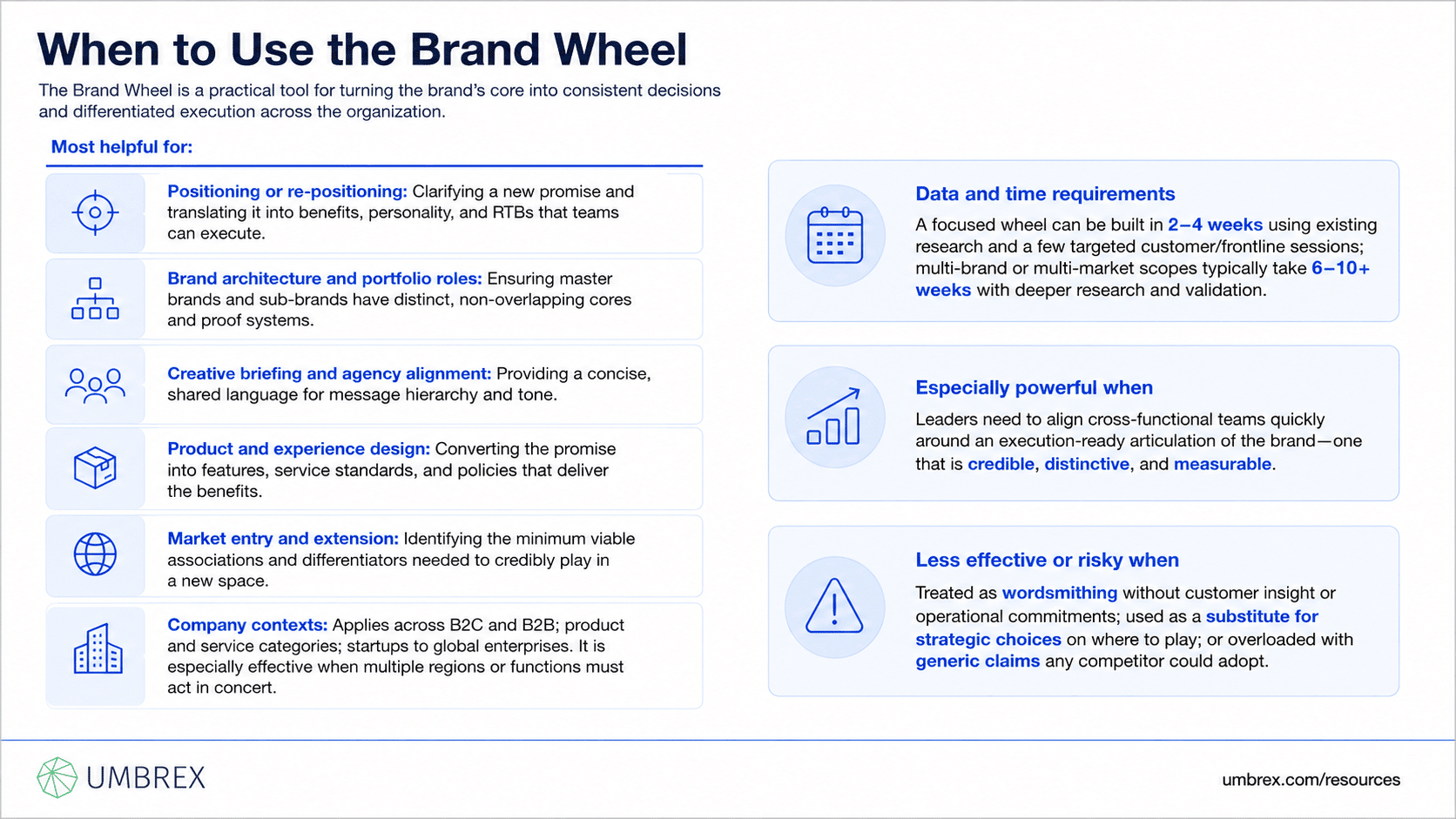
Most helpful for:
- Positioning or re-positioning: Clarifying a new promise and translating it into benefits, personality, and RTBs that teams can execute.
- Brand architecture and portfolio roles: Ensuring master brands and sub-brands have distinct, non-overlapping cores and proof systems.
- Creative briefing and agency alignment: Providing a concise, shared language for message hierarchy and tone.
- Product and experience design: Converting the promise into features, service standards, and policies that deliver the benefits.
- Market entry and extension: Identifying the minimum viable associations and differentiators needed to credibly play in a new space.
Company contexts: Applies across B2C and B2B; product and service categories; startups to global enterprises. It is especially effective when multiple regions or functions must act in concert.
Data and time requirements: A focused wheel can be built in 2–4 weeks using existing research and a few targeted customer/frontline sessions; multi-brand or multi-market scopes typically take 6–10+ weeks with deeper research and validation.
Especially powerful when: Leaders need to align cross-functional teams quickly around an execution-ready articulation of the brand—one that is credible, distinctive, and measurable.
Less effective or risky when: Treated as wordsmithing without customer insight or operational commitments; used as a substitute for strategic choices on where to play; or overloaded with generic claims any competitor could adopt.
How to Apply the Brand Wheel: Step-by-Step
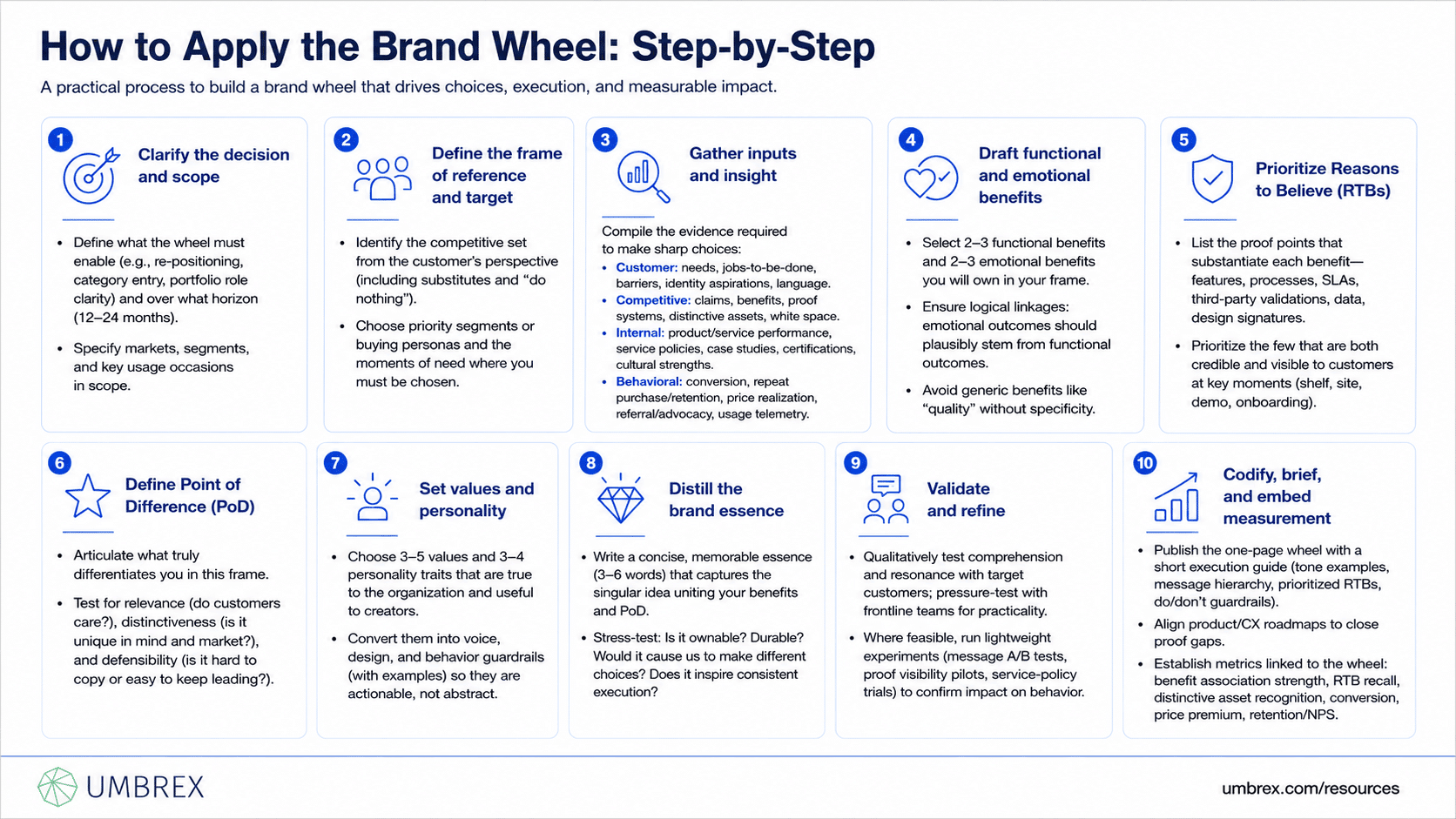
- Clarify the decision and scope
Define what the wheel must enable (e.g., re-positioning, category entry, portfolio role clarity) and over what horizon (12–24 months). Specify markets, segments, and key usage occasions in scope.
- Define the frame of reference and target
Identify the competitive set from the customer’s perspective (including substitutes and “do nothing”). Choose priority segments or buying personas and the moments of need where you must be chosen.
- Gather inputs and insight
Compile the evidence required to make sharp choices:
- Customer: needs, jobs-to-be-done, barriers, identity aspirations, language.
- Competitive: claims, benefits, proof systems, distinctive assets, white space.
- Internal: product/service performance, service policies, case studies, certifications, cultural strengths.
- Behavioral: conversion, repeat purchase/retention, price realization, referral/advocacy, usage telemetry.
- Draft functional and emotional benefits
Select 2–3 functional benefits and 2–3 emotional benefits you will own in your frame. Ensure logical linkages: emotional outcomes should plausibly stem from functional outcomes (e.g., “feel in control” from “predictable results” + “clear guidance”). Avoid generic benefits like “quality” without specificity.
- Prioritize Reasons to Believe (RTBs)
List the proof points that substantiate each benefit—features, processes, SLAs, third-party validations, data, design signatures. Prioritize the few that are both credible and visible to customers at key moments (shelf, site, demo, onboarding).
- Define Point of Difference (PoD)
Articulate what truly differentiates you in this frame. Test for relevance (do customers care?), distinctiveness (is it unique in mind and market?), and defensibility (is it hard to copy or easy to keep leading?).
- Set values and personality
Choose 3–5 values and 3–4 personality traits that are true to the organization and useful to creators. Convert them into voice, design, and behavior guardrails (with examples) so they are actionable, not abstract.
- Distill the brand essence
Write a concise, memorable essence (3–6 words) that captures the singular idea uniting your benefits and PoD. Stress-test: Is it ownable? Durable? Would it cause us to make different choices? Does it inspire consistent execution?
- Validate and refine
Qualitatively test comprehension and resonance with target customers; pressure-test with frontline teams for practicality. Where feasible, run lightweight experiments (message A/B tests, proof visibility pilots, service-policy trials) to confirm impact on behavior.
- Codify, brief, and embed measurement
Publish the one-page wheel with a short execution guide (tone examples, message hierarchy, prioritized RTBs, do/don’t guardrails). Align product/CX roadmaps to close proof gaps. Establish metrics linked to the wheel: benefit association strength, RTB recall, distinctive asset recognition, conversion, price premium, retention/NPS.
Example: The Brand Wheel in Action
Context: A $380M plant-based dairy brand seeks to expand from alternative milks into mainstream yogurt. Incumbents own perceptions of taste and texture; the brand over-indexes on “ethical choice” but underperforms on “everyday delicious.”
Problem: Retail buyers question repeat potential; consumer tests show trial curiosity but low repurchase intent due to perceived texture trade-offs. The company needs a compelling, proof-backed proposition that holds shelf price without constant promotions.
Applying the Brand Wheel:
- Frame & Target (outer rim): Competing in “everyday spoonable yogurt” for health-conscious families seeking dairy alternatives without taste compromise; priority occasions are breakfast and lunchbox snacks.
- Functional Benefits (spoke): “Creamy texture like dairy,” “Sustained energy,” “Gentle on digestion.”
- Emotional Benefits (spoke): “Proud to serve the whole family,” “No-compromise enjoyment,” “Feel good about everyday choices.”
- RTBs (spoke): New micro-fermentation process delivering smaller plant protein particles; blind taste test wins vs. two dairy leaders; 8g protein/serving; live cultures; clean-label ingredients; QR link to process video and test results.
- Point of Difference (spoke): “Dairy-level creaminess without dairy,” consistently proven by independent, repeatable tests.
- Values & Personality (spoke): Values—honesty, craftsmanship, care; Personality—assured, inviting, down-to-earth.
- Essence (center): “Joy, without trade‑offs.”
Actions:
- Packaging refresh: texture-forward imagery and a “Creaminess Proven” badge; peel-back panel titled “How we make plants feel like dairy.”
- In-store sampling with blind taste demos; shopper media showing spoon “stand-up” test.
- Owned content: short fermentation lab videos; third-party test summaries accessible via QR; family-friendly recipe program.
- Product roadmap: maintain creaminess KPI; add kids’ pouch SKU aligned to lunchbox occasion; standardize flavor names and codes for mental availability.
- Policy: “Love the texture or it’s free” guarantee for first purchase.
Outcomes (9–12 months): Aided association with “no compromise taste/texture” rises 14 points; repeat rate improves by 10 points; average selling price holds with fewer promotions; distribution expands to two national retailers; NPS among families increases by 8 points.
Strengths and Limitations
Strengths
- Clarity and focus: Distills positioning into a handful of sharp, execution-ready elements anchored by a central essence.
- Actionable bridge: Connects emotional and functional benefits to visible proof points that inform product, CX, and creative.
- Portable and alignable: A single-page artifact that travels well across regions, agencies, and functions.
- Versatile: Works for master brands and sub-brands, B2C and B2B, products and services.
- Measurement-friendly: Maps neatly to trackable constructs (benefit associations, RTB recall, conversion, price premium, retention).
Limitations
- Not a market strategy tool: It does not choose where to play or how to win; it expresses and operationalizes those choices.
- Risk of abstraction: Without hard RTBs and operational commitments, the wheel devolves into an adjective list.
- Potential overlap with other artifacts: Without governance, multiple templates (wheel, onion, prism) can confuse teams.
- Static temptation: Treating the wheel as fixed can ignore evolving customer needs and category dynamics.
- Over-simplification risk: Complex multi-sided platforms or ecosystems may need additional constructs beyond a single brand core.
Common Pitfalls (and How to Avoid Them)
- Wordsmithing without proof
What goes wrong: Benefits sound inspiring but lack credible RTBs; customers remain unconvinced.
How to avoid: Require 1–2 high-impact proofs per benefit; if gaps exist, build them (certifications, policies, benchmarks) before big media spends.
- Too many benefits and claims
What goes wrong: Memory and execution fragment; teams don’t know what to emphasize.
How to avoid: Cap functional and emotional benefits at 2–3 each; prioritize 3–5 RTBs overall.
- Generic essence
What goes wrong: The hub could apply to any brand; it doesn’t guide trade-offs.
How to avoid: Stress-test against competitors and decisions: “What would we not do because of this essence?” If nothing changes, keep refining.
- Misaligned operations and policies
What goes wrong: Promised relationship and values conflict with fees, returns, or SLAs.
How to avoid: Include product and CX leaders in wheel creation; align service standards and policies to the benefits and values.
- Under-defining the frame of reference
What goes wrong: Benefits optimized for the wrong competitor set; messages miss real moments of need.
How to avoid: Start with clear frame and occasions; validate with decision journeys and win–loss insight.
- Skipping validation
What goes wrong: Claims that resonate internally don’t land with customers; proof cues are invisible at the moment of choice.
How to avoid: Test comprehension and salience with target customers; pilot proof visibility (e.g., on-pack badges, demo elements).
- Portfolio confusion
What goes wrong: Master and sub-brands claim overlapping benefits; internal cannibalization rises.
How to avoid: Build wheels at each portfolio level; explicitly define shared vs. unique elements.
- One-and-done artifact
What goes wrong: The wheel gathers dust as the market evolves; execution drifts.
How to avoid: Embed metrics tied to the wheel; review quarterly and refresh annually while protecting the core.
How the Brand Wheel Relates to Other Frameworks
- STP (Segmentation–Targeting–Positioning): STP sets who you serve and the promise you make. The Brand Wheel operationalizes that promise into essence, benefits, proofs, and personality.
- Kapferer Brand Identity Prism: The Prism offers a 360-degree identity view (Physique, Personality, Culture, Relationship, Reflection, Self-image). The Brand Wheel compresses identity and proposition into a prioritized, brief-friendly hierarchy.
- Brand Onion Model: Both tools build from core essence outward. The wheel’s radial layout commonly emphasizes a tight link between benefits and RTBs and often includes an explicit PoD spoke; the onion uses concentric layers. Teams often use one or the other—not both—to avoid duplication.
- Brand Key (agency variant): The Brand Key adds explicit elements like “competitive environment,” “insight,” and “benefits” with a “brand essence” apex. Choose Brand Key when you need more upstream insight prompts; choose the Wheel for a cleaner execution artifact.
- Keller’s CBBE/Brand Resonance: CBBE explains how customer perceptions and behaviors create equity (salience to resonance). The Brand Wheel defines the inputs—essence, benefits, and proofs—intended to create those perceptions and behaviors.
- Golden Circle (Why–How–What): The wheel maps well: essence (“Why”), benefits/values (“How”), RTBs/attributes (“What”). The wheel adds brand-specific differentiation and category relevance.
- Perceptual Mapping: Maps visualize competitive positions on attributes. Use the Brand Wheel to decide which attributes and emotions to own and which proofs will sustain that position.
Key Takeaways
- The Brand Wheel is a one-page framework that translates positioning into a coherent system of essence, benefits, proofs, personality, and differentiation.
- It is most valuable when you need rapid, organization-wide alignment on what to build, what to say, and how to behave—grounded in evidence.
- Focus on a few, sharp benefits and visible RTBs; ensure everything ladders to a distinctive, durable essence.
- Use it alongside STP for market choices and CBBE/Resonance to track customer perceptions and loyalty; avoid parallel artifacts that create confusion.
- Keep it live: validate with customers, link to behavioral and financial metrics, and refresh annually while protecting the core.
FAQs About the Brand Wheel
Is the Brand Wheel still relevant in digital and omnichannel markets?
Yes. Proliferating touchpoints increase the need for a concise, execution-ready articulation of the brand. The wheel clarifies which benefits and proofs must be consistently visible across search, social, e-commerce, retail, and service interactions.
How is the Brand Wheel different from the Brand Onion or the Kapferer Prism?
The wheel and the onion are cousins—both build from a central essence outward. The wheel typically emphasizes explicit links between benefits and RTBs and often includes a Point of Difference. The Prism is broader and more dimensional (identity facets), useful for deep identity work; the wheel is a tighter execution template.
Can B2B companies use the Brand Wheel?
Absolutely. Translate benefits to B2B drivers (ROI, reliability, risk reduction) and proofs to enterprise cues (case studies, certifications, SLAs, integrations). Include buying-center roles when validating judgments and proof salience.
How long does it take to build a solid Brand Wheel?
With existing research, a focused effort can be completed in 2–4 weeks. Multi-market or portfolio programs with new research and validation typically require 6–10+ weeks.
How do we connect the Brand Wheel to business outcomes?
Map each element to metrics: benefit associations and RTB recall (brand tracking), distinctive asset recognition, conversion and price realization (market performance), and retention/NPS/advocacy (loyalty). Use experiments (A/B, holdouts) to demonstrate causality where feasible.
