

1. What Is the Persona Development Framework?
The Persona Development Framework is a structured method for creating evidence-based archetypes—“personas”—that embody the goals, motivations, constraints, contexts, and behaviors of priority customers or users. Personas are not cartoons or stereotypes; when done well, they are concise, data-driven profiles that guide segmentation, targeting, positioning, product design, and go-to-market execution.
Within the Segmentation, Targeting & Positioning (STP) toolkit, personas translate abstract segments into human-centered stories and decision criteria that cross-functional teams can rally around. They blend the “who” (demographics or firmographics), the “why” (needs and attitudes), and the “how” (behaviors, channels, context) into a usable artifact that informs strategy and day-to-day decisions—from messaging and creative to pricing, product features, and sales plays.
Consultants and marketing leaders deploy personas to align executives, product, marketing, design, and sales on the same audiences and value propositions—avoiding one-size-fits-all decisions and poorly targeted execution.
2. Origin and Background
Personas originated in software and interaction design. Alan Cooper popularized the approach in the late 1990s (notably in “The Inmates Are Running the Asylum,” 1999), using research-based characters to drive product decisions that serve specific user goals. Marketing adapted the practice in the 2000s via “buyer personas,” emphasizing purchase decision roles and information needs.
Origin: Personas were popularized in UX by Alan Cooper in the late 1990s; “buyer persona” practice became mainstream in marketing in the 2000s through research and consulting communities.
Why it was created: Teams needed a concrete, shared understanding of priority users and buyers—what they value, their constraints, and the contexts of use or purchase—so they could make consistent, customer-centric decisions.
How it spread: Through design thinking, agile product development, and modern marketing practices; reinforced by business school teaching, UX research methods, and consulting playbooks.
3. How the Persona Development Framework Works
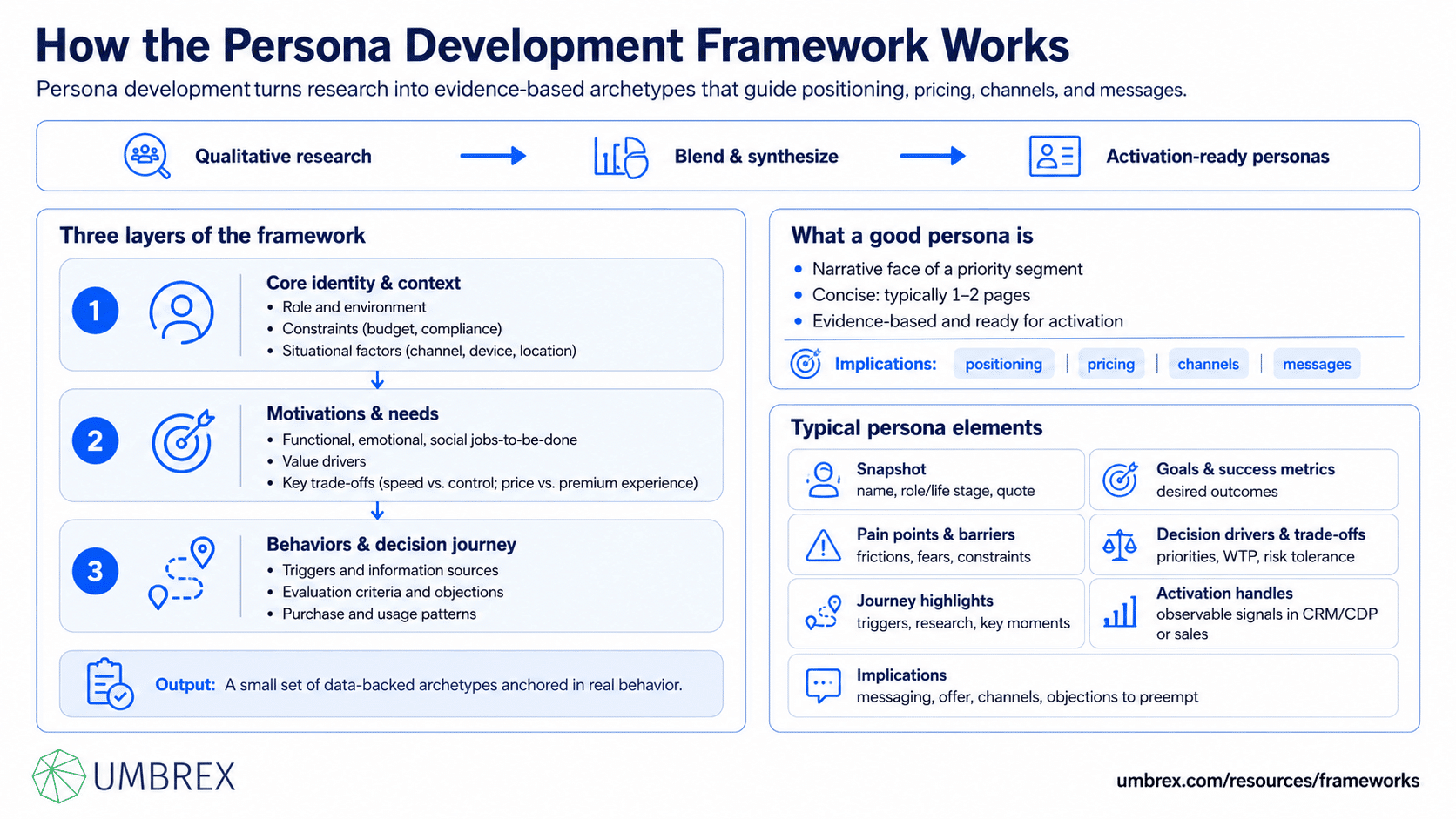
The framework blends qualitative and quantitative research into a small set of archetypes anchored in real data. It connects three layers:
- Core identity and context: Role, environment, constraints (e.g., budget, compliance), and situational factors (e.g., channel preference, device, location).
- Motivations and needs: Functional, emotional, and social jobs-to-be-done; value drivers and trade-offs (e.g., speed vs. control; price vs. premium experience).
- Behaviors and decision journey: Triggers, sources of information, evaluation criteria, key objections, and purchase/usage patterns.
Personas are the narrative “faces” of your priority segments. A good persona is concise (1–2 pages), evidence-based, and “activation ready”—with clear implications for positioning, pricing, channels, and messages.
Typical Persona Elements
- Snapshot: Persona name, short description, role (or life stage), and a quote that captures the persona’s core mindset.
- Goals and success metrics: What they’re trying to accomplish (outcomes), how they define success.
- Pain points and barriers: Frictions, fears, constraints, and switching costs.
- Decision drivers and trade-offs: Ranked benefit priorities; willingness to pay; risk tolerance; preferred proof points.
- Journey highlights: Triggers, research modes, channel preferences, key moments of truth, post-purchase behaviors.
- Activation handles: Observable attributes/behaviors that help identify the persona (in CRM/CDP, platforms, or sales conversations).
- Implications: Messaging pillars, offer design, channel mix, and objections to preempt.
4. When to Use the Persona Development Framework
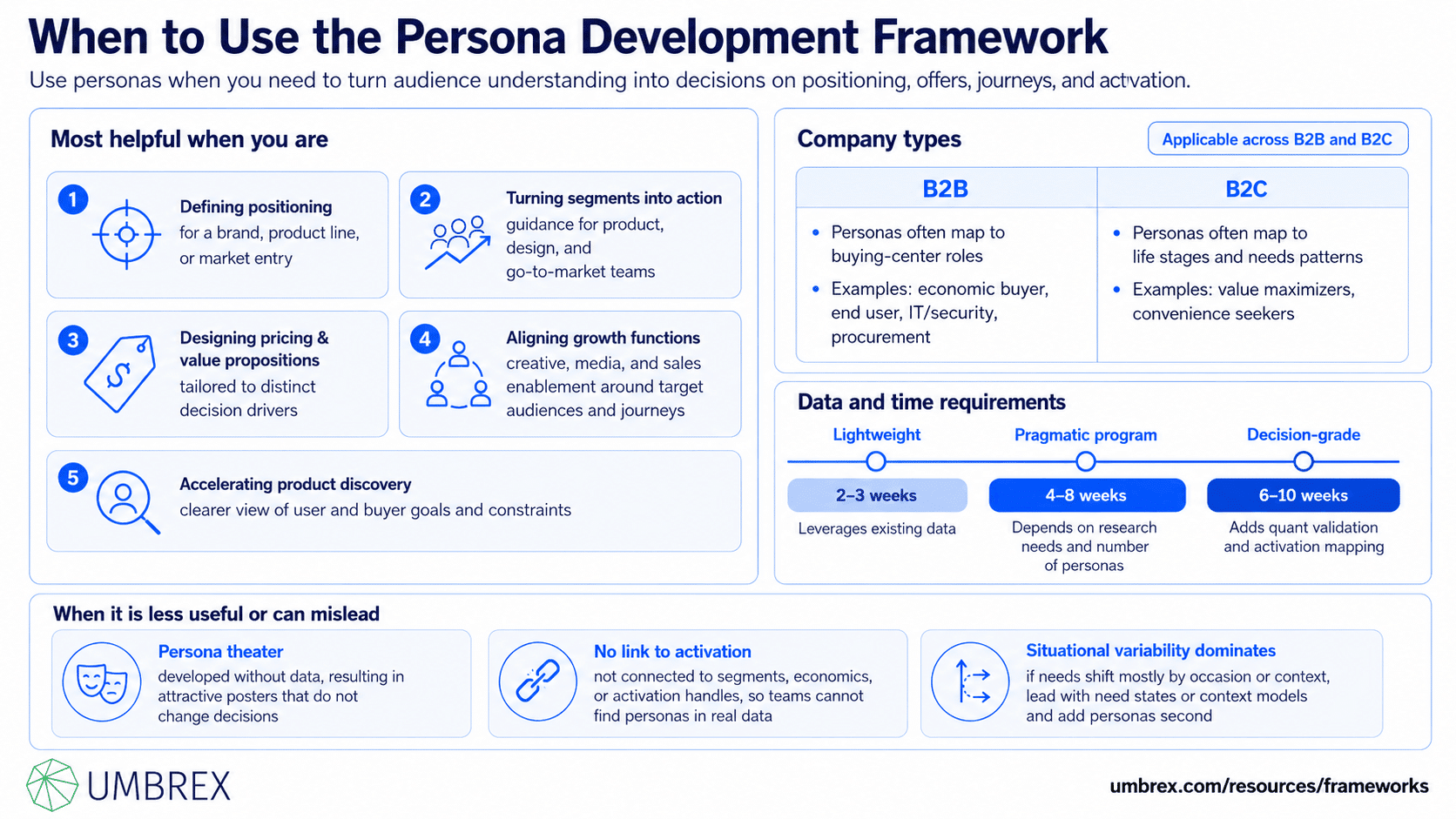
Most helpful when you are:
- Defining or refreshing positioning for a brand, product line, or market entry.
- Translating segments into actionable guidance for product, design, and go-to-market teams.
- Designing pricing/packaging (good–better–best) and value propositions tailored to distinct decision drivers.
- Aligning creative, media, and sales enablement around target audiences and their journeys.
- Accelerating product discovery and prioritization with a clear understanding of user/buyer goals and constraints.
Company types: Applicable across B2C and B2B. In B2B, personas typically map to buying-center roles (economic buyer, end user, IT/security, procurement). In B2C, they often map to life stages and needs patterns (e.g., value maximizers vs. convenience seekers).
Data and time requirements: A pragmatic program takes 4–8 weeks, depending on research needs and number of personas. Lightweight versions can be done in 2–3 weeks leveraging existing data; decision-grade personas with quant validation and activation mapping typically take 6–10 weeks.
When it’s less useful or can mislead:
- If personas are developed without data (“persona theater”)—attractive posters that don’t change decisions.
- When they are not connected to segments, economics, or activation handles—teams can’t find them in real data.
- If your primary variability is situational/occasion-based; then lead with need states or context models, and add personas second.
5. How to Apply the Persona Development Framework: Step-by-Step
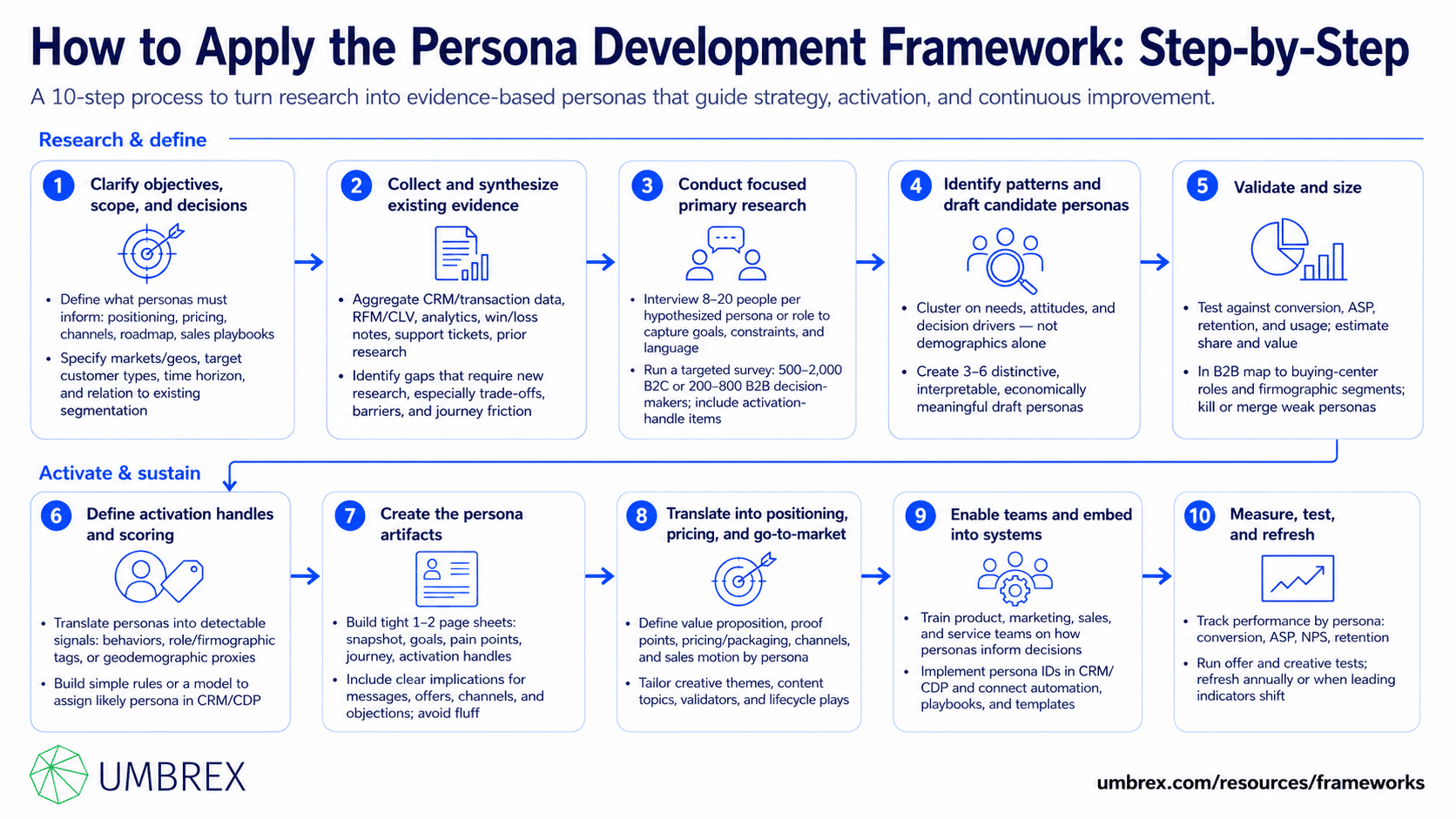
- Clarify objectives, scope, and decisions
Define what the personas must inform: positioning and messaging, pricing/packaging, channel mix, product roadmap, or sales playbooks. Specify markets/geos, target customer types, and time horizon. Align on how personas relate to existing segmentation (e.g., needs-based segments) and where they will be used operationally.
- Collect and synthesize existing evidence
Aggregate what you already know: CRM/transaction data, RFM/CLV patterns, web/app analytics, win/loss notes, sales interviews, support tickets, prior research, and social/review mining. Identify gaps that require new research (e.g., trade-offs, journey barriers).
- Conduct focused primary research
Run qualitative interviews (8–20 per hypothesized persona or role) to capture goals, constraints, trade-offs, and language. Follow with a targeted survey (n=500–2,000 B2C; n=200–800 B2B decision-makers) to quantify attitudes, needs, willingness to pay, and journey behaviors. Include items that map to activation handles (channels, role, behaviors).
- Identify patterns and draft candidate personas
Cluster on needs/attitudes and decision drivers (not demographics alone). Use factor analysis to reduce correlated items; create 3–6 candidate personas that are distinctive, interpretable, and economically meaningful. Write concise drafts with quotes, goals, barriers, and decision criteria.
- Validate and size
Validate personas against outcomes (conversion, ASP, retention, usage). Estimate population shares and value (CLV, margin). In B2B, map to buying-center roles and firmographic segments. Kill or merge personas that are not distinct in decisions or economics.
- Define activation handles and scoring
Translate personas into detectable signals: survey-to-CDP lookalike models, behavioral rules (content consumption patterns, feature usage, journey events), role/firmographic tags (B2B), or geodemographic proxies (B2C). Create a simple classification model or ruleset to assign a likely persona in CRM/CDP.
- Create the persona artifacts (and keep them tight)
Build 1–2 page persona sheets with snapshot, goals, pain points, decision drivers, journey highlights, activation handles, and clear implications (messages, offer design, channels, objections). Avoid fluff; keep to business-relevant content.
- Translate personas into positioning, pricing, and go-to-market
For each target persona, define:
– Value proposition and proof points aligned to top needs
– Pricing/packaging and fences tied to willingness to pay
– Channel mix and sales motion preferences
– Creative themes, content topics, and influencers/validators
– Lifecycle plays (onboarding, cross-sell, retention triggers)
- Enable teams and embed into systems
Train product, marketing, sales, and service on the personas and decisions they inform. Implement persona IDs in CRM/CDP; wire to marketing automation and sales enablement. Build playbooks (talk tracks, objection handling) and creative templates per persona.
- Measure, test, and refresh
Track performance by persona where assigned (conversion, ASP, NPS, retention). Run creative and offer tests per persona. Refresh annually or when leading indicators shift (journey behavior, macro trends). Maintain a change log and governance for additions/retirements.
6. Example: Persona Development in Action
Context: A $480M B2B SaaS company offers workflow automation for mid-market and enterprise customers. Growth has slowed; win/loss shows variability by buyer role and vertical. The company plans to relaunch its pricing tiers and reposition messaging ahead of a new release.
Objective: Build decision-grade personas for the buying center to inform positioning, pricing/packaging, and sales plays—then connect to CRM for activation.
Approach:
- Evidence review: CRM analysis found that deals with CFO involvement had higher ASP but longer cycles; IT-led deals had higher win rates when security certifications were emphasized; ops-led champions drove faster adoption and expansion.
- Research: 30 depth interviews across roles (Ops Director, CFO, CIO/CISO, Line-of-Business GM); survey n=620 decision-makers across NA/EU with items on outcomes (compliance, speed, cost), risk tolerance, ROI evidence, integration effort, and channel preferences.
- Personas identified (four primary):
– Ops Optimizer (economic driver: time-to-value). Needs automation, reliability, and quick deployment; prefers proof via pilots and peer references.
– Control-Seeking CFO (economic driver: predictability). Requires ROI models, price transparency, risk mitigation; values payment flexibility and compliance attestations.
– Security Gatekeeper (CIO/CISO) (economic driver: risk avoidance). Prioritizes certifications, data governance, vendor viability; needs deep technical documentation.
– Growth-Minded GM (economic driver: revenue impact). Cares about speed, scalability, and competitive advantage; responds to case studies and integration breadth.
Activation mapping: Classification model assigns likely persona from first 30 days of engagement (content consumed, roles on calls, RFP items, pricing questions). Persona flags added to CRM; marketing automation sends role-specific content; sales enablement provides talk tracks and objection handling per persona.
Decisions and actions:
- Positioning and messaging: Two-tier message architecture—primary buyer-led thread per persona (e.g., ROI and predictability for CFO), with secondary proof tailored for Gatekeeper needs (security/compliance).
- Pricing/packaging: Introduced “Predictable” plan (fixed-fee with usage buffers) for CFOs; “Scale” plan (usage-based with volume discounts) for GMs. Security add-ons fenced to upper tiers with explicit certifications.
- GTM plays: Ops-led pilots with rapid deployment kits; CFO-focused ROI calculators and case studies; CIO/CISO technical deep dives and audits; GM-focused vertical webinars.
Outcomes (two quarters): Win rate +7 points in opportunities with persona-aligned content; ASP +9% driven by CFO adoption of “Predictable” plan; sales cycle −12% for Ops-led deals with pilot kits; expansion +15% in accounts with GM persona engagement. The company institutionalized persona IDs, integrated them into lead scoring, and ramped role-specific nurture tracks.
7. Strengths and Limitations
Strengths
- Clarity and alignment: Creates a shared, human-centered language that aligns product, marketing, sales, and service.
- Decision-focused: Links directly to positioning, pricing, channels, and sales plays; avoids generic “customer” thinking.
- Scalable and portable: Personas translate across markets with calibration; they provide continuity from strategy to execution.
- Bridges data and storytelling: Synthesizes analytics with narratives that teams remember and use.
Limitations
- Risk of fiction: Without research and validation, personas become stereotypes that mislead decisions.
- Activation gap: Psychographic-rich personas can be hard to identify in systems unless you define handles and scoring.
- Static snapshot: Personas can go stale as markets and platforms change; refresh is required.
- Over-proliferation: Too many personas fragment resources and confuse execution.
8. Common Pitfalls (and How to Avoid Them)
- “Persona theater”
What goes wrong: Pretty posters with names and stock photos—but no data or implications.
Avoid: Anchor personas in research; include activation handles and explicit “so what” for product, pricing, and GTM.
- Demographics masquerading as insight
What goes wrong: Age or job title replaces needs and decision drivers.
Avoid: Lead with outcomes, trade-offs, and journey; use demographics/roles for reach and context only.
- Too many personas
What goes wrong: Teams can’t resource distinct plays; messaging becomes fragmented.
Avoid: Focus on 3–6 personas; designate 1–3 primaries for investment.
- No economic linkage
What goes wrong: Personas don’t tie to value; resource allocation drifts.
Avoid: Size and value personas (CLV, margin, ASP); set segment-level KPIs.
- Weak activation
What goes wrong: Teams can’t identify personas in CRM/media; ideas stall.
Avoid: Define rules/models to assign likely personas; wire IDs into CDP/CRM and automation.
- One-and-done
What goes wrong: The market shifts; personas don’t.
Avoid: Refresh annually; monitor leading indicators (journey shifts, WTP changes, channel adoption).
9. How Persona Development Relates to Other Frameworks
- STP (Segmentation–Targeting–Positioning): Personas operationalize segments—making them vivid and actionable. Targeting chooses which personas to prioritize; Positioning translates their decision drivers into value propositions and messages.
- Needs-Based Segmentation and JTBD: Use needs/JTBD to define the core outcomes and trade-offs; personas wrap those needs in context and role/life-stage details for execution.
- Attitudinal Segmentation: Attitudinal clusters explain belief patterns; personas incorporate these attitudes and their implications for messaging and proof.
- RFM/CLV: Value-based lenses prioritize resource allocation by persona; high-CLV personas often receive premium experiences and service levels.
- Ideal Customer Profile (ICP) in B2B: ICP defines firm-level fit; personas define the human decision-makers within ICP accounts and their motivations.
- Customer Journey Mapping: Personas bring journeys to life—identifying persona-specific triggers, channels, and moments of truth.
- Strategic Canvas / Value Curve: Use the canvas to emphasize factors aligned to target personas’ priorities; de-emphasize what they don’t value.
- Micro-Segmentation / Next-Best-Action: Personas guide what to say and offer; NBA chooses the next action for each individual, informed by persona signals and real-time context.
Choosing tools: Use personas to align teams and design propositions and messages. Pair with needs/attitudinal segmentation for analytics rigor, ICP for account targeting, and NBA/CLV for execution and economics.
10. Key Takeaways
- The Persona Development Framework creates evidence-based, human-centered archetypes that translate segmentation into actionable guidance for product, pricing, and go-to-market.
- Great personas are decision-focused: they capture outcomes, trade-offs, journey, and activation handles—not just demographics.
- Limit personas to 3–6 and tie them to economics (CLV, ASP, win rate); embed IDs in CRM/CDP for activation.
- Use personas alongside needs/attitudinal segmentation, ICP (B2B), and journey mapping; personas make strategy usable across teams.
- Refresh regularly and measure performance by persona; retire or merge personas that lack distinctiveness or value.
11. FAQs About the Persona Development Framework
Are personas still relevant today?
Yes—when they are evidence-based, economically grounded, and activation-ready. Personas align cross-functional teams on who you serve and why they choose you; modern practice links them to data (CDP/CRM) and tests messaging and offers by persona.
How many personas should we have?
As few as necessary to drive distinct decisions—typically 3–6, with 1–3 primaries. More personas create complexity without proportional benefit. Each persona should imply a distinct proposition, message, or route-to-market.
What’s the difference between a segment, persona, ICP, and JTBD?
Segments group customers analytically (e.g., needs/attitudes). Personas humanize priority segments into vivid archetypes with context and journey. ICP (B2B) defines account-level fit (firmographics/technographics). JTBD articulates the underlying “job” and outcomes. They are complementary.
How do we keep personas “data-connected” for activation?
Define observable handles (behaviors, role, channel usage, content consumption) and build a simple classification model to assign likely personas in your CDP/CRM. Use these IDs to drive creative, offers, and sales plays—and validate with in-market tests.
How long does a persona project take?
A focused, decision-grade effort typically takes 6–10 weeks (evidence review, research, synthesis, validation, activation planning). Lightweight versions using existing data can be done in 2–4 weeks to inform a near-term launch or campaign.
Can small or early-stage companies use personas?
Absolutely. Start lean: 8–12 interviews, a short survey, 3–4 personas, and a simple ruleset for activation. The goal is alignment and sharper decisions—not a glossy poster.
