

1. What Is the PRIZM Segmentation System?
PRIZM is a geodemographic segmentation system that classifies households and neighborhoods into distinct, behaviorally meaningful clusters. It links “who and where” people are—demographics, affluence, life stage, and urbanicity—to “what they are likely to buy and how they live” (media habits, product affinities, channel usage). Within the Segmentation, Targeting, and Positioning (STP) toolkit, PRIZM provides an addressable map of consumer mindsets and lifestyles at fine geographic resolution (e.g., ZIP+4, block group), making it highly practical for targeting, media planning, site selection, and local activation.
In plain terms: PRIZM helps you answer “Which types of neighborhoods are we trying to reach? Where are they? What do they value? And how do we reach them efficiently?” It is commonly used by marketers, retailers, media planners, and site selection teams to prioritize markets, tailor messages and offers by locale, and improve return on spend.
PRIZM is standardized, widely adopted in the United States, and frequently integrated into data management platforms, direct mail lists, retail trade areas, and media-buying systems. It complements needs-based and behavioral segmentations by providing a scalable, place-based lens for outreach and channel strategy.
2. Origin and Background
PRIZM (short for “Potential Rating Index for Zip Markets”) was developed by Claritas in the late 1970s as one of the first widely used geodemographic systems. Over decades, it has been refreshed multiple times (e.g., PRIZM NE, PRIZM Premier) to reflect new census data, migration patterns, media consumption, and commerce behaviors. Claritas has continued to maintain and commercialize the system, including through periods when it was associated with larger data and insights firms.
Why it was created: to give marketers a rigorous, scalable way to translate location and demographics into actionable consumer clusters—grounding planning and activation in real neighborhood patterns rather than anecdotes. PRIZM became widely known through direct marketing, retail and media analytics, and business school cases on database marketing and geodemographics.
3. How PRIZM Works
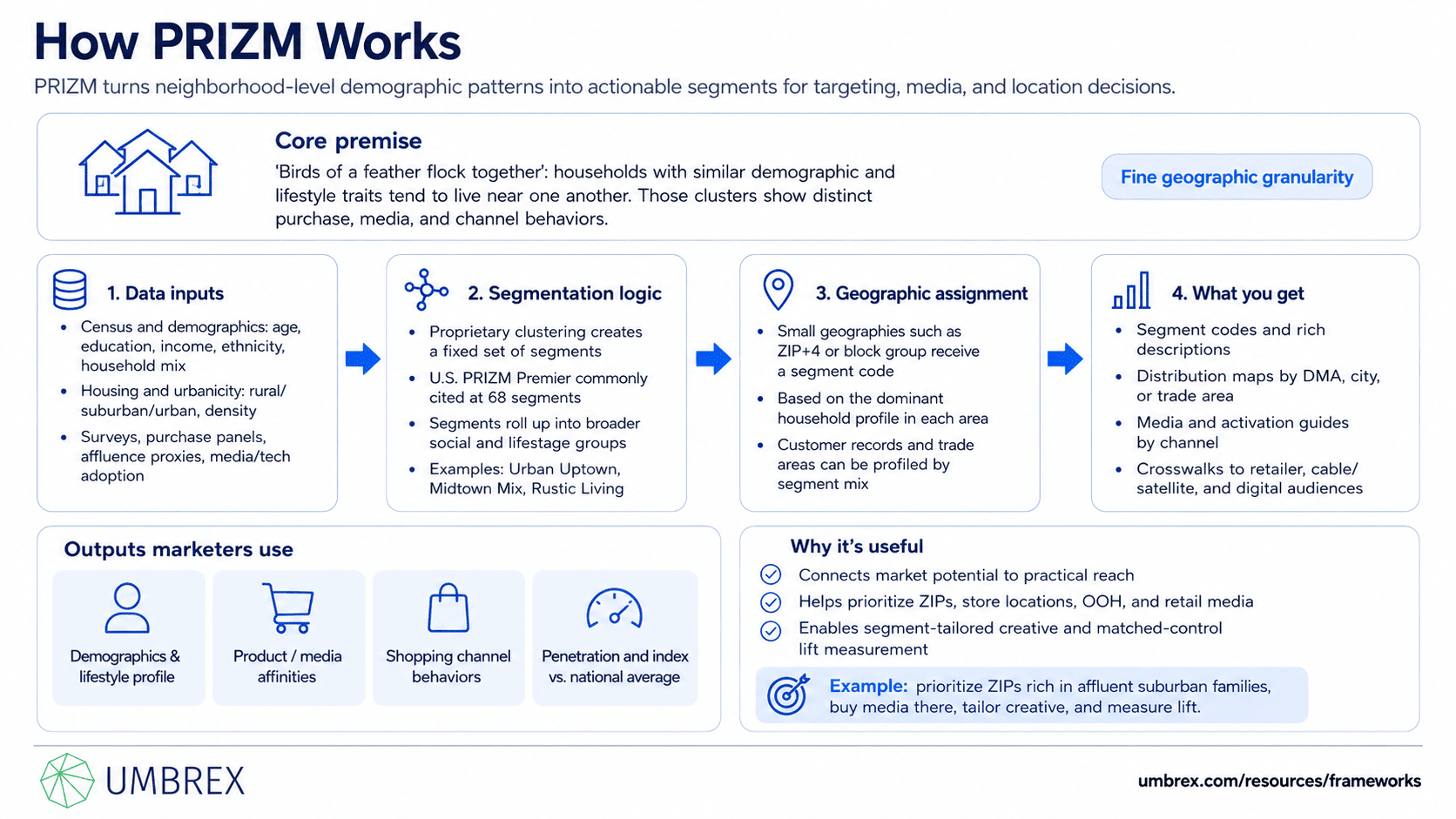
PRIZM is a clustering system built on the premise that “birds of a feather flock together.” Households that share similar demographic and lifestyle characteristics tend to live near one another, and those clusters exhibit distinctive purchasing, media, and channel behaviors. PRIZM captures these patterns at fine geographic levels and assigns each area to a specific segment (and to broader “social” and “lifestage” groups) that marketers can act on.
Core Building Blocks
- Data inputs: Public and commercial sources such as census data (age, education, income, ethnicity, household composition), housing and urbanicity (rural/suburban/urban, density), consumer surveys, purchase panels, credit/affluence proxies, and media/technology adoption indicators.
- Segmentation logic: Proprietary clustering that yields a fixed set of segments (commonly cited as 68 in the current U.S. PRIZM Premier release), grouped into higher-order categories by affluence and lifestage (e.g., “Urban Uptown,” “Midtown Mix,” “Rustic Living,” “Young Achievers,” “Sustaining Families”).
- Geographic assignment: Each small geography (e.g., ZIP+4 or block group) receives a PRIZM segment code based on the dominant household profile. Customer records can be appended with PRIZM via address or ZIP+4, and trade areas can be profiled by segment mix.
What You Get from a PRIZM Profile
- Segment codes and descriptions: Detailed profiles describing demographics, lifestyle, product and media affinities, shopping channels, and response behaviors for each segment.
- Distribution maps: Where target segments live by DMA, city, or trade area; penetration and index vs. national averages.
- Media and activation guides: Recommended channels (linear/digital media, OOH, direct mail) and partner categories likely to reach each segment efficiently.
- Crosswalks: Linkages to retailer audiences, cable/satellite footprints, and digital platform taxonomies to enable execution.
Why It’s Useful
PRIZM connects market potential to practical reach. For example, a retailer can identify ZIPs with high concentrations of “affluent suburban families,” prioritize store locations and OOH placements there, buy retail media in those trade areas, and tailor creative to that segment’s values—then measure lift against matched controls.
4. When to Use PRIZM
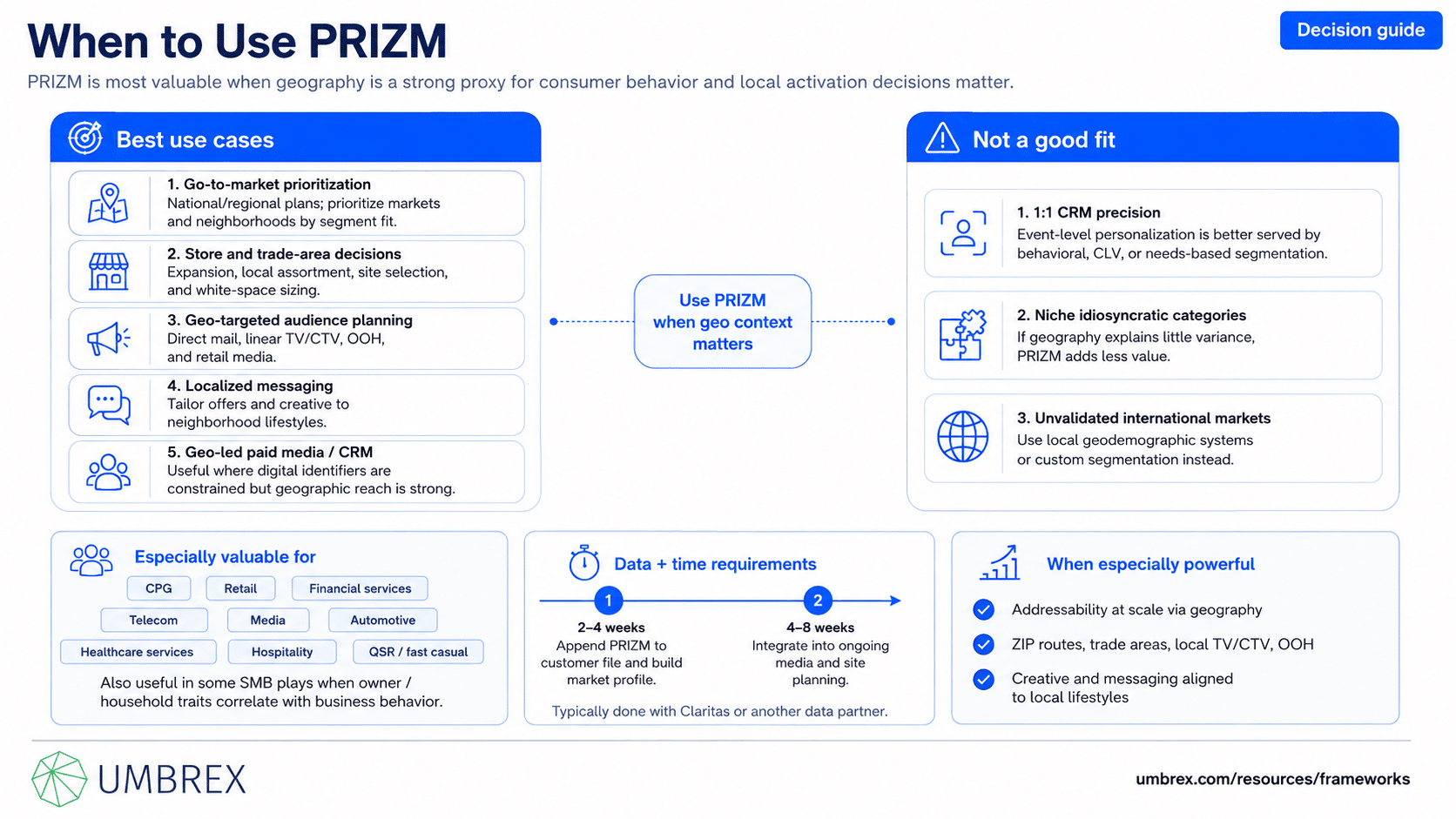
Most helpful when you are:
- Designing national or regional go-to-market plans and need to prioritize markets and neighborhoods by segment fit.
- Planning store expansion, local assortment, or site selection; sizing trade areas and white space by segment density.
- Building audience strategies for direct mail, linear TV/CTV, OOH, and retail media using geographic targeting.
- Localizing offers, messages, and creative to match neighborhood profiles (e.g., health-conscious urban professionals vs. budget-oriented rural families).
- Calibrating paid media and CRM reactivation in markets where digital identifiers are constrained but geographic reach is strong.
Company types: Especially valuable in B2C categories with broad consumer bases—CPG, retail (grocery, specialty, convenience), financial services, telecom, media, automotive, healthcare services, hospitality, QSR/fast casual. It can inform SMB-focused plays where owner/household characteristics correlate with business behavior.
Data and time requirements: With a data partner or Claritas, appending PRIZM to your customer file and building a market profile can be done in 2–4 weeks; integrating into ongoing media and site planning typically takes 4–8 weeks.
When it is especially powerful: When you need addressability at scale via geography (ZIP routes, store trade areas, local TV/CTV, OOH) and want to align creative/messaging to local lifestyles.
When it’s not a good fit:
- High-precision, event-level CRM or 1:1 personalization; behavioral/CLV and needs-based segmentations are better suited for those tasks.
- Highly niche categories with idiosyncratic buyers where geography explains little of the variance.
- International markets without a validated PRIZM calibration; use local geodemographic systems or custom segmentation instead.
5. How to Apply PRIZM: Step-by-Step
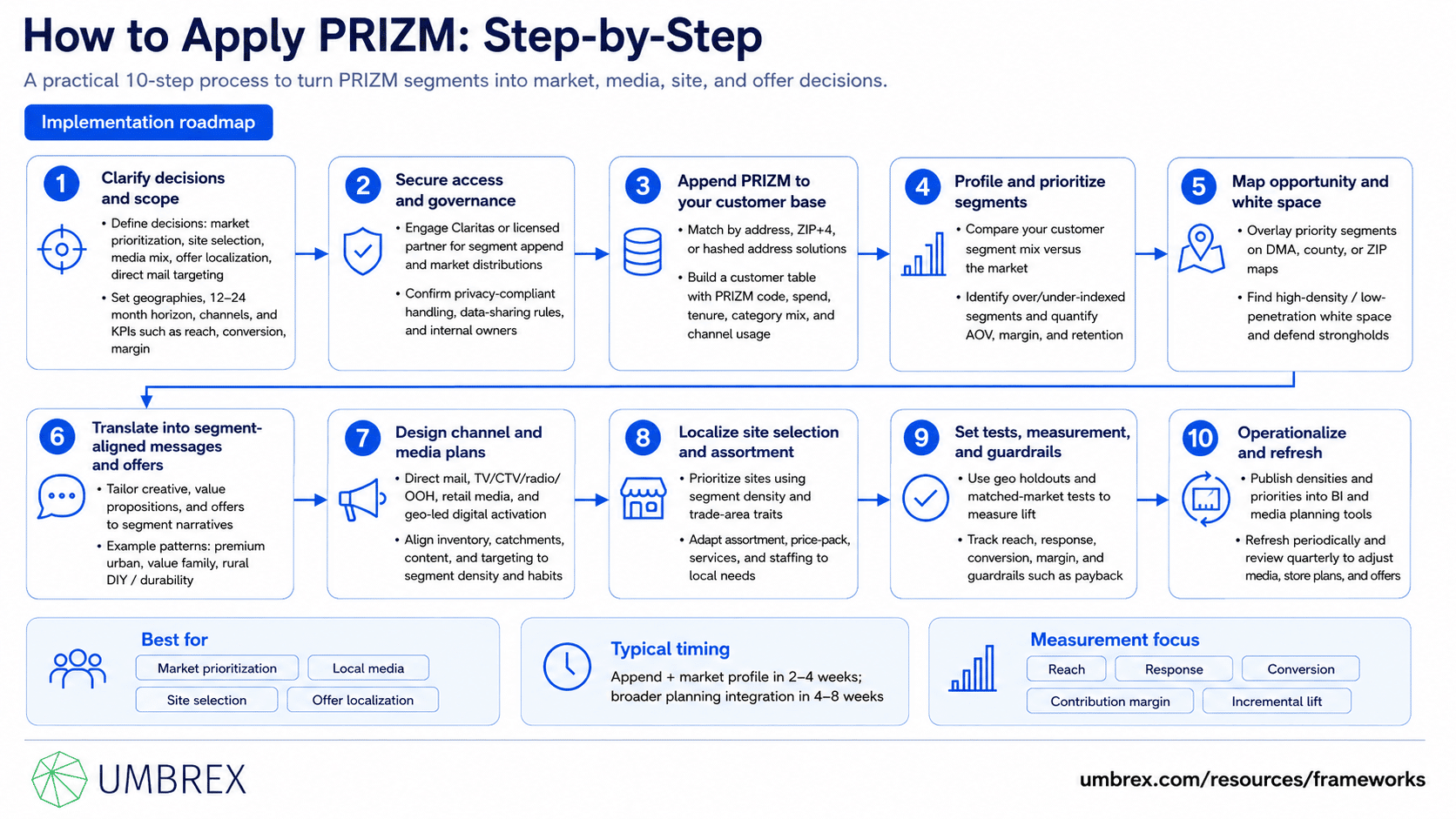
- Clarify decisions and scope
Define what you will decide with PRIZM: market prioritization, site selection, local media mix, offer localization, or direct mail targeting. Specify geographies, time horizon (e.g., next 12–24 months), channels (retail media, CTV, OOH, mail), and KPIs (reach, conversion, contribution margin).
- Secure access and governance
Engage Claritas or a licensed partner to append PRIZM segments to your customer file and to provide market-level PRIZM distributions. Ensure privacy-compliant data handling and clear data-sharing agreements. Establish internal owners for data integration and activation.
- Append PRIZM to your customer base
Match customers via address/ZIP+4 or hashed address solutions. Create a clean table with customer ID, location, PRIZM code, spend, tenure, category mix, and channel usage. For multi-household accounts (e.g., utilities), align at the service address level.
- Profile and prioritize segments
Compare your customers’ PRIZM distribution to market. Identify over- and under-indexing segments for your brand and for specific categories/SKUs. Quantify segment economics (AOV, margin, retention) to prioritize which segments warrant investment.
- Map opportunity and white space
Overlay high-priority segments onto market maps (DMA, county, ZIP). Identify pockets with high segment density but low current penetration (white space) and areas saturated with your best customers (defend and expand). For retail, build trade-area profiles around current and candidate locations.
- Translate into segment-aligned messages and offers
Use PRIZM segment narratives to tailor creative, value propositions, and offers. Example: health-forward, premium positioning for affluent urban professionals; value and family-size bundles for budget-conscious suburban families; DIY messages and durability claims for rural practical segments.
- Design channel and media plans
Activate via:
– Direct mail: Carrier routes with high target-segment density; fenced offers by segment.
– CTV/Linear TV/Radio/OOH: Buy inventory in geographies dense with targets; align dayparts and content to segment media habits.
– Retail media: Target stores and catchments where target segments shop.
– Digital: Use geo-fencing and retailer/partner audiences; map PRIZM segments to platform interest/contextual proxies when possible.
- Localize site selection and assortment
For new or remodeled locations, use segment density and complementary trade-area attributes to prioritize sites. Align local assortment, price-pack architecture, services (e.g., curbside vs. dine-in), and staffing to segment needs.
- Set tests, measurement, and guardrails
Establish geo-based holdouts and matched-market tests to quantify incremental lift. Measure reach, response, conversion, and margin by segment-dense areas. Set guardrails (minimum margin, payback) and revisit segment priorities quarterly.
- Operationalize and refresh
Publish segment densities and priority lists into planning tools (BI dashboards, media planning systems). Refresh data periodically (e.g., annually or as new releases arrive) and after major demographic shifts. Institutionalize a quarterly review to adjust media weights, store plans, and offers by segment.
6. Example: PRIZM in Action
Context: A $700M regional grocer is launching a smaller-format, fresh-and-convenient concept in two metro areas and wants to optimize store locations, local media, and assortment. The brand’s legacy stores over-index in family suburban areas; the new concept targets urban professionals and young families.
Approach: Append PRIZM to loyalty members and e-commerce customers; build market maps of segment density; run trade-area profiles for candidate sites; design local media and offer plans aligned to priority segments.
- Profiling: The grocer’s current base over-indexed in family-oriented suburban segments; under-indexed in urban, high-income professionals and “young new nesters.” These under-indexed segments exhibited higher e-comm adoption and premium fresh category spend in syndicated data.
- Site selection: Candidate sites with top-quartile density of target PRIZM segments and high foot-traffic potential were prioritized. Two proposed sites with appealing rents were dropped due to low target-segment density and weak daypart patterns.
- Local media and offers:
– CTV and OOH buys concentrated in ZIPs with high target density; creative emphasized healthy prepared meals and fast pickup.
– Direct mail to high-density carrier routes with “new customer bundle” offers; QR-linked menu previews tailored to segment tastes.
– Retail media partnerships with nearby premium fitness studios and coworking spaces to reach target segments.
- Assortment: Increased premium ready-to-eat options, smaller pack sizes, and curated local brands. Reduced deep-discount bulk SKUs that resonated less with target segments.
Outcome (first 16 weeks): New stores achieved 112% of traffic plan and 119% of basket value plan; e-comm share was 1.6x legacy store average in those markets. Direct-mail response in top-decile PRIZM routes was 2.4x control routes. Two additional sites were greenlit based on the same PRIZM-guided approach.
7. Strengths and Limitations
Strengths
- Actionable at scale: Converts complex demographics into standardized segments mapped to real places—ideal for media buys, direct mail, OOH, and site planning.
- Common language: Aligns marketing, real estate, and merchandising around a shared view of local demand and lifestyles.
- Cost-effective: Fast to implement using address or ZIP-level data; often delivers immediate lift in local targeting.
- Complementary: Pairs naturally with needs-based and behavioral/CLV segmentations for full-funnel strategy and precision CRM.
Limitations
- Ecological fallacy risk: Neighborhood averages can mask within-area diversity; not every household fits the dominant segment.
- Not a replacement for needs/behavioral insights: PRIZM explains “who/where,” not “why” with category-specific nuance; needs-based work is still required for proposition design.
- U.S.-centric: The classic PRIZM system is calibrated for the U.S.; applying it elsewhere without local calibration can mislead.
- Static between refreshes: While updated periodically, it won’t capture fast-moving micro-shifts without complementary real-time signals.
8. Common Pitfalls (and How to Avoid Them)
- Using ZIP-level only, ignoring micro-variation
What goes wrong: Over-broad targeting wastes spend and blurs insights.
Avoid: Use the finest feasible geography (ZIP+4, block group) and overlay with first-party data.
- Confusing PRIZM with needs
What goes wrong: Segment-aligned creative misses category-specific motivations.
Avoid: Pair PRIZM with needs-based insights; let PRIZM guide where/how to reach, not what to build.
- Copy-pasting creative
What goes wrong: One-size messaging underperforms across diverse segments.
Avoid: Tailor creative and offers by segment; validate through geo-based tests.
- Ignoring economics
What goes wrong: Targeting segments that are easy to reach but low value.
Avoid: Rank segments by CLV/margin and response, not just index; set payback guardrails.
- Set-and-forget
What goes wrong: Demographic shifts and media changes erode performance.
Avoid: Refresh annually (or when new releases drop); monitor leading indicators and reweight media quarterly.
- No privacy/compliance review
What goes wrong: Data-sharing or activation practices fall afoul of evolving regulations.
Avoid: Work through compliant partners; ensure transparent data governance and opt-out mechanisms.
9. How PRIZM Relates to Other Frameworks
- STP (Segmentation–Targeting–Positioning): PRIZM supplies a practical segmentation for Targeting and channel strategy; Positioning still requires needs- and value-based insight.
- Needs-Based Segmentation and JTBD: Use these to define “why” customers choose and how to design propositions; use PRIZM to find and reach those audiences geographically and at scale.
- VALS (psychographics): VALS explains motivation; PRIZM explains where motivated groups live. Many teams cross-reference VALS-like mindsets within PRIZM segments to inform creative.
- RFM/CLV: RFM/CLV drive CRM and lifecycle prioritization. Overlay PRIZM to understand geographic concentration of high-value cohorts and to seed geo-targeted acquisition.
- Conjoint/Max-Diff (pricing and features): After choosing target neighborhoods/segments, quantify feature/price trade-offs in those audiences to design price-pack architecture and assortment.
- Market Landscape Mapping: Landscape work shows competitive presence by market; PRIZM pinpoints micro-markets where you have a right to win and how to localize go-to-market.
Choosing tools: Use needs-based and conjoint to design “what to offer.” Use PRIZM to decide “where and how to reach” those audiences efficiently. Use RFM/CLV for “who to nurture” post-acquisition.
10. Key Takeaways
- PRIZM is a geodemographic system that translates neighborhood characteristics into actionable consumer segments for targeting, media, and site decisions.
- It excels at market prioritization, local activation (CTV/OOH/direct mail/retail media), and store/trade-area strategy.
- Pair PRIZM with needs-based and behavioral/CLV insights: PRIZM guides where/how to reach; needs/behavior guide what to say and sell.
- Avoid ecological fallacies: use the finest geographies, validate with first-party data, and test creative and offers by segment.
- Refresh regularly and enforce privacy/compliance; tie segment choices to economics (CLV, margin, payback).
11. FAQs About the PRIZM Segmentation System
What does PRIZM stand for, and who provides it?
PRIZM stands for “Potential Rating Index for Zip Markets.” It was developed and is maintained by Claritas, which licenses the system, data, and append services to brands and research partners.
How many segments are in PRIZM?
The current U.S. release (PRIZM Premier) is widely cited as having 68 segments, grouped into broader social and lifestage categories. Claritas periodically updates definitions and inputs to reflect new data.
Is PRIZM still relevant in a digital-first world?
Yes—particularly for market prioritization, local activation (CTV, OOH, retail media), direct mail, and site selection. For event-level CRM and 1:1 personalization, pair PRIZM with behavioral/CLV models and first-party data.
Can small or mid-sized companies use PRIZM?
Absolutely. Many start by appending PRIZM to their customer file, profiling top segments, and focusing media and direct mail on high-density neighborhoods. It’s a cost-effective step toward more sophisticated targeting.
Can PRIZM be used outside the U.S.?
Classic PRIZM is U.S.-centric. For other countries, use local geodemographic systems or commission a custom segmentation. If applying PRIZM concepts abroad, validate with local data before scaling.
How long does a PRIZM-based project take?
Appending PRIZM to your customer file and producing a first set of insights usually takes 2–4 weeks. Embedding into media planning, site selection, and measurement frameworks typically takes another 4–8 weeks.
How do we connect PRIZM to digital media?
Use geo-targeting (ZIP/geo-fencing), retailer/partner audiences aligned to target trade areas, and contextual/interest proxies that mirror PRIZM profiles. Test and refine with matched-market or geo-lift designs to ensure incremental performance.
