

1. What Is the Competitor Response Profile Framework?
The Competitor Response Profile Framework is a structured way to anticipate how specific rivals will react to your moves—price changes, product launches, channel shifts, promotions, partnerships, or messaging. Rather than viewing “the market” as an abstract force, it profiles named competitors’ objectives, incentives, capabilities, decision processes, and past behavior to forecast the likely speed, severity, and form of their responses.
It is an external and competitive analysis framework used in marketing and strategy. Marketers deploy it to choose actions that achieve objectives while avoiding unnecessary price wars, platform retaliation, or channel conflict. Consultants commonly build response profiles before major launches or pricing changes to de-risk plans and design contingencies.
In plain terms: it helps you answer, “If we do X, what will Competitor A, B, and C do next—and what should we do about it?”
2. Origin and Background
The practice of profiling competitor behavior has deep roots in strategy. Michael E. Porter’s competitor analysis (Competitive Strategy, 1980) and the later “Four Corners” model—examining a rival’s drivers, current strategy, assumptions, and capabilities—popularized a systematic approach to predicting competitor actions. In consulting and business school usage, this work evolved into practical “competitor response profiles” used to forecast reactions to specific strategic moves.
Origin of the specific term “Competitor Response Profile Framework”: Unknown; the method has been in widespread use since at least the 1990s in consulting playbooks and corporate strategy processes, often drawing on Porter’s foundations combined with war-gaming and scenario planning.
Why it was created: leaders routinely underestimated or misread competitor reactions, resulting in avoidable price wars, channel pushback, copycat launches, and wasted marketing spend. Response profiling brought discipline to an area often driven by intuition or bias.
3. How the Competitor Response Profile Framework Works
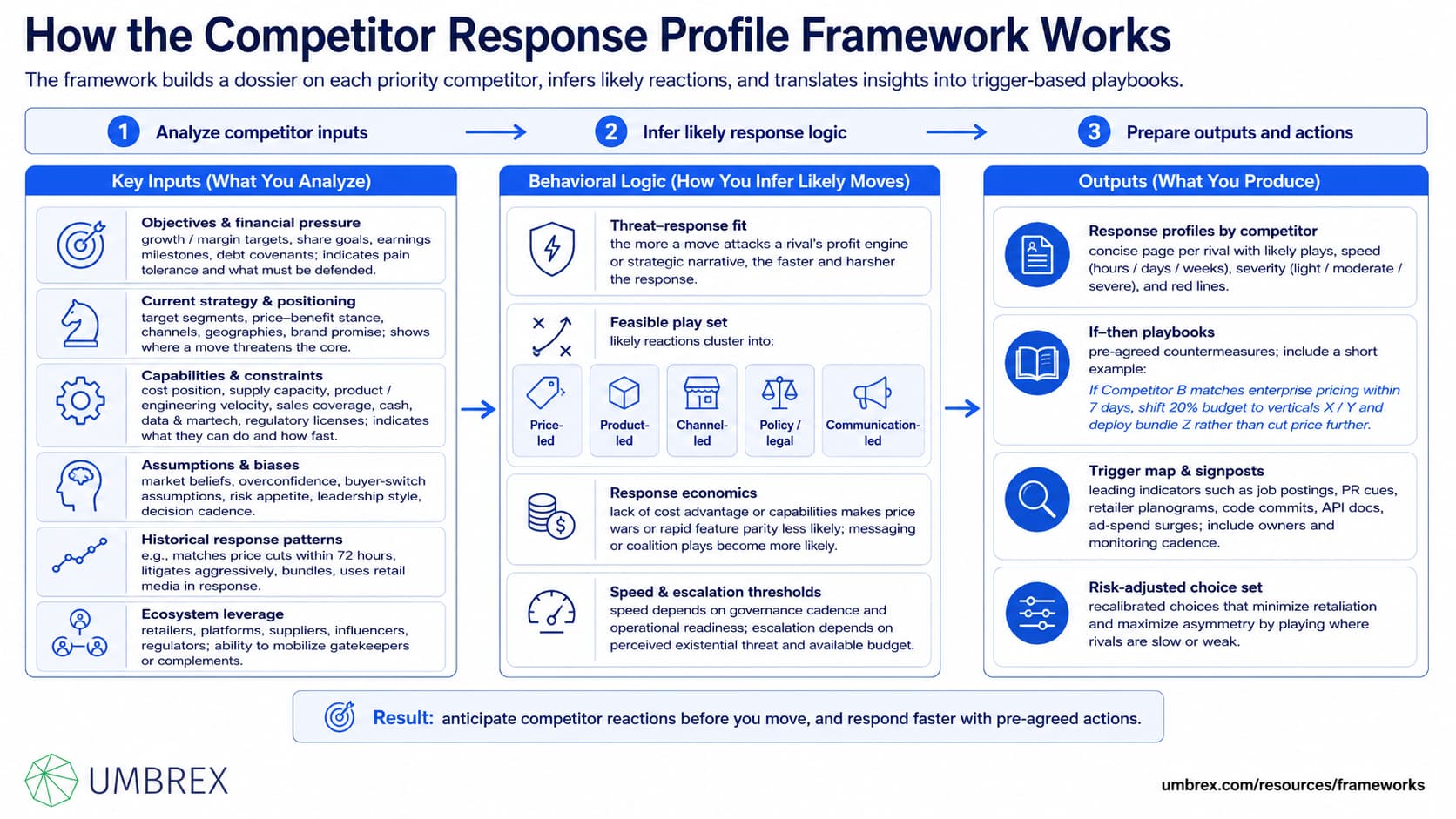
At its core, the framework builds a dossier on each priority competitor and converts that understanding into “if–then” forecasts and trigger-based playbooks. It has three building blocks: inputs, behavioral logic, and outputs.
Key Inputs (What You Analyze)
- Objectives and financial pressure: Stated growth and margin targets, market share goals, upcoming earnings milestones, debt covenants—signals of how much pain they will tolerate and what they must defend.
- Current strategy and positioning: Target segments, price–benefit stance, channel mix, geographic focus, brand promises; shows where a move threatens their core.
- Capabilities and constraints: Cost position, supply capacity, product and engineering velocity, sales coverage, cash on hand, data and martech, regulatory licenses; indicates what they can respond with, and how fast.
- Assumptions and biases: How they view the market (e.g., overconfidence in brand, belief that buyers won’t switch), cultural risk appetite, leadership style, decision-making cadence.
- Historical response patterns: Documented behaviors—e.g., matches price cuts within 72 hours, litigates aggressively, bundles in reaction to innovation, uses retail media to counter channel moves.
- Ecosystem leverage: Relationships with platforms, retailers, suppliers, influencers, and regulators; potential to mobilize gatekeepers or complements as part of response.
Behavioral Logic (How You Infer Likely Moves)
- Threat–response fit: The more your move attacks a rival’s profit engine or strategic narrative, the faster and harsher their response.
- Feasible play set: Rival reactions cluster into typical plays:
– Price-led (cuts, rebates, bundles, loyalty offers)
– Product-led (feature parity, accelerated roadmap, acquisitions)
– Channel-led (exclusive deals, distribution pressure, retail media offensives)
– Policy/legal (regulatory complaints, IP enforcement, platform lobbying)
– Communication-led (PR counter-narratives, FUD—fear, uncertainty, doubt)
- Response economics: If a rival lacks cost advantage or required capabilities, price wars or fast feature parity are less likely; they may pivot to messaging or coalition plays instead.
- Speed and escalation thresholds: Response speed depends on governance cadence and operational readiness; escalation depends on perceived existential threat and available budgets.
Outputs (What You Produce)
- Response profiles by competitor: A concise page per rival with likely plays, speed (hours/days/weeks), severity (light/moderate/severe), and red lines (moves they almost certainly defend).
- If–then playbooks: Pre-agreed countermeasures, e.g., “If Competitor B matches price in enterprise tier within 7 days, then shift 20% budget to verticals X/Y and deploy bundle Z rather than further cutting price.”
- Trigger map and signposts: Leading indicators to watch (e.g., job postings, PR cues, retailer planograms, code commits in open-source repos, API docs, ad spend surges) with owners and monitoring cadence.
- Risk-adjusted choice set: Strategic choices recalibrated to minimize costly retaliation and maximize asymmetry (playing where rivals are slow or weak).
4. When to Use the Competitor Response Profile Framework
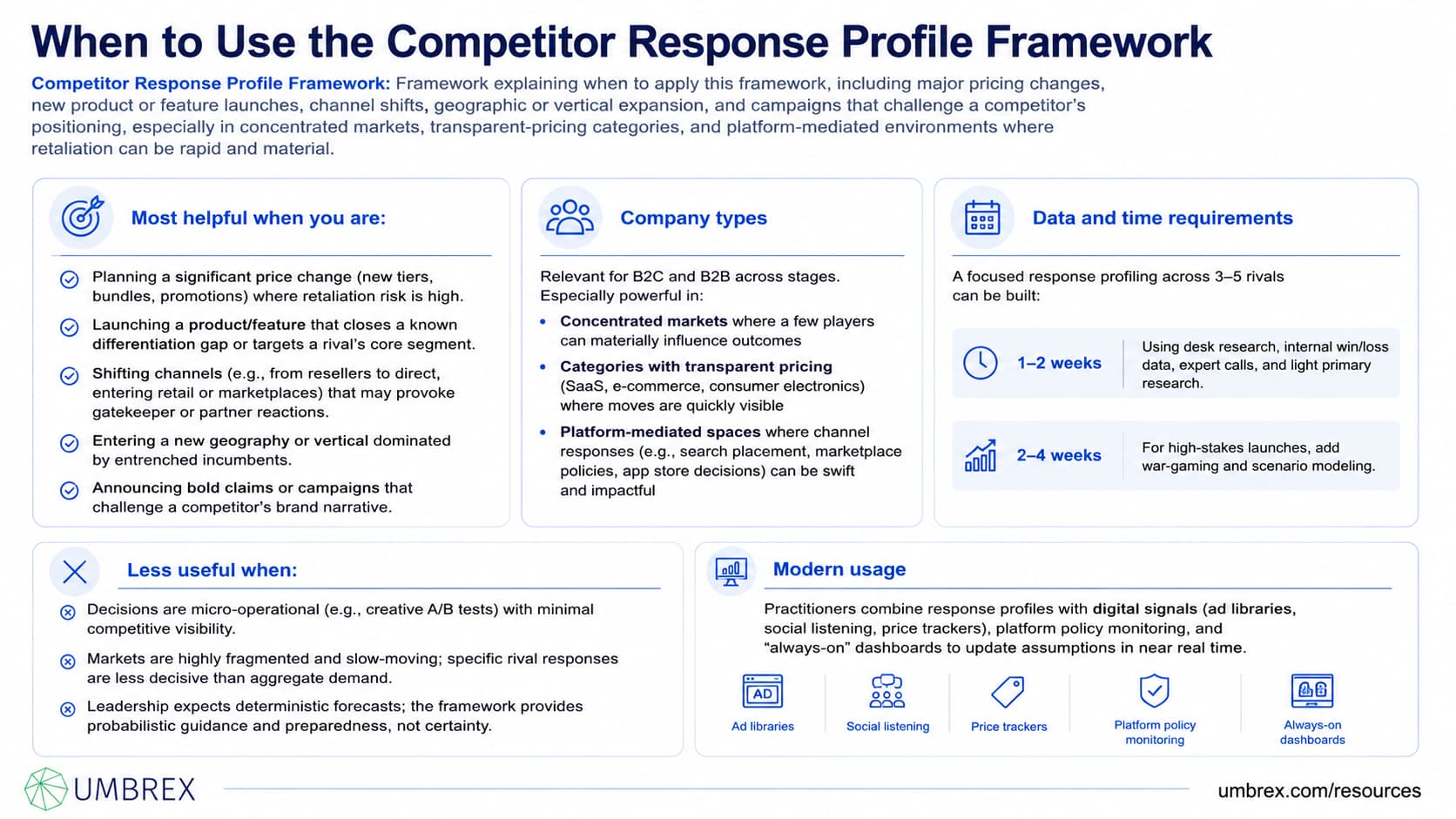
Most helpful when you are:
- Planning a significant price change (new tiers, bundles, promotions) where retaliation risk is high.
- Launching a product/feature that closes a known differentiation gap or targets a rival’s core segment.
- Shifting channels (e.g., from resellers to direct, entering retail or marketplaces) that may provoke gatekeeper or partner reactions.
- Entering a new geography or vertical dominated by entrenched incumbents.
- Announcing bold claims or campaigns that challenge a competitor’s brand narrative.
Company types: Relevant for B2C and B2B across stages. Especially powerful in concentrated markets, categories with transparent pricing (SaaS, e-commerce, consumer electronics), and platform-mediated spaces where channel responses can be swift.
Data and time requirements: A focused response profiling across 3–5 rivals can be built in 1–2 weeks using desk research, internal win/loss data, expert calls, and light primary research. For high-stakes launches, add war-gaming and scenario modeling over 2–4 weeks.
Less useful when:
- Decisions are micro-operational (e.g., creative A/B tests) with minimal competitive visibility.
- Markets are highly fragmented and slow-moving; specific rival responses are less decisive than aggregate demand.
- Leadership expects deterministic forecasts; the framework provides probabilistic guidance and preparedness, not certainty.
Modern usage: Practitioners combine response profiles with digital signals (ad libraries, social listening, price trackers), platform policy monitoring, and “always-on” dashboards to update assumptions in near real time.
5. How to Apply the Competitor Response Profile Framework: Step-by-Step
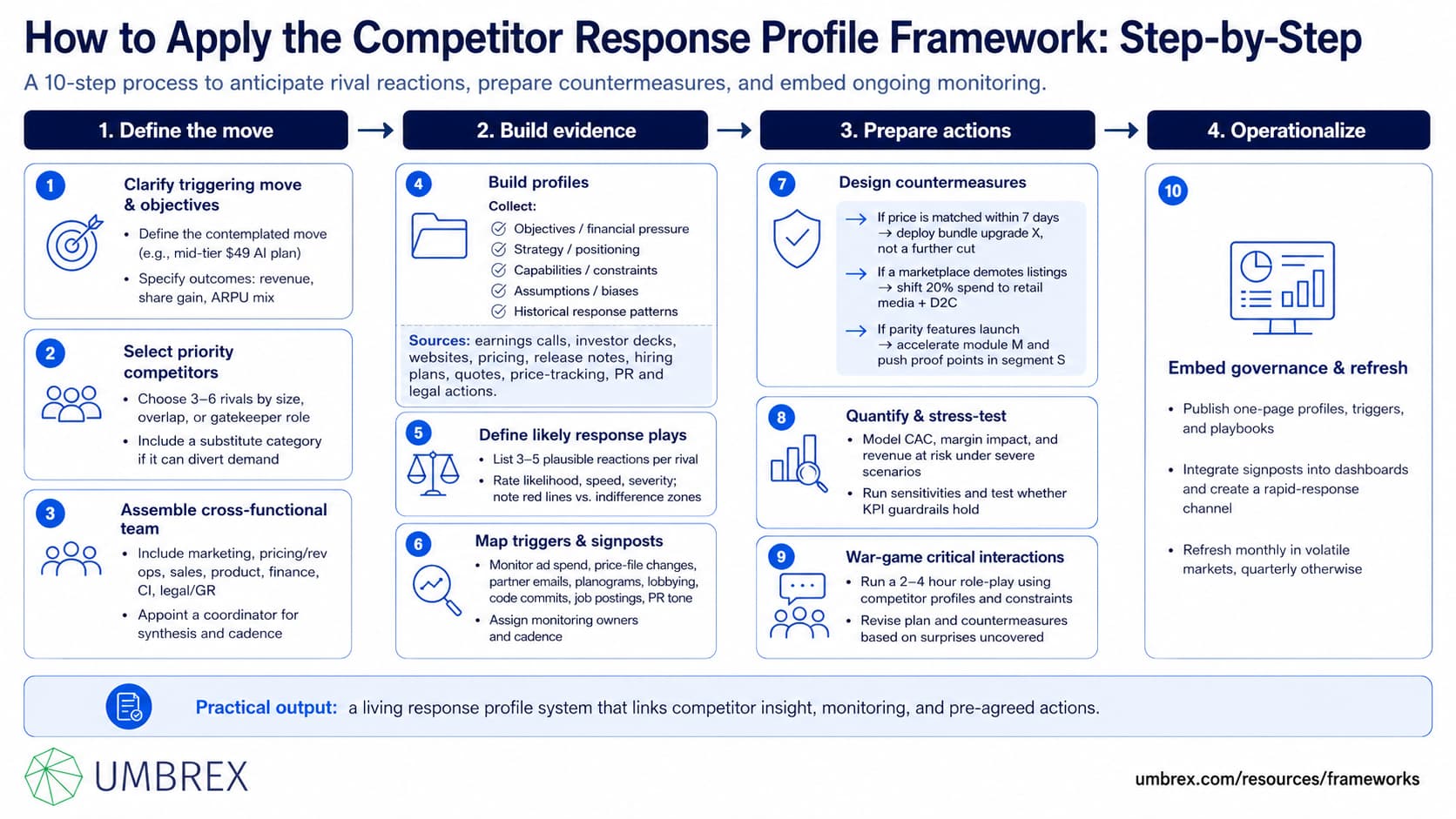
- Clarify the triggering move and objectives
Define the move you are contemplating (e.g., “Introduce a mid-tier plan at $49 with AI features”) and the outcomes you need (revenue, share gain, ARPU mix). The clarity of the contemplated move shapes the fidelity of the response forecast.
- Select priority competitors
Choose 3–6 rivals whose reactions matter most—by size, overlap, or gatekeeper role (platforms, major retailers). Include at least one substitute category if it plausibly draws your targets away.
- Assemble a cross-functional team
Include marketing, pricing/revenue ops, sales, product, finance, competitive intelligence, and legal/GR (if regulatory or IP issues are possible). Appoint a coordinator for synthesis and cadence.
- Build the profiles (evidence-based)
For each competitor, collect:
– Objectives/financial pressure: earnings calls, investor decks, hiring plans.
– Current strategy/positioning: websites, campaigns, channel mix, public pricing.
– Capabilities/constraints: cost structure signals, product velocity (release notes), sales coverage, distribution contracts, partnerships.
– Assumptions/biases: executive interviews, past quotes, strategic bets.
– Historical response patterns: price-tracking history, promotion timing, legal actions, PR tactics.
- Define likely response plays
List 3–5 plausible reactions per rival and rate each on:
– Likelihood (low/med/high)
– Speed (hours/days/weeks)
– Severity (light/moderate/severe impact on your economics)
Write concise rationales drawing on the evidence. Note red lines (must-defend areas) versus zones of indifference.
- Map triggers and signposts
For high-likelihood reactions, specify leading indicators you can monitor: ad spend spikes (ad libraries), price file changes, partner email templates, retail planogram updates, lobbying filings, code commits, job postings, or PR tone shifts. Assign monitoring owners and cadence.
- Design your countermeasures
Create if–then responses that preserve your objectives while avoiding avoidable escalation. Examples:
– “If Competitor A matches price within 7 days, then deploy bundle upgrade X instead of further cutting.”
– “If Marketplace Y demotes our listing after exclusive partner deals, then pivot 20% spend to retail media plus D2C.”
– “If rival launches parity features, accelerate roadmap module M and push proof points in segment S.”
- Quantify and stress-test
Translate severe scenarios into unit economics: expected CAC under price matching, margin impact of promo escalation, revenue at risk from channel retaliation. Run sensitivity analyses; validate that your countermeasures keep KPIs within guardrails.
- War-game critical interactions
Run a 2–4 hour session where team members role-play each competitor using the profiles and constraints. Iterate your plan and countermeasures based on surprises uncovered.
- Embed governance and refresh
Publish one-page profiles, triggers, and playbooks. Integrate signposts into dashboards. Set a refresh cadence (monthly in volatile markets, quarterly otherwise), and create a rapid-response channel for cross-functional action when triggers fire.
6. Example: Competitor Response Profiling in Action
Context: A $400M B2B SaaS company offering analytics for mid-market enterprises plans to launch an AI-assisted insights module and introduce a new $49 per-seat mid-tier plan to accelerate growth in North America and the UK.
Problem: Leadership fears a price war with the premium incumbent (Competitor A), bundling retaliation by a platform-based rival (Competitor B), and messaging attacks from a niche challenger (Competitor C) claiming privacy risks.
Profiles built:
- Competitor A (Premium incumbent):
– Objectives: Defend enterprise ARPU; maintain 85% gross margin; hit aggressive expansion targets signaled in investor guidance.
– Strategy: High-touch sales, premium services, compliance leadership.
– Capabilities: Deep enterprise features; slower roadmap; high cost base.
– History: Avoids broad price cuts; uses targeted loyalty discounts and adds services to defend accounts; litigated over IP in past disputes.
– Likely responses: Targeted retention bundles for at-risk accounts (high likelihood, 1–2 weeks), PR positioning on enterprise-grade security (medium, immediate), broad price match (low).
- Competitor B (Platform bundle rival):
– Objectives: Drive attach of analytics to core platform; expand MAU; monetize via bundle discounts.
– Strategy: Underprice stand-alone tools via bundles; heavy channel leverage through marketplace.
– Capabilities: Fast feature parity; powerful channel control; strong retail media.
– History: Matches feature headlines in 30–60 days; offers 6-month bundle promos.
– Likely responses: 20% bundle promo (high, 1 week), marketplace merchandising demotion (medium, 2–3 weeks), rapid “AI lite” feature launch (medium, 30–45 days).
- Competitor C (Niche privacy-focused challenger):
– Objectives: Grow share in regulated verticals; build brand as the “safe” alternative.
– Strategy: Thought leadership; privacy-by-design; selective enterprise wins.
– Capabilities: Limited sales coverage; agile comms; modest R&D scale.
– History: Aggressive FUD campaigns on rivals’ privacy practices; no price wars.
– Likely responses: PR/blog series questioning AI data handling (high, 1 week); security certification showcase (medium).
Plan adjustments and countermeasures:
- Price: Kept enterprise tier pricing intact; introduced mid-tier at $49 with clear fences. If A deploys targeted discounts, respond with value-based ROI calculators and an “upgrade credit” rather than blanket cuts.
- Channel: Reduced reliance on B’s marketplace at launch (cap at 20% of new MRR); increased direct and partner-led sales; lined up two alternative marketplaces.
- Messaging: Pre-empted C’s FUD with third-party privacy attestations, clear AI data sheets, and customer references in regulated sectors.
- Triggers: If B launches a 20% bundle promo, shift 15% spend to vertical field marketing and partners; if A runs retention bundles, target their Tier-2 accounts with integration-focused offers; if C’s FUD gains traction (share of voice >15% on “AI privacy analytics”), deploy executive comms and third-party validation content within 72 hours.
Outcome: Within two weeks of launch, B ran a bundle promo; the team pivoted spend per the playbook, preserving CAC within plan. A offered selective service credits to two shared prospects; the team countered with ROI proof and integration SLAs, winning one of the two deals without discounting. C published a critical blog series; pre-baked privacy assets limited negative sentiment, and third-party validations outperformed C’s content in paid and organic reach. Six months in, the mid-tier accounted for 28% of new ARR with stable net dollar retention, and no broad price war ensued.
7. Strengths and Limitations
Strengths
- Actionable foresight: Translates competitor understanding into concrete, trigger-based playbooks.
- Risk mitigation: Reduces the chance of stumbling into costly price wars or channel retaliation.
- Alignment and speed: Creates a common language across marketing, sales, product, and finance; accelerates response when rivals move.
- Customer-centric impact: Helps preserve price realization and brand positioning by choosing battles wisely.
Limitations
- Subjectivity: Profiles can reflect bias or wishful thinking without evidence and challenge.
- Dynamic complexity: Rivals can surprise; ecosystems and gatekeepers add non-linear effects.
- Data gaps: Private companies, opaque channels, or emerging markets provide fewer signals; confidence bands are needed.
- Self-fulfilling risks: Overemphasis on retaliation can make teams timid, missing high-ROI moves.
8. Common Pitfalls (and How to Avoid Them)
- Projecting your logic onto rivals
What goes wrong: Assuming competitors share your economics, governance, or risk appetite.
Avoid: Ground profiles in evidence (financials, history, governance) and stress-test with external experts.
- Confusing statements with behavior
What goes wrong: Taking PR lines or investor platitudes as strategy.
Avoid: Prioritize revealed preferences: price files, release notes, channel contracts, hiring patterns.
- Binary thinking (will/won’t)
What goes wrong: Overconfidence in a single forecast.
Avoid: Rate likelihood, speed, and severity; prepare for multiple plausible paths.
- Ignoring gatekeepers and complements
What goes wrong: Platform or retailer actions blindside plans.
Avoid: Treat platforms and major partners as “competitors” in response profiling.
- One-and-done profiles
What goes wrong: Outdated assumptions persist while rivals change leadership or strategy.
Avoid: Refresh quarterly; track signposts; update playbooks when triggers fire.
- No quantified guardrails
What goes wrong: Escalation drifts into uneconomic price wars.
Avoid: Define stop-loss rules and KPIs (min margin, CAC caps) and adhere to them.
- Under-resourcing countermeasures
What goes wrong: Playbooks exist on paper but lack budget or owners.
Avoid: Assign owners, pre-approve budgets, and pre-build assets (creative, offers, PR).
9. How the Competitor Response Profile Framework Relates to Other Frameworks
- Porter’s Five Forces: Five Forces explains structural pressures and average profitability. Response profiling zooms in on named rivals to anticipate tactical and strategic reactions to your moves.
- STEEP/PESTEL (macro scan): Macro shifts (regulation, technology, social) change rivals’ constraints and incentives; update response profiles accordingly.
- Scenario Planning: High-uncertainty competitor moves become core scenario branches; playbooks can be tested for robustness across scenarios.
- Issue Impact–Uncertainty Matrix: Use it to prioritize which competitive uncertainties deserve hedges and triggers; build response profiles for those issues.
- Competitive Positioning Map: Positioning maps show price–benefit landscape; response profiles forecast how that landscape may shift when you move.
- War-gaming/Game theory: War-gaming is the workshop method; response profiles are the inputs and outputs that make war-games realistic and actionable.
Choosing tools: Use response profiles when planning a specific move and needing to anticipate rival behavior. Use Five Forces and STEEP/PESTEL for context, then response profiling and war-gaming to convert strategy into resilient actions.
10. Key Takeaways
- The Competitor Response Profile Framework anticipates how named rivals will react to your moves—speed, severity, and play type—so you can choose smarter actions and prepare countermeasures.
- Build profiles from evidence: objectives, strategy, capabilities, assumptions, and historical patterns; include platforms and gatekeepers.
- Translate profiles into if–then playbooks with triggers, owners, budgets, and quantified guardrails.
- Use alongside Five Forces, STEEP/PESTEL, and war-gaming to create resilient strategies.
- Refresh regularly; rival incentives and capabilities change with leadership, macro shifts, and platform policies.
11. FAQs About the Competitor Response Profile Framework
Is this framework still relevant in fast-moving digital markets?
Yes—and arguably more so. Platform policies, ad auctions, and rapid feature cycles amplify the speed and impact of rival reactions. Modern practice layers in real-time signals (ad libraries, price trackers, API updates) and rapid-response playbooks.
How is this different from Porter’s “Four Corners” analysis?
Four Corners (drivers, current strategy, assumptions, capabilities) is a foundation for understanding competitors. A response profile applies that understanding to a specific contemplated move and produces if–then forecasts, triggers, and countermeasures.
How granular should the profiles be?
One page per priority rival is sufficient for most decisions. Focus on 3–5 likely plays with ratings for likelihood, speed, and severity, plus signposts and red lines. More detail rarely adds accuracy; better monitoring and triggers do.
Can small or early-stage companies use this framework?
Absolutely. Keep it lightweight: profile 2–3 main rivals, identify the top two likely reactions, and prepare two counterplays. The discipline helps avoid costly price moves and focuses scarce resources.
How long does it take to build decision-grade response profiles?
1–2 weeks for 3–5 rivals using desk research, internal data, and select expert calls. Add 1–2 weeks if you run war-gaming and deeper quantification. The payoff is faster, smarter decisions and fewer surprises.
Can we quantify response likelihoods?
You can score on a 1–5 scale with rationale and calibrate using historical frequencies (e.g., how often a rival price-matched within a week). Avoid false precision in probabilities; focus on readiness and triggers.
