

1. What Is Porter’s Five Forces?
Porter’s Five Forces is a structured framework for assessing the competitive intensity and attractiveness of an industry. It evaluates the external pressures that determine industry profitability over the long run: the threat of new entrants, the threat of substitutes, the bargaining power of buyers, the bargaining power of suppliers, and the rivalry among existing competitors.
While often taught as a strategy tool, it is equally valuable in marketing. Understanding the five forces helps marketers anticipate pricing pressure, channel dynamics, promotion intensity, the feasibility of differentiation, and where to focus positioning to create defensible profit pools. Consultants commonly use Five Forces early in engagements to ground growth, entry, or repositioning strategies in the structural realities of the market.
In plain terms: it explains why some industries allow premium pricing and strong margins, while others devolve into price wars and constant churn—and what a company can do to tilt the odds in its favor.
2. Origin and Background
Porter’s Five Forces was created by Michael E. Porter, Professor at Harvard Business School. It was introduced in the 1979 Harvard Business Review article “How Competitive Forces Shape Strategy” and expanded in Porter’s 1980 book “Competitive Strategy.”
Why it was created: to provide a systematic lens for analyzing industry structure beyond the then-prevailing focus on direct competition. Porter showed that suppliers, customers, entrants, and substitutes all exert pressure that shapes the economics of competition and strategic choices.
The framework gained prominence through HBS teaching, consulting practice, and its intuitive, memorable structure. It remains one of the most widely used tools in strategy and competitive marketing analysis.
3. How Porter’s Five Forces Works
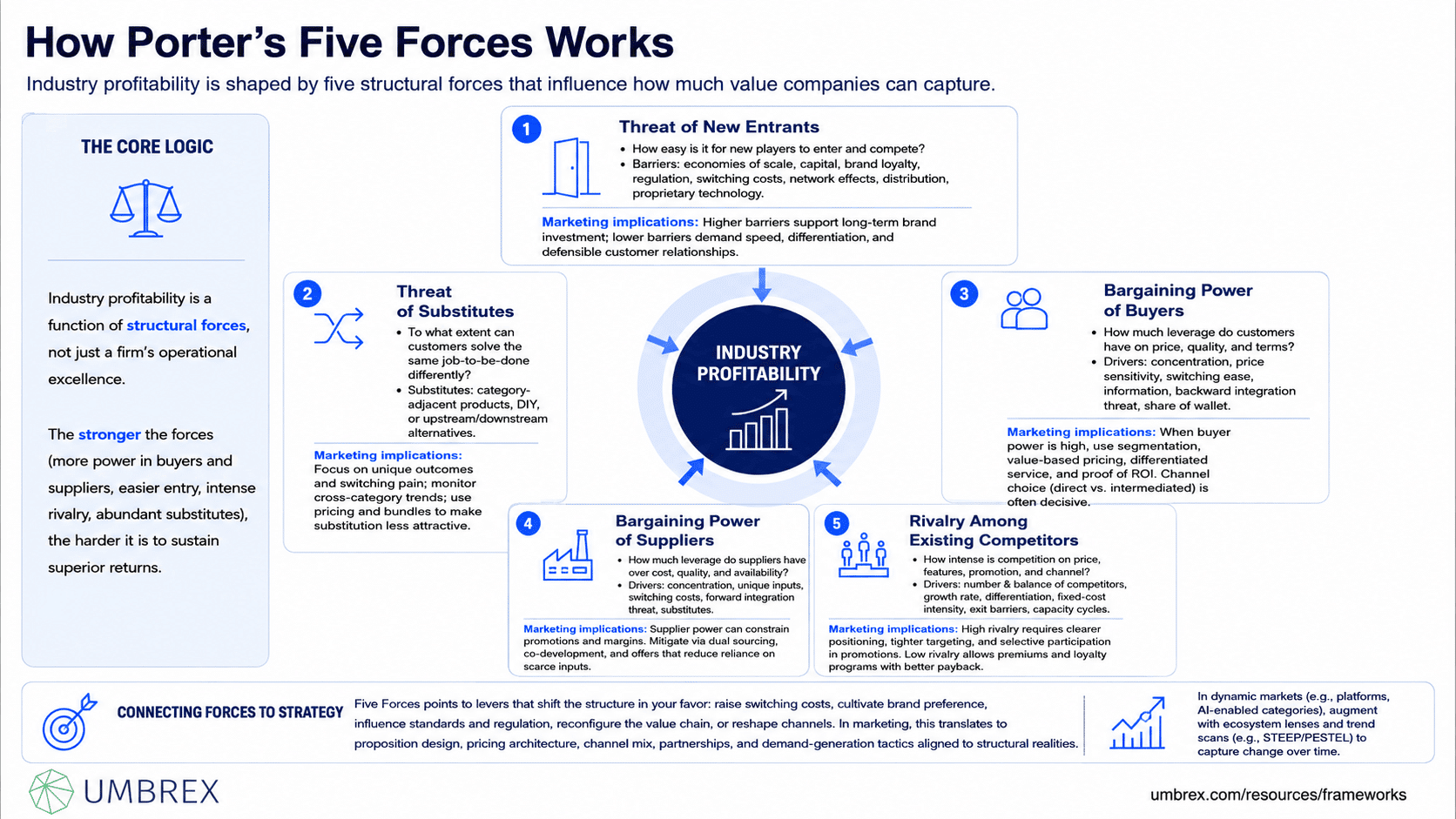
The core logic is that industry profitability is a function of structural forces, not just a firm’s operational excellence. Each force either limits or enables a company’s ability to capture value. The stronger the forces (more power in buyers and suppliers, easier entry, intense rivalry, abundant substitutes), the harder it is to sustain superior returns.
The Five Forces
- Threat of New Entrants:
How easy is it for new players to enter and compete?
Typical barriers: economies of scale, capital requirements, brand loyalty, regulatory licenses, switching costs, network effects, distribution access, and proprietary technology.
Marketing implications: the higher the entry barriers, the more your brand can invest for long-term payback; lower barriers imply a need for speed, rapid differentiation, and defensible customer relationships (e.g., loyalty, ecosystems).
- Threat of Substitutes:
To what extent can customers solve the same job-to-be-done with a different product or approach?
Typical substitutes: category-adjacent products, DIY solutions, or upstream/downstream alternatives (e.g., videoconferencing substituting for travel).
Marketing implications: focus positioning on unique outcomes and switching pain; monitor cross-category trends; design pricing and bundles to make substitution less attractive.
- Bargaining Power of Buyers:
How much leverage do customers have on price, quality, and terms?
Drivers: concentration of buyers, price sensitivity, ease of switching, availability of information, backward integration threat, and share of wallet.
Marketing implications: when buyer power is high, use segmentation, value-based pricing, differentiated service levels, and proof of ROI to blunt price pressure. Channel selection (direct vs. intermediated) is often decisive.
- Bargaining Power of Suppliers:
How much leverage do suppliers have over cost, quality, and availability?
Drivers: supplier concentration, uniqueness of inputs, switching costs, potential forward integration, and availability of substitutes.
Marketing implications: supplier power can constrain promotional levers and margin-funded offers. Mitigation includes dual sourcing, co-development partnerships, and designing offers that reduce reliance on scarce inputs.
- Rivalry Among Existing Competitors:
How intense is competition on price, features, promotion, and channel?
Drivers: number and balance of competitors, industry growth rate, differentiation, fixed-cost intensity, exit barriers, and capacity cycles.
Marketing implications: high rivalry demands clearer positioning, tighter targeting, and selective participation in promotion-heavy battlegrounds. In low-rivalry niches, brands can command premiums and build loyalty programs with better payback.
Connecting Forces to Strategy
Five Forces is not just descriptive. It points to levers that shift the structure in your favor: raise switching costs, cultivate brand preference, influence standards and regulation, reconfigure the value chain, or reshape channels. In marketing, this translates to proposition design, pricing architecture, channel mix, partnerships, and demand-generation tactics aligned to structural realities.
In dynamic markets (e.g., platforms, AI-enabled categories), practitioners often augment Five Forces with ecosystem lenses (complements, gatekeepers) and with trend scans (e.g., STEEP/PESTEL) to capture change over time.
4. When to Use Porter’s Five Forces
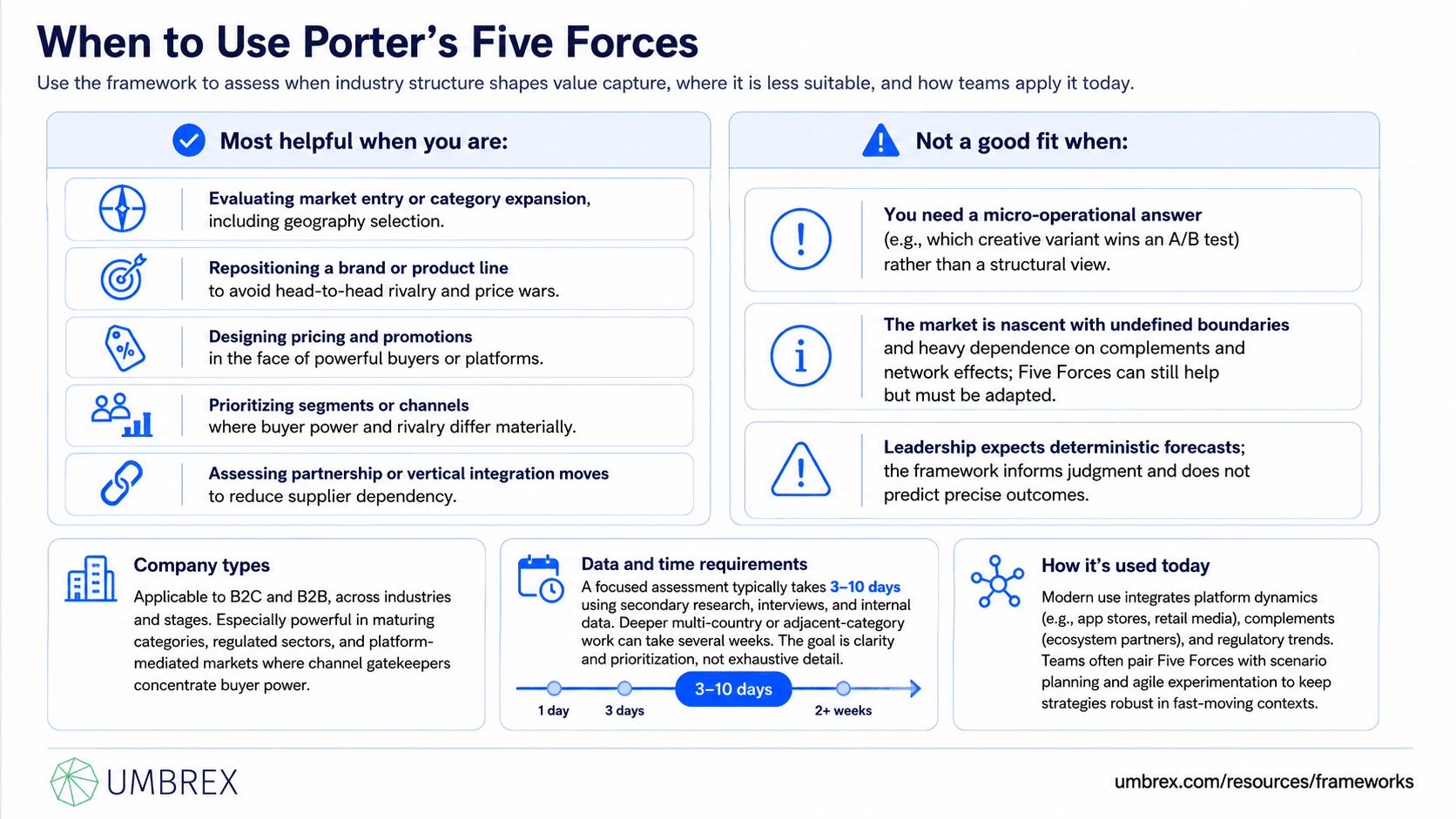
Most helpful when you are:
- Evaluating market entry or category expansion, including geography selection.
- Repositioning a brand or product line to avoid head-to-head rivalry and price wars.
- Designing pricing and promotions in the face of powerful buyers or platforms.
- Prioritizing segments or channels where buyer power and rivalry differ materially.
- Assessing partnership or vertical integration moves to reduce supplier dependency.
Company types: Applicable to B2C and B2B, across industries and stages. Especially powerful for firms in maturing categories, regulated sectors, and platform-mediated markets where channel gatekeepers concentrate buyer power.
Data and time requirements: A focused Five Forces assessment typically takes 3–10 days, using secondary research, interviews, and internal data. Deeper projects (multi-country, adjacent categories) can take several weeks. The value is in clarity and prioritization, not exhaustive detail.
Not a good fit when:
- You need a micro-operational answer (e.g., which creative variant wins an A/B test) rather than a structural view.
- The market is nascent with undefined boundaries and heavy dependence on complements and network effects. Five Forces can still help but must be adapted.
- Leadership expects deterministic forecasts. The framework informs judgment; it does not predict precise outcomes.
How it’s used today: Modern use integrates platform dynamics (e.g., app stores, retail media), complements (ecosystem partners), and regulatory trends. Teams pair Five Forces with scenario planning and agile experimentation to keep strategies robust in fast-moving contexts.
5. How to Apply Porter’s Five Forces: Step-by-Step
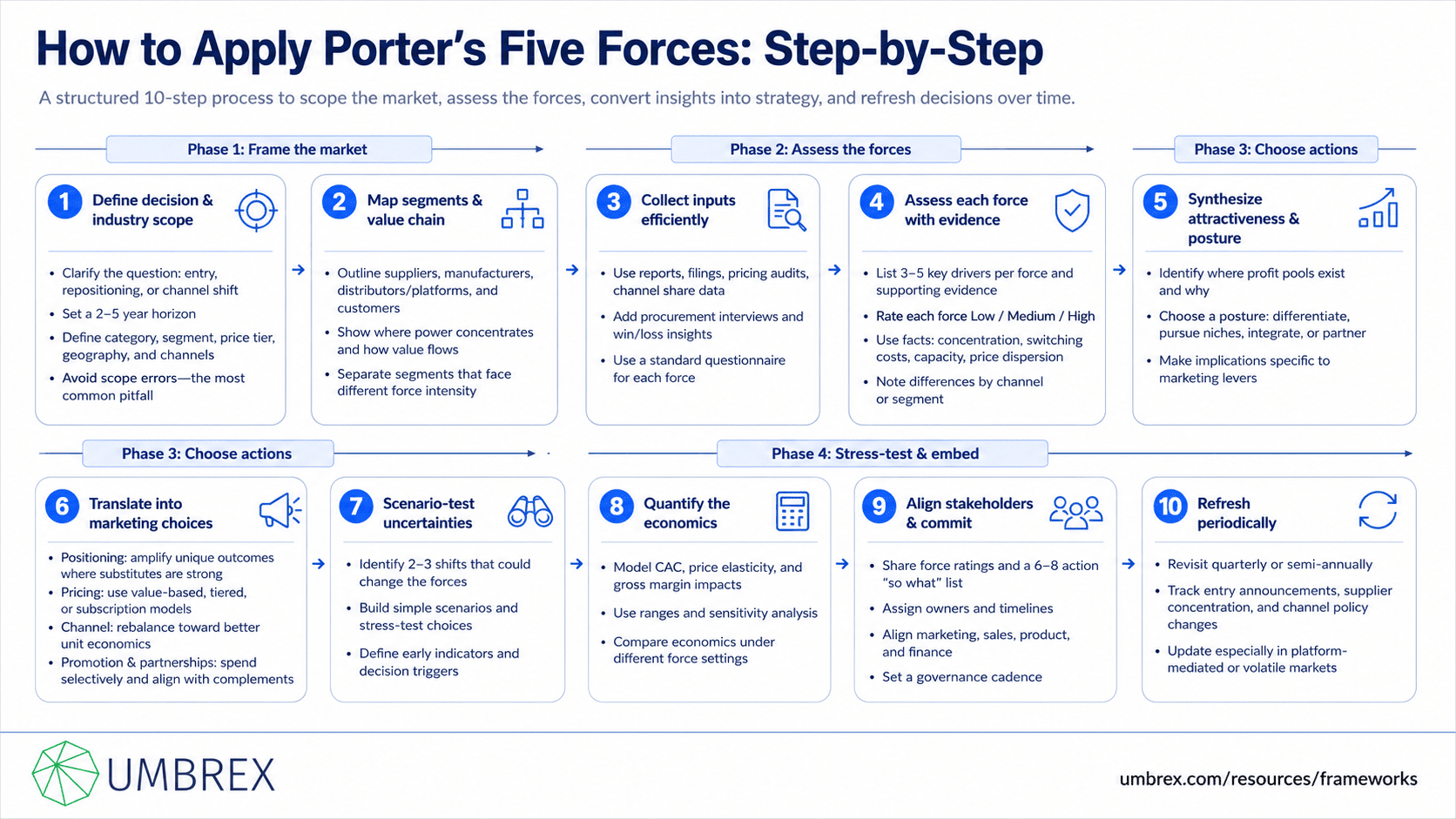
- Define the decision and industry scope
Clarify the strategic question (entry, repositioning, channel shift) and time horizon (2–5 years for most marketing strategy). Precisely define the “industry” and boundary: product category, customer segments, price tiers, geography, and channels. Misframed scope is the most common source of error.
- Map segments and value chain
Outline the end-to-end value chain: suppliers, manufacturers, distributors/platforms, and end customers. Note where power concentrates (e.g., major retailers, app stores, dominant marketplaces) and how value flows. Identify distinct customer and competitor segments that may face different force intensities.
- Collect inputs efficiently
Gather data via industry reports, regulatory filings, pricing audits, channel share data, procurement interviews, and win/loss insights. For speed, use a structured questionnaire per force to ensure completeness and comparability across segments.
- Assess each force with evidence
For each force, document 3–5 key drivers, the evidence, and your rating (e.g., Low/Medium/High). Avoid vague generalities; cite facts (concentration ratios, switching costs, capacity utilization, price dispersion). Note differences by channel or segment.
- Synthesize to industry attractiveness and strategic posture
Summarize where profit pools exist and why. Choose an initial posture: compete head-on with differentiation, pursue niche segments with weaker forces, integrate vertically, or partner to counterbalance buyer/supplier power. Ensure implications are specific to marketing levers.
- Translate into marketing choices
Convert structural insights into actions:
– Positioning: amplify unique outcomes where substitutes are strong.
– Pricing: adopt value-based or tiered pricing under high buyer power; lock in with subscriptions where appropriate.
– Channel: rebalance toward channels that dilute platform power or offer better unit economics.
– Promotion: concentrate spend where rivalry is lower or where you can create distinctiveness (e.g., communities, content).
– Partnerships: align with complements to raise switching costs and reduce acquisition costs.
- Scenario-test critical uncertainties
Identify 2–3 uncertainties that could shift forces (e.g., new regulation lowering entry barriers; a platform changing fees). Build simple scenarios and stress-test your choices. Define early indicators and decision triggers.
- Quantify the economics
Where possible, model unit economics under different force settings: customer acquisition cost (CAC) under platform fee changes, price elasticity under intensified rivalry, gross margin under supplier cost shocks. Use ranges and sensitivity analyses.
- Align stakeholders and commit
Share a concise readout: force ratings by segment, the “so what” list of 6–8 actions, and owners with timelines. Gain buy-in from marketing, sales, product, and finance. Close the loop with a governance cadence for updates.
- Refresh periodically
Revisit the assessment quarterly or semi-annually, especially in platform-mediated markets or turbulent macro conditions. Track a short set of indicators (e.g., entry announcements, supplier concentration shifts, channel policy changes).
6. Example: Five Forces in Action
Context: A $700M premium coffee chain is considering entering the ready-to-drink (RTD) canned coffee category in the U.S. grocery channel within 12 months.
Problem: Leadership wants to know whether the category is structurally attractive and, if entering, how to position and route-to-market to avoid margin erosion.
Applying Five Forces:
- Threat of New Entrants: Moderate. Co-packers and private label reduce capital barriers; however, refrigerated distribution and retailer slotting fees create hurdles. Brand equity matters. Decision: leverage brand and invest in shopper marketing to justify slotting; secure exclusive co-manufacturing capacity to slow fast followers.
- Threat of Substitutes: High. Substitutes include brewed-at-home coffee, energy drinks, and cold brew from cafes. Decision: position around “premium café-quality on-the-go” with taste and ingredient superiority; offer multi-pack pricing to reduce per-unit comparison to energy drinks.
- Bargaining Power of Buyers: High. Large retailers and marketplaces demand trade spend and have strong private label options. Decision: pursue a dual-channel strategy—selective grocery penetration plus direct-to-consumer subscription packs to diversify dependence; negotiate with retailers using traffic-driving brand data.
- Bargaining Power of Suppliers: Moderate to High. Coffee bean prices are volatile; aluminum cans and cold-chain logistics have limited suppliers. Decision: hedge commodity exposure, pre-negotiate capacity, and explore lightweight packaging variants to reduce dependence on constrained inputs.
- Rivalry: High. National brands and insurgents compete aggressively on promotions. Decision: avoid weekly price wars; focus on limited seasonal flavors, differentiated pack sizes, and retail media targeting to win specific shopper missions rather than broad discounting.
Outcome: The team concluded the category is attractive for a premium niche if they limit exposure to high-power buyers and avoid price-led rivalry. They launched with a narrow SKU set in two retailers (with exclusive flavors), maintained premium pricing, and built a D2C subscription for multipacks. Twelve months post-launch, gross margins met plan due to disciplined promotion, and the brand secured incremental end-cap features by demonstrating premium basket lift.
7. Strengths and Limitations
Strengths
- Clarifies structural economics: Moves marketing debate from tactics to the forces shaping sustainable profitability.
- Sharpens choices: Highlights where to compete (segments/channels) and how (differentiation vs. cost, partnership vs. integration).
- Common language: Aligns cross-functional teams around externally driven realities and risk management.
- Action-linked: Points to concrete levers—positioning, pricing, channel mix, partnerships—that marketers control.
Limitations
- Static snapshot: Captures a point in time; without scenarios and refreshes, it can mislead in fast-changing markets.
- Supply-side bias: Underweights demand-side dynamics like brand preference and customer lifetime value unless explicitly integrated.
- Ecosystem gaps: Original model does not include complements or platform gatekeepers; these can dominate digital markets.
- Boundary sensitivity: Results vary with how the “industry” is defined. Poor scoping leads to false conclusions.
8. Common Pitfalls (and How to Avoid Them)
- Misdefining the industry
What goes wrong: Overly broad or narrow boundaries distort force intensity.
Avoid: Specify product, customer, price tier, channel, and geography. Validate boundaries with customer and competitor behavior.
- Ignoring segments and channels
What goes wrong: Treating all buyers or rivals as homogeneous hides pockets of attractiveness.
Avoid: Rate forces by segment and channel; prioritize where forces are most favorable.
- Confusing symptoms with drivers
What goes wrong: “Margins are low” becomes both input and output.
Avoid: Anchor assessments in causal drivers (concentration, switching costs, capacity) with evidence.
- Underweighting substitutes
What goes wrong: Teams focus on direct rivals and miss cross-category switching.
Avoid: Define the customer’s job-to-be-done; map adjacent categories and DIY options.
- Overlooking complements and gatekeepers
What goes wrong: Platform fees, app-store rules, or retail media dynamics blindside plans.
Avoid: Add a “complements/gatekeepers” lens to your analysis and factor into channel and pricing strategy.
- No translation to action
What goes wrong: The output is a descriptive slide, not strategic choices.
Avoid: For each key finding, specify the marketing lever to pull, with owner and timeline.
- One-and-done analysis
What goes wrong: The environment shifts, but the strategy does not.
Avoid: Refresh quarterly or when leading indicators move; tie into planning rhythms.
9. How Porter’s Five Forces Relates to Other Frameworks
- STEEP/PESTEL (macro scan): Use STEEP/PESTEL first to identify external trends (regulation, technology, social shifts) that may alter force intensities. Then apply Five Forces to assess structural implications for profitability.
- Scenario Planning: Five Forces identifies where uncertainty matters (e.g., entry barriers dropping); scenarios test strategy robustness across different futures.
- Value Chain Analysis: Complements Five Forces by diagnosing where value is created and captured; informs vertical integration or partnership choices to counter buyer/supplier power.
- Blue Ocean Strategy: Five Forces analyzes existing industry structure; Blue Ocean focuses on creating uncontested space. Many strategies blend both: find niches with weaker forces and reshape value curves.
- SWOT: Five Forces informs “Threats” and “Opportunities.” Use it to avoid generic SWOTS by grounding them in structural facts.
- BCG Matrix and Ansoff: Portfolio and growth direction tools benefit from a Five Forces lens to evaluate the attractiveness of each option before resource allocation.
- Value Net (Brandenburger & Nalebuff): Adds complements and coopetition explicitly—use alongside Five Forces in platform or ecosystem contexts.
Choosing tools: If you are evaluating where to play and how external forces affect margins, start with Five Forces. If your primary question is “what macro changes are coming,” start with STEEP/PESTEL. In platform-heavy markets, add an ecosystem/complements lens.
10. Key Takeaways
- Porter’s Five Forces explains industry attractiveness by analyzing five external pressures on profitability.
- It is highly useful in marketing to guide positioning, pricing, channel strategy, and partnership decisions.
- Define the industry precisely and assess forces by segment/channel to find attractive profit pools.
- Translate structural insights into concrete actions—don’t stop at descriptive analysis.
- Augment with macro scans and ecosystem lenses in fast-moving, platform-mediated markets.
- Refresh regularly; the framework is a thinking aid, not a one-time answer.
11. FAQs About Porter’s Five Forces
Is Porter’s Five Forces still relevant in digital and platform markets?
Yes, but it should be adapted. Add complements and gatekeepers (platforms, app stores, retail media) to reflect ecosystem power. Pair with scenario planning and data on network effects.
How is Five Forces different from PESTEL or STEEP?
PESTEL/STEEP scans macro-environmental trends; Five Forces assesses the structural economics of a specific industry. Use PESTEL to spot change drivers, then Five Forces to understand how those drivers affect profitability and strategy.
Can small or early-stage companies use Five Forces?
Absolutely. Keep it narrow and practical: define a precise niche, assess forces for that niche, and make 4–6 clear choices (positioning, pricing, channel, partnerships). The goal is to avoid entering unwinnable battlegrounds.
How long does a robust Five Forces analysis take?
A rapid assessment can be done in 3–5 days; deeper, multi-segment analyses typically take 2–4 weeks. Focus on evidence-based ratings and actionable implications rather than encyclopedic detail.
How quantitative should the analysis be?
Qualitative logic is the foundation, but quantification strengthens decisions. Use concentration ratios, switching-cost estimates, price dispersion, and sensitivity analyses on unit economics to calibrate force intensity and test resilience.
