

1. What Is STEEP / STEEPLE Analysis?
STEEP / STEEPLE Analysis is a structured way to scan and interpret the macro-environmental forces that shape markets, customer behavior, and competitive dynamics. It is a marketing and strategy framework used to identify external drivers of change—social, technological, economic, environmental, political, legal, and ethical—that sit outside a company’s direct control yet fundamentally influence demand, availability, pricing, and perception.
In marketing, it helps leaders anticipate how shifts in demographics, regulation, technology, and broader societal expectations will impact brand positioning, go-to-market choices, product roadmaps, and communications. Consultants commonly use STEEP / STEEPLE as an early “sense-making” pass before deeper analyses, to ensure strategies are grounded in reality—not wishful thinking.
STEEP stands for Social, Technological, Economic, Environmental, and Political. STEEPLE adds Legal and Ethical as distinct lenses. The tool’s value is not in the acronym itself, but in the disciplined habits it enforces: scanning widely, prioritizing what matters, and linking external trends to marketing decisions.
2. Origin and Background
The roots of STEEP / STEEPLE lie in decades of environmental scanning practice in strategy and marketing. The best-known antecedent is PEST (Political, Economic, Social, Technological), which has been taught and used since at least the late 1960s in business schools and consulting. Over time, practitioners expanded PEST to include Environmental, Legal, and Ethical considerations—producing variants such as PESTEL/PESTLE, STEEP, and STEEPLE.
Origin: The specific “STEEP” and “STEEPLE” acronyms have no single, definitive creator. They have been in widespread use since at least the 1990s through business school curricula, managerial texts, and consulting engagement playbooks.
Why it was created: to provide a simple, shared structure for scanning external forces that are too often overlooked in internal planning, and to translate that scan into marketing strategy implications (market selection, proposition design, messaging, channel choices, risk management) and longer-range scenario thinking.
3. How STEEP / STEEPLE Analysis Works
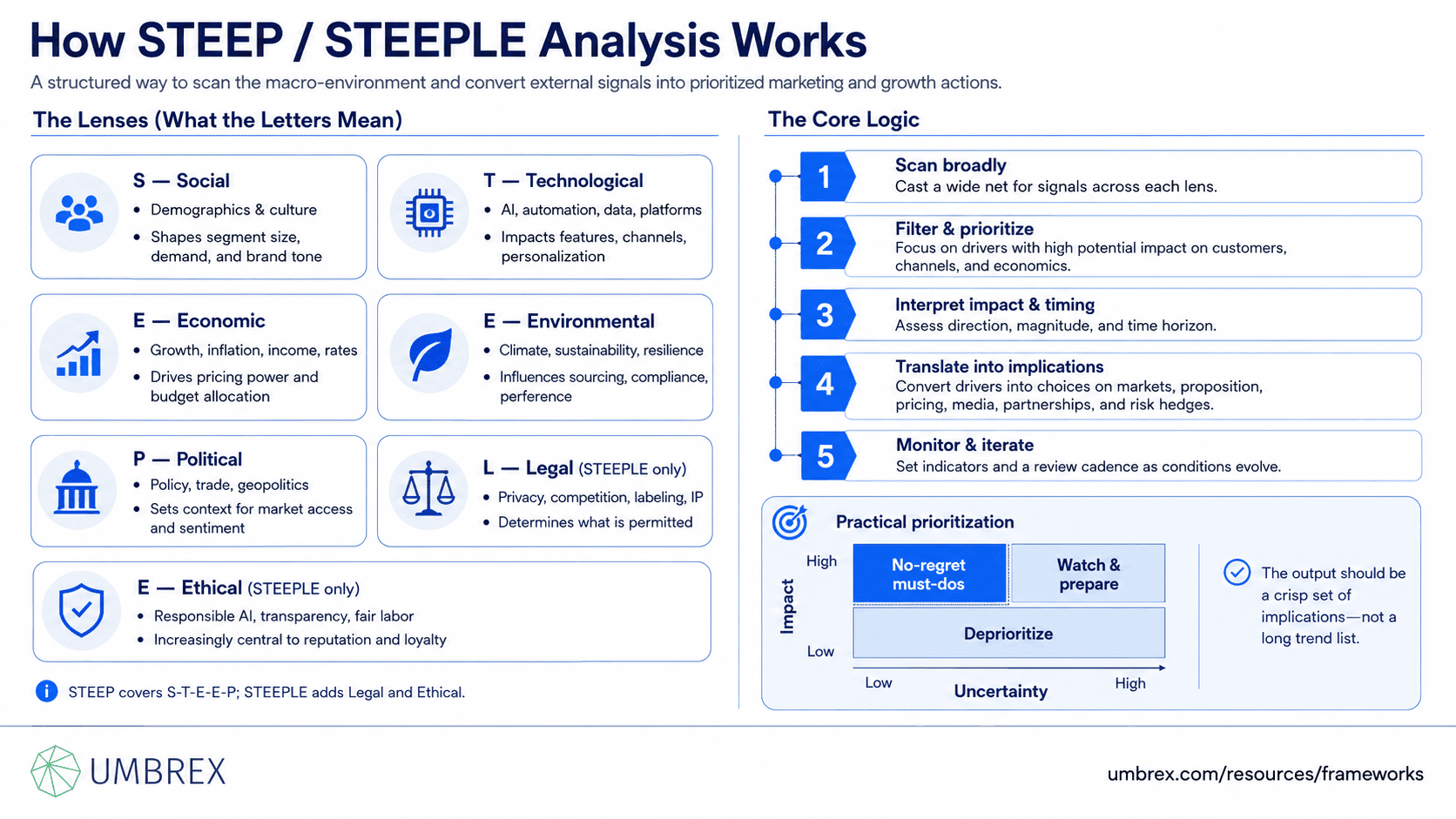
At its core, STEEP / STEEPLE is a taxonomy and a process. The taxonomy ensures coverage of the full macro-environment; the process turns observations into prioritized, actionable insights for marketing and growth decisions.
The Lenses (What the Letters Mean)
- S — Social: Demographics, cultural norms, lifestyles, attitudes, values, health and wellness trends, education, migration, and media consumption behaviors. In marketing, this often shapes segment sizes, demand drivers, sentiment, and brand tone.
- T — Technological: Enabling technologies, adoption curves, infrastructure, data and analytics, AI, automation, media platforms, and martech. Impacts product features, channels, personalization, and cost-to-serve.
- E — Economic: Growth, inflation, disposable income, employment, interest rates, exchange rates, consumer confidence, and cost structures. Drives pricing power, elasticity, and budget allocations.
- E — Environmental: Climate risks, resource constraints, sustainability expectations, circular economy, supply chain resilience, and packaging footprints. Influences brand preference, compliance, and sourcing choices.
- P — Political: Policy priorities, trade relations, public investment, geopolitical shifts, and government influence on markets. Sets the context for market access and public sentiment.
- L — Legal (STEEPLE only): Laws and regulations governing privacy, competition, consumer protection, labeling, advertising, and IP. Determines what is permitted and how to compete fairly.
- E — Ethical (STEEPLE only): Stakeholder expectations above and beyond legal requirements—privacy norms, responsible AI, fair labor, transparency, and brand purpose. Increasingly central to reputation and loyalty.
The Core Logic
STEEP / STEEPLE follows a simple logic:
- Scan broadly: Cast a wide net for signals across each lens.
- Filter and prioritize: Focus on a short list of drivers with high potential impact on customers, channels, and economics.
- Interpret impact and timing: For each driver, assess the direction, magnitude, and time horizon of its effects.
- Translate into implications: Turn prioritized drivers into concrete choices—market selection, proposition and pricing moves, media mix, partnerships, and risk hedges.
- Monitor and iterate: Establish indicators and a cadence to revisit assumptions as conditions evolve.
Practically, teams often use an impact–uncertainty matrix to separate “no-regret must-dos” (high impact, low uncertainty) from “watch and prepare” issues (high impact, high uncertainty), and “deprioritize” areas (low impact). The output is a crisp set of implications, not a long trend list.
4. When to Use STEEP / STEEPLE Analysis
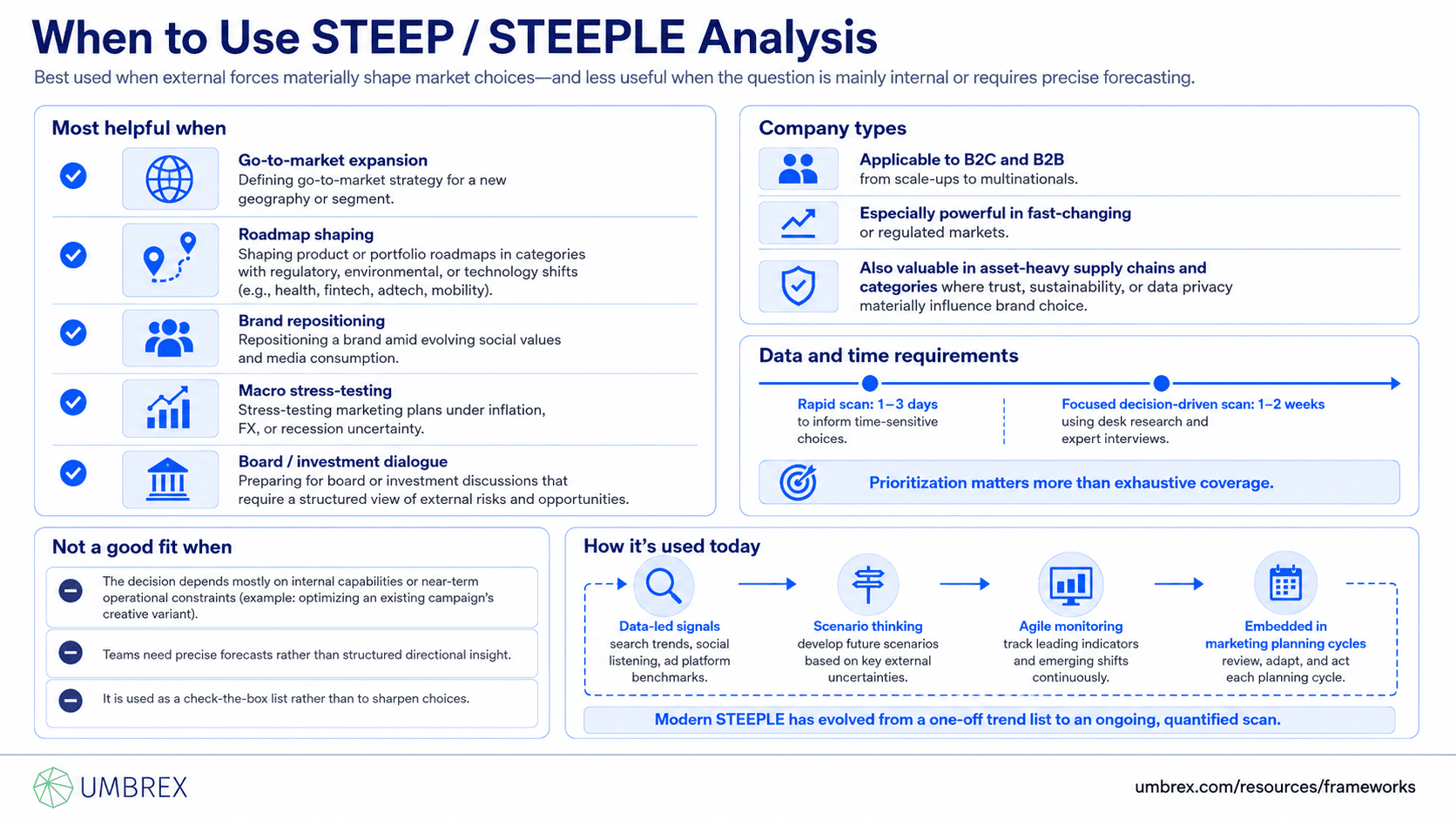
Most helpful when:
- Defining go-to-market strategy for a new geography or segment.
- Shaping product/portfolio roadmaps in categories with regulatory, environmental, or tech shifts (e.g., health, fintech, adtech, mobility).
- Repositioning a brand amid evolving social values and media consumption.
- Stress-testing marketing plans under macroeconomic uncertainty (inflation, FX, recession risk).
- Preparing for board or investment discussions requiring a structured view of external risks and opportunities.
Company types: Applicable to B2C and B2B, from scale-ups to multinationals. Especially powerful for companies in fast-changing or regulated markets, asset-heavy supply chains, or categories where trust, sustainability, or data privacy are material to brand choice.
Data and time requirements: A focused, decision-driven STEEPLE can be completed in 1–2 weeks with desk research and expert interviews; a rapid version can be done in 1–3 days to inform time-sensitive choices. The key is prioritization, not exhaustive coverage.
Not a good fit when:
- The decision depends almost entirely on internal capabilities or near-term operational constraints (e.g., optimizing an existing campaign’s creative variant).
- Teams seek precise forecasts rather than structured directional insight. STEEPLE guides judgment; it does not predict exact outcomes.
- Used as a check-the-box list rather than a tool to sharpen choices; it becomes noise rather than signal.
How it’s used today: Modern practitioners integrate STEEPLE with data-led signals (search trends, social listening, ad platform benchmarks), scenario-thinking, and agile monitoring. The framework remains relevant, but the practice has shifted from static one-off slides to ongoing, quantified scans embedded in marketing planning cycles.
5. How to Apply STEEP / STEEPLE: Step-by-Step
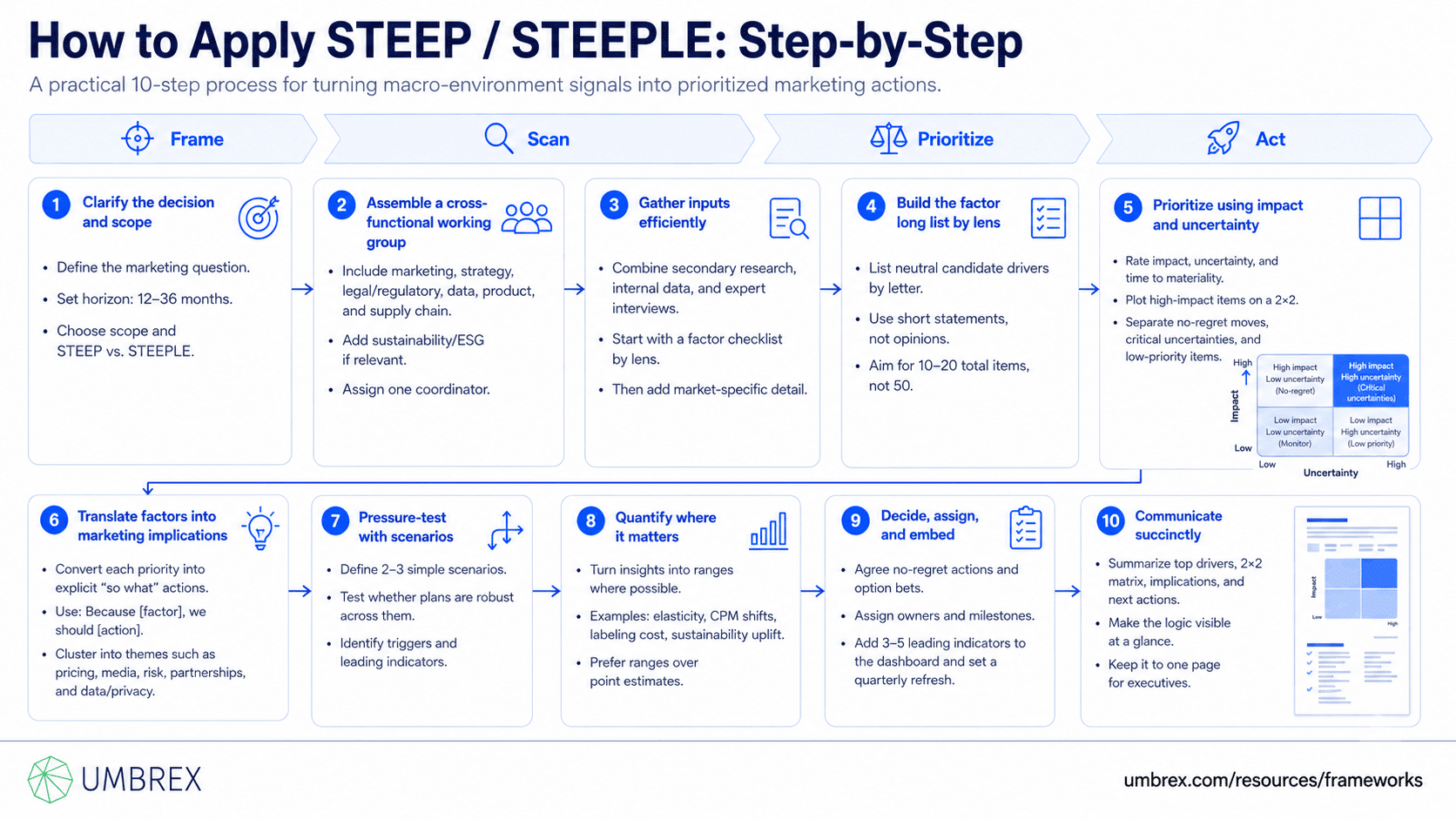
- Clarify the decision and scope
Define the marketing question you must answer (e.g., “Should we enter Market X in the next 18 months?” or “How should we reposition Brand Y for Gen Z?”). Set the time horizon (12–36 months for most marketing strategy) and level of analysis (global, regional, or specific country; category vs. subcategory). Decide whether to use STEEP or STEEPLE—if legal and ethical issues are material (data privacy, health claims, sustainability), use STEEPLE.
- Assemble a cross-functional working group
Include marketing, strategy, regulatory/legal, data/insights, product, supply chain, and, if relevant, sustainability/ESG. Assign one coordinator. This improves coverage and ensures implications translate into actions across the funnel and supply chain.
- Gather inputs efficiently
Use a mix of secondary research (industry reports, government publications, analyst notes, platform trend data), internal data (sales, pricing, churn, brand trackers), and expert interviews (e.g., regulatory counsel, channel partners). For speed, start with a pre-built factor checklist per lens, then layer market-specific detail.
- Build the factor long list by lens
For each letter, list candidate drivers as short, neutral statements (e.g., “Rising sugar taxes,” “Shift to short-form video,” “Tight labor market for pharmacists”). Avoid opinions at this stage. Aim for 10–20 items total across lenses—not 50.
- Prioritize using impact and uncertainty
For each factor, rate:
– Impact on the decision area (High/Medium/Low) with rationale.
– Uncertainty over the planning horizon (High/Medium/Low).
– Time to materiality (Now/12 months/24+ months).
Plot high-impact items on a simple 2×2 (Impact vs. Uncertainty). This separates:
- High impact, low uncertainty: No-regret moves to incorporate immediately.
- High impact, high uncertainty: Critical uncertainties to monitor and scenario-plan.
- Medium/low impact: Track lightly or park to avoid distraction.
- Translate factors into marketing implications
For each prioritized factor, write explicit “so what” statements. Use a standard template:
“Because [factor], we should [action] to achieve [outcome], by [owner] within [timeframe].”
Cluster implications into themes (e.g., “Proposition & Pricing,” “Channel & Media,” “Reputation & Risk,” “Partnerships,” “Data & Privacy”). This forces clarity and creates an action backlog.
- Pressure-test with scenarios
For 2–3 high-impact uncertainties, outline simple scenarios (e.g., “Privacy Tightens,” “Inflation Persists,” “Packaging Regulation Accelerates”). Test whether your marketing plan is robust across them. Identify trigger points and leading indicators that would shift your stance.
- Quantify where it matters
Convert qualitative insights into numbers where possible: elasticity ranges under inflation, expected CPM shifts from platform policy changes, cost impact of new labeling, or uplift from sustainability claims. Use ranges rather than single-point estimates.
- Decide, assign, and embed
Agree the set of no-regret actions and option bets, assign owners, and set milestones. Embed 3–5 leading indicators into your marketing dashboard (e.g., regulatory tracker, search interest, platform policy updates, consumer confidence index). Establish a quarterly refresh cadence.
- Communicate succinctly
Summarize on one page: top 5 drivers, impact–uncertainty matrix, 6–8 implications, and next actions. Busy executives should be able to see the logic at a glance.
6. Example: STEEPLE in Action
Context: A $1.2B global consumer beverages company is considering launching a plant-based ready-to-drink (RTD) protein shake in two European markets within 18 months.
Problem: Leadership needs to decide whether to launch, how to position, and which channels to prioritize, amid shifting regulations on nutrition claims, sustainability expectations, and rising media costs.
Applying STEEPLE:
- Social: Growing fitness and wellness culture; increased interest in high-protein diets; sensitivity to ultra-processed foods. Implication: Emphasize clean-label credentials, visible protein content, and functional benefits with simple ingredient storytelling.
- Technological: Retail media networks scaling; short-form video dominant; rapid innovation in recyclable packaging. Implication: Shift 20–30% of launch budget to retail media; develop creator partnerships; pilot lightweight recyclable bottles.
- Economic: Inflation pressuring disposable income; private label gaining share. Implication: Offer trial sizes and subscription bundles; design price-pack architecture with good-better-best tiers.
- Environmental: Strong consumer preference for low-footprint packaging; retailer mandates on recyclability. Implication: Use recycled content and display carbon footprint; secure retailer approvals pre-launch.
- Political: EU-level policy focus on healthy diets; local incentives for sustainable packaging innovation. Implication: Pursue co-funded pilots with retailers and apply for packaging grants.
- Legal: Stricter rules on nutrition and health claims; front-of-pack labeling requirements. Implication: Pre-clear claims with legal; align copy with regulatory standards to avoid reformulation or relabeling costs.
- Ethical: Expectations for transparent sourcing and fair labor; scrutiny of greenwashing. Implication: Publish sourcing standards; third-party certifications; conservative sustainability claims backed by data.
Outcome: The team identified five no-regret moves (clean-label positioning, recyclable packaging, retail media focus, claim pre-clearance, ethical sourcing transparency) and two option bets (premium line for fitness specialists; D2C subscription test). Launch proceeded in one market first to de-risk labeling compliance and supply. Early results showed above-plan trial and strong retailer support, validating the STEEPLE-led choices.
7. Strengths and Limitations
Strengths
- Comprehensive yet simple: Ensures wide environmental coverage without overcomplicating.
- Sharpens strategic conversations: Forces prioritization and explicit “so what” implications for marketing.
- Creates a common language: Aligns cross-functional teams around external realities and risks.
- Flexible and scalable: Useful for rapid assessments or in-depth pre-work for scenarios and market entry cases.
Limitations
- Can become a laundry list: Without prioritization, it degenerates into a trend catalog that doesn’t inform choices.
- Static snapshot risk: One-off analyses age quickly in volatile contexts; ongoing monitoring is required.
- Subjectivity: Impact ratings can reflect biases; triangulation and external benchmarks are essential.
- Not predictive: It structures thinking but does not forecast; overreliance can create false certainty.
8. Common Pitfalls (and How to Avoid Them)
- Misdefining the decision
What goes wrong: Teams scan too broadly and produce generic insights.
Avoid: Frame a specific marketing decision with time horizon and geography. Use it to filter factors ruthlessly.
- Confusing macro and micro
What goes wrong: Internal issues (e.g., creative fatigue) get mixed into external scanning.
Avoid: Only include forces outside your control; address internal issues elsewhere (e.g., marketing effectiveness review).
- Overstuffing the list
What goes wrong: 40+ factors overwhelm decision-makers.
Avoid: Cap to 10–20 items; focus on high-impact, time-relevant drivers.
- No translation to action
What goes wrong: Insight without implications yields inertia.
Avoid: For each priority factor, write a clear action statement with owner and timeline.
- Ignoring uncertainty
What goes wrong: Plans assume one future; surprises force expensive pivots.
Avoid: Use impact–uncertainty mapping and simple scenarios; define triggers and contingencies.
- One-and-done mindset
What goes wrong: The scan becomes obsolete as conditions change.
Avoid: Set quarterly refreshes and track 3–5 leading indicators in dashboards.
- Underweighting Legal and Ethical
What goes wrong: Late-stage compliance issues derail campaigns or products.
Avoid: Use STEEPLE when privacy, claims, or sustainability are material; involve legal early.
- Bias toward the news cycle
What goes wrong: Overreacting to headlines; missing slow-moving structural shifts.
Avoid: Balance short-term signals with multi-year trends and structural data.
9. How STEEP / STEEPLE Relates to Other Frameworks
- Porter’s Five Forces: Use Five Forces to assess industry structure and competitive pressures; use STEEPLE first to understand broader contextual drivers that may shift those forces (e.g., regulation altering barriers to entry).
- SWOT: STEEPLE informs the “Opportunities” and “Threats” in SWOT. The external scan feeds a more grounded SWOT that avoids generic, unprioritized items.
- Scenario Planning: STEEPLE is a feeder for scenario design, identifying the critical uncertainties that define scenarios. Scenario planning then tests strategy robustness across them.
- Segmentation and JTBD (Jobs-to-be-Done): Use STEEPLE to identify macro shifts in needs and values; then apply segmentation/JTBD to define target customers and propositions within that context.
- Go-to-Market Playbooks and Growth Loops: STEEPLE provides the environmental guardrails for channel choice, acquisition economics, and experimentation rhythms.
- Risk Registers and Compliance Frameworks: Legal and ethical insights from STEEPLE often translate into enterprise risk items and compliance requirements; coordinate to ensure consistency.
Choice vs. overlap: PEST, PESTLE, STEEP, and STEEPLE are functional equivalents with different emphases. Choose STEEPLE when legal and ethical issues are material to marketing success; use a lighter-weight STEEP when speed matters and those issues are peripheral. They can be combined sequentially with deeper tools (Five Forces, scenarios) for a full picture.
10. Key Takeaways
- STEEP / STEEPLE is a disciplined macro-environment scan that anchors marketing strategy in external reality.
- Use STEEPLE when legal and ethical factors could materially affect brand, data, claims, or channel choices; use STEEP for faster scans.
- The power lies in prioritization and translation into actions—not in listing trends.
- Combine impact–uncertainty mapping with simple scenarios to build robust plans and clear contingencies.
- Embed a refresh cadence and leading indicators; one-off scans go stale quickly in volatile markets.
- Best used as a first-pass sense-making tool that feeds deeper analyses (e.g., Five Forces, segmentation, scenario planning).
11. FAQs About STEEP / STEEPLE
Is STEEP / STEEPLE still relevant today?
Yes. If anything, volatility in regulation, technology, and social expectations makes structured external scanning more important. The modern twist is integrating real-time signals and refreshing regularly, rather than treating it as a static exercise.
What’s the difference between STEEP, STEEPLE, PEST, and PESTLE?
They’re variants of the same idea. PEST covers Political, Economic, Social, Technological. PESTLE/PESTEL and STEEP add Environmental; STEEPLE adds Legal and Ethical explicitly. Use the variant that best fits your decision—if compliance and reputation are central, choose STEEPLE.
Can small or early-stage companies use STEEPLE?
Absolutely. Keep it lightweight: 8–12 high-impact factors, 1–2 hours of desk research, and a short workshop to define implications. The goal is clarity on the few external drivers that matter for your next set of moves.
How long does a practical STEEPLE take?
A rapid version can be done in 1–3 days to inform a decision. A robust version with expert input, quantification, and scenarios typically takes 1–2 weeks. Enterprise-wide scans can take longer but should still strive for focus.
How do we quantify a largely qualitative framework?
Translate priority factors into ranges for key KPIs: price elasticity under inflation, expected CPM changes from platform policies, compliance cost per unit, or adoption curves for new channels. Use ranges and sensitivity tests, not single-point forecasts.
