

1. What Is SWOT Analysis?
SWOT Analysis is a simple, structured way to evaluate a business, product, or initiative across four lenses: Strengths, Weaknesses, Opportunities, and Threats. It helps leaders link internal realities (what we’re good at, where we’re constrained) to external conditions (where the market is opening up, where risks are rising), and then make better choices.
Within Marketing—and especially in external and competitive analysis—SWOT is often used to synthesize a fact base into a single view that senior teams can align around. It is a staple in consulting because it provides a common language to converge diverse inputs (customer insights, competitor moves, capabilities, financials) into a decision-oriented picture.
Although the framework spans internal and external elements, its primary purpose in competitive analysis is to make the outside-in view (opportunities and threats) actionable by connecting it to what the organization can realistically leverage or must fix (strengths and weaknesses).
2. Origin and Background
Origin: Disputed; in use since at least the 1960s. SWOT is frequently associated with work at the Stanford Research Institute and with management educator Albert Humphrey, but the exact authorship and chronology are not definitive.
Why it was created: managers needed a concise way to summarize complex strategic diagnostics and translate them into choices. SWOT’s quadrant structure was designed to surface contrasts and trade-offs without requiring heavy analytical machinery.
How it became widely known: through business school curricula, classic strategy texts, and extensive use in consulting, corporate planning, and marketing workshops. Its accessibility—whiteboard-friendly and cross-functional—fueled its adoption.
3. How SWOT Analysis Works
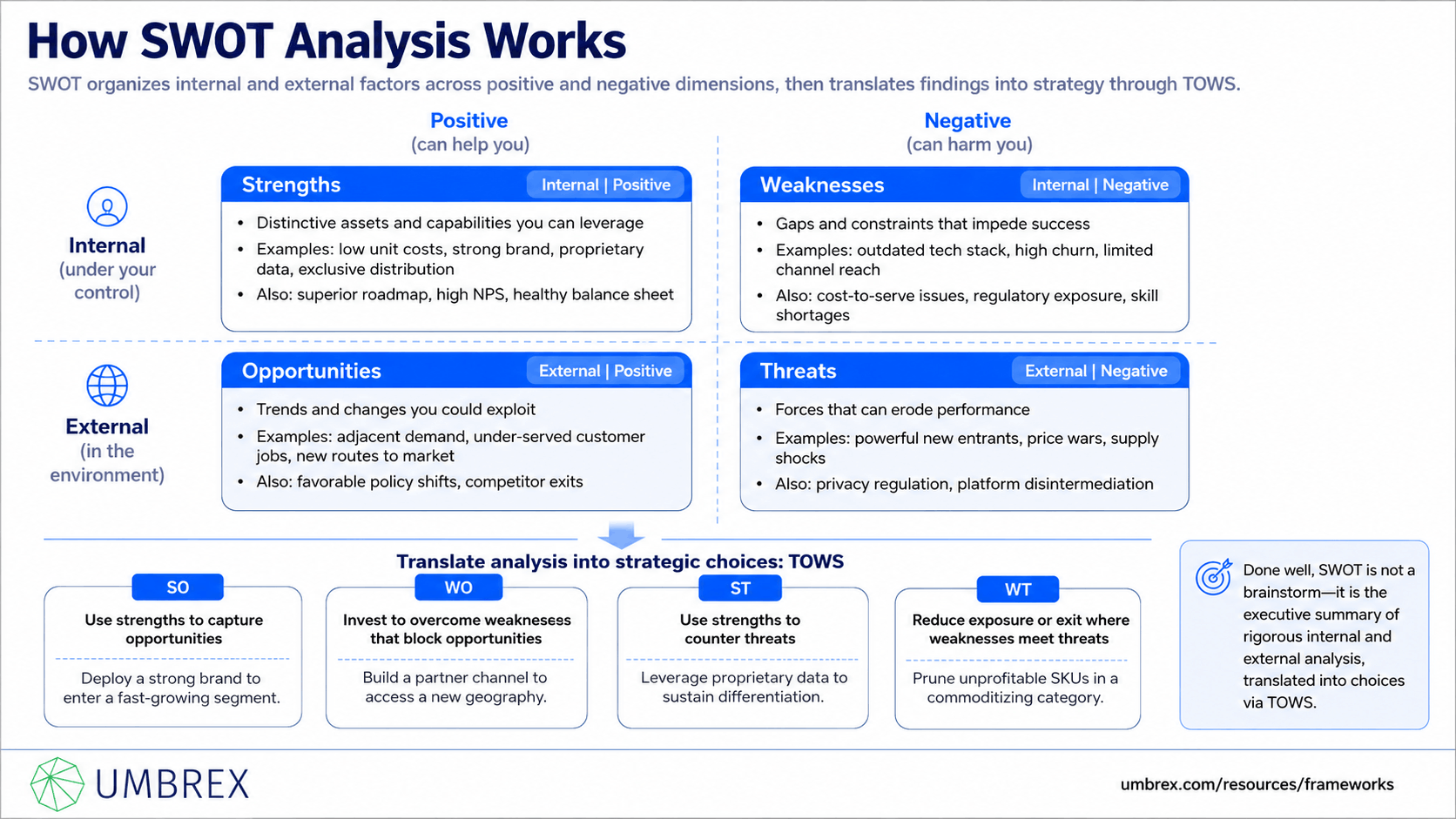
SWOT is a 2×2 structure with four quadrants. The top half is internal (under your control). The bottom half is external (in the environment). The left side is positive (can help you). The right side is negative (can harm you).
- Strengths (Internal, Positive)
- Distinctive assets, capabilities, relationships, and performance advantages you can leverage.
- Examples: low unit costs, strong brand equity, proprietary data, exclusive distribution, superior product roadmap, high NPS, healthy balance sheet.
- Weaknesses (Internal, Negative)
- Capability gaps, structural constraints, and performance deficits that impede success.
- Examples: outdated tech stack, high churn, limited channel reach, cost-to-serve issues, regulatory exposure, skill shortages.
- Opportunities (External, Positive)
- Trends, segments, and changes in technology/regulation/consumer behavior that you could exploit.
- Examples: adjacent demand, under-served customer jobs, new distribution routes, favorable policy shifts, competitor exits.
- Threats (External, Negative)
- Competitive moves, macro or industry forces, and disruptive technologies that can erode performance.
- Examples: powerful new entrants, price wars, supply shocks, privacy regulation, platform disintermediation.
The logic is to populate each quadrant with evidence-based bullets and then synthesize to strategy. A useful extension is the TOWS matrix, which matches quadrants to generate strategic options:
- SO (Strength–Opportunity): Use strengths to capture opportunities (e.g., deploy a strong brand to enter a fast-growing segment).
- WO (Weakness–Opportunity): Invest to overcome weaknesses that block opportunities (e.g., build a partner channel to access a new geography).
- ST (Strength–Threat): Use strengths to counter threats (e.g., leverage proprietary data to maintain differentiation against fast followers).
- WT (Weakness–Threat): Reduce exposure or exit where weaknesses meet threats (e.g., prune unprofitable SKUs in a commoditizing category).
Done well, SWOT is not a brainstorm; it is the executive summary of a rigorous external and internal analysis, translated into choices via TOWS.
4. When to Use SWOT Analysis
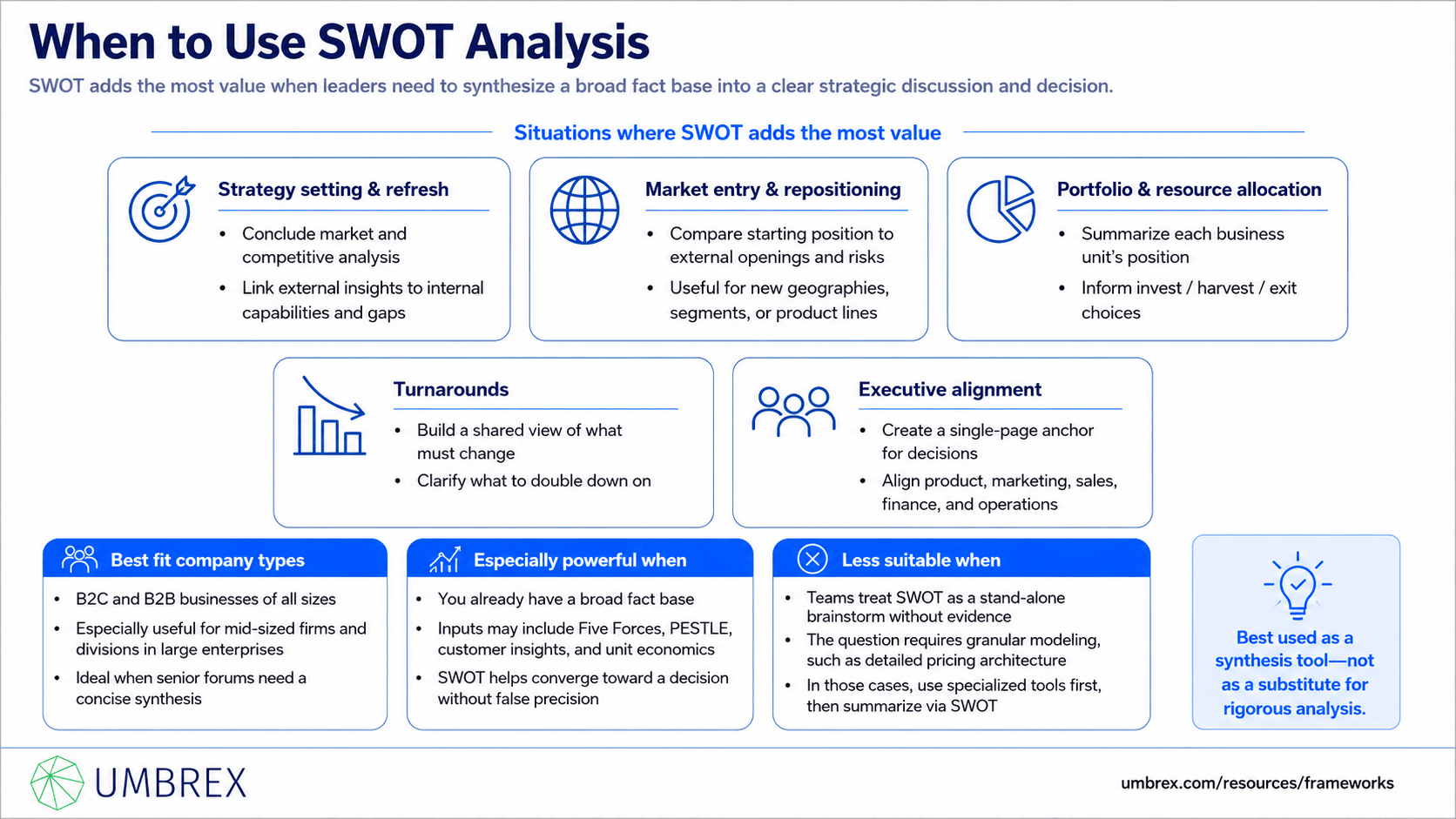
Situations where SWOT adds the most value:
- Strategy setting and refresh: Concluding a market and competitive analysis by connecting insights to capabilities and gaps.
- Market entry and repositioning: Comparing your starting position to external openings and risks for a new geography, segment, or product line.
- Portfolio and resource allocation: Summarizing each business unit’s position to inform invest/harvest/exit decisions.
- Turnarounds: Creating a clear, shared view of what must change versus what to double down on.
- Executive alignment: Building a single page that anchors decisions across product, marketing, sales, finance, and operations.
Company types: B2C and B2B businesses of all sizes. Particularly helpful for mid-sized firms and divisions in large enterprises that need a concise synthesis for senior forums.
Especially powerful when: You have a broad fact base (e.g., Five Forces, PESTLE, customer insights, unit economics) and need to converge on a decision. SWOT forces clarity without false precision.
Less suitable when: Teams treat it as a stand-alone brainstorm without evidence, or when questions require granular modeling (e.g., detailed pricing architecture). In those cases, use specialized tools first, then summarize via SWOT.
5. How to Apply SWOT Analysis: Step-by-Step
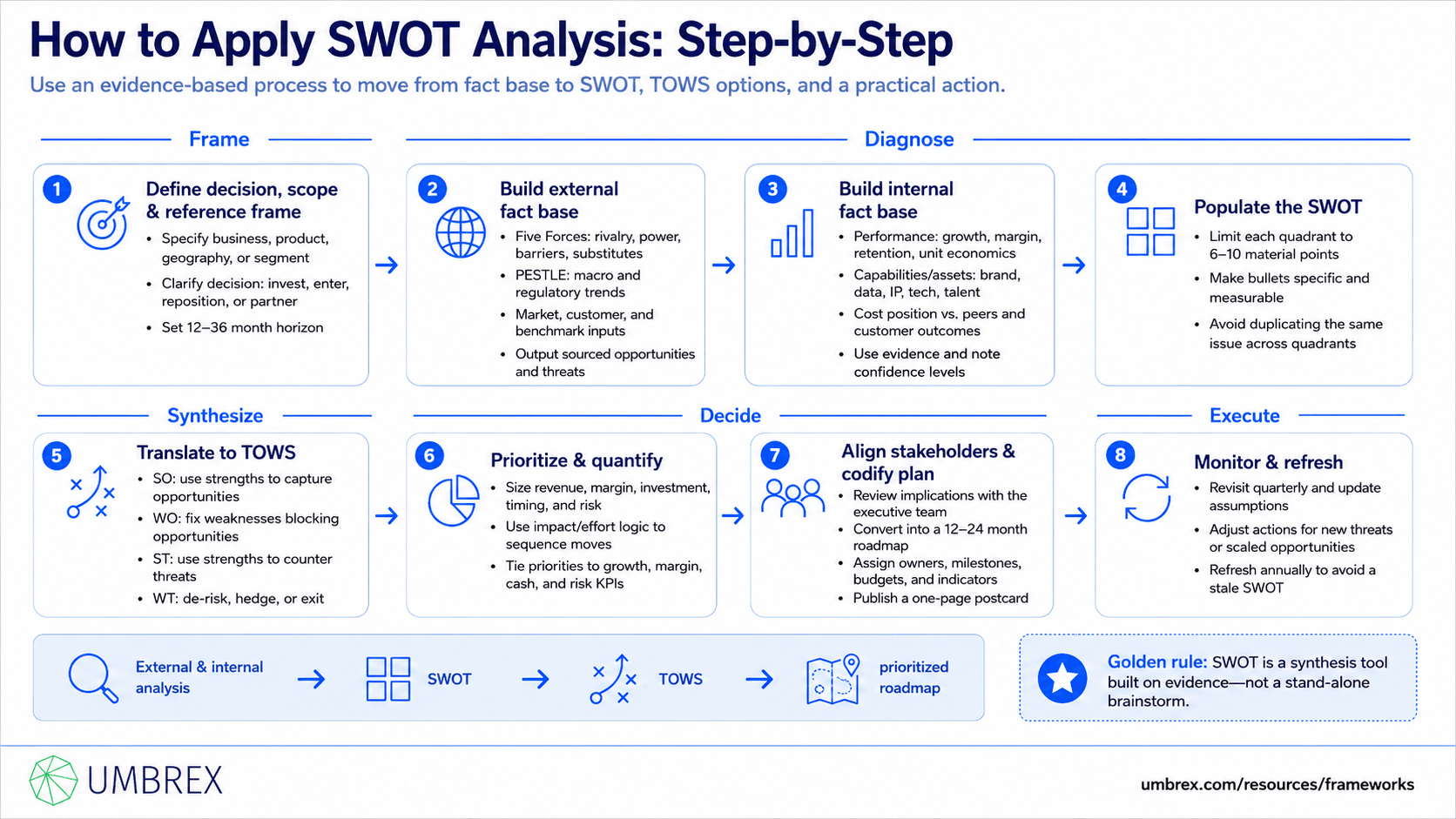
- Define the decision, scope, and reference frame.
Be explicit: Which business, product, geography, or segment are you analyzing? What decision must this inform (e.g., invest, enter, reposition, partner)? Over what time horizon (12–36 months)? Clarity on scope keeps the SWOT focused and comparable.
- Build the external fact base (for O and T).
Conduct targeted analyses:
- Competitive structure: Porter’s Five Forces to understand rivalry, supplier/buyer power, entry barriers, and substitutes.
- Macro and regulatory: PESTLE for political, economic, social, technological, legal, environmental trends.
- Market and customer: Growth, segmentation, willingness-to-pay, decision drivers, switching costs.
- Benchmarks: Price, service levels, distribution reach, product/feature comparisons.
Summarize opportunities and threats with specific, sourced bullets.
- Build the internal fact base (for S and W).
Assess capabilities and economics:
- Performance: Revenue growth, margins, price realization, churn/retention, unit economics.
- Capabilities and assets: Brand equity, data, IP, technology stack, partnerships, talent, operations.
- Cost position: Experience curves, productivity, cost-to-serve versus peers.
- Customer outcomes: NPS/CSAT, adoption, time-to-value, case studies.
Use evidence rather than opinions; note confidence levels.
- Populate the SWOT with evidence-based bullets.
Limit each quadrant to the 6–10 most material points. Make bullets specific and measurable where possible (e.g., “Net retention 114% in enterprise segment” rather than “Strong customer loyalty”). Avoid duplicating the same idea across quadrants.
- Translate to strategy using a TOWS matrix.
Create a 2×2 that pairs quadrants to generate options:
- SO: “How do we exploit top opportunities with our distinctive strengths?”
- WO: “Which weaknesses must we fix to unlock the best opportunities?”
- ST: “How can we use our strengths to neutralize the biggest threats?”
- WT: “Where should we de-risk, hedge, or exit given weaknesses and threats?”
Prioritize 3–5 options with owners, timing, and rough economics.
- Prioritize and quantify.
Pressure-test options with quick sizing: revenue/margin potential, investment, time-to-impact, risk. Use a simple impact/effort matrix to sequence moves. Tie priorities to enterprise KPIs (growth, margin, cash, risk).
- Align stakeholders and codify the plan.
Socialize the SWOT and TOWS-derived roadmap with the executive team. Convert into a 12–24 month plan with milestones, budgets, and leading indicators. Publish a one-page “postcard” for broad alignment.
- Monitor and refresh.
Revisit quarterly to check assumptions and update for market moves. Adjust actions when new threats emerge or opportunities scale. An annual refresh helps prevent drift into a generic, stale SWOT.
6. Example: SWOT Analysis in Action
Company: A $450M B2B SaaS provider of workflow automation tools expanding into the healthcare vertical.
Problem: Growth in core horizontal markets was slowing. Healthcare showed strong demand, but the firm faced entrenched competitors, complex regulation, and a fragmented buyer landscape. The CEO needed a crisp view of whether to enter and how.
Applying SWOT:
- Scope: U.S. healthcare provider segment (IDNs and large hospitals), 24–36 month horizon.
- External fact base: Five Forces highlighted high buyer power and strong regulatory barriers. PESTLE flagged rising compliance (HIPAA, HITRUST), favorable digitization funding, and labor shortages driving automation interest.
- Internal fact base: Strengths included a scalable platform, strong enterprise security, and proven integrations with leading EHRs via partners. Weaknesses included limited healthcare-specific features, small vertical sales team, and no relevant certifications.
SWOT highlights:
- Strengths: Enterprise-grade security (SOC 2 Type II), robust workflow engine, strong ecosystem partnerships, 118% net revenue retention in enterprise accounts.
- Weaknesses: No HITRUST certification, limited healthcare references, nascent channel in healthcare, slow professional services capacity.
- Opportunities: Federal funding for care automation, acute labor shortages increasing ROI for automation, competitor focus on revenue cycle leaving clinical workflows under-served.
- Threats: EHR vendors bundling basic automation, procurement cycles >12 months, new data privacy rules and breach penalties.
TOWS-derived options:
- SO: Leverage security strength and workflow engine to target under-served clinical workflows; launch with two lighthouse IDNs.
- WO: Invest in HITRUST certification and hire a healthcare solutions team; co-develop 3 reference implementations.
- ST: Deepen partnerships with EHR vendors to pre-empt bundling threat; deliver deeper integrations that EHRs won’t prioritize.
- WT: Avoid SMB provider segment initially (long sales cycles, price pressure); deploy a deal desk to control discounting.
Decisions and actions: Commit $8M over 18 months to certification, vertical sales, and services. Launch a healthcare solutions package, co-market with two partners, and design a reference program. Establish price guardrails and a health vertical PMM function.
Results (12 months): Closed 6 lighthouse deals with 3 marquee references; price realization +140 bps vs. initial deal assumptions; services utilization up 20 points; healthcare pipeline 3.5x QoQ. The quarterly refresh retired threats related to EHR bundling for targeted workflows due to deeper integration wins.
7. Strengths and Limitations
Strengths
- Clarity and alignment: One page that integrates internal and external realities; accelerates executive decisions.
- Versatility: Works at business, product, market, or initiative level; equally useful in entry, growth, or turnaround contexts.
- Bridge to action: The TOWS extension naturally generates strategic options and sequenced moves.
- Accessible: Easy to socialize across functions and with partners; fosters shared language.
Limitations
- Risk of superficiality: Without a fact base, lists become generic platitudes.
- Static snapshot: Does not capture dynamics (competitor reactions, regulation shifts) unless refreshed and paired with scenarios.
- Subjectivity and bias: Internal views can overstate strengths and understate weaknesses; external threats can be downplayed.
- No inherent prioritization: The framework does not weight items; teams must impose prioritization and quantify impact.
8. Common Pitfalls (and How to Avoid Them)
- Brainstorming without evidence.
What goes wrong: Lists become generic (“great team,” “big market”).
How to avoid: Require data citations (benchmarks, KPIs, customer quotes) for each material bullet.
- Mixing internal and external.
What goes wrong: Threats listed as weaknesses (e.g., “price pressure”) or strengths listed as opportunities.
How to avoid: Enforce definitions: S/W are controllable; O/T are environmental.
- Overlong lists with no prioritization.
What goes wrong: Signal is buried; actions don’t follow.
How to avoid: Cap each quadrant at 6–10 items; bold top 3 and tie them to actions.
- Vague language.
What goes wrong: Non-specific claims can’t guide decisions.
How to avoid: Be precise: “Gross margin 600 bps above peer median” beats “strong margins.”
- Ignoring competition and economics.
What goes wrong: Underestimates threats; misses profit migration.
How to avoid: Pair with Five Forces and profit pool mapping; quantify price realization and cost-to-serve.
- No link to choices.
What goes wrong: SWOT sits in a deck; nothing changes.
How to avoid: Always follow with TOWS options, owners, timing, and KPIs.
- One-and-done usage.
What goes wrong: Snapshot gets stale as conditions shift.
How to avoid: Refresh quarterly; add scenario triggers to watch list.
9. How SWOT Analysis Relates to Other Frameworks
- Porter’s Five Forces: Use Five Forces for a deep external assessment of industry structure. Feed key insights into Opportunities and Threats in SWOT; use SWOT to connect them to your specific strengths and weaknesses.
- PESTLE: PESTLE identifies macro drivers (regulation, technology, economy). These typically populate the Opportunities and Threats quadrants and frame scenario planning.
- VRIO/Resource-Based View: VRIO assesses whether capabilities are a source of sustained advantage. Use it to validate which Strengths are truly distinctive and defensible.
- Value Chain and Cost Curves: These quantify operational advantages and bottlenecks; they inform Strengths/Weaknesses with evidence on cost position and process excellence.
- Profit Pool Mapping: Reveals where profits accrue; pairs with SWOT to ensure Opportunities are economically attractive and Threats are real to your P&L.
- Strategic Group Mapping: Clarifies competitor archetypes; enriches SWOT by making Threats/Opportunities segment-specific.
- TOWS Matrix: The action engine for SWOT. It converts the four lists into concrete strategic options (SO/WO/ST/WT) and prioritization.
- Route-to-Market (RTM) Design: After SWOT highlights channel-related Opportunities/Threats, RTM prescribes channel architecture, incentives, and logistics.
Choosing among tools: If you need a comprehensive external diagnosis, start with Five Forces and PESTLE. If you need to connect external insights to internal realities and decide what to do, use SWOT plus TOWS. If you need to operationalize channel or capability choices, move to RTM, value chain, or VRIO.
10. Key Takeaways
- SWOT Analysis synthesizes internal strengths/weaknesses with external opportunities/threats to inform strategic choices.
- It is most powerful when fed by rigorous external analysis (Five Forces, PESTLE) and internal economics, not brainstorming.
- Use TOWS to convert SWOT into actions: leverage strengths, fix critical weaknesses, counter threats, and avoid value traps.
- Keep it specific and prioritized; limit each quadrant to the most material, evidence-backed points.
- Refresh regularly—SWOT is a snapshot in a moving market; pair with scenarios and clear KPIs.
11. FAQs About SWOT Analysis
Is SWOT Analysis still relevant today?
Yes—when used as a synthesis tool, not a substitute for analysis. Modern practice pairs SWOT with Five Forces, PESTLE, and unit economics, then uses TOWS to generate concrete actions with owners and KPIs.
What’s the difference between SWOT and TOWS?
SWOT organizes insights into four quadrants. TOWS is a follow-on step that cross-maps those quadrants (SO/WO/ST/WT) to generate and prioritize strategies. SWOT without TOWS risks being a static list.
How much data do we need to do SWOT well?
Enough to be specific: competitor benchmarks, customer evidence (win–loss, NPS), basic economics (margins, cost-to-serve), and macro trends. You don’t need perfect precision—directionally correct and sourced beats exhaustive but late.
Can small or early-stage companies use SWOT?
Absolutely. Keep the scope tight (one product/segment), ground bullets in customer interviews and simple benchmarks, and prioritize 2–3 moves from a TOWS exercise. Revisit monthly as you learn.
How long does a meaningful SWOT take?
A focused effort typically takes 1–2 weeks if you leverage existing analysis. A more robust version (with external interviews and deeper benchmarking) can take 3–6 weeks, often as the synthesis phase of a broader strategy project.
How do we avoid bias in SWOT?
Use external benchmarks, require evidence for each bullet, include contrarian reviews, and involve cross-functional leaders. Mark confidence levels and call out assumptions explicitly.
