

1. What Is Scenario Planning?
Scenario Planning is a structured method for imagining multiple plausible futures and testing how your strategy performs under each. Instead of betting on a single forecast, you develop a small set of divergent “scenarios” that explore how critical uncertainties could unfold, then design robust strategies, contingency plans, and early warning indicators accordingly.
In plain terms: it’s a disciplined way to prepare for uncertainty. You identify the external forces that matter (regulation, technology, macroeconomics, geopolitics, climate, consumer behavior), select the most uncertain and impactful ones, and construct contrasting narratives (e.g., “Fast adoption with low capital costs” vs. “Policy drag with high rates”). You then stress-test your choices in those worlds and define options that create advantage across the spread of outcomes.
Scenario Planning is a market, portfolio, and environmental analysis framework. It is widely used by consultants and executives to inform long-range strategy, capital allocation, risk management, and M&A—particularly in volatile or regulated environments where single-point forecasts are brittle.
2. Origin and Background
Origin: Intellectual roots trace to military and policy analysis (e.g., Herman Kahn at RAND/Hudson Institute in the 1960s). Scenario Planning was popularized in business by Royal Dutch/Shell in the 1970s under Pierre Wack, helping the company navigate oil shocks more effectively than peers. Later, Paul J. H. Schoemaker (“Scenario Planning: A Tool for Strategic Thinking,” HBR, 1995) and Peter Schwartz (“The Art of the Long View,” 1991) broadened adoption in the corporate world.
The framework emerged to counter the limits of linear forecasting in complex, uncertain environments. By highlighting critical uncertainties, building shared mental models, and preparing options, organizations could avoid “surprise” and move faster as signals emerged.
It became widely known via high-profile Shell cases, business school curricula, and corporate strategy practice—especially in energy, transportation, healthcare, technology, and public policy.
3. How Scenario Planning Works
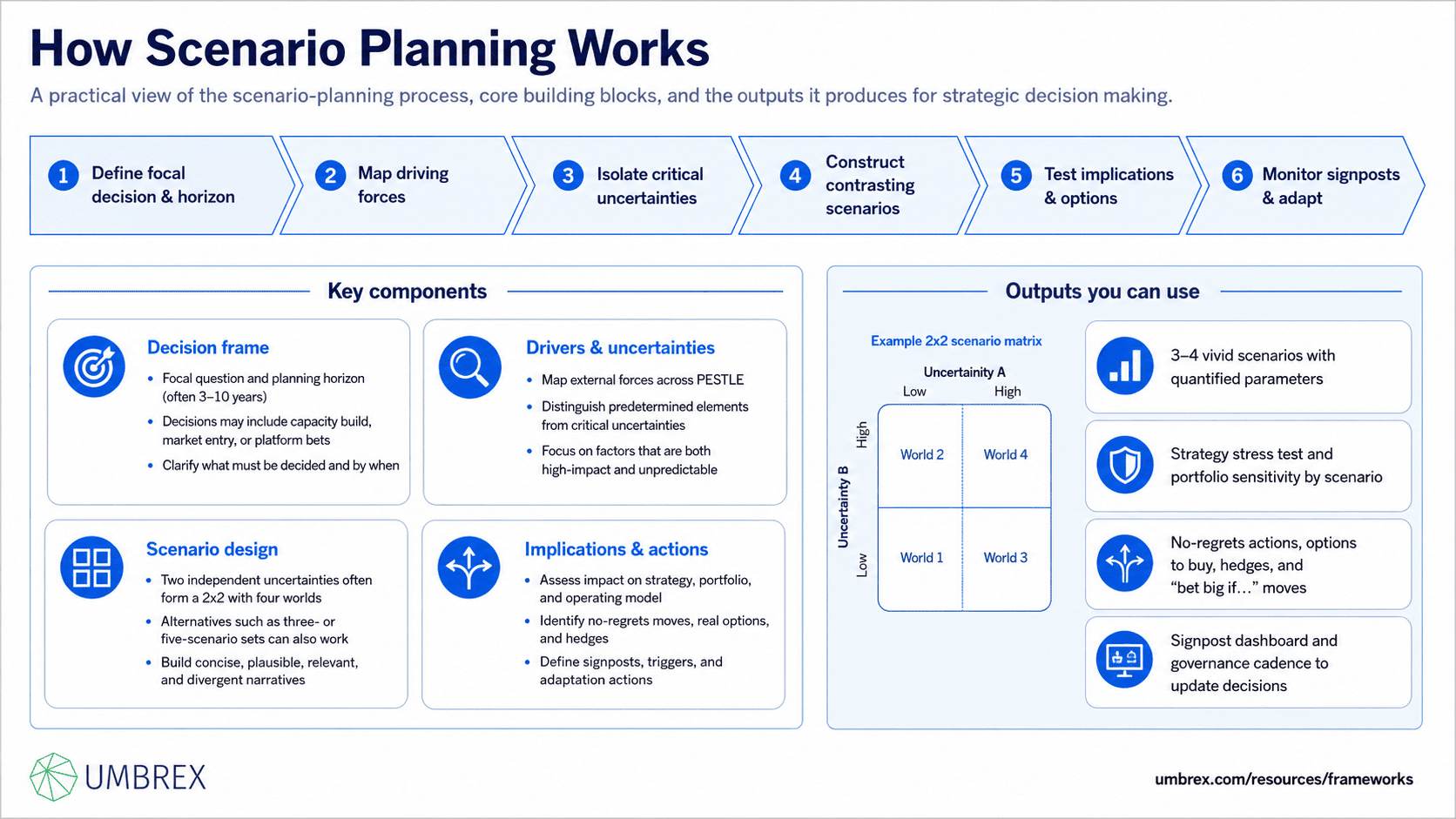
At its core, Scenario Planning follows a simple logic: define the focal decision and time horizon → map driving forces → isolate the most important uncertainties → construct a few contrasting scenarios → test implications and options → monitor signposts and adapt.
Key components
- Focal question and horizon: The decision(s) you must make (e.g., capacity build, market entry, platform bet) and the time frame in which uncertainties may play out (often 3–10 years).
- Driving forces: External trends and uncertainties across PESTLE (Political, Economic, Social, Technological, Legal, Environmental). Separate “predetermined elements” (near-certain) from “critical uncertainties” (both high-impact and unpredictable).
- Scenario axes: Two independent, high-impact uncertainties often define a 2×2, yielding four distinct, internally consistent worlds. Other forms (three- or five-scenario sets) are valid if they tell materially different stories.
- Scenario narratives: Concise, evidence-based “world stories” describing how the chosen uncertainties evolve, with implications for customers, competitors, partners, costs, and regulation. Good scenarios are plausible, relevant, and divergent.
- Strategic implications: How your strategy, portfolio, and operating model perform in each world—risks exposed, opportunities created, and capability requirements.
- Strategic options and no-regrets moves: Decisions that are robust across scenarios (no-regrets), options that are valuable in some scenarios (real options), and hedges that limit downside.
- Signposts and triggers: Observable indicators that signal which scenario is unfolding (e.g., policy milestones, cost curves, market behaviors), and predefined triggers for action.
Outputs you can use
- A small set (typically 3–4) of vivid scenarios with quantified parameters
- A strategy stress test and portfolio sensitivity to each scenario
- A list of no-regrets actions, options to buy, hedges, and “bet big if…” moves
- A signpost dashboard and governance cadence to update decisions as signals emerge.
4. When to Use Scenario Planning
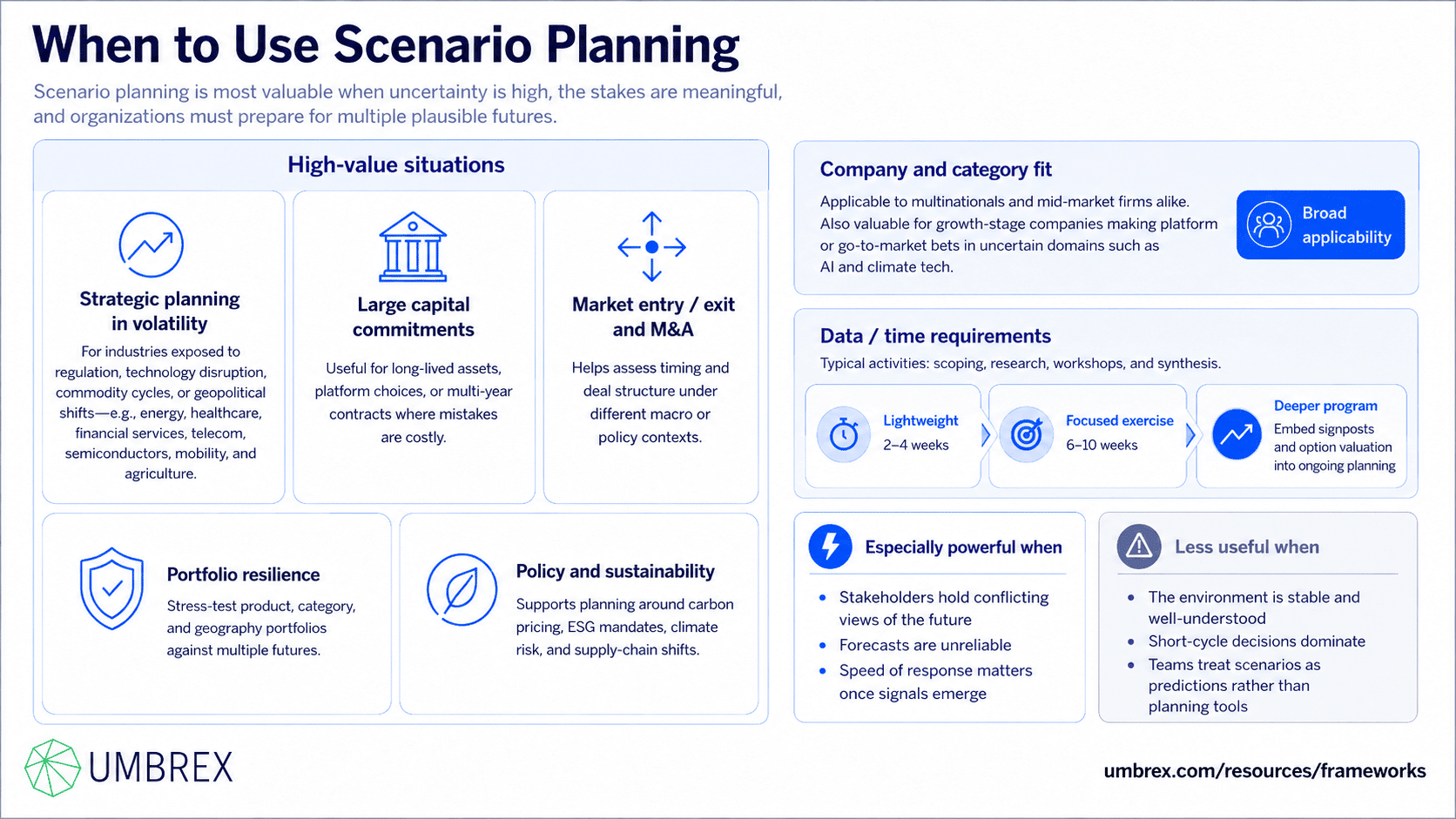
High-value situations:
- Strategic planning in volatility: Industries exposed to regulation, technology disruption, commodity cycles, or geopolitical shifts (energy, healthcare, financial services, telecom, semiconductors, mobility, agriculture).
- Large capital commitments: Long-lived assets (plants, networks), platform choices, or multi-year contracts where errors are costly.
- Market entry/exit and M&A: Timing and structure of deals under different macro or policy contexts.
- Portfolio resilience: Stress testing product/category/geography portfolios against multiple futures.
- Policy and sustainability: Carbon pricing, ESG mandates, climate risk, and supply chain shifts.
Company and category fit: Useful for multinationals and mid-market firms alike; also applicable for growth-stage companies making platform or go-to-market bets in uncertain domains (e.g., AI, climate tech).
Data/time requirements: A focused exercise can be completed in 6–10 weeks (scoping, research, workshops, synthesis). Lightweight versions (2–4 weeks) support specific decisions; deeper programs embed signposts and option valuation into ongoing planning.
Especially powerful when: Stakeholders hold conflicting views of the future; forecasts are unreliable; and speed of response matters once signals emerge.
Less useful when: The environment is stable and well-understood; short-cycle decisions dominate; or teams treat scenarios as predictions rather than planning tools.
5. How to Apply Scenario Planning: Step-by-Step
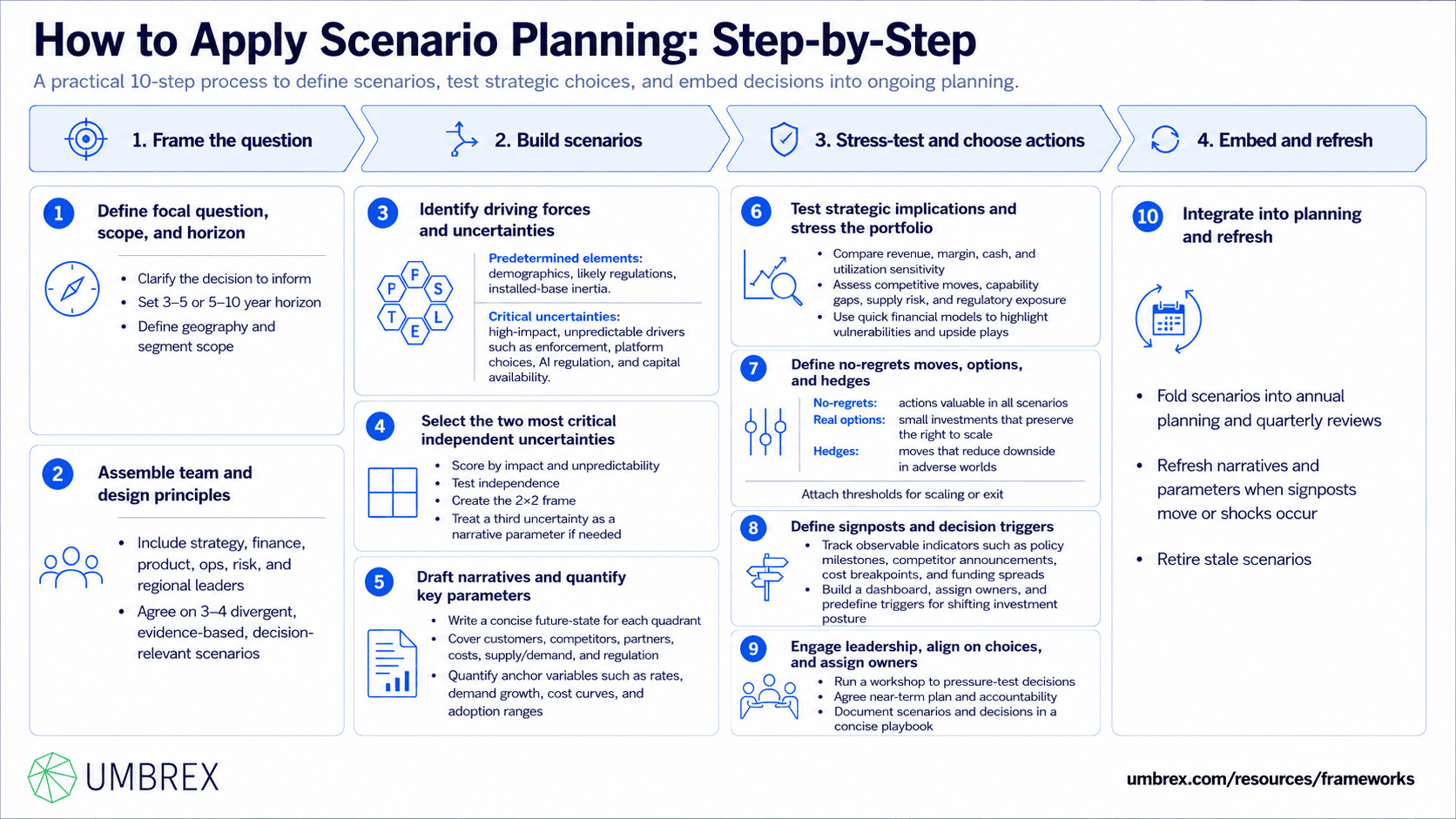
- Define the focal question, scope, and time horizon.
Clarify what decision(s) the scenarios must inform (e.g., 5-year capacity plan in North America, entry into two Asian markets, migration to a new platform). Set the horizon (e.g., 3–5 years for tech, 5–10 for capital-intensive industries) and geographic/segment scope.
- Assemble a cross-functional team and agree on design principles.
Include strategy, finance, product/technology, operations, risk, regulatory, and regional leaders. Align on principles: 3–4 divergent scenarios, evidence-based, decision-relevant, with quantifiable parameters where possible.
- Identify driving forces and uncertainties (PESTLE scan).
Generate a broad list of external drivers via expert interviews, market/tech scans, and data (e.g., policy calendars, rate forecasts, cost curves, adoption data). Separate:
- Predetermined elements: Demographics, announced regulations with high likelihood, installed-base inertia.
- Critical uncertainties: High-impact drivers with meaningful unpredictability (e.g., policy enforcement, competitor platform choices, AI regulation, capital availability).
- Select the two most critical and independent uncertainties.
Score uncertainties by impact and unpredictability; test independence (avoid axes that are simply causes/effects of each other). Choose the pair that yields the most decision-relevant divergence and construct a 2×2 frame. If a third uncertainty is crucial, incorporate it as a parameter within narratives.
- Draft scenario narratives and quantify key parameters.
For each quadrant, create a 1–2 page “future state” with headlines, causal logic, and implications for customers, competitors, partners, costs, supply/demand, and regulation. Quantify anchor variables (e.g., interest rates, demand growth, price curves, cost-of-capital, adoption rates) with ranges.
- Test strategic implications and stress the portfolio.
For each scenario, assess how your current strategy and options perform:
- Revenue, margin, cash, and capacity utilization sensitivity
- Competitive dynamics and potential entrant moves
- Capability gaps, supply chain risks, regulatory exposure
Use quick financial models to compare outcomes; highlight vulnerabilities and upside plays.
- Define no-regrets moves, options, and hedges.
Classify actions:
- No-regrets: Valuable in all scenarios (e.g., modularizing architecture, data capabilities, selective cost-out, diversified sourcing).
- Real options: Small investments that create the right to scale if a scenario unfolds (e.g., pilot in a region, JV with an emergent platform, reserving capacity).
- Hedges: Actions that mitigate downside in adverse scenarios (e.g., contractual clauses, flexible financing, inventory strategies).
Attach thresholds for scaling or exiting each option.
- Define signposts and decision triggers.
Identify observable indicators with target values/dates (e.g., policy enactment milestones, competitor announcements, cost curve breakpoints, funding spreads). Build a dashboard and assign owners. Predefine triggers for shifting investment posture.
- Engage leadership, align on choices, and assign owners.
Run a workshop to pressure-test decisions, agree on the near-term plan, and assign accountability for options, hedges, and signpost monitoring. Document the narrative and decisions in a concise playbook.
- Integrate into planning and refresh.
Fold scenarios into annual planning and quarterly reviews. Refresh narratives and parameters when signposts move or exogenous shocks occur; retire stale scenarios.
6. Example: Scenario Planning in Action
Context: A $1.8B EV charging network operator must decide on a 5-year capital plan for North America. Uncertainties include the pace of EV adoption, federal/state policy support, competitive pricing, and cost of capital. The current plan assumes steady adoption and moderate interest rates; the board asks for a scenario-based strategy.
Critical uncertainties selected: (1) EV adoption pace (Fast vs. Slow), and (2) Cost of capital & policy support (Loose/Supportive vs. Tight/Constrained). This yields four scenarios:
- A. Green Fast Lane (Fast adoption, Loose/Supportive): Stimulus and tax credits extended; OEMs hit production targets; interest rates ease. Utilization ramps quickly; competition intensifies; price pressure moderate.
- B. Crowded & Cheap (Fast adoption, Tight/Constrained): Adoption still strong, but rates remain high and subsidies fade; capital scarce; demand outstrips quality supply; weaker players struggle to finance expansion.
- C. Policy Push, Consumer Drag (Slow adoption, Loose/Supportive): Subsidies available but consumer uptake lags (range anxiety, macro softness). Overcapacity risk; quality and reliability differentiate.
- D. Slow & Dear (Slow adoption, Tight/Constrained): High rates and limited subsidies; OEM delays. Utilization grows slowly; survival depends on capital discipline and diversified revenue.
Implications and options:
- No-regrets: Standardize modular station design; invest in uptime analytics and field service; secure long-term power purchase agreements; diversify siting (urban corridors + retail partners).
- Options to buy:
- Letters of intent with two retail chains for priority sites (exercise if A or B emerges).
- JV with a utility for demand-response revenue stream (valuable in C/D for resilience).
- Hedges: Flexible EPC contracts; interest rate hedges; staged deployment gates tied to utilization thresholds.
Quantification: The team models utilization, price/margin, and capex under each scenario. In A, rapid build-out yields strong NPV; in B, capital scarcity favors players with balance sheet resilience—deliberately slow the tail of the pipeline to preserve cash. In C, focus on reliability and partnerships; defer speculative corridors. In D, capex throttled; prioritize profitable micro-markets and ancillary revenues (advertising, grid services).
Signposts and triggers: EV sales mix vs. forecasts, federal/state policy milestones, competitor financing rounds, 10-year yield spreads, utilization on pilot corridors. Triggers: if EV sales penetration exceeds X% for three consecutive quarters and funding spreads compress below Y bps, accelerate site activation by Z%; if policy support fades and utilization lags thresholds, freeze lower-tier sites and pivot to utility JV.
Outcomes (9 months): The company replaces a monolithic plan with a scenario-driven portfolio: 60% of capex in prioritized, modular corridors; 20% reserved for option exercises; 20% contingent on signposts. When rates stay elevated but adoption is strong (Scenario B tendencies), the firm slows lower-tier builds, negotiates better EPC terms, and raises a project-finance tranche at improved terms due to superior reliability metrics. Competitors overcommitted; the company’s disciplined options preserve cash and capture premium sites as weaker players retrench.
7. Strengths and Limitations
Strengths
- Improves strategic resilience: Prepares robust choices and contingencies; reduces reaction time when the world shifts.
- Broadens thinking: Challenges single-point forecasts and groupthink; creates shared mental models across leadership.
- Aligns investments with uncertainty: Clarifies no-regrets, options, and hedges; ties capital deployment to signposts.
- Integrates qualitative and quantitative: Combines narratives with parameter ranges and financial stress tests.
Limitations
- Time and facilitation intensive: Requires cross-functional engagement and disciplined synthesis.
- Subjectivity risk: Poorly chosen axes or biased narratives can mislead; evidence discipline is essential.
- Not a forecast: Scenarios are plausible futures, not probabilities; you still need financial modeling and market sizing.
- Staleness risk: Scenarios can age quickly if not refreshed as signposts move.
8. Common Pitfalls (and How to Avoid Them)
- Choosing trivial or correlated axes.
What goes wrong: Scenarios collapse into minor variations; decisions remain unchanged.
Avoid it: Score uncertainties by impact and unpredictability; test independence; select axes that matter to your decision.
- Storytelling without numbers.
What goes wrong: Vivid narratives lack financial implications; hard to prioritize.
Avoid it: Quantify key parameters (demand, prices, cost of capital) with ranges; run simple P&L/NPV sensitivities.
- Too many scenarios.
What goes wrong: Complexity overwhelms action; attention diffuses.
Avoid it: Three or four well-crafted scenarios are usually sufficient.
- Treating scenarios as predictions.
What goes wrong: Teams anchor on a “favorite” scenario; no options or hedges are prepared.
Avoid it: Enforce equal treatment; focus on robustness, options, and triggers—not picking a winner.
- No link to decisions or budgets.
What goes wrong: Great workshop, no change in capital allocation or milestones.
Avoid it: Translate outcomes into no-regrets moves, option budgets, and decision rights; track in planning cadences.
- Ignoring signposts.
What goes wrong: Scenarios sit on a shelf; slow reaction to change.
Avoid it: Build a dashboard; assign owners; use triggers to adjust posture automatically.
- Axis drift and scope creep.
What goes wrong: Scenarios mix geographies or segments inconsistently; apples-to-oranges implications.
Avoid it: Define unit of analysis and keep narratives internally consistent to your scope.
9. How Scenario Planning Relates to Other Frameworks
- PESTLE and Five Forces: Use these to surface driving forces and structure industry dynamics; feed the most uncertain, high-impact factors into your scenario axes.
- Three Horizons of Growth: Scenarios inform H2/H3 bets and the timing of their scale-up; link options and signposts to horizon governance.
- GE–McKinsey / Market Attractiveness–Competitive Strength: Use scenarios to stress-test attractiveness/strength scores; ensure the portfolio is resilient across futures.
- BCG Growth–Share and PLC: Combine with scenarios to plan migration paths and cash flows under different market evolutions.
- Ansoff Product–Market Matrix: Scenarios help decide when and where to pursue penetration, product development, market development, or diversification.
- Real Options and Monte Carlo: Quantitative complements for valuing options and modeling probability distributions around key parameters.
- War-gaming and competitor analysis: Layer competitor moves and responses into scenarios to test strategic robustness.
10. Key Takeaways
- Scenario Planning builds 3–4 plausible, divergent futures around critical uncertainties to test and strengthen strategy.
- Pick decision-relevant, independent axes; create concise narratives with quantified parameters; avoid “story only.”
- Translate into no-regrets moves, options, and hedges—tied to signposts and triggers for action.
- Integrate scenarios into planning and portfolio governance; refresh as signals move.
- Use alongside PESTLE/Five Forces, Three Horizons, portfolio matrices, and real-options analysis for a complete resilience toolkit.
11. FAQs About Scenario Planning
Is Scenario Planning still relevant in fast-moving markets?
Yes—especially when forecasts are unreliable. The point isn’t predicting the future; it’s preparing robust moves and options tied to early warning indicators so you can act faster than competitors as the world unfolds.
How many scenarios should we build?
Three or four well-constructed scenarios are typically sufficient. More than four dilutes attention; fewer than three often fails to capture meaningful divergence. Ensure each scenario is decision-relevant and internally consistent.
How is Scenario Planning different from forecasting?
Forecasting projects a most-likely path; Scenario Planning explores multiple plausible paths around critical uncertainties. Use forecasts for budgets when appropriate; use scenarios to test strategy and define options and triggers.
What time horizon should we use?
Choose a horizon long enough for key uncertainties to play out (often 3–5 years in tech, 5–10 in capital-intensive sectors). You can nest horizons—short-term signposts that inform medium-term investments.
How long does a robust scenario exercise take?
A focused effort typically takes 6–10 weeks (scoping, research, workshops, modeling, synthesis). Lightweight versions for specific choices can be done in 2–4 weeks; ongoing programs embed signposts into quarterly reviews.
Can smaller companies use Scenario Planning without heavy overhead?
Absolutely. Keep it lean: two workshops, a short PESTLE scan, a 2×2 with three scenarios, simple financial sensitivities, and a one-page signpost dashboard. The goal is better decisions, not academic thoroughness.
