

1. What Is the Three Horizons of Growth?
The Three Horizons of Growth is a portfolio and time-horizon framework that helps leaders balance short-term performance with medium- and long-term growth. It organizes initiatives into three “horizons,” each with distinct goals, risk profiles, and management disciplines:
- Horizon 1 (H1): Strengthen and extend the core business—optimize, defend share, and drive near-term cash.
- Horizon 2 (H2): Build emerging businesses and adjacencies—scale the next engines of growth over the medium term.
- Horizon 3 (H3): Create options for future growth—seed new platforms, technologies, and business models with longer time horizons.
In plain terms: H1 keeps the lights on and pays the bills, H2 becomes tomorrow’s H1, and H3 seeds what could become the next H2. Each horizon requires different metrics, funding approaches, and talent. The framework is used widely by consultants and executives to plan portfolios, allocate capital, and govern innovation without starving the core.
Functionally, it is a market and portfolio analysis framework. It complements tools like BCG and GE–McKinsey by adding a time dimension and explicitly delineating management systems for near-, mid-, and long-term bets.
2. Origin and Background
Origin: Popularized by McKinsey & Company in the book “The Alchemy of Growth” (1999) by Mehrdad Baghai, Stephen Coley, and David White.
The framework was created to address a persistent problem: firms over-optimizing today’s core while under-investing in tomorrow’s growth. It provided a practical way to stage investments and management attention across time horizons, so that core operations improve while new growth engines are incubated and scaled.
It became widely known through McKinsey’s client work, executive education, and business school teaching. Over time, practitioners have integrated the Three Horizons with agile product development, venture-style governance, and innovation accounting to make it more dynamic and evidence-led.
3. How the Three Horizons Framework Works

The framework divides the growth agenda across three horizons that coexist—not as serial phases but as parallel streams—each managed with distinct objectives, KPIs, funding logic, and governance.
Horizon 1 (H1): Extend and defend the core
- Objective: Optimize and grow existing businesses with proven product-market fit.
- Typical moves: Pricing and mix optimization, salesforce productivity, channel expansion, cost/complexity reduction, incremental innovation, customer experience upgrades.
- KPIs: Revenue and margin growth, cash generation, share, NRR/retention, cost-to-serve, operational efficiency.
- Funding/governance: Annual budgets, clear P&L accountability, operational gates; lower risk tolerance, high predictability.
Horizon 2 (H2): Build emerging businesses
- Objective: Scale validated adjacencies or new ventures to meaningful revenue within ~2–3 years.
- Typical moves: New segments/geographies/channels for current products, modular product extensions, platform adjacencies, partnerships and tuck-in M&A.
- KPIs: Leading indicators of scale—new logo velocity, cohort retention, attach rates, unit economics (payback, LTV/CAC), contribution margin trajectory.
- Funding/governance: Milestone-based funding (stage gates), cross-functional venture teams, higher risk tolerance with explicit kill/pivot criteria.
Horizon 3 (H3): Create options for future growth
- Objective: Discover, prototype, and validate new platforms, technologies, and business models with 3–5+ year horizons.
- Typical moves: Breakthrough R&D, venture incubation, strategic bets in new categories, business model experiments, ecosystem plays.
- KPIs: Evidence of problem-solution fit and market potential—validated learning milestones, technical de-risking, partner traction, willingness-to-pay signals, option value.
- Funding/governance: Real-options logic (small bets, expand as evidence accumulates), discovery metrics, separate governance to shield from H1 pressures.
Key principles
- Parallel portfolios: All three horizons run concurrently; you resource each deliberately.
- Different disciplines: H1 favors operational excellence; H2 needs scaling playbooks; H3 needs experimentation and discovery.
- Migrations: Healthy portfolios show H3 options graduating to H2, and H2 businesses maturing to H1 over time.
- Guardrails over quotas: “70-20-10” (or similar) is a guideline, not a rule. Allocation should follow strategy, risk appetite, and evidence.
4. When to Use the Three Horizons
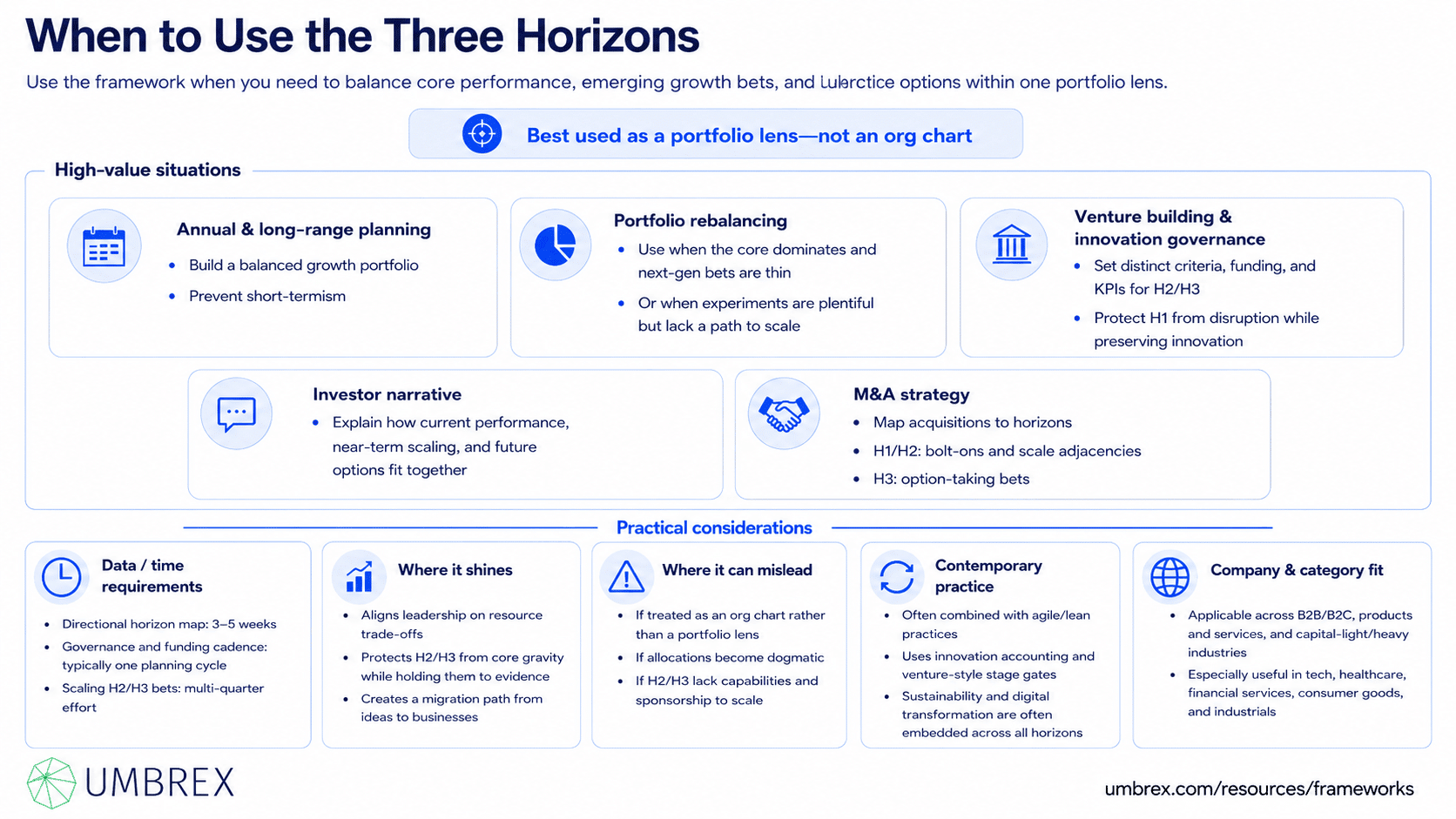
High-value situations:
- Annual and long-range planning: Build a balanced growth portfolio and prevent short-termism.
- Portfolio rebalancing: When the core dominates and pipeline of next-gen bets is thin; or conversely when too many experiments lack a path to scale.
- Venture building and innovation governance: Set criteria, funding, and KPIs for H2/H3 without disrupting H1.
- Investor narrative: Communicate how today’s performance, near-term scaling, and future options fit together.
- M&A strategy: Map acquisitions to horizons (bolt-ons for H1/H2; option-taking for H3).
Company and category fit: Applicable across B2B/B2C, product and service businesses, and capital-light/heavy industries. Especially valuable in tech, healthcare, financial services, consumer goods, and industrials where S-curves, adjacencies, and disruption matter.
Data/time requirements: A directional horizon map can be built in 3–5 weeks. Embedding governance and funding cadences typically takes a planning cycle; scaling H2/H3 bets is a multi-quarter endeavor.
Where it shines: Aligning leadership on resource trade-offs; protecting H2/H3 from core gravity while holding them to evidence; creating a migration path from ideas to businesses.
Where it can mislead: If treated as an org chart (“we are the H3 team”) rather than a portfolio lens; if allocations become dogmatic; or if H2/H3 are starved of the capabilities and sponsorship required to scale.
Contemporary practice: Leaders increasingly combine Three Horizons with agile/lean practices, “innovation accounting” (evidence-based metrics), and venture-style stage gates. Many also embed sustainability and digital transformation as cross-cutting themes across horizons.
5. How to Apply Three Horizons: Step-by-Step
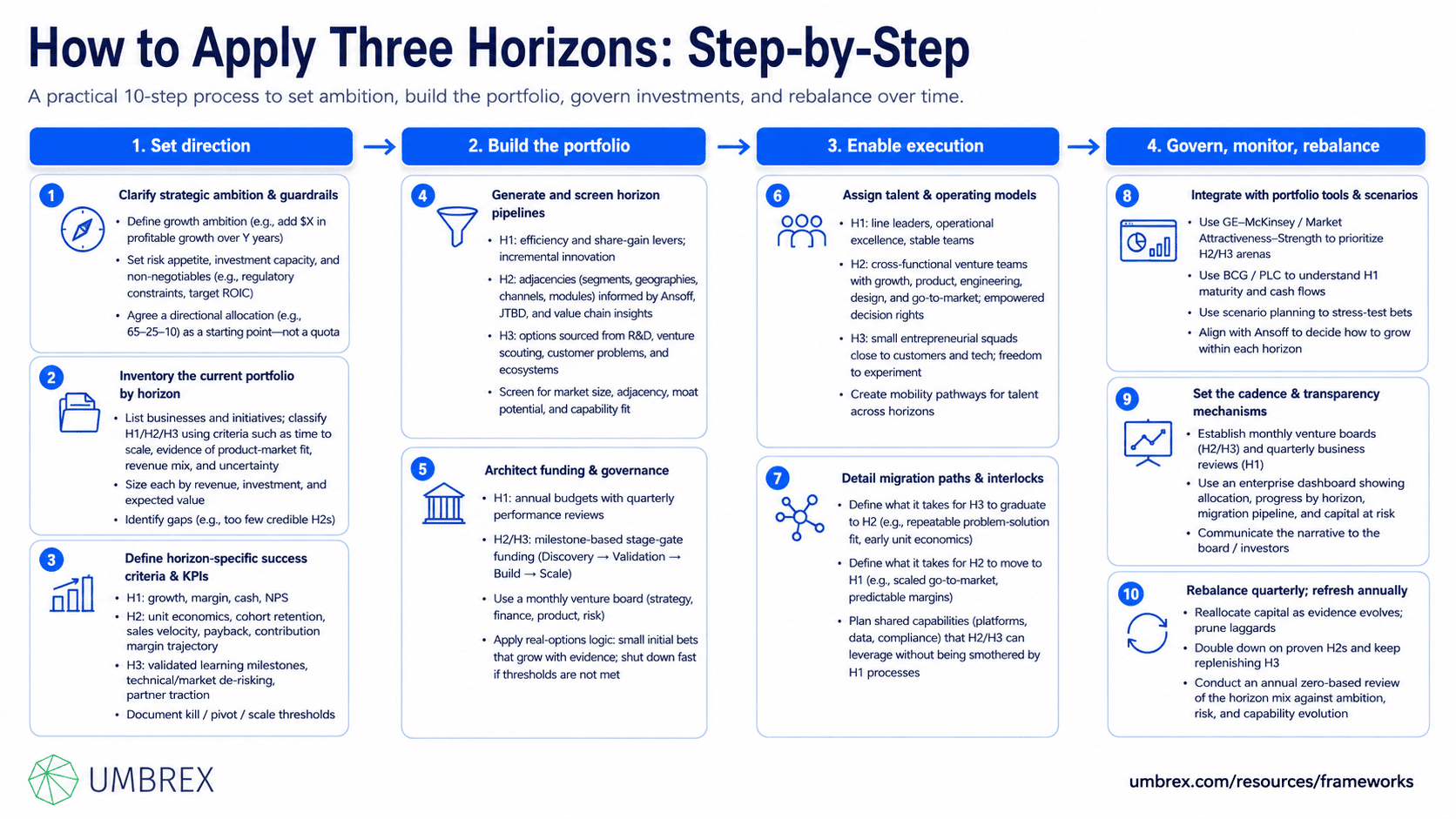
- Clarify strategic ambition and guardrails.
Define growth ambition (e.g., “add $X in profitable growth over Y years”). Articulate risk appetite, investment capacity, and non-negotiables (e.g., regulatory constraints, target ROIC). Agree a directional allocation (e.g., 65–25–10) as a starting point—not a quota.
- Inventory the current portfolio by horizon.
List businesses and initiatives; classify H1/H2/H3 using objective criteria (time to scale, evidence of product-market fit, revenue mix, uncertainty). Size each by revenue, investment, and expected value. Identify gaps (e.g., too few credible H2s).
- Define horizon-specific success criteria and KPIs.
H1: financial and operational metrics (growth, margin, cash, NPS). H2: unit economics, cohort retention, sales velocity, payback, contribution margin trajectory. H3: validated learning milestones, technical/market de-risking, partner traction. Document kill/pivot/scale thresholds.
- Generate and screen horizon pipelines.
H1: efficiency and share-gain levers; incremental innovation. H2: adjacencies (segments, geos, channels, modules) informed by Ansoff, JTBD, and value chain insights. H3: options sourced from R&D, venture scouting, customer problems, and ecosystems. Screen with clear criteria (market size, adjacency, moat potential, capability fit).
- Architect funding and governance.
H1: annual budgets with quarterly performance reviews. H2/H3: milestone-based “stage-gate” funding (e.g., Discovery → Validation → Build → Scale) with a venture board (strategy, finance, product, risk) that meets monthly. Use real-options logic—small initial bets that grow with evidence; shut down fast if thresholds aren’t met.
- Assign talent and operating models.
H1: line leaders, operational excellence, stable teams. H2: cross-functional venture teams with growth, product, engineering, design, and go-to-market; empowered decision rights. H3: small, entrepreneurial squads close to customers and tech; freedom to experiment. Create mobility pathways for talent across horizons.
- Detail migration paths and interlocks.
Document what it takes for an H3 option to graduate to H2 (e.g., repeatable problem-solution fit, early unit economics) and for H2 to move to H1 (e.g., scaled go-to-market, predictable margins). Plan shared capabilities (platforms, data, compliance) that H2/H3 can leverage without being smothered by H1 processes.
- Integrate with portfolio tools and scenarios.
Use GE–McKinsey/Market Attractiveness–Strength to prioritize H2/H3 arenas; BCG/PLC to understand H1 maturity and cash flows; scenario planning to stress-test bets. Align with Ansoff to decide “how” to grow within each horizon.
- Set the cadence and transparency mechanisms.
Establish monthly venture boards (H2/H3), quarterly business reviews (H1), and an enterprise dashboard showing allocation, progress by horizon, migration pipeline, and capital at risk. Communicate the narrative to the board/investors.
- Rebalance quarterly; refresh annually.
Reallocate capital as evidence evolves; prune laggards; double down on proven H2s; keep replenishing H3. Conduct an annual zero-based review of the horizon mix against ambition, risk, and capability evolution.
6. Example: Three Horizons in Action
Context: A $1.4B specialty chemical company faces slowing growth in its core coatings business (H1). Competitors are entering with lower-cost formulations. The CEO wants to reaccelerate by expanding into adjacent end-markets and exploring bio-based materials.
Horizon mapping:
- H1 (core coatings): $1.1B revenue, margins under pressure, high share in industrial OEMs. Opportunities: price/mix optimization, SKU rationalization, debottlenecking plants, supply chain cost-out, cross-sell of service packages.
- H2 (adjacent applications): Two emerging businesses at $60M each—protective coatings for renewables and high-performance packaging—both with strong pilot customers but uneven unit economics.
- H3 (bio-based materials platform): Three options—enzyme-enabled binders, recycled-content additives, and nanostructured coatings—at lab/prototype stage with early partner interest.
Actions:
- H1: Launch price–pack architecture; implement advanced S&OP; reduce long-tail SKUs by 25%; automate two bottleneck processes; introduce a premium service tier with guaranteed turnaround. Target +150 bps margin.
- H2: Create two venture teams with dedicated sales engineers and product management; set milestones (≥30% gross margin, ≤12-month payback, three lighthouse references each). Add channel partners in EMEA; standardize onboarding kits; adjust formulations for faster cure time based on JTBD research.
- H3: Fund $8M across three options with quarterly venture board reviews; criteria to graduate: validated addressable market ≥$500M, willingness-to-pay evidence, regulatory feasibility, a pilot with a top-tier customer. Form a consortium with a biopolymer startup and a packaging OEM to de-risk supply and market entry.
Outcomes (12–18 months): H1 margin improves 180 bps; working capital days reduced by 8. The renewables coatings H2 reaches $110M run-rate with 34% gross margin and three marquee references; packaging H2 hits unit-economics thresholds in two regions. One bio-based option is paused (regulatory hurdles), one pivots to an additive with faster path to validation, and one graduates to H2 after securing a multi-year co-development agreement. The company communicates an allocation shift from 85–12–3 to 70–22–8 over two years with explicit milestones and risk controls.
7. Strengths and Limitations
Strengths
- Balance and clarity: Prevents short-termism while avoiding innovation theatre; aligns leaders on near-, mid-, and long-term bets.
- Distinct management systems: Tailors KPIs, funding, and governance to the uncertainty of each horizon.
- Migration logic: Encourages graduation from H3 → H2 → H1; creates a pipeline, not a graveyard of pilots.
- Communication power: Provides a credible investor narrative connecting today’s cash to tomorrow’s growth.
- Integration-friendly: Works well with portfolio matrices, Ansoff, JTBD, agile, and stage-gate processes.
Limitations
- Misclassification risk: Teams label risky core tweaks as H2/H3 to attract funding, or vice versa.
- Dogma danger: Overly rigid “70-20-10” allocations ignore context and evidence.
- Organizational gravity: H1 processes can smother H2/H3 unless protected by governance and talent models.
- Execution load: Running three systems in parallel requires disciplined governance and scarce cross-functional talent.
- False serialism: Treating horizons as sequential phases delays necessary parallel investment.
8. Common Pitfalls (and How to Avoid Them)
- Using horizons as an org chart.
What goes wrong: Silos form; knowledge and platforms don’t transfer.
Avoid it: Treat horizons as a portfolio lens; enable talent mobility and shared platforms with ring-fenced autonomy for H2/H3.
- Ritualistic allocation (“70-20-10” by fiat).
What goes wrong: Misaligned spend; under- or over-funding relative to evidence and strategy.
Avoid it: Set directional guardrails; adjust quarterly based on milestones, market signals, and risk appetite.
- Starving H2 of go-to-market muscle.
What goes wrong: Great prototypes stall at scale; unit economics never stabilize.
Avoid it: Form dedicated venture teams; assign sales/CS capacity; define repeatable playbooks and partner models.
- No kill/pivot discipline in H3.
What goes wrong: Zombie projects consume capital and credibility.
Avoid it: Use real-options funding with explicit learning milestones and thresholds; celebrate disciplined exits.
- Label inflation.
What goes wrong: Incremental H1 improvements relabeled as H2/H3 to seem innovative.
Avoid it: Define horizon criteria clearly (time to scale, uncertainty, novelty, adjacency); audit classifications.
- Core cannibalization anxiety.
What goes wrong: H2/H3 that could disrupt H1 are blocked.
Avoid it: Use separate governance; predefine cannibalization guardrails; better to self-disrupt than be disrupted.
- Innovation theatre.
What goes wrong: Hackathons and pilots without migration plans or economics.
Avoid it: Tie H3 to customer problems, market sizing, and partner traction; require migration hypotheses to H2.
9. How Three Horizons Relates to Other Frameworks
- BCG Growth–Share / GE–McKinsey: Use these to prioritize where to invest across businesses today; use Three Horizons to stage investments over time and tailor governance by uncertainty.
- Ansoff Product–Market Matrix: Ansoff answers “how to grow” (penetration, product, market, diversification). Three Horizons answers “over what timeframes, with what risk, and how to govern.”
- Product Life Cycle (PLC): PLC describes market maturity of a product; horizons describe your portfolio’s time-balanced growth system. Mature PLC units sit in H1; new launches can be H2; explorations are H3.
- Jobs-To-Be-Done (JTBD): Use JTBD to identify and validate H2/H3 opportunities and to focus H1 incremental innovation on decisive outcomes.
- Blue Ocean / Strategy Canvas: Use to design distinctive H2/H3 propositions; manage their incubation and scale through horizon governance.
- Stage-Gate, Agile, and Innovation Accounting: These provide the operating system for H2/H3—hypothesis-driven tests, milestones, evidence-based funding.
- Scenario Planning and Real Options: Stress-test H2/H3 bets against external uncertainty and manage funding as options that expand with evidence.
10. Key Takeaways
- Three Horizons balances today’s performance (H1), near-term growth engines (H2), and future options (H3)—run in parallel, not sequence.
- Each horizon needs distinct KPIs, funding, risk tolerance, and talent; one-size-fits-all governance fails.
- Guardrails beat quotas: adjust allocation based on strategy, evidence, and risk, not ritualistic splits.
- Health shows migration: H3 options graduating to H2, and H2 businesses scaling to H1 with predictable economics.
- Combine with portfolio, market, and product frameworks to choose arenas and design scalable bets; use venture-style governance to avoid innovation theatre.
- Protect H2/H3 from core gravity while leveraging shared capabilities—separate governance, integrated platforms.
11. FAQs About the Three Horizons of Growth
Is Three Horizons still relevant in agile, fast-moving markets?
Yes. If anything, it’s more relevant. Agile accelerates learning within horizons; the framework ensures you’re investing across time, using appropriate KPIs and funding models for uncertainty rather than forcing all work through H1 processes.
What about the “70-20-10” investment rule?
Treat it as a starting guideline, not dogma. Your mix should reflect strategy, risk appetite, and evidence. Capital-intensive industries or turnaround situations may skew to H1; disruptive contexts may merit larger H2/H3 allocations—with stage-gate discipline.
How long do horizons last?
They are not fixed time boxes. H1 is “the core today,” H2 is what can scale in the next ~2–3 years, and H3 is 3–5+ years out. In some digital businesses, H2 cycles in 12–18 months; in regulated or hardware-heavy spaces, H2/H3 timelines are longer.
Can small or early-stage companies use Three Horizons?
Absolutely—lightly. H1 = current product-market fit and cash, H2 = next segment/module/geography with line of sight to scale, H3 = 1–2 exploratory options. Use lean metrics and keep governance simple, but avoid betting everything on a single horizon.
How do we measure H3 options?
Use “innovation accounting”: hypothesis milestones, customer discovery evidence (problem/solution fit), technical de-risking, partner traction, and early willingness-to-pay signals. Fund as real options—expand with evidence, shut down when thresholds aren’t met.
What’s the difference between Three Horizons and Ansoff?
Ansoff structures growth moves by market and product (penetration, market development, product development, diversification). Three Horizons structures growth by time and uncertainty, prescribing different governance and metrics for near-, mid-, and long-term bets. Use them together: pick moves with Ansoff; stage and govern with Horizons.
