

1. What Is Porter’s Generic Strategies Framework?
Porter’s Generic Strategies Framework is a classic lens for choosing how a business will compete. It says there are three fundamental ways to achieve competitive advantage at the business-unit level: Cost Leadership (win on lower cost), Differentiation (win on unique value), and Focus (serve a narrow segment better than broad competitors—either via low cost or differentiation). The premise is simple: superior performance comes from a clear choice and a coherent set of activities that reinforce that choice.
In plain terms, the framework forces a decision: Will you be the low-cost producer serving broad needs, the uniquely valuable provider for broad needs, or a specialist serving a well-defined niche with either a cost or differentiation edge? Trying to straddle often leads to being “stuck in the middle”—not the lowest cost, not distinct enough to command a premium.
This is a foundational market and portfolio analysis tool. Consultants and executives use it to set business-unit strategy, assess strategic fit across a portfolio, and align investments, operating models, and metrics with the chosen path.
2. Origin and Background
Origin: Introduced by Michael E. Porter in “Competitive Strategy” (1980) and reiterated in subsequent works, including “What Is Strategy?” (Harvard Business Review, 1996). The “stuck in the middle” warning and the need for activity-fit trade-offs are core to Porter’s view.
Porter developed the framework to clarify the basic strategic positions available within an industry and to explain why firms that try to mix incompatible positions underperform. It complemented his Five Forces model by specifying how firms can respond to industry structure with a defensible position.
The framework became ubiquitous through business school curricula and strategy practice because it offers crisp choices that translate into operating implications—cost structures, value propositions, pricing power, and capability systems.
3. How Porter’s Generic Strategies Work
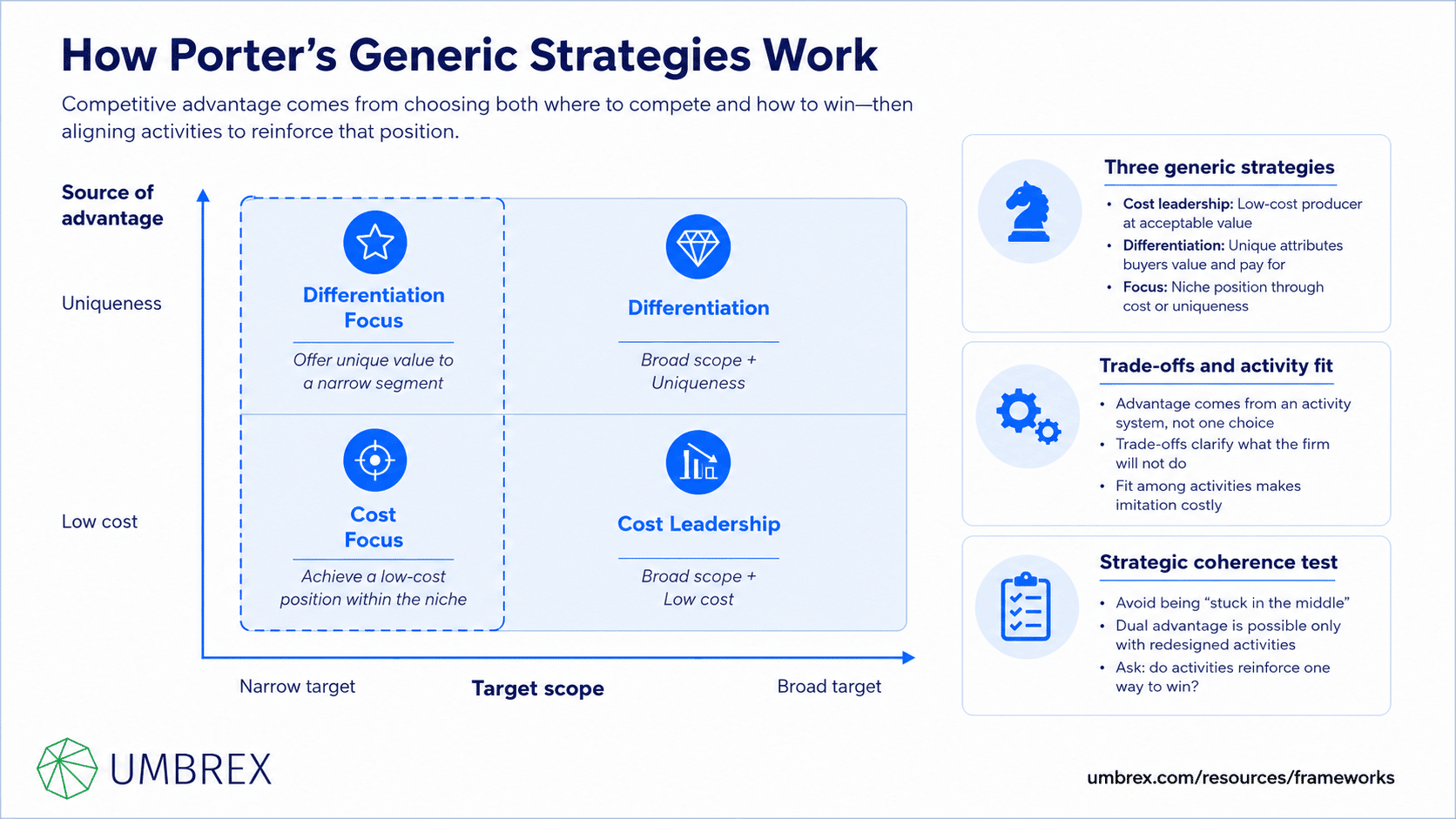
The framework defines two primary dimensions—scope (broad vs. narrow target) and source of advantage (low cost vs. uniqueness)—producing three generic strategies:
The three generic strategies
- Cost Leadership (broad scope, low cost): Aim to be the industry’s low-cost producer while offering acceptable value to a wide set of customers. Advantages stem from scale, learning, process design, asset utilization, supply power, standardization, and product/service designed-to-cost. Pricing can undercut rivals or match industry prices while earning superior margins.
- Differentiation (broad scope, uniqueness): Offer unique attributes valued by many buyers who will pay a premium—performance, design, brand, service, reliability, ecosystem, or experience. The goal is price premium and/or stickiness that outweighs the added cost of differentiation.
- Focus (narrow scope, either cost or differentiation): Serve a well-defined segment (customer group, geography, use case, or channel) better than broad competitors by tailoring activities. Two variants:
- Cost Focus: Achieve a low-cost position within the niche (e.g., specific channel/format, stripped offer for a segment with homogenous needs).
- Differentiation Focus: Offer unique value to a narrow segment (e.g., regulatory-grade quality for a specific industry).
Trade-offs and activity fit
Porter emphasized that sustainable advantage is not about a single choice but about a system of activities that fit together and make imitation costly. Trade-offs (what you won’t do) strengthen position by preventing straddling. For example, a cost leader avoids high-cost customization; a differentiator invests in service levels and brand storytelling that a cost leader won’t match without undermining its cost base.
“Stuck in the middle” and modern nuance
Porter warned that mixing incompatible choices leads to strategic drift—costs too high for cost leadership and uniqueness too shallow for differentiation. Modern practice recognizes exceptions—firms can deliver strong value at attractive costs when they redesign the activity system (e.g., new technology, platform scale). But even “dual advantage” stories are coherent positions, not an undisciplined mix. The litmus test remains: do your activities reinforce a clear way to win, or do they fight each other?
4. When to Use Porter’s Generic Strategies
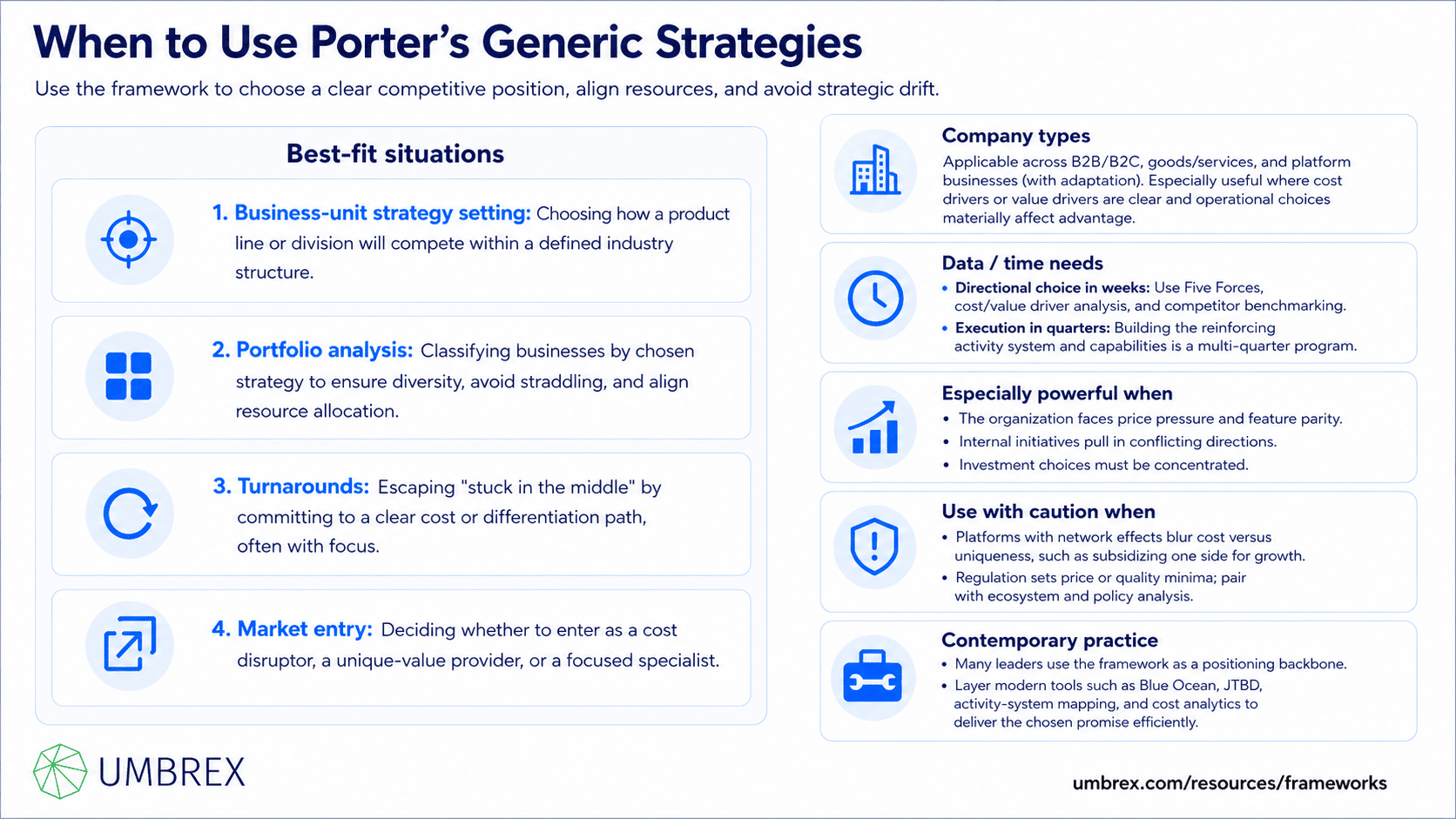
Best-fit situations:
- Business-unit strategy setting: Choosing how a product line or division will compete within a defined industry structure.
- Portfolio analysis: Classifying businesses by chosen strategy to ensure diversity, avoid straddling, and align resource allocation.
- Turnarounds: Escaping “stuck in the middle” by committing to a clear cost or differentiation path (often with focus).
- Market entry: Deciding whether to enter as a cost disruptor, a unique-value provider, or a focused specialist.
Company types: Applicable across B2B/B2C, goods/services, and platform businesses (with adaptation). Especially useful in industries with clear cost drivers or value drivers and where operational choices meaningfully affect advantage.
Data/time needs: A directional strategy choice can be made in weeks using industry structure (Five Forces), cost and value driver analysis, and competitor benchmarking. Building the reinforcing activity system and capabilities is a multi-quarter program.
Especially powerful when: The organization faces price pressure and feature parity; internal initiatives pull in conflicting directions; or investment choices must be concentrated.
Use with caution when: Platforms with network effects blur cost/uniqueness (e.g., subsidizing one side for growth) or regulation sets price/quality minima. The framework still helps, but pair it with ecosystem and policy analysis.
Contemporary practice: Many leaders use the framework as a “positioning backbone,” then layer modern tools (Blue Ocean, JTBD, activity-system mapping, cost analytics) to design a differentiated and efficient way to deliver the chosen promise.
5. How to Apply Porter’s Generic Strategies: Step-by-Step
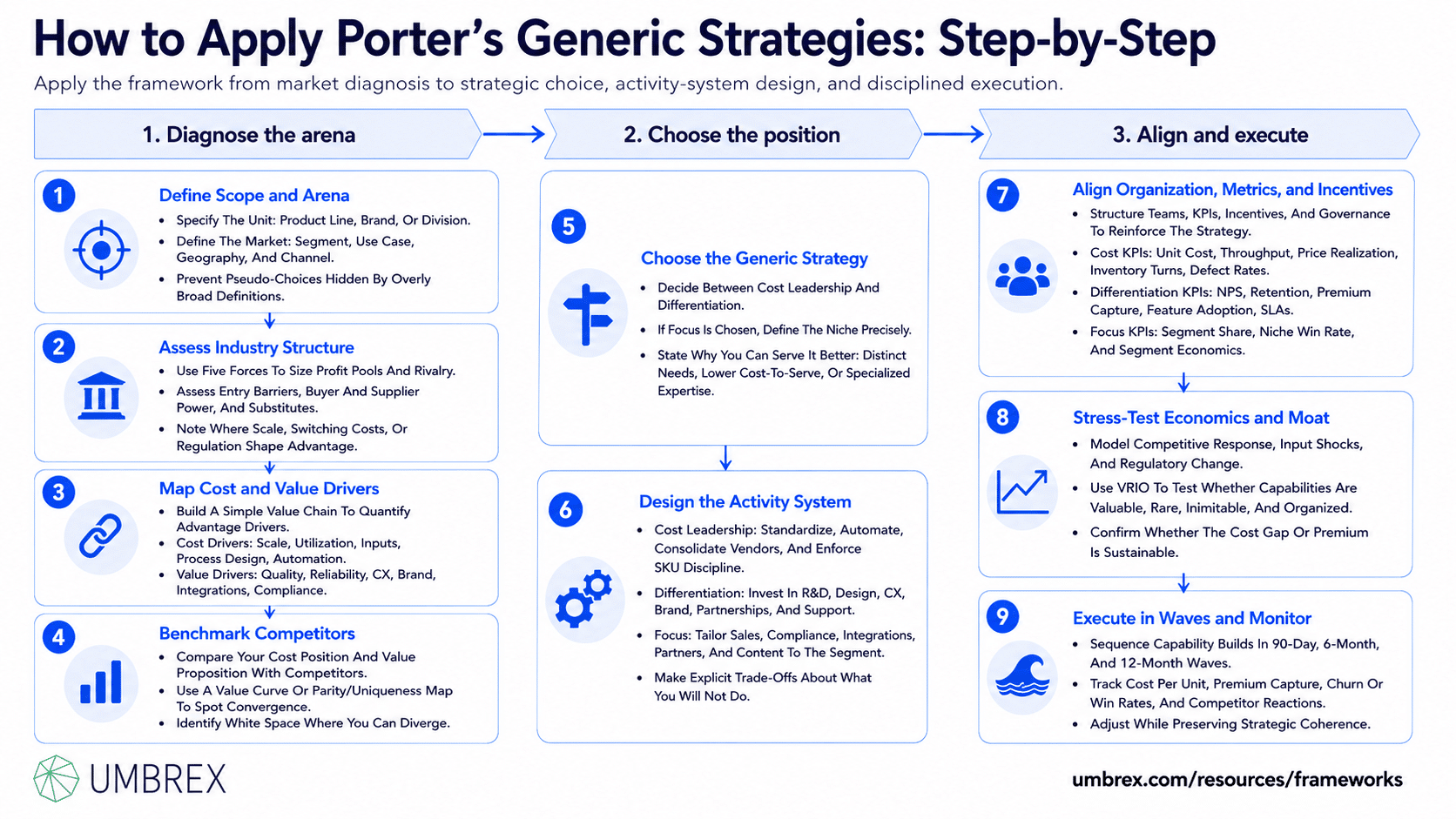
- Define the business scope and competitive arena.
Specify the unit (product line, brand, division) and the market definition: customer segment, use case, geography, and channel. Clarity here prevents pseudo-choices that hide segment differences.
- Assess industry structure and economics.
Use Porter’s Five Forces to understand profit pools, rivalry, entry barriers, buyer/supplier power, and substitutes. Identify where scale economies, switching costs, or regulation shape advantage. This frames which generic strategy is feasible and defensible.
- Map cost drivers and value drivers.
Build a simple value chain and quantify:
- Cost drivers: Scale/learning, capacity utilization, input costs, process design, automation, design-to-cost, channel mix, service intensity, returns/warranty rates.
- Value drivers: Performance/quality, reliability, time-to-value, brand, customer experience, ecosystem/integrations, compliance, customization, network/complements.
- Benchmark competitors and identify white space.
Compare your cost position and value proposition to competitors and substitutes. Use a Blue Ocean value curve or parity/uniqueness map to see where the industry converges and where you can diverge.
- Choose your generic strategy and (if relevant) focus segment.
Decide: Cost Leadership vs. Differentiation. If focus is chosen, define the niche precisely (customer, use case, channel, geography) and why you can serve it better (distinct needs, lower cost-to-serve, regulatory expertise, ecosystem).
- Design the reinforcing activity system.
Translate the choice into activities that fit together:
- For Cost Leadership: Product standardization, modular designs, vendor consolidation, long production runs, strict SKU discipline, self-service channels, automation, lean operations, shared-service back office, tight working-capital management.
- For Differentiation: R&D focus on chosen value drivers, premium materials/SLAs, distinctive design, superior CX, brand/storytelling, ecosystem partnerships, high-touch support, selective distribution.
- For Focus: Specialized sales coverage, tailored compliance/quality systems, segment-specific integrations, curated partner network, content and references in-segment.
Make explicit trade-offs—activities you will not pursue because they conflict with the position.
- Align organization, metrics, and incentives.
Structure teams and KPIs to reinforce the strategy:
- Cost leader KPIs: unit costs, on-time throughput, price realization vs. peers, inventory turns, defect rates.
- Differentiator KPIs: NPS/retention, price premium, adoption of premium features, service SLAs, brand health.
- Focused KPIs: segment share, win rate vs. generalists in the niche, segment-specific economics.
Incentives and governance should reward the chosen path (e.g., discourage customization creep in a cost strategy).
- Stress-test economics and moat.
Model scenarios: Can you sustain the cost gap or premium under competitive response, input shocks, or regulatory changes? Use VRIO to test whether underlying capabilities are valuable, rare, inimitable, and organized.
- Execute in waves and monitor leading indicators.
Sequence capability builds (90-day, 6-month, 12-month waves). Track early signals: cost per unit, premium capture, churn/win rates in target segments, and competitor reactions. Adjust while preserving strategic coherence.
6. Example: Porter’s Generic Strategies in Action
Context: A $1.2B regional grocery chain faces margin pressure from national discounters (low cost) and specialty grocers (differentiation). Growth is flat, private-label penetration lags peers, and customer surveys show “adequate but undistinguished” experience. The business appears stuck in the middle—promotions heavy, store formats inconsistent, and service levels variable.
Choice: Leadership commits to a Cost Leadership with Focus on suburban family shoppers—winning on everyday value and speed for the weekly shop, not competing head-to-head on premium assortments with specialty stores.
Activity system:
- Assortment & SKU discipline: Reduce SKUs by 20% in center store; expand high-rotation private label with design-to-cost; standardize planograms.
- Operations: Roll out cross-docking and shelf-ready packaging; optimize labor with demand-driven scheduling; invest in scan-based trading and shrink reduction.
- Store format: Standard mid-size footprint optimized for fast trips; self-checkout expansion; simple navigation.
- Pricing & promotions: Shift from deep discounting to EDLP (Everyday Low Price) on key value items; targeted digital coupons for pantry staples, not long-tail SKUs.
- Supply & vendor terms: Vendor consolidation with volume tiers; multi-year contracts; direct import for shelf-stables.
- What they won’t do: No expansion into in-store fine dining or costly prepared-food experiments; limited seasonal indulgence SKUs.
Outcomes (12–18 months): Center-store unit costs drop 7%; private-label mix rises from 22% to 32%; price gap vs. discounters narrows by 120 bps while gross margin holds due to mix and shrink gains; weekly shop trip frequency grows 6%; NPS stabilizes (no premium experience promised). The chain reclaims share among target families and communicates a crisp strategy to investors: focused cost leadership, not blended premium plays.
7. Strengths and Limitations
Strengths
- Clarity: Forces explicit choices and trade-offs; creates a common language for how to win.
- Operational translation: Links the strategy directly to activity systems, capabilities, and metrics.
- Portfolio discipline: Helps avoid overlapping or conflicting positions across business units and brands.
- Defensibility: Emphasizes fit and trade-offs, making imitation harder and advantage more durable.
Limitations
- Perceived rigidity: Critics argue it underplays hybrid or value-innovative strategies; in practice, hybrids succeed when backed by a coherent activity system, not ad hoc mixing.
- Static risk: Without refresh, the chosen position can be undermined by technology, regulation, or new business models.
- Platform nuance: In multi-sided markets, cost and differentiation often interplay via subsidies and network effects—requires ecosystem strategy alongside Porter.
- Measurement complexity: True cost positions and premiums require granular measurement; averages can mislead.
8. Common Pitfalls (and How to Avoid Them)
- “Stuck in the middle.”
What goes wrong: Trying to be both low-cost and premium without the activity system to support either.
Avoid it: Choose. Make explicit trade-offs; stop activities that don’t reinforce the position.
- Vague scope definition.
What goes wrong: “Broad” and “narrow” left undefined; segments differ materially, masking real choices.
Avoid it: Define scope by segment, use case, channel, and geography; build focused variants where needed.
- Cost cutting ≠ cost leadership.
What goes wrong: Across-the-board cuts erode value drivers and brand; short-term gains, long-term damage.
Avoid it: Build structural cost advantages (design-to-cost, process redesign, scale) while protecting table-stakes value.
- Feature bloat in differentiation.
What goes wrong: Adding expensive features customers won’t pay for; margin erosion.
Avoid it: Tie differentiation to willingness-to-pay; use JTBD and value curves to focus on decisive value drivers.
- Customization creep in focus plays.
What goes wrong: Tailoring beyond the niche’s common needs inflates cost-to-serve.
Avoid it: Standardize within the niche; enforce rules of engagement and SKU/service discipline.
- Misreading rivals’ responses.
What goes wrong: Cost leader triggers price war without a real structural advantage; differentiator faces mimicry.
Avoid it: Stress-test moats; prepare response playbooks; monitor imitation speed.
- Incoherent incentives.
What goes wrong: Sales comp or product OKRs reward behaviors that undermine the chosen strategy.
Avoid it: Align KPIs and incentives with cost or differentiation priorities; audit quarterly.
9. How Porter’s Generic Strategies Relate to Other Frameworks
- Porter’s Five Forces: Five Forces explains industry structure; Generic Strategies specify how to position within it. Use Forces first to understand profit pools, then choose a strategy aligned to where advantage is earnable.
- Value Chain and Activity System Maps: These operationalize your choice—showing where to cut cost or invest in differentiation and how activities fit together.
- GE–McKinsey / Market Attractiveness–Competitive Strength: Portfolio tools to decide where to invest across businesses. Generic Strategies define how each chosen business competes.
- BCG Growth–Share Matrix: Allocates resources by growth/share; Generic Strategies inform the strategic posture for each unit (defend cost advantage, deepen differentiation, or pursue a focus niche).
- Blue Ocean Strategy (Value Curve/ERRC): Blue Ocean redesigns factors of competition to create new value; once chosen, anchor the new position in a coherent cost or differentiation logic to sustain it.
- JTBD and Value Proposition Statement: JTBD clarifies which outcomes to differentiate on; the VPS crystallizes the promise consistent with your chosen strategy.
- VRIO/Core Competence: Use these to test whether capabilities underpinning your cost or differentiation advantage are durable and organized.
- Ansoff Product–Market Matrix: Ansoff tells you where to grow (penetration, product, market, diversification); Generic Strategies tell you how to compete in each chosen arena.
10. Key Takeaways
- Porter’s Generic Strategies offer three clear ways to win: Cost Leadership, Differentiation, or Focus (cost or differentiation) based on scope and source of advantage.
- Sustainable advantage comes from coherent, reinforcing activities and explicit trade-offs—not isolated initiatives.
- Being “stuck in the middle” is a real risk; modern hybrids work only when backed by a redesigned, internally consistent activity system.
- Define scope precisely, quantify cost and value drivers, choose a position, and align operations, metrics, and incentives accordingly.
- Use alongside Five Forces, Value Chain, portfolio matrices, and JTBD/Blue Ocean to build a complete, evidence-based strategy.
11. FAQs About Porter’s Generic Strategies Framework
Is Porter’s framework still relevant today?
Yes. Despite platform dynamics and rapid tech shifts, the core logic—choose a clear source of advantage and align activities—remains essential. Modern winners still succeed through coherent cost systems (e.g., automation, asset-light models) or distinct value (e.g., ecosystem, experience), often with a focused scope.
Can a company pursue both cost leadership and differentiation?
Not as a grab bag. Dual advantage is possible when a firm redesigns its activity system (e.g., technology, business model) to deliver superior value at structurally lower cost. Without that coherence, attempts to do both tend to erode advantage and margins—Porter’s “stuck in the middle.”
How do I choose between cost leadership and differentiation?
Start with industry structure and your capabilities. Where scale/learning effects are strong and value drivers are commoditizing, cost leadership can be defensible. Where customers will pay for distinct outcomes and you can build hard-to-copy capabilities (brand, IP, service), differentiation fits. If you have a segment where your fit is uniquely strong, consider a focus play.
What is the “focus” strategy in practice?
It means serving a narrow, well-defined segment better than broad competitors—either at lower cost (e.g., channel-specific, standardized offers) or with tailored differentiation (e.g., specialized compliance or performance). Success hinges on tight segmentation, tailored activities, and disciplined scope.
How long does it take to implement a generic strategy?
A clear choice and high-level design can be set in 4–8 weeks. Building the reinforcing activity system—process redesign, supply/vendor changes, product/brand shifts, capability builds—typically takes 2–4 quarters for visible traction, longer for full effect. Sequencing and discipline are key.
How does this relate to Blue Ocean Strategy?
Blue Ocean helps you redefine the factors of competition and craft a new value curve. Porter’s framework grounds that choice in competitive discipline—are you creating a unique, defensible differentiation play, a lower-cost model, or a focused niche? Use both: Blue Ocean to design; Porter to sustain.
